Signed Spiking Neuron Enabled by an Orthogonal-Easy-Axis Magnetic Tunnel Junction
Pith reviewed 2026-06-28 07:26 UTC · model grok-4.3
The pith
An MTJ device with orthogonal easy axes in its layers functions as a signed leaky integrate-and-fire neuron.
A machine-rendered reading of the paper's core claim, the machinery that carries it, and where it could break.
Core claim
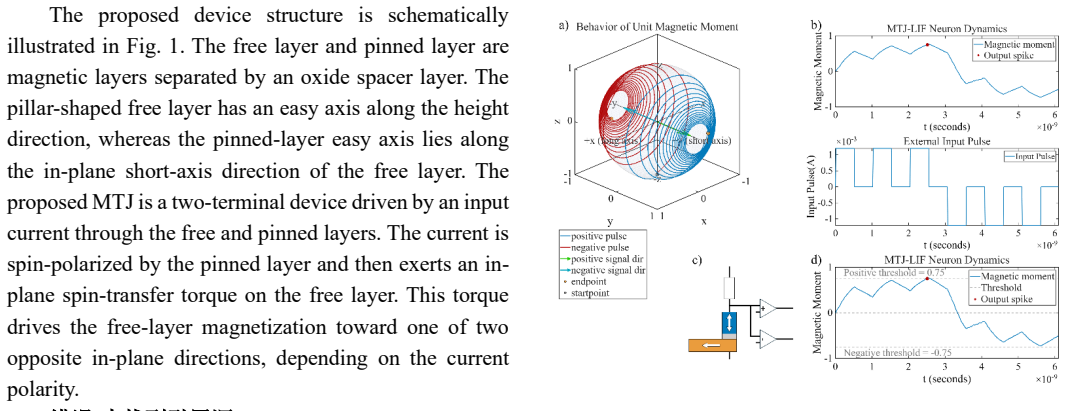
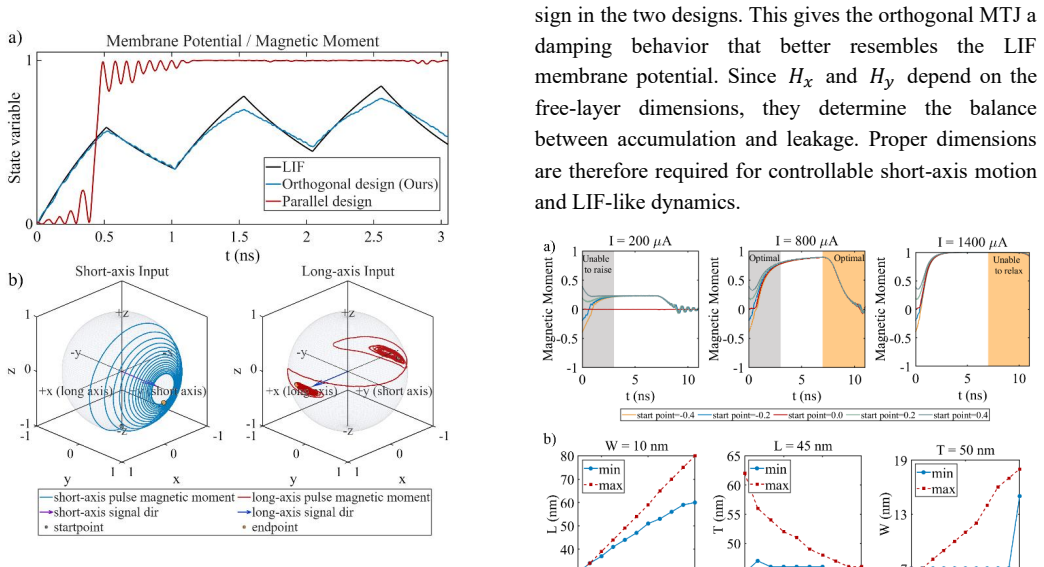
With orthogonal easy axes in the free and pinned layers, the magnetic tunnel junction enables bipolar spike generation and maps its magnetic-moment dynamics to signed leaky integrate-and-fire membrane-potential evolution. Landau-Lifshitz-Gilbert simulations show that proper free-layer dimensions allow the device response to follow a signed LIF equation. A representative design of 10 nm x 45 nm x 50 nm corresponds to an aspect ratio of about 2:9:10. Network evaluations using the fitted device-neuron model achieve 91.06% on CIFAR-10 and 77.40% on CIFAR10-DVS, retaining most of the accuracy of ideal signed LIF neurons.
What carries the argument
Orthogonal-easy-axis magnetic tunnel junction that maps magnetic-moment dynamics to signed LIF membrane-potential evolution
If this is right
- The device supports bipolar spike generation for richer information than standard MTJ neurons.
- Chosen dimensions make the magnetic response match the signed LIF equation.
- Networks built on the device model reach 91.06 percent accuracy on CIFAR-10.
- Performance stays close to that of ideal signed LIF neurons across tested datasets.
Where Pith is reading between the lines
- The design could be combined with other MTJ-based components to reduce overall system power in spiking networks.
- Variations in layer thickness might be explored to tune the leak time constant for different tasks.
- Real-device measurements would reveal whether the signed mapping holds under operating temperatures typical of integrated circuits.
Load-bearing premise
The Landau-Lifshitz-Gilbert simulations with chosen free-layer dimensions accurately represent real-device behavior without unmodeled effects such as thermal fluctuations or fabrication imperfections.
What would settle it
Fabricate the 10 nm by 45 nm by 50 nm orthogonal-easy-axis MTJ and record its output under stepped input currents to test whether the effective membrane potential follows the signed LIF differential equation.
Figures

read the original abstract
Signed spiking neurons carry richer information than standard spiking neurons. This work proposes a compact magnetic tunnel junction (MTJ)-based neuron for signed leaky integrate-and-fire (LIF) operation. With orthogonal easy axes in the free and pinned layers, the device enables bipolar spike generation and maps magnetic-moment dynamics to signed LIF membrane-potential evolution. Landau--Lifshitz--Gilbert simulations show that proper free-layer dimensions allow the device response to follow a signed LIF equation. A representative design of 10 nm x 45 nm x 50 nm corresponds to an aspect ratio of about 2:9:10. Network evaluations using the fitted device-neuron model achieve 91.06% on CIFAR-10 and 77.40% on CIFAR10-DVS, retaining most of the accuracy of ideal signed LIF neurons.
Editorial analysis
A structured set of objections, weighed in public.
Referee Report
Summary. The paper proposes an MTJ-based signed spiking neuron with orthogonal easy axes between free and pinned layers to enable bipolar spike generation. It claims that magnetic-moment dynamics under LLG evolution can be mapped to signed LIF membrane-potential behavior for appropriate free-layer dimensions (example: 10 nm × 45 nm × 50 nm). Deterministic LLG simulations are used to identify dimensions where the response follows a signed LIF equation; a fitted device-neuron model is then evaluated in networks, yielding 91.06% on CIFAR-10 and 77.40% on CIFAR10-DVS while retaining most accuracy of ideal signed LIF neurons.
Significance. If the signed-LIF mapping is robust, the work would supply a compact, CMOS-compatible hardware primitive for signed spiking neurons, increasing information capacity per neuron relative to standard binary spikes. The concrete network accuracies provide a quantitative benchmark of end-to-end utility. Credit is due for the explicit dimension example and the end-to-end network evaluation, though both rest on a fitted model derived from deterministic simulations.
major comments (2)
- [Abstract / LLG simulations] Abstract and LLG simulation section: the central claim that “proper free-layer dimensions allow the device response to follow a signed LIF equation” rests entirely on deterministic LLG runs. No Langevin thermal-noise term is included, yet at the stated 10 nm scale the kT fluctuation strength is comparable to anisotropy energy and can destroy both the linear leak regime and the bipolar threshold crossing required for the signed-LIF mapping. This omission is load-bearing for the device-to-neuron equivalence.
- [Abstract] Abstract: no simulation parameters (damping, saturation magnetization, temperature, integration timestep), no goodness-of-fit metric (e.g., RMS error or R² to the ideal signed-LIF ODE), and no direct overlay of device trajectory versus analytic LIF solution are reported. Without these, it is impossible to judge how closely the chosen aspect ratio actually reproduces the target dynamics.
Simulated Author's Rebuttal
We thank the referee for the constructive feedback. We address each major comment below and will revise the manuscript to strengthen the presentation of the LLG results.
read point-by-point responses
-
Referee: [Abstract / LLG simulations] Abstract and LLG simulation section: the central claim that “proper free-layer dimensions allow the device response to follow a signed LIF equation” rests entirely on deterministic LLG runs. No Langevin thermal-noise term is included, yet at the stated 10 nm scale the kT fluctuation strength is comparable to anisotropy energy and can destroy both the linear leak regime and the bipolar threshold crossing required for the signed-LIF mapping. This omission is load-bearing for the device-to-neuron equivalence.
Authors: We agree that thermal fluctuations represent an important consideration at these dimensions and that their absence limits claims about robustness. The deterministic LLG runs were intended to establish the existence of a dimension regime in which the orthogonal-easy-axis MTJ can produce signed-LIF-like dynamics. In the revision we will add a dedicated subsection discussing thermal effects and will include preliminary stochastic LLG simulations that incorporate the Langevin term to test whether the linear-leak and bipolar-threshold regimes survive realistic noise levels. revision: yes
-
Referee: [Abstract] Abstract: no simulation parameters (damping, saturation magnetization, temperature, integration timestep), no goodness-of-fit metric (e.g., RMS error or R² to the ideal signed-LIF ODE), and no direct overlay of device trajectory versus analytic LIF solution are reported. Without these, it is impossible to judge how closely the chosen aspect ratio actually reproduces the target dynamics.
Authors: We accept that the current manuscript lacks the quantitative details needed for independent assessment. The revised version will report the complete set of LLG parameters, supply RMS-error and R² values quantifying agreement with the analytic signed-LIF ODE, and add figures that overlay representative device trajectories against the ideal solution for the 10 nm × 45 nm × 50 nm geometry. revision: yes
Circularity Check
No circularity: simulation-to-model chain is independent
full rationale
The paper derives the signed-LIF mapping from deterministic LLG simulations of the orthogonal-easy-axis MTJ for chosen dimensions (10 nm × 45 nm × 50 nm), then fits a device-neuron model to those simulation traces and evaluates it on CIFAR-10/CIFAR10-DVS. No equation or claim reduces to its own inputs by construction; the LLG runs supply external dynamical evidence, the fit is a post-processing step, and the network accuracies are genuine evaluations rather than tautological predictions. No self-citations, uniqueness theorems, or ansatzes are invoked in the provided text to close the loop.
Axiom & Free-Parameter Ledger
free parameters (1)
- free-layer dimensions =
10 nm x 45 nm x 50 nm
axioms (1)
- standard math Landau-Lifshitz-Gilbert equation accurately describes the magnetic moment dynamics in the MTJ
Reference graph
Works this paper leans on
-
[1]
K. Roy, et al. “Spintronic neural systems.” Nat Rev Electr Eng vol. 1, pp. 714 –729, 2024. DOI: 10.1038/s44287-024-00107-9
-
[2]
A crossbar array of magnetoresistive memory devices for in-memory computing
S. Jung, et al. “A crossbar array of magnetoresistive memory devices for in-memory computing.” Nature vol. 601, pp. 211 –216, 2022. DOI: 10.1038/s41586-021- 04196-6
-
[3]
L. Liu, et al. “Domain wall magnetic tunnel junction- based artificial synapses and neurons for all -spin neuromorphic hardware.” Nat. Commun. vol. 15, no. 4534, 2024. DOI: doi.org/10.1038/s41467-024-48631-4
-
[4]
Z. Chen, et al. “Nanoscale exchange -bias magnetic tunnel junctions enabled memristive synapse and leaky - integrate-fire neuron for neuromorphic computing.” Nat. Commun. Mar. 24, 2026, to be published. DOI: 10.1038/s41467-026-70802-8. 50
-
[5]
Neuromorphic Hebbian learning with magnetic tunnel junction synapses
P. Zhou, et al. “Neuromorphic Hebbian learning with magnetic tunnel junction synapses.” Commun. Eng. vol. 4, pp. 142, 2025. DOI: 10.1038/s44172-025-00479-2
-
[6]
Spiking dynamics in dual free layer perpendicular magnetic tunnel junctions,
L. Farcis, et al. “Spiking dynamics in dual free layer perpendicular magnetic tunnel junctions,” Nano Letters, vol. 23, no. 17, pp. 7869 –7875, 2023, DOI: 10.1021/acs.nanolett.3c01597
-
[7]
Domain Wall Leaky Integrate- and-Fire Neurons with Shape -Based Configurable Activation Functions,
W. H. Brigner, J. Alsaleem, K. Zahedinejad, J. A. C. Incorvia, and S. Rakheja, “Domain Wall Leaky Integrate- and-Fire Neurons with Shape -Based Configurable Activation Functions,” IEEE T. Electron Dev., vol. 69, no. 5, pp. 2353 –2359, May 2022. doi: 10.1109/TED.2022.3159508. [Online]. Available: https://doi.org/10.1109/TED.2022.3159508 61
-
[8]
Shape Anisotropy - Dependent Leaking in Magnetic Neurons for Bio - Mimetic Neuromorphic Computing,
T. Leonard, N. Zogbi, S. Liu, W. S. Rogers, C. H. Bennett, and J. A. C. Incorvia, “Shape Anisotropy - Dependent Leaking in Magnetic Neurons for Bio - Mimetic Neuromorphic Computing,” ACS Nano, vol. 19, no. 3, pp. 3470 –3477, 2025. doi: 10.1021/acsnano.4c13020. [Online]. Available: https://doi.org/10.1021/acsnano.4c13020
-
[9]
D. Zhao, Y . Zeng, and Y . Li, “BackEISNN: A Deep Spiking Neural Network With Adaptive Self -Feedback and Balanced Excitatory –Inhibitory Neurons,” Neural Networks, vol. 154, pp. 68 –77, 2022. doi: 10.1016/j.neunet.2022.06.036. [Online]. Available: https://doi.org/10.1016/j.neunet.2022.06.036
-
[10]
An All Integer -Based Spiking Neural Network With Dynamic Threshold Adaptation,
C. Zou, X. Cui, S. Feng, G. Chen, Y . Zhong, Z. Dai, and Y . Wang, “An All Integer -Based Spiking Neural Network With Dynamic Threshold Adaptation,” Frontiers in Neuroscience, vol. 18, Art. no. 1449020, 2024. doi: 10.3389/fnins.2024.1449020. [Online]. Av ailable: https://doi.org/10.3389/fnins.2024.1449020 76
-
[11]
Fast-snn: Fast spiking neural network by converting quantized ann
Y . Hu, et al. “Fast-snn: Fast spiking neural network by converting quantized ann.” IEEE Trans. Pattern Anal. Mach. Intell. vol. 45, no. 12, pp. 14546-14562, Dec. 2023, DOI: 10.1109/TPAMI.2023.3275769
-
[12]
Size dependence of intrinsic spin transfer switching current density in elliptical spin valves
R. Heindl, et al. “Size dependence of intrinsic spin transfer switching current density in elliptical spin valves.” Appl. Phys. Lett. vol. 92, no. 26, 2008. DOI: 10.1063/1.2953980
-
[13]
Magnetization Dynamics Modulated by Dzyaloshinskii-Moriya Interaction in the Double - Interface Spin -Transfer Torque Magnetic Tunnel Junction
S. Li, et al. “Magnetization Dynamics Modulated by Dzyaloshinskii-Moriya Interaction in the Double - Interface Spin -Transfer Torque Magnetic Tunnel Junction.” Nanoscale Research Letters vol. 14, no. 315,
-
[14]
DOI: 10.1186/s11671-019-3150-4. 86
-
[15]
Magnetic Tunnel Junction Mimics Stochastic Cortical Spiking Neurons
A. Sengupta, et al. “Magnetic Tunnel Junction Mimics Stochastic Cortical Spiking Neurons.” Scientific Reports vol. 6, no. 30039, 2016. DOI: 10.1038/srep30039
-
[16]
A Compact Model of Perpendicular Spin -Transfer-Torque Magnetic Tunnel Junction,
C. -T. Tung, et al. “A Compact Model of Perpendicular Spin -Transfer-Torque Magnetic Tunnel Junction,” IEEE T. Electron Dev., vol. 71, no. 1, pp. 57– 61, Jan. 2024, doi: 10.1109/TED.2023.3313997
-
[17]
Spin Transfer Torque Switching Dynamics in CoFeB/MgO Magnetic Tunnel Junctions
A. Meo, et al. “Spin Transfer Torque Switching Dynamics in CoFeB/MgO Magnetic Tunnel Junctions.” Physical Review B, vol. 103, no. 5, Art. no. 054426, 2021. DOI: 10.1103/PhysRevB.103.054426
-
[18]
Deep Residual Learning for Image Recognition
K. He, et al. “Deep Residual Learning for Image Recognition.” Proc. IEEE Conference on Computer Vision and Pattern Recognition (CVPR), pp. 770 –778,
-
[19]
DOI: 10.1109/CVPR.2016.90
-
[20]
Spikformer: When Spiking Neural Network Meets Transformer
Z. Zhou, et al. “Spikformer: When Spiking Neural Network Meets Transformer.” Proc. International Conference on Learning Representations (ICLR), 2023
2023
discussion (0)
Sign in with ORCID, Apple, or X to comment. Anyone can read and Pith papers without signing in.