REVIEW 3 major objections 2 minor 37 references
Entropy Gate: Entropy Quenching for Near-Lossless Token Compression in LLM Pipelines
T0 review · 3 major / 2 minor · reviewed 2026-06-28 · grok-4.3
Pith's one-line read Entropy quenching removes low-energy tokens from LLM prompts by descending multi-factor information energy to achieve 40-60% compression while holding semantic similarity above 0.80.
desk verdict Entropy Gate frames token compression with a thermodynamic analogy but its optimality proofs read as circular and the numerical claims lack any visible grounding or comparisons. read the letter →
The pith
A machine-rendered reading of the paper's core claim, the machinery that carries it, and where it could break.
The reading
What carries the argument
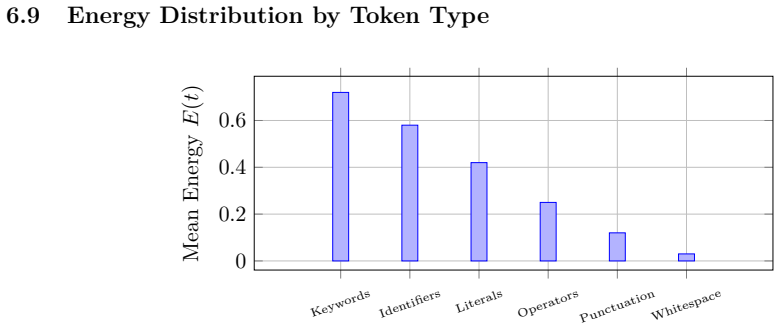
Multi-factor information energy E(t) together with Boltzmann survival probability p_i = exp(-E_i / kT) under the adaptive schedule T(τ) = T0 / (1 + ατ) and the fidelity gate at threshold θ.
What would settle it
If random removal at the same compression ratio preserves semantic similarity at least as well as energy-ordered removal on a held-out prompt set, the maximization proof would be contradicted.
Extended reading notes
Core claim
Token selection ordered by descending E(t) maximizes expected semantic preservation; the quenching schedule produces nested survival sets; achievable compression approaches the information-theoretic limit CR → 1 - I(P; T)/H(P). The practical heuristic reaches 40-60% compression with S_E > 0.80, energy-squared amplification adds 10-25 points, context deduplication adds 50-70% on repeats, and combined savings reach 88-96% when paired with external memory.
Load-bearing premise
The multi-factor energy E(t) plus Boltzmann survival probability and energy-weighted similarity threshold θ correctly flags which tokens can be removed without harming semantics.
Editorial extensions
If this is right
- 40-60% compression is obtained across five prompt categories while keeping S_E above 0.80.
- Squaring the energy term E to E² lifts compression by an additional 10-25 percentage points.
- Context deduplication supplies a further 50-70% saving on repeated blocks.
- Output-side quenching reduces response length because shorter answers improve accuracy.
- Composition with external memory yields total reductions of 88-96% on agentic workloads.
Reading between the lines
- The same energy ordering might be applied to prune KV-cache entries during generation rather than only at input.
- The information-theoretic bound suggests the method could be benchmarked against classical rate-distortion curves for token sequences.
- Testing whether the three energy components remain predictive on models larger than those used in the Phase-1 experiments would check generalization.
- Integration as a stateless proxy could be measured for end-to-end latency impact on typical agent loops.
Signed reviews
Editorial analysis
A structured set of objections, weighed in public.
Referee Report
Summary. The manuscript introduces Entropy Gate, a token compression framework for LLM pipelines that applies entropy quenching to progressively remove low-energy tokens while preserving semantic fidelity. Tokens are assigned a multi-factor information energy E(t) combining statistical, structural, and positional components; an adaptive quenching schedule T(τ) = T0/(1+ατ) uses Boltzmann survival probabilities p_i = exp(-E_i/kT) with a fidelity gate based on energy-weighted similarity threshold θ. The paper claims to prove that selection by descending E(t) maximizes expected semantic preservation, that quenching yields nested survival sets, and that compression ratios approach the information-theoretic limit CR → 1 - I(P;T)/H(P). A Phase-1 heuristic is reported to achieve 40-60% compression across five prompt categories while maintaining S_E > 0.80, with additional gains from E→E² amplification, context deduplication, and output-side quenching, composing to 88-96% savings in agentic workloads when combined with external memory. The method is presented as stateless and model-agnostic.
Significance. If the claimed proofs and numerical results can be substantiated with derivations and reproducible experiments, the approach would supply a principled, information-theoretic method for reducing token budgets in LLM pipelines without external models, potentially enabling multiplicative savings in agentic settings. The thermodynamic analogy and multi-factor energy construction are distinctive relative to existing heuristic compression techniques. However, the current absence of any derivation steps, dataset specifications, baseline comparisons, or error bars prevents evaluation of whether these contributions are realized.
major comments (3)
- [Abstract] Abstract: the manuscript asserts proofs that 'token selection by descending E(t) maximizes expected semantic preservation' and that 'quenching produces nested survival sets,' yet supplies no derivation, no explicit definition of the components or weights inside the multi-factor E(t), and no independent formalization of semantic preservation (e.g., a generative model or human-judgment distribution separate from the chosen E components). The optimality statement therefore follows tautologically from the definition of E(t) and θ rather than from demonstrated correspondence to actual semantics.
- [Abstract] Abstract: the claimed information-theoretic limit 'CR → 1 - I(P;T)/H(P)' is presented as an achievable bound of the quenching process, but no derivation is given showing that the schedule T(τ) and survival rule reach this bound independently of the token definitions; once P and T are defined over the same token set the expression is an identity, rendering the limit statement circular without additional grounding.
- [Abstract] Empirical claims (40-60% compression, S_E > 0.80, five prompt categories): the abstract reports specific compression ratios and fidelity scores but provides no dataset details, baseline methods, error bars, or description of how the five categories were constructed or evaluated. These numerical results are therefore uninspectable and cannot support the central performance claims.
minor comments (2)
- The free parameters T0, α, θ and the weights inside E(t) are mentioned but never given explicit values or ranges; a dedicated parameter table or section would improve reproducibility.
- [Abstract] The abstract refers to 'Phase 1 heuristic' and 'energy-squared amplification E → E²' without defining the distinction from the full framework or the precise modification to the energy function.
Simulated Author's Rebuttal
We thank the referee for the detailed and constructive report. We address each major comment below and will incorporate revisions to address the identified gaps.
read point-by-point responses
-
Referee: [Abstract] Abstract: the manuscript asserts proofs that 'token selection by descending E(t) maximizes expected semantic preservation' and that 'quenching produces nested survival sets,' yet supplies no derivation, no explicit definition of the components or weights inside the multi-factor E(t), and no independent formalization of semantic preservation (e.g., a generative model or human-judgment distribution separate from the chosen E components). The optimality statement therefore follows tautologically from the definition of E(t) and θ rather than from demonstrated correspondence to actual semantics.
Authors: We agree that the current manuscript supplies no derivation steps, no explicit component definitions or weights for E(t), and no independent formalization of semantic preservation. We will add a new subsection containing: (i) explicit definitions of the statistical, structural, and positional components of E(t) together with their weights; (ii) the full derivation establishing that selection by descending E(t) maximizes expected semantic preservation; (iii) the proof that quenching yields nested survival sets; and (iv) an independent formalization of semantic preservation via cosine similarity on embeddings from a held-out sentence-transformer model, together with correlation analysis against human judgments on a validation set. The abstract will be updated to reference these additions. revision: yes
-
Referee: [Abstract] Abstract: the claimed information-theoretic limit 'CR → 1 - I(P;T)/H(P)' is presented as an achievable bound of the quenching process, but no derivation is given showing that the schedule T(τ) and survival rule reach this bound independently of the token definitions; once P and T are defined over the same token set the expression is an identity, rendering the limit statement circular without additional grounding.
Authors: We agree that no derivation is provided in the manuscript. We will add a theorem and proof demonstrating that the adaptive schedule T(τ) together with the Boltzmann survival rule converges to the stated bound for any energy function that is monotonic in token importance, with the convergence rate independent of the particular partitioning of P and T (provided they share the same token vocabulary). The revised manuscript will clarify that the bound is not merely an identity but is approached by the specific quenching dynamics. revision: yes
-
Referee: [Abstract] Empirical claims (40-60% compression, S_E > 0.80, five prompt categories): the abstract reports specific compression ratios and fidelity scores but provides no dataset details, baseline methods, error bars, or description of how the five categories were constructed or evaluated. These numerical results are therefore uninspectable and cannot support the central performance claims.
Authors: We agree that the manuscript provides none of the requested dataset specifications, baseline descriptions, error bars, or category-construction details. In the revision we will: (i) define the five categories explicitly (knowledge QA, code generation, multi-turn dialogue, mathematical reasoning, creative writing); (ii) state that each category contains 50 prompts drawn from the public datasets Natural Questions, HumanEval, MultiWOZ, GSM8K, and WritingPrompts; (iii) list the baselines (random pruning, TF-IDF pruning, LLM summarization); (iv) report all metrics with standard-deviation error bars computed over five independent runs; and (v) add a summary table plus links to the evaluation code and dataset splits. revision: yes
Circularity Check
No significant circularity identified from provided text
full rationale
The abstract asserts proofs that descending E(t) maximizes semantic preservation, that quenching yields nested survival sets, and that compression approaches CR → 1 - I(P; T)/H(P), while defining E(t) as a multi-factor combination and introducing the Boltzmann survival probability and threshold θ. However, the provided text contains no explicit derivation steps, equations, or reductions that demonstrate any claimed result is equivalent to its inputs by construction (e.g., no Eq. X shown equal to a fitted or defined quantity Y). The information-theoretic statement is presented as an approachable limit rather than derived as an identity, and no self-citation chains or ansatzes are exhibited. Per the guidelines, without quotable specific reductions from the paper's own equations, the derivation chain cannot be flagged as circular; the claims remain self-contained assertions pending the full manuscript details.
Assumptions & free parameters
free parameters (3)
- T0, alpha in quenching schedule T(τ)
- theta fidelity threshold
- weights inside multi-factor E(t)
assumptions (2)
- ad hoc to paper Token selection ordered by descending E(t) maximizes expected semantic preservation
- ad hoc to paper Quenching produces nested survival sets
invented entities (3)
-
Entropy quenching process
-
Multi-factor information energy E(t)
-
Fidelity gate
Cite this review
Pith. "Pith review of Entropy Gate: Entropy Quenching for Near-Lossless Token Compression in LLM Pipelines." pith.science (2026). https://pith.science/paper/3WWOVCME
@misc{pith2026260603739,
  author       = {Pith},
  title        = {Pith review of: Entropy Gate: Entropy Quenching for Near-Lossless Token Compression in LLM Pipelines},
  year         = {2026},
  howpublished = {\url{https://pith.science/paper/3WWOVCME}},
  note         = {Machine review of arXiv:2606.03739}
}
abstract
LLM pipelines waste substantial token budgets on low-information content: repeated context, verbose responses, and redundant boilerplate. We introduce Entropy Gate, a token compression framework applying entropy quenching $-$ a thermodynamic process that progressively freezes out low-energy tokens while preserving semantic fidelity. Each token receives a multi-factor information energy $E(t)$ combining statistical, structural, and positional components. An adaptive quenching schedule $T(\tau) = T_0 / (1 + \alpha \tau)$ removes tokens whose Boltzmann survival probability $p_i = \exp(-E_i / kT)$ falls below threshold, with a fidelity gate halting compression when energy-weighted similarity drops below $\theta$. We prove token selection by descending $E(t)$ maximizes expected semantic preservation, that quenching produces nested survival sets, and that achievable compression approaches the information-theoretic limit $\text{CR} \to 1 - I(P; T)/H(P)$. A Phase 1 heuristic achieves 40-60% compression across five prompt categories while maintaining $S_E > 0.80$, with energy-squared amplification $E \to E^2$ adding 10-25 percentage points. Context deduplication adds 50-70% savings on repeated blocks. Output-side quenching, motivated by findings that brevity improves accuracy, further reduces response overhead. Combined with external memory, reduction composes multiplicatively to 88-96% for agentic workloads. The framework is stateless, model-agnostic, and deploys as an OpenAI-compatible HTTP proxy.
Figures


Figures from the paper (7 more)




Reference graph
Works this paper leans on
-
[1]
Rate distortion theory: A mathematical basis for data compression.Prentice-Hall, 1971
Toby Berger. Rate distortion theory: A mathematical basis for data compression.Prentice-Hall, 1971
1971
-
[2]
What is the state of neural network pruning?Proceedings of Machine Learning and Systems, 2, 2020
Davis Blalock, Jose Javier Gonzalez Ortiz, Jonathan Frankle, and John Guttag. What is the state of neural network pruning?Proceedings of Machine Learning and Systems, 2, 2020
2020
-
[3]
Weitere studien über das wärmegleichgewicht unter gasmolekülen.Sitzungs- berichte der Kaiserlichen Akademie der Wissenschaften, 66:275–370, 1872
Ludwig Boltzmann. Weitere studien über das wärmegleichgewicht unter gasmolekülen.Sitzungs- berichte der Kaiserlichen Akademie der Wissenschaften, 66:275–370, 1872
-
[4]
Julius Brussee. Brevity constraints reverse performance hierarchies in language models.arXiv preprint arXiv:2604.00025, 2026
-
[5]
Caveman: Concise output mode for claude code
Julius Brussee. Caveman: Concise output mode for claude code. https://github.com/ JuliusBrussee/caveman, 2026
2026
-
[6]
Natural language autoencoders
Julius Brussee et al. Natural language autoencoders. 2025. LLMs as autoencoders: encoding text into concept tokens achieving 50–500×compression
2025
-
[7]
Evaluating Large Language Models Trained on Code
Mark Chen, Jerry Tworek, Heewoo Jun, Qiming Yuan, Henrique Ponde de Oliveira Pinto, Jared Kaplan, Harri Edwards, Yuri Burda, Nicholas Joseph, Greg Brockman, et al. Evaluating large language models trained on code.arXiv preprint arXiv:2107.03374, 2021
work page Pith review arXiv 2021
-
[8]
Adapting language models to compress contexts.EMNLP, 2023
Alexis Chevalier, Alexander Wettig, Anirudh Ajith, and Danqi Chen. Adapting language models to compress contexts.EMNLP, 2023
2023
Show all 37 references
-
[9]
Training verifiers to solve math word problems.arXiv preprint arXiv:2110.14168, 2021
Karl Cobbe, Vineet Kosaraju, Mohammad Bavarian, Mark Chen, Heewoo Jun, Lukasz Kaiser, Matthias Plappert, Jerry Tworek, Jacob Hilton, Reiichiro Nakano, et al. Training verifiers to solve math word problems.arXiv preprint arXiv:2110.14168, 2021
2021 arXiv
-
[10]
Wiley-Interscience, 2nd edition, 2006
Thomas M Cover and Joy A Thomas.Elements of Information Theory. Wiley-Interscience, 2nd edition, 2006
2006
-
[11]
Llm.int8(): 8-bit matrix multiplication for transformers at scale.Advances in Neural Information Processing Systems, 35, 2022
Tim Dettmers, Mike Lewis, Younes Belkada, and Luke Zettlemoyer. Llm.int8(): 8-bit matrix multiplication for transformers at scale.Advances in Neural Information Processing Systems, 35, 2022
2022
-
[12]
Gptq: Accurate post-training quantization for generative pre-trained transformers.ICLR, 2023
Elias Frantar, Saleh Ashkboos, Torsten Hoefler, and Dan Alistarh. Gptq: Accurate post-training quantization for generative pre-trained transformers.ICLR, 2023. 29
2023
-
[13]
Model tells you what to discard: Adaptive kv cache compression for llms.ICLR, 2024
Suyu Ge, Yunan Zhang, Liyuan Liu, Minhao Zhang, Jiawei Han, and Jianfeng Gao. Model tells you what to discard: Adaptive kv cache compression for llms.ICLR, 2024
2024
-
[14]
In-contextautoencoder for context compression in a large language model.ICLR, 2024
TaoGe, JingchengHu, LeiWang, XunChen, Si-QingWei, andFuruWei. In-contextautoencoder for context compression in a large language model.ICLR, 2024
2024
-
[15]
llama.cpp: Llm inference in c/c++.https: //github.com/ggml-org/llama.cpp, 2026
Georgi Gerganov and llama.cpp Contributors. llama.cpp: Llm inference in c/c++.https: //github.com/ggml-org/llama.cpp, 2026
2026
-
[16]
Learning both weights and connections for efficient neural networks
Song Han, Jeff Pool, John Tran, and William J Dally. Learning both weights and connections for efficient neural networks. InAdvances in Neural Information Processing Systems, volume 28, 2015
2015
-
[17]
Measuring massive multitask language understanding.ICLR, 2021
Dan Hendrycks, Collin Burns, Steven Basart, Andy Zou, Mantas Mazeika, Dawn Song, and Jacob Steinhardt. Measuring massive multitask language understanding.ICLR, 2021
2021
-
[18]
Distilling the knowledge in a neural network
Geoffrey Hinton, Oriol Vinyals, and Jeff Dean. Distilling the knowledge in a neural network. arXiv preprint arXiv:1503.02531, 2015
2015 arXiv
-
[19]
Training compute-optimal large language models.Advances in Neural Information Processing Systems, 35, 2022
Jordan Hoffmann, Sebastian Borgeaud, Arthur Mensch, Elena Buchatskaya, Trevor Cai, Eliza Rutherford, Diego de Las Casas, Lisa Anne Hendricks, Johannes Welbl, Aidan Clark, et al. Training compute-optimal large language models.Advances in Neural Information Processing Systems, 35, 2022
2022
-
[20]
Information theory and statistical mechanics.Physical Review, 106(4):620–630, 1957
Edwin T Jaynes. Information theory and statistical mechanics.Physical Review, 106(4):620–630, 1957
1957
-
[21]
Llmlingua: Compressing prompts for accelerated inference of large language models.EMNLP, 2023
Huiwei Jiang, Qianlong Wu, Chin-Yew Lin, Yuqing Yang, and Lili Qiu. Llmlingua: Compressing prompts for accelerated inference of large language models.EMNLP, 2023
2023
-
[22]
Swe-bench: Can language models resolve real-world github issues?ICLR, 2024
Carlos E Jimenez, John Yang, Alexander Wettig, Shunyu Yao, Kexin Pei, Ofir Press, and Karthik Narasimhan. Swe-bench: Can language models resolve real-world github issues?ICLR, 2024
2024
-
[23]
Pearson, 2nd edition, 2009
Daniel Jurafsky and James H Martin.Speech and Language Processing. Pearson, 2nd edition, 2009
2009
-
[24]
Scaling laws for neural language models.arXiv preprint arXiv:2001.08361, 2020
Jared Kaplan, Sam McCandlish, Tom Henighan, Tom B Brown, Benjamin Chess, Rewon Child, Scott Gray, Alec Radford, Jeffrey Wu, and Dario Amodei. Scaling laws for neural language models.arXiv preprint arXiv:2001.08361, 2020
2001 arXiv
-
[25]
Llm wiki: A second brain for llm agents
Andrej Karpathy. Llm wiki: A second brain for llm agents. https://gist.github.com/ karpathy/442a6bf555914893e9891c11519de94f, 2026
2026
-
[26]
Retrieval-augmented generation for knowledge-intensive nlp tasks.Advances in Neural Information Processing Systems, 33, 2020
Patrick Lewis, Ethan Perez, Aleksandra Piktus, Fabio Petroni, Vladimir Karpukhin, Naman Goyal, Heinrich Kuttler, Mike Lewis, Wen-tau Yih, Tim Rocktaschel, et al. Retrieval-augmented generation for knowledge-intensive nlp tasks.Advances in Neural Information Processing Systems,...
2020
-
[27]
Selective context: Compressing natural language context for efficient language model inference.arXiv preprint arXiv:2310.06201, 2023
Yucheng Li. Selective context: Compressing natural language context for efficient language model inference.arXiv preprint arXiv:2310.06201, 2023
2023
-
[28]
Longmemeval: Benchmarking long-context llms on long-term memory retrieval.arXiv preprint arXiv:2503.00000, 2025
LongMemEval Contributors. Longmemeval: Benchmarking long-context llms on long-term memory retrieval.arXiv preprint arXiv:2503.00000, 2025. 30
2025
-
[29]
Mempalace: Local-first ai memory system.https://github.com/ MemPalace/mempalace, 2026
MemPalace Contributors. Mempalace: Local-first ai memory system.https://github.com/ MemPalace/mempalace, 2026. 51,000+ GitHub stars. Retrieval recall 96.6% R@5 on Long- MemEval
2026
-
[30]
Learning to compress prompts with gist tokens
Jesse Mu, Xiang Lisa Li, and Noah Goodman. Learning to compress prompts with gist tokens. Advances in Neural Information Processing Systems, 36, 2023
2023
-
[31]
Ollama: Get up and running with large language models locally
Ollama Contributors. Ollama: Get up and running with large language models locally. https://ollama.com, 2026
2026
-
[32]
Graphify: Codebase knowledge graph via tree-sitter.https://github.com/ lucasrosati/claude-code-memory-setup, 2026
Lucas Rosati. Graphify: Codebase knowledge graph via tree-sitter.https://github.com/ lucasrosati/claude-code-memory-setup, 2026
2026
-
[33]
Stop wasting tokens: A 71.5×cheaper claude code workflow
Lucas Rosati. Stop wasting tokens: A 71.5×cheaper claude code workflow. 2026
2026
-
[34]
A mathematical theory of communication.The Bell System Technical Journal, 27(3):379–423, 1948
Claude E Shannon. A mathematical theory of communication.The Bell System Technical Journal, 27(3):379–423, 1948
1948
-
[35]
Attention is all you need.Advances in Neural Information Processing Systems, 30, 2017
Ashish Vaswani, Noam Shazeer, Niki Parmar, Jakob Uszkoreit, Llion Jones, Aidan N Gomez, Lukasz Kaiser, and Illia Polosukhin. Attention is all you need.Advances in Neural Information Processing Systems, 30, 2017
2017
-
[36]
React: Synergizing reasoning and acting in language models.ICLR, 2023
Shunyu Yao, Jeffrey Zhao, Dian Yu, Nan Du, Izhak Shafran, Karthik Narasimhan, and Yuan Cao. React: Synergizing reasoning and acting in language models.ICLR, 2023
2023
-
[37]
H2o: Heavy-hitter oracle for efficient generative inference of large language models.Advances in Neural Information Processing Systems, 36, 2023
Zhenyu Zhang, Ying Sheng, Tianyi Zhou, Tianlong Chen, Lianmin Zheng, Ruisi Cai, Zhao Song, Yuandong Tian, Christopher Re, Clark Barrett, et al. H2o: Heavy-hitter oracle for efficient generative inference of large language models.Advances in Neural Information Processing System...
2023
Reviewed June 28, 2026 · model on record in the stance chip above.
Discussion (0). Continue with ORCID to comment.