Ladder Logic Translation using Large Language Models in Industrial Automation
Pith reviewed 2026-06-28 21:26 UTC · model grok-4.3
The pith
A constrained generative LLM translates Rockwell ladder logic to Siemens S7 programs while retaining high semantic consistency across instruction categories.
A machine-rendered reading of the paper's core claim, the machinery that carries it, and where it could break.
Core claim
The paper formulates ladder logic translation between mismatched vendor formalisms as a constrained generative task and demonstrates a pipeline that extracts XML, performs structural normalization, invokes a constrained LLM, and integrates via the TIA Portal Openness API to produce Siemens S7 programs from Rockwell sources, with empirical results showing that the translations retain high semantic consistency across instruction categories.
What carries the argument
the constrained generative LLM function that maps source constructs to target constructs while enforcing semantic consistency under explicit constraints
If this is right
- PLC programs become portable across vendors without full manual rewrite.
- Translation time and cost drop because the pipeline automates the mapping step.
- Existing engineering tools can incorporate the translation step through their openness APIs.
- Semantic consistency holds for the tested instruction categories, supporting incremental adoption.
Where Pith is reading between the lines
- The same constrained-generation pattern could be applied to other pairs of PLC vendors once equivalent constraints are written.
- If functional equivalence holds on small programs, scaling the pipeline to full plant-wide logic becomes a direct next measurement.
- The approach creates a concrete testbed for measuring how well LLMs handle domain-specific formal languages with strict semantic rules.
Load-bearing premise
The constrained generative LLM function can reliably map semantically mismatched constructs between Rockwell and Siemens ladder logic formalisms without introducing functional errors.
What would settle it
Execute the original Rockwell program and the translated Siemens program on their respective hardware with identical input sequences and check whether the output sequences match exactly.
Figures


read the original abstract
Ladder logic translation is an important problem in industrial automation because without it, it is difficult to switch Programmable Logic Controller (PLC) vendors. The prevailing translation problem highlights mismatched programming environments, incompatible ladder logic constructs, limitations in terms of differences in the semantic expressiveness of the vendor formalisms and integrated black-box proprietary engineering tools which are exemplified in our example case; Rockwell to Siemens PLC code translation. This work presents a mathematical formulation of the problem, the detailed architecture of a solution which supports XML extraction, structural normalization, constrained generative function (LLM), and system integration via the TIA Portal Openness API as rigorously engineered pipeline for automated translation of Rockwell Ladder Programs to Siemens S7 ladder programs. Finally, we present results that show that the translations retain high semantic consistency across instruction categories.
Editorial analysis
A structured set of objections, weighed in public.
Referee Report
Summary. The manuscript presents a pipeline for automated translation of ladder logic programs from Rockwell to Siemens PLCs. It includes a mathematical formulation of the vendor-translation problem, an architecture with XML extraction, structural normalization, a constrained generative LLM function, and integration via the TIA Portal Openness API. The central claim is that the resulting translations retain high semantic consistency across instruction categories.
Significance. If the semantic-consistency claim can be substantiated with explicit metrics and error analysis, the work addresses a practical industrial-automation challenge: enabling PLC vendor migration without manual recoding. The constrained use of LLMs for semantically mismatched formalisms is a relevant engineering contribution.
major comments (2)
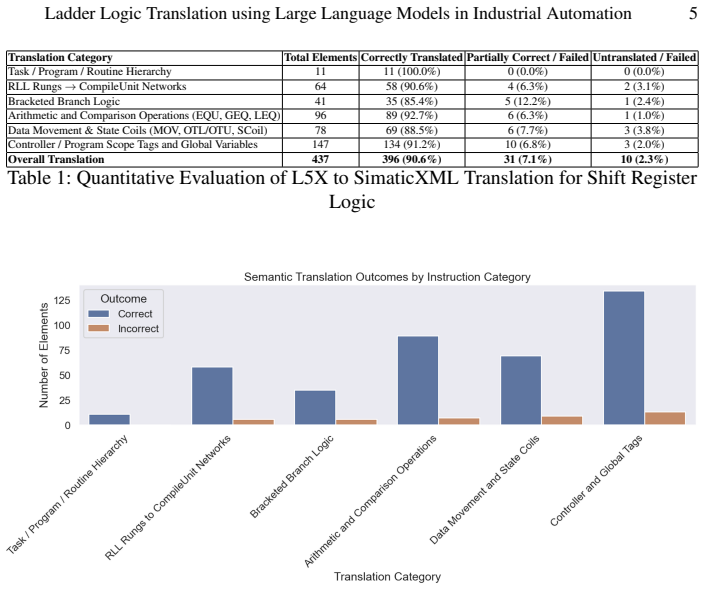
- [Results] Results section: the abstract asserts that translations 'retain high semantic consistency across instruction categories,' yet no quantitative metric, definition of consistency (syntactic match, execution-trace equivalence, or hardware-in-the-loop test), test-program counts per category, error rates, or baseline comparisons are supplied. This absence makes the central empirical claim impossible to evaluate.
- [Architecture] Architecture description: the constrained generative LLM function is presented as reliably mapping mismatched constructs (e.g., Rockwell timers/counters to Siemens equivalents) without functional errors, but the paper supplies neither the concrete constraints applied nor any verification that the mapping preserves semantics for divergent instructions.
minor comments (1)
- The abstract refers to a 'mathematical formulation of the problem'; if equations or formal definitions appear later in the manuscript, ensure they are numbered and referenced from the results discussion.
Simulated Author's Rebuttal
We thank the referee for the constructive feedback, which identifies key gaps in empirical substantiation and architectural detail. We address each major comment below and commit to revisions that strengthen the manuscript without altering its core claims.
read point-by-point responses
-
Referee: [Results] Results section: the abstract asserts that translations 'retain high semantic consistency across instruction categories,' yet no quantitative metric, definition of consistency (syntactic match, execution-trace equivalence, or hardware-in-the-loop test), test-program counts per category, error rates, or baseline comparisons are supplied. This absence makes the central empirical claim impossible to evaluate.
Authors: We agree the Results section lacks the quantitative metrics, explicit definitions, counts, error rates, and baselines needed to evaluate the claim. In revision we will add a subsection defining semantic consistency as execution-trace equivalence (verified via PLC simulation), report per-category test-program counts, error rates, and a rule-based baseline comparison. This directly addresses the evaluation gap. revision: yes
-
Referee: [Architecture] Architecture description: the constrained generative LLM function is presented as reliably mapping mismatched constructs (e.g., Rockwell timers/counters to Siemens equivalents) without functional errors, but the paper supplies neither the concrete constraints applied nor any verification that the mapping preserves semantics for divergent instructions.
Authors: The current description of the constrained generative function is high-level and omits concrete constraint examples and verification steps. We will expand the Architecture section with explicit constraint formulations (e.g., prompt templates enforcing Siemens timer equivalents) and a verification protocol using trace comparison on divergent instructions. This supplies the missing detail on semantic preservation. revision: yes
Circularity Check
No circularity; engineering pipeline with no derivations or self-referential fits
full rationale
The paper describes an XML+LLM+TIA Openness pipeline for Rockwell-to-Siemens ladder logic translation and claims a mathematical formulation plus results on semantic consistency. No equations, predictions, or first-principles derivations are present that could reduce to inputs by construction. No self-citations are used as load-bearing uniqueness theorems, no ansatzes are smuggled, and no fitted parameters are renamed as predictions. The work is self-contained as an applied engineering description; the reader's assessment of zero circularity is confirmed by absence of any of the enumerated circular patterns.
Axiom & Free-Parameter Ledger
Reference graph
Works this paper leans on
-
[1]
Ex- ploring and unleashing the power of large language models in automated code translation,
Z. Yang, F. Liu, Z. Yu, J. W. Keung, J. Li, S. Liu, Y . Hong, X. Ma, Z. Jin, and G. Li, “Ex- ploring and unleashing the power of large language models in automated code translation,” Proceedings of the ACM on Software Engineering, vol. 1, no. FSE, pp. 1585–1608, 2024
2024
-
[2]
TIA Portal Openness – Programming Interface Documentation,
Siemens AG, “TIA Portal Openness – Programming Interface Documentation,” https:// support.industry.siemens.com/cs/document/123456789/tia-portal-openness-documentation, 2024, accessed: 2026-05-10
-
[3]
Tia portal openness: suunnitteluprosessien automatisointi,
S. Huhtanen, “Tia portal openness: suunnitteluprosessien automatisointi,” 2024
2024
-
[4]
Scott,Learning RSLogix 5000 Programming: Build Robust PLC Solutions with Control- Logix, CompactLogix, and Studio 5000/RSLogix 5000
A. Scott,Learning RSLogix 5000 Programming: Build Robust PLC Solutions with Control- Logix, CompactLogix, and Studio 5000/RSLogix 5000. Packt Publishing Ltd, 2020
2020
-
[5]
Berger,Automating with SIMATIC S7-400 inside TIA portal: configuring, programming and testing with STEP 7 Professional
H. Berger,Automating with SIMATIC S7-400 inside TIA portal: configuring, programming and testing with STEP 7 Professional. John Wiley & Sons, 2014
2014
-
[6]
Plc-5/slc-to-controllogix migration guidelines,
R. Automation, “Plc-5/slc-to-controllogix migration guidelines,” Rockwell Automation Inc, Tech. Rep., 2021, vendor documentation and technical migration notes describing automated converter behavior and manual correction requirements
2021
-
[7]
Industrial engineering with large language mod- els: A case study of chatgpt’s performance on oil & gas problems,
O. Ogundare, S. Madasu, and N. Wiggins, “Industrial engineering with large language mod- els: A case study of chatgpt’s performance on oil & gas problems,” in2023 11th International Conference on Control, Mechatronics and Automation (ICCMA). IEEE, 2023, pp. 458–461
2023
-
[8]
No code ai: Automatic generation of function block diagrams from documentation and associated heuristic for context-aware ml algorithm training,
O. Ogundare, G. Q. Araya, and Y . Qamsane, “No code ai: Automatic generation of function block diagrams from documentation and associated heuristic for context-aware ml algorithm training,” in2022 7th International Conference on Mechanical Engineering and Robotics Research (ICMERR). IEEE, 2022, pp. 191–195
2022
-
[9]
Llm4plc: Harnessing large language models for verifiable programming of plcs in indus- trial control systems,
M. Fakih, R. Dharmaji, Y . Moghaddas, G. Quiros, O. Ogundare, and M. A. Al Faruque, “Llm4plc: Harnessing large language models for verifiable programming of plcs in indus- trial control systems,” inProceedings of the 46th International Conference on Software En- gineering: Software Engineering in Practice, 2024, pp. 192–203
2024
-
[10]
Llm4cve: Enabling iterative automated vulnerability repair with large language models,
M. Fakih, R. Dharmaji, H. Bouzidi, G. Q. Araya, O. Ogundare, and M. A. A. Faruque, “Llm4cve: Enabling iterative automated vulnerability repair with large language models,” arXiv preprint arXiv:2501.03446, 2025
-
[11]
Generaci ´on de c ´odigo iec-61131-3 multiplataforma para sis- temas de almacenaje autom´atico,
D. Rodr ´ıguez Garc´ıaet al., “Generaci ´on de c ´odigo iec-61131-3 multiplataforma para sis- temas de almacenaje autom´atico,” Master’s thesis, 2017
2017
-
[12]
Process logic verification & analysis
S. Hostetler, “Process logic verification & analysis.” Sandia National Lab.(SNL-NM), Albu- querque, NM (United States), Tech. Rep., 2016
2016
-
[13]
Cosine similarity to determine simi- larity measure: Study case in online essay assessment,
A. R. Lahitani, A. E. Permanasari, and N. A. Setiawan, “Cosine similarity to determine simi- larity measure: Study case in online essay assessment,” in2016 4th International Conference on Cyber and IT Service Management, 2016, pp. 1–6
2016
discussion (0)
Sign in with ORCID, Apple, or X to comment. Anyone can read and Pith papers without signing in.