A Quantum Collocation Approach to One-Dimensional Boundary Value Problems with Coherent Amplitude Amplification
Pith reviewed 2026-07-01 05:45 UTC · model grok-4.3
The pith
A joint residual oracle on spatial and parameter registers lets quantum amplitude amplification solve one-dimensional boundary value problems with poly-log gate complexity and quadratic speedup.
A machine-rendered reading of the paper's core claim, the machinery that carries it, and where it could break.
Core claim
The central claim is that the reversible residual oracle can be implemented with gate complexity polynomial in the logarithm of the number of collocation points, while retaining the quadratic search acceleration associated with amplitude amplification in the parameter space. The joint action of the residual-threshold oracle on spatial and parameter registers produces amplification dynamics that decompose into a coherent superposition of spatially conditioned amplitude-amplification processes. Success probability is then governed by a weighted combination of the spatially dependent amplification angles, and the effects of discretization, ansatz expressivity, oracle tolerance, and finite preci
What carries the argument
The residual-threshold oracle that acts jointly on the spatial and parameter registers, decomposing global amplification into a coherent superposition of spatially conditioned processes.
If this is right
- Success probability follows from a weighted sum of spatially dependent amplification angles rather than a single global angle.
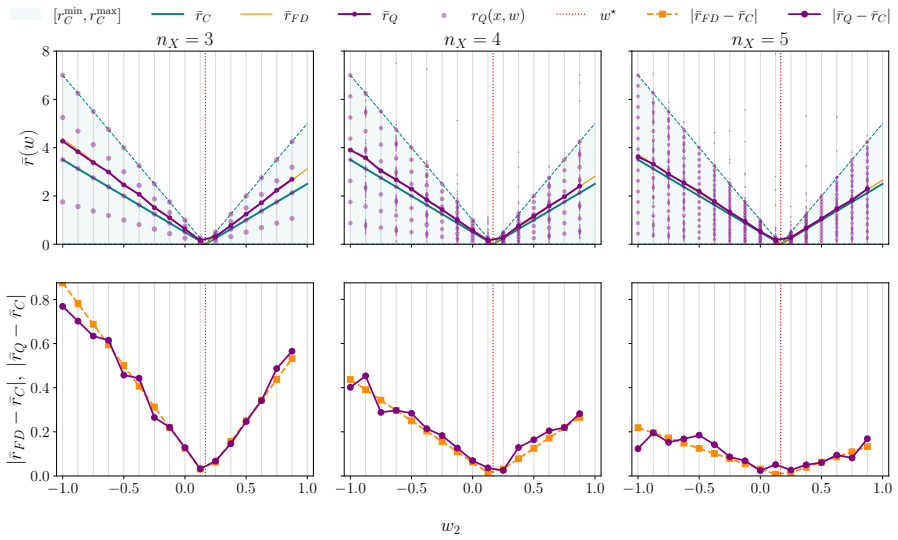
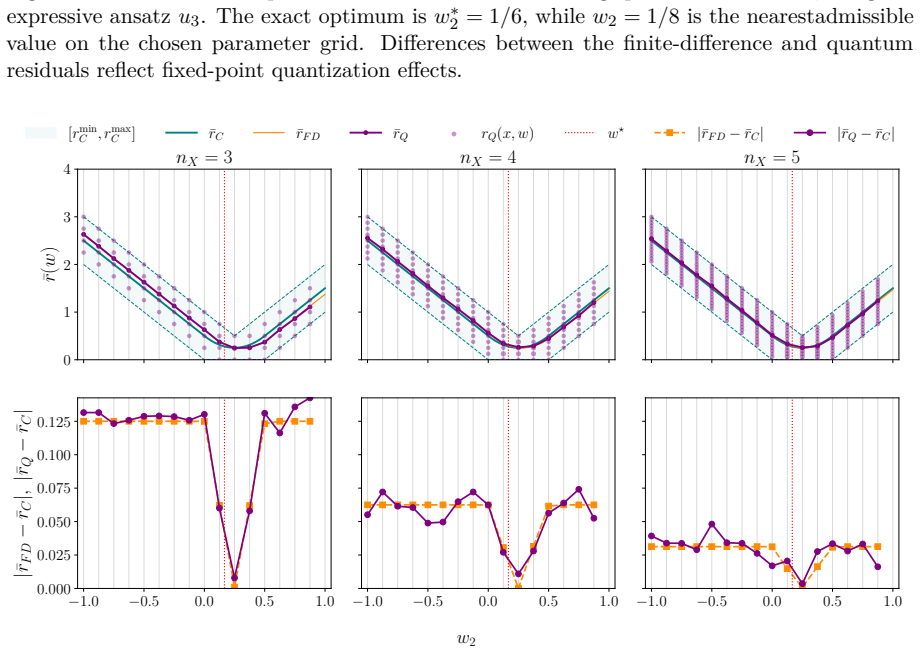
- Approximation quality and amplification behavior are controlled by discretization density, ansatz expressivity, oracle tolerance, and finite-precision effects.
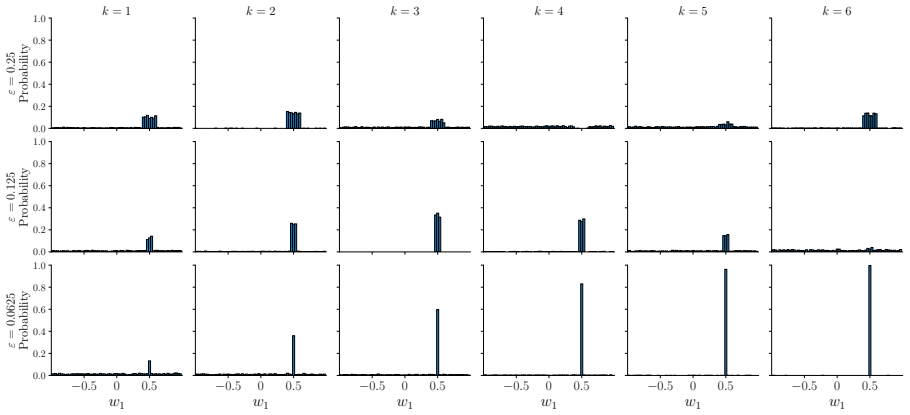
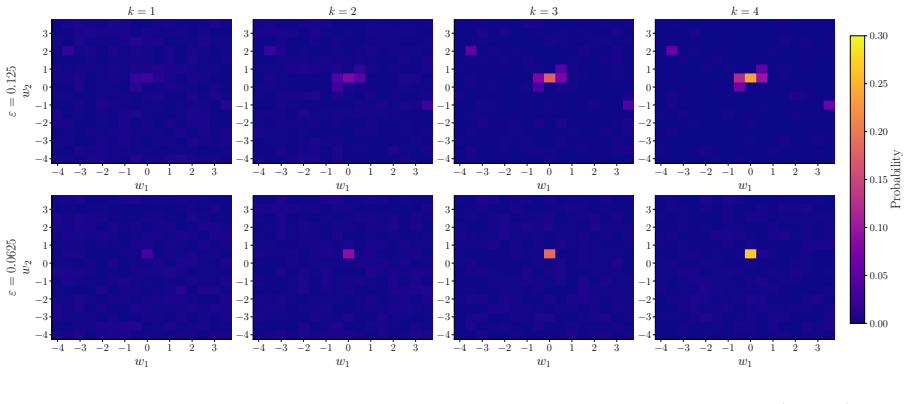
- Numerical experiments confirm the predicted search dynamics hold across varying discretization and precision regimes.
- The quadratic acceleration in the parameter space survives the spatially conditioned decomposition.
Where Pith is reading between the lines
- The same joint-oracle structure might be adapted to time-dependent or higher-dimensional problems if the spatial register can be enlarged without destroying the poly-log cost.
- Hybrid quantum-classical workflows could use the method as an inner solver for residual minimization loops that are otherwise expensive on classical hardware.
- The decomposition into independent spatial amplification channels suggests a natural way to parallelize the quantum search across multiple spatial subdomains.
- If the ansatz is chosen to be a low-depth variational form, the overall circuit depth might remain compatible with near-term hardware even as the number of collocation points grows.
Load-bearing premise
The residual-threshold oracle can be built to act jointly on spatial and parameter registers so that the resulting amplification splits into spatially conditioned processes without extra cost that would erase the poly-log scaling or the quadratic speedup.
What would settle it
An explicit circuit construction or resource count showing that the joint residual oracle requires gate complexity super-polynomial in the log of the number of collocation points, or a numerical run in which the observed search speedup falls below quadratic.
Figures


read the original abstract
We propose a quantum collocation framework for approximating solutions of one-dimensional linear and nonlinear boundary value problems. The method formulates the search for admissible solutions as a residual-based quantum search over a discretized ansatz space, where candidate solutions are evaluated through residual conditions imposed at collocation points. A residual-threshold oracle is constructed that acts jointly on spatial and parameter registers. This joint oracle structure leads to amplification dynamics that decompose into a coherent superposition of spatially conditioned amplitude-amplification processes rather than a single global amplification mechanism. We derive the corresponding amplification geometry and show that the success probability is governed by a weighted combination of spatially dependent amplification angles. Furthermore, we prove that the reversible residual oracle can be implemented with gate complexity polynomial in the logarithm of the number of collocation points, while retaining the quadratic search acceleration associated with amplitude amplification in the parameter space. We analyze how the spatially dependent oracle structure influences the amplification dynamics and corresponding success probabilities. Furthermore, we investigate how discretization, ansatz expressivity, oracle tolerance, and finite-precision effects influence both approximation quality and amplification behavior. Numerical experiments validate the theoretical predictions and illustrate the resulting search dynamics across different discretization and precision regimes.
Editorial analysis
A structured set of objections, weighed in public.
Referee Report
Summary. The paper claims to develop a quantum collocation approach for solving one-dimensional linear and nonlinear boundary value problems by casting the problem as a residual-based quantum search in a discretized ansatz space. A key innovation is the construction of a residual-threshold oracle that acts jointly on spatial and parameter registers, leading to amplification dynamics that are a coherent superposition of spatially conditioned amplitude-amplification processes. The authors derive the corresponding amplification geometry, prove that the oracle can be implemented with gate complexity polynomial in the logarithm of the number of collocation points while retaining quadratic speedup, analyze the effects of various parameters on the method, and provide numerical validation of the theoretical predictions.
Significance. Should the central results on the oracle construction and amplification dynamics be correct, this work represents a significant contribution to quantum algorithms for differential equations. The ability to achieve poly-log gate complexity in the number of collocation points while preserving the quadratic speedup from amplitude amplification is a strong point, as is the handling of the spatial dependence in a coherent manner. The numerical experiments provide concrete support for the claims. This approach could open new avenues for quantum collocation methods in scientific computing.
minor comments (2)
- The abstract is quite dense; separating the description of the joint oracle, the amplification geometry derivation, and the complexity proof into distinct sentences would improve readability.
- Notation for the spatially dependent amplification angles and the weighted success probability could be introduced with an explicit equation or table early in the main text for easier reference.
Simulated Author's Rebuttal
We thank the referee for the positive summary, significance assessment, and recommendation of minor revision. No specific major comments were listed in the report, so we have no individual points requiring point-by-point response or manuscript changes.
Circularity Check
No significant circularity in derivation chain
full rationale
The paper constructs a joint residual-threshold oracle acting on spatial and parameter registers, derives the resulting amplification geometry as a superposition of spatially conditioned processes, and proves the reversible oracle implementation has poly(log N) gate cost while the quadratic speedup in parameter space is retained. These steps are presented as independent derivations from the oracle definition and quantum search formalism; no equation reduces a claimed prediction or complexity bound to a fitted input by construction, no uniqueness theorem is imported from self-citation, and no ansatz is smuggled via prior work. The numerical validation is separate from the analytic claims. The derivation chain is therefore self-contained against external benchmarks.
Axiom & Free-Parameter Ledger
Reference graph
Works this paper leans on
-
[1]
U. M. Ascher and L. R. Petzold.Computer Methods for Ordinary Differential Equations and Differential-Algebraic Equations. SIAM, 1998
1998
-
[2]
Bennett, Richard Cleve, David P
Adriano Barenco, Charles H. Bennett, Richard Cleve, David P. DiVincenzo, Norman Margolus, Peter Shor, Tycho Sleator, John Smolin, and Harald Weinfurter. Elementary gates for quantum computation.Physical Review A, 52(5):3457–3467, 1995
1995
-
[3]
Variational quantum pde solvers based on residual minimization.Quantum Information Processing, 24(3):91, 2025
Lukas Berger and Martin Friesdorf. Variational quantum pde solvers based on residual minimization.Quantum Information Processing, 24(3):91, 2025
2025
-
[4]
Quantum Amplitude Amplification and Estimation
Gilles Brassard, Peter Høyer, Michele Mosca, and Alain Tapp. Quantum amplitude amplifica- tion and estimation.Contemporary Mathematics, 305:53–74, 2002. arXiv:quant-ph/0005055
work page internal anchor Pith review Pith/arXiv arXiv 2002
-
[5]
Brenner and L
Susanne C. Brenner and L. Ridgway Scott.The Mathematical Theory of Finite Element Methods, volume 15 ofTexts in Applied Mathematics. Springer, 3 edition, 2008
2008
-
[6]
Childs, Robin Kothari, and Rolando D
Andrew M. Childs, Robin Kothari, and Rolando D. Somma. Quantum algorithm for systems of linear equations with exponentially improved dependence on precision.SIAM Journal on Computing, 46(6):1920–1950, 2017
1920
-
[7]
Childs and Jin-Peng Liu
Andrew M. Childs and Jin-Peng Liu. Quantum spectral methods for differential equations. Communications in Mathematical Physics, 375(2):1427–1457, 2020
2020
-
[8]
Childs, Jin-Peng Liu, and Alex Ostrander
Andrew M. Childs, Jin-Peng Liu, and Alex Ostrander. High-precision quantum algorithms for partial differential equations.Quantum, 5:574, 2021
2021
-
[9]
Numerical analysis of physics-informed neural networks and related models in physics-informed machine learning.Acta Numerica, 33:73–238, 2024
Tim De Ryck and Siddhartha Mishra. Numerical analysis of physics-informed neural networks and related models in physics-informed machine learning.Acta Numerica, 33:73–238, 2024
2024
-
[10]
Thomas G. Draper. Addition on a quantum computer.Contemporary Mathematics
-
[11]
Lov K. Grover. A fast quantum mechanical algorithm for database search. pages 212–219, 1996. 29
1996
-
[12]
Harrow, Avinatan Hassidim, and Seth Lloyd
Aram W. Harrow, Avinatan Hassidim, and Seth Lloyd. Quantum algorithm for linear systems of equations.Physical Review Letters, 103(15):150502, 2009
2009
-
[13]
Hesthaven, Sigal Gottlieb, and David Gottlieb.Spectral Methods for Time-Dependent Problems, volume 21 ofCambridge Monographs on Applied and Computational Mathematics
Jan S. Hesthaven, Sigal Gottlieb, and David Gottlieb.Spectral Methods for Time-Dependent Problems, volume 21 ofCambridge Monographs on Applied and Computational Mathematics. Cambridge University Press, 2007
2007
-
[14]
Quantum simulation of partial differential equations via schrödingerisation.Journal of Computational Physics, 464:111282, 2022
Shi Jin, Nana Liu, and Yue Yu. Quantum simulation of partial differential equations via schrödingerisation.Journal of Computational Physics, 464:111282, 2022
2022
-
[15]
Hamiltonian simulation for nonlinear partial differential equations.Communications in Computational Physics, 34(1):148–182, 2023
Shi Jin, Nana Liu, and Yue Yu. Hamiltonian simulation for nonlinear partial differential equations.Communications in Computational Physics, 34(1):148–182, 2023
2023
-
[16]
Quantum simulation of partial differential equations: Applications and extensions.Acta Numerica, 32:383–478, 2023
Shi Jin, Nana Liu, and Yue Yu. Quantum simulation of partial differential equations: Applications and extensions.Acta Numerica, 32:383–478, 2023
2023
-
[17]
Improved quantum algorithms for linear and nonlinear differential equations
Hari Krovi. Improved quantum algorithms for linear and nonlinear differential equations. Quantum, 7:913, 2023
2023
-
[18]
LeVeque.Finite Difference Methods for Ordinary and Partial Differential Equations: Steady-State and Time-Dependent Problems
Randall J. LeVeque.Finite Difference Methods for Ordinary and Partial Differential Equations: Steady-State and Time-Dependent Problems. SIAM, Philadelphia, PA, 2007
2007
-
[19]
Kolden, Hari Krovi, N
Jin-Peng Liu, H. Kolden, Hari Krovi, N. F. Loureiro, K. Trivisa, and Andrew M. Childs. Efficient quantum algorithm for dissipative nonlinear differential equations.Proceedings of the National Academy of Sciences, 118(35):e2026805118, 2021
2021
-
[20]
Quantum algorithms and the finite element method
Ashley Montanaro and Sam Pallister. Quantum algorithms and the finite element method. Physical Review A, 93(3):032324, 2016
2016
-
[21]
Nielsen and Isaac L
Michael A. Nielsen and Isaac L. Chuang.Quantum Computation and Quantum Information. Cambridge University Press, Cambridge, 10th anniversary edition edition, 2010
2010
-
[22]
Meyer, et al
Lorenzo Panichi, David Wierichs, Jakob J. Meyer, et al. Quantum physics-informed neural networks.Quantum Machine Intelligence, 8(1):15, 2026
2026
-
[23]
Raissi, P
M. Raissi, P. Perdikaris, and G. E. Karniadakis. Physics-informed neural networks: A deep learning framework for solving forward and inverse problems involving nonlinear partial differential equations.Journal of Computational Physics, 378:686–707, 2019
2019
-
[24]
Quantum arithmetic with the quantum fourier transform.Quantum Information Processing, 16(1):152, 2017
Lidia Ruiz-Perez and Juan Carlos Garcia-Escartin. Quantum arithmetic with the quantum fourier transform.Quantum Information Processing, 16(1):152, 2017
2017
-
[25]
Jagtap, and Siddhartha Mishra
Tim De Ryck, Ameya D. Jagtap, and Siddhartha Mishra. Error estimates for physics- informed neural networks approximating the navier–stokes equations.IMA Journal of Numerical Analysis, 42(4):3217–3248, 2022
2022
-
[26]
Quantum algorithms for partial differential equations based on hamiltonian simulation.Physical Review Research, 6(1):013112, 2024
Yuki Sato and Tadashi Kadowaki. Quantum algorithms for partial differential equations based on hamiltonian simulation.Physical Review Research, 6(1):013112, 2024
2024
-
[27]
Efficient floating point arithmetic for quantum computers.IEEE Access, 10:72400–72415, 2022
Raphael Seidel, Nikolay Tcholtchev, Sebastian Bock, Colin Kai-Uwe Becker, and Manfred Hauswirth. Efficient floating point arithmetic for quantum computers.IEEE Access, 10:72400–72415, 2022
2022
-
[28]
Stoer and R
J. Stoer and R. Bulirsch.Introduction to Numerical Analysis. Springer, 3rd edition, 2002
2002
-
[29]
Quantum networks for elementary arithmetic operations.Physical Review A, 54(1):147–153, 1996
Vlatko Vedral, Adriano Barenco, and Artur Ekert. Quantum networks for elementary arithmetic operations.Physical Review A, 54(1):147–153, 1996. 30
1996
-
[30]
A comprehensive study of quantum arithmetic circuits.Philosophical Transactions A: Mathematical, Physical and Engineering Sciences, 383(2288):20230392, 2025
Siyi Wang, Xiufan Li, Wei Jie Bryan Lee, Suman Deb, Eugene Lim, and Anupam Chattopad- hyay. A comprehensive study of quantum arithmetic circuits.Philosophical Transactions A: Mathematical, Physical and Engineering Sciences, 383(2288):20230392, 2025. 31
2025
discussion (0)
Sign in with ORCID, Apple, or X to comment. Anyone can read and Pith papers without signing in.