Near-Optimal Distributed 2-Ruling Sets on Graphs with Low Arboricity
Pith reviewed 2026-06-27 08:16 UTC · model grok-4.3
The pith
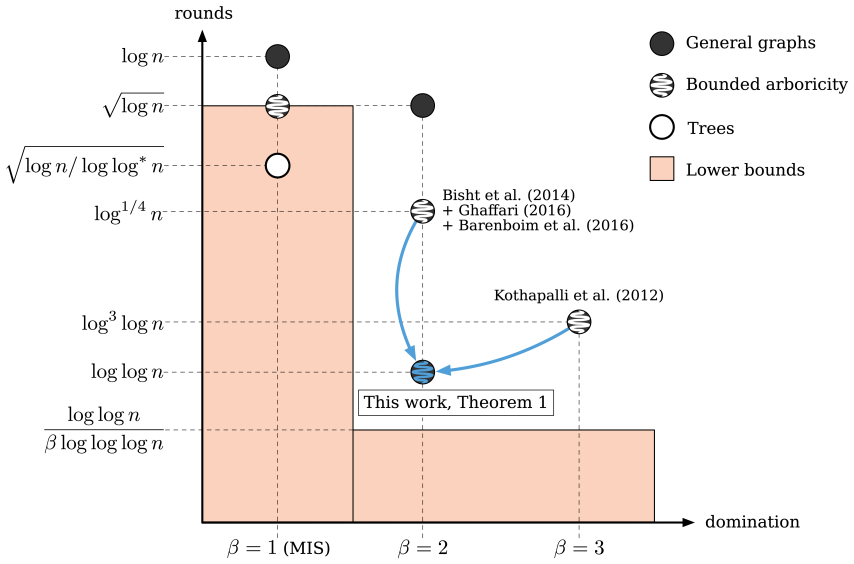
Randomized algorithm computes 2-ruling sets in O(log log n) rounds on graphs with arboricity O(log log n).
A machine-rendered reading of the paper's core claim, the machinery that carries it, and where it could break.
Core claim
A randomized algorithm that w.h.p. computes a 2-ruling set on any n-node graph with bounded arboricity in O(log log n) rounds.
What carries the argument
Randomized procedure that repeatedly samples and prunes candidate nodes while exploiting the low-arboricity decomposition to keep the remaining degree small after each round.
If this is right
- Graphs of arboricity up to O(log log n) admit exponentially faster distributed 2-ruling sets than general graphs.
- For any constant or slowly growing α the new bound is Õ(log^{5/8} α + log^{5/3} log n).
- In the MPC model the same sparsity regime yields an O(log log log n)-round algorithm.
- β = 2 is the largest domination radius that can be achieved in log^{o(1)} n rounds on arboricity-2 graphs.
Where Pith is reading between the lines
- The same sampling-and-pruning idea may yield fast ruling sets under other sparsity notions such as bounded degeneracy.
- One could attempt to derandomize the procedure while preserving the O(log log n) bound.
- The MPC result suggests that low-arboricity instances are also easy for massively parallel symmetry breaking beyond the LOCAL model.
Load-bearing premise
The input graph has arboricity at most O(log log n).
What would settle it
An n-node graph of arboricity O(log log n) on which every 2-ruling-set algorithm requires ω(log log n) rounds with high probability.
Figures
read the original abstract
Given a graph $G=(V,E)$, a $\beta$-ruling set is a subset of nodes $S\subseteq V$ that is independent, and each node in $V$ is at distance at most $\beta$ from some node in $S$. In this paper, we present almost optimal distributed algorithms for finding $2$-ruling sets in the classical \LOCAL model. Our main contribution is a randomized algorithm that w.h.p.\ computes a $2$-ruling set on any $n$-node graph with bounded arboricity in $O(\log \log n)$ rounds. In fact, the algorithm works up to arboricity $O(\log\log n)$, improves exponentially over the prior state of the art that can be achieved by combining [Barenboim, Elkin, Pettie, Schneider; JACM'16], [Ghaffari; SODA'16], and [Bisht, Kothapalli and Pemmaraju; PODC'14], and nearly matches the lower bound of $\Omega(\log \log n / \log \log \log n)$ [Balliu, Brandt, Kuhn, Olivetti; FOCS'20]. The domination parameter $\beta=2$ is optimal for algorithms with runtime $\log^{o(1)}n$: on graphs with arboricity $2$, there is a lower bound of $\Omega(\sqrt{\log n})$ rounds for MIS (i.e., $\beta = 1$) [Khoury, Schild; FOCS'25]. Additionally, we obtain improved algorithms for larger arboricity. For general graphs with arboricity $\alpha$, we present a randomized algorithm that computes a $2$-ruling set in $\widetilde{O}(\log^{5/8} \alpha +\log^{5/3} \log n)$ rounds. This improves exponentially over the state of the art for a large range of non-constant arboricity. Our techniques extend beyond distributed computing. We present an $O(\log \log \log n)$-round algorithm in the low-space Massively Parallel Computation (\mpc) model that w.h.p.\ computes a $2$-ruling set on any graph with arboricity up to $2^{poly (\log \log n)}$, improving exponentially over the state of the art from [Kothapalli, Pai, Pemmaraju; FSTTCS'20] combined with [Fischer, Giliberti, Grunau; SPAA'23].
Editorial analysis
A structured set of objections, weighed in public.
Referee Report
Summary. The paper presents randomized distributed algorithms for computing 2-ruling sets (independent dominating sets with distance-2 domination) in the LOCAL model. The central claim is an O(log log n)-round w.h.p. algorithm for any n-node graph with arboricity up to O(log log n), which improves exponentially over the combination of prior results from Barenboim et al. (JACM'16), Ghaffari (SODA'16), and Bisht et al. (PODC'14) and nearly matches the Ω(log log n / log log log n) lower bound of Balliu et al. (FOCS'20). Additional results include a ilde{O}(log^{5/8} α + log^{5/3} log n)-round algorithm for general arboricity α and an O(log log log n)-round MPC algorithm for arboricity up to 2^{poly(log log n)}.
Significance. If the claims hold, the result is significant: it supplies the first sub-polylogarithmic-time algorithm for 2-ruling sets that is near-optimal in the low-arboricity regime, correctly distinguishes the β=2 case from the stronger MIS lower bound on arboricity-2 graphs (Khoury-Schild FOCS'25), and gives exponential improvements for both the LOCAL and MPC models. The explicit runtime comparisons to independent prior work and the cited lower bound, together with the parameter-free form of the O(log log n) bound relative to the lower bound, strengthen the contribution.
minor comments (2)
- [Abstract] The abstract states the O(log log n) bound holds 'up to arboricity O(log log n)' but does not explicitly restate the precise dependence on α in the general-arboricity result; adding a single sentence in the introduction clarifying the transition point between the two regimes would improve readability.
- [Abstract] The MPC result is stated for arboricity up to 2^{poly(log log n)}; a brief remark on whether the same technique yields a smooth trade-off for intermediate arboricity values would be helpful.
Simulated Author's Rebuttal
We thank the referee for the positive review, the accurate summary of our results, and the recommendation to accept the paper. We appreciate the recognition of the exponential improvements and the near-optimality in the low-arboricity regime.
Circularity Check
No circularity; derivation self-contained against external benchmarks
full rationale
The paper presents a new randomized LOCAL-model algorithm for 2-ruling sets whose O(log log n) runtime (w.h.p.) on graphs with arboricity O(log log n) is derived from the input sparsity parameter and standard concentration arguments; it is compared to an independent lower bound of Ω(log log n / log log log n) from Balliu et al. FOCS'20 and improves on combinations of prior independent results (Barenboim et al. JACM'16, Ghaffari SODA'16, Bisht et al. PODC'14). The β=2 optimality distinction versus the MIS lower bound on arboricity-2 graphs is likewise external. No equation reduces the runtime claim to a fitted parameter, self-citation chain, or renamed input; the MPC extension follows the same pattern. The derivation chain is therefore self-contained.
Axiom & Free-Parameter Ledger
axioms (2)
- domain assumption LOCAL model: synchronous rounds with neighbor communication only
- standard math w.h.p. success probability 1-1/poly(n)
Reference graph
Works this paper leans on
-
[1]
A Fast and Simple Randomized Parallel Algorithm for the Maximal Independent Set Problem.Journal of Algorithms, 7(4):567–583, 1986
Noga Alon, Lásló Babai, and Alon Itai. A Fast and Simple Randomized Parallel Algorithm for the Maximal Independent Set Problem.Journal of Algorithms, 7(4):567–583, 1986
1986
-
[2]
Ruling Sets in Random Order and Adversarial Streams
Sepehr Assadi and Aditi Dudeja. Ruling Sets in Random Order and Adversarial Streams. In the International Symposium on Distributed Computing (DISC), pages 6:1–6:18, 2021.doi: 10.4230/LIPIcs.DISC.2021.6
-
[3]
Goldberg, Michael Luby, and Serge A
Baruch Awerbuch, Andrew V. Goldberg, Michael Luby, and Serge A. Plotkin. Network De- composition and Locality in Distributed Computation. Inthe Proceedings of the Symposium on Foundations of Computer Science (FOCS), pages 364–369, 1989
1989
-
[4]
Lower Bounds for Maximal Matchings and Maximal Independent Sets
Alkida Balliu, Sebastian Brandt, Juho Hirvonen, Dennis Olivetti, Mikaël Rabie, and Jukka Suomela. Lower Bounds for Maximal Matchings and Maximal Independent Sets. Inthe Pro- ceedings of the Symposium on Foundations of Computer Science (FOCS), 2019
2019
-
[5]
Distributed∆-coloring plays hide-and-seek
Alkida Balliu, Sebastian Brandt, Fabian Kuhn, and Dennis Olivetti. Distributed∆-coloring plays hide-and-seek. InProc. 54th ACM Symp. on Theory of Computing (STOC), 2022
2022
-
[6]
Near-linear Size Hypergraph Cut Sparsifiers , booktitle =
Alkida Balliu, Sebastian Brandt, and Dennis Olivetti. Distributed Lower Bounds for Ruling Sets. Inthe Proceedings of the Symposium on Foundations of Computer Science (FOCS), pages 365–376, 2020.doi:10.1109/FOCS46700.2020.00042
-
[7]
Distributed lower bounds for ruling sets.SIAM J
Alkida Balliu, Sebastian Brandt, and Dennis Olivetti. Distributed lower bounds for ruling sets.SIAM J. Comput., 51(1):70–115, 2022. URL:https://doi.org/10.1137/20m1381770, doi:10.1137/20M1381770
-
[8]
On the Impact of Identifiers on Local Decision
Alkida Balliu, Mohsen Ghaffari, Fabian Kuhn, and Dennis Olivetti. Node and edge averaged complexities of local graph problems. InProceedings of the 2022 ACM Symposium on Principles of Distributed Computing, PODC’22, page 4–14, New York, NY, USA, 2022. Association for Computing Machinery.doi:10.1145/3519270.3538419
-
[9]
Barenboim and M
L. Barenboim and M. Elkin. Sublogarithmic distributed mis algorithm for sparse graphs us- ing nash-williams decomposition.Distributed Computing, 22(5):363–379, 2010.doi:10.1007/ s00446-009-0088-2
2010
-
[10]
Locally-iterative distributed(δ+ 1)- coloring and applications.J
Leonid Barenboim, Michael Elkin, and Uri Goldenberg. Locally-iterative distributed(δ+ 1)- coloring and applications.J. ACM, 69(1), December 2021.doi:10.1145/3486625
-
[11]
Leonid Barenboim, Michael Elkin, and Fabian Kuhn. Distributed(δ+ 1)-coloring in linear (in δ) time.SIAM Journal on Computing, 43(1):72–95, 2014.arXiv:https://doi.org/10.1137/ 12088848X,doi:10.1137/12088848X
-
[12]
The Locality of Dis- tributed Symmetry Breaking.Journal of the ACM, 63(3):20:1–20:45, 2016
Leonid Barenboim, Michael Elkin, Seth Pettie, and Johannes Schneider. The Locality of Dis- tributed Symmetry Breaking.Journal of the ACM, 63(3):20:1–20:45, 2016
2016
-
[13]
Nearly-optimal distributed ruling sets for trees and high-girth graphs
Malte Baumecker, Yannic Maus, and Jara Uitto. Nearly-optimal distributed ruling sets for trees and high-girth graphs. InProceedings of the ACM Symposium on Principles of Distributed Computing, PODC ’25, page 88–98, New York, NY, USA, 2025. Association for Computing Machinery.doi:10.1145/3732772.3733547. 22
-
[14]
Paul Beame, Paraschos Koutris, and Dan Suciu. Communication Steps for Parallel Query Processing.the Journal of the ACM, 64(6), 2017.doi:10.1145/3125644
-
[15]
Brief announcement: Super-fast t- ruling sets
Tushar Bisht, Kishore Kothapalli, and Sriram Pemmaraju. Brief announcement: Super-fast t- ruling sets. Inthe Proceedings of the ACM Symposium on Principles of Distributed Computing (PODC), pages 379–381, 2014.doi:10.1145/2611462.2611512
-
[16]
Massively Parallel Correla- tion Clustering in Bounded Arboricity Graphs
Mélanie Cambus, Davin Choo, Havu Miikonen, and Jara Uitto. Massively Parallel Correla- tion Clustering in Bounded Arboricity Graphs. In Seth Gilbert, editor,35th International Symposium on Distributed Computing (DISC 2021), volume 209 ofLeibniz International Pro- ceedings in Informatics (LIPIcs), pages 15:1–15:18, Dagstuhl, Germany, 2021. Schloss Dagstuhl...
-
[18]
Time and space optimal massively parallel algorithm for the 2-ruling set problem
Mélanie Cambus, Fabian Kuhn, Shreyas Pai, and Jara Uitto. Time and space optimal massively parallel algorithm for the 2-ruling set problem. In Rotem Oshman, editor,37th International Symposium on Distributed Computing, DISC 2023, October 10-12, 2023, L’Aquila, Italy, vol- ume 281 ofLIPIcs, pages 11:1–11:12. Schloss Dagstuhl - Leibniz-Zentrum für Informati...
-
[19]
Chandra Chekuri, Aleksander Bjørn Christiansen, Jacob Holm, Ivor van der Hoog, Kent Quan- rud, Eva Rotenberg, and Chris Schwiegelshohn.Adaptive Out-Orientations with Applications, pages 3062–3088. URL:https://epubs.siam.org/doi/abs/10.1137/1.9781611977912.110, arXiv:https://epubs.siam.org/doi/pdf/10.1137/1.9781611977912.110,doi:10.1137/1. 9781611977912.110
-
[20]
Breuckmann and Chinmay Nirkhe , editor =
Aleksander Bjørn Grodt Christiansen, Krzysztof Nowicki, and Eva Rotenberg. Improved dy- namic colouring of sparse graphs. InProceedings of the 55th Annual ACM Symposium on Theory of Computing, STOC 2023, page 1201–1214, New York, NY, USA, 2023. Association for Computing Machinery.doi:10.1145/3564246.3585111
-
[21]
Corinna Coupette and Christoph Lenzen.A Breezing Proof of the KMW Bound, pages 184–195. URL:https://epubs.siam.org/doi/abs/10.1137/1.9781611976496.21,arXiv:https:// epubs.siam.org/doi/pdf/10.1137/1.9781611976496.21,doi:10.1137/1.9781611976496. 21
-
[22]
Graph sparsification for derandomizing mas- sively parallel computation with low space
Artur Czumaj, Peter Davies, and Merav Parter. Graph sparsification for derandomizing mas- sively parallel computation with low space. InProceedings of the 32nd ACM Symposium on Parallelism in Algorithms and Architectures, SPAA ’20, page 175–185, New York, NY, USA,
-
[23]
Association for Computing Machinery.doi:10.1145/3350755.3400282
-
[24]
Near-optimal hashing algorithms for approximate nearest neighbor in high dimensions,
Jeffrey Dean and Sanjay Ghemawat. MapReduce: Simplified Data Processing on Large Clus- ters.Communications of the ACM, pages 107–113, 2008.doi:10.1145/1327452.1327492
-
[25]
Near-optimal distributed dominating set in bounded arboricity graphs.Distributed Computing, 37(4):387–398, May 2023.doi:10.1007/ s00446-023-00447-z
Michal Dory, Mohsen Ghaffari, and Saeed Ilchi. Near-optimal distributed dominating set in bounded arboricity graphs.Distributed Computing, 37(4):387–398, May 2023.doi:10.1007/ s00446-023-00447-z. 23
2023
-
[26]
Talya Eden, Saleet Mossel, and Dana Ron.Approximating the Arboricity in Sublinear Time, pages 2404–2425. URL:https://epubs.siam.org/doi/abs/10.1137/1.9781611977073.96, arXiv:https://epubs.siam.org/doi/pdf/10.1137/1.9781611977073.96,doi:10.1137/1. 9781611977073.96
-
[27]
Talya Eden, Dana Ron, and C. Seshadhri.Faster sublinear approximation of the number of k-cliques in low-arboricity graphs, pages 1467–1478. 2020. URL:https://epubs.siam. org/doi/abs/10.1137/1.9781611975994.89,arXiv:https://epubs.siam.org/doi/pdf/10. 1137/1.9781611975994.89,doi:10.1137/1.9781611975994.89
-
[28]
Esary, Frank Proschan, and David W
James D. Esary, Frank Proschan, and David W. Walkup. Association of random variables, with applications.The Annals of Mathematical Statistics, 38(5):1466–1474, 1967.doi:10. 1214/aoms/1177698701
arXiv 1967
-
[29]
Salwa Faour and Fabian Kuhn. Brief Announcement: Faster CONGEST Approximation Al- gorithms for Maximum Weighted Independent Set in Sparse Graphs. In Dariusz R. Kowalski, editor,39th International Symposium on Distributed Computing (DISC 2025), volume 356 of Leibniz International Proceedings in Informatics (LIPIcs), pages54:1–54:7, Dagstuhl, Germany, 2025....
-
[30]
Deterministic massively parallel sym- metry breaking for sparse graphs
Manuela Fischer, Jeff Giliberti, and Christoph Grunau. Deterministic massively parallel sym- metry breaking for sparse graphs. InProceedings of the 35th ACM Symposium on Parallelism in Algorithms and Architectures, SPAA ’23, page 89–100, New York, NY, USA, 2023. Association for Computing Machinery.doi:10.1145/3558481.3591081
-
[31]
Atailboundforread- k families of functions.Random Structures & Algorithms, 47(1):99–108, 2015
DmitryGavinsky, ShacharLovett, MichaelSaks, andSrikanthSrinivasan. Atailboundforread- k families of functions.Random Structures & Algorithms, 47(1):99–108, 2015. URL:https:// onlinelibrary.wiley.com/doi/abs/10.1002/rsa.20532,arXiv:https://onlinelibrary. wiley.com/doi/pdf/10.1002/rsa.20532,doi:10.1002/rsa.20532
-
[32]
Gfeller and E
B. Gfeller and E. Vicari. A randomized distributed algorithm for the maximal independent set problem in growth-bounded graphs. Inthe Proceedings of the ACM Symposium on Principles of Distributed Computing (PODC), pages 53–60, 2007
2007
-
[33]
An Improved Distributed Algorithm for Maximal Independent Set
Mohsen Ghaffari. An Improved Distributed Algorithm for Maximal Independent Set. Inthe Proceedings of the ACM-SIAM Symposium on Discrete Algorithms (SODA), pages 270–277, 2016
2016
-
[34]
Dynamic o(arboricity) coloring in polylogarithmic worst-case time
Mohsen Ghaffari and Christoph Grunau. Dynamic o(arboricity) coloring in polylogarithmic worst-case time. InProceedings of the 56th Annual ACM Symposium on Theory of Computing, STOC 2024, page 1184–1191, New York, NY, USA, 2024. Association for Computing Machin- ery.doi:10.1145/3618260.3649782
-
[35]
Brendan McMahan, Krishna Pillutla, Thomas Steinke, and Abhradeep Thakurta
Mohsen Ghaffari and Christoph Grunau. Near-optimal deterministic network decomposition and ruling set, and improved MIS. Inthe Proceedings of the Symposium on Foundations of Computer Science (FOCS), pages 2148–2179, 2024.doi:10.1109/FOCS61266.2024.00007
-
[36]
Improved distributed network decomposition, hitting sets, and spanners, via derandomiza- tion
Mohsen Ghaffari, Christoph Grunau, Bernhard Haeupler, Saeed Ilchi, and Václav Rozhon. Improved distributed network decomposition, hitting sets, and spanners, via derandomiza- tion. In Nikhil Bansal and Viswanath Nagarajan, editors,Proceedings of the 2023 ACM- SIAM Symposium on Discrete Algorithms, SODA 2023, Florence, Italy, January 22-25, 2023, 24 pages ...
-
[37]
Improved MPC Algorithms for MIS, Match- ing, and Coloring on Trees and Beyond
Mohsen Ghaffari, Christoph Grunau, and Ce Jin. Improved MPC Algorithms for MIS, Match- ing, and Coloring on Trees and Beyond. In Hagit Attiya, editor,34th International Symposium on Distributed Computing (DISC 2020), volume 179 ofLeibniz International Proceedings in Informatics (LIPIcs), pages 34:1–34:18, Dagstuhl, Germany, 2020. Schloss Dagstuhl – Leibni...
-
[38]
Improved distributed delta- coloring
Mohsen Ghaffari, Juho Hirvonen, Fabian Kuhn, and Yannic Maus. Improved distributed delta- coloring. Inthe Proceedings of the ACM Symposium on Principles of Distributed Computing (PODC), pages 427–436, 2018. URL:https://dl.acm.org/citation.cfm?id=3212764
2018
-
[39]
Mohsen Ghaffari and Jara Uitto.Sparsifying Distributed Algorithms with Ramifications in Mas- sively Parallel Computation and Centralized Local Computation, pages 1636–1653. 2019. URL: https://epubs.siam.org/doi/abs/10.1137/1.9781611975482.99,arXiv:https://epubs. siam.org/doi/pdf/10.1137/1.9781611975482.99,doi:10.1137/1.9781611975482.99
-
[40]
Massively Parallel Ruling Set Made Deterministic
Jeff Giliberti and Zahra Parsaeian. Massively Parallel Ruling Set Made Deterministic. In Dan Alistarh, editor,38th International Symposium on Distributed Computing (DISC 2024), volume 319 ofLeibniz International Proceedings in Informatics (LIPIcs), pages 29:1– 29:21, Dagstuhl, Germany, 2024. Schloss Dagstuhl – Leibniz-Zentrum für Informatik. URL: https://...
-
[41]
Henzinger, S
M. Henzinger, S. Krinninger, and D. Nanongkai. A deterministic almost-tight dis- tributed algorithm for approximating single-source shortest paths. InProc. 48th ACM Symp. on Theory of Computing (STOC), pages 489–498, 2016
2016
-
[42]
G. Iliopoulos and N. Balakrishnan. Conditional independence of blocked ordered data.Statis- tics and Probability Letters, 79(8):1008–1015, 2009. URL:https://www.sciencedirect.com/ science/article/pii/S0167715208005683,doi:10.1016/j.spl.2008.12.005
-
[43]
Michael Isard, Mihai Budiu, Yuan Yu, Andrew Birrell, and Dennis Fetterly. Dryad: Distributed Data-Parallel Programs from Sequential Building Blocks.ACM SIGOPS Operating Systems Review, pages 59–72, 2007.doi:10.1145/1272996.1273005
-
[44]
Fast deterministic massively parallel ruling sets algorithms
Hongyan Ji, Kishore Kothapalli, Sriram V Pemmaraju, and Ajitanshu Singh. Fast deterministic massively parallel ruling sets algorithms. InProceedings of the 26th International Conference on Distributed Computing and Networking, ICDCN ’25, page 152–160, New York, NY, USA,
-
[45]
Association for Computing Machinery.doi:10.1145/3700838.3700872
-
[46]
Karloff, Siddharth Suri, and Sergei Vassilvitskii
Howard J. Karloff, Siddharth Suri, and Sergei Vassilvitskii. A Model of Computation for MapReduce. Inthe Proceedings of the ACM-SIAM Symposium on Discrete Algorithms (SODA), pages 938–948, 2010.doi:10.1137/1.9781611973075.76
-
[47]
Breaking barriers for distributed mis by faster degree reduction,
Seri Khoury and Aaron Schild. Breaking barriers for distributed mis by faster degree reduction,
-
[48]
URL:https://arxiv.org/abs/2505.15652,arXiv:2505.15652
-
[49]
Round elimination via self-reduction: Closing gaps for distributed maximal matching, 2025
Seri Khoury and Aaron Schild. Round elimination via self-reduction: Closing gaps for distributed maximal matching, 2025. URL:https://arxiv.org/abs/2505.15654,arXiv: 2505.15654. 25
arXiv 2025
-
[50]
Sparse matrix multiplication and triangle listing in the congested clique model
Kishore Kothapalli, Shreyas Pai, and Sriram V. Pemmaraju. Sample-And-Gather: Fast Ruling Set Algorithms in the Low-Memory MPC Model. In Nitin Saxena and Sunil Simon, editors, 40th IARCS Annual Conference on Foundations of Software Technology and Theoretical Com- puter Science (FSTTCS 2020), volume 182 ofLeibniz International Proceedings in Informatics (LI...
-
[51]
Kishore Kothapalli and Sriram Pemmaraju. Super-Fast 3-Ruling Sets. pages 136–147, 2012. doi:10.4230/LIPIcs.FSTTCS.2012.136
-
[52]
F. Kuhn, T. Moscibroda, and R. Wattenhofer. Local computation: Lower and upper bounds. J. of the ACM, 63(2), 2016
2016
-
[53]
Deterministic distributed ruling sets of line graphs
Fabian Kuhn, Yannic Maus, and Simon Weidner. Deterministic distributed ruling sets of line graphs. In Zvi Lotker and Boaz Patt-Shamir, editors,Structural Information and Communica- tion Complexity - 25th International Colloquium, SIROCCO 2018, Ma’ale HaHamisha, Israel, June 18-21, 2018, Revised Selected Papers, volume 11085 ofLecture Notes in Computer Sci...
-
[54]
Brief Announcement: Exponential Speed-up of Local Algorithms Using Non-Local Communication
Christoph Lenzen and Roger Wattenhofer. Brief Announcement: Exponential Speed-up of Local Algorithms Using Non-Local Communication. Inthe Proceedings of the ACM Symposium on Principles of Distributed Computing (PODC), pages 295–296, 2010.doi:10.1145/1835698. 1835772
-
[55]
Minimum dominating set approximation in graphs of bounded arboricity
Christoph Lenzen and Roger Wattenhofer. Minimum dominating set approximation in graphs of bounded arboricity. In Nancy A. Lynch and Alexander A. Shvartsman, editors,Distributed Computing, pages 510–524, Berlin, Heidelberg, 2010. Springer Berlin Heidelberg
2010
-
[56]
Locality in Distributed Graph Algorithms.SIAM Journal on Computing, 21(1):193–201, 1992
Nati Linial. Locality in Distributed Graph Algorithms.SIAM Journal on Computing, 21(1):193–201, 1992
1992
-
[57]
M. Luby. A Simple Parallel Algorithm for the Maximal Independent Set Problem.SIAM Journal on Computing, 15:1036–1053, 1986
1986
-
[58]
Distributed graph coloring made easy
Yannic Maus. Distributed graph coloring made easy. In Kunal Agrawal and Yossi Azar, editors, SPAA ’21: 33rd ACM Symposium on Parallelism in Algorithms and Architectures, Virtual Event, USA, 6-8 July, 2021, pages 362–372. ACM, 2021.doi:10.1145/3409964.3461804
-
[59]
Distributed symmetry breaking on power graphs via sparsification
Yannic Maus, Saku Peltonen, and Jara Uitto. Distributed symmetry breaking on power graphs via sparsification. InProceedings of the 2023 ACM Symposium on Principles of Distributed Computing, PODC ’23, page 157–167, New York, NY, USA, 2023. Association for Computing Machinery.doi:10.1145/3583668.3594579
-
[60]
Adir Morgan, Shay Solomon, and Nicole Wein. Algorithms for the Minimum Domi- nating Set Problem in Bounded Arboricity Graphs: Simpler, Faster, and Combinatorial. In Seth Gilbert, editor,35th International Symposium on Distributed Computing (DISC 2021), volume 209 ofLeibniz International Proceedings in Informatics (LIPIcs), pages 33:1– 33:19, Dagstuhl, Ger...
-
[61]
Pemmaraju, Talal Riaz, and Peter Robinson
Shreyas Pai, Gopal Pandurangan, Sriram V. Pemmaraju, Talal Riaz, and Peter Robinson. Symmetry Breaking in the Congest Model: Time- and Message-Efficient Algorithms for Ruling Sets. In Andréa Richa, editor,31st International Symposium on Distributed Computing (DISC 2017), volume 91 ofLeibniz International Proceedings in Informatics (LIPIcs), pages 38:1– 38...
-
[62]
Shreyas Pai and Sriram V. Pemmaraju. Brief Announcement: Deterministic Massively Par- allel Algorithms for Ruling Sets. Inthe Proceedings of the ACM Symposium on Principles of Distributed Computing (PODC), pages 366–368, 2022.doi:10.1145/3519270.3538472
-
[63]
Distributed computing: A locality-sensitive approach
David Peleg. Distributed computing: A locality-sensitive approach. 1987. URL:https: //api.semanticscholar.org/CorpusID:58843423
1987
-
[64]
Using Read-k Inequalities to Analyze a Distributed MIS Algorithm
Sriram Pemmaraju and Talal Riaz. Using Read-k Inequalities to Analyze a Distributed MIS Algorithm. In Panagiota Fatourou, Ernesto Jiménez, and Fernando Pedone, edi- tors,20th International Conference on Principles of Distributed Systems (OPODIS 2016), volume 70 ofLeibniz International Proceedings in Informatics (LIPIcs), pages 9:1–9:17, Dagstuhl, Germany,...
-
[65]
Polylogarithmic-time Deterministic Network Decompo- sition and Distributed Derandomization
Václav Rozhoň and Mohsen Ghaffari. Polylogarithmic-time Deterministic Network Decompo- sition and Distributed Derandomization. Inthe Proceedings of the Annual ACM Symposium on Theory of Computing (STOC), pages 350–363, 2020
2020
-
[67]
Symmetry breaking depending on the chromatic number or the neighborhood growth.Theor
Johannes Schneider, Michael Elkin, and Roger Wattenhofer. Symmetry breaking depending on the chromatic number or the neighborhood growth.Theor. Comput. Sci., 509:40–50, 2013. doi:10.1016/j.tcs.2012.09.004
-
[68]
A new technique for distributed symmetry breaking
Johannes Schneider and Roger Wattenhofer. A new technique for distributed symmetry breaking. Inthe Proceedings of the ACM Symposium on Principles of Distributed Comput- ing (PODC), pages 257–266, 2010.doi:10.1145/1835698.1835760
-
[69]
O’Reilly Media, Inc., 2009
Tom White.Hadoop: The Definitive Guide. O’Reilly Media, Inc., 2009
2009
-
[70]
Franklin, Scott Shenker, and Ion Stoica
Matei Zaharia, Mosharaf Chowdhury, Michael J. Franklin, Scott Shenker, and Ion Stoica. Spark: ClusterComputing with WorkingSets. Inthe Proceedings of the USENIX Conference on Hot Topics in Cloud Computing (HotCloud), page 10, 2010.doi:10.5555/1863103.1863113
-
[71]
Probabilistic methods in combinatorics: Lecture 15, correlation in- equalities
Yufei Zhao. Probabilistic methods in combinatorics: Lecture 15, correlation in- equalities. MIT OpenCourseWare, 18.226 Probabilistic Methods in Combina- torics, 2022. Accessed: 2026-01-06. URL:https://ocw.mit.edu/courses/ 18-226-probabilistic-methods-in-combinatorics-fall-2022/resources/mit18_226_ f22_lec15_pdf/. 27 A Extended Related Work Dominationβ Run...
2022
discussion (0)
Sign in with ORCID, Apple, or X to comment. Anyone can read and Pith papers without signing in.