REVIEW 4 major objections 7 minor 113 references
NTIRE 2025 Challenge on Efficient Burst HDR and Restoration: Datasets, Methods, and Results
T0 review · 4 major / 7 minor · reviewed 2026-08-15 · deepseek-v4-flash
Pith's one-line read This challenge report claims that fusing nine noisy, misaligned RAW frames with varied exposures into one HDR RGB image is now feasible on-device, and demonstrates it with a new synthetic 300-scene dataset and a winning 43.22 dB result…
desk verdict A solid NTIRE challenge report with a new synthetic burst-HDR dataset; the main soft spot is unvalidated dataset realism, but the paper is honest about its limits and worth peer review. read the letter →
The pith
A machine-rendered reading of the paper's core claim, the machinery that carries it, and where it could break.
The reading
What carries the argument
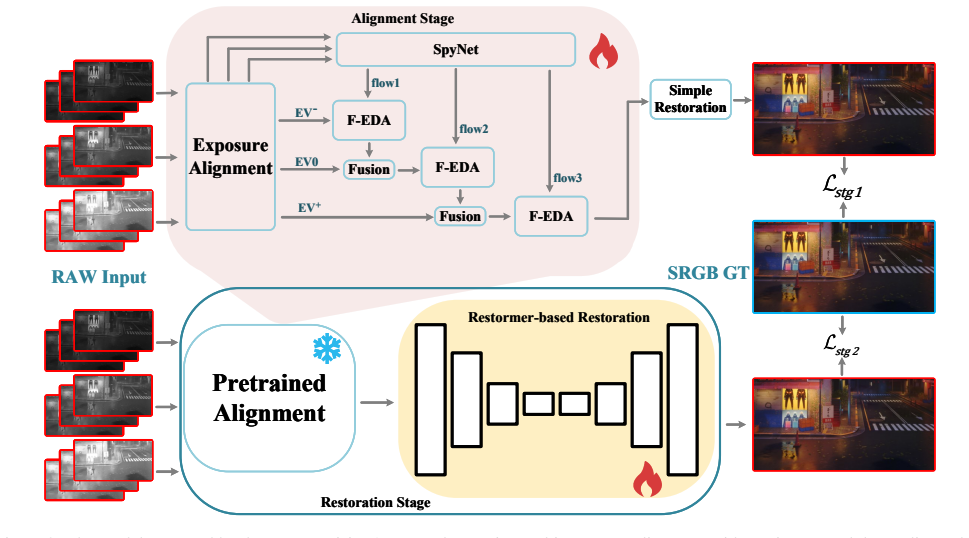
The load-bearing objects are the synthetic virtual imaging pipeline that creates the dataset and the align-then-restore model architecture shared by the leading submissions. The pipeline generates nine clean RAW frames at low, medium, and high exposure, synthesizes a ground-truth HDR RGB image, then adds mixed Gaussian–Poisson noise, rotation, translation, and motion blur so that the first frame stays aligned with the ground truth. The winning model's mechanism is a recursive Flow-based Enhanced Deformable Alignment module that works after statistically derived exposure alignment, followed by a frozen alignment stage and a separate restoration stage built on transformer blocks; this lets alignment be optimized without being perturbed by restoration losses.
What would settle it
Take a small set of real RAW bursts captured with known exposure times, run the same six submitted models on them, and compare PSNR against a high-quality reference; if the relative order or the size of the gaps changes materially, the synthetic benchmark does not predict on-device performance.
Extended reading notes
Core claim
The central claim is that efficient burst HDR and restoration can be benchmarked under realistic resource caps, and that current methods already reach high fidelity within them. The winning approach combines recursive flow-based enhanced deformable alignment with a two-stage training schedule that first learns multi-exposure alignment, freezes it, then learns restoration with transformer blocks; this decoupling is presented as the key to resolving the conflict between alignment and restoration. The paper reports that this model reached 43.22 dB PSNR and 0.992 SSIM on the hidden test set, while a second model reached 42.75 dB with fewer than half the parameters, and the fastest model ran in about 64 ms per image. The paper also observes that all competitive submissions followed an align-then-restore structure, suggesting that separating the two roles is currently the effective recipe for this task.
Load-bearing premise
The ranking transfers to real phones only if the synthetic virtual imaging pipeline's mixed noise, rotation, translation, and motion blur faithfully reproduce what a real camera burst produces; the paper does not validate this against real captured bursts, so that representativeness is the load-bearing premise.
Editorial extensions
If this is right
- The released 300-scene dataset becomes a reusable testbed for burst HDR fusion with fixed efficiency accounting, so future methods can be compared on identical data and identical FLOP and parameter budgets.
- Under the stated caps, the top PSNR of 43.22 dB indicates that efficient multi-frame HDR restoration is close to the quality of much larger unconstrained models, supporting on-device deployment.
- All six valid submissions shared an align-first, restore-second architecture, which the paper presents as evidence that decoupling alignment from restoration is currently the winning design.
- Efficiency trade-offs are real: the second-ranked model used less than half the winner's parameters at a 0.47 dB gap, and the fastest model ran in about 64 ms, so choosing a model depends on the deployment target.
- Because ranking used only PSNR, with SSIM as a reference, the paper notes that an alternative efficiency metric such as PSNR per second of runtime could have changed the rankings.
Reading between the lines
- If the synthetic degradations (mixed Poisson–Gaussian noise, small rotations, translations, motion blur) do not match real sensors, the reported ranking may not transfer to actual phones; the paper itself states no validation against real captured bursts, so a small real-burst test set would settle this.
- The two-stage freeze-alignment-then-restore training recipe is a transferable idea: the same decoupling could be applied to burst super-resolution, raw denoising, or video restoration whenever alignment error and restoration error compete.
- A PSNR-only metric rewards pixel-average fidelity and may undercount perceptual quality in dark and saturated regions; extending the benchmark with perceptual or task-based metrics would likely reorder the lower ranks even though the top PSNR may stay similar.
- Because FLOPs were computed with a fixed analyzer and runtime was not constrained, faster methods such as the 64 ms model are arguably more efficient in deployment terms; a composite score combining quality and runtime would make the challenge's efficiency claims more actionable.
Signed reviews
Editorial analysis
A structured set of objections, weighed in public.
Referee Report
Summary. This paper is the official report of the NTIRE 2025 Challenge on Efficient Burst HDR and Restoration. The organizers introduce a novel synthetic RAW multi-frame fusion dataset: 300 training scenes and 20 validation/test scenes, each containing nine noisy, misaligned, multi-exposure RAW frames plus a clean HDR RGB ground truth. Participants had to reconstruct the RGB image under strict efficiency constraints (under 30M parameters and 4T FLOPs). Six teams submitted valid solutions; the winning team, ImvisionAI, achieved a PSNR of 43.22 dB on the 20-scene test set. The paper describes the dataset, challenge rules, final ranking, qualitative results, and each participant method, and concludes that the approaches highlight a potential new state of the art in efficient multi-frame HDR fusion and restoration.
Significance. If the benchmark is accepted as a valid testbed, this paper provides a reusable dataset, a starting codebase, and a reproducible evaluation protocol for efficient burst HDR and restoration, which would be a useful community resource. The strengths are concrete: the dataset and code are publicly released; the organizers state that submitted code was verified; the challenge constraints are clearly defined; six diverse methods are described in enough detail to be reproduced; and the qualitative analysis includes failure cases. However, the central validity claim is not yet fully supported. The synthetic imaging pipeline is described only qualitatively, with no validation against real mobile-camera bursts, no baseline result from the provided starting kit, and a test set of only 20 scenes with no variance information. These issues affect the interpretation of the ranking and the 'potential new state-of-the-art' conclusion. The paper is therefore a promising challenge report whose benchmark-validity claims need strengthening.
major comments (4)
- [Sec. 2.2, Sec. 2.1, Sec. 5.2] The claim that the challenge 'simulates real-world mobile photography scenarios' (Sec. 2.1) rests on the synthetic pipeline described qualitatively in Sec. 2.2, but no quantitative validation is provided: there is no comparison of the synthesized noise, blur, or misalignment statistics against real mobile-camera bursts, no held-out real-capture test set, and no baseline result from the provided starting kit. The paper's own conclusion (Sec. 5.2) lists missing ISP effects (bad pixel correction, fixed-pattern noise, lens shading) that are relevant to real sensors. Because the ranking and the 'potential new state-of-the-art' conclusion depend on the synthetic data being representative, the manuscript should provide either a real-capture validation subset, a statistical comparison of degradation parameters to a real sensor, or at least an explicit analysis of the expected domain gap. Without this, the benchmark's transferability to real devices is not established.
- [Table 1, Sec. 2.2, Sec. 2.4] The final ranking is based on average PSNR over only 20 test scenes, and Table 1 reports point estimates with no per-scene results, standard deviations, or confidence intervals. The 0.47 dB gap between first and second place may be within the noise for a 20-scene test set. The paper should include per-scene score distributions, a paired significance test (e.g., paired t-test or Wilcoxon signed-rank), or error bars to support the ranking claims. Additionally, no starting-kit baseline is reported, so the reader cannot determine how much of the absolute PSNR values (43.22 dB) reflects the proposed methods versus the intrinsic difficulty of the synthetic task.
- [Sec. 2.3.1] The PSNR evaluation is described as measured 'after conversion to 8-bit format,' but the conversion procedure (tone mapping, clipping, gamma, or normalization) is not specified. Since the final scores and rankings are the paper's headline results, the exact 8-bit conversion must be documented or provided in code so that future work can reproduce the metric. The same applies to the SSIM computation in grayscale; please state whether the metric is computed per image and then averaged, and over which value range.
- [Sec. 2.2] The dataset generation pipeline is described only qualitatively (mixed Gaussian-Poisson noise, rotation, translation, motion blur), with no numerical specification of the noise parameters, blur kernel sizes, or misalignment ranges. This prevents independent recreation of the dataset and makes it difficult to assess whether the degradations are in a realistic range. Please report the actual parameter settings used in the virtual imaging pipeline, or point to a public generation script that defines them uniquely.
minor comments (7)
- [Sec. 4.5, Eq. (1)] The text states that 'all distances in (1) were calculated using the L1 norm,' but the equation writes ||x−x̂||^2 and ||∇x−∇x̂||^2, which normally denote squared L2 terms. Please align the notation with the text, or clarify that the superscript 2 indicates a squared L1 distance.
- [Sec. 4.1] The sentence 'The team used AdamW optimizer (α=0.9 and β=0.9)' appears to misname the hyperparameters; AdamW uses betas (β1, β2), not α and β. Please correct.
- [Sec. 5.1 and ref. [36]] Reference [36] (TMRnet) is cited as an optical-flow method, but TMRnet is a temporal memory relation network for surgical workflow recognition; please verify that this is the intended reference and that the name matches the cited method.
- [Sec. 2.2] The phrase 'nine clean RAW frames with various exposure levels are captured' should read 'synthesized' or 'generated,' since the dataset is produced by a virtual imaging pipeline rather than physical capture.
- [Sec. 2.3.1] Please specify explicitly that PSNR is averaged over the 20 test images, rather than computed on a concatenated image, and state the 8-bit value range used in the computation.
- [Sec. 4.3] The text refers to the 'GRBG filter size of the raw Bayer inputs'; please verify whether the correct Bayer pattern is RGGB or GRBG, and use consistent terminology throughout.
- [Fig. 2] The second row of Figure 2 is labeled 'input reference frame,' but the figure does not specify which of the nine input frames is the reference; please add a label or caption note identifying the reference frame.
Circularity Check
No circularity: the dataset PSNR ranking is measured on a held-out test set with hidden ground truth and independently verified code.
full rationale
This paper is a challenge report rather than a derivation chain, so the circularity patterns (self-definition, fitted input called prediction, uniqueness imported from authors, ansatz smuggled via citation, renaming) do not apply. The load-bearing claim is that the NTIRE 2025 Efficient Burst HDR and Restoration Challenge provides a valid benchmark and that the winning method reaches 43.22 dB PSNR. That claim is supported by an evaluation procedure in which the ground-truth images for the validation and test sets are kept hidden from participants: Sec. 2.2 states 'the GT images in these sets hidden from participants,' and Sec. 2.4 states that in the testing phase 'GT images remaining undisclosed' while 'The organizers verify and execute the provided code to verify the final results.' The reported PSNR is therefore a measured outcome on a held-out test set, not a fitted parameter renamed as a prediction. The only self-references are incidental: reference [42] cites this same challenge report in the list of NTIRE 2025 challenges, and participant teams cite their own method papers (e.g., [69], [24]); none of these carries a load-bearing argument or substitutes for the measured results. The concern that the synthetic virtual imaging pipeline of Sec. 2.2 may not transfer to real mobile capture is a real external-validity risk, and Sec. 5.2 itself concedes missing degradations such as bad-pixel correction, fixed-pattern noise, and lens shading; however, this is a question of benchmark realism, not circularity, because the ranking is internally consistent and independently evaluated on the stated test set.
Assumptions & free parameters
free parameters (2)
- Dataset synthesis degradation parameters (Gaussian/Poisson noise levels, motion blur kernels, rotation/translation… =
not disclosed
- Competition constraints (30M parameters, 4T FLOPs) =
30,000,000; 4.0e12
assumptions (3)
- domain assumption PSNR on the 20-scene test set is a sufficient proxy for image quality and ranking.
- domain assumption The synthetic degradation pipeline faithfully reproduces real-world burst HDR RAW capture.
- domain assumption fvcore FlopCountAnalysis provides an accurate measure of computational cost at 768x1536 output resolution.
Cite this review
Pith. "Pith review of NTIRE 2025 Challenge on Efficient Burst HDR and Restoration: Datasets, Methods, and Results." pith.science (2026). https://pith.science/paper/4DCMRON2
@misc{pith2026250512089,
  author       = {Pith},
  title        = {Pith review of: NTIRE 2025 Challenge on Efficient Burst HDR and Restoration: Datasets, Methods, and Results},
  year         = {2026},
  howpublished = {\url{https://pith.science/paper/4DCMRON2}},
  note         = {Machine review of arXiv:2505.12089}
}
read the original abstract
This paper reviews the NTIRE 2025 Efficient Burst HDR and Restoration Challenge, which aims to advance efficient multi-frame high dynamic range (HDR) and restoration techniques. The challenge is based on a novel RAW multi-frame fusion dataset, comprising nine noisy and misaligned RAW frames with various exposure levels per scene. Participants were tasked with developing solutions capable of effectively fusing these frames while adhering to strict efficiency constraints: fewer than 30 million model parameters and a computational budget under 4.0 trillion FLOPs. A total of 217 participants registered, with six teams finally submitting valid solutions. The top-performing approach achieved a PSNR of 43.22 dB, showcasing the potential of novel methods in this domain. This paper provides a comprehensive overview of the challenge, compares the proposed solutions, and serves as a valuable reference for researchers and practitioners in efficient burst HDR and restoration.
Figures


Figures from the paper (5 more)


Reference graph
Works this paper leans on
-
[1]
Ntire 2020 challenge on real image denoising: Dataset, methods and results
Abdelrahman Abdelhamed, Mahmoud Afifi, Radu Timofte, and Michael S Brown. Ntire 2020 challenge on real image denoising: Dataset, methods and results. InCVPR Work- shops, 2020. 1
2020
-
[2]
Ntire 2021 challenge on burst super-resolution: Methods and re- sults
Goutam Bhat, Martin Danelljan, and Radu Timofte. Ntire 2021 challenge on burst super-resolution: Methods and re- sults. InProceedings of the IEEE/CVF Conference on Computer Vision and Pattern Recognition, pages 613–626,
2021
-
[3]
Deep burst super-resolution
Goutam Bhat, Martin Danelljan, Luc Van Gool, and Radu Timofte. Deep burst super-resolution. InProceedings of the IEEE/CVF conference on computer vision and pattern recognition, pages 9209–9218, 2021. 1, 2
2021
-
[4]
Ntire 2022 burst super-resolution challenge
Goutam Bhat, Martin Danelljan, Radu Timofte, Yizhen Cao, Yuntian Cao, Meiya Chen, Xihao Chen, Shen Cheng, Akshay Dudhane, Haoqiang Fan, et al. Ntire 2022 burst super-resolution challenge. InProceedings of the IEEE/CVF conference on computer vision and pattern recognition, pages 1041–1061, 2022. 2, 3
2022
-
[5]
Self-supervised burst super- resolution
Goutam Bhat, Micha ¨el Gharbi, Jiawen Chen, Luc Van Gool, and Zhihao Xia. Self-supervised burst super- resolution. InProceedings of the IEEE/CVF international conference on computer vision, pages 10605–10614, 2023. 2
2023
-
[6]
Unprocessing im- ages for learned raw denoising
Tim Brooks, Ben Mildenhall, Tianfan Xue, Jiawen Chen, Dillon Sharlet, and Jonathan T Barron. Unprocessing im- ages for learned raw denoising. InCVPR, 2019. 1
2019
-
[7]
Bracketing image restoration and enhancement with high-low frequency decomposition
Genggeng Chen, Kexin Dai, Kangzhen Yang, Tao Hu, Xi- angyu Chen, Yongqing Yang, Wei Dong, Peng Wu, Yanning Zhang, and Qingsen Yan. Bracketing image restoration and enhancement with high-low frequency decomposition. In Proceedings of the IEEE/CVF Conference on Computer Vi- sion and Pattern Recognition, pages 6097–6107, 2024. 1
2024
-
[8]
Learning continuous exposure value representations for single-image hdr reconstruction
Su-Kai Chen, Hung-Lin Yen, Yu-Lun Liu, Min-Hung Chen, Hou-Ning Hu, Wen-Hsiao Peng, and Yen-Yu Lin. Learning continuous exposure value representations for single-image hdr reconstruction. InICCV, 2023. 1
2023
Show all 113 references
-
[9]
Ntire 2024 challenge on image super-resolution (x4): Methods and results
Zheng Chen, Zongwei Wu, Eduard Zamfir, Kai Zhang, Yu- lun Zhang, Radu Timofte, Xiaokang Yang, Hongyuan Yu, Cheng Wan, Yuxin Hong, et al. Ntire 2024 challenge on image super-resolution (x4): Methods and results. InPro- ceedings of the IEEE/CVF Conference on Computer Vision and ...
2024
-
[10]
NTIRE 2025 challenge on image super-resolution (×4): Methods and results
Zheng Chen, Kai Liu, Jue Gong, Jingkai Wang, Lei Sun, Zongwei Wu, Radu Timofte, Yulun Zhang, et al. NTIRE 2025 challenge on image super-resolution (×4): Methods and results. InProceedings of the IEEE/CVF Conference on Computer Vision and Pattern Recognition (CVPR) Work- shops, 2025. 2
2025
-
[11]
NTIRE 2025 challenge on real-world face restoration: Methods and results
Zheng Chen, Jingkai Wang, Kai Liu, Jue Gong, Lei Sun, Zongwei Wu, Radu Timofte, Yulun Zhang, et al. NTIRE 2025 challenge on real-world face restoration: Methods and results. InProceedings of the IEEE/CVF Conference on Computer Vision and Pattern Recognition (CVPR) Work- shops, 2025. 2
2025
-
[12]
Rethinking coarse-to-fine approach in single image deblurring
Sung-Jin Cho, Seo-Won Ji, Jun-Pyo Hong, Seung-Won Jung, and Sung-Jea Ko. Rethinking coarse-to-fine approach in single image deblurring. InICCV, 2021. 1
2021
-
[13]
Improving image restoration by revisiting global informa- tion aggregation
Xiaojie Chu, Liangyu Chen, Chengpeng Chen, and Xin Lu. Improving image restoration by revisiting global informa- tion aggregation. InECCV, pages 53–71. Springer, 2022. 6, 7
2022
-
[14]
NTIRE 2025 challenge on raw image restoration and super-resolution
Marcos Conde, Radu Timofte, et al. NTIRE 2025 challenge on raw image restoration and super-resolution. InProceed- ings of the IEEE/CVF Conference on Computer Vision and Pattern Recognition (CVPR) Workshops, 2025. 2
2025
-
[15]
Raw image reconstruc- tion from RGB on smartphones
Marcos Conde, Radu Timofte, et al. Raw image reconstruc- tion from RGB on smartphones. NTIRE 2025 challenge re- port. InProceedings of the IEEE/CVF Conference on Com- puter Vision and Pattern Recognition (CVPR) Workshops,
2025
-
[16]
Efficient deep models for real-time 4k image super-resolution
Marcos V Conde, Eduard Zamfir, Radu Timofte, Daniel Motilla, Cen Liu, Zexin Zhang, Yunbo Peng, Yue Lin, Ji- aming Guo, Xueyi Zou, et al. Efficient deep models for real-time 4k image super-resolution. ntire 2023 benchmark and report. InProceedings of the IEEE/CVF conference on ...
2023
-
[17]
Deformable convolu- tional networks
Jifeng Dai, Haozhi Qi, Yuwen Xiong, Yi Li, Guodong Zhang, Han Hu, and Yichen Wei. Deformable convolu- tional networks. InProceedings of the IEEE international conference on computer vision, pages 764–773, 2017. 10
2017
-
[18]
Learnable global spatio-temporal adaptive aggregation for bracketing im- age restoration and enhancement
Xinwei Dai, Yuanbo Zhou, Xintao Qiu, Hui Tang, Wei Deng, Qinquan Gao, and Tong Tong. Learnable global spatio-temporal adaptive aggregation for bracketing im- age restoration and enhancement. InProceedings of the IEEE/CVF conference on computer vision and pattern recognition, p...
2024
-
[19]
Highres-net: Recursive fusion for multi-frame super-resolution of satellite imagery.arXiv preprint arXiv:2002.06460, 2020
Michel Deudon, Alfredo Kalaitzis, Israel Goytom, Md Ri- fat Arefin, Zhichao Lin, Kris Sankaran, Vincent Michal- ski, Samira E Kahou, Julien Cornebise, and Yoshua Bengio. Highres-net: Recursive fusion for multi-frame super-resolution of satellite imagery.arXiv preprint arXiv:20...
2002 arXiv
-
[20]
Burst image restoration and enhancement
Akshay Dudhane, Syed Waqas Zamir, Salman Khan, Fa- had Shahbaz Khan, and Ming-Hsuan Yang. Burst image restoration and enhancement. InProceedings of the ieee/cvf Conference on Computer Vision and Pattern Recognition, pages 5759–5768, 2022. 1, 2
2022
-
[21]
Burstormer: Burst image restoration and enhancement transformer
Akshay Dudhane, Syed Waqas Zamir, Salman Khan, Fa- had Shahbaz Khan, and Ming-Hsuan Yang. Burstormer: Burst image restoration and enhancement transformer. In 2023 IEEE/CVF Conference on Computer Vision and Pat- tern Recognition (CVPR), pages 5703–5712. IEEE, 2023. 1, 2
2023
-
[22]
Hdr image reconstruction from a single exposure using deep cnns.ACM TOG, 2017
Gabriel Eilertsen, Joel Kronander, Gyorgy Denes, Rafał K Mantiuk, and Jonas Unger. Hdr image reconstruction from a single exposure using deep cnns.ACM TOG, 2017. 1
2017
-
[23]
NTIRE 2025 challenge on night photography rendering
Egor Ershov, Sergey Korchagin, Alexei Khalin, Artyom Panshin, Arseniy Terekhin, Ekaterina Zaychenkova, Georgiy Lobarev, Vsevolod Plokhotnyuk, Denis Abramov, Elisey Zhdanov, Sofia Dorogova, Yasin Mamedov, Nikola Banic, Georgii Perevozchikov, Radu Timofte, et al. NTIRE 2025 chal...
2025
-
[24]
Darkir: Robust low-light image restoration.arXiv preprint arXiv:2412.13443, 2024
Daniel Feijoo, Juan C Benito, Alvaro Garcia, and Marcos V Conde. Darkir: Robust low-light image restoration.arXiv preprint arXiv:2412.13443, 2024. 8
2024
-
[25]
NTIRE 2025 challenge on cross-domain few-shot object detection: Methods and results
Yuqian Fu, Xingyu Qiu, Bin Ren Yanwei Fu, Radu Timofte, Nicu Sebe, Ming-Hsuan Yang, Luc Van Gool, et al. NTIRE 2025 challenge on cross-domain few-shot object detection: Methods and results. InProceedings of the IEEE/CVF Conference on Computer Vision and Pattern Recognition (CV...
2025
-
[26]
Deep burst denoising
Cl ´ement Godard, Kevin Matzen, and Matt Uyttendaele. Deep burst denoising. InProceedings of the European con- ference on computer vision (ECCV), pages 538–554, 2018. 1
2018
-
[27]
Toward convolutional blind denoising of real pho- tographs
Shi Guo, Zifei Yan, Kai Zhang, Wangmeng Zuo, and Lei Zhang. Toward convolutional blind denoising of real pho- tographs. InCVPR, 2019. 1
2019
-
[28]
A differentiable two-stage alignment scheme for burst im- age reconstruction with large shift
Shi Guo, Xi Yang, Jianqi Ma, Gaofeng Ren, and Lei Zhang. A differentiable two-stage alignment scheme for burst im- age reconstruction with large shift. InProceedings of the IEEE/CVF Conference on Computer Vision and Pattern Recognition, pages 17472–17481, 2022. 1
2022
-
[29]
NTIRE 2025 challenge on text to image generation model qual- ity assessment
Shuhao Han, Haotian Fan, Fangyuan Kong, Wenjie Liao, Chunle Guo, Chongyi Li, Radu Timofte, et al. NTIRE 2025 challenge on text to image generation model qual- ity assessment. InProceedings of the IEEE/CVF Confer- ence on Computer Vision and Pattern Recognition (CVPR) Workshops...
2025
-
[30]
Burst photography for high dynamic range and low-light imaging on mobile cameras.ACM Transac- tions on Graphics (ToG), 35(6):1–12, 2016
Samuel W Hasinoff, Dillon Sharlet, Ryan Geiss, Andrew Adams, Jonathan T Barron, Florian Kainz, Jiawen Chen, and Marc Levoy. Burst photography for high dynamic range and low-light imaging on mobile cameras.ACM Transac- tions on Graphics (ToG), 35(6):1–12, 2016. 1
2016
-
[31]
Drct: Saving image super-resolution away from informa- tion bottleneck
Chih-Chung Hsu, Chia-Ming Lee, and Yi-Shiuan Chou. Drct: Saving image super-resolution away from informa- tion bottleneck. InProceedings of the IEEE/CVF Confer- ence on Computer Vision and Pattern Recognition, pages 6133–6142, 2024. 7
2024
-
[32]
Scope of va- lidity of psnr in image/video quality assessment.Electron- ics letters, 44(13):800–801, 2008
Quan Huynh-Thu and Mohammed Ghanbari. Scope of va- lidity of psnr in image/video quality assessment.Electron- ics letters, 44(13):800–801, 2008. 3
2008
-
[33]
Learned smartphone isp on mobile gpus with deep learning, mobile ai & aim 2022 challenge: report
Andrey Ignatov, Radu Timofte, Shuai Liu, Chaoyu Feng, Furui Bai, Xiaotao Wang, Lei Lei, Ziyao Yi, Yan Xiang, Zibin Liu, et al. Learned smartphone isp on mobile gpus with deep learning, mobile ai & aim 2022 challenge: report. InEuropean Conference on Computer Vision, pages 44–7...
2022
-
[34]
NTIRE 2025 challenge on video quality enhancement for video conferencing: Datasets, methods and results
Varun Jain, Zongwei Wu, Quan Zou, Louis Florentin, Henrik Turbell, Sandeep Siddhartha, Radu Timofte, et al. NTIRE 2025 challenge on video quality enhancement for video conferencing: Datasets, methods and results. InPro- ceedings of the IEEE/CVF Conference on Computer Vision an...
2025
-
[35]
When fast fourier transform meets transformer for image restoration
Xingyu Jiang, Xiuhui Zhang, Ning Gao, and Yue Deng. When fast fourier transform meets transformer for image restoration. InComputer Vision – ECCV 2024, pages 381– 402, Cham, 2025. Springer Nature Switzerland. 8
2024
-
[36]
Temporal memory relation net- work for workflow recognition from surgical video.IEEE Transactions on Medical Imaging, 40(7):1911–1923, 2021
Yueming Jin, Yonghao Long, Cheng Chen, Zixu Zhao, Qi Dou, and Pheng-Ann Heng. Temporal memory relation net- work for workflow recognition from surgical video.IEEE Transactions on Medical Imaging, 40(7):1911–1923, 2021. 10
1911
-
[37]
Burstm: Deep burst multi-scale sr using fourier space with optical flow
EungGu Kang, Byeonghun Lee, Sunghoon Im, and Ky- ong Hwan Jin. Burstm: Deep burst multi-scale sr using fourier space with optical flow. InEuropean Conference on Computer Vision, pages 459–477. Springer, 2024. 1, 2
2024
-
[38]
Noise distribution adaptive self-supervised image denoising using tweedie distribution and score matching
Kwanyoung Kim, Taesung Kwon, and Jong Chul Ye. Noise distribution adaptive self-supervised image denoising using tweedie distribution and score matching. InProceedings of the IEEE/CVF Conference on Computer Vision and Pattern Recognition, pages 2008–2016, 2022. 10
2008
-
[39]
High dynamic range and super-resolution from raw image bursts.arXiv preprint arXiv:2207.14671, 2022
Bruno Lecouat, Thomas Eboli, Jean Ponce, and Julien Mairal. High dynamic range and super-resolution from raw image bursts.arXiv preprint arXiv:2207.14671, 2022. 1
2022 arXiv
-
[40]
Photo-realistic single image super-resolution using a generative adversarial network
Christian Ledig, Lucas Theis, Ferenc Husz ´ar, Jose Ca- ballero, Andrew Cunningham, Alejandro Acosta, Andrew Aitken, et al. Photo-realistic single image super-resolution using a generative adversarial network. InCVPR, 2017. 1
2017
-
[41]
Deep recursive hdri: Inverse tone mapping using generative ad- versarial networks
Siyeong Lee, Gwon Hwan An, and Suk-Ju Kang. Deep recursive hdri: Inverse tone mapping using generative ad- versarial networks. InECCV, 2018. 1
2018
-
[42]
NTIRE 2025 challenge on efficient burst hdr and restoration: Datasets, methods, and results
Sangmin Lee, Eunpil Park, Angel Canelo, Hyunhee Park, Youngjo Kim, Hyungju Chun, Xin Jin, Chongyi Li, Chun- Le Guo, Radu Timofte, et al. NTIRE 2025 challenge on efficient burst hdr and restoration: Datasets, methods, and results. InProceedings of the IEEE/CVF Conference on Com...
2025
-
[43]
Efficient burst raw de- noising with variance stabilization and multi-frequency de- noising network.International Journal of Computer Vision, 130(8):2060–2080, 2022
Dasong Li, Yi Zhang, Ka Lung Law, Xiaogang Wang, Hongwei Qin, and Hongsheng Li. Efficient burst raw de- noising with variance stabilization and multi-frequency de- noising network.International Journal of Computer Vision, 130(8):2060–2080, 2022. 1
2022
-
[44]
NTIRE 2025 challenge on day and night raindrop removal for dual-focused images: Methods and results
Xin Li, Yeying Jin, Xin Jin, Zongwei Wu, Bingchen Li, Yufei Wang, Wenhan Yang, Yu Li, Zhibo Chen, Bihan Wen, Robby Tan, Radu Timofte, et al. NTIRE 2025 challenge on day and night raindrop removal for dual-focused images: Methods and results. InProceedings of the IEEE/CVF Confe...
2025
-
[45]
NTIRE 2025 challenge on short-form ugc video quality assessment and enhancement: Kwaisr dataset and study
Xin Li, Xijun Wang, Bingchen Li, Kun Yuan, Yizhen Shao, Suhang Yao, Ming Sun, Chao Zhou, Radu Timofte, and Zhibo Chen. NTIRE 2025 challenge on short-form ugc video quality assessment and enhancement: Kwaisr dataset and study. InProceedings of the IEEE/CVF Conference on Compute...
2025
-
[46]
NTIRE 2025 challenge on short-form ugc video qual- ity assessment and enhancement: Methods and results
Xin Li, Kun Yuan, Bingchen Li, Fengbin Guan, Yizhen Shao, Zihao Yu, Xijun Wang, Yiting Lu, Wei Luo, Suhang Yao, Ming Sun, Chao Zhou, Zhibo Chen, Radu Timofte, et al. NTIRE 2025 challenge on short-form ugc video qual- ity assessment and enhancement: Methods and results. In Proc...
2025
-
[47]
Ntire 2023 challenge on image denois- ing: Methods and results
Yawei Li, Yulun Zhang, Radu Timofte, Luc Van Gool, Zhi- jun Tu, Kunpeng Du, Hailing Wang, Hanting Chen, Wei Li, Xiaofei Wang, et al. Ntire 2023 challenge on image denois- ing: Methods and results. InProceedings of the IEEE/CVF Conference on Computer Vision and Pattern Recognit...
2023
-
[48]
Swinir: Image restoration using swin transformer
Jingyun Liang, Jiezhang Cao, Guolei Sun, Kai Zhang, Luc Van Gool, and Radu Timofte. Swinir: Image restoration using swin transformer. InICCV, 2021. 1
2021
-
[49]
NTIRE 2025 the 2nd restore any image model (RAIM) in the wild challenge
Jie Liang, Radu Timofte, Qiaosi Yi, Zhengqiang Zhang, Shuaizheng Liu, Lingchen Sun, Rongyuan Wu, Xindong Zhang, Hui Zeng, Lei Zhang, et al. NTIRE 2025 the 2nd restore any image model (RAIM) in the wild challenge. In Proceedings of the IEEE/CVF Conference on Computer Vi- sion a...
2025
-
[50]
Enhanced deep residual networks for sin- gle image super-resolution
Bee Lim, Sanghyun Son, Heewon Kim, Seungjun Nah, and Kyoung Mu Lee. Enhanced deep residual networks for sin- gle image super-resolution. InCVPR Workshops, 2017. 1
2017
-
[51]
Improving image restoration through removing degradations in textual repre- sentations.arXiv preprint arXiv:2312.17334, 2023
Jingbo Lin, Zhilu Zhang, Yuxiang Wei, Dongwei Ren, Dongsheng Jiang, and Wangmeng Zuo. Improving image restoration through removing degradations in textual repre- sentations.arXiv preprint arXiv:2312.17334, 2023. 1
2023 arXiv
-
[52]
Improving bracket im- age restoration and enhancement with flow-guided align- ment and enhanced feature aggregation.arXiv preprint arXiv:2404.10358, 2024
Wenjie Lin, Zhen Liu, Chengzhi Jiang, Mingyan Han, Ting Jiang, and Shuaicheng Liu. Improving bracket im- age restoration and enhancement with flow-guided align- ment and enhanced feature aggregation.arXiv preprint arXiv:2404.10358, 2024. 1
2024 arXiv
-
[53]
Learning raw image denoising with bayer pattern unification and bayer preserving aug- mentation
Jiaming Liu, Chi-Hao Wu, Yuzhi Wang, Qin Xu, Yuqian Zhou, Haibin Huang, Chuan Wang, Shaofan Cai, Yifan Ding, Haoqiang Fan, et al. Learning raw image denoising with bayer pattern unification and bayer preserving aug- mentation. InProceedings of the IEEE/CVF Conference on Comput...
2019
-
[54]
Deep adaptive inference networks for single image super-resolution
Ming Liu, Zhilu Zhang, Liya Hou, Wangmeng Zuo, and Lei Zhang. Deep adaptive inference networks for single image super-resolution. InECCV Workshops, 2020. 1
2020
-
[55]
NTIRE 2025 XGC quality assessment challenge: Methods and results
Xiaohong Liu, Xiongkuo Min, Qiang Hu, Xiaoyun Zhang, Jie Guo, et al. NTIRE 2025 XGC quality assessment challenge: Methods and results. InProceedings of the IEEE/CVF Conference on Computer Vision and Pattern Recognition (CVPR) Workshops, 2025. 2
2025
-
[56]
NTIRE 2025 challenge on low light image enhancement: Methods and results
Xiaoning Liu, Zongwei Wu, Florin-Alexandru Vasluianu, Hailong Yan, Bin Ren, Yulun Zhang, Shuhang Gu, Le Zhang, Ce Zhu, Radu Timofte, et al. NTIRE 2025 challenge on low light image enhancement: Methods and results. In Proceedings of the IEEE/CVF Conference on Computer Vi- sion ...
2025
-
[57]
Single-image hdr reconstruction by learning to re- verse the camera pipeline
Yu-Lun Liu, Wei-Sheng Lai, Yu-Sheng Chen, Yi-Lung Kao, Ming-Hsuan Yang, Yung-Yu Chuang, and Jia-Bin Huang. Single-image hdr reconstruction by learning to re- verse the camera pipeline. InCVPR, 2020. 1
2020
-
[58]
A convnet for the 2020s
Zhuang Liu, Hanzi Mao, Chao-Yuan Wu, Christoph Fe- ichtenhofer, Trevor Darrell, and Saining Xie. A convnet for the 2020s. InProceedings of the IEEE/CVF conference on computer vision and pattern recognition, pages 11976– 11986, 2022. 7
2022
-
[59]
Sgdr: Stochastic gradient descent with warm restarts
Ilya Loshchilov and Frank Hutter. Sgdr: Stochastic gradient descent with warm restarts. InInternational Conference on Learning Representations, 2022. 6, 8, 9
2022
-
[60]
Ebsr: Fea- ture enhanced burst super-resolution with deformable align- ment
Ziwei Luo, Lei Yu, Xuan Mo, Youwei Li, Lanpeng Jia, Haoqiang Fan, Jian Sun, and Shuaicheng Liu. Ebsr: Fea- ture enhanced burst super-resolution with deformable align- ment. InProceedings of the IEEE/CVF Conference on Computer Vision and Pattern Recognition, pages 471–478,
-
[61]
Bsrt: Improving burst super-resolution with swin trans- former and flow-guided deformable alignment
Ziwei Luo, Youwei Li, Shen Cheng, Lei Yu, Qi Wu, Zhi- hong Wen, Haoqiang Fan, Jian Sun, and Shuaicheng Liu. Bsrt: Improving burst super-resolution with swin trans- former and flow-guided deformable alignment. InProceed- ings of the IEEE/CVF Conference on Computer Vision and Pa...
2022
-
[62]
Intriguing findings of frequency selection for image deblurring
Xintian Mao, Yiming Liu, Fengze Liu, Qingli Li, Wei Shen, and Yan Wang. Intriguing findings of frequency selection for image deblurring. InAAAI, 2023. 1
2023
-
[63]
Burst denois- ing with kernel prediction networks
Ben Mildenhall, Jonathan T Barron, Jiawen Chen, Dil- lon Sharlet, Ren Ng, and Robert Carroll. Burst denois- ing with kernel prediction networks. InProceedings of the IEEE conference on computer vision and pattern recogni- tion, pages 2502–2510, 2018. 1
2018
-
[64]
An analy- sis and implementation of the hdr+ burst denoising method
Antoine Monod, Julie Delon, and Thomas Veit. An analy- sis and implementation of the hdr+ burst denoising method. Image Processing On Line, 11:142–169, 2021. 1
2021
-
[65]
Deep multi-scale convolutional neural network for dynamic scene deblurring
Seungjun Nah, Tae Hyun Kim, and Kyoung Mu Lee. Deep multi-scale convolutional neural network for dynamic scene deblurring. InCVPR, 2017. 1
2017
-
[66]
Swiftbrush: One- step text-to-image diffusion model with variational score distillation
Thuan Hoang Nguyen and Anh Tran. Swiftbrush: One- step text-to-image diffusion model with variational score distillation. InProceedings of the IEEE/CVF Conference on Computer Vision and Pattern Recognition, pages 7807– 7816, 2024. 10
2024
-
[67]
Nan: Noise-aware nerfs for burst-denoising
Naama Pearl, Tali Treibitz, and Simon Korman. Nan: Noise-aware nerfs for burst-denoising. InProceedings of the IEEE/CVF Conference on Computer Vision and Pattern Recognition, pages 12672–12681, 2022. 2
2022
-
[68]
Ntire 2021 challenge on high dynamic range imaging: Dataset, methods and results
Eduardo P ´erez-Pellitero, Sibi Catley-Chandar, Ales Leonardis, and Radu Timofte. Ntire 2021 challenge on high dynamic range imaging: Dataset, methods and results. InCVPR Workshops, 2021. 1
2021
-
[69]
Recursive multi- exposure alignment with spatiotemporal decoupling for ef- ficient burst hdr and restoration
Tianheng Qiu, Qi Wu, Yuchun Dong, Shenglin Ding, Guanghua Pan, Xuan Huang, and Hu Wei. Recursive multi- exposure alignment with spatiotemporal decoupling for ef- ficient burst hdr and restoration. InCVPR Workshops, 2025. 5
2025
-
[70]
Optical flow estima- tion using a spatial pyramid network
Anurag Ranjan and Michael J Black. Optical flow estima- tion using a spatial pyramid network. InProceedings of the IEEE conference on computer vision and pattern recogni- tion, pages 4161–4170, 2017. 5, 6, 10
2017
-
[71]
The ninth ntire 2024 efficient super-resolution challenge report
Bin Ren, Yawei Li, Nancy Mehta, Radu Timofte, Hongyuan Yu, Cheng Wan, Yuxin Hong, Bingnan Han, Zhuoyuan Wu, Yajun Zou, et al. The ninth ntire 2024 efficient super-resolution challenge report. InProceedings of the IEEE/CVF Conference on Computer Vision and Pattern Recognition, ...
2024
-
[72]
The tenth NTIRE 2025 efficient super-resolution challenge report
Bin Ren, Hang Guo, Lei Sun, Zongwei Wu, Radu Tim- ofte, Yawei Li, et al. The tenth NTIRE 2025 efficient super-resolution challenge report. InProceedings of the IEEE/CVF Conference on Computer Vision and Pattern Recognition (CVPR) Workshops, 2025. 2
2025
-
[73]
Burst denoising via temporally shifted wavelet transforms
Xuejian Rong, Denis Demandolx, Kevin Matzen, Priyam Chatterjee, and Yingli Tian. Burst denoising via temporally shifted wavelet transforms. InComputer Vision–ECCV 2020: 16th European Conference, Glasgow, UK, August 23–28, 2020, Proceedings, Part XIII 16, pages 240–256. Springe...
2020
-
[74]
U- net: Convolutional networks for biomedical image segmen- tation
Olaf Ronneberger, Philipp Fischer, and Thomas Brox. U- net: Convolutional networks for biomedical image segmen- tation. InMedical image computing and computer-assisted intervention–MICCAI 2015: 18th international conference, Munich, Germany, October 5-9, 2015, proceedings, par...
2015
-
[75]
NTIRE 2025 challenge on UGC video enhancement: Meth- ods and results
Nickolay Safonov, Alexey Bryntsev, Andrey Moskalenko, Dmitry Kulikov, Dmitriy Vatolin, Radu Timofte, et al. NTIRE 2025 challenge on UGC video enhancement: Meth- ods and results. InProceedings of the IEEE/CVF Confer- ence on Computer Vision and Pattern Recognition (CVPR) Worksh...
2025
-
[76]
Generative modeling by estimating gradients of the data distribution.Advances in neural information processing systems, 32, 2019
Yang Song and Stefano Ermon. Generative modeling by estimating gradients of the data distribution.Advances in neural information processing systems, 32, 2019. 10
2019
-
[77]
NTIRE 2025 challenge on event-based image deblurring: Methods and results
Lei Sun, Andrea Alfarano, Peiqi Duan, Shaolin Su, Kaiwei Wang, Boxin Shi, Radu Timofte, Danda Pani Paudel, Luc Van Gool, et al. NTIRE 2025 challenge on event-based image deblurring: Methods and results. InProceedings of the IEEE/CVF Conference on Computer Vision and Pattern Re...
2025
-
[78]
The tenth ntire 2025 image denoising challenge report
Lei Sun, Hang Guo, Bin Ren, Luc Van Gool, Radu Timo- fte, Yawei Li, et al. The tenth ntire 2025 image denoising challenge report. InProceedings of the IEEE/CVF Confer- ence on Computer Vision and Pattern Recognition (CVPR) Workshops, 2025. 2
2025
-
[79]
Ef- ficient view synthesis and 3d-based multi-frame denoising with multiplane feature representations
Thomas Tanay, Ale ˇs Leonardis, and Matteo Maggioni. Ef- ficient view synthesis and 3d-based multi-frame denoising with multiplane feature representations. InProceedings of the IEEE/CVF Conference on Computer Vision and Pattern Recognition, pages 20898–20907, 2023. 2
2023
-
[80]
Scale-recurrent network for deep image deblurring
Xin Tao, Hongyun Gao, Xiaoyong Shen, Jue Wang, and Ji- aya Jia. Scale-recurrent network for deep image deblurring. InCVPR, 2018. 1
2018
-
[81]
NTIRE 2025 image shadow removal challenge report
Florin-Alexandru Vasluianu, Tim Seizinger, Zhuyun Zhou, Cailian Chen, Zongwei Wu, Radu Timofte, et al. NTIRE 2025 image shadow removal challenge report. InProceed- ings of the IEEE/CVF Conference on Computer Vision and Pattern Recognition (CVPR) Workshops, 2025. 2
2025
-
[82]
NTIRE 2025 ambi- ent lighting normalization challenge
Florin-Alexandru Vasluianu, Tim Seizinger, Zhuyun Zhou, Zongwei Wu, Radu Timofte, et al. NTIRE 2025 ambi- ent lighting normalization challenge. InProceedings of the IEEE/CVF Conference on Computer Vision and Pattern Recognition (CVPR) Workshops, 2025. 2
2025
-
[83]
A connection between score matching and denoising autoencoders.Neural computation, 23(7):1661– 1674, 2011
Pascal Vincent. A connection between score matching and denoising autoencoders.Neural computation, 23(7):1661– 1674, 2011. 10
2011
-
[84]
Ntire 2023 challenge on stereo image super-resolution: Methods and results
Longguang Wang, Yulan Guo, Yingqian Wang, Juncheng Li, Shuhang Gu, Radu Timofte, Ming Cheng, Haoyu Ma, Qiufang Ma, Xiaopeng Sun, et al. Ntire 2023 challenge on stereo image super-resolution: Methods and results. In Proceedings of the IEEE/CVF conference on computer vi- sion an...
2023
-
[85]
Ntire 2023 challenge on light field image super-resolution: Dataset, methods and re- sults
Yingqian Wang, Longguang Wang, Zhengyu Liang, Jun- gang Yang, Radu Timofte, Yulan Guo, Kai Jin, Zeqiang Wei, Angulia Yang, Sha Guo, et al. Ntire 2023 challenge on light field image super-resolution: Dataset, methods and re- sults. InProceedings of the IEEE/CVF Conference on Co...
2023
-
[86]
Ntire 2024 challenge on light field image super-resolution: Methods and results
Yingqian Wang, Zhengyu Liang, Qianyu Chen, Longguang Wang, Jungang Yang, Radu Timofte, Yulan Guo, Wentao Chao, Yiming Kan, Xuechun Wang, et al. Ntire 2024 challenge on light field image super-resolution: Methods and results. InProceedings of the IEEE/CVF Conference on Computer...
2024
-
[87]
NTIRE 2025 challenge on light field image super-resolution: Methods and results
Yingqian Wang, Zhengyu Liang, Fengyuan Zhang, Lvli Tian, Longguang Wang, Juncheng Li, Jungang Yang, Radu Timofte, Yulan Guo, et al. NTIRE 2025 challenge on light field image super-resolution: Methods and results. InPro- ceedings of the IEEE/CVF Conference on Computer Vision an...
2025
-
[88]
Image quality assessment: from error visibility to structural similarity.IEEE transactions on image pro- cessing, 13(4):600–612, 2004
Zhou Wang, Alan C Bovik, Hamid R Sheikh, and Eero P Simoncelli. Image quality assessment: from error visibility to structural similarity.IEEE transactions on image pro- cessing, 13(4):600–612, 2004. 3
2004
-
[89]
To- wards real-world burst image super-resolution: Bench- mark and method
Pengxu Wei, Yujing Sun, Xingbei Guo, Chang Liu, Guan- bin Li, Jie Chen, Xiangyang Ji, and Liang Lin. To- wards real-world burst image super-resolution: Bench- mark and method. InProceedings of the IEEE/CVF In- ternational Conference on Computer Vision, pages 13233– 13242, 2023. 1, 2
2023
-
[90]
Con- vnext v2: Co-designing and scaling convnets with masked autoencoders
Sanghyun Woo, Shoubhik Debnath, Ronghang Hu, Xinlei Chen, Zhuang Liu, In So Kweon, and Saining Xie. Con- vnext v2: Co-designing and scaling convnets with masked autoencoders. InProceedings of the IEEE/CVF conference on computer vision and pattern recognition, pages 16133– 1614...
2023
-
[91]
Handheld multi-frame super-resolution.ACM Transactions on Graphics (ToG), 38 (4):1–18, 2019
Bartlomiej Wronski, Ignacio Garcia-Dorado, Manfred Ernst, Damien Kelly, Michael Krainin, Chia-Kai Liang, Marc Levoy, and Peyman Milanfar. Handheld multi-frame super-resolution.ACM Transactions on Graphics (ToG), 38 (4):1–18, 2019. 1
2019
-
[92]
Basis prediction net- works for effective burst denoising with large kernels
Zhihao Xia, Federico Perazzi, Micha ¨el Gharbi, Kalyan Sunkavalli, and Ayan Chakrabarti. Basis prediction net- works for effective burst denoising with large kernels. In Proceedings of the IEEE/CVF Conference on Computer Vi- sion and Pattern Recognition, pages 11844–11853, 2020. 1
2020
-
[93]
High quality reference feature for two stage bracketing image restoration and enhancement
Xiaoxia Xing, Hyunhee Park, Fan Wang, Ying Zhang, Se- jun Song, Changho Kim, and Xiangyu Kong. High quality reference feature for two stage bracketing image restoration and enhancement. InProceedings of the IEEE/CVF Con- ference on Computer Vision and Pattern Recognition, page...
2024
-
[94]
Crnet: A detail-preserving network for unified im- age restoration and enhancement task
Kangzhen Yang, Tao Hu, Kexin Dai, Genggeng Chen, Yu Cao, Wei Dong, Peng Wu, Yanning Zhang, and Qingsen Yan. Crnet: A detail-preserving network for unified im- age restoration and enhancement task. InProceedings of the IEEE/CVF Conference on Computer Vision and Pattern Recognit...
2024
-
[95]
NTIRE 2025 challenge on single image reflection removal in the wild: Datasets, methods and results
Kangning Yang, Jie Cai, Ling Ouyang, Florin-Alexandru Vasluianu, Radu Timofte, Jiaming Ding, Huiming Sun, Lan Fu, Jinlong Li, Chiu Man Ho, Zibo Meng, et al. NTIRE 2025 challenge on single image reflection removal in the wild: Datasets, methods and results. InProceedings of the...
2025
-
[96]
Metaformer is actually what you need for vision
Weihao Yu, Mi Luo, Pan Zhou, Chenyang Si, Yichen Zhou, Xinchao Wang, Jiashi Feng, and Shuicheng Yan. Metaformer is actually what you need for vision. InPro- ceedings of the IEEE/CVF conference on computer vision and pattern recognition, pages 10819–10829, 2022. 9
2022
-
[97]
NTIRE 2025 challenge on hr depth from images of specular and transparent surfaces
Pierluigi Zama Ramirez, Fabio Tosi, Luigi Di Stefano, Radu Timofte, Alex Costanzino, Matteo Poggi, Samuele Salti, Stefano Mattoccia, et al. NTIRE 2025 challenge on hr depth from images of specular and transparent surfaces. InProceedings of the IEEE/CVF Conference on Computer V...
2025
-
[98]
See more details: Efficient image super- resolution by experts mining
Eduard Zamfir, Zongwei Wu, Nancy Mehta, Yulun Zhang, and Radu Timofte. See more details: Efficient image super- resolution by experts mining. InForty-first International Conference on Machine Learning, 2024. 3
2024
-
[99]
Cycleisp: Real image restoration via improved data synthesis
Syed Waqas Zamir, Aditya Arora, Salman Khan, Munawar Hayat, Fahad Shahbaz Khan, Ming-Hsuan Yang, and Ling Shao. Cycleisp: Real image restoration via improved data synthesis. InCVPR, 2020. 1
2020
-
[100]
Multi-stage progressive image restoration
Syed Waqas Zamir, Aditya Arora, Salman Khan, Munawar Hayat, Fahad Shahbaz Khan, Ming-Hsuan Yang, and Ling Shao. Multi-stage progressive image restoration. InCVPR,
-
[101]
Restormer: Efficient transformer for high-resolution image restoration
Syed Waqas Zamir, Aditya Arora, Salman Khan, Mu- nawar Hayat, Fahad Shahbaz Khan, and Ming-Hsuan Yang. Restormer: Efficient transformer for high-resolution image restoration. InProceedings of the IEEE/CVF conference on computer vision and pattern recognition, pages 5728–5739,
-
[102]
Adaptive deconvolutional networks for mid and high level feature learning
Matthew D Zeiler, Graham W Taylor, and Rob Fergus. Adaptive deconvolutional networks for mid and high level feature learning. In2011 international conference on com- puter vision, pages 2018–2025. IEEE, 2011. 6
2018
-
[103]
Dy- namic scene deblurring using spatially variant recurrent neural networks
Jiawei Zhang, Jinshan Pan, Jimmy Ren, Yibing Song, Lin- chao Bao, Rynson WH Lau, and Ming-Hsuan Yang. Dy- namic scene deblurring using spatially variant recurrent neural networks. InCVPR, 2018. 1
2018
-
[104]
Beyond a gaussian denoiser: Residual learning of deep cnn for image denoising.IEEE TIP, 2017
Kai Zhang, Wangmeng Zuo, Yunjin Chen, Deyu Meng, and Lei Zhang. Beyond a gaussian denoiser: Residual learning of deep cnn for image denoising.IEEE TIP, 2017. 1
2017
-
[105]
Ffdnet: To- ward a fast and flexible solution for cnn-based image de- noising.IEEE TIP, 2018
Kai Zhang, Wangmeng Zuo, and Lei Zhang. Ffdnet: To- ward a fast and flexible solution for cnn-based image de- noising.IEEE TIP, 2018. 1
2018
-
[106]
Learning a single convolutional super-resolution network for multiple degradations
Kai Zhang, Wangmeng Zuo, and Lei Zhang. Learning a single convolutional super-resolution network for multiple degradations. InCVPR, 2018. 1
2018
-
[107]
Image super-resolution using very deep residual channel attention networks
Yulun Zhang, Kunpeng Li, Kai Li, Lichen Wang, Bineng Zhong, and Yun Fu. Image super-resolution using very deep residual channel attention networks. InECCV, 2018. 1
2018
-
[108]
Image super-resolution using very deep residual channel attention networks
Yulun Zhang, Kunpeng Li, Kai Li, Lichen Wang, Bineng Zhong, and Yun Fu. Image super-resolution using very deep residual channel attention networks. InProceedings of the European conference on computer vision (ECCV), pages 286–301, 2018. 10
2018
-
[109]
Ntire 2023 challenge on image super-resolution (x4): Methods and results
Yulun Zhang, Kai Zhang, Zheng Chen, Yawei Li, Radu Timofte, Junpei Zhang, Kexin Zhang, Rui Peng, Yanbiao Ma, Licheng Jia, et al. Ntire 2023 challenge on image super-resolution (x4): Methods and results. InProceed- ings of the IEEE/CVF Conference on Computer Vision and Pattern ...
2023
-
[110]
Exposure bracketing is all you need for unifying image restoration and enhancement tasks.arXiv preprint arXiv:2401.00766, 2024
Zhilu Zhang, Shuohao Zhang, Renlong Wu, Zifei Yan, and Wangmeng Zuo. Exposure bracketing is all you need for unifying image restoration and enhancement tasks.arXiv preprint arXiv:2401.00766, 2024. 1
2024 arXiv
-
[111]
Ntire 2024 challenge on bracketing image restoration and enhance- ment: Datasets methods and results
Zhilu Zhang, Shuohao Zhang, Renlong Wu, Wangmeng Zuo, Radu Timofte, Xiaoxia Xing, Hyunhee Park, Sejun Song, Changho Kim, Xiangyu Kong, et al. Ntire 2024 challenge on bracketing image restoration and enhance- ment: Datasets methods and results. InProceedings of the IEEE/CVF Con...
2024
-
[112]
Srformer: Permuted self- attention for single image super-resolution
Yupeng Zhou, Zhen Li, Chun-Le Guo, Song Bai, Ming- Ming Cheng, and Qibin Hou. Srformer: Permuted self- attention for single image super-resolution. InProceedings of the IEEE/CVF International Conference on Computer Vision, pages 12780–12791, 2023. 10
2023
-
[113]
Rawhdr: High dynamic range image reconstruction from a single raw im- age
Yunhao Zou, Chenggang Yan, and Ying Fu. Rawhdr: High dynamic range image reconstruction from a single raw im- age. InICCV, 2023. 1
2023
Reviewed August 15, 2026 · model on record in the stance chip above.
Discussion (0). Continue with ORCID to comment.