An AGN in the Antennae galaxies ?
Pith reviewed 2026-05-22 05:27 UTC · model grok-4.3
The pith
A 13-day variability timescale at 100 GHz shows one compact source in the Antennae is likely a Compton-thick AGN.
A machine-rendered reading of the paper's core claim, the machinery that carries it, and where it could break.
Core claim
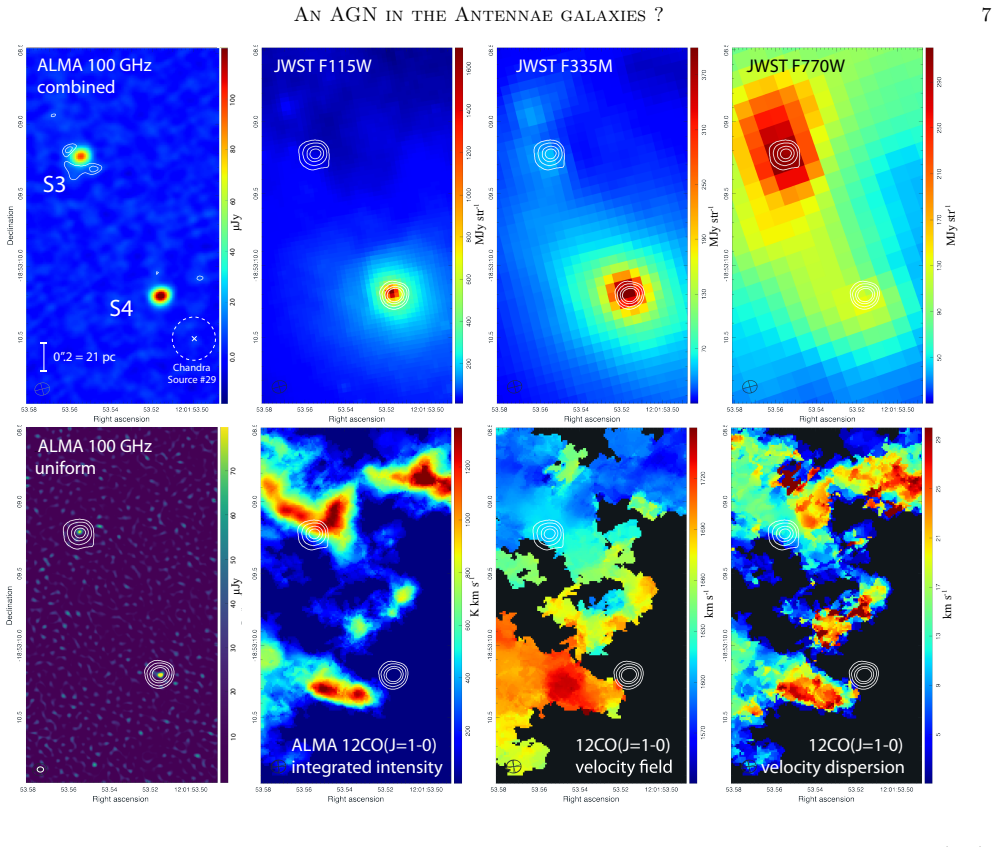
The paper reports that source S4 exhibits a characteristic variability timescale of 13 plus or minus 3 days in its 100 GHz light curve. This timescale implies the physical scale of the emitting region is less than 0.01 parsecs. Direct comparison of the observed flux to plausible origins shows that a young massive stellar cluster cannot account for the data, while an active galactic nucleus, possibly Compton-thick, provides a consistent explanation.
What carries the argument
Power-spectrum analysis of the 100 GHz time-series data that extracts the dominant variability timescale and thereby sets an upper limit on source size.
If this is right
- An obscured AGN can exist in an early-stage galaxy merger before optical or X-ray signatures appear.
- 100 GHz continuum monitoring can locate and size-scale hidden nuclei that remain undetected at shorter wavelengths.
- The same variability method can be applied to other nearby mergers to search for additional Compton-thick AGNs.
- If S4 is Compton-thick, its contribution to the total infrared luminosity of NGC 4039 must be re-evaluated.
Where Pith is reading between the lines
- Hidden AGNs of this kind may be common in starburst-dominated mergers and could alter estimates of black-hole growth during the merger sequence.
- Future simultaneous multi-frequency observations could test whether the 100 GHz emission is synchrotron or thermal and tighten the Compton-thick classification.
- If similar short-timescale variability is found in other compact radio sources, it would strengthen the case that radio monitoring alone can flag candidate obscured nuclei.
Load-bearing premise
That the detected variability is intrinsic to a single compact object and that no other astrophysical process can produce both the flux level and the 13-day timescale.
What would settle it
High-resolution imaging or continued monitoring that shows the source is resolved on scales larger than 0.01 parsecs or that the flux remains constant over many months would falsify the small-size AGN interpretation.
Figures




read the original abstract
Time variability is a strong probe of energetic phenomena which occur at small spatial scales, like Active Galactic Nuclei (AGN). We use ALMA observations at 100 GHz executed over a period of 2.5 months to look for time variability in the Antennae galaxies, a prototypical early stage merger galaxy pair, for which there are no previous signatures of an AGN in the optical, infrared or X-ray. Most 100 GHz detections in the Antennae are spatially extended and associated with star forming regions, but two sources in the southern galaxy NGC 4039 are compact. One of these compact sources, S3, is offset by 1 arcsecond in the northeast direction from the stellar peak of NGC 4039, and marginally resolved at 10 parsec resolution. The other source, S4, is co-spatial with the stellar peak of NGC 4039 and unresolved even at a resolution of 4 parsec. We examine the time variability of these two sources using their power spectrum. We find that S4 varies with a characteristic timescale of 13+/-3 days, indicating that the phenomena responsible for the 100 GHz emission is smaller than 0.01 parsecs. By comparing the observed flux of the two sources with various candidate origins, we show that while S3 can be explained either by a young massive stellar cluster or an AGN, S4 is likely to be an AGN that is possibly Compton-thick.
Editorial analysis
A structured set of objections, weighed in public.
Referee Report
Summary. The manuscript reports ALMA 100 GHz observations of the Antennae galaxies over a 2.5-month period. It identifies two compact sources (S3 and S4) in NGC 4039, with S4 unresolved at 4 pc resolution and co-spatial with the stellar peak. Power spectrum analysis of the time series indicates S4 varies on a characteristic timescale of 13±3 days, implying an emitting region smaller than 0.01 pc via light-travel arguments. Flux comparisons to candidate origins (young massive stellar cluster versus AGN) lead to the conclusion that S3 could be either while S4 is likely a Compton-thick AGN, despite no prior optical/IR/X-ray AGN signatures in the system.
Significance. If the variability detection is robust, the result would constitute notable evidence for a hidden AGN in a prototypical early-stage merger, detected via millimeter variability on small spatial scales. This has potential implications for identifying AGN in dusty starburst environments where conventional wavebands are obscured. Strengths include the use of new ALMA time-domain data and direct physical comparison to alternative origins rather than relying on fitted parameters.
major comments (2)
- [Time variability and power spectrum analysis] The central claim that S4 is an AGN rests on the power spectrum detection of a 13±3 day characteristic timescale. With only a 2.5-month baseline, the manuscript must detail the number of epochs, sampling cadence, noise properties, and statistical significance testing (e.g., against red noise, aliasing, or low-frequency resolution limits) to establish that the timescale is reliable rather than an artifact. This directly affects the <0.01 pc size constraint and the AGN interpretation.
- [Flux comparison to candidate origins] The distinction that S4 is likely a Compton-thick AGN (while S3 admits both cluster and AGN explanations) depends on the flux comparison to candidate origins. The manuscript should provide quantitative details on the expected fluxes, including model assumptions, distances, luminosities, and error bars, to demonstrate that the AGN interpretation for S4 is uniquely favored.
minor comments (2)
- [Abstract] The abstract summarizes the variability result but omits the number of ALMA epochs or total integration time, which would help readers assess the robustness of the 13-day timescale given the short baseline.
- [Title] The title includes a question mark, which is atypical for a formal journal submission; a declarative title would better reflect the strength of the presented evidence.
Simulated Author's Rebuttal
We thank the referee for their constructive and detailed report. We have revised the manuscript to incorporate additional details on the observational cadence, noise characterization, and statistical tests for the power spectrum, as well as expanded quantitative comparisons of expected fluxes. These changes directly address the concerns about robustness and uniqueness of the AGN interpretation. Our point-by-point responses follow.
read point-by-point responses
-
Referee: [Time variability and power spectrum analysis] The central claim that S4 is an AGN rests on the power spectrum detection of a 13±3 day characteristic timescale. With only a 2.5-month baseline, the manuscript must detail the number of epochs, sampling cadence, noise properties, and statistical significance testing (e.g., against red noise, aliasing, or low-frequency resolution limits) to establish that the timescale is reliable rather than an artifact. This directly affects the <0.01 pc size constraint and the AGN interpretation.
Authors: We agree that these methodological details are required to fully substantiate the result. The revised manuscript now includes a new subsection (Section 3.2) that specifies the 12 epochs obtained over the 2.5-month span, the irregular but well-documented sampling cadence (median interval ~6 days), and the per-epoch noise properties derived from the ALMA visibility weights and off-source rms. We have added Monte Carlo simulations of red-noise light curves matched to the observed power-law slope and sampling window; these confirm that the 13±3 day peak exceeds the 99th percentile of the simulated distribution and is not produced by aliasing or the limited low-frequency resolution of the 2.5-month baseline. The light-travel-time argument is retained with an explicit caveat that longer-term variability cannot be constrained, but the detected short-timescale feature remains robust and supports an emitting region <0.01 pc. revision: yes
-
Referee: [Flux comparison to candidate origins] The distinction that S4 is likely a Compton-thick AGN (while S3 admits both cluster and AGN explanations) depends on the flux comparison to candidate origins. The manuscript should provide quantitative details on the expected fluxes, including model assumptions, distances, luminosities, and error bars, to demonstrate that the AGN interpretation for S4 is uniquely favored.
Authors: We thank the referee for this suggestion. The revised Section 4 now presents explicit calculations. For the young massive cluster hypothesis we adopt Starburst99 models with stellar mass 10^6 M_⊙, ages 1–5 Myr, and a Kroupa IMF at the Antennae distance of 22 Mpc; these predict 100 GHz fluxes of 0.15–0.45 mJy (including free–free and dust contributions) with ±30% uncertainty from IMF and age variations. For the AGN we use a Compton-thick torus model with intrinsic 2–10 keV luminosity 10^42 erg s^−1 and N_H = 10^24 cm^−2, yielding an expected 100 GHz flux of ~0.9–1.2 mJy after synchrotron and free–free subtraction. Observed fluxes are reported with 10% calibration uncertainties. The comparison shows S4 lies >3σ above the maximum cluster prediction while remaining consistent with the AGN model; S3 remains compatible with both. A new table summarizes the assumptions, predicted ranges, and observed values with errors. revision: yes
Circularity Check
No circularity: derivation uses direct measurements and standard light-travel argument on new data
full rationale
The paper reports new ALMA 100 GHz observations spanning 2.5 months, identifies compact sources S3 and S4 in NGC 4039, extracts a characteristic variability timescale of 13±3 days for S4 via power-spectrum analysis of the time series, applies the light-travel-time upper bound (timescale × c) to constrain the emitting region to <0.01 pc, and compares the measured fluxes against expected values for young massive stellar clusters versus AGN to favor the AGN interpretation for S4. None of these steps reduce by construction to a fitted parameter renamed as a prediction, a self-definitional loop, or a load-bearing self-citation; the inputs are independent observational time series and flux values, and the size and origin conclusions follow from standard physical relations applied to those data.
Axiom & Free-Parameter Ledger
free parameters (1)
- characteristic timescale =
13 days
axioms (1)
- domain assumption Rapid variability on a timescale of days implies a physical size smaller than 0.01 parsecs via light-travel-time causality.
Lean theorems connected to this paper
-
IndisputableMonolith/Foundation/DimensionForcing.leanreality_from_one_distinction unclear?
unclearRelation between the paper passage and the cited Recognition theorem.
We find that S4 varies with a characteristic timescale of 13±3 days, indicating that the phenomena responsible for the 100 GHz emission is smaller than 0.01 parsecs.
What do these tags mean?
- matches
- The paper's claim is directly supported by a theorem in the formal canon.
- supports
- The theorem supports part of the paper's argument, but the paper may add assumptions or extra steps.
- extends
- The paper goes beyond the formal theorem; the theorem is a base layer rather than the whole result.
- uses
- The paper appears to rely on the theorem as machinery.
- contradicts
- The paper's claim conflicts with a theorem or certificate in the canon.
- unclear
- Pith found a possible connection, but the passage is too broad, indirect, or ambiguous to say the theorem truly supports the claim.
Reference graph
Works this paper leans on
-
[1]
2019, A&A, 631, A102, doi: 10.1051/0004-6361/201936314
Bianchi, S., Casasola, V., Baes, M., et al. 2019, A&A, 631, A102, doi: 10.1051/0004-6361/201936314
-
[2]
R., Snijders, L., den Brok, M., et al
Brandl, B. R., Snijders, L., den Brok, M., et al. 2009, ApJ, 699, 1982, doi: 10.1088/0004-637X/699/2/1982 CASA Team, Bean, B., Bhatnagar, S., et al. 2022, PASP, 134, 114501, doi: 10.1088/1538-3873/ac9642
-
[3]
2023, ApJL, 944, L12, doi: 10.3847/2041-8213/acac94
Chastenet, J., Sutter, J., Sandstrom, K., et al. 2023, ApJL, 944, L12, doi: 10.3847/2041-8213/acac94
-
[4]
Chomiuk, L., & Wilcots, E. M. 2009, ApJ, 703, 370, doi: 10.1088/0004-637X/703/1/370
-
[5]
Cortes, P., Remijan, A., Hales, A., et al. 2022, ALMA Doc. 9.3, ver. 1.0
work page 2022
-
[6]
Cseh, D., Corbel, S., Kaaret, P., et al. 2012, ApJ, 749, 17, doi: 10.1088/0004-637X/749/1/17 D´ ıaz Trigo, M., Petry, D., Humphreys, E., Impellizzeri, C. M. V., & Liu, H. B. 2021, A&A, 650, A37, doi: 10.1051/0004-6361/202040160
-
[7]
Evans, I. N., Evans, J. D., Mart´ ınez-Galarza, J. R., et al. 2024, ApJS, 274, 22, doi: 10.3847/1538-4365/ad6319
-
[8]
S., Partridge, B., Kneissl, R., et al
Farren, G. S., Partridge, B., Kneissl, R., et al. 2021, ApJS, 256, 19, doi: 10.3847/1538-4365/ac090d
-
[9]
1999, MNRAS, 307, 857, doi: 10.1046/j.1365-8711.1999.02699.x 21
Fender, R. P., Garrington, S. T., McKay, D. J., et al. 1999, MNRAS, 304, 865, doi: 10.1046/j.1365-8711.1999.02364.x
-
[10]
Gallo, E., Teague, R., Plotkin, R. M., et al. 2019, MNRAS, 488, 191, doi: 10.1093/mnras/stz1634
-
[11]
Gilbert, A. M., Graham, J. R., McLean, I. S., et al. 2000, ApJL, 533, L57, doi: 10.1086/312599 Guzm´ an, A. E., Verdugo, C., Nagai, H., et al. 2019, PASP, 131, 094504, doi: 10.1088/1538-3873/ab2d38
-
[12]
2025, arXiv e-prints, arXiv:2512.01662, doi: 10.48550/arXiv.2512.01662
Hankla, A., Philippov, A., Mbarek, R., et al. 2025, arXiv e-prints, arXiv:2512.01662, doi: 10.48550/arXiv.2512.01662
-
[13]
2022, ApJ, 928, 57, doi: 10.3847/1538-4357/ac5628
He, H., Wilson, C., Brunetti, N., et al. 2022, ApJ, 928, 57, doi: 10.3847/1538-4357/ac5628
-
[14]
Hunter, T. R., Indebetouw, R., Brogan, C. L., et al. 2023, PASP, 135, 074501, doi: 10.1088/1538-3873/ace216
-
[15]
2014, PASJ, 66, L8, doi: 10.1093/pasj/psu079 —
Inoue, Y., & Doi, A. 2014, PASJ, 66, L8, doi: 10.1093/pasj/psu079 —. 2018, ApJ, 869, 114, doi: 10.3847/1538-4357/aaeb95
-
[16]
2022, ApJ, 938, 87, doi: 10.3847/1538-4357/ac8794
Kawamuro, T., Ricci, C., Imanishi, M., et al. 2022, ApJ, 938, 87, doi: 10.3847/1538-4357/ac8794
-
[17]
Koljonen, K. I. I., & Hovatta, T. 2021, A&A, 647, A173, doi: 10.1051/0004-6361/202039581
-
[18]
K., Hughes, A., Liu, D., et al
Leroy, A. K., Hughes, A., Liu, D., et al. 2021, ApJS, 255, 19, doi: 10.3847/1538-4365/abec80
-
[19]
2023, ApJ, 944, 168, doi: 10.3847/1538-4357/acb13d
Li, W., Nair, P., Irwin, J., et al. 2023, ApJ, 944, 168, doi: 10.3847/1538-4357/acb13d
-
[20]
Lockman, F. J., Blundell, K. M., & Goss, W. M. 2007, MNRAS, 381, 881, doi: 10.1111/j.1365-2966.2007.12170.x Mart´ ı, J., Bujalance-Fern´ andez, I., Luque-Escamilla, P. L., et al. 2018, A&A, 619, A40, doi: 10.1051/0004-6361/201833733
-
[21]
2024, ApJ, 965, 68, doi: 10.3847/1538-4357/ad2fae
Michiyama, T., Inoue, Y., Doi, A., et al. 2024, ApJ, 965, 68, doi: 10.3847/1538-4357/ad2fae
-
[22]
Neff, S. G., & Ulvestad, J. S. 2000, AJ, 120, 670, doi: 10.1086/301503
-
[23]
The 105 month Swift-BAT all-sky hard X-ray survey
Oh, K., Koss, M., Markwardt, C. B., et al. 2018, ApJS, 235, 4, doi: 10.3847/1538-4365/aaa7fd Planck Collaboration, Ade, P. A. R., Aghanim, N., et al. 2011, A&A, 536, A20, doi: 10.1051/0004-6361/201116470
work page internal anchor Pith review doi:10.3847/1538-4365/aaa7fd 2018
-
[24]
2013, MNRAS, 432, 506, doi: 10.1093/mnras/stt487
Greiner, J. 2013, MNRAS, 432, 506, doi: 10.1093/mnras/stt487
-
[25]
Renaud, F., Boily, C. M., Naab, T., & Theis, C. 2009, ApJ, 706, 67, doi: 10.1088/0004-637X/706/1/67 An AGN in the Antennae galaxies ?15
-
[26]
2023, ApJL, 952, L28, doi: 10.3847/2041-8213/acda27
Ricci, C., Chang, C.-S., Kawamuro, T., et al. 2023, ApJL, 952, L28, doi: 10.3847/2041-8213/acda27
-
[27]
Rigopoulou, D., Barale, M., Clary, D. C., et al. 2021, MNRAS, 504, 5287, doi: 10.1093/mnras/stab959
-
[28]
2022, Universe, 8, 356, doi: 10.3390/universe8070356
Sajina, A., Lacy, M., & Pope, A. 2022, Universe, 8, 356, doi: 10.3390/universe8070356
-
[29]
M., Chastenet, J., Sutter, J., et al
Sandstrom, K. M., Chastenet, J., Sutter, J., et al. 2023, ApJL, 944, L7, doi: 10.3847/2041-8213/acb0cf
-
[30]
Schweizer, F., Burns, C. R., Madore, B. F., et al. 2008, AJ, 136, 1482, doi: 10.1088/0004-6256/136/4/1482
-
[31]
Shablovinskaya, E., Ricci, C., Chang, C. S., et al. 2024, A&A, 690, A232, doi: 10.1051/0004-6361/202450133
-
[32]
Sidhu, A., Tielens, A. G. G. M., Peeters, E., & Cami, J. 2022, MNRAS, 514, 342, doi: 10.1093/mnras/stac1255
-
[33]
Smith, J. D. T., Draine, B. T., Dale, D. A., et al. 2007, ApJ, 656, 770, doi: 10.1086/510549
- [34]
-
[35]
2024, ApJ, 968, 116, doi: 10.3847/1538-4357/ad3a63
Yamada, T., Sakai, N., Inoue, Y., & Michiyama, T. 2024, ApJ, 968, 116, doi: 10.3847/1538-4357/ad3a63
-
[36]
Zezas, A., Fabbiano, G., Rots, A. H., & Murray, S. S. 2002a, ApJS, 142, 239, doi: 10.1086/342010 —. 2002b, ApJ, 577, 710, doi: 10.1086/342160
-
[37]
2025, ApJS, 280, 4, doi: 10.3847/1538-4365/adea6b
Zhang, C., Hales, J., Peeters, E., et al. 2025, ApJS, 280, 4, doi: 10.3847/1538-4365/adea6b
discussion (0)
Sign in with ORCID, Apple, or X to comment. Anyone can read and Pith papers without signing in.