Tropical Geometry as a Restricted Architecture for Physics-Informed Neural Networks: Applications in Nonlinear Fluid-Structure Examples
Pith reviewed 2026-07-02 17:44 UTC · model grok-4.3
The pith
Tropical algebra supplies exact support constraints that shrink the hypothesis space of PINNs to match valid formal power series solutions of nonlinear differential equations.
A machine-rendered reading of the paper's core claim, the machinery that carries it, and where it could break.
Core claim
Tropical methods, via the fundamental theorem of tropical differential algebraic geometry, identify the exact support of the valid formal power series solution; this support is embedded as a hard architectural constraint inside the PINN, provably equivalent to the singularity data given by Briot-Bouquet indicial analysis, and the resulting restricted network converges reliably on the Van der Pol and Burgers equations where unconstrained PINNs stagnate.
What carries the argument
The Valuation-Support equivalence that maps tropical valuations directly onto the support of formal power series solutions, thereby supplying the hard constraint that restricts the neural network hypothesis space.
If this is right
- The hybrid architecture applies directly to fluid-structure models governed by nonlinear algebraic differential equations such as vortex-induced vibrations and shock waves.
- Embedding the tropical support constraint reduces the effective search space and thereby mitigates stagnation on stiff or chaotic loss landscapes.
- The method inherits the mesh-free character of PINNs while adding an exact symbolic restriction derived from tropical geometry.
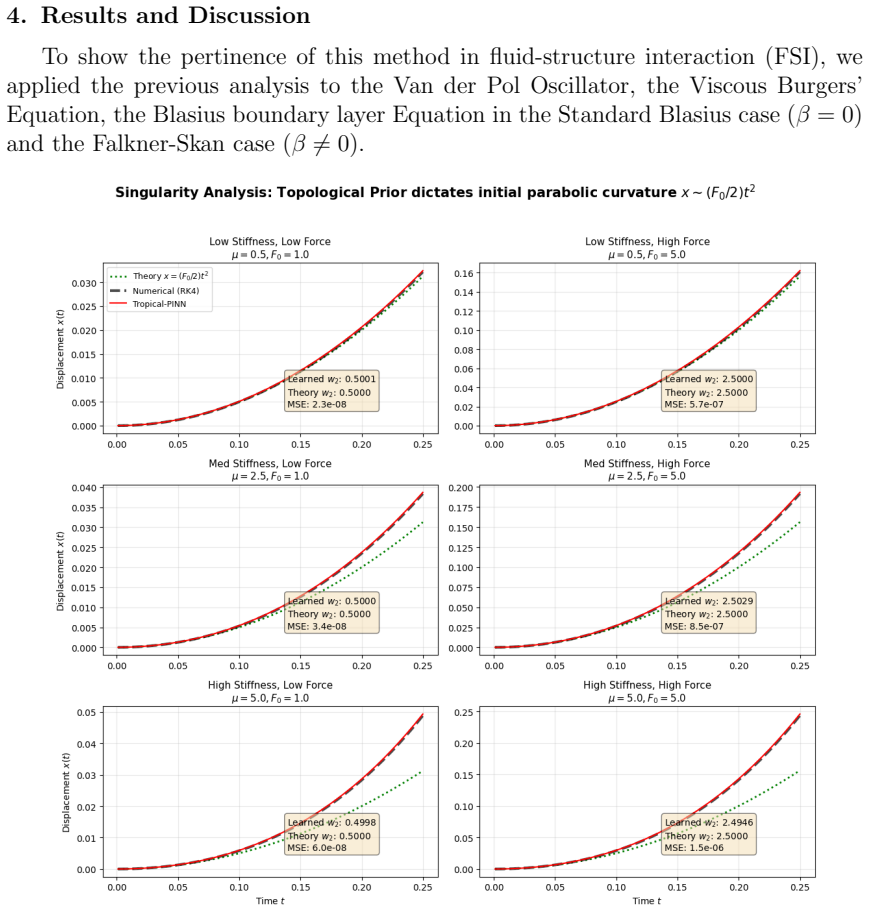
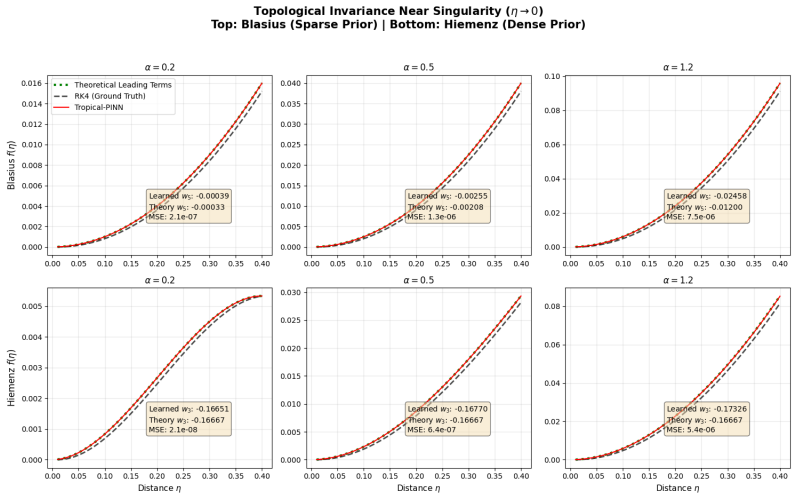
- Numerical evidence on the Van der Pol and Burgers equations confirms both faster convergence and improved pointwise accuracy once the support constraint is active.
Where Pith is reading between the lines
- The same tropical-support restriction could be tested on other stiff nonlinear systems such as the Navier-Stokes equations at moderate Reynolds numbers.
- If the equivalence holds for higher-order or systems of equations, the approach would supply a general preprocessing step for any PINN applied to polynomial differential equations.
- The method opens a route to hybrid solvers that first compute the tropical support symbolically and then train only the coefficients inside that support.
Load-bearing premise
Tropical algebra can algorithmically determine a hard constraint whose support exactly matches that of the valid formal power series solution.
What would settle it
An explicit series solution to either the Van der Pol or Burgers equation whose monomial support differs from the support returned by the tropical algorithm, or a numerical trial in which the tropically constrained PINN shows no improvement in convergence rate over the unconstrained version on the same equation and initial data.
Figures
read the original abstract
Nonlinear algebraic (polynomial) differential equations that govern fluid-structure interactions, such as those modeling vortex-induced vibrations, and shock waves, often lack analytical solutions, creating significant challenges to efficient prediction and control. While Physics-Informed Neural Networks (PINNs) offer a mesh-free numerical alternative, they frequently suffer from convergence stagnation when optimizing over chaotic landscapes or stiff singularities. This paper introduces a hybrid methodology that integrates tropical differential algebraic geometry with deep learning. Using tropical algebra, we algorithmically determine a hard constraint, which we use to restrict the neural network's hypothesis space to the exact support of the valid formal power series solution. We establish a theoretical Valuation-Support equivalence between classical Briot-Bouquet indicial analysis and the fundamental theorem of tropical differential algebraic geometry, proving that tropical methods accurately identify singularity structures. Numerical experiments on the Van der Pol and Burgers' equations demonstrate that embedding these tropical constraints directly into the network architecture drastically reduces the search space, overcoming optimization stagnation and improving both accuracy and convergence speed in non-homogeneous physical regimes.
Editorial analysis
A structured set of objections, weighed in public.
Referee Report
Summary. The manuscript proposes a hybrid method that combines tropical differential algebraic geometry with physics-informed neural networks to restrict the network hypothesis space via a hard constraint derived from the exact support of formal power series solutions. It claims to prove a Valuation-Support equivalence between Briot-Bouquet indicial analysis and the fundamental theorem of tropical differential algebraic geometry, and reports that this restriction improves accuracy and convergence speed on the Van der Pol and Burgers equations in non-homogeneous regimes.
Significance. If the claimed equivalence produces an exact, implementable hard constraint without relaxation and the numerical gains are reproducible, the work could provide a mathematically grounded way to reduce optimization difficulties in PINNs for singular or stiff nonlinear problems. The explicit use of tropical methods to encode support information is a distinctive contribution that, if substantiated, would merit attention in the intersection of algebraic geometry and scientific machine learning.
major comments (2)
- [Abstract] Abstract and central construction: the Valuation-Support equivalence is asserted to yield the exact support of the valid formal power series solution via the fundamental theorem of tropical DAG, yet no hypotheses are stated under which the tropical variety recovers the full support (rather than only leading-term valuations) for non-homogeneous equations; this equivalence is load-bearing for the claim that the resulting constraint is both exact and hard.
- [Abstract] Abstract: the description of embedding the tropical constraint directly into the network architecture does not indicate whether the support set is enforced exactly (e.g., via architectural masking or indicator functions) or via a relaxed penalty term; without this detail the assertion that the search space is 'drastically reduced' cannot be evaluated.
minor comments (1)
- [Abstract] The abstract refers to 'non-homogeneous physical regimes' but does not clarify how the method extends the classical Briot-Bouquet setting, which is typically stated for homogeneous equations.
Simulated Author's Rebuttal
We thank the referee for the careful reading and valuable comments on the manuscript. The points raised concern the clarity of the Valuation-Support equivalence and the precise mechanism of the architectural constraint. We provide point-by-point responses below and will revise the manuscript to address these issues.
read point-by-point responses
-
Referee: [Abstract] Abstract and central construction: the Valuation-Support equivalence is asserted to yield the exact support of the valid formal power series solution via the fundamental theorem of tropical DAG, yet no hypotheses are stated under which the tropical variety recovers the full support (rather than only leading-term valuations) for non-homogeneous equations; this equivalence is load-bearing for the claim that the resulting constraint is both exact and hard.
Authors: We agree that the abstract would benefit from an explicit statement of the hypotheses. The full manuscript derives the Valuation-Support equivalence by applying the fundamental theorem of tropical differential algebraic geometry to the support of the differential polynomial, which recovers the complete set of valuations (hence the full support) when the equation satisfies the Briot-Bouquet conditions with a non-homogeneous term whose valuation is strictly greater than the leading indicial root. We will revise both the abstract and the theoretical section to state these conditions clearly, confirming that the resulting constraint is exact and hard. revision: yes
-
Referee: [Abstract] Abstract: the description of embedding the tropical constraint directly into the network architecture does not indicate whether the support set is enforced exactly (e.g., via architectural masking or indicator functions) or via a relaxed penalty term; without this detail the assertion that the search space is 'drastically reduced' cannot be evaluated.
Authors: The constraint is enforced exactly by architectural masking: the final layer of the network is restricted so that only monomials belonging to the tropical support set may have non-zero coefficients, with all other coefficients fixed at zero through direct masking (equivalent to indicator functions on the output). No penalty term is used. We will add this implementation detail to the abstract and the methods section to make the reduction of the hypothesis space explicit. revision: yes
Circularity Check
No significant circularity; derivation is self-contained against external benchmarks.
full rationale
The paper asserts a Valuation-Support equivalence and claims to prove it via the fundamental theorem of tropical differential algebraic geometry, then uses the resulting support set as an architectural constraint on the PINN hypothesis space. No quoted step reduces a claimed prediction or first-principles result to a fitted parameter, self-definition, or load-bearing self-citation chain; the equivalence is presented as a theorem established within the manuscript rather than imported by ansatz or prior self-work. Experiments on Van der Pol and Burgers equations are reported as independent numerical validation. The central claim therefore retains independent mathematical and empirical content outside its own inputs.
Axiom & Free-Parameter Ledger
axioms (1)
- domain assumption Valuation-Support equivalence between classical Briot-Bouquet indicial analysis and the fundamental theorem of tropical differential algebraic geometry
Reference graph
Works this paper leans on
-
[1]
The fundamental theorem of tropical differential algebraic geometry
Aroca, F., Garay-López, C., Toghani, Z., 2016. The fundamental theorem of tropical differential algebraic geometry. Pacific Journal of Mathematics. 283 (2), 257-270. https://msp.org/pjm/2016/283-2/pjm-v283-n2-p01-s.pdf
2016
-
[2]
Bararnia, H., Esmaeilpour, M., (2022). On the application of physics informed neural networks (PINN) to solve boundary layer thermal-fluid problems. International Communications in Heat and Mass Transfer. 132, 105890. https://doi.org/10.1016/j.icheatmasstransfer.2021.105890
-
[3]
Bhaumik, B., Changdar, S., Chakraverty, S., De, S., (2024). Effects of viscosity and induced magnetic fields on weakly nonlinear wave transmission in a viscoelastic tube using physics-informed neural networks. Physics of Fluids 1 December. 36 (12), 121902. https://doi.org/10.1063/5.0235391
-
[4]
A perturbative Painlevé approach to nonlinear differential equations
Conte, R., Fordy, A., Pickering, A., (1993). A perturbative Painlevé approach to nonlinear differential equations. Physica D: Nonlinear Phenomena. 69 (1–2), 33-58. https://doi.org/10.1016/0167-2789(93)90179-5
-
[5]
Solving Ordinary Differential Equations II: Stiff and Differential-Algebraic Problems
Hairer, E., Wanner, G., (1991). Solving Ordinary Differential Equations II: Stiff and Differential-Algebraic Problems. Springer-Verlag, Berlin
1991
-
[6]
Global branching of solutions to ordinary differential equations and integrability
Halburd, R., (2025). Global branching of solutions to ordinary differential equations and integrability. Proc. A. 481 (2328): 20250149. https://doi.org/10.1098/rspa.2025.0149
-
[7]
Hardika, M., Morton, C., Martinuzzi, R. J., (2024). An improved van der Pol wake oscillator model for a 1DOF circular cylinder undergoing vortex induced vibrations. European Journal of Mechanics - B/Fluids. 104, 17-31. https://doi.org/10.1016/j.euromechflu.2023.11.006
-
[8]
Iwano, M., (1966). On a singular point of Briot–Bouquet type of a system of two ordinary nonlinear differential equations. Publ. Res. Inst. Math. Sci. 2 (1), 17–115. https://doi.org/10.2977/PRIMS/1195196068
-
[9]
Jay, L.O. (2005). Specialized Runge-Kutta methods for index 2 differential-algebraic equations. Math. Comput. 75, 641-654
2005
-
[10]
Improvement for modeling the damping of the wake oscillator based on the Van der Pol scheme
Liu, Z., Jin, C., Li, S., Li, W., Wang, J., (2024). Improvement for modeling the damping of the wake oscillator based on the Van der Pol scheme. Physics of Fluids 36 (7): 075152. https://doi.org/10.1063/5.0214541
- [11]
-
[12]
Painlev\' e , P., (1900). M\' e moire sur les \' e quations diff\' e rentielles dont l'int\' e grale g\' e n\' e rale est uniforme. Bulletin de la Soci\' e t\' e Math\' e matique de France 28, 201-261. https://doi.org/10.24033/bsmf.633
-
[13]
Painlev\'e, P., (1902). Sur les équations différentielles du second ordre et d'ordre supérieur dont l'intégrale générale est uniforme. Acta Mathematica 25, 1 - 85. https://doi.org/10.1007/BF02419020
-
[14]
Properties of the Set of Functions Generated by Neural Networks of Fixed Size
Petersen, P., Raslan, M., Voigtlaender, F., (2021). Properties of the Set of Functions Generated by Neural Networks of Fixed Size. Found Comput Math 21, 375–444. https://doi.org/10.1007/s10208-020-09461-0
-
[15]
Raissi, M., Perdikaris, P., & Karniadakis, G. E. (2019). Physics-informed neural networks: A deep learning framework for solving forward and inverse problems involving nonlinear partial differential equations. Journal of Computational Physics, 378, 686-707. https://doi.org/10.1016/j.jcp.2018.10.045
-
[16]
Singular Nonlinear Partial Differential Equations
Raymond, G., Tahara, H., (1996). Singular Nonlinear Partial Differential Equations. Friedr. Vieweg & Sohn Verlagsgesellschaft mbH, Braunschweig/Wiesbaden. https://doi.org/10.1007/978-3-322-80284-2
-
[17]
Understanding Machine Learning: From Theory to Algorithms
Shalev-Shwartz, S., Ben-David, S., (2014). Understanding Machine Learning: From Theory to Algorithms. Cambridge University Press
2014
-
[18]
Boundary-Layer Theory (9th ed.)
Schlichting, H., Gersten, K., (2017). Boundary-Layer Theory (9th ed.). Springer. https://doi.org/10.1007/978-3-662-52919-5
-
[19]
Wang, L., Yu, M., (2019). A comparative study of implicit Jacobian-free Rosenbrock-Wanner, ESDIRK and BDF methods for unsteady flow simulation with high-order flux reconstruction formulations. arXiv:1904.04825
work page internal anchor Pith review Pith/arXiv arXiv 2019
-
[20]
Understanding and Mitigating Gradient Flow Pathologies in Physics-Informed Neural Networks
Wang, S., Teng, Y., Perdikaris, P., (2021). Understanding and Mitigating Gradient Flow Pathologies in Physics-Informed Neural Networks. SIAM Journal on Scientific Computing 43(5), A3055-A3081. doi:10.1137/20M1318043
-
[21]
Hypothesis spaces for deep learning
Wang, R., Xu, Y., Yan, M., (2026). Hypothesis spaces for deep learning. Neural Networks 193, 107995. https://doi.org/10.1016/j.neunet.2025.107995
-
[22]
The Painlevé property for partial differential equations
Weiss, J., Tabor, M., Carnevale, G., (1983). The Painlevé property for partial differential equations. J. Math. Phys. 24 (3): 522–526. https://doi.org/10.1063/1.525721
-
[23]
Linearizability Problem of Resonant Degenerate Singular Point for Polynomial Differential Systems
Yusen, W., Cui, Z., Liu, L., (2012). Linearizability Problem of Resonant Degenerate Singular Point for Polynomial Differential Systems. Journal of Applied Mathematics 383282. https://doi.org/10.1155/2012/383282
discussion (0)
Sign in with ORCID, Apple, or X to comment. Anyone can read and Pith papers without signing in.