Composition: Building Community with Arts, Math, and Code (Experience Report)
Pith reviewed 2026-06-26 01:52 UTC · model grok-4.3
The pith
Composition is a free event series on art, mathematics, and code whose structure, selection process, outreach, and community response are described.
A machine-rendered reading of the paper's core claim, the machinery that carries it, and where it could break.
Core claim
The authors document Composition as an ongoing series of free events that integrate artistic practice with mathematical ideas and programming. They specify the typical event format, the artist-selection workflow, the outreach channels for both calls for participation and audience promotion, and the qualitative community responses received so far.
What carries the argument
The Composition event series itself, carried by its free-access policy, interdisciplinary artist roster, and explicit outreach and selection procedures.
If this is right
- Other organizers can copy the described event structure, selection steps, and outreach tactics to run similar free series.
- Targeted outreach increases both the number and diversity of artist submissions.
- Interdisciplinary events of this kind generate measurable community interest and repeat attendance.
- Free admission removes a financial barrier that otherwise limits participation in art-math-code activities.
Where Pith is reading between the lines
- The same combination of free access and cross-domain curation could be tested in other cities or delivered online to reach wider audiences.
- Longer-term tracking of repeat attendees or follow-on collaborations would reveal whether the series produces sustained networks rather than one-off events.
- The model suggests a low-cost way to surface mathematical ideas to audiences who primarily identify as artists or programmers.
Load-bearing premise
The authors' observations of community response accurately capture the series' impact without selection bias or self-reporting limitations.
What would settle it
An independent participant survey or attendance log that shows substantially different engagement levels, demographic patterns, or motivations than those described in the report.
Figures




read the original abstract
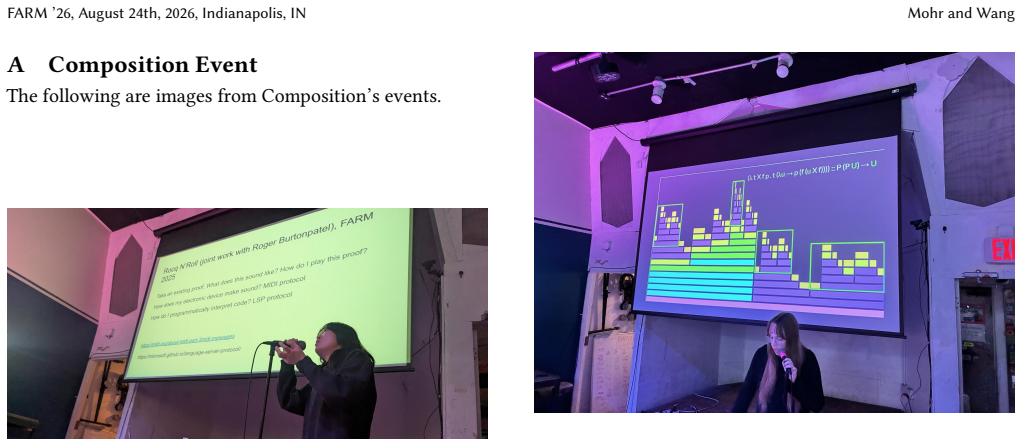
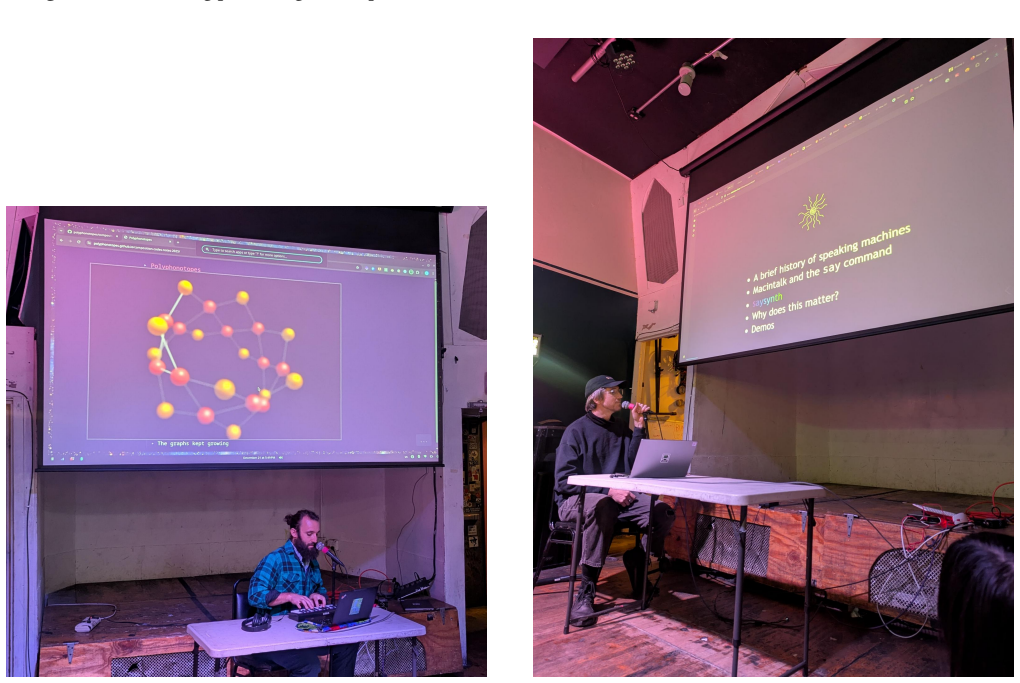
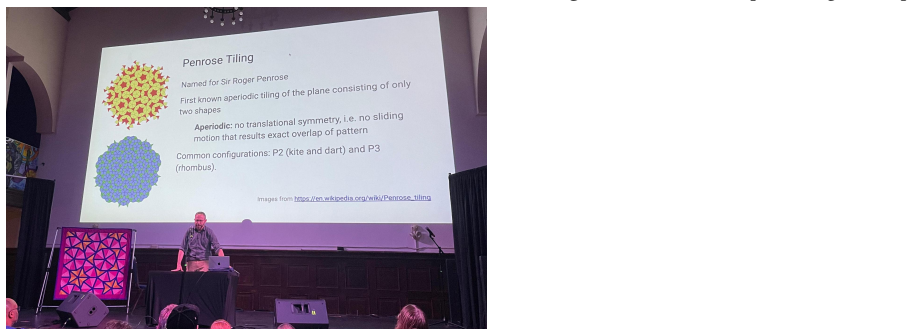
Composition (https://composition.codes) is a free event series on art, mathematics, and code. This experience report covers Composition's event structure, artist selection process, outreach efforts for submissions and event promotion, and the community response.
Editorial analysis
A structured set of objections, weighed in public.
Referee Report
Summary. The manuscript is an experience report describing Composition, a free event series on art, mathematics, and code. It details the event structure, artist selection process, outreach efforts for submissions and promotion, and observed community responses based on organizer observations.
Significance. If the descriptions are accurate, the report offers practical insights into organizing interdisciplinary community events at the intersection of arts, math, and code, which may be useful for similar initiatives in multimedia computing and CS outreach. Its contribution is primarily anecdotal, as it contains no quantitative data, error bars, or external validation of community impact.
minor comments (2)
- [Abstract] The abstract provides a high-level overview but does not mention the scale of the series (e.g., number of events held or participants); adding one or two concrete figures would help readers assess the scope without altering the descriptive nature of the report.
- The manuscript would benefit from a brief table or timeline summarizing key events, dates, and participation numbers to improve readability of the descriptive sections.
Simulated Author's Rebuttal
We thank the referee for their positive summary of the manuscript, recognition of its practical insights for organizing interdisciplinary events, and recommendation to accept. No major comments were provided for us to address.
Circularity Check
No significant circularity
full rationale
This is a purely descriptive experience report with no equations, derivations, quantitative models, predictions, or fitted parameters. The content covers event structure, selection processes, outreach, and narrative observations of community response. No load-bearing steps exist that could reduce by construction to inputs, self-citations, or ansatzes, making the paper self-contained by design.
Axiom & Free-Parameter Ledger
Reference graph
Works this paper leans on
-
[1]
2022.Penrose tiling quilt.https://mzucker.github.io/2022/11/13/ penrose-tiling-quilt.html
2022
-
[2]
2022.Pentagonal tiling pillowcase.https://mzucker.github.io/2022/11/ 17/pentagonal-tiling-pillowcase.html
2022
-
[3]
2026.AlgoArt Home Page.https://algoart.org/
2026
-
[4]
https://www.ams.org/meetings/national/national
2026.AMS National Meetings & Joint Mathematics Meetings (JMM). https://www.ams.org/meetings/national/national
2026
-
[5]
2026.arjun’s archive.https://arjunmakesthings.github.io/
2026
-
[6]
2026.The Bridges Organization – Mathematics · Art · Music · Architec- ture·Culture.https://www.bridgesmathart.org/
2026
-
[7]
2026.Composition.https://composition.codes/
2026
-
[8]
2026.Composition.https://www.wonderville.nyc/events/composition- 12-21-25
2026
-
[9]
2026.Composition.https://www.youtube.com/channel/ UCa4LxmzZET8Xyyjpev3qDZw
2026
-
[10]
2026.Composition - Algorave ∪ Technical Salon ∪ Meetup.https: //www.instagram.com/composition.codes
2026
-
[11]
2026.Composition #1·Luma.https://luma.com/w9zx0rhu
2026
-
[12]
2026.front page - wondering.xyz.https://wondering.xyz/#
2026
-
[13]
https://www.computermusic.org/icmc-conference-2026/
2026.ICMC Conference 2026 | International Computer Music Association. https://www.computermusic.org/icmc-conference-2026/
2026
-
[14]
2026.Inliquid is Your Community Art Resource.https://www.inliquid. org/
2026
-
[15]
2026.livecode.nyc | Livecode.NYC.https://livecode.nyc/
2026
-
[16]
2026.Matt Zucker | 2026 Joint Mathematics Meetings | Mathematical Art Galleries.https://gallery.bridgesmathart.org/exhibitions/2026-jmm- art-exhibition/matt-zucker
2026
-
[17]
bridgesmathart.org/artists/k8yKT9/michael-wehar
2026.Michael Wehar | Mathematical Art Galleries.https://gallery. bridgesmathart.org/artists/k8yKT9/michael-wehar
2026
-
[18]
2026.New Jersey Programming Languages and Systems Seminar.https: //njpls.org/
2026
-
[19]
2026.Nick Romano.https://nicolasromano.up.railway.app/?utm_ source=luma
2026
-
[20]
2026.Penn Libraries.https://www.library.upenn.edu
2026
-
[21]
siggraph.org/
2026.Philadelphia ACM SIGGRAPH Chapter – Connecting and Serving the Computer Graphics Industry of Philadelphia.https://philadelphia. siggraph.org/
2026
-
[22]
2026.The Rotunda. Arts. Culture. Community.https://www.therotunda. org/
2026
-
[23]
2026.saysynth: Make music with Mac’s say command.http://saysynth. org
2026
-
[24]
2026.WONDERVILLE.https://www.wonderville.nyc/
2026
-
[25]
https://functional-art.org/
2026.Workshop on Functional Art, Music, Modeling and Design (FARM). https://functional-art.org/
2026
-
[26]
2026.Prismriver.https://codeberg.org/aniva/Prismriver Composition: Building Community with Arts, Math, and Code (Experience Report) FARM ’26, August 24th, 2026, Indianapolis, IN
aniva. 2026.Prismriver.https://codeberg.org/aniva/Prismriver Composition: Building Community with Arts, Math, and Code (Experience Report) FARM ’26, August 24th, 2026, Indianapolis, IN
2026
-
[27]
Roger Burtonpatel and Claire Wang. 2025. Demo: Rocq N’Roll. In Proceedings of the 13th ACM SIGPLAN International Workshop on Functional Art, Music, Modelling, and Design(New York, NY, USA, 2025-10-12)(FARM ’25). Association for Computing Machinery, 18–20. doi:10.1145/3759162.3759642
-
[28]
Nick Collins and Alex McLean. 2014. Algorave: Live performance of algorithmic electronic dance music. InProceedings of the International Conference on New Interfaces for Musical Expression. 355–358
2014
-
[29]
Alex McLean, Felix Roos, Matthew Kaney, Martin Gius, Diego Vil- laseñor, Dagur Kristinn Sigurðsson, Jack Armitage, and Julian Rohrhu- ber. 2026. Uzulangs: a Community of Musical Pattern Languages. (2026)
2026
-
[30]
Isidore Mohr. 2025. Demo: Girard’s Paradox as Structure Music. InProceedings of the 13th ACM SIGPLAN International Workshop on Functional Art, Music, Modelling, and Design(New York, NY, USA, 2025-10-12)(FARM ’25). Association for Computing Machinery, 28–30. doi:10.1145/3759162.3759644 FARM ’26, August 24th, 2026, Indianapolis, IN Mohr and Wang A Compositi...
discussion (0)
Sign in with ORCID, Apple, or X to comment. Anyone can read and Pith papers without signing in.