REVIEW 5 major objections 6 minor
WCM: World-Cognition Model for Generalizable Human-Robot Interaction
T0 review · 5 major / 6 minor · reviewed 2026-08-01 · deepseek-v4-flash
Pith's one-line read The paper reports that WCM, a robot built on the SLAK architecture with asynchronous execution and chain-of-thought distillation from rollouts and teaching, achieves a 73.8% average success rate across nine real-world human-robot interactio
desk verdict A solid architectural idea with a thin evaluation; the 73.8% headline is not yet credible, but the teaching-to-distillation loop is worth a serious look. read the letter →
The pith
A machine-rendered reading of the paper's core claim, the machinery that carries it, and where it could break.
The reading
What carries the argument
The core object is the SLAK architecture, which separates Sensing, Logic, Action, and Knowledge into explicit layers connected by a shared state interface. Each decision is represented as a tuple: scene state, user instruction, retrieved memory, reasoning trace, selected action, expected outcome, and realized outcome. The asynchronous runtime decouples reasoning from execution so the robot can act, explain, and listen concurrently, while a validation check discards stale actions when the context changes. The training loop refines raw recorded traces—trimming detours from successes and correcting failures—and optimizes a chain-of-thought negative log-likelihood loss with teaching examples wei
What would settle it
Have an independent evaluator re-run the nine tasks with pre-written, video-scored success criteria and a third-party rater; if the measured average success rate falls substantially below 73.8%, or if the reported ablation drop on part-level tasks does not reproduce, the central empirical claim is undermined.
Extended reading notes
Core claim
On the paper's own terms, the central discovery is that a robot does not need a monolithic end-to-end policy to interact well: by making perception, reasoning, action, and memory separate but tightly coupled, and by using the resulting explicit decision records as reasoning supervision, a low-cost mobile manipulator can handle a suite of dialogue-driven tasks, transfer to unseen instructions, and improve from interactive teaching. The authors identify the mechanism as a weighted distillation of refined chain-of-thought traces from both autonomous rollouts and human-guided teaching episodes, with teaching examples weighted more heavily in the training objective. The long-horizon screwdriver-t
Load-bearing premise
The load-bearing premise is that the nine hand-selected tasks and the authors' undefined success criteria give a fair, consistent measure of human-robot interaction capability; if scoring was lenient or the tasks were chosen to fit the system, the 73.8% figure would not establish that the architecture is responsible for the performance.
Editorial extensions
If this is right
- A robot on hardware costing under $2,000 can sustain dialogue, explanation, mid-execution correction, and teaching, suggesting that interaction capability need not be reserved for high-end platforms.
- Held-out transfer across four tasks not seen in CoT fine-tuning suggests that reasoning-supervision from decision records generalizes to new spoken instructions better than motor-level imitation.
- The teaching mode's improvement—from below 20% to 82% after teaching plus distillation—indicates that natural-language guidance can substitute for teleoperation in acquiring long-horizon tasks.
- Removing the asynchronous runtime inflates end-to-end run time by 1.4–1.7×, and removing part-level sensing cues drops the screwdriver-to-drawer success rate from 69% to 0%, identifying both as load-bearing components.
- The system records failures as reusable experience and converts them into corrected chain-of-thought supervision, so unsuccessful runs contribute to future competence rather than being discarded.
Reading between the lines
- If the approach scales, the explicit separation of reasoning from execution could let a single reasoning model serve many robot bodies, since actions are bound to a reusable skill library rather than a hardware-specific policy.
- The teaching-to-distillation loop suggests a path where end-users generate training data simply by teaching, potentially reducing the need for expert teleoperation datasets and enabling continual on-site improvement.
- A testable extension is to check whether the recorded expected outcomes match what the scene state actually supports: if the reasoning model hallucinates outcomes, distillation would amplify the errors rather than correct them.
- The case-study comparison, if extended to a controlled benchmark with identical success criteria and independent scoring, would clarify how much of the reported performance comes from the architecture versus the choice of tasks.
Editorial analysis
A structured set of objections, weighed in public.
Referee Report
Summary. The paper presents WCM, a human-centered embodied agent built on the SLAK architecture (Sensing, Logic, Action, Knowledge) with an asynchronous runtime. WCM records decision traces from autonomous rollouts and human teaching episodes, refines them offline into chain-of-thought supervision, and distills this into its reasoning model. The authors report a 73.8% average success rate across nine real-world human-robot interaction tasks, including tasks held out from CoT fine-tuning and a long-horizon task acquired through teaching. They also provide a case-study comparison against a commercial system and ablations of the asynchronous runtime and the sensing layer.
Significance. The paper's main strengths are the clear articulation of the SLAK architecture, the idea of decoupling sensing, reasoning, action, and memory while providing an asynchronous runtime, and the human-in-the-loop teaching-to-distillation loop. The empirical effort on nine physical tasks, with per-task trial counts and video demonstrations, is valuable as an exploratory case study. If the reported 73.8% success rate were backed by a pre-registered success rubric, larger trial counts with confidence intervals, and a fair baseline, the result would be a meaningful step toward interactive, explainable robot control. However, as presented, the evaluation does not yet support the paper's strong claims about interaction quality, correction handling, or learning from teaching.
major comments (5)
- [Table I / §III-B] The headline success rate is not interpretable because 'success' is never operationally defined. For each of the nine tasks, Table I reports only a binary success ratio, with no rubric stating what constitutes a successful handover, placement, disposal, or 'hold the BBQ tongs.' For example, does handover success require the object to be placed in the user's hand, or merely released within reach? Does 'put the bottle in the trash can' require the bottle to be fully inside, or merely dropped toward the opening? Without a published, itemized success criterion, the reported 73.8% cannot be independently verified or compared across tasks. The Conclusion's acknowledgment that this is 'a case-study evaluation' (Sec. IV) does not resolve this, because the Abstract and Introduction present the number as the main evidence for the system's capabilities.
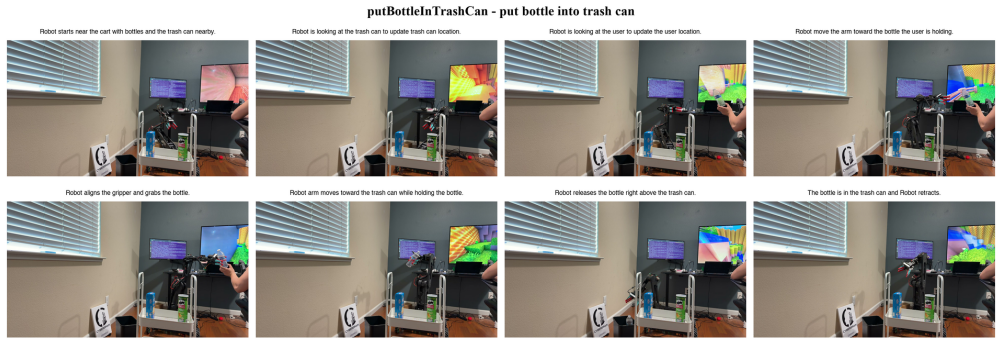
- [Table I / §III-B] The statistical basis for the headline is very thin. Each task is evaluated on only 9–15 attempts, and no confidence intervals, significance tests, or inter-rater reliability are reported. Concretely, 'Hand me the jacket' (6/9 success) and 'Put the bottle in the trash can' (9/14 success) are both reported as 67% and 64% respectively, but with these sample sizes the differences between tasks are well within binomial noise. The claim that WCM 'achieves' 73.8% therefore rests on a small, author-selected sample with no uncertainty quantification. I would expect at minimum binomial confidence intervals, a fixed number of trials per task decided in advance, and an explicit statement of how trials were generated (e.g., object placements, user utterances, environment variations).
- [§II-B1, Eq. (3)] The CoT distillation loop is partially self-referential and the refinement procedure R is not specified. The paper states that 'a stronger model ensemble reviews the recorded reasoning and outcomes... and produces cleaner reasoning traces through voting or consensus' but does not identify this ensemble, its size, its prompting, or how failures are converted into 'corrected CoT traces.' Because the same model family may be involved in both inference and refinement, the reported improvements from distillation could reflect the refinement model's bias rather than genuine task competence. The paper should specify the refinement model, provide examples of raw versus refined traces, and ablate the refinement step (e.g., training directly on raw rollouts versus refined rollouts). Without this, the claim that WCM 'turns interaction into training signal' is not falsifiable.
- [Appendix B / Table II] The case-study comparison with X-Square's WALL-OSS does not support the efficiency claims in the paper. Success rates are reported for WCM only; the baseline's per-task success rates are omitted. Moreover, the baseline's GPU busy time is estimated as the full movement time under the assumption that a VLA 'runs on the GPU at every control step,' while WCM's GPU time is measured on the actual system. This asymmetric methodology makes the comparison illustrative at best. If the paper wants to claim that WCM frees the GPU or is faster, it must measure the baseline on the same hardware/software stack or, at minimum, obtain the baseline's own measured GPU occupancy and success rates. As written, Table II's averaged '88.0%' success for WCM against an absent baseline is misleading.
- [Abstract / §III] There is a construct-validity gap between the paper's claims and what is measured. The Abstract says WCM 'explains, accepts mid-execution correction, and improves from interaction,' but Table I only reports binary task completion. No experiment reports explanation accuracy, the rate at which user corrections were correctly interpreted and executed, or the amount of improvement attributable to teaching versus to additional attempts. The ablation in Table III measures only success and run time, not whether the robot's reasoning traces are faithful. To support the paper's thesis, the evaluation needs interaction-specific metrics (e.g., correction success rate, explanation correctness judged against a rubric, learning gain from teaching episodes with a control condition that repeats untaught rollouts). Without such measures, the reported success rate is compatible with a conventional instruc
minor comments (6)
- [§II-A2, Eq. (1)] The validation threshold ε in Eq. (1) is never given a value or a sensitivity analysis. Since the runtime's behavior depends on this threshold, please state how it was chosen and whether results are robust to its value.
- [§II-B, Eq. (3)] The teaching loss weight λ is described as ≥1 but no value is reported. A brief hyperparameter table or a sentence on how λ was selected would improve reproducibility.
- [Table I footnotes] The footnotes state that four tasks are 'held out from CoT training set,' but the paper does not list which tasks were in the training set versus held out. Please make the training/held-out split explicit for each task.
- [Appendix B / Table II] The statement 'X-Square did not provide per-task success rates' is unusual for a comparison; please clarify whether these numbers come from public videos or from a direct request, and whether the movement times are measured from the same video start conditions.
- [General] Figure 2 and the demo figures are referenced, but the paper does not include the actual video frames or links to videos. Since the paper's contribution includes 'live demos,' please include supplementary material or URLs.
- [§I] The phrase 'physical AI, robot imagination, and manipulation [16, 32, 36, 7, 1, 21, 34]' is broad; a sentence distinguishing world models for prediction from the proposed interaction-oriented world-cognition model would help position the contribution.
Circularity Check
No significant circularity: the headline 73.8% success rate is an externally measured task-completion result, not a consequence of the training equations.
full rationale
WCM's central claim is an empirical 73.8% average success rate on nine physical HRI tasks, with four tasks explicitly marked as held out from CoT fine-tuning and one task evaluated before and after teaching/distillation. The success rates in Table I are external task-completion measurements, not consequences of the training objective in Eq. (3). The CoT flywheel (Eqs. 2–3) is self-referential as a training loop—WCM distills its own rollouts refined by a stronger model ensemble—but the paper does not use that loop to derive the evaluation numbers; the held-out tasks and the pre/post-teaching contrast provide an external check. Self-citations ([9], [14], [33]–[35]) are background citations for sensing and 3D/world-model baselines and are not load-bearing for the headline. The case-study comparison is explicitly disclaimed as illustrative rather than controlled, so it does not function as a forced derivation. The main weaknesses—undefined success criteria and absence of HRI-specific metrics for explanation or correction quality—are construct-validity concerns, not circular reductions. No equation or self-citation chain makes the claimed result equal to its own input.
Assumptions & free parameters
free parameters (2)
- lambda (teaching loss weight) =
not reported
- epsilon (validation threshold) =
not reported
assumptions (4)
- domain assumption The pretrained LLM/VLM already has enough semantic and physical commonsense to ground instructions and solve held-out tasks.
- domain assumption The low-level Action skill library reliably executes navigation, reaching, grasping, placing, handover, and articulated-object interactions.
- ad hoc to paper A 'stronger model ensemble' can refine noisy autonomous rollouts into correct CoT traces.
- domain assumption The authors' unstated success criteria are consistent and representative.
Cite this review
Pith. "Pith review of WCM: World-Cognition Model for Generalizable Human-Robot Interaction." pith.science (2026). https://pith.science/paper/4RFUQBBI
@misc{pith2026260722999,
  author       = {Pith},
  title        = {Pith review of: WCM: World-Cognition Model for Generalizable Human-Robot Interaction},
  year         = {2026},
  howpublished = {\url{https://pith.science/paper/4RFUQBBI}},
  note         = {Machine review of arXiv:2607.22999}
}
read the original abstract
Language agents can now interact fluently with users in software, but robots still struggle to bring comparable interaction to physical tasks. Current robot-control paradigms, including vision-language-action policies and world-model-based planners, are mainly optimized for instruction execution, leaving users with little visibility into why an action is chosen and few mechanisms to redirect, correct, or teach the robot through interaction. To solve this problem, we present the World-Cognition Model (WCM), a human-centered embodied agent built on the SLAK architecture (Sensing, Logic, Action, and Knowledge) and an asynchronous runtime. SLAK separates perception, reasoning, control, and memory, while the runtime allows reasoning, dialogue, and execution to proceed concurrently. WCM further introduces a human-in-the-loop teaching mode that enables users to interactively teach the robot difficult or long-horizon tasks. Teaching episodes and autonomous task rollouts are refined into chain-of-thought supervision to continually improve the model. WCM achieves a 73.8% average success rate across nine real-world human-robot interaction tasks, including tasks held out from CoT fine-tuning and a long-horizon task learned through teaching.
Figures


Figures from the paper (8 more)


Reviewed August 1, 2026 · model on record in the stance chip above.
Discussion (0). Sign in to comment.