OptiLoop: Coordination-in-the-Loop Verification and Repair for LLM-Generated Optimization Agents
Pith reviewed 2026-06-29 15:16 UTC · model grok-4.3
The pith
Semantic errors in LLM-generated optimization agents surface only during coordination and are repaired by running them in short bounded loops against a reference.
A machine-rendered reading of the paper's core claim, the machinery that carries it, and where it could break.
Core claim
For generated optimization agents deployed inside decentralized decision loops, correctness should be validated in the loop itself rather than through isolated execution alone. OptiLoop instantiates the idea by generating local agents from natural-language specifications, verifying them through short bounded coordination runs against a fixed reference counterparty using an ADMM-style consensus protocol, extracting structured behavioral and static evidence, and applying evidence-driven repair that escalates from localized code fixes to corrected-formulation repair when failures are structural.
What carries the argument
Short bounded coordination runs against a fixed reference counterparty that surface behavioral failures and supply structured evidence for repair under an ADMM-style consensus protocol.
If this is right
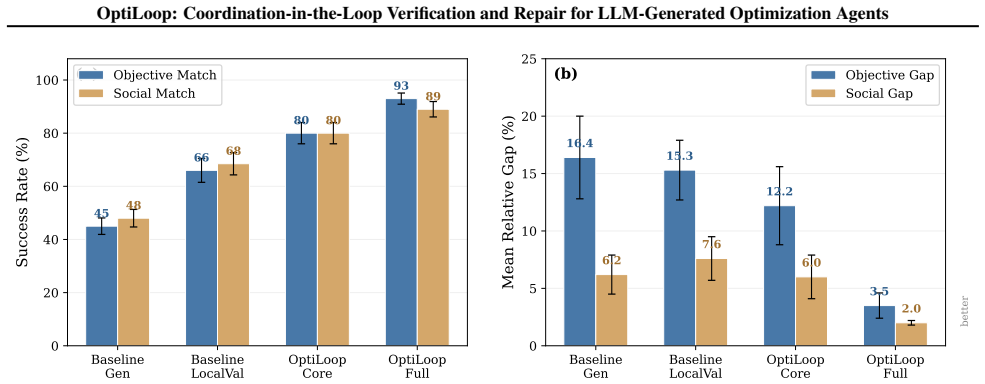
- Local validation alone leaves objective match at 66 percent and social match at 68.5 percent.
- Evidence extracted from coordination runs enables both code-level fixes and escalation to formulation-level repair.
- Reusing episodic lessons from earlier repairs improves performance on subsequent instances.
- Mean objective gap falls from 15.3 percent to 3.5 percent and mean social gap from 7.6 percent to 2.0 percent on the test set.
Where Pith is reading between the lines
- The same coordination-in-the-loop pattern could be tested on LLM agents for other private multi-party tasks such as negotiation or matching.
- Replacing the single fixed reference with a small set of varied references might expose additional counterparty-specific errors.
- Embedding the verification step inside live decentralized systems could reduce reliance on manual review before deployment.
Load-bearing premise
Short bounded coordination runs against a single fixed reference counterparty are sufficient to surface and allow repair of all semantic errors that local checks miss.
What would settle it
A generated agent that passes repeated short coordination runs with the reference yet still shows incorrect incentive response or mis-scoped constraints when tested in longer interactions or with different counterparties.
Figures

read the original abstract
Many decentralized decision problems require multiple parties to coordinate on shared decisions while keeping objectives, constraints, and data private. Large language models (LLMs) offer a promising way to lower the barrier to participation by generating local optimization agents from natural-language specifications. In coordination settings, however, executability is not enough: a generated agent may compile, solve, and pass local checks while still being semantically wrong, for example by misrepresenting costs, mis-scoping constraints, or responding incorrectly to incentives. Such errors often surface only during coordination, as systematic behavioral failures rather than infeasibility. We propose coordination-in-the-loop verification and repair for LLM-generated optimization agents. We instantiate this idea with an Alternating Direction Method of Multipliers (ADMM)-style consensus protocol and introduce OptiLoop, a pipeline that generates local optimization agents from text, verifies them through short, bounded coordination runs against a fixed reference counterparty, extracts structured behavioral and static evidence, and applies evidence-driven repair. When failures are structural rather than implementational, OptiLoop escalates from localized code fixes to corrected-formulation repair, and it can additionally reuse episodic lessons from prior instances. On 40 held-out test scenarios, OptiLoop-Full improves objective match from 66.0% to 93.0% and social match from 68.5% to 89.0% relative to a strong local-validation baseline, while reducing mean objective gap from 15.3% to 3.5% and mean social gap from 7.6% to 2.0%. These results show that, for generated optimization agents deployed inside decentralized decision loops, correctness should be validated in the loop itself rather than through isolated execution alone.
Editorial analysis
A structured set of objections, weighed in public.
Referee Report
Summary. The manuscript introduces OptiLoop, a pipeline for LLM-generated optimization agents that performs verification and repair via short bounded ADMM-style coordination runs against a fixed reference counterparty. Behavioral and static evidence is extracted to drive localized code fixes or escalated formulation repair, with optional reuse of episodic lessons. On 40 held-out test scenarios, OptiLoop-Full is reported to raise objective match from 66.0% to 93.0% and social match from 68.5% to 89.0% relative to a local-validation baseline, while cutting mean objective gap from 15.3% to 3.5% and mean social gap from 7.6% to 2.0%.
Significance. If the empirical gains hold under full methodological disclosure, the work provides concrete evidence that local validation is insufficient for semantic correctness in decentralized LLM-generated agents and that in-loop coordination can surface and repair errors such as misrepresented costs or mis-scoped constraints. The structured evidence extraction and episodic reuse mechanisms are constructive contributions. The results would be of interest to the optimization and multi-agent systems communities provided the fixed-reference premise is validated.
major comments (2)
- [Abstract] Abstract: the 'objective match' and 'social match' metrics, the construction and hold-out procedure for the 40 scenarios, and the precise definition of the local-validation baseline are not supplied. These omissions are load-bearing because the central numerical claims (66.0%→93.0% objective match, 15.3%→3.5% gap) cannot be interpreted or reproduced without them.
- [Abstract] Abstract and method description: the verification procedure rests on short bounded coordination runs against a single fixed reference counterparty. No experiments or analysis demonstrate that this reference is representative of the space of possible counterparties or interaction lengths; if semantic errors (e.g., incorrect incentive responses) appear only outside this narrow setting, the reported gap reductions would reflect only the subset of errors visible to that reference rather than a general coordination-in-the-loop solution.
Simulated Author's Rebuttal
We thank the referee for the constructive feedback on clarity and scope. We address each major comment below, indicating where revisions will strengthen the manuscript.
read point-by-point responses
-
Referee: [Abstract] Abstract: the 'objective match' and 'social match' metrics, the construction and hold-out procedure for the 40 scenarios, and the precise definition of the local-validation baseline are not supplied. These omissions are load-bearing because the central numerical claims (66.0%→93.0% objective match, 15.3%→3.5% gap) cannot be interpreted or reproduced without them.
Authors: We agree the abstract should be self-contained for the central claims. Objective match is the fraction of scenarios where the agent's objective value lies within 1% of the reference optimum; social match is defined analogously for aggregate social welfare. The 40 scenarios were sampled from a pool of 200 natural-language specifications, each paired with a ground-truth solution obtained via a commercial solver, with the 40 held out after training/validation splits. The local-validation baseline executes the generated code with only static and local feasibility checks, omitting any coordination run. These definitions appear in Sections 3.2 and 4.1; we will add concise versions to the abstract. revision: yes
-
Referee: [Abstract] Abstract and method description: the verification procedure rests on short bounded coordination runs against a single fixed reference counterparty. No experiments or analysis demonstrate that this reference is representative of the space of possible counterparties or interaction lengths; if semantic errors (e.g., incorrect incentive responses) appear only outside this narrow setting, the reported gap reductions would reflect only the subset of errors visible to that reference rather than a general coordination-in-the-loop solution.
Authors: The fixed reference was chosen to isolate the effect of coordination-in-the-loop repair under reproducible conditions, surfacing errors such as mis-specified costs or incentive mis-responses that appear during consensus. Bounded ADMM runs of fixed length suffice to expose these behavioral failures. We acknowledge the absence of explicit sensitivity analysis across alternative counterparties. In revision we will add a dedicated paragraph in Section 5 justifying the reference choice on the basis of scenario coverage and outlining straightforward extensions to multiple or adaptive references, thereby clarifying the scope of the claimed generality. revision: partial
Circularity Check
No circularity; empirical results on held-out scenarios are direct measurements.
full rationale
The paper reports objective and social match/gap metrics on 40 held-out test scenarios as direct empirical outcomes of running OptiLoop-Full versus a local-validation baseline. No equations, fitted parameters renamed as predictions, self-citations, or ansatzes appear in the abstract or description. The central claim is an observed improvement (66%→93% objective match, etc.) rather than a derivation that reduces to its own inputs by construction. This is the most common honest finding for an experimental pipeline paper.
Axiom & Free-Parameter Ledger
axioms (1)
- domain assumption Short bounded coordination runs against a fixed reference agent can detect semantic mismatches missed by local validation
Reference graph
Works this paper leans on
-
[1]
Ifa=ACCEPTandhas failis true, override to REFORMULATE
-
[2]
Ifa=ACCEPTandhas failis false, accept as-is
-
[3]
If the patch does not change the objective behavior, we accept the patched agent as an escape hatch
If a=CODEFIX , apply a minimal patch (typically 1–2 lines) and re-run local validation and a short verification episode. If the patch does not change the objective behavior, we accept the patched agent as an escape hatch
-
[4]
retry with feedback
Ifa=REFORMULATE, perform structural repair as described below; retries are bounded. Corrected-formulation repair.When the action is REFORMULATE, the repair module may emit an explicit corrected mathematical formulation F ′ (sets/indices, parameters, variables, objective, constraints). If present, OptiLoop replaces the current formulation with F ′, regener...
2011
discussion (0)
Sign in with ORCID, Apple, or X to comment. Anyone can read and Pith papers without signing in.