Black Hole Stars Across the Universe: Identifying Central Engine Dominated Little Red Dots at zsim1.5-9.5
Pith reviewed 2026-06-27 02:18 UTC · model grok-4.3
The pith
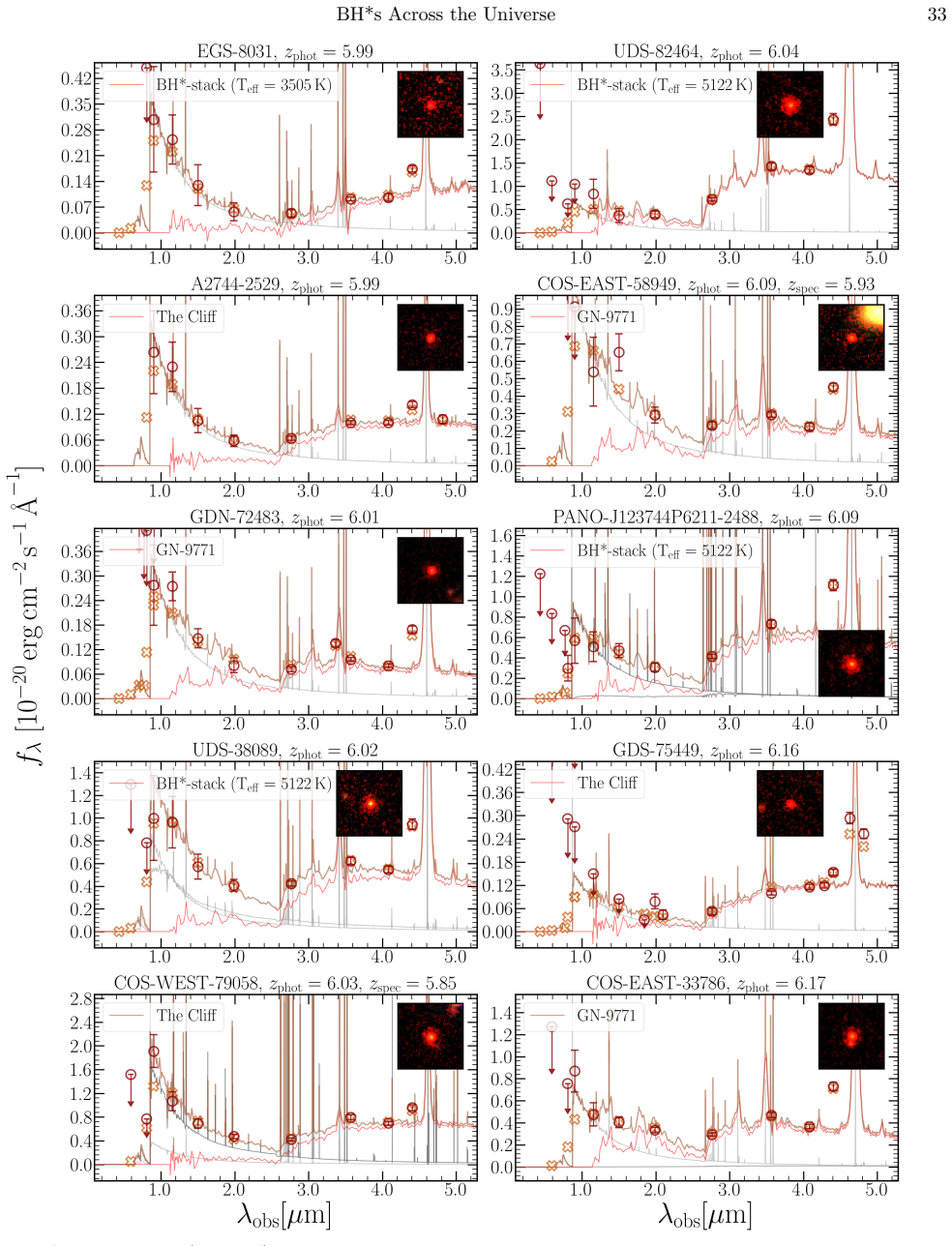
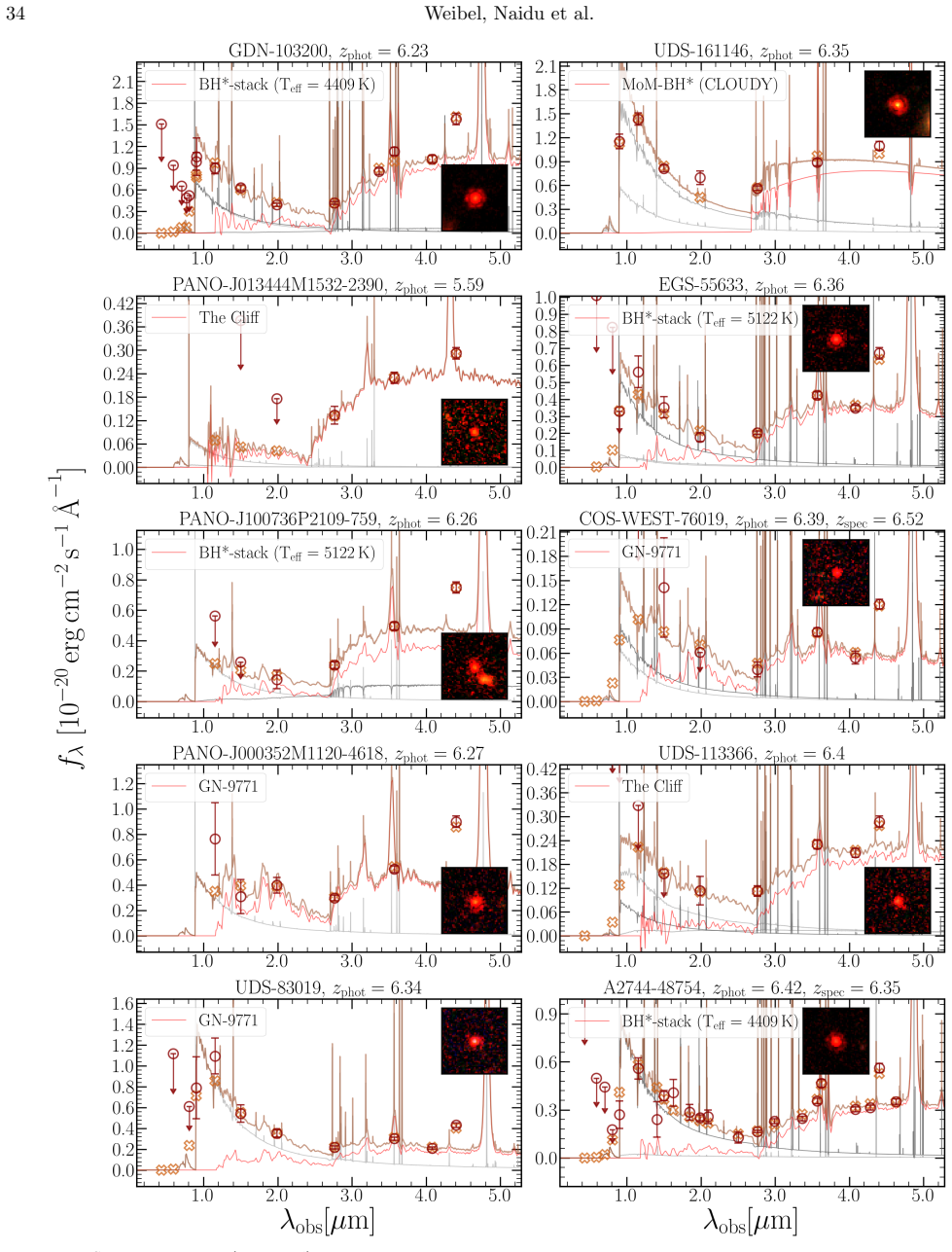
BH*-dominated Little Red Dots exist from z~1.7 to 9.3 and persist until cosmic noon.
A machine-rendered reading of the paper's core claim, the machinery that carries it, and where it could break.
Core claim
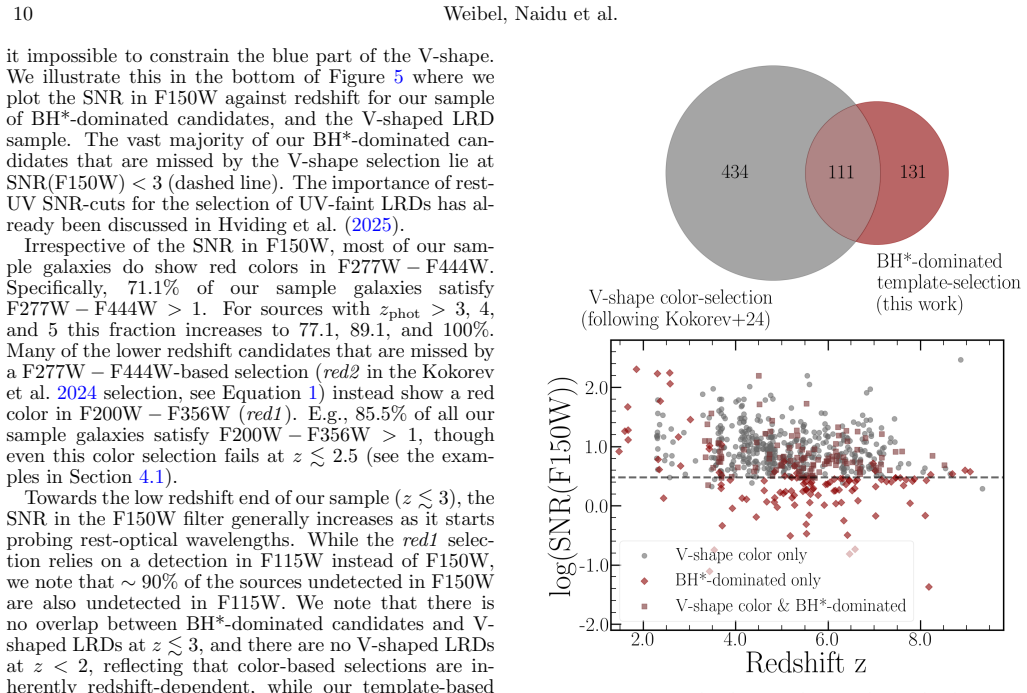
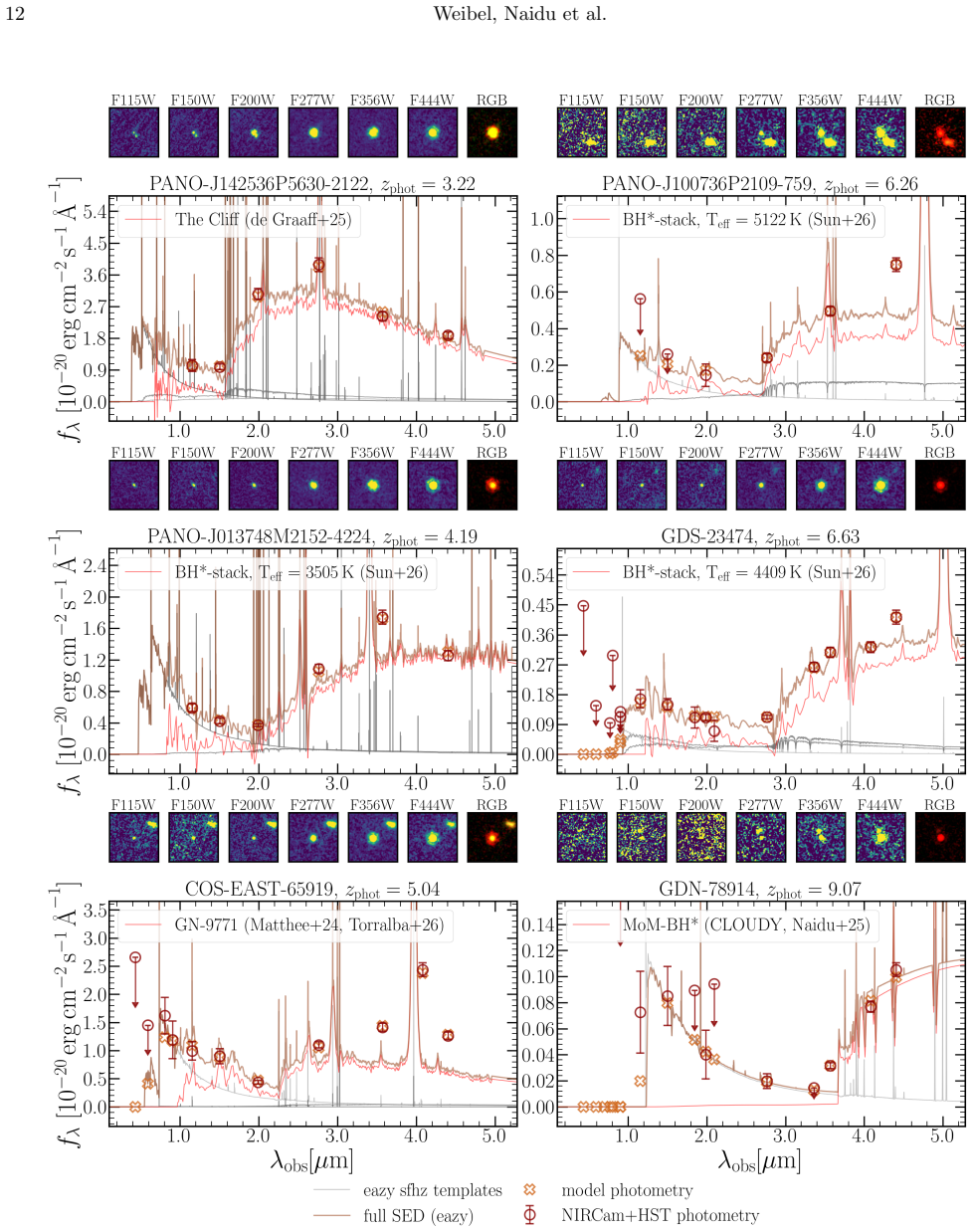
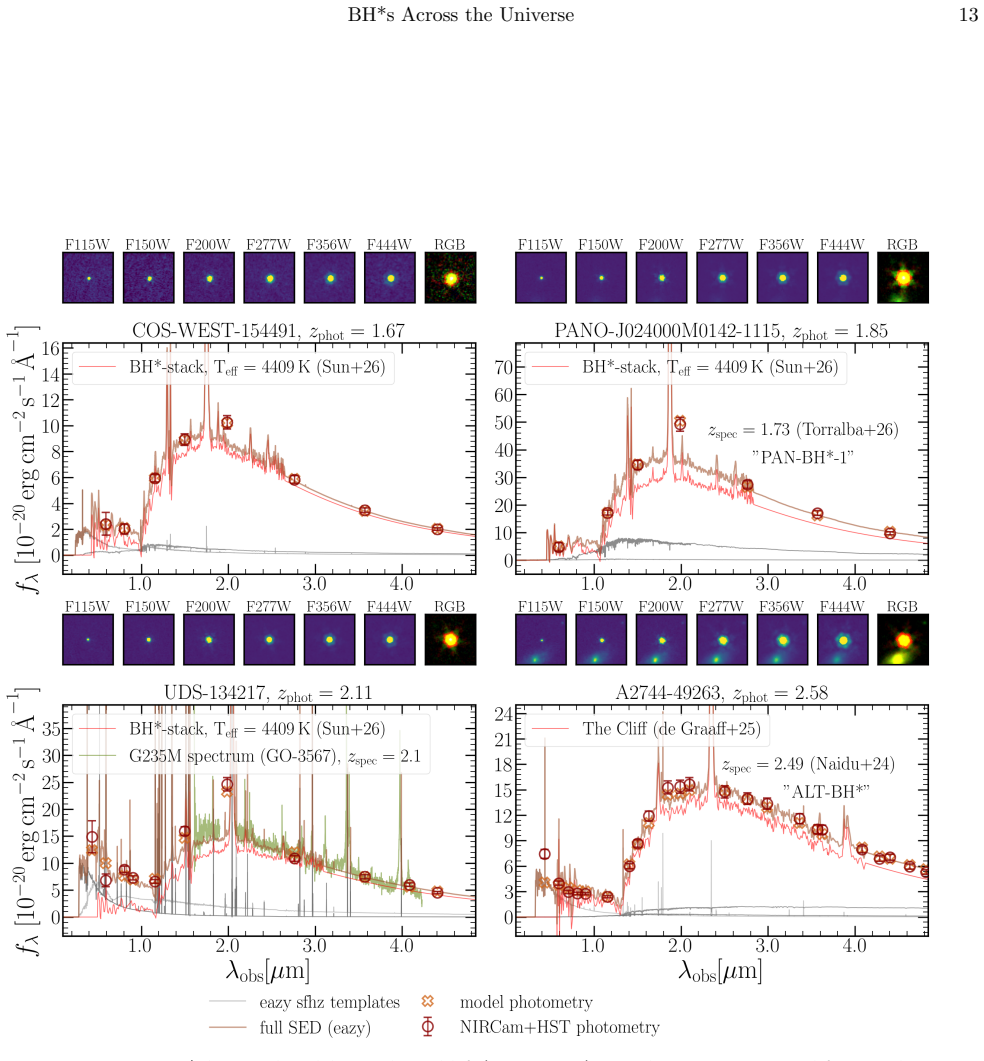
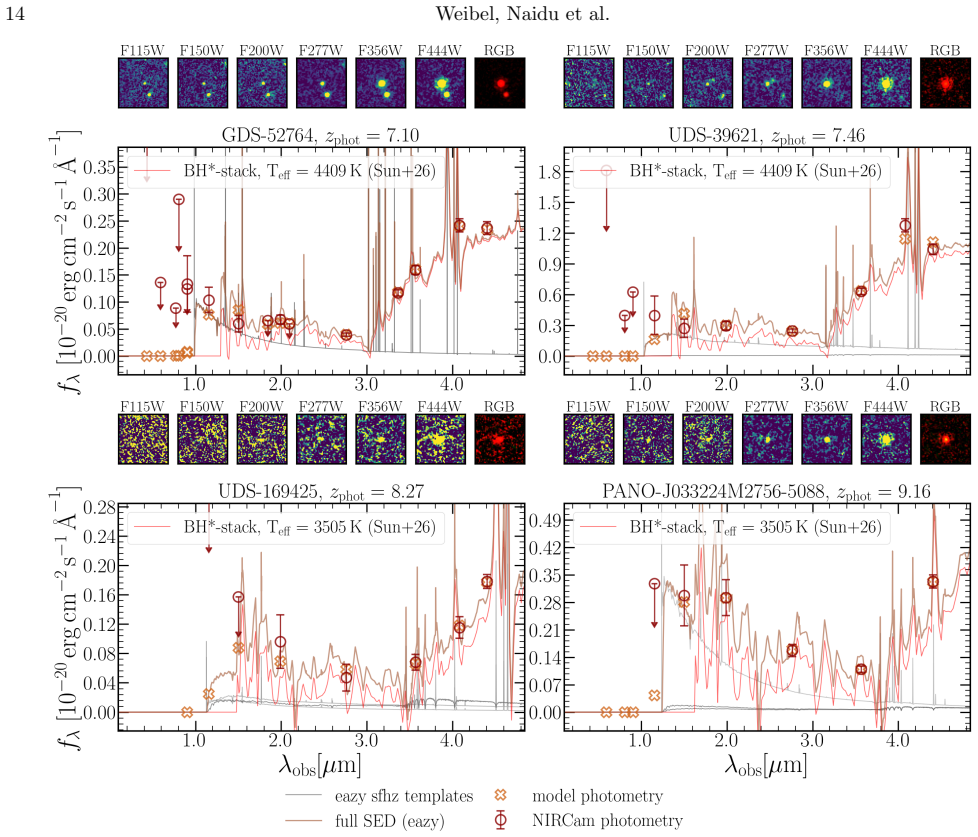
Selecting compact sources where a BH* template contributes >80% to the best fitting SED in the rest-optical yields a sample of 241 BH*-dominated candidates spanning z~1.7-9.3 and log(L_5100) ~42-44.5. These objects show a median Balmer break of ~3 with some exceeding 10, and bolometric luminosities log(L_bol) ~42-45 that imply Eddington-accreting black holes of 10^4-10^7 solar masses. The number density reaches ~10^{-5} Mpc^{-3} at z~5-6 before declining toward z~2, demonstrating that BH*-dominated sources persist at least until cosmic noon.
What carries the argument
The >80% BH* template contribution threshold applied to the rest-optical in eazy SED fitting, which selects central-engine-dominated sources independent of a blue UV excess.
Load-bearing premise
That a BH* template contribution exceeding 80% in the rest-optical reliably isolates central-engine-dominated sources without substantial contamination from star-forming hosts or other SED components.
What would settle it
Spectroscopic observations showing that most selected candidates exhibit strong star-formation emission lines or host-galaxy features inconsistent with central-engine dominance would falsify the isolation method.
Figures


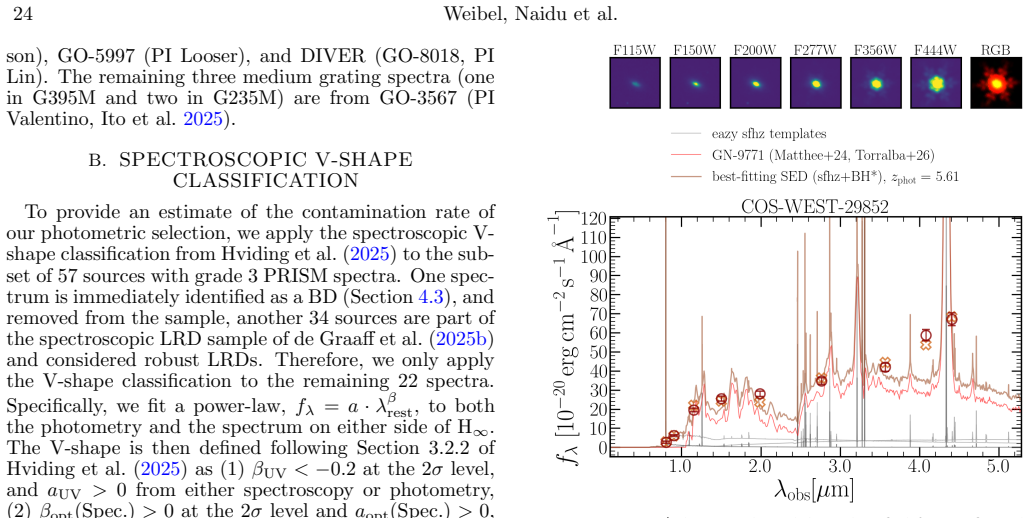

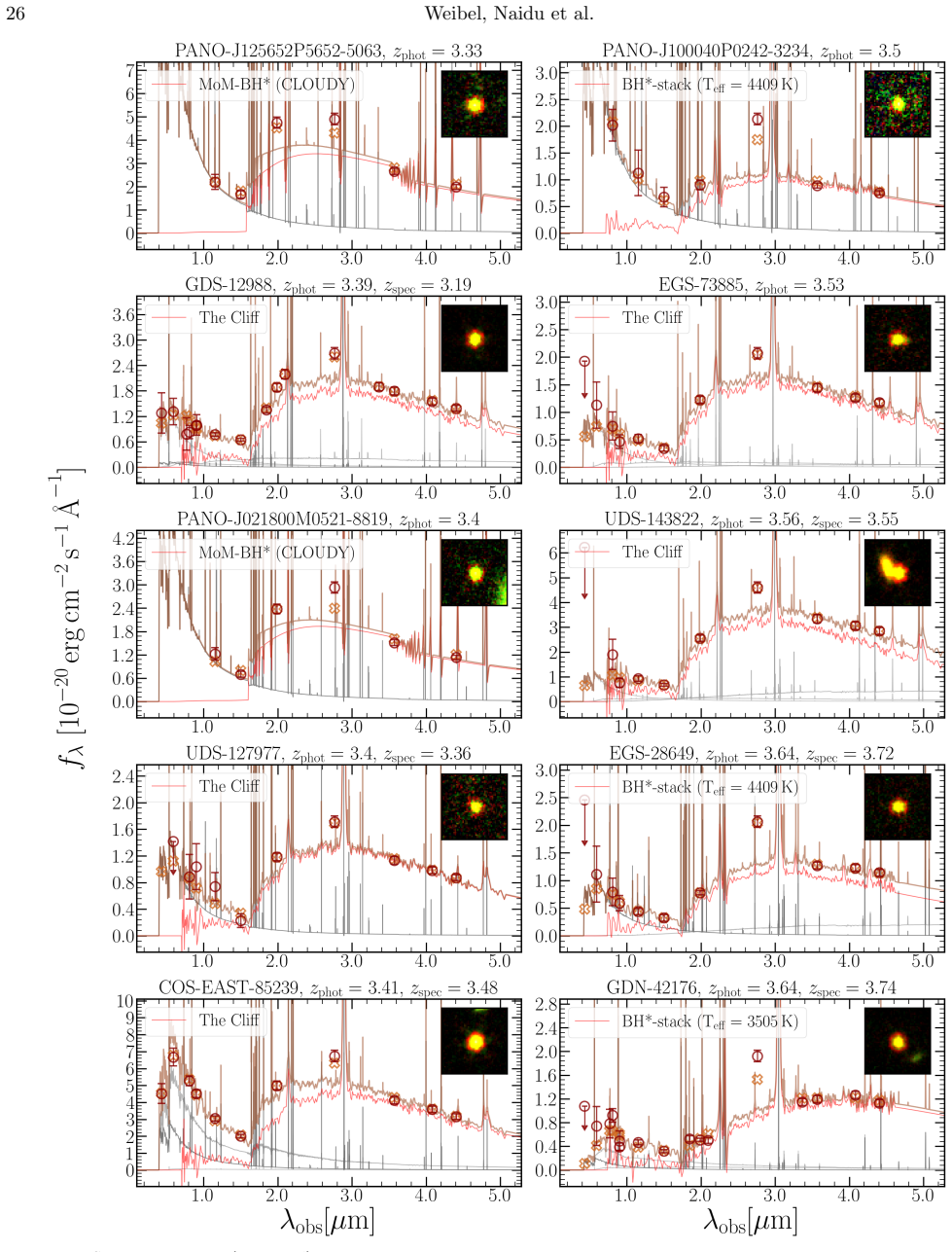


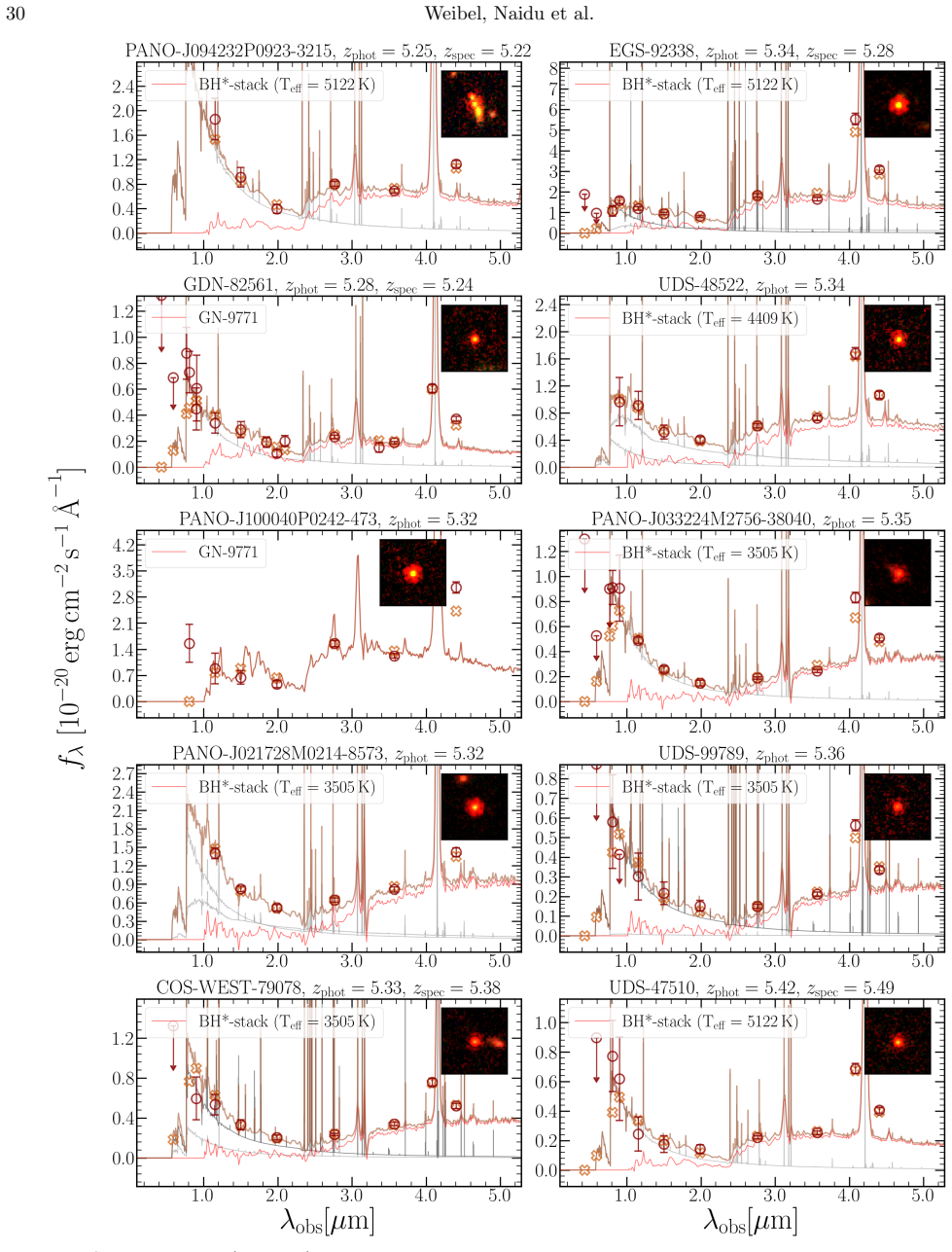

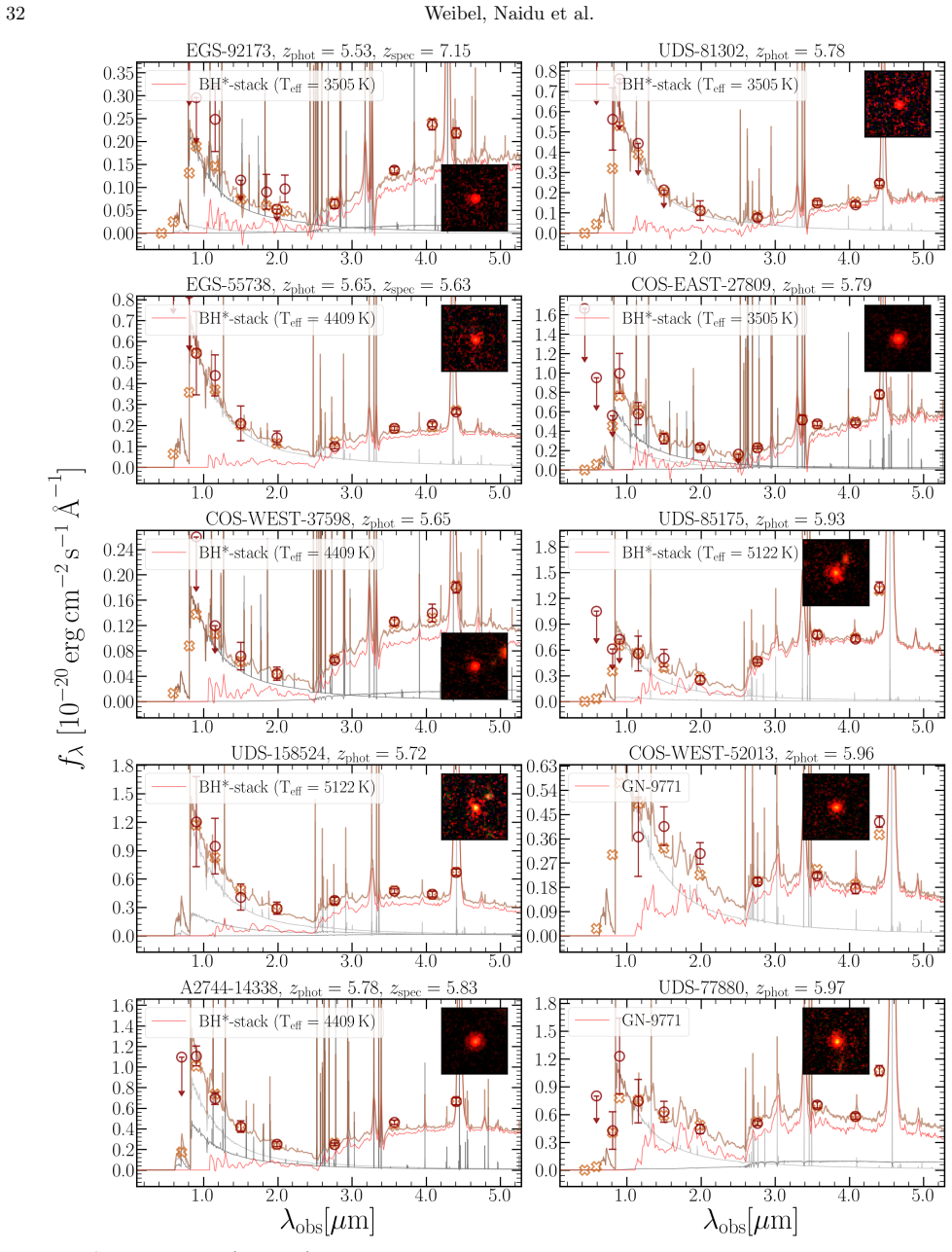


read the original abstract
Photometric selections of Little Red Dots (LRDs) largely rely on identifying their ``V-shaped'' spectral energy distribution (SED). Recent work suggests this V-shape stems from a combination of a central engine -- also referred to as a Black Hole Star (BH*) -- and a star-forming host galaxy. We present a new and highly complementary photometric selection that is based on incorporating BH* templates in the \texttt{eazy} redshift fitting code. Selecting compact sources where a BH* template contributes $>80$\% to the best fitting SED in the rest-optical, we compile a sample of 241 BH*-dominated candidates from $\sim1000\,{\rm arcmin}^2$ of legacy and pure parallel JWST imaging. Our selection does not require a blue UV-component, and it successfully identifies objects that resemble the paradigmatic sources ``MoM-BH*-1'' and ``The Cliff''. We find that BH*-dominated sources exist across a wide range of redshifts ($z\sim1.7-9.3$) and optical luminosities (log$(L_{5100}/{\rm erg}\,{\rm s}^{-1})\sim42-44.5$), and we measure a median Balmer break strength of $\sim3$, with some breaks reaching values $>10$. We estimate bolometric luminosities in the range log$(L_{\rm bol}/{\rm erg}\,{\rm s}^{-1})\sim42-45$, which, assuming accretion at the Eddington-limit, would translate to black hole masses of $M_{\rm BH}\sim10^4-10^7{\rm M_\odot}$, spanning the intermediate mass black hole to the quasar regime. The number density of BH*-dominated candidates peaks at $z\sim5-6$ ($\sim10^{-5}\,{\rm Mpc}^{-3}$) and it declines by an order of magnitude down to $z\sim2$. Tentatively, comparing to V-shaped LRD samples suggests that the fraction of BH*-dominated sources among the broader LRD population does not decrease towards lower redshift. Crucially, our work demonstrates that BH*-dominated sources are not merely an early-Universe phenomenon but rather persist at least until cosmic noon.
Editorial analysis
A structured set of objections, weighed in public.
Referee Report
Summary. The manuscript introduces a photometric selection for central-engine-dominated Little Red Dots (LRDs), termed Black Hole Stars (BH*), by adding BH* templates to the eazy code and requiring that a BH* template contributes >80% of the rest-optical flux in the best-fit SED. From ~1000 arcmin² of JWST legacy and pure-parallel imaging, the authors compile 241 compact candidates at z~1.7–9.3 with median Balmer-break strength ~3, bolometric luminosities log L_bol ~42–45, and implied BH masses 10^4–10^7 M_⊙. They report a number density peaking at ~10^{-5} Mpc^{-3} near z~5–6 and declining by an order of magnitude to z~2, and tentatively conclude that the BH*-dominated fraction among LRDs does not decrease toward lower redshift, demonstrating that such sources persist to cosmic noon.
Significance. If the >80% BH* cut cleanly isolates central-engine-dominated sources, the work supplies a valuable complementary sample to V-shaped LRD selections, extends the known redshift baseline of intermediate-mass BH candidates, and supplies the first quantitative indication that the phenomenon is not confined to the reionization era. The reported number-density evolution and Balmer-break statistics would then directly constrain seeding and accretion models at 1<z<3.
major comments (3)
- [Selection criterion (abstract and methods description)] The central persistence claim (abstract) rests on the single 80% BH* contribution threshold applied to eazy fits; no mock-catalog tests, spectroscopic validation, or sensitivity analysis to template library choices are presented to show that this cut excludes star-forming or dusty-host contamination at z≲3, where the rest-optical is more easily mimicked by host-galaxy light.
- [Number density and redshift distribution (results)] The reported decline in number density from z~5–6 to z~2 and the non-decreasing BH*-dominated fraction among LRDs are derived from the 241-candidate sample without stated completeness corrections, area-weighted selection functions, or error budgets on the ~1000 arcmin² survey volume; these quantities are load-bearing for the evolutionary conclusion.
- [Comparison to prior LRD samples (discussion)] The tentative comparison to V-shaped LRD samples (abstract) is presented without quantitative overlap statistics, shared selection functions, or control samples, leaving open whether the claimed persistence is an artifact of differing selection biases rather than a physical result.
minor comments (2)
- [Survey description] The abstract states the survey area as '~1000 arcmin²' but provides no breakdown by field, depth, or filter coverage that would allow independent assessment of the sample construction.
- [Template fitting description] Notation for the BH* template contribution (e.g., exact wavelength range used for the 'rest-optical' fraction) is not defined in the provided text, complicating reproducibility of the 80% cut.
Simulated Author's Rebuttal
We thank the referee for their constructive and detailed report. We address each major comment below and have revised the manuscript to strengthen the presentation of our results while acknowledging limitations where appropriate.
read point-by-point responses
-
Referee: [Selection criterion (abstract and methods description)] The central persistence claim (abstract and methods description) rests on the single 80% BH* contribution threshold applied to eazy fits; no mock-catalog tests, spectroscopic validation, or sensitivity analysis to template library choices are presented to show that this cut excludes star-forming or dusty-host contamination at z≲3, where the rest-optical is more easily mimicked by host-galaxy light.
Authors: We agree that the 80% threshold is central to the selection and that additional validation would be valuable. The manuscript does not include mock-catalog tests or spectroscopic validation, as these are beyond the scope of the current photometric analysis. In revision we have added a sensitivity analysis varying the BH* contribution threshold (70–90%) and template library choices, demonstrating that the redshift distribution, Balmer-break statistics, and number-density trend remain qualitatively unchanged. We have also expanded the discussion of potential low-z contamination, noting that the observed median Balmer-break strength of ~3 (with values >10) is difficult to reproduce with pure host-galaxy templates at z≲3. revision: partial
-
Referee: [Number density and redshift distribution (results)] The reported decline in number density from z~5–6 to z~2 and the non-decreasing BH*-dominated fraction among LRDs are derived from the 241-candidate sample without stated completeness corrections, area-weighted selection functions, or error budgets on the ~1000 arcmin² survey volume; these quantities are load-bearing for the evolutionary conclusion.
Authors: We acknowledge that a full treatment of completeness and selection functions is desirable. The ~1000 arcmin² area comprises a heterogeneous mix of legacy and pure-parallel fields, precluding a uniform area-weighted selection function or completeness correction with existing data. In the revised manuscript we have added an explicit error budget incorporating Poisson statistics and field-to-field variance, clarified the effective comoving volume calculation, and inserted appropriate caveats on the number-density evolution. The reported order-of-magnitude decline remains significant within these uncertainties. revision: yes
-
Referee: [Comparison to prior LRD samples (discussion)] The tentative comparison to V-shaped LRD samples (abstract) is presented without quantitative overlap statistics, shared selection functions, or control samples, leaving open whether the claimed persistence is an artifact of differing selection biases rather than a physical result.
Authors: The comparison is explicitly labeled tentative in the abstract and discussion. We have expanded the relevant section to describe the methodological differences between the BH*-dominated selection and V-shaped LRD selections and to explain why quantitative overlap statistics would require a joint re-analysis of identical fields. We agree that shared selection functions would be the ideal next step but lie outside the present work; the persistence statement is therefore presented only as a suggestion supported by the current data. revision: partial
Circularity Check
No significant circularity: selection and counts are independent of fitted parameters
full rationale
The paper applies an external template library inside the eazy code to photometric data and defines the sample via a fixed >80% BH* contribution threshold in the rest-optical; number densities, luminosities, and the persistence claim are then obtained by direct counting of the selected objects in redshift bins. No equations, self-citations, or ansatzes are shown that reduce these outputs to quantities defined by the same fit parameters or prior author work. The derivation chain therefore remains self-contained against external benchmarks.
Axiom & Free-Parameter Ledger
free parameters (1)
- 80% BH* contribution threshold
Reference graph
Works this paper leans on
-
[1]
2022, ApJS, 263, 42, doi: 10.3847/1538-4365/ac9ead
A Catalog of Quasar Properties from Sloan Digital Sky Survey Data Release 16. , keywords =. doi:10.3847/1538-4365/ac9ead , archivePrefix =. 2209.03987 , primaryClass =
-
[2]
Mysteries of Capotauro: Investigating the puzzling nature of an extreme F356W-dropout. , keywords =. doi:10.1051/0004-6361/202557061 , archivePrefix =. 2509.01664 , primaryClass =
-
[3]
2026 , eprint=
The Extreme Rarity and Physical Properties of Low-redshift AGNs with Balmer Absorption , author=. 2026 , eprint=
2026
-
[4]
2025, MNRAS, 536, 3677, doi: 10.1093/mnras/stae2765 Astropy Collaboration, Robitaille, T
The nature of low-luminosity AGNs discovered by JWST based on clustering analysis: progenitors of low-z quasars?. , keywords =. doi:10.1093/mnras/stae2765 , archivePrefix =. 2410.08707 , primaryClass =
-
[5]
How to quench a dwarf galaxy: The impact of inhomogeneous reionization on dwarf galaxies and cosmic filaments. , keywords =. doi:10.1093/mnras/staa639 , archivePrefix =. 1905.11414 , primaryClass =
-
[6]
D., Onoue, M., Inayoshi, K., et al
Hidden Little Monsters: Spectroscopic Identification of Low-mass, Broad-line AGNs at z > 5 with CEERS. , keywords =. doi:10.3847/2041-8213/ace5a0 , archivePrefix =. 2302.00012 , primaryClass =
-
[7]
Little Red Dot - Host Galaxy = Black Hole Star: A Gas-Enshrouded Heart at the Center of Every Little Red Dot. arXiv e-prints , keywords =. doi:10.48550/arXiv.2601.20929 , archivePrefix =. 2601.20929 , primaryClass =
work page internal anchor Pith review Pith/arXiv arXiv doi:10.48550/arxiv.2601.20929
-
[8]
The M_ BH -M_ * Relationship at 3<z<7 : Big Black Holes in Little Red Dots. arXiv e-prints , keywords =. doi:10.48550/arXiv.2510.07376 , archivePrefix =. 2510.07376 , primaryClass =
-
[9]
The M-sigma Relation in Local Active Galaxies
The M _ BH - _ * Relation in Local Active Galaxies. , keywords =. doi:10.1086/500507 , archivePrefix =. astro-ph/0512461 , primaryClass =
work page internal anchor Pith review Pith/arXiv arXiv doi:10.1086/500507
-
[10]
Sustained super-Eddington accretion in high-redshift quasars. , keywords =. doi:10.1051/0004-6361/202348788 , archivePrefix =. 2312.08422 , primaryClass =
-
[11]
Size matters: are we witnessing super-Eddington accretion in high-redshift black holes from JWST?. , keywords =. doi:10.1051/0004-6361/202451249 , archivePrefix =. 2406.17847 , primaryClass =
-
[12]
Rapidly Accreting Supergiant Protostars: Embryos of Supermassive Black Holes?
Rapidly Accreting Supergiant Protostars: Embryos of Supermassive Black Holes?. , keywords =. doi:10.1088/0004-637X/756/1/93 , archivePrefix =. 1203.2613 , primaryClass =
work page internal anchor Pith review Pith/arXiv arXiv doi:10.1088/0004-637x/756/1/93
-
[13]
Nature Reviews Physics , keywords =
The origins of massive black holes. Nature Reviews Physics , keywords =. doi:10.1038/s42254-021-00364-9 , archivePrefix =. 2110.10175 , primaryClass =
-
[14]
2026, arXiv e-prints, arXiv:2601.04955, doi: 10.48550/arXiv.2601.04955
Rapid emergence of overmassive black holes in the early Universe. arXiv e-prints , keywords =. doi:10.48550/arXiv.2601.04955 , archivePrefix =. 2601.04955 , primaryClass =
-
[15]
Primordial Black Holes as Dark Matter
Primordial black holes as dark matter. , keywords =. doi:10.1103/PhysRevD.94.083504 , archivePrefix =. 1607.06077 , primaryClass =
work page internal anchor Pith review Pith/arXiv arXiv doi:10.1103/physrevd.94.083504
-
[16]
Intermediate-Mass Black Holes. , keywords =. doi:10.1146/annurev-astro-032620-021835 , archivePrefix =. 1911.09678 , primaryClass =
work page internal anchor Pith review Pith/arXiv arXiv doi:10.1146/annurev-astro-032620-021835 1911
-
[17]
The properties of primordially-seeded black holes and their hosts in the first billion years: implications for JWST. , keywords =. doi:10.1051/0004-6361/202555959 , archivePrefix =. 2506.08116 , primaryClass =
-
[18]
The possible accretion discs of GN-z11 at redshift z = 10.6, MoM-z14 at z = 14.44 and other high redshift objects. arXiv e-prints , keywords =. doi:10.48550/arXiv.2509.05459 , archivePrefix =. 2509.05459 , primaryClass =
-
[19]
doi:10.5281/zenodo.7299500 , eid =
-
[20]
VENUS: Two Faint Little Red Dots Separated by 70\,pc Hidden in a Single Lensed Galaxy at z 7. arXiv e-prints , keywords =. doi:10.48550/arXiv.2601.06015 , archivePrefix =. 2601.06015 , primaryClass =
-
[21]
Relations Between Central Black Hole Mass and Total Galaxy Stellar Mass in the Local Universe
Relations between Central Black Hole Mass and Total Galaxy Stellar Mass in the Local Universe. , keywords =. doi:10.1088/0004-637X/813/2/82 , archivePrefix =. 1508.06274 , primaryClass =
work page internal anchor Pith review Pith/arXiv arXiv doi:10.1088/0004-637x/813/2/82
-
[22]
UNCOVER: 404 Error Models Not Found for the Triply Imaged Little Red Dot A2744-QSO1. , keywords =. doi:10.3847/1538-4357/ada613 , archivePrefix =. 2410.06257 , primaryClass =
-
[23]
Tip of the Iceberg: Overmassive Black Holes at 4 < z < 7 Found by JWST Are Not Inconsistent with the Local Relation. , keywords =. doi:10.3847/1538-4357/ada603 , archivePrefix =. 2403.00074 , primaryClass =
-
[24]
2025, arXiv e-prints, arXiv:2512.04208, doi: 10.48550/arXiv.2512.04208
A Black-Hole Envelope Interpretation for Cosmological Demographics of Little Red Dots. arXiv e-prints , keywords =. doi:10.48550/arXiv.2512.04208 , archivePrefix =. 2512.04208 , primaryClass =
-
[25]
Irony at z=6.68: a bright AGN with forbidden Fe emission and multi-component Balmer absorption. arXiv e-prints , keywords =. doi:10.48550/arXiv.2510.00101 , archivePrefix =. 2510.00101 , primaryClass =
-
[26]
SN 1994W: an interacting supernova or two interacting shells?. , keywords =. doi:10.1111/j.1365-2966.2008.14042.x , archivePrefix =. 0804.0428 , primaryClass =
-
[27]
2023, ApJL, 957, L7, doi: 10.3847/2041-8213/ad037a
UNCOVER: A NIRSpec Identification of a Broad-line AGN at z = 8.50. , keywords =. doi:10.3847/2041-8213/ad037a , archivePrefix =. 2308.11610 , primaryClass =
-
[28]
2024b, ApJ, 975, 178, doi: 10.3847/1538-4357/ad7d03
Silencing the Giant: Evidence of Active Galactic Nucleus Feedback and Quenching in a Little Red Dot at z = 4.13. , keywords =. doi:10.3847/1538-4357/ad7d03 , archivePrefix =. 2407.20320 , primaryClass =
-
[29]
MINERVA: A NIRCam Medium Band and MIRI Imaging Survey to Unlock the Hidden Gems of the Distant Universe. arXiv e-prints , keywords =. doi:10.48550/arXiv.2507.19706 , archivePrefix =. 2507.19706 , primaryClass =
-
[30]
An Extremely Compact, Low-mass Galaxy on its Way to Quiescence at z = 5.2. , keywords =. doi:10.3847/2041-8213/acd457 , archivePrefix =. 2303.11349 , primaryClass =
-
[31]
A catalog of rich clusters of galaxies. , keywords =. doi:10.1086/191333 , adsurl =
-
[32]
JWST UNCOVER: the overabundance of ultraviolet-luminous galaxies at z > 9. , keywords =. doi:10.1093/mnras/stae1260 , archivePrefix =. 2312.05030 , primaryClass =
-
[33]
Evolutionary Tracks and Spectral Properties of Quasi-stars and Their Correlation with Little Red Dots. , keywords =. doi:10.3847/2041-8213/ae3713 , archivePrefix =. 2510.17952 , primaryClass =
-
[34]
Quasar evolution and the growth of black holes. , keywords =. doi:10.1093/mnras/259.4.725 , adsurl =
-
[35]
doi:10.5281/zenodo.15472354 , url =
Brammer, Gabriel and Valentino, Francesco , title =. doi:10.5281/zenodo.15472354 , url =
-
[36]
doi:10.5281/zenodo.8319596 , version =
msaexp: NIRSpec analyis tools. doi:10.5281/zenodo.8319596 , version =
-
[37]
RUBIES: A complete census of the bright and red distant Universe with JWST/NIRSpec. , keywords =. doi:10.1051/0004-6361/202452186 , archivePrefix =. 2409.05948 , primaryClass =
-
[38]
The JWST-PRIMAL archival survey: A JWST/NIRSpec reference sample for the physical properties and Lyman- absorption and emission of 600 galaxies at z = 5.0 ‑ 13.4. , keywords =. doi:10.1051/0004-6361/202450243 , archivePrefix =. 2404.02211 , primaryClass =
-
[39]
The atmospheric structure and fundamental parameters of the red supergiants AH Scorpii, UY Scuti, and KW Sagittarii. , keywords =. doi:10.1051/0004-6361/201220920 , archivePrefix =. 1305.6179 , primaryClass =
work page internal anchor Pith review Pith/arXiv arXiv doi:10.1051/0004-6361/201220920
-
[40]
Active Galactic Nuclei Selection and Demographics: A New Age with JWST/MIRI. , keywords =. doi:10.3847/1538-4357/ad3643 , archivePrefix =. 2310.12330 , primaryClass =
-
[41]
Significant Evidence of an AGN Contribution in GHZ2 at z = 12.34. arXiv e-prints , keywords =. doi:10.48550/arXiv.2511.03035 , archivePrefix =. 2511.03035 , primaryClass =
-
[42]
The Deepest GLIMPSE of a Dense Gas Cocoon Enshrouding a Little Red Dot. arXiv e-prints , keywords =. doi:10.48550/arXiv.2511.07515 , archivePrefix =. 2511.07515 , primaryClass =
-
[43]
The Large-scale Environments of Low-luminosity AGNs at 3.9 < z < 6 and Implications for Their Host Dark Matter Halos from a Complete NIRCam Grism Redshift Survey. arXiv e-prints , keywords =. doi:10.48550/arXiv.2505.02896 , archivePrefix =. 2505.02896 , primaryClass =
-
[44]
Investigating photometric and spectroscopic variability in the multiply imaged little red dot A2744-QSO1. , keywords =. doi:10.1051/0004-6361/202554110 , archivePrefix =. 2502.07875 , primaryClass =
-
[45]
2026, MNRAS, 545, staf2131, doi: 10.1093/mnras/staf2131
Impact of resonance, Raman, and Thomson scattering on hydrogen line formation in Little Red Dots. , keywords =. doi:10.1093/mnras/staf2131 , archivePrefix =. 2508.08768 , primaryClass =
-
[46]
The Balmer Break and Optical Continuum of Little Red Dots from Super-Eddington Accretion. , keywords =. doi:10.3847/1538-4357/ae0c19 , archivePrefix =. 2507.07190 , primaryClass =
-
[47]
2025, ApJL, 980, L27, doi: 10.3847/2041-8213/adaebd
Extremely Dense Gas around Little Red Dots and High-redshift Active Galactic Nuclei: A Nonstellar Origin of the Balmer Break and Absorption Features. , keywords =. doi:10.3847/2041-8213/adaebd , archivePrefix =. 2409.07805 , primaryClass =
-
[48]
Little Red Dots as the Very First Activity of Black Hole Growth. , keywords =. doi:10.3847/2041-8213/adea66 , archivePrefix =. 2503.05537 , primaryClass =
-
[49]
Spectral Uniformity of Little Red Dots: A Natural Outcome of Coevolving Seed Black Holes and Nascent Starbursts. arXiv e-prints , keywords =. doi:10.48550/arXiv.2509.19422 , archivePrefix =. 2509.19422 , primaryClass =
work page internal anchor Pith review Pith/arXiv arXiv doi:10.48550/arxiv.2509.19422
-
[50]
2026c, ApJ, 997, 364, doi: 10.3847/1538-4357/ae2bdf
The Discovery of Little Red Dots in the Local Universe: Signatures of Cool Gas Envelopes. , keywords =. doi:10.3847/1538-4357/ae2bdf , archivePrefix =. 2507.10659 , primaryClass =
-
[51]
JADES and BlackTHUNDER: rest-frame Balmer-line absorption and the local environment in a Little Red Dot at z = 5. arXiv e-prints , keywords =. doi:10.48550/arXiv.2506.14870 , archivePrefix =. 2506.14870 , primaryClass =
-
[52]
Environmental Evidence for Overly Massive Black Holes in Low-mass Galaxies and a Black Hole Halo Mass Relation at z 5. , keywords =. doi:10.3847/1538-4357/ade886 , archivePrefix =. 2412.02846 , primaryClass =
-
[53]
2026, arXiv e-prints, arXiv:2603.17667, doi: 10.48550/arXiv.2603.17667
The Engine and its Flows: Little Red Dot spectra are shaped by the column densities of their gas envelopes. arXiv e-prints , keywords =. doi:10.48550/arXiv.2603.17667 , archivePrefix =. 2603.17667 , primaryClass =
-
[54]
Radio emission from little red dots may reveal their true nature. , keywords =. doi:10.1051/0004-6361/202453194 , archivePrefix =. 2502.03742 , primaryClass =
-
[55]
Quasar Clustering and the Lifetime of Quasars
Quasar Clustering and the Lifetime of Quasars. , keywords =. doi:10.1086/318331 , archivePrefix =. astro-ph/0002384 , primaryClass =
work page internal anchor Pith review Pith/arXiv arXiv doi:10.1086/318331
-
[56]
Black Hole Envelopes in Little Red Dots. , keywords =. doi:10.1093/mnras/staf1898 , archivePrefix =. 2505.06965 , primaryClass =
-
[57]
Precise Bolometric Luminosities and Effective Temperatures of 23 Late-T and Y Dwarfs Obtained with JWST. , keywords =. doi:10.3847/1538-4357/ad6301 , archivePrefix =. 2407.08518 , primaryClass =
-
[58]
Little Red Dots as Late-stage Quasi-stars. , keywords =. doi:10.3847/1538-4357/ae274a , archivePrefix =. 2507.09085 , primaryClass =
-
[59]
Population III stars: hidden or disappeared?. , keywords =. doi:10.1111/j.1365-2966.2007.12215.x , archivePrefix =. 0707.1433 , primaryClass =
-
[60]
ALMA Lensing Cluster Survey: Hubble Space Telescope and Spitzer Photometry of 33 Lensed Fields Built with CHArGE. , keywords =. doi:10.3847/1538-4365/ac9909 , archivePrefix =. 2207.07125 , primaryClass =
-
[61]
An Atlas of Color-selected Quiescent Galaxies at z > 3 in Public JWST Fields. , keywords =. doi:10.3847/1538-4357/acbefa , archivePrefix =. 2302.10936 , primaryClass =
-
[62]
Population III star-forming environments
A needle in a haystack? Catching Population III stars in the epoch of reionization: I. Population III star-forming environments. , keywords =. doi:10.1093/mnras/stad1201 , archivePrefix =. 2301.10259 , primaryClass =
-
[63]
The Brightest Ly$\alpha$ Emitter: Pop III or Black Hole?
The brightest Ly emitter: Pop III or black hole?. , keywords =. doi:10.1093/mnras/stv1795 , archivePrefix =. 1506.07173 , primaryClass =
work page internal anchor Pith review Pith/arXiv arXiv doi:10.1093/mnras/stv1795
-
[64]
Bursting at the seams: the star-forming main sequence and its scatter at z = 3─9 using NIRCam photometry from JADES. , keywords =. doi:10.1093/mnras/staf1950 , archivePrefix =. 2508.04410 , primaryClass =
-
[65]
Origins of the UV continuum and Balmer emission lines in Little Red Dots: observational validation of dense gas envelope models enshrouding the AGN. arXiv e-prints , keywords =. doi:10.48550/arXiv.2601.10573 , archivePrefix =. 2601.10573 , primaryClass =
work page internal anchor Pith review Pith/arXiv arXiv doi:10.48550/arxiv.2601.10573
-
[66]
Relatively Fast and Reasonably Furious: Evidence for Increased Burstiness in Smaller Halos at Cosmic Dawn. arXiv e-prints , keywords =. doi:10.48550/arXiv.2601.07912 , archivePrefix =. 2601.07912 , primaryClass =
work page internal anchor Pith review Pith/arXiv arXiv doi:10.48550/arxiv.2601.07912
-
[67]
Spatially resolved broad line region in a quasar at z=4: Dynamical black hole mass and prominent outflow. arXiv e-prints , keywords =. doi:10.48550/arXiv.2509.13911 , archivePrefix =. 2509.13911 , primaryClass =
-
[68]
The AURORA Survey: Robust Helium Abundances at High Redshift Reveal a Subpopulation of Helium-enhanced Galaxies in the Early Universe. , keywords =. doi:10.3847/1538-4357/ae18db , archivePrefix =. 2507.17057 , primaryClass =
-
[69]
Nonparametric Star Formation History Reconstruction with Gaussian Processes. I. Counting Major Episodes of Star Formation. , keywords =. doi:10.3847/1538-4357/ab2052 , archivePrefix =. 1901.02877 , primaryClass =
work page internal anchor Pith review Pith/arXiv arXiv doi:10.3847/1538-4357/ab2052 1901
-
[70]
EIGER. II. First Spectroscopic Characterization of the Young Stars and Ionized Gas Associated with Strong H and [O III] Line Emission in Galaxies at z = 5-7 with JWST. , keywords =. doi:10.3847/1538-4357/acc846 , archivePrefix =. 2211.08255 , primaryClass =
-
[71]
The star-forming and ionizing properties of dwarf z 6-9 galaxies in JADES: insights on bursty star formation and ionized bubble growth. , keywords =. doi:10.1093/mnras/stae1857 , archivePrefix =. 2306.05295 , primaryClass =
-
[72]
EIGER. VI. The Correlation Function, Host Halo Mass, and Duty Cycle of Luminous Quasars at z 6. , keywords =. doi:10.3847/1538-4357/ad778b , archivePrefix =. 2403.07986 , primaryClass =
-
[73]
The Impact of Mass-dependent Stochasticity at Cosmic Dawn. , keywords =. doi:10.3847/1538-4357/ad7b36 , archivePrefix =. 2405.13108 , primaryClass =
-
[74]
Breaking degeneracies in the first galaxies with clustering. , keywords =. doi:10.1093/mnrasl/slad115 , archivePrefix =. 2306.09403 , primaryClass =
-
[75]
Supermassive primordial black holes in multiverse: for nano-Hertz gravitational wave and high-redshift JWST galaxies. arXiv e-prints , keywords =. doi:10.48550/arXiv.2306.17577 , archivePrefix =. 2306.17577 , primaryClass =
-
[76]
Sub-Eddington accreting supermassive primordial black holes explain Little Red Dots. arXiv e-prints , keywords =. doi:10.48550/arXiv.2410.20663 , archivePrefix =. 2410.20663 , primaryClass =
-
[77]
Scrutinizing the primordial black hole interpretation of PTA gravitational waves and JWST early galaxies. , keywords =. doi:10.1103/PhysRevD.109.123002 , archivePrefix =. 2307.01457 , primaryClass =
-
[78]
Accelerating Early Massive Galaxy Formation with Primordial Black Holes. , keywords =. doi:10.3847/2041-8213/ac927f , archivePrefix =. 2208.13178 , primaryClass =
-
[79]
Accelerated by dark matter: a high-redshift pathway to efficient galaxy-scale star formation. , keywords =. doi:10.1093/mnras/staf471 , archivePrefix =. 2407.10900 , primaryClass =
-
[80]
Feedback-free starbursts at cosmic dawn: Observable predictions for JWST. , keywords =. doi:10.1051/0004-6361/202348727 , archivePrefix =. 2311.14662 , primaryClass =
discussion (0)
Sign in with ORCID, Apple, or X to comment. Anyone can read and Pith papers without signing in.