Spectral Uniformity of Little Red Dots: A Natural Outcome of Coevolving Seed Black Holes and Nascent Starbursts
Pith reviewed 2026-05-18 14:32 UTC · model grok-4.3
The pith
The V-shaped spectra of little red dots result from seed black holes growing super-Eddington alongside young starbursts that quench after 15 million years.
A machine-rendered reading of the paper's core claim, the machinery that carries it, and where it could break.
Core claim
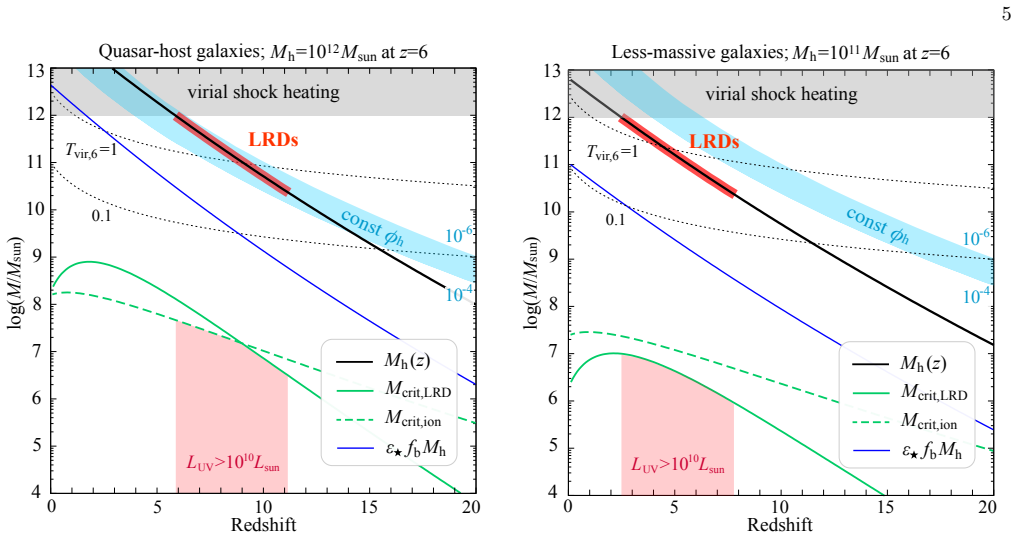
We investigate gas accretion during the assembly of massive halos with M_h ≳ 10^{10-11} M_⊙ at redshifts z ≃ 4-10, driving both rapid BH feeding and concurrent nuclear starbursts. As the BH grows to ∼10^{6-7} M_⊙ via super-Eddington accretion, the accretion power inflates a dense envelope whose effective temperature approaches the Hayashi limit at T_eff ≃ 5000 K, producing red optical emission, while a coeval young stellar population of ∼10^7 M_⊙ provides blue UV emission. This early coevolving system naturally reproduces the characteristic spectral features of the so-called little red dots (LRDs), a population of broad-line active galactic nuclei (AGNs), including the V-shaped UV-to-optical
What carries the argument
Super-Eddington accretion onto a seed black hole that inflates a dense envelope at the Hayashi limit temperature, coevolving with a nuclear starburst population.
Load-bearing premise
Super-Eddington accretion inflates a dense envelope that settles at an effective temperature near 5000 K to produce the dominant red optical emission.
What would settle it
Detection of strong X-ray or radio emission from little red dots, or measurement showing the red continuum originates from dust or stars instead of an accretion envelope, would challenge the model.
Figures



read the original abstract
The birth of seeds of massive black holes (BHs) and nascent galaxies at cosmic dawn takes place in dense gaseous environments, which play a crucial role in shaping their coevolution and radiation spectra. We investigate gas accretion during the assembly of massive halos with $M_{\rm h}\gtrsim 10^{10-11}~M_\odot$ at redshifts $z\simeq 4-10$, driving both rapid BH feeding and concurrent nuclear starbursts. As the BH grows to $\sim 10^{6-7}~M_\odot$ via super-Eddington accretion, the accretion power inflates a dense envelope whose effective temperature approaches the Hayashi limit at $T_{\rm eff}\simeq 5000~{\rm K}$, producing red optical emission, while a coeval young stellar population of $\sim 10^7~M_\odot$ provides blue UV emission. This early coevolving system naturally reproduces the characteristic spectral features of the so-called little red dots (LRDs), a population of broad-line active galactic nuclei (AGNs), including the V-shaped UV-to-optical spectra and weakness of X-ray, infrared, and radio emission. Massive stars in the nuclear starburst soon explode as supernovae, injecting energy and momentum that expel gas from the nucleus, quench gas supply to the BH envelope, and ultimately drive a transition into normal AGN phases. For individual LRDs, the optical-to-UV luminosity ratio remains nearly constant at $L_{\rm opt}/L_{\rm UV}\simeq 2-10$ from the onset of accretion bursts for $\simeq 15~{\rm Myr}$, one-third of the Salpeter time, until quenching by stellar feedback. While this ratio is sustained for the LRD population at $z\simeq 4-8$, it declines toward lower redshifts as BHs can no longer maintain red envelopes, thereby losing the LRD characteristics.
Editorial analysis
A structured set of objections, weighed in public.
Referee Report
Summary. The paper claims that the V-shaped UV-to-optical spectra, weakness of X-ray/IR/radio emission, and roughly constant L_opt/L_UV ratio of little red dots (LRDs) at z ≃ 4-8 are a natural outcome of coevolving seed black holes growing via super-Eddington accretion and concurrent nuclear starbursts in dense gaseous halos. As the BH reaches ~10^6-7 M_⊙, the accretion power inflates a dense envelope whose T_eff approaches the Hayashi limit (~5000 K) to produce red optical emission, while a coeval ~10^7 M_⊙ stellar population supplies blue UV continuum; supernova feedback quenches accretion after ~15 Myr (one-third Salpeter time), driving a transition to normal AGN phases and explaining the decline of LRD characteristics at lower redshifts.
Significance. If the scenario holds, it supplies a unified physical picture linking super-Eddington BH seed growth, envelope inflation, and stellar feedback to explain the spectral uniformity of LRDs as a transient high-redshift phase, with implications for early galaxy-BH coevolution models. The work offers a falsifiable prediction for the ~15 Myr duration of the LRD phase tied to stellar lifetimes and feedback timescales.
major comments (2)
- [Abstract] Abstract: The statement that the accretion envelope's effective temperature 'approaches the Hayashi limit at T_eff ≃ 5000 K' is asserted without derivation from the super-Eddington flow structure equations (energy transport, opacity, and accretion luminosity balance) for the halo gas densities and accretion rates at z ≃ 4-10. This is load-bearing for the central claim that red optical emission and the V-shaped spectrum emerge naturally rather than from an assumed boundary condition.
- [Abstract] Abstract: The reported constancy of L_opt/L_UV ≃ 2-10 for ≃ 15 Myr is tied directly to the chosen nuclear stellar mass (~10^7 M_⊙), super-Eddington accretion rate, and the Salpeter timescale until supernova quenching; without sensitivity analysis or independent calibration of these inputs, the ratio is partly by construction and undermines the claim of a pure prediction for the LRD population.
minor comments (2)
- The manuscript relies on order-of-magnitude estimates but lacks quantitative spectral synthesis or direct comparison to observed LRD samples, which would strengthen verification of the V-shaped spectra and luminosity ratios.
- Clarify the precise definition and boundary conditions of the 'dense accretion envelope' in the model setup to allow reproducibility of the T_eff result.
Simulated Author's Rebuttal
We thank the referee for their careful reading and constructive comments. We address each major comment below and have revised the manuscript to strengthen the physical derivations and robustness tests as suggested.
read point-by-point responses
-
Referee: [Abstract] Abstract: The statement that the accretion envelope's effective temperature 'approaches the Hayashi limit at T_eff ≃ 5000 K' is asserted without derivation from the super-Eddington flow structure equations (energy transport, opacity, and accretion luminosity balance) for the halo gas densities and accretion rates at z ≃ 4-10. This is load-bearing for the central claim that red optical emission and the V-shaped spectrum emerge naturally rather than from an assumed boundary condition.
Authors: We agree that an explicit derivation from the flow structure equations would make the argument more self-contained. In the revised manuscript we have added a new subsection (Section 3.1) that derives T_eff by balancing the super-Eddington accretion luminosity against radiative transport through the envelope. Using the relevant halo gas densities at z ≃ 4-10, Thomson plus free-free opacities, and the condition that the photosphere occurs where optical depth reaches unity, the calculation shows that the envelope inflates until T_eff settles near 5000 K, consistent with the Hayashi limit for a convective, radiation-pressure-supported atmosphere. The key equations and numerical estimates are now included. revision: yes
-
Referee: [Abstract] Abstract: The reported constancy of L_opt/L_UV ≃ 2-10 for ≃ 15 Myr is tied directly to the chosen nuclear stellar mass (~10^7 M_⊙), super-Eddington accretion rate, and the Salpeter timescale until supernova quenching; without sensitivity analysis or independent calibration of these inputs, the ratio is partly by construction and undermines the claim of a pure prediction for the LRD population.
Authors: We acknowledge that the specific numerical range of L_opt/L_UV depends on the adopted stellar mass and accretion rate. The duration of the constant-ratio phase, however, is set by the stellar lifetime and supernova feedback timescale rather than by fine-tuning. In the revised manuscript we have added a sensitivity analysis (new Figure 5 and accompanying text in Section 4) in which the nuclear stellar mass is varied from 5×10^6 to 3×10^7 M_⊙ and the accretion rate by a factor of three. Across this range the L_opt/L_UV ratio remains between 2 and 10 for 10–20 Myr before quenching, confirming that the transient duration is a robust outcome of the coevolution scenario while the exact ratio is parameter-dependent. revision: yes
Circularity Check
No significant circularity in the presented derivation chain.
full rationale
The paper's central model invokes standard super-Eddington accretion physics to inflate an envelope whose photosphere is stated to approach the Hayashi limit (a known stellar-structure boundary condition), while a coeval stellar population supplies the UV continuum; the reported constancy of L_opt/L_UV over ~15 Myr follows directly from the adopted stellar lifetimes, supernova feedback timescale, and Salpeter e-folding time without any quoted reduction of the output ratio to a fitted parameter or self-referential definition. No equations are shown that equate a 'prediction' to its input by construction, and no load-bearing step collapses to an unverified self-citation or ansatz smuggled from prior work. The derivation therefore remains self-contained against external benchmarks of accretion-disk theory and stellar population synthesis.
Axiom & Free-Parameter Ledger
free parameters (3)
- BH seed mass and super-Eddington accretion rate
- Nuclear stellar mass ~10^7 solar masses
- Envelope effective temperature 5000 K
axioms (2)
- domain assumption Dense gaseous environments at cosmic dawn drive both rapid BH feeding and concurrent nuclear starbursts.
- domain assumption Supernova feedback from the starburst expels gas and quenches BH accretion after ~15 Myr.
invented entities (1)
-
Dense accretion envelope around the growing BH
no independent evidence
Lean theorems connected to this paper
-
IndisputableMonolith/Cost/FunctionalEquation.leanwashburn_uniqueness_aczel unclear?
unclearRelation between the paper passage and the cited Recognition theorem.
the accretion power inflates a dense envelope whose effective temperature approaches the Hayashi limit at T_eff ≃ 5000 K, producing red optical emission, while a coeval young stellar population of ∼10^7 M_⊙ provides blue UV emission
-
IndisputableMonolith/Foundation/AlphaCoordinateFixation.leanJ_uniquely_calibrated_via_higher_derivative unclear?
unclearRelation between the paper passage and the cited Recognition theorem.
For individual LRDs, the optical-to-UV luminosity ratio remains nearly constant at L_opt/L_UV ≃ 2−10 from the onset of accretion bursts for ≃15 Myr, one-third of the Salpeter time, until quenching by stellar feedback
What do these tags mean?
- matches
- The paper's claim is directly supported by a theorem in the formal canon.
- supports
- The theorem supports part of the paper's argument, but the paper may add assumptions or extra steps.
- extends
- The paper goes beyond the formal theorem; the theorem is a base layer rather than the whole result.
- uses
- The paper appears to rely on the theorem as machinery.
- contradicts
- The paper's claim conflicts with a theorem or certificate in the canon.
- unclear
- Pith found a possible connection, but the passage is too broad, indirect, or ambiguous to say the theorem truly supports the claim.
Forward citations
Cited by 8 Pith papers
-
(LRDs)$^2$: The Low-ReDshift Little Red Dots Survey. II. DESI DR1 Sample
The survey identifies 27 low-redshift LRDs with compact morphology, V-shaped continua, broad Balmer lines with extreme decrements, and ubiquitous outflows, matching high-z counterparts and yielding a number density lo...
-
The Structure and Evolution of LRDs: Insights from JWST NIRSpec Medium and High Resolution Spectroscopy at $z\sim4$
Spectroscopic study of 11 LRDs at z~4 finds AGN origin for optical emission via broad Hα correlations and introduces a clumpy envelope model with growth timescales of 10^5-10^7 years.
-
A Magnetized Black Hole Envelope Model for Little Red Dots
A theoretical model of a magnetized black hole envelope is developed to explain the broad emission lines and X-ray faintness observed in little red dots using co-rotating plasma clumps and limited X-ray sources.
-
Paschen Jumps in Little Red Dots: Evidence for Nebular Continua
Paschen jumps in Little Red Dots indicate their continua originate from free-bound recombination emission in low-temperature nebular gas rather than thermalized or AGN components.
-
Little Red Dots on FIRE: The Ability of Bursty Galaxies to Host an Abundant Population of High-Redshift AGN
FIRE-2 simulations with gravitational torque-driven and free-fall accretion models predict enough high-redshift AGN to explain little red dots, with a super-Eddington Eddington-limited scenario for M_BH >= 2e5 Msun in...
-
On the quenching of LRD X-ray emission by both Compton-thick gas and high accretion rates
LRDs require Compton-thick gas at moderate metallicity plus high accretion rates producing weak X-rays to explain their non-detection, implying they are not chemically pristine.
-
The AGN nature of strong CIII emitters in the Early Universe with JWST
Half of strong CIII] emitters at z=5-7 show secure AGN signatures, with median equivalent width rising 0.67 dex relative to z=3-4 galaxies.
-
Non-LTE atmosphere models of very luminous sources and their applicability to Little Red Dots, quasi-stars, and similar objects
Non-LTE wind atmosphere models computed with CMFGEN reproduce the SED and Balmer decrement of most Little Red Dots when dust-attenuated with Av ~2, while predicting Fe II, O I, and Ca lines, but struggle to produce bo...
Reference graph
Works this paper leans on
-
[1]
Akins, H. B., Casey, C. M., Lambrides, E., et al. 2024, arXiv e-prints, arXiv:2406.10341, doi: 10.48550/arXiv.2406.10341
-
[2]
Alonso-Herrero, A., P´ erez-Gonz´ alez, P. G., Alexander, D. M., et al. 2006, ApJ, 640, 167, doi: 10.1086/499800
-
[3]
2025, MNRAS, 536, 3677, doi: 10.1093/mnras/stae2765
Arita, J., Kashikawa, N., Onoue, M., et al. 2025, MNRAS, 536, 3677, doi: 10.1093/mnras/stae2765
-
[4]
Baraffe, I., Heger, A., & Woosley, S. E. 2001, ApJ, 550, 890, doi: 10.1086/319808
-
[5]
Begelman, M. C. 2010, MNRAS, 402, 673, doi: 10.1111/j.1365-2966.2009.15916.x
-
[6]
Begelman, M. C., & Dexter, J. 2025, arXiv e-prints, arXiv:2507.09085, doi: 10.48550/arXiv.2507.09085
-
[7]
Begelman, M. C., Volonteri, M., & Rees, M. J. 2006, MNRAS, 370, 289, doi: 10.1111/j.1365-2966.2006.10467.x
-
[8]
2025, arXiv e-prints, arXiv:2507.04011, doi: 10.48550/arXiv.2507.04011
Billand, J.-B., Elbaz, D., Gentile, F., et al. 2025, arXiv e-prints, arXiv:2507.04011, doi: 10.48550/arXiv.2507.04011
-
[9]
2025, arXiv e-prints, arXiv:2507.08929, doi: 10.48550/arXiv.2507.08929
Brazzini, M., D’Eugenio, F., Maiolino, R., et al. 2025, arXiv e-prints, arXiv:2507.08929, doi: 10.48550/arXiv.2507.08929
-
[10]
Statistical Properties of X-ray Clusters: Analytic and Numerical Comparisons
Bryan, G. L., & Norman, M. L. 1998, ApJ, 495, 80, doi: 10.1086/305262
work page internal anchor Pith review doi:10.1086/305262 1998
-
[11]
Bullock, J. S., Kolatt, T. S., Sigad, Y., et al. 2001, MNRAS, 321, 559, doi: 10.1046/j.1365-8711.2001.04068.x
-
[12]
Casey, C. M., Akins, H. B., Kokorev, V., et al. 2024, arXiv e-prints, arXiv:2407.05094, doi: 10.48550/arXiv.2407.05094
-
[13]
Casey, C. M., Akins, H. B., Finkelstein, S. L., et al. 2025, arXiv e-prints, arXiv:2505.18873, doi: 10.48550/arXiv.2505.18873 22
-
[14]
Cenci, E., & Habouzit, M. 2025, MNRAS, doi: 10.1093/mnras/staf1362
-
[15]
2015, MNRAS, 447, 3291, doi: 10.1093/mnras/stu2694
Ceverino, D., Dekel, A., Tweed, D., & Primack, J. 2015, MNRAS, 447, 3291, doi: 10.1093/mnras/stu2694
-
[16]
Chang, S.-J., Gronke, M., Matthee, J., & Mason, C. 2025, arXiv e-prints, arXiv:2508.08768, doi: 10.48550/arXiv.2508.08768
-
[17]
Chen, C.-H., Ho, L. C., Li, R., & Inayoshi, K. 2025a, arXiv e-prints, arXiv:2505.03183, doi: 10.48550/arXiv.2505.03183
-
[18]
Chen, C.-H., Ho, L. C., Li, R., & Zhuang, M.-Y. 2025b, ApJ, 983, 60, doi: 10.3847/1538-4357/ada93a
-
[19]
Chen, K., Li, Z., Inayoshi, K., & Ho, L. C. 2025, arXiv e-prints, arXiv:2505.22600, doi: 10.48550/arXiv.2505.22600
-
[20]
2018, MNRAS, 475, 4104, doi: 10.1093/mnras/sty086
Chon, S., Hosokawa, T., & Yoshida, N. 2018, MNRAS, 475, 4104, doi: 10.1093/mnras/sty086
-
[21]
2020, MNRAS, 494, 2851, doi: 10.1093/mnras/staa863
Chon, S., & Omukai, K. 2020, MNRAS, 494, 2851, doi: 10.1093/mnras/staa863
-
[22]
Cioffi, D. F., McKee, C. F., & Bertschinger, E. 1988, ApJ, 334, 252, doi: 10.1086/166834
-
[23]
1996, ApJS, 103, 363, doi: 10.1086/192281 de Graaff, A., Rix, H.-W., Naidu, R
Courteau, S. 1996, ApJS, 103, 363, doi: 10.1086/192281 de Graaff, A., Rix, H.-W., Naidu, R. P., et al. 2025, arXiv e-prints, arXiv:2503.16600, doi: 10.48550/arXiv.2503.16600
-
[24]
Dekel, A., & Birnboim, Y. 2006, MNRAS, 368, 2, doi: 10.1111/j.1365-2966.2006.10145.x
-
[25]
2025a, arXiv e-prints, arXiv:2506.11664, doi: 10.48550/arXiv.2506.11664
Dekel, A., Mandelker, N., Li, Z., et al. 2025a, arXiv e-prints, arXiv:2506.11664, doi: 10.48550/arXiv.2506.11664
-
[26]
2023, MNRAS, 523, 3201, doi: 10.1093/mnras/stad1557
Li, Z. 2023, MNRAS, 523, 3201, doi: 10.1093/mnras/stad1557
-
[27]
Dekel, A., Stone, N. C., Chowdhury, D. D., et al. 2025b, A&A, 695, A97, doi: 10.1051/0004-6361/202452393
-
[28]
2013, MNRAS, 435, 999, doi: 10.1093/mnras/stt1338 D’Eugenio, F., Cameron, A
Dekel, A., Zolotov, A., Tweed, D., et al. 2013, MNRAS, 435, 999, doi: 10.1093/mnras/stt1338 D’Eugenio, F., Juodˇ zbalis, I., Ji, X., et al. 2025, arXiv e-prints, arXiv:2506.14870, doi: 10.48550/arXiv.2506.14870 Di Matteo, T., Khandai, N., DeGraf, C., et al. 2012, ApJL, 745, L29, doi: 10.1088/2041-8205/745/2/L29
-
[29]
Dijkstra, M., Gilfanov, M., Loeb, A., & Sunyaev, R. 2012, MNRAS, 421, 213, doi: 10.1111/j.1365-2966.2011.20292.x
-
[30]
Draine, B. T. 2011, Physics of the Interstellar and Intergalactic Medium
work page 2011
-
[31]
Eggenberger, P., Ekstr¨ om, S., Georgy, C., et al. 2021, A&A, 652, A137, doi: 10.1051/0004-6361/202141222 Ekstr¨ om, S., Georgy, C., Eggenberger, P., et al. 2012, A&A, 537, A146, doi: 10.1051/0004-6361/201117751 Euclid Collaboration, Bisigello, L., Rodighiero, G., et al. 2025, arXiv e-prints, arXiv:2503.15323, doi: 10.48550/arXiv.2503.15323
-
[32]
Fakhouri, O., Ma, C.-P., & Boylan-Kolchin, M. 2010, MNRAS, 406, 2267, doi: 10.1111/j.1365-2966.2010.16859.x
-
[33]
Fan, X., Ba˜ nados, E., & Simcoe, R. A. 2023, ARA&A, 61, 373, doi: 10.1146/annurev-astro-052920-102455
-
[34]
2013, ApJ, 764, 41, doi: 10.1088/0004-637X/764/1/41
Fragos, T., Lehmer, B., Tremmel, M., et al. 2013, ApJ, 764, 41, doi: 10.1088/0004-637X/764/1/41
-
[35]
Fujimoto, S., Brammer, G. B., Watson, D., et al. 2022, Nature, 604, 261, doi: 10.1038/s41586-022-04454-1
-
[36]
J., Labb´ e, I., Zitrin, A., et al
Furtak, L. J., Labb´ e, I., Zitrin, A., et al. 2024, Nature, 628, 57, doi: 10.1038/s41586-024-07184-8
-
[37]
Furtak, L. J., Secunda, A. R., Greene, J. E., et al. 2025, A&A, 698, A227, doi: 10.1051/0004-6361/202554110
-
[38]
Gloudemans, A. J., Duncan, K. J., Eilers, A.-C., et al. 2025, ApJ, 986, 130, doi: 10.3847/1538-4357/adddb9
-
[39]
Greene, J. E., Strader, J., & Ho, L. C. 2020, ARA&A, 58, 257, doi: 10.1146/annurev-astro-032620-021835
work page internal anchor Pith review doi:10.1146/annurev-astro-032620-021835 2020
-
[40]
Greene, J. E., Labbe, I., Goulding, A. D., et al. 2024, ApJ, 964, 39, doi: 10.3847/1538-4357/ad1e5f
-
[41]
Grimm, H.-J., Gilfanov, M., & Sunyaev, R. 2003, MNRAS, 339, 793, doi: 10.1046/j.1365-8711.2003.06224.x
-
[42]
N., Maiolino, R., Juodˇ zbalis, I., et al
Hainline, K. N., Maiolino, R., Juodˇ zbalis, I., et al. 2025, ApJ, 979, 138, doi: 10.3847/1538-4357/ad9920
-
[43]
2023a, arXiv e-prints, arXiv:2304.06658, doi: 10.48550/arXiv.2304.06658
Harikane, Y., Nakajima, K., Ouchi, M., et al. 2023a, arXiv e-prints, arXiv:2304.06658, doi: 10.48550/arXiv.2304.06658
-
[44]
2023, ApJ, 959, 39, doi: 10.3847/1538-4357/ad029e
Harikane, Y., Zhang, Y., Nakajima, K., et al. 2023b, ApJ, 959, 39, doi: 10.3847/1538-4357/ad029e
- [45]
-
[46]
Heger, A., Jeannin, L., Langer, N., & Baraffe, I. 1997, A&A, 327, 224, doi: 10.48550/arXiv.astro-ph/9705097
work page internal anchor Pith review Pith/arXiv arXiv doi:10.48550/arxiv.astro-ph/9705097 1997
-
[47]
Hickox, R. C., & Alexander, D. M. 2018, ARA&A, 56, 625, doi: 10.1146/annurev-astro-081817-051803
-
[48]
2013, ApJ, 778, 178, doi: 10.1088/0004-637X/778/2/178
Yoshida, N. 2013, ApJ, 778, 178, doi: 10.1088/0004-637X/778/2/178
-
[49]
Hu, H., Inayoshi, K., Haiman, Z., Ho, L. C., & Ohsuga, K. 2025, ApJL, 983, L37, doi: 10.3847/2041-8213/adc680
-
[50]
2022, ApJ, 934, 132, doi: 10.3847/1538-4357/ac75d8
Hu, H., Inayoshi, K., Haiman, Z., Quataert, E., & Kuiper, R. 2022, ApJ, 934, 132, doi: 10.3847/1538-4357/ac75d8
-
[51]
Hviding, R. E., de Graaff, A., Miller, T. B., et al. 2025, arXiv e-prints, arXiv:2506.05459, doi: 10.48550/arXiv.2506.05459
-
[52]
2014, ApJ, 794, 139, doi: 10.1088/0004-637X/794/2/139
Ichikawa, K., Imanishi, M., Ueda, Y., et al. 2014, ApJ, 794, 139, doi: 10.1088/0004-637X/794/2/139
-
[53]
2025, arXiv e-prints, arXiv:2503.05537, doi: 10.48550/arXiv.2503.05537 23
Inayoshi, K. 2025, arXiv e-prints, arXiv:2503.05537, doi: 10.48550/arXiv.2503.05537 23
-
[54]
2014, MNRAS, 445, 1549, doi: 10.1093/mnras/stu1870
Inayoshi, K., & Haiman, Z. 2014, MNRAS, 445, 1549, doi: 10.1093/mnras/stu1870
-
[55]
Inayoshi, K., Haiman, Z., & Ostriker, J. P. 2016, MNRAS, 459, 3738, doi: 10.1093/mnras/stw836
-
[56]
Inayoshi, K., Harikane, Y., Inoue, A. K., Li, W., & Ho, L. C. 2022, ApJL, 938, L10, doi: 10.3847/2041-8213/ac9310
-
[57]
2013, MNRAS, 431, 3036, doi: 10.1093/mnras/stt362
Inayoshi, K., Hosokawa, T., & Omukai, K. 2013, MNRAS, 431, 3036, doi: 10.1093/mnras/stt362
-
[58]
2025, ApJL, 980, L27, doi: 10.3847/2041-8213/adaebd
Inayoshi, K., & Maiolino, R. 2025, ApJL, 980, L27, doi: 10.3847/2041-8213/adaebd
-
[59]
Inayoshi, K., Ostriker, J. P., Haiman, Z., & Kuiper, R. 2018, MNRAS, 476, 1412, doi: 10.1093/mnras/sty276
-
[60]
The Emergence of Little Red Dots from Binary Massive Black Holes
Haiman, Z. 2025, arXiv e-prints, arXiv:2505.05322, doi: 10.48550/arXiv.2505.05322
work page internal anchor Pith review Pith/arXiv arXiv doi:10.48550/arxiv.2505.05322 2025
-
[61]
2020, ARA&A, 58, 27, doi: 10.1146/annurev-astro-120419-014455
Inayoshi, K., Visbal, E., & Haiman, Z. 2020, ARA&A, 58, 27, doi: 10.1146/annurev-astro-120419-014455
-
[62]
Inoue, A. K. 2011, MNRAS, 415, 2920, doi: 10.1111/j.1365-2966.2011.18906.x
-
[63]
2025, arXiv e-prints, arXiv:2508.14155, doi: 10.48550/arXiv.2508.14155
Jeon, J., Liu, B., Bromm, V., et al. 2025, arXiv e-prints, arXiv:2508.14155, doi: 10.48550/arXiv.2508.14155
-
[64]
2025a, arXiv e-prints, arXiv:2501.13082, doi: 10.48550/arXiv.2501.13082
Ji, X., Maiolino, R., ¨Ubler, H., et al. 2025, arXiv e-prints, arXiv:2501.13082, doi: 10.48550/arXiv.2501.13082
-
[65]
2024, ApJ, 975, 214, doi: 10.3847/1538-4357/ad7d09 Juodˇ zbalis, I., Ji, X., Maiolino, R., et al
Jiang, D., Onoue, M., Jiang, L., et al. 2024, ApJ, 975, 214, doi: 10.3847/1538-4357/ad7d09 Juodˇ zbalis, I., Ji, X., Maiolino, R., et al. 2024, MNRAS, 535, 853, doi: 10.1093/mnras/stae2367 Juodˇ zbalis, I., Marconcini, C., D’Eugenio, F., et al. 2025, arXiv e-prints, arXiv:2508.21748, doi: 10.48550/arXiv.2508.21748 Kereˇ s, D., Katz, N., Weinberg, D. H., &...
-
[66]
Kido, D., Ioka, K., Hotokezaka, K., Inayoshi, K., & Irwin, C. M. 2025, arXiv e-prints, arXiv:2505.06965, doi: 10.48550/arXiv.2505.06965
-
[67]
Killi, M., Watson, D., Brammer, G., et al. 2024, A&A, 691, A52, doi: 10.1051/0004-6361/202348857
-
[68]
Kim, C.-G., & Ostriker, E. C. 2015, ApJ, 802, 99, doi: 10.1088/0004-637X/802/2/99
-
[69]
Kocevski, D. D., Onoue, M., Inayoshi, K., et al. 2023, ApJL, 954, L4, doi: 10.3847/2041-8213/ace5a0
-
[70]
Kocevski, D. D., Finkelstein, S. L., Barro, G., et al. 2025, ApJ, 986, 126, doi: 10.3847/1538-4357/adbc7d
-
[71]
2020, ApJ, 898, 142, doi: 10.3847/1538-4357/aba047
Kojima, T., Ouchi, M., Rauch, M., et al. 2020, ApJ, 898, 142, doi: 10.3847/1538-4357/aba047
-
[72]
Kokorev, V., Caputi, K. I., Greene, J. E., et al. 2024, ApJ, 968, 38, doi: 10.3847/1538-4357/ad4265
-
[73]
2024.arXiv e-prints, arXiv:2407.04777 Kormendy, J., & Ho, L
Kokubo, M., & Harikane, Y. 2024, arXiv e-prints, arXiv:2407.04777, doi: 10.48550/arXiv.2407.04777
-
[74]
Kormendy, J., & Ho, L. C. 2013, ARA&A, 51, 511, doi: 10.1146/annurev-astro-082708-101811
work page internal anchor Pith review doi:10.1146/annurev-astro-082708-101811 2013
-
[75]
Kormendy, J., & Kennicutt, Jr., R. C. 2004, ARA&A, 42, 603, doi: 10.1146/annurev.astro.42.053102.134024
-
[76]
Labbe, I., Greene, J. E., Matthee, J., et al. 2024, arXiv e-prints, arXiv:2412.04557, doi: 10.48550/arXiv.2412.04557
-
[77]
Labbe, I., Greene, J. E., Bezanson, R., et al. 2025, ApJ, 978, 92, doi: 10.3847/1538-4357/ad3551
-
[78]
The case for super-Eddington accretion in JWST broad-line AGN during the first billion years
Lambrides, E., Garofali, K., Larson, R., et al. 2024, arXiv e-prints, arXiv:2409.13047, doi: 10.48550/arXiv.2409.13047
work page internal anchor Pith review Pith/arXiv arXiv doi:10.48550/arxiv.2409.13047 2024
-
[79]
Li, J., Silverman, J. D., Shen, Y., et al. 2025, ApJ, 981, 19, doi: 10.3847/1538-4357/ada603
-
[80]
Li, R., Ho, L. C., & Chen, C.-H. 2025, arXiv e-prints, arXiv:2505.12867, doi: 10.48550/arXiv.2505.12867
discussion (0)
Sign in with ORCID, Apple, or X to comment. Anyone can read and Pith papers without signing in.