Developing a Culturally Grounded, AI-Augmented UX Research Point of View (POV): An Exemplar Case Study from Telemedicine Dementia Care
Pith reviewed 2026-06-28 21:08 UTC · model grok-4.3
The pith
A culturally grounded AI-augmented UXR POV was developed for telemedicine dementia care in Nigeria by combining mixed-methods research with generative AI as a bounded collaborator.
A machine-rendered reading of the paper's core claim, the machinery that carries it, and where it could break.
Core claim
The central claim is that a defensible UXR POV for the TeleDeCa framework can be formed through mixed-methods research, hypothesis generation, and ontology-based modelling, with generative AI integrated as a bounded research collaborator that aids synthesis, exploration, and narrative while human judgment maintains ethical accountability and cultural sensitivity.
What carries the argument
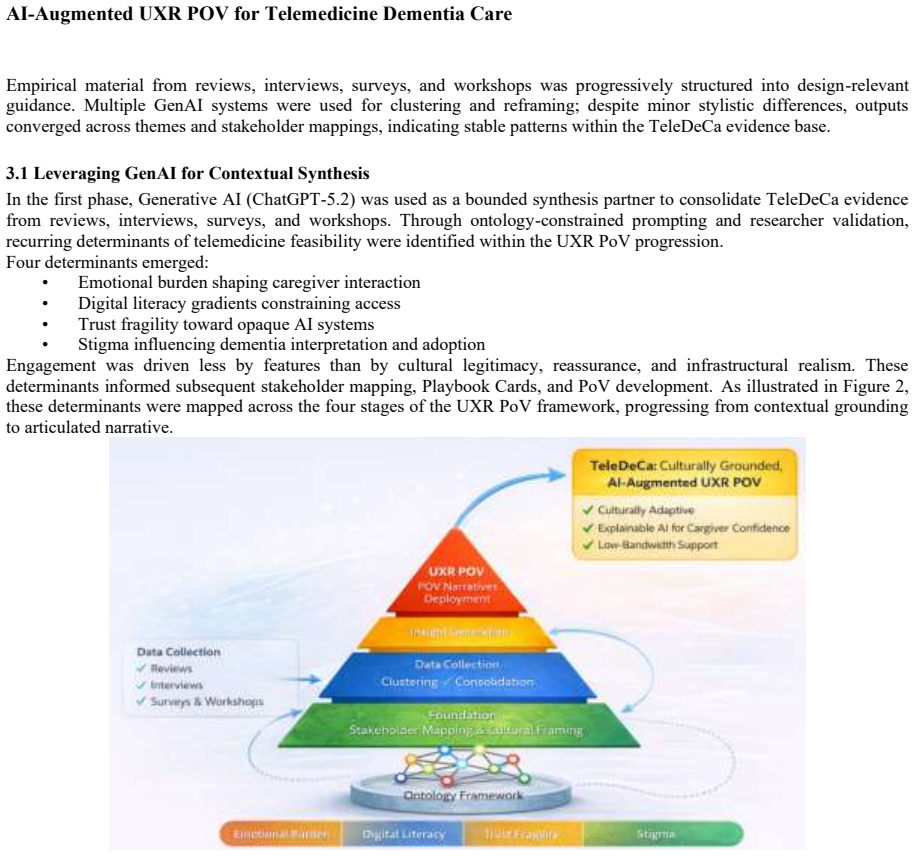
The UXR POV pyramid framework extended by treating generative AI as a bounded collaborator for synthesis and hypothesis work.
If this is right
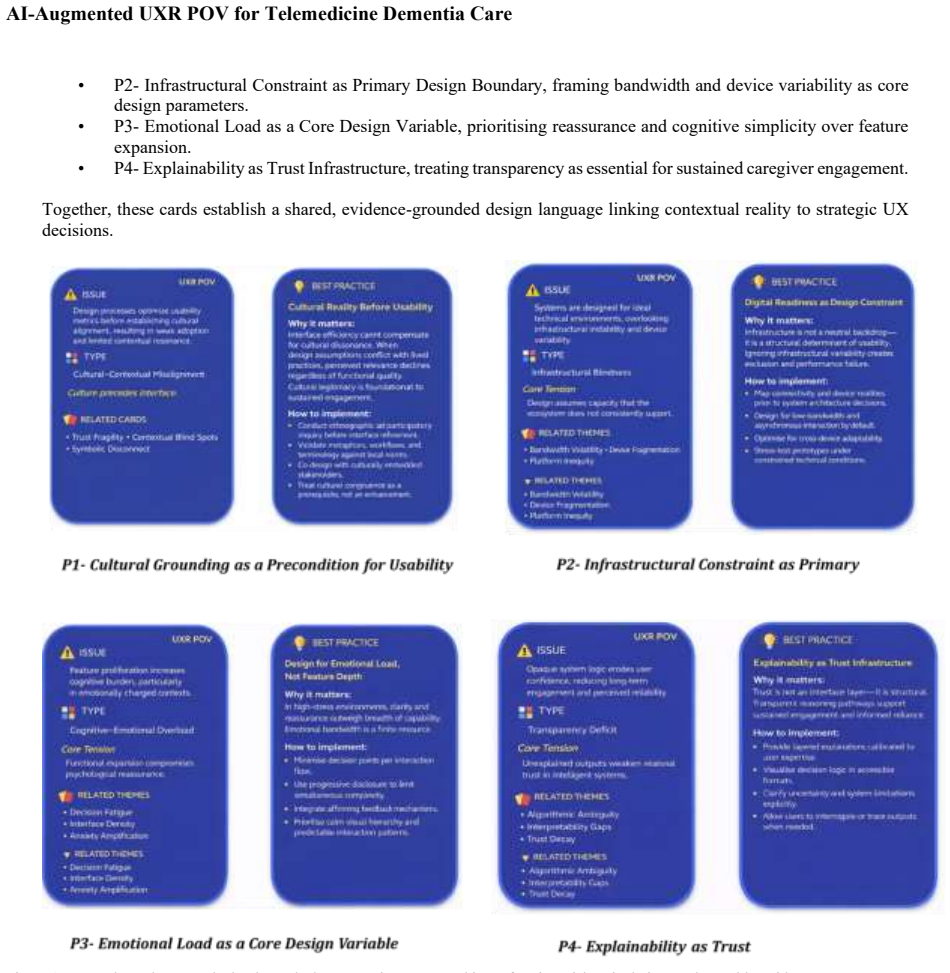
- Teams can apply the extracted play cards to construct similar POVs in other low-resource health settings.
- AI assistance in research synthesis becomes usable without full system validation.
- Telemedicine dementia care frameworks gain an initial culturally informed perspective to guide early decisions.
- The UXR POV Playbook gains concrete extension material for culturally sensitive applications.
Where Pith is reading between the lines
- The approach could shorten the time needed to turn fragmented research into stakeholder-aligned guidance in similar cultural contexts.
- Reusable play cards might transfer to non-health domains where cultural grounding matters.
- Testing the POV in actual caregiver interactions would reveal whether the bounded AI step improves or distorts later design choices.
Load-bearing premise
Generative AI can be integrated across the UXR POV framework as a bounded research collaborator while preserving human judgment, ethical accountability, and cultural sensitivity without requiring a fully finalised system or validated outcomes.
What would settle it
A follow-up test in which the resulting POV produces design choices that overlook Nigerian family caregiver realities or ethical standards despite human review would show the bounded-AI integration does not preserve those elements.
Figures

read the original abstract
User Experience Research (UXR) Points of View (POVs) distil complex and often fragmented research evidence into actionable perspectives that guide how teams interpret user needs, frame design decisions, and align stakeholders. Although POVs are widely used in industry practice, there are few published examples that explicitly document how POVs are constructed, particularly in culturally sensitive and low-resource contexts. This paper presents an exemplar case study demonstrating how a culturally grounded, AI-augmented UXR POV was developed to inform TeleDeCa, a telemedicine dementia care framework for family caregivers in Nigeria. Building on the UXR POV Playbook and pyramid framework, we illustrate how mixed-methods research, hypothesis generation, and ontology-based modelling can be combined to form a defensible POV without requiring a fully finalised system or validated outcomes. Generative AI (GenAI) is integrated across the UXR POV framework as a bounded research collaborator, supporting synthesis, hypothesis exploration, and narrative construction while preserving human judgment, ethical accountability, and cultural sensitivity. The contribution of this paper lies in the extraction of reusable Play Cards and a Play that extend the UXR POV Playbook and serve as exemplar material for the CHI 2026 workshop on developing AI-powered UXR POVs.
Editorial analysis
A structured set of objections, weighed in public.
Referee Report
Summary. The manuscript presents an exemplar case study demonstrating the development of a culturally grounded, AI-augmented UXR Point of View (POV) to inform TeleDeCa, a telemedicine dementia care framework for family caregivers in Nigeria. Building on the UXR POV Playbook and pyramid framework, it combines mixed-methods research, hypothesis generation, and ontology-based modelling, with Generative AI integrated as a bounded research collaborator to support synthesis, hypothesis exploration, and narrative construction while preserving human judgment and cultural sensitivity. The central contribution is the extraction of reusable Play Cards and a Play that extend the existing Playbook and serve as exemplar material for the CHI 2026 workshop on AI-powered UXR POVs.
Significance. If the described workflow holds, the paper offers a rare documented example of POV construction in a culturally sensitive, low-resource context, addressing a gap in published UXR practice. The explicit framing as a process-oriented case study (rather than a validated system or empirical outcomes) aligns the contribution with its stated goals and provides reusable extensions to the Playbook. This is particularly relevant for the target workshop. The stress-test concern regarding absence of validation data or error bars does not land, as the manuscript consistently positions its value in process description and extracted artifacts rather than empirical claims.
minor comments (2)
- The abstract and introduction refer to 'Play Cards and a Play' as the extracted contribution, but the manuscript would benefit from a brief table or figure summarizing their structure and how they map to the original Playbook elements for immediate clarity to readers.
- Notation for the pyramid framework and ontology-based modelling is introduced without a dedicated diagram or glossary; adding one would aid readers unfamiliar with the prior UXR POV Playbook.
Simulated Author's Rebuttal
We thank the referee for their positive and constructive assessment. We appreciate the recognition that the manuscript's value lies in its process description and reusable artifacts rather than empirical claims, and that this framing aligns with the contribution to the CHI 2026 workshop.
Circularity Check
No significant circularity detected
full rationale
The paper is an exemplar case study that describes a workflow for developing a culturally grounded AI-augmented UXR POV by combining mixed-methods research, hypothesis generation, and ontology-based modelling, then extracting reusable Play Cards and a Play as extensions to a pre-existing UXR POV Playbook and pyramid framework. No derivation chain reduces by construction to its own inputs; the central contribution is the documented process and extracted artifacts themselves, which are presented as self-contained outputs of the described case study without fitted parameters renamed as predictions, self-definitional loops, or load-bearing self-citations that would require external verification of the framework's origin. The paper's internal logic stands independently of any need for validated outcomes or finalized systems.
Axiom & Free-Parameter Ledger
axioms (1)
- domain assumption The UXR POV Playbook and pyramid framework provide a valid and sufficient foundation for constructing culturally grounded POVs.
invented entities (1)
-
Play Cards and Play
no independent evidence
Reference graph
Works this paper leans on
-
[1]
https://doi.org/10.1162/DESI_a_00164 [10]. Amershi S., Weld D., Vorvoreanu M., Fourney A., Nushi B., Collisson P., Suh J., Iqbal S., Bennett P.N., Inkpen K., Teevan J., Kikin-Gil R., and Horvitz E. 2019. Guidelines for human -AI interaction. In Proceedings of the 2019 CHI Conference on Human Factors in Computing Systems (CHI '19). ACM, New York, NY, USA, ...
-
[2]
https://doi.org/10.1109/MIS.2006.75 [17]. Pirolli P. and Card S. 2005. The sensemaking process and leverage points for analyst technology as identified through cogniti ve task analysis. In Proceedings of the International Conference on Intelligence Analysis , Vol. 5. [18]. Katz C., Ruiz J.M., Saigí -Rubió F., and Novillo -Ortiz D. 2025. The state of the a...
discussion (0)
Sign in with ORCID, Apple, or X to comment. Anyone can read and Pith papers without signing in.