REVIEW 4 major objections 5 minor 44 references
How Cars Move: Analyzing Driving Dynamics for Safer Urban Traffic
T0 review · 4 major / 5 minor · reviewed 2026-08-11 · deepseek-v4-flash
Pith's one-line read In urban traffic prediction, injecting knowledge of how cars move cuts fast-vehicle speed errors by 15.7%.
desk verdict Plausible architecture for BEV motion prediction with a learned motion-field prior, but the internal numbers contradict each other and the main claim is unverified. read the letter →
The pith
A machine-rendered reading of the paper's core claim, the machinery that carries it, and where it could break.
The reading
What carries the argument
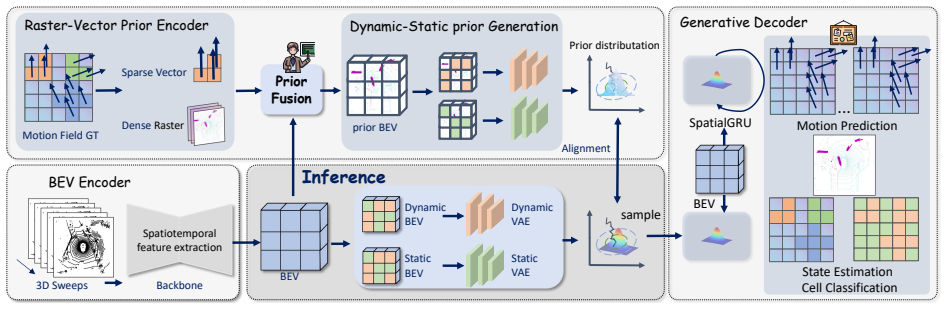
The load-bearing object is the Motion Field Reference (MFR), a spatial representation of where and how cars move, processed through two modules. The Raster-Vector prior Encoder (RVpE) combines a dual-branch grid analysis with a component-interaction branch that encodes sampled trajectories and produces a prior BEV; the Dynamic-Static pattern Generator (DSpG) separates the scene into dynamic and static BEV representations, models their latent distribution with a VAE, and refines future motion with a SpatialGRU. A pattern-consistency KL loss aligns the learned latent with the prior, and the whole pipeline is trained jointly with the backbone.
What would settle it
Inspect the construction of the Motion Field Ground Truth and the prior BEV in the code or data pipeline: if any future sweeps beyond the input 5 frames are used, retrain with the ground truth built only from the input frames; if the reported error reductions vanish, the central claim fails. An independent reproduction on nuScenes using the public split and described preprocessing should also reproduce the 8.92% and 15.73% reductions.
Extended reading notes
Core claim
The paper's central claim is that structured knowledge about driving dynamics, captured as a motion field reference with directional patterns, regional variation, and car interdependencies, can be injected into existing BEV motion predictors and consistently reduce prediction error. Concretely, the authors report that the full PriorMotion pipeline lowers slow-pattern mean speed error by 8.92% and fast-pattern error by 15.73% over the MotionNet/STPN baseline, and by 4.67% and 14.75% over BE-STI/STI, while improving classification accuracy for dynamic categories and cutting errors in distant regions by 34.4% for fast patterns. They further report better generalization when a category is masked during training, with a generalization index of 86.4% versus 81.6% for the MotionNet baseline.
Load-bearing premise
The motion field used as supervision and as prior is assumed to be computed from the observed input alone, with no future frames feeding into it.
Editorial extensions
If this is right
- Existing BEV motion-prediction backbones can be upgraded with the RVpE and DSpG modules at a reported inference cost of 69 ms per sample, requiring no new sensor input.
- Fast-moving vehicles in peripheral regions benefit most: the paper reports a 34.4% error reduction for fast patterns at distances beyond 20 meters on the STPN backbone.
- Classification of dynamic actors improves, with pedestrian accuracy rising from 82.9% to 86.9% compared with the BE-STI baseline.
- The framework improves stability of multi-step predictions, reducing the stability error at 20m+ from 0.0267 to 0.0088.
- The generalization experiment suggests the learned motion priors help maintain accuracy when entire object categories are absent during training.
Reading between the lines
- The paper does not state whether the Motion Field Ground Truth is computed from future sweeps; if it is, the reported gains would reflect information leakage rather than driving-dynamics priors, and this is the key assumption to check before relying on the numbers.
- The generalization index is measured by masking one category during training, so the improved index may show category-agnostic motion priors rather than adaptation to genuinely unseen driving domains.
- The same pattern-extractor and generator design could transfer to other grid-based occupancy or traffic-flow prediction tasks, but the paper only demonstrates it on nuScenes-style BEV data.
- A direct test of the driving-dynamics hypothesis would be to retrain without the Motion Field Reference; the paper's ablations indicate the extractor alone contributes part of the gain, so the prior itself is what carries the improvement.
Editorial analysis
A structured set of objections, weighed in public.
Referee Report
Summary. The paper proposes PriorMotion, a bird's-eye-view (BEV) motion prediction framework evaluated on the nuScenes dataset. The architecture couples a conventional BEV feature extractor with two new modules: a Pattern Knowledge Extractor (RVpE) that combines raster and vector priors, and a Dynamic-Static Pattern Generator (DSpG) that uses VAE-based latent modeling and a 'Motion Field Ground Truth' (MFGT) prior. The central quantitative claims are that integrating these modules into the STPN and STI backbones reduces slow/fast pattern errors by 8.92%/15.73% and 4.67%/14.75% respectively (Table 2), and also improves classification accuracy, long-range forecasting, and generalization. The paper introduces new evaluation metrics for generalization and stability and reports an inference time of 69 ms per sample.
Significance. If the reported results were reliable, PriorMotion would offer a modest but consistent improvement over existing BEV grid-based motion predictors on a standard benchmark, and the modular decomposition into static and dynamic pattern generation is a reasonable design direction. The paper should be credited for formulating a clear problem, using a standard benchmark, and attempting to localize contributions through ablation studies. However, the evidence is compromised by internal inconsistencies in the ablation and efficiency tables, a generalization metric whose definition appears directionally wrong, an unclear specification of the MFGT supervision that raises potential information-leakage concerns, and the absence of code or error bars. The central quantitative claim is therefore not established by the present manuscript.
major comments (4)
- [Sec. 4.2, Tables 6 and 7] The ablation and efficiency tables are internally inconsistent in a way that directly undermines the headline improvements. Table 6 row (d), labeled 'Pattern Generator', reports Static 0.0251, Slow 0.2247, Fast 0.8318, which are identical to Table 7 row (f), the full model, yet Table 7 row (d) (latent modeling only) and row (e) (latent + fusion) report different values. Likewise, Table 6 row (c), 'Pattern Extractor', matches Table 7 row (c) but not Table 7 row (b), which is also an extractor-only configuration. Additionally, the STPN baseline itself differs across Table 2 (0.2467), Table 5 (0.2587), and Table 7 (0.2477). These inconsistencies mean the claimed reductions of 8.92% and 15.73% cannot be attributed to the proposed components, and the runtime comparison (24 ms vs 69 ms in Table 6) lacks a consistent module configuration.
- [Sec. 3.2.2, Fig. 2] The paper uses a 'Motion Field Ground Truth (MFGT)' as supervision for the prior encoder but never states whether MFGT is computed from future sweeps. If the prior BEV implicitly encodes future positions, the reported improvements would be invalid due to information leakage. Please specify the exact computation of MFGT from observed history alone, or, if it does use future data, explain how leakage is avoided.
- [Sec. 4.1, Eq. (13)] The generalization metric is defined as GI = LMask_Mc / LMc, with the text stating that 'Higher GI indicates better generalization.' With this definition, a higher ratio corresponds to a larger error on masked categories relative to the base error, which indicates worse generalization. The definition appears directionally wrong. Please clarify the intended formula (e.g., 1 - ratio) and explain how the percentages in Table 4 are derived from it.
- [Sec. 4.3, 'Cross-scenario validation'] The paragraph claims additional evaluations on 'urban flow datasets' confirming a 15.2% stability gain and a 22.3% long-range error reduction, but no dataset, table, or experimental protocol is provided. This claim is unverifiable and should be either fully documented in a dedicated subsection or removed.
minor comments (5)
- [Abstract and Introduction] The abstract frames the work in terms of 'urban infrastructure management and resource allocation,' which does not match the actual technical content of BEV motion prediction on nuScenes. Please align the framing with the task throughout.
- [Table 2] Rows such as 'StaticModel Rules,' 'FlowNet3D,' and 'HPLFlowNet' are not described in the experimental setup; please clarify whether these are re-implemented baselines under the same protocol or results taken from prior papers, and how their inputs are adapted to the BEV grid.
- [References] References [34] and [35] are the same paper (Wei et al.) and should be merged; also, 'V ora' in reference [2] should be 'Vora'.
- [Figures] Figure 1 contains typos: 'prediciton' and 'knowlegde' should be corrected.
- [Sec. 4.1, Implementation details] The loss weights (lambda_move, lambda_state, lambda_cls, lambda_pattern), the fusion weight rho, the VAE latent dimension, and the number of training runs/seeds are not reported. Without these details, the numerical claims are not reproducible and no variance estimate is available.
Circularity Check
No circular derivation found: the claimed gains are empirical outcomes of a supervised model evaluated on an external benchmark, not consequences of the paper's definitions or self-citations.
full rationale
The paper's derivation chain is an empirical machine-learning pipeline: PriorMotion's RVpE and DSpG modules are trained with the supervised losses in Eq. (11) and evaluated on nuScenes against external baselines. The central claims, e.g. 'reduces slow pattern errors by 8.92% and fast pattern errors by 15.73%' (Sec. 4.2), are arithmetic ratios of reported test errors, not quantities encoded into the loss or defined in terms of the output. The motion-field prior is learned from data and used as a regularizer (Eq. 12), not derived from the evaluation metrics, so the prediction does not reduce to a fitted input. Self-citations such as BE-STI [33] appear as a backbone and baseline, but the comparison is against nuScenes benchmark numbers and is externally falsifiable; these citations are not load-bearing. The skeptical reviewer's table inconsistencies (e.g., different MotionNet baseline values across Tables 2, 5, and 7, and Table 6 row (d) duplicating Table 7 row (f)) are genuine reproducibility concerns about the reported numbers, but they do not demonstrate that any claimed result is equivalent to its own input by construction. No specific circular step can be quoted from the paper's equations, so the honest finding is no significant circularity.
Assumptions & free parameters
free parameters (4)
- Loss weights lambda_move, lambda_state, lambda_cls, lambda_pattern
- Fusion weight rho =
learnable
- Speed group thresholds =
0.2, 5 m/s
- VAE latent dimension and hidden dimensions
assumptions (4)
- domain assumption nuScenes is representative of urban traffic
- domain assumption Gaussian latent dynamics capture motion evolution
- domain assumption Category masking during training measures generalization
- domain assumption MFGT prior does not leak future information
invented entities (1)
-
Motion Field Reference / Motion Field Ground Truth
Cite this review
Pith. "Pith review of How Cars Move: Analyzing Driving Dynamics for Safer Urban Traffic." pith.science (2026). https://pith.science/paper/4ZOW537V
@misc{pith2026241204020,
  author       = {Pith},
  title        = {Pith review of: How Cars Move: Analyzing Driving Dynamics for Safer Urban Traffic},
  year         = {2026},
  howpublished = {\url{https://pith.science/paper/4ZOW537V}},
  note         = {Machine review of arXiv:2412.04020}
}
read the original abstract
Understanding the spatial dynamics of cars within urban systems is essential for optimizing infrastructure management and resource allocation. Recent empirical approaches for analyzing traffic patterns have gained traction due to their applicability to city-scale policy development. However, conventional methodologies often rely on fragmented grid-based techniques, which may overlook critical interdependencies among spatial elements and temporal continuity. These limitations can compromise analytical effectiveness in complex urban environments. To address these challenges, we propose PriorMotion, a data integration framework designed to systematically uncover movement patterns through driving dynamics analysis. Our approach combines multi-scale empirical observations with customized analytical tools to capture evolving spatial-temporal trends in urban traffic. Comprehensive evaluations demonstrate that PriorMotion significantly enhances analytical outcomes, including increased accuracy in traffic pattern analysis, improved adaptability to heterogeneous data environments, and reduced long-term projection errors. Validation confirms its effectiveness for urban infrastructure management applications requiring precise characterization of complex spatial-temporal interactions.
Figures


Figures from the paper (2 more)


Reference graph
Works this paper leans on
-
[1]
Chauf- feurnet: Learning to drive by imitating the best and synthe- sizing the worst
Mayank Bansal, Alex Krizhevsky, and Abhijit Ogale. Chauf- feurnet: Learning to drive by imitating the best and synthe- sizing the worst. arXiv preprint arXiv:1812.03079, 2018. 1
arXiv 2018
-
[2]
Long-range pattern forecasting performance (20m+)
Holger Caesar, Varun Bankiti, Alex H Lang, Sourabh V ora, Venice Erin Liong, Qiang Xu, Anush Krishnan, Yu Pan, Gi- 5 Method Backbone Static↓ Slow↓ Fast↓ Stability↓ MotionNet STPN 0.0224 0.2587 1.2990 0.0267 STPN /(Ours) STPN 0.0263 0.2207 0.8549 0.0088 STI STI 0.0215 0.2784 1.1200 0.0221 STI /(Ours) STI 0.0254 0.1922 0.7962 0.0075 Table 5. Long-range patt...
-
[3]
Argoverse: 3d tracking and forecasting with rich maps
Ming-Fang Chang, John Lambert, Patsorn Sangkloy, Jag- jeet Singh, Slawomir Bak, Andrew Hartnett, De Wang, Peter Carr, Simon Lucey, Deva Ramanan, et al. Argoverse: 3d tracking and forecasting with rich maps. In Proceedings of the IEEE/CVF conference on computer vision and pattern recognition, pages 8748–8757, 2019. 1
work page 2019
-
[4]
Exploiting more information in sparse point cloud for 3d single object tracking
Yubo Cui, Jiayao Shan, Zuoxu Gu, Zhiheng Li, and Zheng Fang. Exploiting more information in sparse point cloud for 3d single object tracking. IEEE Robotics and Automation Letters, 7(4):11926–11933, 2022. 1
work page 2022
-
[5]
Uncertainty-aware short-term motion prediction of traffic actors for urban transportation systems
Nemanja Djuric, Vladan Radosavljevic, Henggang Cui, Thi Nguyen, Fang-Chieh Chou, Tsung-Han Lin, Nitin Singh, and Jeff Schneider. Uncertainty-aware short-term motion prediction of traffic actors for urban transportation systems. In Proceedings of the IEEE/CVF Winter Conference on Ap- plications of Computer Vision, pages 2095–2104, 2020. 1
work page 2020
-
[6]
Scaling motion forecasting models with ensemble distillation
Scott Ettinger, Kratarth Goel, Avikalp Srivastava, and Rami Al-Rfou. Scaling motion forecasting models with ensemble distillation. arXiv preprint arXiv:2404.03843, 2024. 2
arXiv 2024
-
[7]
Tpnet: Trajectory proposal network for motion prediction
Liangji Fang, Qinhong Jiang, Jianping Shi, and Bolei Zhou. Tpnet: Trajectory proposal network for motion prediction. In Proceedings of the IEEE/CVF Conference on Computer Vision and Pattern Recognition, pages 6797–6806, 2020. 1
work page 2020
-
[8]
Xiuye Gu, Yijie Wang, Chongruo Wu, Yong Jae Lee, and Panqu Wang. Hplflownet: Hierarchical permutohedral lattice flownet for scene flow estimation on large-scale point clouds. In Proceedings of the IEEE/CVF conference on computer vi- sion and pattern recognition, pages 3254–3263, 2019. 5
work page 2019
Show all 44 references
-
[9]
Social gan: Socially acceptable tra- jectories with generative adversarial networks
Agrim Gupta, Justin Johnson, Li Fei-Fei, Silvio Savarese, and Alexandre Alahi. Social gan: Socially acceptable tra- jectories with generative adversarial networks. In Proceed- ings of the IEEE conference on computer vision and pattern recognition, pages 2255–2264, 2018. 2
2018
-
[10]
Diffmap: Enhancing map segmentation with map prior using diffusion model
Peijin Jia, Tuopu Wen, Ziang Luo, Mengmeng Yang, Kun Jiang, Ziyuan Liu, Xuewei Tang, Zhiquan Lei, Le Cui, Bo Zhang, et al. Diffmap: Enhancing map segmentation with map prior using diffusion model. IEEE Robotics and Au- tomation Letters, 2024. 1, 2
2024
-
[11]
P-mapnet: Far-seeing map generator enhanced by both sdmap and hdmap priors
Zhou Jiang, Zhenxin Zhu, Pengfei Li, Huan-ang Gao, Tianyuan Yuan, Yongliang Shi, Hang Zhao, and Hao Zhao. P-mapnet: Far-seeing map generator enhanced by both sdmap and hdmap priors. IEEE Robotics and Automation Letters, 2024. 1
2024
-
[12]
Motion segmentation & multiple object tracking by correlation co-clustering
Margret Keuper, Siyu Tang, Bjoern Andres, Thomas Brox, and Bernt Schiele. Motion segmentation & multiple object tracking by correlation co-clustering. IEEE transactions on pattern analysis and machine intelligence , 42(1):140–153,
-
[13]
Kingma and Jimmy Ba
Diederik P. Kingma and Jimmy Ba. Adam: A method for stochastic optimization, 2017. 4
2017
-
[14]
Pointpillars: Fast encoders for object detection from point clouds
Alex H Lang, Sourabh V ora, Holger Caesar, Lubing Zhou, Jiong Yang, and Oscar Beijbom. Pointpillars: Fast encoders for object detection from point clouds. In Proceedings of the IEEE/CVF conference on computer vision and pattern recognition, pages 12697–12705, 2019. 2
2019
-
[15]
A survey on motion prediction and risk assessment for intelli- gent vehicles
St ´ephanie Lef`evre, Dizan Vasquez, and Christian Laugier. A survey on motion prediction and risk assessment for intelli- gent vehicles. ROBOMECH journal, 1:1–14, 2014. 2
2014
-
[16]
Weakly supervised class-agnostic motion prediction for urban transportation systems
Ruibo Li, Hanyu Shi, Ziang Fu, Zhe Wang, and Guosheng Lin. Weakly supervised class-agnostic motion prediction for urban transportation systems. In Proceedings of the IEEE/CVF Conference on Computer Vision and Pattern Recognition, pages 17599–17608, 2023. 1, 2
2023
-
[17]
Pnpnet: End-to-end per- ception and prediction with tracking in the loop
Ming Liang, Bin Yang, Wenyuan Zeng, Yun Chen, Rui Hu, Sergio Casas, and Raquel Urtasun. Pnpnet: End-to-end per- ception and prediction with tracking in the loop. In Proceed- ings of the IEEE/CVF Conference on Computer Vision and Pattern Recognition, pages 11553–11562, 2020. 1
2020
-
[18]
Flownet3d: Learning scene flow in 3d point clouds
Xingyu Liu, Charles R Qi, and Leonidas J Guibas. Flownet3d: Learning scene flow in 3d point clouds. In Pro- ceedings of the IEEE/CVF conference on computer vision and pattern recognition, pages 529–537, 2019. 5
2019
-
[19]
Self- supervised pillar motion learning for urban transportation systems
Chenxu Luo, Xiaodong Yang, and Alan Yuille. Self- supervised pillar motion learning for urban transportation systems. In Proceedings of the IEEE/CVF Conference on Computer Vision and Pattern Recognition , pages 3183– 3192, 2021. 2, 5
2021
-
[20]
Multi- modal fusion transformer for end-to-end urban transporta- tion systems
Aditya Prakash, Kashyap Chitta, and Andreas Geiger. Multi- modal fusion transformer for end-to-end urban transporta- tion systems. In Proceedings of the IEEE/CVF conference on computer vision and pattern recognition, pages 7077–7087,
-
[21]
Pointnet: Deep learning on point sets for 3d classification and segmentation
Charles R Qi, Hao Su, Kaichun Mo, and Leonidas J Guibas. Pointnet: Deep learning on point sets for 3d classification and segmentation. In Proceedings of the IEEE conference on computer vision and pattern recognition, pages 652–660,
-
[22]
Pointnet++: Deep hierarchical feature learning on point sets in a metric space
Charles Ruizhongtai Qi, Li Yi, Hao Su, and Leonidas J Guibas. Pointnet++: Deep hierarchical feature learning on point sets in a metric space. Advances in neural information processing systems, 30, 2017. 2
2017
-
[23]
Long-term occupancy grid prediction using recurrent neural networks
Marcel Schreiber, Stefan Hoermann, and Klaus Dietmayer. Long-term occupancy grid prediction using recurrent neural networks. In 2019 International Conference on Robotics and Automation (ICRA), pages 9299–9305. IEEE, 2019. 2, 5 6 Method Module Static Slow Fast P.E. P.G. L.M. P....
2019
-
[24]
Beyond pixels: Leveraging geom- etry and shape cues for online multi-object tracking
Sarthak Sharma, Junaid Ahmed Ansari, J Krishna Murthy, and K Madhava Krishna. Beyond pixels: Leveraging geom- etry and shape cues for online multi-object tracking. In 2018 IEEE International Conference on Robotics and Automation (ICRA), pages 3508–3515. IEEE, 2018. 2
2018
-
[25]
Pointr- cnn: 3d object proposal generation and detection from point cloud
Shaoshuai Shi, Xiaogang Wang, and Hongsheng Li. Pointr- cnn: 3d object proposal generation and detection from point cloud. In Proceedings of the IEEE/CVF conference on com- puter vision and pattern recognition , pages 770–779, 2019. 5
2019
-
[26]
Pv-rcnn: Point- voxel feature set abstraction for 3d object detection
Shaoshuai Shi, Chaoxu Guo, Li Jiang, Zhe Wang, Jianping Shi, Xiaogang Wang, and Hongsheng Li. Pv-rcnn: Point- voxel feature set abstraction for 3d object detection. In Pro- ceedings of the IEEE/CVF conference on computer vision and pattern recognition, pages 10529–10538, 2020. 2
2020
-
[27]
Grid-centric traffic scenario perception for urban transportation systems: A comprehensive review
Yining Shi, Kun Jiang, Jiusi Li, Zelin Qian, Junze Wen, Mengmeng Yang, Ke Wang, and Diange Yang. Grid-centric traffic scenario perception for urban transportation systems: A comprehensive review. arXiv preprint arXiv:2303.01212,
-
[28]
Multi-object tracking with quadruplet convolutional neu- ral networks
Jeany Son, Mooyeol Baek, Minsu Cho, and Bohyung Han. Multi-object tracking with quadruplet convolutional neu- ral networks. In Proceedings of the IEEE conference on computer vision and pattern recognition, pages 5620–5629,
-
[29]
Attentiongan: Unpaired image-to-image transla- tion using attention-guided generative adversarial networks
Hao Tang, Hong Liu, Dan Xu, Philip HS Torr, and Nicu Sebe. Attentiongan: Unpaired image-to-image transla- tion using attention-guided generative adversarial networks. IEEE transactions on neural networks and learning systems, 34(4):1972–1987, 2021. 2
1972
-
[30]
Monocular plan view net- works for urban transportation systems
Dequan Wang, Coline Devin, Qi-Zhi Cai, Philipp Kr¨ahenb¨uhl, and Trevor Darrell. Monocular plan view net- works for urban transportation systems. In 2019 IEEE/RSJ International Conference on Intelligent Robots and Systems (IROS), pages 2876–2883. IEEE, 2019. 1
2019
-
[31]
Self- supervised class-agnostic motion prediction with spatial and temporal consistency regularizations
Kewei Wang, Yizheng Wu, Jun Cen, Zhiyu Pan, Xingyi Li, Zhe Wang, Zhiguo Cao, and Guosheng Lin. Self- supervised class-agnostic motion prediction with spatial and temporal consistency regularizations. In Proceedings of the IEEE/CVF Conference on Computer Vision and Pattern Reco...
2024
-
[32]
Semi-supervised class-agnostic motion prediction with pseudo label regenera- tion and bevmix
Kewei Wang, Yizheng Wu, Zhiyu Pan, Xingyi Li, Ke Xian, Zhe Wang, Zhiguo Cao, and Guosheng Lin. Semi-supervised class-agnostic motion prediction with pseudo label regenera- tion and bevmix. In Proceedings of the AAAI Conference on Artificial Intelligence, pages 5490–5498, 2024. 1, 2, 5
2024
-
[33]
Be-sti: Spatial-temporal integrated network for class-agnostic motion prediction with bidirectional enhancement
Yunlong Wang, Hongyu Pan, Jun Zhu, Yu-Huan Wu, Xin Zhan, Kun Jiang, and Diange Yang. Be-sti: Spatial-temporal integrated network for class-agnostic motion prediction with bidirectional enhancement. In Proceedings of the IEEE/CVF Conference on Computer Vision and Pattern Recogn...
2022
-
[34]
Spatiotemporal transformer attention network for 3d voxel level joint segmentation and motion prediction in point cloud
Zhensong Wei, Xuewei Qi, Zhengwei Bai, Guoyuan Wu, Saswat Nayak, Peng Hao, Matthew Barth, Yongkang Liu, and Kentaro Oguchi. Spatiotemporal transformer attention network for 3d voxel level joint segmentation and motion prediction in point cloud. In 2022 IEEE Intelligent Vehicle...
2022
-
[35]
Spatiotemporal transformer attention network for 3d voxel level joint segmentation and motion prediction in point cloud
Zhensong Wei, Xuewei Qi, Zhengwei Bai, Guoyuan Wu, Saswat Nayak, Peng Hao, Matthew Barth, Yongkang Liu, and Kentaro Oguchi. Spatiotemporal transformer attention network for 3d voxel level joint segmentation and motion prediction in point cloud. In 2022 IEEE Intelligent Vehicle...
2022
-
[36]
Fimp: Future interaction mod- eling for multi-agent motion prediction
Sungmin Woo, Minjung Kim, Donghyeong Kim, Sungjun Jang, and Sangyoun Lee. Fimp: Future interaction mod- eling for multi-agent motion prediction. arXiv preprint arXiv:2401.16189, 2024. 2
2024 arXiv
-
[37]
Mo- tionnet: Joint perception and motion prediction for urban transportation systems based on bird’s eye view maps
Pengxiang Wu, Siheng Chen, and Dimitris N Metaxas. Mo- tionnet: Joint perception and motion prediction for urban transportation systems based on bird’s eye view maps. In Proceedings of the IEEE/CVF conference on computer vi- sion and pattern recognition, pages 11385–11395, 202...
2020
-
[38]
Multi-agent trajectory prediction with difficulty-guided feature enhancement network
Guipeng Xin, Duanfeng Chu, Liping Lu, Zejian Deng, Yuang Lu, and Xigang Wu. Multi-agent trajectory prediction with difficulty-guided feature enhancement network. arXiv preprint arXiv:2407.18551, 2024. 2
2024 arXiv
-
[39]
Center- based 3d object detection and tracking
Tianwei Yin, Xingyi Zhou, and Philipp Krahenbuhl. Center- based 3d object detection and tracking. In Proceedings of the IEEE/CVF conference on computer vision and pattern recognition, pages 11784–11793, 2021. 2
2021
-
[40]
Trajgen: Generating realistic and diverse trajectories with re- active and feasible agent behaviors for urban transportation 7 systems
Qichao Zhang, Yinfeng Gao, Yikang Zhang, Youtian Guo, Dawei Ding, Yunpeng Wang, Peng Sun, and Dongbin Zhao. Trajgen: Generating realistic and diverse trajectories with re- active and feasible agent behaviors for urban transportation 7 systems. IEEE Transactions on Intelligent ...
2022
-
[41]
Tnt: Target-driven trajectory pre- diction
Hang Zhao, Jiyang Gao, Tian Lan, Chen Sun, Ben Sapp, Balakrishnan Varadarajan, Yue Shen, Yi Shen, Yuning Chai, Cordelia Schmid, et al. Tnt: Target-driven trajectory pre- diction. In Conference on Robot Learning, pages 895–904. PMLR, 2021. 1
2021
-
[42]
Genad: Generative end-to-end urban transportation systems
Wenzhao Zheng, Ruiqi Song, Xianda Guo, Chenming Zhang, and Long Chen. Genad: Generative end-to-end urban transportation systems. arXiv preprint arXiv:2402.11502 ,
-
[43]
Point rcnn: An angle-free framework for rotated object detection
Qiang Zhou and Chaohui Yu. Point rcnn: An angle-free framework for rotated object detection. Remote Sensing, 14 (11):2605, 2022. 5
2022
-
[44]
Mapprior: Bird’s-eye view perception with generative mod- els, 2023
Xiyue Zhu, Vlas Zyrianov, Zhijian Liu, and Shenlong Wang. Mapprior: Bird’s-eye view perception with generative mod- els, 2023. 1 8
2023
Reviewed August 11, 2026 · model on record in the stance chip above.
Discussion (0). Continue with ORCID to comment.