Quantum error correction with the toric code
Pith reviewed 2026-06-28 09:39 UTC · model grok-4.3
The pith
Neutral atom arrays preserve logical information in a toric code through 90 cycles of syndrome extraction with qubit reloading.
A machine-rendered reading of the paper's core claim, the machinery that carries it, and where it could break.
Core claim
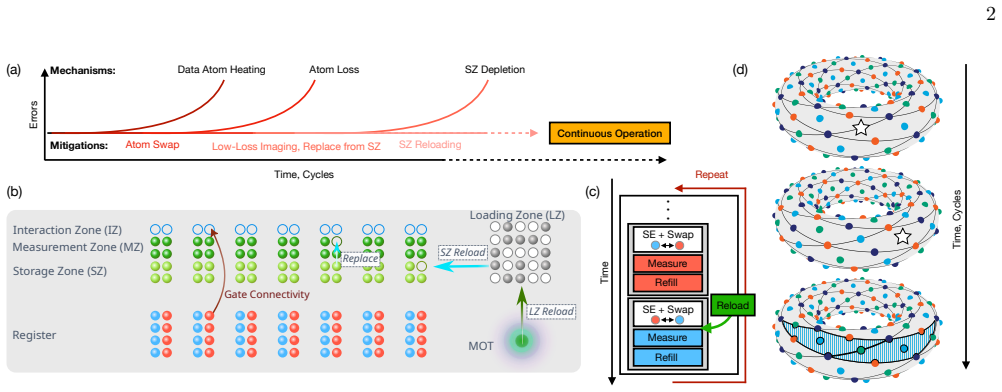
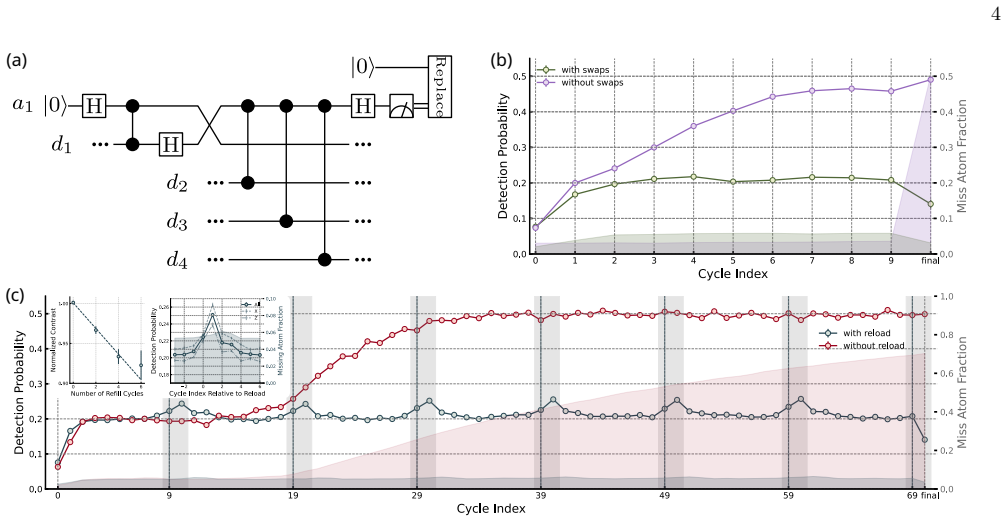
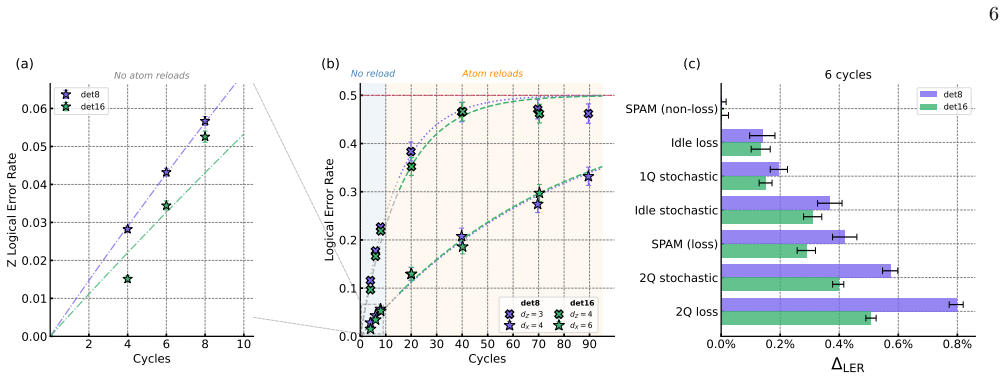
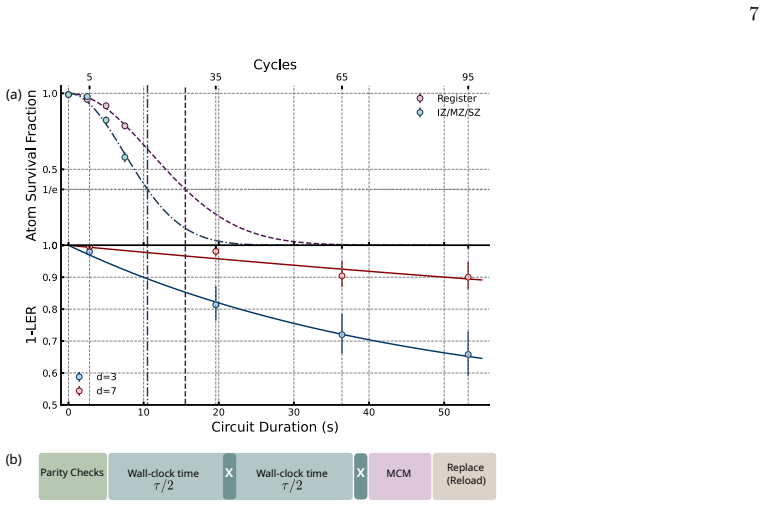
We demonstrate many cycles of syndrome extraction in a toric quantum error correcting code, using mid-circuit measurement and replacement of lost qubits, including reloading of a qubit reservoir for indefinite coherent operation. We characterize the logical error rate after up to 90 cycles, showing that logical information can be preserved through multiple rounds of qubit reloading. Comparing two distances of the code up to 8 rounds of syndrome extraction shows a lower absolute logical error rate for the larger distance code.
What carries the argument
The toric code (a topological lattice code that encodes logical qubits in nonlocal degrees of freedom) together with mid-circuit measurement and reservoir reloading of lost atoms.
If this is right
- Logical information survives multiple rounds of qubit loss and replacement.
- Larger code distance yields lower logical error even when reloading is required.
- The system can run for an arbitrary number of cycles by repeated reservoir reloading.
- Syndrome extraction can be performed on neutral-atom hardware at the scale needed for repeated correction.
Where Pith is reading between the lines
- If reservoir reloading fidelity can be raised further, the same architecture could support continuous operation of much larger logical qubit arrays.
- The reloading technique may transfer to other atom-loss-limited platforms such as trapped ions or Rydberg arrays.
- Direct tests at still larger distances would show whether the observed error suppression continues to improve as predicted by the toric code threshold.
Load-bearing premise
Mid-circuit measurements and reservoir reloading do not introduce systematic biases that would make the reported logical error rates appear lower for the larger distance code than they actually are.
What would settle it
An experiment in which the logical error rate after eight or more cycles is higher for the larger-distance code than for the smaller-distance code, or in which error rates increase sharply immediately after each reservoir reload.
Figures
read the original abstract
Quantum computing platforms based on arrays of tweezer-confined neutral atoms have recently emerged as a competitive modality thanks to a direct path toward high qubit count, rapidly advancing operation fidelities, and their ability to execute circuits with arbitrary qubit connectivity. These features will enable the use of efficient error correction schemes with high encoding-rates, time-efficient decoding, and resource-efficient architectures based on transversal gates. With these goals in mind, recent state of the art neutral atom demonstrations focus on the transition from the use of physical qubits to error-corrected logical qubits, but to date there has been no demonstration of repeated error correction scalable to arbitrary depth. Here, we demonstrate many cycles of syndrome extraction in a toric quantum error correcting code, using mid-circuit measurement and replacement of lost qubits, including reloading of a qubit reservoir for indefinite coherent operation. We characterize the logical error rate after up to 90 cycles, showing that logical information can be preserved through multiple rounds of qubit reloading. Comparing two distances of the code up to 8 rounds of syndrome extraction shows a lower absolute logical error rate for the larger distance code.
Editorial analysis
A structured set of objections, weighed in public.
Referee Report
Summary. The manuscript reports an experimental demonstration of repeated syndrome extraction cycles in a toric quantum error correcting code implemented on a neutral-atom array. Using mid-circuit measurements and replacement of lost qubits, including reloading from a qubit reservoir, the authors characterize logical error rates after up to 90 cycles and compare two code distances, claiming a lower absolute logical error rate for the larger-distance code after up to 8 rounds of syndrome extraction.
Significance. If the experimental controls confirm that mid-circuit operations and reloading introduce no distance-dependent biases, this would constitute a significant advance for neutral-atom platforms by demonstrating scalable, repeated error correction and the ability to preserve logical information indefinitely through reservoir reloading. The distance comparison, if validated with quantitative data, would support expected error suppression scaling with code distance in this modality.
major comments (2)
- [Abstract] The central claim that the larger-distance code exhibits a lower absolute logical error rate after 8 rounds is load-bearing for the paper's conclusion on error suppression, yet the abstract provides no numerical error rates, statistical uncertainties, control experiments, or data-processing details; without these, it is impossible to confirm that the measurements support the claimed logical error suppression or that the difference is not due to artifacts.
- [Abstract (experimental description)] The comparison of logical error rates between the two distances relies on the assumption that mid-circuit measurements and reservoir reloading are distance-independent; however, no calibration data, error budget, or control experiments are described to rule out distance-dependent fidelity variations, timing skew, or residual excitation, which directly impacts the validity of attributing the lower error rate to code distance rather than experimental artifacts.
minor comments (1)
- [Abstract] The abstract would be strengthened by including at least the key extracted logical error rates and their uncertainties to allow immediate assessment of the claims.
Simulated Author's Rebuttal
We thank the referee for their detailed and constructive review of our manuscript. We address each major comment below, agreeing where revisions are warranted to improve clarity and providing explanations based on the content of the full manuscript and supplementary materials.
read point-by-point responses
-
Referee: [Abstract] The central claim that the larger-distance code exhibits a lower absolute logical error rate after 8 rounds is load-bearing for the paper's conclusion on error suppression, yet the abstract provides no numerical error rates, statistical uncertainties, control experiments, or data-processing details; without these, it is impossible to confirm that the measurements support the claimed logical error suppression or that the difference is not due to artifacts.
Authors: We agree that the abstract would benefit from additional quantitative detail to make the central claim more self-contained. In the revised manuscript we will update the abstract to report the measured logical error rates (with uncertainties) for both code distances after 8 rounds, along with a concise reference to the control experiments and data-processing pipeline used to extract these rates. This change will allow readers to directly assess the evidence for logical error suppression without needing to consult the main text. revision: yes
-
Referee: [Abstract (experimental description)] The comparison of logical error rates between the two distances relies on the assumption that mid-circuit measurements and reservoir reloading are distance-independent; however, no calibration data, error budget, or control experiments are described to rule out distance-dependent fidelity variations, timing skew, or residual excitation, which directly impacts the validity of attributing the lower error rate to code distance rather than experimental artifacts.
Authors: The full manuscript (Sections III and IV) and supplementary information contain the requested calibration data, error budgets, and control experiments that demonstrate mid-circuit measurements and reservoir reloading introduce no statistically significant distance-dependent biases within the precision of the experiment. To address the referee’s concern about visibility, we will revise the abstract to explicitly note that these controls confirm distance-independent operation. We will also add a cross-reference in the abstract to the relevant supplementary sections. This constitutes a partial revision focused on presentation rather than new data acquisition. revision: partial
Circularity Check
No circularity: experimental measurements with no derivation chain
full rationale
The paper reports physical experimental results on syndrome extraction cycles, logical error rates after up to 90 cycles, and distance comparisons in a toric code using neutral atoms. No derivation, first-principles calculation, parameter fitting to data, or self-citation load-bearing premise is present in the abstract or described claims. The central claims are direct measurements of physical quantities, not reductions of outputs to inputs by construction. This matches the default expectation of no circularity for non-derivational work.
Axiom & Free-Parameter Ledger
axioms (1)
- domain assumption Standard quantum error correction theory for the toric code applies to the neutral-atom hardware when mid-circuit measurements and reloading are performed.
Reference graph
Works this paper leans on
-
[1]
or in ordered arrays [5] from a spatially-separated MOT while maintaining coherence in existing qubits has recently been demonstrated using simple characterization circuits involving only single-qubit operations. In this work, we integrate continuous loading, mid-circuit mea- surement, and qubit reuse into a fault-tolerant quantum memory circuit, showing ...
Pith/arXiv arXiv 2026
-
[2]
Norcia, H
M. Norcia, H. Kim, W. Cairncross, M. Stone, A. Ryou, M. Jaffe, M. Brown,et al., Iterative assembly of 171 yb atom arrays with cavity-enhanced optical lattices, PRX Quantum5, 030316 (2024)
2024
-
[3]
R. Tao, M. Ammenwerth, F. Gyger, I. Bloch, and J. Zeiher, High-fidelity detection of large-scale atom arrays in an optical lattice, Physical Review Letters133, 013401 (2024)
2024
-
[4]
H. J. Manetsch, G. Nomura, E. Bataille, X. Lv, K. H. Leung, and M. Endres, A tweezer array with 6,100 highly coherent atomic qubits, Nature647, 60 (2025)
2025
-
[5]
Lin, H.-S
R. Lin, H.-S. Zhong, Y. Li, Z.-R. Zhao, L.-T. Zheng, T.-R. Hu, H.-M. Wu, Z. Wu, W.-J. Ma, Y. Gao,et al., Ai-enabled parallel assembly of thousands of defect-free neutral atom arrays, Physical Review Letters135, 060602 (2025)
2025
-
[6]
N.-C. Chiu, E. C. Trapp, J. Guo, M. H. Abobeih, L. M. Stewart, S. Hollerith, P. L. Stroganov, M. Kalinowski, A. A. Geim, S. J. Evered,et al., Continuous operation of a coherent 3,000-qubit system, Nature646, 1075 (2025)
2025
-
[7]
J. A. Muniz, M. Stone, D. T. Stack, M. Jaffe, J. M. Kindem,et al., High-fidelity universal gates in the 171Yb ground-state nuclear-spin qubit, PRX Quantum6, 020334 (2025)
2025
-
[8]
R. B.-S. Tsai, X. Sun, A. L. Shaw, R. Finkelstein, and M. Endres, Benchmarking and linear response modeling of high- fidelity Rydberg gates (2024), arXiv:2407.20184
arXiv 2024
-
[9]
Peper, Y
M. Peper, Y. Li, D. Y. Knapp, M. Bileska, S. Ma, G. Liu, P. Peng, B. Zhang, S. P. Horvath, A. P. Burgers, and J. D. Thompson, Spectroscopy and modeling of 171Yb rydberg states for high-fidelity two-qubit gates, Phys. Rev. X15, 011009 (2025)
2025
- [10]
-
[11]
S. J. Evered, M. Xu, S. H. Li, A. A. Geim, J. Ataides, M. Kalinowski, D. Bluvstein, N. Maskara, C. Kokail, M. Greiner, et al., High-fidelity entangling gates and nonlocal circuits with neutral atoms, arXiv preprint arXiv:2604.25987 (2026)
Pith/arXiv arXiv 2026
-
[12]
Bluvstein, H
D. Bluvstein, H. Levine, G. Semeghini, T. T. Wang, S. Ebadi, M. Kalinowski, A. Keesling, N. Maskara, H. Pichler, M. Greiner,et al., A quantum processor based on coherent transport of entangled atom arrays, Nature604, 451 (2022)
2022
-
[13]
B. W. Reichardt, A. Paetznick, D. Aasen, I. Basov, J. M. Bello-Rivas,et al., Logical computation demonstrated with a neutral atom quantum processor, arXiv preprint arXiv:2411.11822 (2024)
Pith/arXiv arXiv 2024
-
[14]
Chinnarasu, C
R. Chinnarasu, C. Poole, L. Phuttitarn, A. Noori, T. Graham, S. Coppersmith, A. Balantekin, and M. Saffman, Variational simulation of the lipkin-meshkov-glick model on a neutral atom quantum computer, PRX Quantum6, 020350 (2025)
2025
-
[15]
C. Zhao, C. Duckering, A. Gu, N. Maskara, and H. Zhou, Towards ultra-high-rate quantum error correction with recon- figurable atom arrays, arXiv preprint arXiv:2604.16209 (2026)
Pith/arXiv arXiv 2026
-
[16]
Q. Xu, H. Zhou, G. Zheng, D. Bluvstein, J. P. B. Ataides, M. D. Lukin, and L. Jiang, Fast and parallelizable logical computation with homological product codes, Physical Review X15, 021065 (2025)
2025
-
[17]
W. Yang, J. Chadwick, M. H. Teo, J. Viszlai, and F. Chong, Spacetime-efficient and hardware-compatible complex quantum logic units in qldpc codes, arXiv preprint arXiv:2602.14273 (2026)
arXiv 2026
-
[18]
P. Webster, L. Berent, O. Chandra, E. T. Hockings, N. Baspin, F. Thomsen, S. C. Smith, and L. Z. Cohen, The pinnacle architecture: Reducing the cost of breaking rsa-2048 to 100 000 physical qubits using quantum ldpc codes, arXiv preprint arXiv:2602.11457 (2026)
Pith/arXiv arXiv 2048
- [19]
-
[20]
Bomb´ ın, Single-shot fault-tolerant quantum error correction, Physical Review X5, 031043 (2015)
H. Bomb´ ın, Single-shot fault-tolerant quantum error correction, Physical Review X5, 031043 (2015)
2015
-
[21]
M. Cain, D. Bluvstein, C. Zhao, S. Gu, N. Maskara, M. Kalinowski, A. A. Geim, A. Kubica, M. D. Lukin, and H. Zhou, Fast correlated decoding of transversal logical algorithms, arXiv preprint arXiv:2505.13587 (2025)
arXiv 2025
- [22]
-
[23]
H. Zhou, C. Zhao, M. Cain, D. Bluvstein, N. Maskara, C. Duckering, H.-Y. Hu, S.-T. Wang, A. Kubica, and M. D. Lukin, Low-overhead transversal fault tolerance for universal quantum computation, Nature646, 303 (2025)
2025
-
[24]
Bluvstein, S
D. Bluvstein, S. J. Evered, A. A. Geim, S. H. Li, H. Zhou, T. Manovitz,et al., Logical quantum processor based on reconfigurable atom arrays, Nature626, 58 (2024)
2024
-
[25]
B. Zhang, G. Liu, G. Bornet, S. P. Horvath, P. Peng, S. Ma, S. Huang, S. Puri, and J. D. Thompson, Leveraging erasure errors in logical qubits with metastable 171yb atoms, arXiv preprint arXiv:2506.13724 (2025)
Pith/arXiv arXiv 2025
-
[26]
Bluvstein, A
D. Bluvstein, A. A. Geim, S. H. Li, S. J. Evered, J. P. Bonilla Ataides, G. Baranes, A. Gu, T. Manovitz, M. Xu, M. Kalinowski,et al., A fault-tolerant neutral-atom architecture for universal quantum computation, Nature649, 39 (2026)
2026
-
[27]
O. Lib, H. Timme, M. Ammenwerth, F. Gyger, R. Tao, S. Sun, I. Bloch, and J. Zeiher, Velocity-enabled quantum computing with neutral atoms, arXiv preprint arXiv:2603.15561 (2026)
arXiv 2026
-
[28]
Gottesman, Stabilizer codes and quantum error correction (1997), arXiv:quant-ph/9705052 [quant-ph]
D. Gottesman, Stabilizer codes and quantum error correction (1997), arXiv:quant-ph/9705052 [quant-ph]
Pith/arXiv arXiv 1997
-
[29]
G. Q. AI and collaborators, Suppressing quantum errors by scaling a surface code logical qubit, Nature614, 676 (2023)
2023
-
[30]
G. Q. AI and collaborators, Quantum error correction below the surface code threshold, Nature638, 920 (2025)
2025
-
[31]
Eickbusch, M
A. Eickbusch, M. McEwen, V. Sivak, A. Bourassa, J. Atalaya, J. Claes, D. Kafri, C. Gidney, C. W. Warren, J. Gross, et al., Demonstration of dynamic surface codes, Nature Physics , 1 (2025)
2025
-
[32]
Lacroix, A
N. Lacroix, A. Bourassa, F. J. Heras, L. M. Zhang, J. Bausch, A. W. Senior, T. Edlich, N. Shutty, V. Sivak, A. Bengtsson, et al., Scaling and logic in the colour code on a superconducting quantum processor, Nature645, 614 (2025). 10
2025
-
[33]
A. Vezvaee, C. Benito, M. Morford-Oberst, A. Bermudez, and D. A. Lidar, Surface code scaling on heavy-hex supercon- ducting quantum processors, arXiv preprint arXiv:2510.18847 (2025)
arXiv 2025
-
[34]
S. Dasu, M. DeCross, A. Y. Guo, A. Lavasani, J. Behrends, A. Benhemou, Y.-H. Chen, K. Mayer, C. N. Self, S. Simsek, et al., Computing with many encoded logical qubits beyond break-even, arXiv preprint arXiv:2602.22211 (2026)
arXiv 2026
-
[35]
M. A. Norcia, W. B. Cairncross, H. Kim,et al., Mid-circuit qubit measurement and rearrangement in a 171Yb atomic array, Phys. Rev. X13, 041034 (2023)
2023
-
[36]
Y. Li, Y. Bao, M. Peper, C. Li, and J. Thompson, Fast, continuous and coherent atom replacement in a neutral atom qubit array (2025), arXiv preprint arXiv:2506.15633
arXiv 2025
-
[37]
Singh, C
K. Singh, C. Bradley, S. Anand, V. Ramesh, R. White, and H. Bernien, Mid-circuit correction of correlated phase errors using an array of spectator qubits, Science380, 1265 (2023)
2023
-
[38]
Gyger, M
F. Gyger, M. Ammenwerth, R. Tao, H. Timme, S. Snigirev, I. Bloch, and J. Zeiher, Continuous operation of large-scale atom arrays in optical lattices, Physical Review Research6, 033104 (2024)
2024
-
[39]
Muniz, D
J. Muniz, D. Crow, H. Kim, J. Kindem, W. Cairncross, A. Ryou, T. Bohdanowicz, C.-A. Chen, Y. Ji, A. Jones,et al., Repeated ancilla reuse for logical computation on a neutral atom quantum computer, Physical Review X15, 041040 (2025)
2025
-
[40]
Kitaev, Fault-tolerant quantum computation by anyons, Annals of Physics303, 2 (2003)
A. Kitaev, Fault-tolerant quantum computation by anyons, Annals of Physics303, 2 (2003)
2003
-
[41]
Dennis, A
E. Dennis, A. Kitaev, A. Landahl, and J. Preskill, Topological quantum memory, Journal of Mathematical Physics43, 4452 (2002), https://pubs.aip.org/aip/jmp/article-pdf/43/9/4452/19183135/4452 1 online.pdf
2002
-
[42]
Duclos-Cianci and D
G. Duclos-Cianci and D. Poulin, Fast decoders for topological quantum codes, Phys. Rev. Lett.104, 050504 (2010)
2010
-
[43]
Horsman, A
D. Horsman, A. G. Fowler, S. Devitt, and R. V. Meter, Surface code quantum computing by lattice surgery, New Journal of Physics14, 123011 (2012)
2012
-
[44]
A. G. Fowler, M. Mariantoni, J. M. Martinis, and A. N. Cleland, Surface codes: Towards practical large-scale quantum computation, Phys. Rev. A86, 032324 (2012)
2012
-
[45]
M. B. Hastings, J. Haah, and R. O’Donnell, Fiber bundle codes: breaking the n1/2 polylog(n) barrier for quantum ldpc codes, inProceedings of the 53rd Annual ACM SIGACT Symposium on Theory of Computing, STOC 2021 (Association for Computing Machinery, New York, NY, USA, 2021) p. 1276–1288
2021
-
[46]
M. N. H. Chow, V. Buchemmavari, S. Omanakuttan, B. J. Little, S. Pandey, I. H. Deutsch, and Y.-Y. Jau, Circuit-based leakage-to-erasure conversion in a neutral-atom quantum processor, PRX Quantum5, 040343 (2024)
2024
-
[47]
P. Liu, S. J. S. Tan, E. Huang, U. A. Acar, H. Zhou, and C. Zhao, Achieving optimal-distance atom-loss correction via pauli envelope (2026), arXiv:2603.04156 [quant-ph]
Pith/arXiv arXiv 2026
-
[48]
A. G. Fowler, D. Sank, J. Kelly, R. Barends, and J. M. Martinis, Scalable extraction of error models from the output of error detection circuits, arXiv preprint arXiv:1405.1454 (2014)
Pith/arXiv arXiv 2014
- [49]
-
[50]
Y. Wu, S. Kolkowitz, S. Puri, and J. D. Thompson, Erasure conversion for fault-tolerant quantum computing in alkaline earth rydberg atom arrays, Nature Communications13, 4657 (2022)
2022
-
[51]
A. G. Fowler, Optimal complexity correction of correlated errors in the surface code (2013), arXiv:1310.0863 [quant-ph]
Pith/arXiv arXiv 2013
-
[52]
Higgott and C
O. Higgott and C. Gidney, Sparse Blossom: correcting a million errors per core second with minimum-weight matching, Quantum9, 1600 (2025)
2025
-
[53]
Gidney, Stim: a fast stabilizer circuit simulator, Quantum5, 497 (2021)
C. Gidney, Stim: a fast stabilizer circuit simulator, Quantum5, 497 (2021)
2021
-
[54]
P.-J. H. Derks, A. Townsend-Teague, A. G. Burchards, and J. Eisert, Designing fault-tolerant circuits using detector error models, Quantum9, 1905 (2025)
1905
-
[55]
T. M. Stace, S. D. Barrett, and A. C. Doherty, Thresholds for topological codes in the presence of loss, Physical review letters102, 200501 (2009)
2009
-
[56]
S. D. Barrett and T. M. Stace, Fault tolerant quantum computation with very high threshold for loss errors, Phys. Rev. Lett.105, 200502 (2010)
2010
-
[57]
Barnes, P
K. Barnes, P. Battaglino, B. J. Bloom, K. Cassella, R. Coxe, N. Crisosto, J. P. King, S. S. Kondov, K. Kotru, S. C. Larsen, et al., Assembly and coherent control of a register of nuclear spin qubits, Nature Communications13, 2779 (2022)
2022
-
[58]
J. A. Jones, Designing short robust not gates for quantum computation, Phys. Rev. A87, 052317 (2013)
2013
-
[59]
G. Baranes, M. Cain, J. Ataides, D. Bluvstein, J. Sinclair, V. Vuletic, H. Zhou, and M. D. Lukin, Leveraging atom loss errors in fault tolerant quantum algorithms, arXiv preprint arXiv:2502.20558 (2025)
arXiv 2025
-
[60]
T. M¨ uller, T. Alexander, M. E. Beverland, M. B¨ uhler, B. R. Johnson, T. Maurer, and D. Vandeth, Improved belief propagation is sufficient for real-time decoding of quantum memory (2025), arXiv:2506.01779 [quant-ph]
arXiv 2025
-
[61]
Hashim, L
A. Hashim, L. B. Nguyen, N. Goss, B. Marinelli, R. K. Naik, H. Mitchell, D. I. Santiago, T. Tomesh, M. Ippoliti, M. Kliesch, I. Roth, R. Harper, S. T. Flammia, J. J. Wallman, J. Emerson, I. Hincks, C. Granade, J. Combes, and I. Siddiqi, A practical introduction to benchmarking and characterization of quantum computers, PRX Quantum6, 030202 (2025)
2025
-
[62]
M. A. Nielsen, A simple formula for the average gate fidelity of a quantum dynamical operation, Phys. Lett. A303, 249 (2002)
2002
-
[63]
LZ to SZ & MZ
B. Clader, C. J. Trout, J. P. Barnes, K. Schultz, G. Quiroz, and P. Titum, Impact of correlations and heavy tails on quantum error correction, Physical Review A103, 052428 (2021). 11 Supplemental Material Atom Computing and Collaborators Dated: June 4, 2026 SI. SZ RELOADING SEQUENCE Extended Data Fig. S1 illustrates the sequence for atom reload operations...
2021
discussion (0)
Sign in with ORCID, Apple, or X to comment. Anyone can read and Pith papers without signing in.