Security and Human-Centered Assessment of BACnet-Controlled DALI Infrastructure in an Educational Building Automation Testbed
Pith reviewed 2026-06-27 04:18 UTC · model grok-4.3
The pith
Assessing BACnet-controlled DALI infrastructure requires usable tool interfaces, physical observability, interpretable naming, and safe mental models for command priorities in addition to protocol knowledge.
A machine-rendered reading of the paper's core claim, the machinery that carries it, and where it could break.
Core claim
Using network-oriented enumeration, object-level inspection, physical rack analysis, and reflective HCI analysis of tool-supported learning in the Thun educational testbed, the paper shows that BACS assessment is not only a technical protocol task: it also requires usable tool interfaces, physical observability, interpretable naming conventions, and safe mental models for command priorities.
What carries the argument
The integration of BACnet service enumeration and DALI group mapping with physical observability and HCI reflection on tool-supported learning.
If this is right
- Cybersecurity education in building automation must incorporate hands-on tool use and physical inspection alongside protocol study.
- Tool interfaces for BACS assessment should prioritize clear object hierarchies and room-level path visibility.
- System naming conventions directly affect analysts' ability to form accurate mental models of command priorities.
- Responsible experimentation in cyber-physical building environments benefits from combined network and physical analysis methods.
Where Pith is reading between the lines
- The same combination of protocol tools and physical inspection may be needed for other building protocols such as Modbus or KNX.
- Standardized educational testbeds could support development of assessment checklists that include naming and priority-model checks.
- Vendors could reduce assessment difficulty by adopting consistent, room-mapped object naming practices across deployments.
Load-bearing premise
The observations and mappings obtained during the April 2026 hackathon in the Thun testbed using Yabe and BACteria are representative of typical BACnet/DALI deployments and tool-supported learning.
What would settle it
A documented BACnet/DALI assessment in another real deployment that succeeds without physical rack access, without interpretable naming, or without explicit attention to command-priority mental models would challenge the necessity of those elements.
Figures

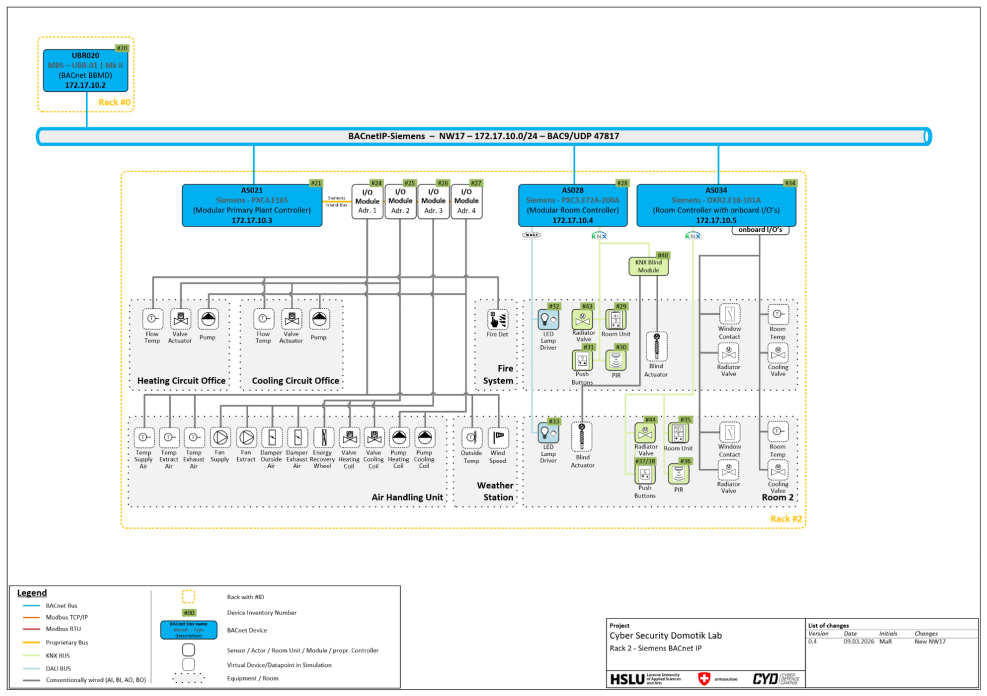

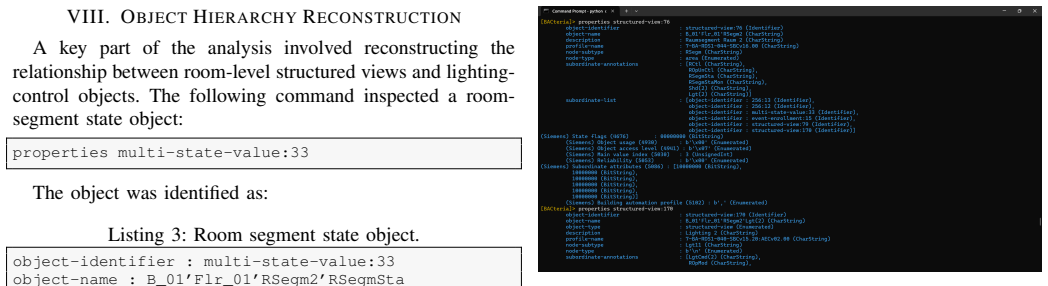
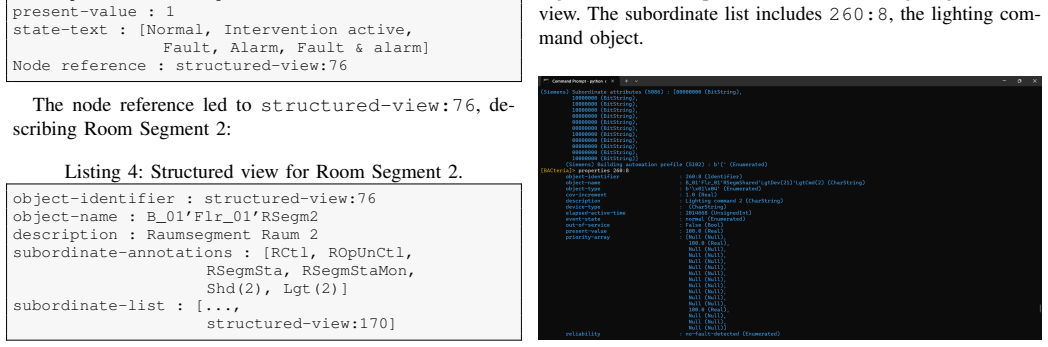


read the original abstract
Building automation and control systems integrate heating, ventilation, air conditioning, lighting, sensing, and management functions through specialized communication protocols. While this integration enables flexible building operation, it also creates complex cyber-physical environments that are difficult to inspect, secure, and explain to new analysts. This paper presents a practical security and human-centered case study of a BACnet/IP building automation testbed with DALI lighting infrastructure, investigated during a domotics-oriented cybersecurity hackathon in Thun, Switzerland in April 2026. The study combines network-oriented enumeration, object-level inspection, physical rack analysis, and reflective HCI analysis of tool-supported learning. Using Yabe and BACteria, the work documents observable BACnet services, reconstructs structured object hierarchies, identifies room-level lighting-control paths, and maps BACnet objects to DALI group-level infrastructure. The analysis emphasizes that BACS assessment is not only a technical protocol task: it also requires usable tool interfaces, physical observability, interpretable naming conventions, and safe mental models for command priorities. The paper contributes a compact case study of BACnet/DALI exploration in an educational testbed and discusses implications for cybersecurity education, human-centered security tooling, and responsible experimentation in cyber-physical building environments.
Editorial analysis
A structured set of objections, weighed in public.
Referee Report
Summary. The paper presents a practical security and human-centered case study of a BACnet/IP building automation testbed with DALI lighting infrastructure in an educational setting in Thun, Switzerland. Based on observations from an April 2026 domotics-oriented cybersecurity hackathon, it combines network enumeration using Yabe and BACteria, reconstruction of BACnet object hierarchies, identification of room-level lighting-control paths, and mapping of BACnet objects to DALI group infrastructure. The analysis concludes that BACS assessment requires not only technical protocol knowledge but also usable tool interfaces, physical observability, interpretable naming conventions, and safe mental models for command priorities, while discussing implications for cybersecurity education and human-centered tooling.
Significance. If the observations hold, the work provides a concrete, documented example of protocol-level exploration in a real educational testbed, highlighting practical challenges at the intersection of building automation security and human factors. This could inform the design of better analysis tools and educational approaches for cyber-physical systems, though the single-site qualitative nature limits broader claims.
major comments (2)
- [Abstract] Abstract: The central claim that BACS assessment 'is not only a technical protocol task' but also requires usable tool interfaces, physical observability, interpretable naming conventions, and safe mental models for command priorities rests entirely on qualitative reflection from the single Thun testbed hackathon; no quantitative metrics, controlled evaluation, error analysis, or comparative data from other deployments are reported to establish these as general requirements rather than site-specific observations.
- [Abstract] Abstract (methods and observations description): The study documents observable BACnet services, object hierarchies, and DALI mappings but provides no quantitative validation, baseline comparisons, or assessment of how representative the Yabe/BACteria enumeration and room-level mappings are of typical BACnet/DALI deployments, making the human-centered conclusions dependent on an unverified assumption of representativeness.
minor comments (1)
- [Abstract] The manuscript date reference to April 2026 should be clarified for readers (e.g., whether it is a planned event or typographical).
Simulated Author's Rebuttal
We thank the referee for the constructive comments on our case study. The work is a qualitative documentation of a single educational testbed rather than a quantitative or generalizable evaluation, and we address each point below.
read point-by-point responses
-
Referee: [Abstract] Abstract: The central claim that BACS assessment 'is not only a technical protocol task' but also requires usable tool interfaces, physical observability, interpretable naming conventions, and safe mental models for command priorities rests entirely on qualitative reflection from the single Thun testbed hackathon; no quantitative metrics, controlled evaluation, error analysis, or comparative data from other deployments are reported to establish these as general requirements rather than site-specific observations.
Authors: We agree the observations derive from a single-site hackathon in the Thun testbed and do not constitute quantitative validation or general requirements. The abstract presents these as conclusions from the documented case study to highlight practical human-centered challenges. We will revise the abstract to explicitly frame the points as site-specific observations from this educational deployment without implying broader generality. revision: yes
-
Referee: [Abstract] Abstract (methods and observations description): The study documents observable BACnet services, object hierarchies, and DALI mappings but provides no quantitative validation, baseline comparisons, or assessment of how representative the Yabe/BACteria enumeration and room-level mappings are of typical BACnet/DALI deployments, making the human-centered conclusions dependent on an unverified assumption of representativeness.
Authors: The manuscript makes no claim of representativeness for typical BACnet/DALI deployments and does not assume the Thun testbed is representative. It is presented as a case study of an educational testbed, with the contribution being the concrete documentation of services, hierarchies, mappings, and observed human factors. No quantitative validation or baselines are provided or planned, as these would exceed the qualitative case-study scope. revision: no
Circularity Check
No circularity: purely observational case study with no derivations or self-referential reductions
full rationale
The paper presents a descriptive case study of BACnet/DALI exploration in one educational testbed using specific tools during a hackathon. It reports observations (enumeration, hierarchies, mappings) and draws human-centered conclusions directly from those activities. No equations, predictions, fitted parameters, or load-bearing self-citations appear in the provided text or abstract. The central claim is framed as an emphasis from the case study itself rather than a derived result that reduces to its inputs by construction. This matches the default expectation for non-circular observational reports.
Axiom & Free-Parameter Ledger
Reference graph
Works this paper leans on
-
[1]
BACnet Committee – ASHRAE SSPC 135,
BACnet Committee, “BACnet Committee – ASHRAE SSPC 135,” https: //bacnet.org/, n.d., accessed: 2026-06-02
2026
-
[2]
BACnet: The ASHRAE Building Automation and Con- trol Networking Protocol,
ASHRAE, “BACnet: The ASHRAE Building Automation and Con- trol Networking Protocol,” https://www.ashrae.org/technical-resources/ bookstore/bacnet, n.d., accessed: 2026-06-02
2026
-
[3]
DALI and DALI-2: Standardized Smart Lighting Con- trol and IEC 62386,
DALI Alliance, “DALI and DALI-2: Standardized Smart Lighting Con- trol and IEC 62386,” https://www.dali-alliance.org/dali/, n.d., accessed: 2026-06-02
2026
-
[4]
Security of building automation and control systems: Survey and future research directions,
V . Graveto, T. Cruz, and P. Sim˜oes, “Security of building automation and control systems: Survey and future research directions,”Computers & Security, vol. 112, p. 102527, 2022, https://doi.org/10.1016/j.cose.2021. 102527
-
[5]
On building automation system security,
C. Morales-Gonzalez, M. Harper, M. Cash, L. Luo, Z. Ling, Q. Z. Sun, and X. Fu, “On building automation system security,”High-Confidence Computing, vol. 4, no. 3, p. 100236, 2024, https://doi.org/10.1016/j.hcc. 2024.100236
-
[6]
A critical review of cyber-physical security for building automation systems,
G. Li, L. Ren, Y . Fu, Z. Yang, V . Adetola, J. Wen, Q. Zhu, T. Wu, K. S. Candan, and Z. O’Neill, “A critical review of cyber-physical security for building automation systems,”Annual Reviews in Control, vol. 55, pp. 237–254, 2023, https://doi.org/10.1016/j.arcontrol.2023.02.004
-
[7]
CYD Campus BACS Hackathon 2025 – Exploring Security for Building Automation and Control Sys- tems,
armasuisse Science and Technology, “CYD Campus BACS Hackathon 2025 – Exploring Security for Building Automation and Control Sys- tems,” https://www.ar.admin.ch/en/domotic-hackathon-cyd-campus-en, 2025, accessed: 2026-06-02
2025
-
[8]
Security implications of publicly reachable building automation systems,
O. Gasser, Q. Scheitle, C. Denis, N. Schricker, and G. Carle, “Security implications of publicly reachable building automation systems,” in2017 IEEE Security and Privacy Workshops (SPW), San Jose, CA, USA, 2017, pp. 199–204, https://doi.org/10.1109/SPW.2017.13
-
[9]
BACnet Secure Connect Whitepaper,
ASHRAE, “BACnet Secure Connect Whitepaper,” https: //www.ashrae.org/File%20Library/Technical%20Resources/Bookstore/ BACnet-SC-Whitepaper-v15 Final 20190521.pdf, 2019, accessed: 2026-06-02
2019
-
[10]
User, usage and usability: Redefin- ing human centric cyber security,
M. Grobler, R. Gaire, and S. Nepal, “User, usage and usability: Redefin- ing human centric cyber security,”Frontiers in Big Data, vol. 4, 2021, https://doi.org/10.3389/fdata.2021.583723
-
[11]
Cyber ranges and security testbeds: Scenarios, functions, tools and architecture,
M. M. Yamin, B. Katt, and V . Gkioulos, “Cyber ranges and security testbeds: Scenarios, functions, tools and architecture,”Computers & Security, vol. 88, p. 101636, 2020, https://doi.org/10.1016/j.cose.2019. 101636
discussion (0)
Sign in with ORCID, Apple, or X to comment. Anyone can read and Pith papers without signing in.