REVIEW 3 major objections 4 minor 236 references
Safeguarding connected autonomous vehicle communication: Protocols, intra- and inter-vehicular attacks and defenses
T0 review · 3 major / 4 minor · reviewed 2026-08-08 · deepseek-v4-flash
Pith's one-line read The paper claims to be the first survey to systematically synthesize attacks and defenses across both intra- and inter-vehicle communication in connected autonomous vehicles, organized by a new taxonomy.
desk verdict A broad but padded CAV security survey whose headline novelty claim is contradicted by its own Table 1 and whose proposed protocols and simulations are not actually in the paper. read the letter →
The pith
A machine-rendered reading of the paper's core claim, the machinery that carries it, and where it could break.
The reading
What carries the argument
The load-bearing device is the paper's new classification system for CAV security threats: a taxonomy that groups attacks by target component and impact, supported by a severity framework and a comparative matrix of prior surveys with columns for intra-vehicle coverage, inter-vehicle coverage, attack vectors, standards, and evaluation tools. The taxonomy does the argument's work by letting every known attack be located at one or both communication layers and mapped to compromised security goals such as integrity, confidentiality, authentication, and availability. On top of that map the paper attaches best-practice countermeasures and protocol choices, so the same classification that describes the threat also organizes the defense.
What would settle it
A reader could open the surveys listed in the paper's Table 1 and check whether any of them already synthesizes both intra- and inter-vehicle attack classes with comparable depth, and could also look for the paper's simulation setup and protocol implementations; absent reproducible simulations or concrete protocol specifications, the claim that attacks were demonstrated to impact CAV operations is not verifiable from the text.
Extended reading notes
Core claim
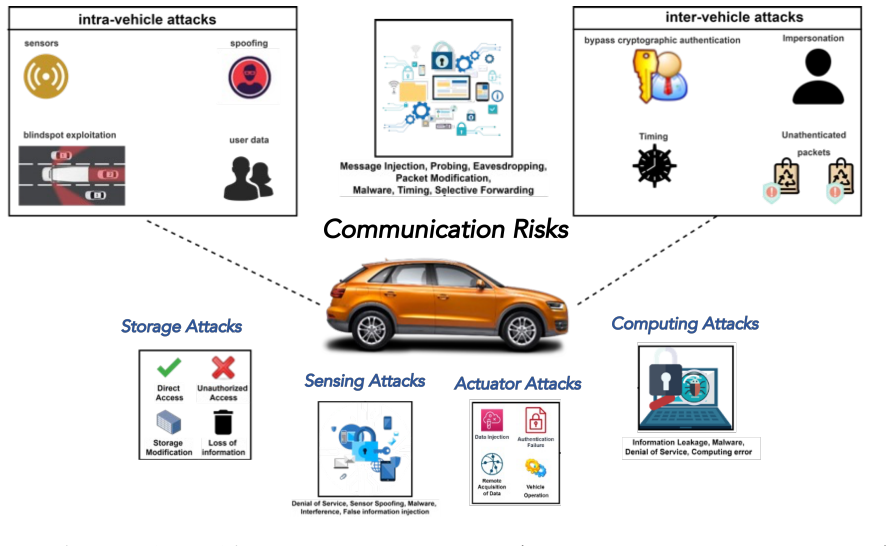
The paper's central claim is that the security of connected autonomous vehicle communication is a single problem with two connected halves—intra-vehicular communication within the car and inter-vehicular communication between cars and infrastructure—and that previous work has generally treated these halves separately. The paper reviews existing security architectures, proposes a unified taxonomy of attacks that range from zero-day exploits and replay or relay attacks to sensor spoofing, jamming, GPS attacks, and adversarial machine learning on perception systems, and presents a set of practical security protocols claimed to integrate into existing CAV systems with low overhead. It further states that simulations demonstrate how these attacks impact CAV operations and that use cases, including valet parking, lane changing, web-based monitoring, and blockchain event recording, show how the protocols fit real-world applications. Read sympathetically, the contribution is a first-of-kind synthesis and a gap-bridging reference for designing secure CAV communications.
Load-bearing premise
The load-bearing premise is that no earlier survey has already brought intra- and inter-vehicular communication attacks and defenses together in one systematic review; if prior surveys already cover both sides to a meaningful degree, the paper's first-of-kind claim and the stated reason for its existence weaken.
Editorial extensions
If this is right
- CAV security designs should coordinate the intra-vehicle and inter-vehicle layers, because the taxonomy shows that widely used attacks such as denial of service, replay, and eavesdropping cross both levels.
- Threat modeling can use the paper's taxonomy as a checklist, recording for each vulnerability its target component, attack vector, severity, and the security goal it compromises.
- No single protocol in the reviewed set covers all threats, so the implied best practice is layered defense that combines authentication, encryption, anomaly detection, and per-vehicle security domains.
- If the claimed low-overhead protocols are integrated as described, manufacturers can improve data integrity and confidentiality in CAV communication without sacrificing the real-time response that safety-critical driving decisions require.
- The open-issues list points to standardization and security evaluation tools as the main bottlenecks, meaning the survey's own framework is a starting point rather than the end of the design problem.
Reading between the lines
- If the first-of-kind claim is set aside, the paper's durable value is as an up-to-date compilation and comparison; the synthesis is a reference map rather than a validated engineering solution.
- A testable extension would be to encode the taxonomy as a structured database and score real automotive incident reports against its severity criteria to see whether the predicted impact categories match reported outcomes.
- The paper reviews several newer protocols but does not provide full specifications or benchmark results for the ones it calls practical; implementing those protocols on a common simulator and measuring latency, overhead, and detection rate is a direct next step.
- The taxonomy could also be applied to emerging CAV communication standards as they mature, since the same attack classes are likely to reappear on new electrical and electronic architectures and automotive Ethernet.
Editorial analysis
A structured set of objections, weighed in public.
Referee Report
Summary. The manuscript is a survey of security for connected autonomous vehicle (CAV) communication, with sections on application use cases, standards, communication architectures, attack taxonomies, defense solutions, protocols, and future research directions. The authors position the paper as the first systematic synthesis of both intra- and inter-vehicular attacks and defenses, and they additionally claim to propose practical security protocols and to demonstrate via simulations how attacks affect CAV operations.
Significance. If the claims were accurate, the survey would be a useful consolidated reference for CAV communication security, bringing together standards, architectures, attacks, protocols, and evaluation tools. The paper does contain a broad collection of cited works and several useful summary tables and taxonomies. However, the central novelty and contribution claims are not supported by the manuscript's own content: the claimed 'first' synthesis is contradicted by the paper's related-work table, and the claimed original protocols and simulation demonstrations do not appear anywhere in the text. These overclaims are load-bearing and materially affect the paper's contribution.
major comments (3)
- [Section 1.4 and Table 1] The paper claims in Section 1.4 that 'none bridges the gap between intra- and inter-vehicular communication attacks' and that this paper 'is the first to systematically synthesize both intra- and inter-vehicular attacks and defenses.' This is directly contradicted by the manuscript's own Table 1, which marks Wang et al. [22] as covering both 'Inter-Comm' and 'Intra-Comm.' Section 1.3 also states that [22] 'investigates and compares the intra- and inter-network connections, communication and networking challenges in CAVs.' Since the novelty claim is presented as a primary contribution, this internal inconsistency is a serious, load-bearing problem.
- [Section 1.4 and Abstract] The contribution list in Section 1.4 states 'We propose a set of practical security protocols' and 'we demonstrate through simulations how they impact CAV operations,' and the Abstract repeats the claim of 'the proposal of practical security protocols.' The manuscript contains no original protocol specification and no simulation experiments. Section 6.1 reviews protocols proposed by other research groups (e.g., Li-Net, ASC, SAP-IoV, AnonSURP, HSDN-GRA), and the simulation results mentioned in the text belong to the surveyed works. These claims cannot be verified from the manuscript and should either be removed or supported by actual protocol designs and simulation results.
- [Section 5.6, Table 5] The 'Comparative Analysis of Security Frameworks for CAVs' in Table 5 compares 'Proposed Solutions' with 'Existing Solutions' without naming a single proposed framework or existing framework. The entries are generic assertions (e.g., 'Highly scalable using distributed architecture' versus 'Often centralized, less scalable') with no references, so the table does not provide the promised side-by-side comparison of the frameworks surveyed in the paper. This weakens the paper's stated contribution of analyzing and comparing existing frameworks.
minor comments (4)
- [Section 2.2.1] The heading 'SO/SAE 21434' appears to be a typo; it should read 'ISO/SAE 21434'.
- [Sections 7 and 8] Section 7 ('Open Issues and Future Directions') and Section 8 ('Future Roadmap') substantially overlap; both discuss future protocols, blockchain, post-quantum cryptography, 5G, and simulation/testing. Merging these sections would improve readability and avoid duplication.
- [Throughout] The manuscript contains many spacing and capitalization irregularities, such as 'CA Vs', 'T able', 'V ANET', and 'SO/SAE', which should be corrected in a final edit.
- [Table 1] The row labeled 'Our Survey' marks 'Eval. Tools' and 'Standards Overview' as covered, but the paper does not propose or evaluate a new tool; the table should be annotated to clarify that these checkmarks indicate coverage of the topics in the survey, not original contributions.
Circularity Check
No circularity: the paper is a survey whose claims are descriptive; its novelty overclaim is a correctness issue, not a circular derivation.
full rationale
This manuscript is a literature review and taxonomy, not a derivation. Its central claims are descriptive claims about the state of the literature (e.g., that it is 'the first to systematically synthesize both intra- and inter-vehicular attacks and defenses' in Section 1.4). A descriptive novelty claim can be false or unsupported, but it does not reduce to its own inputs in the way that a fitted parameter renamed as a prediction or a uniqueness theorem imported from the authors' own prior work would. The paper's own Table 1 marks Wang et al. [22] as covering both inter- and intra-vehicle communication, which undermines the 'first' claim, and the claimed simulations and protocol proposals are not present as original experiments or specifications in the manuscript. However, those are accuracy and substantiation problems, not circular reasoning. The many self-citations in the reference list are used as examples of prior work or as background context (e.g., Auto-CIDS [61], SDN hardware [115], blockchain handover [118]); they are not invoked as the justification for the paper's central contribution. No equation, fitted quantity, or derived result is shown to be equivalent by construction to an input. Therefore there is no detectable circularity, and the appropriate score is 0.
Assumptions & free parameters
assumptions (3)
- domain assumption The paper's summaries of cited works are faithful to the original sources.
- domain assumption The claimed gap in the literature (no prior survey covers both intra- and inter-vehicular security) is real.
- domain assumption The taxonomy categories such as 'intra-vehicle' and 'inter-vehicle' are meaningful and mutually exclusive enough to organize the field.
Cite this review
Pith. "Pith review of Safeguarding connected autonomous vehicle communication: Protocols, intra- and inter-vehicular attacks and defenses." pith.science (2026). https://pith.science/paper/5F7HXO7C
@misc{pith2026250204201,
  author       = {Pith},
  title        = {Pith review of: Safeguarding connected autonomous vehicle communication: Protocols, intra- and inter-vehicular attacks and defenses},
  year         = {2026},
  howpublished = {\url{https://pith.science/paper/5F7HXO7C}},
  note         = {Machine review of arXiv:2502.04201}
}
read the original abstract
The advancements in autonomous driving technology, coupled with the growing interest from automotive manufacturers and tech companies, suggest a rising adoption of Connected Autonomous Vehicles (CAVs) in the near future. Despite some evidence of higher accident rates in AVs, these incidents tend to result in less severe injuries compared to traditional vehicles due to cooperative safety measures. However, the increased complexity of CAV systems exposes them to significant security vulnerabilities, potentially compromising their performance and communication integrity. This paper contributes by presenting a detailed analysis of existing security frameworks and protocols, focusing on intra- and inter-vehicle communications. We systematically evaluate the effectiveness of these frameworks in addressing known vulnerabilities and propose a set of best practices for enhancing CAV communication security. The paper also provides a comprehensive taxonomy of attack vectors in CAV ecosystems and suggests future research directions for designing more robust security mechanisms. Our key contributions include the development of a new classification system for CAV security threats, the proposal of practical security protocols, and the introduction of use cases that demonstrate how these protocols can be integrated into real-world CAV applications. These insights are crucial for advancing secure CAV adoption and ensuring the safe integration of autonomous vehicles into intelligent transportation systems.
Figures


Figures from the paper (1 more)

Reference graph
Works this paper leans on
-
[22]
J. Wang, J. Liu, N. Kato, Networking and communications in autonomous driving: A survey, IEEE Communications Surveys & Tutorials 21 (2018) 1243–1274
2018
-
[1]
D. J. Fagnant, K. Kockelman, Preparing a nation for autonomous vehicles: opportu- nities, barriers and policy recommendations, Transportation Research Part A: Policy and Practice 77 (2015) 167–181
2015
-
[2]
Litman, Autonomous vehicle implementation predictions, Victoria Transport Policy Institute Victoria, Canada, 2017
T. Litman, Autonomous vehicle implementation predictions, Victoria Transport Policy Institute Victoria, Canada, 2017
2017
-
[3]
Narbayeva, T
S. Narbayeva, T. Bakibayev, K. Abeshev, I. Makarova, K. Shubenkova, A. Pashkevich, Blockchain technology on the way of autonomous vehicles development, Transportation Research Procedia 44 (2020) 168–175
2020
-
[4]
Kalra, S
N. Kalra, S. M. Paddock, Driving to safety: How many miles of driving would it take to demonstrate autonomous vehicle reliability?, Transportation Research Part A: Policy and Practice 94 (2016) 182–193
2016
-
[5]
Hodge, K
C. Hodge, K. Hauck, S. Gupta, J. C. Bennett, Vehicle Cybersecurity Threats and Mitigation Approaches, Technical Report, National Renewable Energy Lab.(NREL), Golden, CO (United States), 2019
2019
-
[6]
Calandriello, P
G. Calandriello, P. Papadimitratos, J.-P. Hubaux, A. Lioy, On the performance of secure vehicular communication systems, IEEE transactions on dependable and secure computing 8 (2010) 898–912
2010
-
[7]
Chowdhury, G
A. Chowdhury, G. Karmakar, J. Kamruzzaman, A. Jolfaei, R. Das, Attacks on self- driving cars and their countermeasures: A survey, IEEE Access 8 (2020) 207308– 207342
2020
Show all 236 references
-
[8]
A. O. Al Zaabi, C. Y. Yeun, E. Damiani, Autonomous vehicle security: Conceptual model, in: 2019 IEEE Transportation Electrification Conference and Expo, Asia-Pacific (ITEC Asia-Pacific), IEEE, 2019, pp. 1–5. 51
2019
-
[9]
Abraham, C
H. Abraham, C. Lee, S. Brady, C. Fitzgerald, B. Mehler, B. Reimer, J. F. Coughlin, Autonomous vehicles, trust, and driving alternatives: A survey of consumer preferences, Massachusetts Inst. Technol, AgeLab, Cambridge 1 (2016) 16
2016
-
[10]
Accessed: 2021-04-18
IEEE, How can autonomous vehicles be protected against cyber security threats?, https://innovationatwork.ieee.org/how-can-autonomous-vehicles-be-protected-against- cyber-security-threats/, 2021. Accessed: 2021-04-18
2021
-
[11]
Zorz, Are we doing enough to protect connected cars?, https://www.helpnetsecurity.com/2020/04/15/protect-connected-cars/, 2020
M. Zorz, Are we doing enough to protect connected cars?, https://www.helpnetsecurity.com/2020/04/15/protect-connected-cars/, 2020. Ac- cessed: 2021-04-18
2020
-
[12]
Tsugawa, Inter-vehicle communications and their applications to intelligent vehicles: an overview, in: Intelligent Vehicle Symposium, 2002
S. Tsugawa, Inter-vehicle communications and their applications to intelligent vehicles: an overview, in: Intelligent Vehicle Symposium, 2002. IEEE, volume 2, IEEE, 2002, pp. 564–569
2002
-
[13]
El-Rewini, K
Z. El-Rewini, K. Sadatsharan, D. F. Selvaraj, S. J. Plathottam, P. Ranganathan, Cy- bersecurity challenges in vehicular communications, Vehicular Communications 23 (2020) 100214
2020
-
[14]
doi: 10.1016/S1353-4858(20)30005-2
Upstream Security: 2020 Global Automotive Cyber security Report, Network Security 2020 (2020) 4–4. doi: 10.1016/S1353-4858(20)30005-2
2020 doi
-
[15]
Viriyasitavat, M
W. Viriyasitavat, M. Boban, H.-M. Tsai, A. Vasilakos, Vehicular communications: Survey and challenges of channel and propagation models, IEEE Vehicular Technology Magazine 10 (2015) 55–66
2015
-
[16]
Singh, M
D. Singh, M. Singh, I. Singh, H.-J. Lee, Secure and reliable cloud networks for smart transportation services, in: 2015 17th International Conference on Advanced Commu- nication Technology (ICACT), IEEE, 2015, pp. 358–362
2015
-
[17]
B. Ying, D. Makrakis, Z. Hou, Motivation for protecting selfish vehicles’ location privacy in vehicular networks, IEEE Transactions on Vehicular Technology 64 (2015) 5631–5641
2015
-
[18]
Abbott-McCune, L
S. Abbott-McCune, L. A. Shay, Techniques in hacking and simulating a modem auto- motive controller area network, in: 2016 IEEE International Carnahan Conference on Security Technology (ICCST), IEEE, 2016, pp. 1–7
2016
-
[19]
Hussain, S
R. Hussain, S. Zeadally, Autonomous cars: Research results, issues, and future chal- lenges, IEEE Communications Surveys & Tutorials 21 (2018) 1275–1313
2018
-
[20]
Koopman, M
P. Koopman, M. Wagner, Challenges in autonomous vehicle testing and validation, SAE International Journal of Transportation Safety 4 (2016) 15–24
2016
-
[21]
Maimaris, G
A. Maimaris, G. Papageorgiou, A review of intelligent transportation systems from a communications technology perspective, in: 2016 IEEE 19th International Conference on Intelligent Transportation Systems (ITSC), IEEE, 2016, pp. 54–59. 52
2016
-
[23]
Papadimitratos, L
P. Papadimitratos, L. Buttyan, T. Holczer, E. Schoch, J. Freudiger, M. Raya, Z. Ma, F. Kargl, A. Kung, J.-P. Hubaux, Secure vehicular communication systems: design and architecture, IEEE Communications magazine 46 (2008) 100–109
2008
-
[24]
Miller, C
C. Miller, C. Valasek, A survey of remote automotive attack surfaces, black hat USA 2014 (2014) 94
2014
-
[25]
Gupta, R
L. Gupta, R. Jain, G. Vaszkun, Survey of important issues in UA V communication networks, IEEE Communications Surveys & Tutorials 18 (2015) 1123–1152
2015
-
[26]
V. L. Thing, J. Wu, Autonomous vehicle security: A taxonomy of attacks and defences, in: 2016 IEEE International Conference on Internet of Things (iThings) and IEEE Green Computing and Communications (GreenCom) and IEEE Cyber, Physical and Social Computing (CPSCom) and IEEE Sm...
2016
-
[27]
Gifei, A
S. Gifei, A. Salceanu, Integrated management system for quality, safety and security in developing autonomous vehicles, in: 2017 10th International Symposium on Advanced Topics in Electrical Engineering (ATEE), IEEE, 2017, pp. 673–676
2017
-
[28]
C˘ ailean, M
A.-M. C˘ ailean, M. Dimian, Current challenges for visible light communications usage in vehicle applications: A survey, IEEE Communications Surveys & Tutorials 19 (2017) 2681–2703
2017
-
[29]
Karnouskos, F
S. Karnouskos, F. Kerschbaum, Privacy and integrity considerations in hyperconnected autonomous vehicles, Proceedings of the IEEE 106 (2017) 160–170
2017
-
[30]
Parkinson, P
S. Parkinson, P. Ward, K. Wilson, J. Miller, Cyber threats facing autonomous and connected vehicles: Future challenges, IEEE transactions on intelligent transportation systems 18 (2017) 2898–2915
2017
-
[31]
Claybrook, S
J. Claybrook, S. Kildare, Autonomous vehicles: No driver. . . no regulation?, Science 361 (2018) 36–37
2018
-
[32]
De Bruyne, J
J. De Bruyne, J. Werbrouck, Merging self-driving cars with the law, Computer law & security review 34 (2018) 1150–1153
2018
-
[33]
Tomlinson, J
A. Tomlinson, J. Bryans, S. A. Shaikh, Towards viable intrusion detection methods for the automotive controller area network, in: 2nd ACM Computer Science in Cars Symposium, 2018
2018
-
[34]
R. W. van der Heijden, S. Dietzel, T. Leinm¨ uller, F. Kargl, Survey on misbehavior detection in cooperative intelligent transportation systems, IEEE Communications Surveys & Tutorials 21 (2018) 779–811
2018
-
[35]
K. Ren, Q. Wang, C. Wang, Z. Qin, X. Lin, The security of autonomous driving: Threats, defenses, and future directions, Proceedings of the IEEE 108 (2019) 357–372. 53
2019
-
[36]
Goumidi, Z
H. Goumidi, Z. Aliouat, S. Harous, Vehicular cloud computing security: A survey, Arabian Journal for Science and Engineering (2019) 1–27
2019
-
[37]
O. Y. Al-Jarrah, C. Maple, M. Dianati, D. Oxtoby, A. Mouzakitis, Intrusion detection systems for intra-vehicle networks: A review, IEEE Access 7 (2019) 21266–21289
2019
-
[38]
Sharma, S
C. Sharma, S. Moylan, G. Amariucai, E. Y. Vasserman, An extended survey on vehicle security, arXiv preprint arXiv:1910.04150 (2019)
2019 arXiv
-
[39]
J. Wang, Y. Shao, Y. Ge, R. Yu, A survey of vehicle to everything (v2x) testing, Sensors 19 (2019) 334
2019
-
[40]
Sommer, J
F. Sommer, J. D¨ urrwang, R. Kriesten, Survey and classification of automotive security attacks, Information 10 (2019) 148
2019
-
[41]
Baldini, R
G. Baldini, R. Neisse, On the application of policy-based frameworks to autonomous vehicles, in: 2020 Global Internet of Things Summit (GIoTS), IEEE, 2020, pp. 1–6
2020
-
[42]
Qayyum, M
A. Qayyum, M. Usama, J. Qadir, A. Al-Fuqaha, Securing connected & autonomous vehicles: Challenges posed by adversarial machine learning and the way forward, IEEE Communications Surveys & Tutorials 22 (2020) 998–1026
2020
-
[43]
Halder, A
S. Halder, A. Ghosal, M. Conti, Secure over-the-air software updates in connected vehicles: A survey, Computer Networks (2020) 107343
2020
-
[44]
F. Luo, S. Hou, X. Zhang, Z. Yang, W. Pan, Security risk analysis approach for safety-critical systems of connected vehicles, Electronics 9 (2020) 1242
2020
-
[45]
Promyslov, K
V. Promyslov, K. Semenkov, Security threats for autonomous and remotely controlled vehicles in smart city, in: 2020 International Conference on Industrial Engineering, Applications and Manufacturing (ICIEAM), IEEE, 2020, pp. 1–5
2020
-
[46]
M. Pham, K. Xiong, A survey on security attacks and defense techniques for connected and autonomous vehicles, arXiv preprint arXiv:2007.08041 (2020)
2020 arXiv
-
[47]
Green, The self drive act: An opportunity to re-legislate a minimum cybersecurity federal framework for autonomous vehicles, Santa Clara Law Review 60 (2020) 217
A. Green, The self drive act: An opportunity to re-legislate a minimum cybersecurity federal framework for autonomous vehicles, Santa Clara Law Review 60 (2020) 217
2020
-
[48]
Virag, T
D. Virag, T. Offerman, B. de Jong, M. Preuss, It security challenges for continu- ously connected near-autonomous vehicles, in: 2020 IEEE International Conference on Engineering, Technology and Innovation (ICE/ITMC), IEEE, 2020, pp. 1–8
2020
-
[49]
Z. Wang, H. Wei, J. Wang, X. Zeng, Y. Chang, Security issues and solutions for connected and autonomous vehicles in a sustainable city: A survey, Sustainability 14 (2022) 12409
2022
-
[50]
S. J. Taylor, F. Ahmad, H. N. Nguyen, S. A. Shaikh, Vehicular platoon communication: architecture, security threats and open challenges, Sensors 23 (2023) 134. 54
2023
-
[51]
Hataba, A
M. Hataba, A. Sherif, M. Mahmoud, M. Abdallah, W. Alasmary, Security and pri- vacy issues in autonomous vehicles: A layer-based survey, IEEE Open Journal of the Communications Society 3 (2022) 811–829
2022
-
[52]
Ahmed, M
M. Ahmed, M. A. Mirza, S. Raza, H. Ahmad, F. Xu, W. U. Khan, Q. Lin, Z. Han, Vehicular communication network enabled cav data offloading: A review, IEEE Trans- actions on Intelligent Transportation Systems (2023)
2023
-
[53]
B. Deng, J. Nan, W. Cao, W. Wang, A survey on integration of network communication into vehicle real-time motion control, IEEE Communications Surveys & Tutorials 25 (2023) 2755–2790. doi: 10.1109/COMST.2023.3295384
2023
-
[54]
W. Liu, M. Hua, Z. Deng, Z. Meng, Y. Huang, C. Hu, S. Song, L. Gao, C. Liu, B. Shuai, et al., A systematic survey of control techniques and applications in connected and automated vehicles, IEEE Internet of Things Journal (2023)
2023
-
[55]
Hakak, T
S. Hakak, T. R. Gadekallu, P. K. R. Maddikunta, S. P. Ramu, M. Parimala, C. De Alwis, M. Liyanage, Autonomous vehicles in 5g and beyond: A survey, Vehicular Communi- cations 39 (2023) 100551
2023
-
[56]
V. P. Chellapandi, L. Yuan, C. G. Brinton, S. H. ˙Zak, Z. Wang, Federated learning for connected and automated vehicles: A survey of existing approaches and challenges, IEEE Transactions on Intelligent Vehicles (2023)
2023
-
[57]
Y. Fang, H. Min, X. Wu, W. Wang, X. Zhao, B. Martinez-Pastor, R. Teixeira, Anomaly diagnosis of connected autonomous vehicles: A survey, Information Fusion 105 (2024) 102223
2024
-
[58]
Pipicelli, A
M. Pipicelli, A. Gimelli, B. Sessa, F. De Nola, G. Toscano, G. Di Blasio, Architecture and potential of connected and autonomous vehicles, Vehicles 6 (2024) 275–304
2024
-
[59]
K. Qu, W. Zhuang, Q. Ye, W. Wu, X. Shen, Model-assisted learning for adaptive coop- erative perception of connected autonomous vehicles, IEEE Transactions on Wireless Communications (2024)
2024
-
[60]
Ibn-Khedher, M
H. Ibn-Khedher, M. Laroui, M. Alfaqawi, A. Magnouche, H. Moungla, H. Afifi, 6g- edge support of internet of autonomous vehicles: A survey, Transactions on Emerging Telecommunications Technologies 35 (2024) e4918
2024
-
[62]
Papadimitratos, L
P. Papadimitratos, L. Buttyan, T. Holczer, E. Schoch, J. Freudiger, M. Raya, Z. Ma, F. Kargl, A. Kung, J.-P. Hubaux, Secure vehicular communication systems: design and architecture, IEEE Communications Magazine 46 (2008) 100–109. doi: 10.1109/ MCOM.2008.4689252. 55
2008
-
[63]
Calandriello, P
G. Calandriello, P. Papadimitratos, J.-P. Hubaux, A. Lioy, On the performance of secure vehicular communication systems, IEEE Transactions on Dependable and Secure Computing 8 (2011) 898–912. doi: 10.1109/TDSC.2010.58
2011 doi
-
[64]
Ristanovic, P
N. Ristanovic, P. Papadimitratos, G. Theodorakopoulos, J.-P. Hubaux, J.-Y. Le Boudec, Adaptive message authentication for multi-hop networks, in: 2011 Eighth International Conference on Wireless On-Demand Network Systems and Services, 2011, pp. 96–103. doi: 10.1109/WONS.2011.5720206
2011
-
[65]
Freudiger, M
J. Freudiger, M. H. Manshaei, J.-P. Hubaux, D. C. Parkes, Non-cooperative location privacy, IEEE Transactions on Dependable and Secure Computing 10 (2013) 84–98. doi:10.1109/TDSC.2012.85
2013 doi
-
[66]
Mothukuri, R
V. Mothukuri, R. M. Parizi, J. L. Massa, A. Yazdinejad, An ai multi-model approach to defi project trust scoring and security, in: 2024 IEEE International Conference on Blockchain (Blockchain), IEEE, 2024, pp. 19–28
2024
-
[67]
Eriksson, J
B. Eriksson, J. Groth, A. Sabelfeld, On the road with third-party apps: Security analysis of an in-vehicle app platform., in: VEHITS, 2019, pp. 64–75
2019
-
[68]
A. K. Mandal, A. Cortesi, P. Ferrara, F. Panarotto, F. Spoto, Vulnerability analysis of android auto infotainment apps, in: Proceedings of the 15th ACM International Conference on Computing Frontiers, 2018, pp. 183–190
2018
-
[69]
A. K. Mandal, F. Panarotto, A. Cortesi, P. Ferrara, F. Spoto, Static analysis of android auto infotainment and on-board diagnostics ii apps, Software: Practice and Experience 49 (2019) 1131–1161
2019
-
[70]
Y. Lee, S. Woo, J. Lee, Y. Song, H. Moon, D. H. Lee, Enhanced android app- repackaging attack on in-vehicle network, Wireless Communications and Mobile Com- puting 2019 (2019)
2019
-
[71]
A. K. Mandal, F. Spoto, Static analysis of android apps interaction with automo- tive can, in: Smart Computing and Communication: Third International Conference, SmartCom 2018, Tokyo, Japan, December 10–12, 2018, Proceedings, volume 11344, Springer, 2018, p. 114
2018
-
[72]
Chatzoglou, G
E. Chatzoglou, G. Kambourakis, V. Kouliaridis, A multi-tier security analysis of official car management apps for android, Future Internet 13 (2021) 58
2021
-
[73]
Singh, Information Security of Intelligent Vehicles Communication: Overview, Per- spectives, Challenges, and Possible Solutions, Springer Verlag, Singapor, 2021
M. Singh, Information Security of Intelligent Vehicles Communication: Overview, Per- spectives, Challenges, and Possible Solutions, Springer Verlag, Singapor, 2021
2021
-
[74]
Namakshenas, A
D. Namakshenas, A. Yazdinejad, A. Dehghantanha, R. M. Parizi, G. Srivastava, Ip2fl: Interpretation-based privacy-preserving federated learning for industrial cyber-physical systems, IEEE Transactions on Industrial Cyber-Physical Systems (2024)
2024
-
[75]
Yazdinejad, A
A. Yazdinejad, A. Dehghantanha, H. Karimipour, G. Srivastava, R. M. Parizi, A robust privacy-preserving federated learning model against model poisoning attacks, IEEE Transactions on Information Forensics and Security (2024). 56
2024
-
[76]
M. Oehl, K. Ihme, A.-A. Pape, M. Vukeli´ c, M. Braun, Affective use cases for empathic vehicles in highly automated driving: results of an expert workshop, in: International Conference on Human-Computer Interaction, Springer, 2020, pp. 89–100
2020
-
[77]
Dehghantanha, A
A. Dehghantanha, A. Yazdinejad, R. M. Parizi, Autonomous cybersecurity: Evolving challenges, emerging opportunities, and future research trajectories, in: Proceedings of the Workshop on Autonomous Cybersecurity (AutonomousCyber ’24), 2024, p. 10. URL: https://doi.org/10.1145/3...
2024
-
[78]
Chehri, H
A. Chehri, H. T. Mouftah, Autonomous vehicles in the sustainable cities, the beginning of a green adventure, Sustainable Cities and Society 51 (2019) 101751
2019
-
[79]
M. S. Salek, S. M. Khan, M. Rahman, H.-W. Deng, M. Islam, Z. Khan, M. Chowdhury, M. Shue, A review on cybersecurity of cloud computing for supporting connected vehicle applications, IEEE Internet of Things Journal 9 (2022) 8250–8268
2022
-
[80]
X. Sun, F. R. Yu, P. Zhang, A survey on cyber-security of connected and autonomous vehicles (cavs), IEEE Transactions on Intelligent Transportation Systems (2021) 1–20. doi:10.1109/TITS.2021.3085297
2021
-
[81]
S. R. Pokhrel, Y. Qu, S. Nepal, S. Singh, Privacy-aware autonomous valet parking: Towards experience driven approach, IEEE Transactions on Intelligent Transportation Systems (2020)
2020
-
[82]
D. V. Iroshnikov, L. Y. Larina, A. I. Sidorkin, Autonomous vehicles within the urban space and transport security challenges: Legal aspect, J. Pol. & L. 13 (2020) 133
2020
-
[83]
Scholliers, P
J. Scholliers, P. Pyyk¨ onen, A. Virtanen, E. Aittoniemi, F. Malin, M. Federley, S. Niko- laou, Automated valet parking using IoT: Design, user experience and business op- portunities, in: 8th Transport Research Arena, TRA 2020-Conference cancelled, 2020, p. 6
2020
-
[84]
Khalid, Y
M. Khalid, Y. Cao, K. Wang, P. Dhawankar, M. Raza, Toward autonomous valet parking: A broader perspective, Toward Sustainable And Economic Smart Mobility: Shaping The Future Of Smart Cities (2020) 99
2020
-
[85]
Y. Fu, C. Li, F. R. Yu, T. H. Luan, Y. Zhang, An autonomous lane changing system with knowledge accumulation and transfer assisted by vehicular blockchain, IEEE Internet of Things Journal (2020)
2020
-
[86]
T. Liu, X. Mu, B. Huang, Y. Xie, D. Cao, Driving tasks transfer in deep reinforcement learning for decision-making of autonomous vehicles, arXiv preprint arXiv:2009.03268 (2020)
2020 arXiv
-
[87]
Ferdowsi, U
A. Ferdowsi, U. Challita, W. Saad, N. B. Mandayam, Robust deep reinforcement learn- ing for security and safety in autonomous vehicle systems, in: 2018 21st International Conference on Intelligent Transportation Systems (ITSC), IEEE, 2018, pp. 307–312. 57
2018
-
[88]
W. Xia, H. Li, B. Li, A control strategy of autonomous vehicles based on deep reinforce- ment learning, in: 2016 9th International Symposium on Computational Intelligence and Design (ISCID), volume 2, IEEE, 2016, pp. 198–201
2016
-
[89]
A. E. Sallab, M. Abdou, E. Perot, S. Yogamani, Deep reinforcement learning framework for autonomous driving, Electronic Imaging 2017 (2017) 70–76
2017
-
[90]
Y. Ma, Q. Liu, J. Fu, K. Liufu, Q. Li, Collision-avoidance lane change control method for enhancing safety for connected vehicle platoon in mixed traffic environment, Acci- dent Analysis & Prevention 184 (2023) 106999
2023
-
[91]
Ghorai, A
P. Ghorai, A. Eskandarian, Y.-K. Kim, G. Mehr, State estimation and motion pre- diction of vehicles and vulnerable road users for cooperative autonomous driving: A survey, IEEE transactions on intelligent transportation systems 23 (2022) 16983–17002
2022
-
[92]
Tsiktsiris, A
D. Tsiktsiris, A. Vafeiadis, A. Lalas, M. Dasygenis, K. Votis, D. Tzovaras, A novel image and audio-based artificial intelligence service for security applications in au- tonomous vehicles, Transportation Research Procedia 62 (2022) 294–301
2022
-
[93]
B. R. Mudhivarthi, P. Thakur, G. Singh, Aspects of cyber security in autonomous and connected vehicles, Applied Sciences 13 (2023) 3014
2023
-
[94]
J. Kwon, B. A. Mugabarigira, J. P. Jeong, Web-based car control and monitoring for safe driving of autonomous vehicles, in: 2022 International Conference on Information Networking (ICOIN), 2022, pp. 435–440. doi: 10.1109/ICOIN53446.2022.9687175
2022
-
[95]
H. Guo, E. Meamari, C.-C. Shen, Blockchain-inspired event recording system for au- tonomous vehicles, in: 2018 1st IEEE International Conference on Hot Information- Centric Networking (HotICN), 2018, pp. 218–222. doi:10.1109/HOTICN.2018.8606016
2018
-
[96]
Yazdinejad, Secure and Private ML-based Cybersecurity Framework for Industrial Internet of Things (IIoT), Ph.D
A. Yazdinejad, Secure and Private ML-based Cybersecurity Framework for Industrial Internet of Things (IIoT), Ph.D. thesis, University of Guelph, 2024
2024
-
[97]
Benyahya, A
M. Benyahya, A. Collen, S. Kechagia, N. A. Nijdam, Automated city shuttles: Mapping the key challenges in cybersecurity, privacy and standards to future developments, Computers & Security 122 (2022) 102904
2022
-
[98]
Sheehan, F
B. Sheehan, F. Murphy, M. Mullins, C. Ryan, Connected and autonomous vehicles: A cyber-risk classification framework, Transportation research part A: policy and practice 124 (2019) 523–536
2019
-
[99]
14:00-17:00, ISO 20078-3:2021, ???? URL: https://www.iso.org/cms/render/live/ en/sites/isoorg/contents/data/standard/08/01/80185.html
2021
-
[100]
M. R. Ansari, J.-P. Monteuuis, J. Petit, C. Chen, V2X misbehavior and collective per- ception service: Considerations for standardization, arXiv preprint arXiv:2112.02184 (2021). 58
2021 arXiv
-
[101]
Y. Yuan, R. Tasik, S. S. Adhatarao, Y. Yuan, Z. Liu, X. Fu, Race: reinforced co- operative autonomous vehicle collision avoidance, IEEE Transactions on Vehicular Technology (2020)
2020
-
[102]
Singh, S
M. Singh, S. Kim, Blockchain based intelligent vehicle data sharing framework, arXiv preprint arXiv:1708.09721 (2017)
2017 arXiv
-
[103]
Dorri, M
A. Dorri, M. Steger, S. S. Kanhere, R. Jurdak, Blockchain: A distributed solution to automotive security and privacy, IEEE Communications Magazine 55 (2017) 119–125
2017
-
[104]
Rathee, A
G. Rathee, A. Sharma, R. Iqbal, M. Aloqaily, N. Jaglan, R. Kumar, A blockchain framework for securing connected and autonomous vehicles, Sensors 19 (2019) 3165
2019
-
[105]
Yazdinejad, A
A. Yazdinejad, A. Dehghantanha, H. Karimipour, G. Srivastava, R. M. Parizi, An efficient packet parser architecture for software-defined 5g networks, Physical Commu- nication 53 (2022) 101677
2022
-
[106]
M. S. Eddine, M. A. Ferrag, O. Friha, L. Maglaras, Easbf: An efficient authentication scheme over blockchain for fog computing-enabled internet of vehicles, Journal of Information Security and Applications 59 (2021) 102802
2021
-
[107]
C. Oham, R. A. Michelin, R. Jurdak, S. S. Kanhere, S. Jha, B-ferl: Blockchain based framework for securing smart vehicles, Information Processing & Management 58 (2021) 102426
2021
-
[108]
Xiong, R
J. Xiong, R. Bi, M. Zhao, J. Guo, Q. Yang, Edge-assisted privacy-preserving raw data sharing framework for connected autonomous vehicles, IEEE Wireless Communications 27 (2020) 24–30
2020
-
[109]
L. Wei, C. Zhang, Trinc-based secure and privacy-preserving protocols for vehicular ad hoc networks, in: 2016 IEEE 83rd Vehicular Technology Conference (VTC Spring), IEEE, 2016, pp. 1–5
2016
-
[110]
Hussain, D
R. Hussain, D. Kim, A. O. Tokuta, H. M. Melikyan, H. Oh, Covert communication based privacy preservation in mobile vehicular networks, in: MILCOM 2015-2015 IEEE Military Communications Conference, IEEE, 2015, pp. 55–60
2015
-
[111]
Zhang, H
Q. Zhang, H. Zhong, J. Cui, L. Ren, W. Shi, AC4A V: A flexible and dynamic access control framework for connected and autonomous vehicles, IEEE Internet of Things Journal (2020)
2020
-
[112]
Z. Xu, C. Yang, Z. Tan, Z. Sheng, Raptor code-enabled reliable data transmission for in- vehicle power line communication systems with impulsive noise, IEEE Communications Letters 21 (2017) 2154–2157
2017
-
[113]
Q. He, X. Meng, R. Qu, R. Xi, Machine learning-based detection for cyber security attacks on connected and autonomous vehicles, Mathematics 8 (2020) 1311. 59
2020
-
[114]
T. Zeng, O. Semiari, M. Chen, W. Saad, M. Bennis, Federated learning on the road: Autonomous controller design for connected and autonomous vehicles, arXiv preprint arXiv:2102.03401 (2021)
2021 arXiv
-
[115]
Yazdinejad, A
A. Yazdinejad, A. Bohlooli, K. Jamshidi, Efficient design and hardware implementation of the openflow v1. 3 switch on the virtex-6 fpga ml605, The Journal of Supercomputing 74 (2018) 1299–1320
2018
-
[116]
Yazdinejad, R
A. Yazdinejad, R. M. Parizi, A. Dehghantanha, Q. Zhang, K.-K. R. Choo, An energy- efficient sdn controller architecture for iot networks with blockchain-based security, IEEE Transactions on Services Computing 13 (2020) 625–638
2020
-
[117]
Hackel, P
T. Hackel, P. Meyer, F. Korf, T. C. Schmidt, Software-defined networks supporting time-sensitive in-vehicular communication, in: 2019 IEEE 89th Vehicular Technology Conference (VTC2019-Spring), IEEE, 2019, pp. 1–5
2019
-
[118]
Yazdinejad, R
A. Yazdinejad, R. M. Parizi, A. Dehghantanha, K.-K. R. Choo, Blockchain-enabled authentication handover with efficient privacy protection in sdn-based 5g networks, IEEE Transactions on Network Science and Engineering 8 (2019) 1120–1132
2019
-
[119]
S. A. Abdel Hakeem, A. A. Hady, H. Kim, Current and future developments to improve 5g-newradio performance in vehicle-to-everything communications, Telecommunication systems 75 (2020) 331–353
2020
-
[120]
Yazdinejad, B
A. Yazdinejad, B. Zolfaghari, A. Dehghantanha, H. Karimipour, G. Srivastava, R. M. Parizi, Accurate threat hunting in industrial internet of things edge devices, Digital Communications and Networks 9 (2023) 1123–1130
2023
-
[121]
Al-Sabaawi, K
A. Al-Sabaawi, K. Al-Dulaimi, E. Foo, M. Alazab, Addressing malware attacks on connected and autonomous vehicles: recent techniques and challenges, in: Malware Analysis Using Artificial Intelligence and Deep Learning, Springer, 2021, pp. 97–119
2021
-
[122]
Taeihagh, H
A. Taeihagh, H. S. M. Lim, Governing autonomous vehicles: emerging responses for safety, liability, privacy, cybersecurity, and industry risks, Transport Reviews 39 (2019) 103–128
2019
-
[123]
D. Cao, L. Li, C. Marina, L. Chen, Y. Xing, W. Zhuang, Special issue on internet of things for connected automated driving, IEEE Internet of Things Journal 7 (2020) 3678–3680
2020
-
[124]
Yazdinejad, R
A. Yazdinejad, R. M. Parizi, A. Dehghantanha, H. Karimipour, Federated learning for drone authentication, Ad Hoc Networks 120 (2021) 102574
2021
-
[125]
K. M. Deliparaschos, G. Santha, L. Z. Fragonara, I. Petrunin, A. C. Zolotas, A. Tsour- dos, A preliminary investigation of an autonomous vehicle validation infrastructure for smart cities, in: 2020 International Conference Mechatronic Systems and Materials (MSM), IEEE, 2020, p...
2020
-
[126]
Y. Shao, M. A. M. Zulkefli, Z. Sun, P. Huang, Evaluating connected and autonomous vehicles using a hardware-in-the-loop testbed and a living lab, Transportation Research Part C: Emerging Technologies 102 (2019) 121–135
2019
-
[127]
K. M. Gurumurthy, F. de Souza, A. Enam, J. Auld, Integrating supply and demand perspectives for a large-scale simulation of shared autonomous vehicles, Transportation Research Record (2020) 0361198120921157
2020
-
[128]
J. D. Castro, S. Singh, A. Arora, S. Louie, D. Senic, Enabling safe autonomous ve- hicles by advanced mm-wave radar simulations, in: 2019 IEEE MTT-S International Microwave Symposium (IMS), IEEE, 2019, pp. 1476–1479
2019
-
[129]
Q. Chao, X. Jin, H.-W. Huang, S. Foong, L.-F. Yu, S.-K. Yeung, Force-based het- erogeneous traffic simulation for autonomous vehicle testing, in: 2019 International Conference on Robotics and Automation (ICRA), IEEE, 2019, pp. 8298–8304
2019
-
[130]
J. S. Kiran, P. R. Jakkala, Cyber security and risk analysis on connected autonomous vehicles, Solid State Technology 63 (2020)
2020
-
[131]
Qureshi, M
A. Qureshi, M. Marvi, J. A. Shamsi, A. Aijaz, Euf: A framework for detecting over- the-air malicious updates in autonomous vehicles, Journal of King Saud University- Computer and Information Sciences (2021)
2021
-
[132]
Jadav, M
D. Jadav, M. S. Obaidiat, S. Tanwar, R. Gupta, K.-F. Hsiao, Amalgamation of blockchain and ai to classify malicious behavior of autonomous vehicles, in: 2021 International Conference on Computer, Information and Telecommunication Systems (CITS), 2021, pp. 1–5. doi: 10.1109/CIT...
2021
-
[133]
Yazdinejadna, R
A. Yazdinejadna, R. M. Parizi, A. Dehghantanha, M. S. Khan, A kangaroo-based in- trusion detection system on software-defined networks, Computer Networks 184 (2021) 107688
2021
-
[134]
S. Zang, M. Ding, D. Smith, P. Tyler, T. Rakotoarivelo, M. A. Kaafar, The impact of adverse weather conditions on autonomous vehicles: how rain, snow, fog, and hail affect the performance of a self-driving car, IEEE vehicular technology magazine 14 (2019) 103–111
2019
-
[135]
Yadav, G
A. Yadav, G. Bose, R. Bhange, K. Kapoor, N. C. S. N. Iyenger, R. Caytiles, Security, vulnerability and protection of vehicular on-board diagnostics, International Journal of Security and Its Applications 10 (2016) 405–422. doi: 10.14257/ijsia.2016.10.4.36
2016 doi
-
[136]
B. S. Lim, S. L. Keoh, V. L. Thing, Autonomous vehicle ultrasonic sensor vulnerability and impact assessment, in: 2018 IEEE 4th World Forum on Internet of Things (WF- IoT), IEEE, 2018, pp. 231–236
2018
-
[137]
Taslimasa, S
H. Taslimasa, S. Dadkhah, E. C. P. Neto, P. Xiong, S. Ray, A. A. Ghorbani, Security issues in internet of vehicles (iov): A comprehensive survey, Internet of Things (2023) 100809. 61
2023
-
[138]
Malik, W
S. Malik, W. Sun, Analysis and simulation of cyber attacks against connected and autonomous vehicles, in: 2020 International Conference on Connected and Autonomous Driving (MetroCAD), IEEE, 2020, pp. 62–70
2020
-
[139]
Z. Hou, H. Liu, Y. Zhang, Zero-day vulnerability inspired hazard assessment for au- tonomous driving vehicles, in: 2019 IEEE 19th International Conference on Commu- nication Technology (ICCT), IEEE, 2019, pp. 1348–1354
2019
-
[140]
Porter, S
M. Porter, S. Dey, A. Joshi, P. Hespanhol, A. Aswani, M. Johnson-Roberson, R. Va- sudevan, Detecting deception attacks on autonomous vehicles via linear time-varying dynamic watermarking, arXiv preprint arXiv:2001.09859 (2020)
2020 arXiv
-
[141]
Ahmad, H
U. Ahmad, H. Song, A. Bilal, M. Alazab, A. Jolfaei, Securing smart vehicles from relay attacks using machine learning, The Journal of Supercomputing 76 (2020) 2665–2682
2020
-
[142]
Z. A. Biron, S. Dey, P. Pisu, Real-time detection and estimation of denial of service attack in connected vehicle systems, IEEE Transactions on Intelligent Transportation Systems 19 (2018) 3893–3902
2018
-
[143]
K. M. Ali Alheeti, K. McDonald-Maier, Intelligent intrusion detection in external com- munication systems for autonomous vehicles, Systems Science & Control Engineering 6 (2018) 48–56
2018
-
[144]
Feng, C.-y
X. Feng, C.-y. Li, D.-x. Chen, J. Tang, A method for defensing against multi-source sybil attacks in V ANET, Peer-to-Peer Networking and Applications 10 (2017) 305–314
2017
-
[145]
K. Lim, T. Islam, H. Kim, J. Joung, A sybil attack detection scheme based on adas sensors for vehicular networks, in: 2020 IEEE 17th Annual Consumer Communications & Networking Conference (CCNC), IEEE, 2020, pp. 1–5
2020
-
[146]
D. Suo, J. Moore, M. Boesch, K. Post, S. E. Sarma, Location-based schemes for mitigating cyber threats on connected and automated vehicles: a survey and design framework, IEEE transactions on intelligent transportation systems 23 (2020) 2919– 2937
2020
-
[147]
M. L. Bouchouia, H. Labiod, O. Jelassi, J.-P. Monteuuis, W. B. Jaballah, J. Petit, Z. Zhang, A survey on misbehavior detection for connected and autonomous vehicles, Vehicular Communications (2023) 100586
2023
-
[148]
Tobin, C
J. Tobin, C. Thorpe, L. Murphy, An approach to mitigate black hole attacks on vehicular wireless networks, in: 2017 IEEE 85th Vehicular Technology Conference (VTC Spring), IEEE, 2017, pp. 1–7
2017
-
[149]
Nanda, D
A. Nanda, D. Puthal, J. J. Rodrigues, S. A. Kozlov, Internet of autonomous vehicles communications security: overview, issues, and directions, IEEE Wireless Communi- cations 26 (2019) 60–65
2019
-
[150]
Q. He, X. Meng, R. Qu, Towards a severity assessment method for potential cyber attacks to connected and autonomous vehicles, Journal of Advanced Transportation 2020 (2020). 62
2020
-
[151]
Chattopadhyay, K.-Y
A. Chattopadhyay, K.-Y. Lam, Security of autonomous vehicle as a cyber-physical system, in: 2017 7th International Symposium on Embedded Computing and System Design (ISED), IEEE, 2017, pp. 1–6
2017
-
[152]
Al-Turjman, J
F. Al-Turjman, J. P. Lemayian, Intelligence, security, and vehicular sensor networks in internet of things (iot)-enabled smart-cities: An overview, Computers & Electrical Engineering 87 (2020) 106776
2020
-
[153]
Tayeb, M
S. Tayeb, M. Pirouz, G. Esguerra, K. Ghobadi, J. Huang, R. Hill, D. Lawson, S. Li, T. Zhan, J. Zhan, et al., Securing the positioning signals of autonomous vehicles, in: 2017 IEEE International Conference on Big Data (Big Data), IEEE, 2017, pp. 4522– 4528
2017
-
[154]
Limbasiya, K
T. Limbasiya, K. Z. Teng, S. Chattopadhyay, J. Zhou, A systematic survey of attack detection and prevention in connected and autonomous vehicles, Vehicular Communi- cations (2022) 100515
2022
-
[155]
Z. Yang, J. Ying, J. Shen, Y. Feng, Q. A. Chen, Z. M. Mao, H. X. Liu, Anomaly detection against gps spoofing attacks on connected and autonomous vehicles using learning from demonstration, IEEE Transactions on Intelligent Transportation Systems (2023)
2023
-
[156]
M. Pham, K. Xiong, A survey on security attacks and defense techniques for connected and autonomous vehicles, Computers & Security 109 (2021) 102269
2021
-
[157]
Tomlinson, J
A. Tomlinson, J. Bryans, S. A. Shaikh, Using a one-class compound classifier to detect in-vehicle network attacks, in: Proceedings of the Genetic and Evolutionary Compu- tation Conference Companion, 2018, pp. 1926–1929
2018
-
[158]
Yazdinejad, A
A. Yazdinejad, A. Dehghantanha, R. M. Parizi, G. Epiphaniou, An optimized fuzzy deep learning model for data classification based on nsga-ii, Neurocomputing 522 (2023) 116–128
2023
-
[159]
S. K. Khan, N. Shiwakoti, P. Stasinopoulos, Y. Chen, Cyber-attacks in the next- generation cars, mitigation techniques, anticipated readiness and future directions, Ac- cident Analysis & Prevention 148 (2020) 105837
2020
-
[160]
N. O. Tippenhauer, C. P¨ opper, K. B. Rasmussen, S. Capkun, On the requirements for successful GPS spoofing attacks, in: Proceedings of the 18th ACM conference on Computer and communications security, 2011, pp. 75–86
2011
-
[161]
Manale, T
B. Manale, T. Mazri, Intrusion detection method for gps based on deep learning for autonomous vehicle, International Journal of Electronic Security and Digital Forensics 14 (2022) 37–52
2022
-
[162]
Biggio, B
B. Biggio, B. Nelson, P. Laskov, Poisoning attacks against support vector machines, arXiv preprint arXiv:1206.6389 (2012). 63
2012 arXiv
-
[163]
Biggio, I
B. Biggio, I. Corona, D. Maiorca, B. Nelson, N. ˇSrndi´ c, P. Laskov, G. Giacinto, F. Roli, Evasion attacks against machine learning at test time, in: Joint European conference on machine learning and knowledge discovery in databases, Springer, 2013, pp. 387–402
2013
-
[164]
X. Liu, H. Yang, Z. Liu, L. Song, H. Li, Y. Chen, Dpatch: An adversarial patch attack on object detectors, arXiv preprint arXiv:1806.02299 (2018)
2018 arXiv
-
[165]
J. Lu, H. Sibai, E. Fabry, D. Forsyth, No need to worry about adversarial examples in object detection in autonomous vehicles, arXiv preprint arXiv:1707.03501 (2017)
2017 arXiv
-
[166]
Eykholt, I
K. Eykholt, I. Evtimov, E. Fernandes, B. Li, A. Rahmati, C. Xiao, A. Prakash, T. Kohno, D. Song, Robust physical-world attacks on deep learning visual classifi- cation, in: Proceedings of the IEEE Conference on Computer Vision and Pattern Recognition, 2018, pp. 1625–1634
2018
-
[167]
K. B. Kelarestaghi, M. Foruhandeh, K. Heaslip, R. Gerdes, Intelligent transporta- tion system security: impact-oriented risk assessment of in-vehicle networks, IEEE Intelligent Transportation Systems Magazine (2019) 1–1
2019
-
[168]
Y. Cao, C. Xiao, B. Cyr, Y. Zhou, W. Park, S. Rampazzi, Q. A. Chen, K. Fu, Z. M. Mao, Adversarial sensor attack on lidar-based perception in autonomous driving, in: Proceedings of the 2019 ACM SIGSAC conference on computer and communications security, 2019, pp. 2267–2281
2019
-
[169]
H. Shin, D. Kim, Y. Kwon, Y. Kim, Illusion and dazzle: Adversarial optical channel exploits against lidars for automotive applications, in: International Conference on Cryptographic Hardware and Embedded Systems, Springer, 2017, pp. 445–467
2017
-
[170]
Sitawarin, A
C. Sitawarin, A. N. Bhagoji, A. Mosenia, M. Chiang, P. Mittal, Darts: Deceiving autonomous cars with toxic signs, arXiv preprint arXiv:1802.06430 (2018)
2018 arXiv
-
[171]
J. Kos, I. Fischer, D. Song, Adversarial examples for generative models, in: 2018 IEEE security and privacy workshops (spw), IEEE, 2018, pp. 36–42
2018
-
[172]
Moosavi-Dezfooli, A
S.-M. Moosavi-Dezfooli, A. Fawzi, O. Fawzi, P. Frossard, Universal adversarial per- turbations, in: Proceedings of the IEEE conference on computer vision and pattern recognition, 2017, pp. 1765–1773
2017
-
[173]
Nicolae, M
M.-I. Nicolae, M. Sinn, M. N. Tran, B. Buesser, A. Rawat, M. Wistuba, V. Zantedeschi, N. Baracaldo, B. Chen, H. Ludwig, et al., Adversarial robustness toolbox v1. 0.0, arXiv preprint arXiv:1807.01069 (2018)
2018 arXiv
-
[174]
Yazdinejad, R
A. Yazdinejad, R. M. Parizi, A. Dehghantanha, K.-K. R. Choo, P4-to-blockchain: A secure blockchain-enabled packet parser for software defined networking, Computers & Security 88 (2020) 101629
2020
-
[175]
Yazdinejad, A
A. Yazdinejad, A. Dehghantanha, R. M. Parizi, M. Hammoudeh, H. Karimipour, G. Sri- vastava, Block hunter: Federated learning for cyber threat hunting in blockchain-based iiot networks, IEEE Transactions on Industrial Informatics 18 (2022) 8356–8366. 64
2022
-
[176]
M. Luo, A. C. Myers, G. E. Suh, Stealthy tracking of autonomous vehicles with cache side channels, in: 29th {USENIX} Security Symposium ({USENIX} Security 20), 2020, pp. 859–876
2020
-
[177]
Nelles, A
F. Nelles, A. Yazdinejad, A. Dehghantanha, R. M. Parizi, G. Srivastava, A feder- ated learning approach for multi-stage threat analysis in advanced persistent threat campaigns, arXiv preprint arXiv:2406.13186 (2024)
2024 arXiv
-
[178]
Jiang, N
Q. Jiang, N. Zhang, J. Ni, J. Ma, X. Ma, K.-K. R. Choo, Unified biometric privacy pre- serving three-factor authentication and key agreement for cloud-assisted autonomous vehicles, IEEE Transactions on Vehicular Technology (2020)
2020
-
[179]
Yazdinejad, A
A. Yazdinejad, A. Dehghantanha, R. M. Parizi, G. Srivastava, H. Karimipour, Se- cure intelligent fuzzy blockchain framework: Effective threat detection in iot networks, Computers in Industry 144 (2023) 103801
2023
-
[180]
Nazari, A
H. Nazari, A. Yazdinejad, A. Dehghantanha, F. Zarrinkalam, G. Srivastava, P3gnn: A privacy-preserving provenance graph-based model for apt detection in software defined networking, arXiv preprint arXiv:2406.12003 (2024)
2024 arXiv
-
[181]
S. Garg, K. Kaur, G. Kaddoum, S. H. Ahmed, D. N. K. Jayakody, SDN-based se- cure and privacy-preserving scheme for vehicular networks: A 5G perspective, IEEE Transactions on Vehicular Technology 68 (2019) 8421–8434
2019
-
[182]
S. Chen, J. Hu, Y. Shi, Y. Peng, J. Fang, R. Zhao, L. Zhao, Vehicle-to-everything (V2X) services supported by LTE-based systems and 5G, IEEE Communications Standards Magazine 1 (2017) 70–76
2017
-
[183]
Hashemi, C
M. Hashemi, C. E. Koksal, N. B. Shroff, Out-of-band millimeter wave beamforming and communications to achieve low latency and high energy efficiency in 5G systems, IEEE Transactions on Communications 66 (2017) 875–888
2017
-
[184]
R. Yu, J. Ding, X. Huang, M.-T. Zhou, S. Gjessing, Y. Zhang, Optimal resource sharing in 5G-enabled vehicular networks: A matrix game approach, IEEE Transactions on Vehicular Technology 65 (2016) 7844–7856
2016
-
[185]
S. A. A. Shah, E. Ahmed, M. Imran, S. Zeadally, 5G for vehicular communications, IEEE Communications Magazine 56 (2018) 111–117
2018
-
[186]
Molina-Masegosa, J
R. Molina-Masegosa, J. Gozalvez, LTE-V for sidelink 5G V2X vehicular communi- cations: A new 5G technology for short-range vehicle-to-everything communications, IEEE Vehicular Technology Magazine 12 (2017) 30–39
2017
-
[187]
Makar, A
S. Makar, A. Dehghantanha, F. Zarrinkalam, G. Srivastava, A. Yazdinejad, Systemiza- tion of knowledge (sok)-cross impact of transfer learning in cybersecurity: Offensive, defensive and threat intelligence perspectives, arXiv preprint arXiv:2309.05889 (2023)
2023 arXiv
-
[188]
Quinonez, J
R. Quinonez, J. Giraldo, L. Salazar, E. Bauman, A. Cardenas, Z. Lin, {SA VIOR}: Securing autonomous vehicles with robust physical invariants, in: 29th {USENIX} Security Symposium ( {USENIX} Security 20), 2020, pp. 895–912. 65
2020
-
[189]
P¨ utz, A
A. P¨ utz, A. Zlocki, J. Bock, L. Eckstein, System validation of highly automated vehicles with a database of relevant traffic scenarios, situations 1 (2017) 19–22
2017
-
[190]
R. B. Banerjee, Development of a simulation-based platform for autonomous vehicle algorithm validation, Ph.D. thesis, Massachusetts Institute of Technology, 2019
2019
-
[191]
C. Oham, S. S. Kanhere, R. Jurdak, S. Jha, A blockchain based liability attribution framework for autonomous vehicles, arXiv preprint arXiv:1802.05050 (2018)
2018 arXiv
-
[192]
Iqbal, A
S. Iqbal, A. Haque, M. Zulkernine, Towards a security architecture for protecting connected vehicles from malware, in: 2019 IEEE 89th Vehicular Technology Conference (VTC2019-Spring), 2019, pp. 1–5. doi: 10.1109/VTCSpring.2019.8746516
2019
-
[193]
Zelle, R
D. Zelle, R. Rieke, C. Plappert, C. Krauß, D. Levshun, A. Chechulin, Sepad–security evaluation platform for autonomous driving, in: 2020 28th Euromicro International Conference on Parallel, Distributed and Network-Based Processing (PDP), IEEE, 2020, pp. 413–420
2020
-
[194]
Rosique, P
F. Rosique, P. J. Navarro, C. Fern´ andez, A. Padilla, A systematic review of perception system and simulators for autonomous vehicles research, Sensors 19 (2019) 648
2019
-
[195]
P. Jing, H. Hu, F. Zhan, Y. Chen, Y. Shi, Agent-based simulation of autonomous vehicles: A systematic literature review, IEEE Access 8 (2020) 79089–79103
2020
-
[196]
Q. Chao, H. Bi, W. Li, T. Mao, Z. Wang, M. C. Lin, Z. Deng, A survey on visual traffic simulation: Models, evaluations, and applications in autonomous driving, in: Computer Graphics Forum, volume 39, Wiley Online Library, 2020, pp. 287–308
2020
-
[197]
Huang, K
W. Huang, K. Wang, Y. Lv, F. Zhu, Autonomous vehicles testing methods review, in: 2016 IEEE 19th International Conference on Intelligent Transportation Systems (ITSC), IEEE, 2016, pp. 163–168
2016
-
[198]
D’Antonio, M
G. D’Antonio, M. De Maddis, J. S. Bedolla, P. Chiabert, F. Lombardi, Analytical models for the evaluation of deep-lane autonomous vehicle storage and retrieval system performance, The International Journal of Advanced Manufacturing Technology 94 (2018) 1811–1824
2018
-
[199]
Ivanchev, T
J. Ivanchev, T. Braud, D. Eckhoff, D. Zehe, A. Knoll, A. Sangiovanni-Vincentelli, On the need for novel tools and models for mixed traffic analysis, in: 26th ITS World Congress, Singapore, 2019
2019
-
[200]
Ghiasi, X
A. Ghiasi, X. Li, J. Ma, A mixed traffic speed harmonization model with connected autonomous vehicles, Transportation Research Part C: Emerging Technologies 104 (2019) 210–233
2019
-
[201]
Bhavsar, P
P. Bhavsar, P. Das, M. Paugh, K. Dey, M. Chowdhury, Risk analysis of autonomous vehicles in mixed traffic streams, Transportation Research Record 2625 (2017) 51–61. 66
2017
-
[202]
J. Cui, B. Zhang, Vera: A simplified security risk analysis method for autonomous vehicles, IEEE Transactions on Vehicular Technology 69 (2020) 10494–10505. doi: 10. 1109/TVT.2020.3009165
2020
-
[203]
Z. Zhao, Y. Chen, Z. Hu, Minimum delay routing for connected and autonomous vehicles communications, in: 2020 12th International Symposium on Communication Systems, Networks and Digital Signal Processing (CSNDSP), 2020, pp. 1–5. doi: 10. 1109/CSNDSP49049.2020.9249520
2020
-
[204]
X. Ji, W. Xu, C. Zhang, T. Yun, G. Zhang, X. Wang, Y. Wang, B. Liu, Keep forward- ing path freshest in vanet via applying reinforcement learning, in: 2019 IEEE First International Workshop on Network Meets Intelligent Computations (NMIC), 2019, pp. 13–18. doi: 10.1109/NMIC.2019.00008
2019
-
[205]
R. A. Nazib, S. Moh, Reinforcement learning-based routing protocols for vehicular ad hoc networks: A comparative survey, IEEE Access 9 (2021) 27552–27587. doi: 10. 1109/ACCESS.2021.3058388
2021
-
[206]
H¨ afner, J
B. H¨ afner, J. Jiru, K. Roscher, J. Ott, G. A. Schmitt, Y. Sevilmis, Cvip: A protocol for complex interactions among connected vehicles, in: 2020 IEEE Intelligent Vehicles Symposium (IV), 2020, pp. 510–515. doi: 10.1109/IV47402.2020.9304556
2020
-
[207]
M. A. Panhwar, S. A. Khuhro, T. Mazhar, D. ZhongLiang, M. Bilal, N. Qadir, Li-net: towards a smart li-fi vehicle network, Indian Journal of Science and Technology 13 (2020) 1–9
2020
-
[208]
J. I. Janjua, T. A. Khan, M. S. Khan, M. Nadeem, Li-fi communications in smart cities for truly connected vehicles, in: 2021 2nd International Conference On Smart Cities, Automation & Intelligent Computing Systems (ICON-SONICS), IEEE, 2021, pp. 1–6
2021
-
[209]
B. Ying, A. Nayak, Anonymous and lightweight authentication for secure vehicular networks, IEEE Transactions on Vehicular Technology 66 (2017) 10626–10636. doi:10. 1109/TVT.2017.2744182
2017
-
[210]
C.-M. Chen, B. Xiang, Y. Liu, K.-H. Wang, A secure authentication protocol for internet of vehicles, IEEE Access 7 (2019) 12047–12057. doi: 10.1109/ACCESS.2019. 2891105
2019 doi
-
[211]
M. Tsao, K. Yang, K. Gopalakrishnan, M. Pavone, Private and decentralized location sharing for congestion-aware routing, arXiv preprint arXiv:2202.13305 (2022)
2022 arXiv
-
[212]
N. Phan, X. Wu, H. Hu, D. Dou, Adaptive laplace mechanism: Differential privacy preservation in deep learning, in: 2017 IEEE international conference on data mining (ICDM), IEEE, 2017, pp. 385–394
2017
-
[213]
Gupta, S
R. Gupta, S. Tanwar, N. Kumar, B-iomv: Blockchain-based onion routing protocol for d2d communication in an iomv environment beyond 5g, Vehicular Communications 33 (2022) 100401. 67
2022
-
[214]
Shariq, K
M. Shariq, K. Singh, P. K. Maurya, A. Ahmadian, D. Taniar, Anonsurp: an anonymous and secure ultralightweight rfid protocol for deployment in internet of vehicles systems, The Journal of Supercomputing (2022) 1–26
2022
-
[215]
Alouache, N
L. Alouache, N. Nguyen, R. Chelouah, M. Aliouat, HSDN-GRA: a Hybrid SDN-based Geographic Routing Protocol with Multi-agent Approach, International Journal of Communication Systems (2020). doi: 10.1002/dac.4521
2020 doi
-
[216]
Harrabi, W
S. Harrabi, W. Chainbi, K. Ghedira, A multi-agent proactive routing protocol for vehic- ular ad-hoc networks, in: The 2014 International Symposium on Networks, Computers and Communications, IEEE, 2014, pp. 1–6
2014
-
[217]
Harrabi, I
S. Harrabi, I. B. Jaffar, K. Ghedira, Novel optimized routing scheme for V ANETs, Procedia Computer Science 98 (2016) 32–39
2016
-
[218]
Chattopadhyay, K.-Y
A. Chattopadhyay, K.-Y. Lam, Y. Tavva, Autonomous vehicle: Security by design, IEEE Transactions on Intelligent Transportation Systems (2020)
2020
-
[219]
New Technologies, Development and Applications
P. ˇSkorput, S. Mandˇ zuka, S. Bermanec, H. Vojvodi´ c, Cybersecurity of autonomous and connected vehicles, in: International Conference “New Technologies, Development and Applications”, Springer, 2020, pp. 547–553
2020
-
[220]
Chuprov, I
S. Chuprov, I. Viksnin, I. Kim, L. Reznikand, I. Khokhlov, Reputation and trust models with data quality metrics for improving autonomous vehicles traffic security and safety, in: 2020 IEEE Systems Security Symposium (SSS), IEEE, 2020, pp. 1–8
2020
-
[221]
Ito, Supporting process design in the autonomous era with new standards and guidelines, in: European Conference on Software Process Improvement, Springer, 2020, pp
M. Ito, Supporting process design in the autonomous era with new standards and guidelines, in: European Conference on Software Process Improvement, Springer, 2020, pp. 525–535
2020
-
[222]
V. K. Kukkala, S. Pasricha, T. Bradley, Sedan: Security-aware design of time-critical automotive networks, IEEE Transactions on Vehicular Technology 69 (2020) 9017– 9030
2020
-
[223]
Jakaria, Formal Techniques for Automated Design of Adaptive Networked Systems Based on Security and Resiliency Requirements, Ph.D
A. Jakaria, Formal Techniques for Automated Design of Adaptive Networked Systems Based on Security and Resiliency Requirements, Ph.D. thesis, Tennessee Technological University, 2020
2020
-
[224]
Dirsehan, C
T. Dirsehan, C. Can, Examination of trust and sustainability concerns in autonomous vehicle adoption, Technology in Society (2020) 101361
2020
-
[225]
J. Guo, Q. Yang, S. Fu, R. Boyles, S. Turner, K. Clarke, Towards trustworthy percep- tion information sharing on connected and autonomous vehicles, in: 2020 International Conference on Connected and Autonomous Driving (MetroCAD), IEEE, 2020, pp. 85– 90
2020
-
[226]
Javaid, M
U. Javaid, M. N. Aman, B. Sikdar, A scalable protocol for driving trust management in internet of vehicles with blockchain, IEEE Internet of Things Journal (2020). 68
2020
-
[227]
Chowdhury, A
M. Chowdhury, A. Gawande, L. Wang, Secure information sharing among autonomous vehicles in NDN, in: 2017 IEEE/ACM Second International Conference on Internet- of-Things Design and Implementation (IoTDI), IEEE, 2017, pp. 15–26
2017
-
[228]
DiMase, Z
D. DiMase, Z. A. Collier, J. Chandy, B. S. Cohen, G. D’Anna, H. Dunlap, J. Hallman, J. Mandelbaum, J. Ritchie, L. Vessels, A holistic approach to cyber physical systems security and resilience, in: 2020 IEEE Systems Security Symposium (SSS), IEEE, 2020, pp. 1–8
2020
-
[229]
Ge, Ultra-reliable low-latency communications in autonomous vehicular networks, IEEE Transactions on Vehicular Technology 68 (2019) 5005–5016
X. Ge, Ultra-reliable low-latency communications in autonomous vehicular networks, IEEE Transactions on Vehicular Technology 68 (2019) 5005–5016
2019
-
[230]
X. Liu, Y. Liu, Y. Chen, L. Wang, Z. Lu, Reinforcement learning in v2i communication assisted autonomous driving, in: IEEE International Conference on Communications (ICC), IEEE, 2020, pp. 1–6
2020
-
[231]
Sharma, A
T. Sharma, A. K. Sharma, et al., Heterogeneous-internet of vehicles (Het-IoV) in twenty-first century: a comprehensive study, in: Handbook of Computer Networks and Cyber Security, Springer, 2020, pp. 555–584
2020
-
[232]
Gautham, A
S. Gautham, A. Rajagopala, A. V. Jayakumar, C. Deloglos, E. Karincic, C. Elks, Heterogeneous runtime verification of safety critical cyber physical systems, arXiv preprint arXiv:2009.09533 (2020)
2020 arXiv
-
[233]
Shrestha, S
R. Shrestha, S. Y. Nam, R. Bajracharya, S. Kim, Evolution of V2X communication and integration of blockchain for security enhancements, Electronics 9 (2020) 1338
2020
-
[234]
P¨ ullen, N
D. P¨ ullen, N. A. Anagnostopoulos, T. Arul, S. Katzenbeisser, Security and safety co- engineering of the flexray bus in vehicular networks, in: Proceedings of the International Conference on Omni-Layer Intelligent Systems, 2019, pp. 31–37
2019
-
[235]
Yazdinejad, A
A. Yazdinejad, A. Dehghantanha, G. Srivastava, Ap2fl: auditable privacy-preserving federated learning framework for electronics in healthcare, IEEE Transactions on Con- sumer Electronics (2023)
2023
-
[236]
Namakshenas, A
D. Namakshenas, A. Yazdinejad, A. Dehghantanha, G. Srivastava, Federated quantum- based privacy-preserving threat detection model for consumer internet of things, IEEE Transactions on Consumer Electronics (2024)
2024
-
[237]
Yazdinejad, A
A. Yazdinejad, A. Dehghantanha, G. Srivastava, H. Karimipour, R. M. Parizi, Hybrid privacy preserving federated learning against irregular users in next-generation internet of things, Journal of Systems Architecture (2024) 103088. 69
2024
Reviewed August 8, 2026 · model on record in the stance chip above.
Discussion (0). Continue with ORCID to comment.