XRISM Observations of Abell 1795: Evidence for Low Turbulence and Resonant Scattering
Pith reviewed 2026-06-27 19:29 UTC · model grok-4.3
The pith
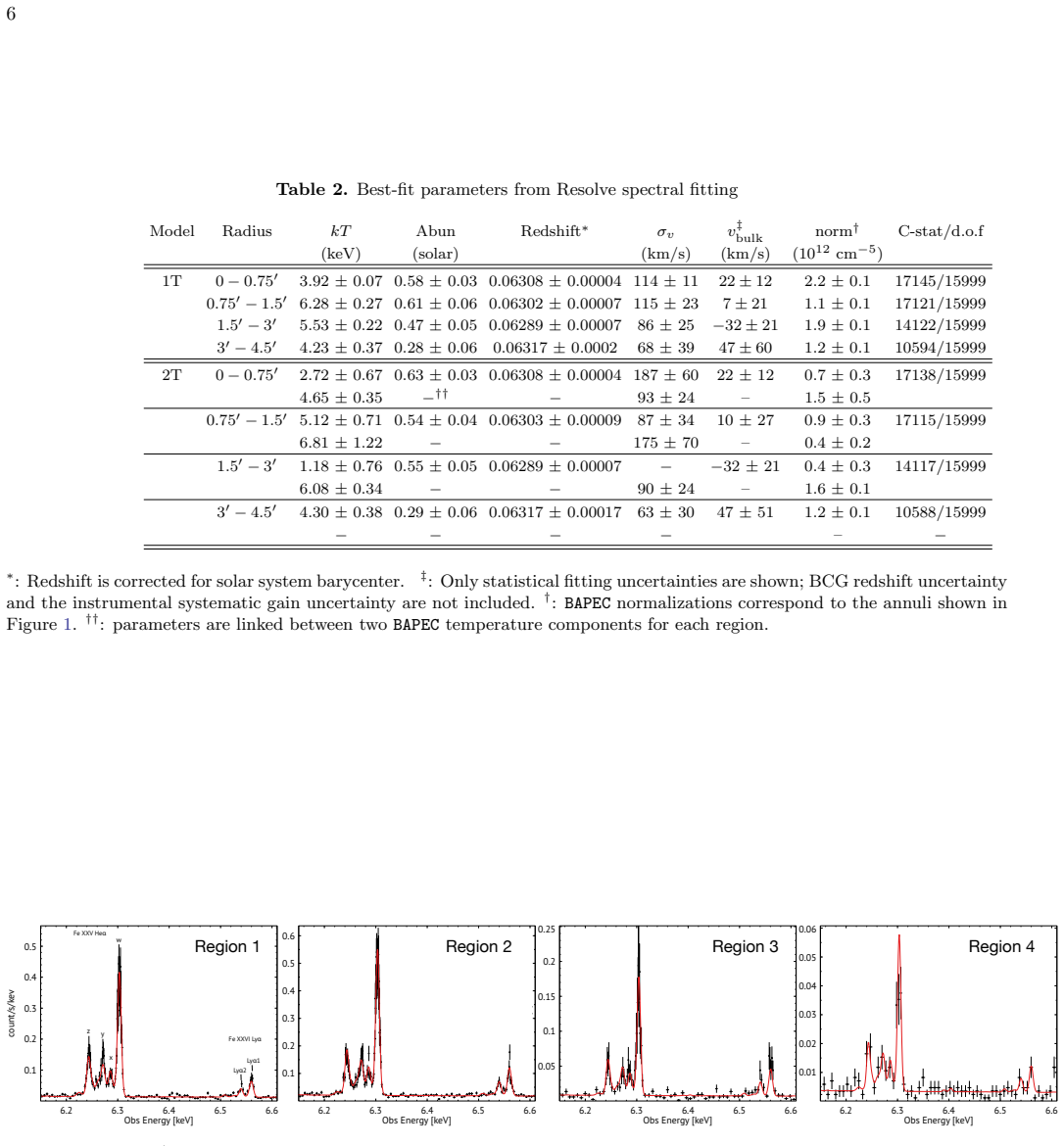
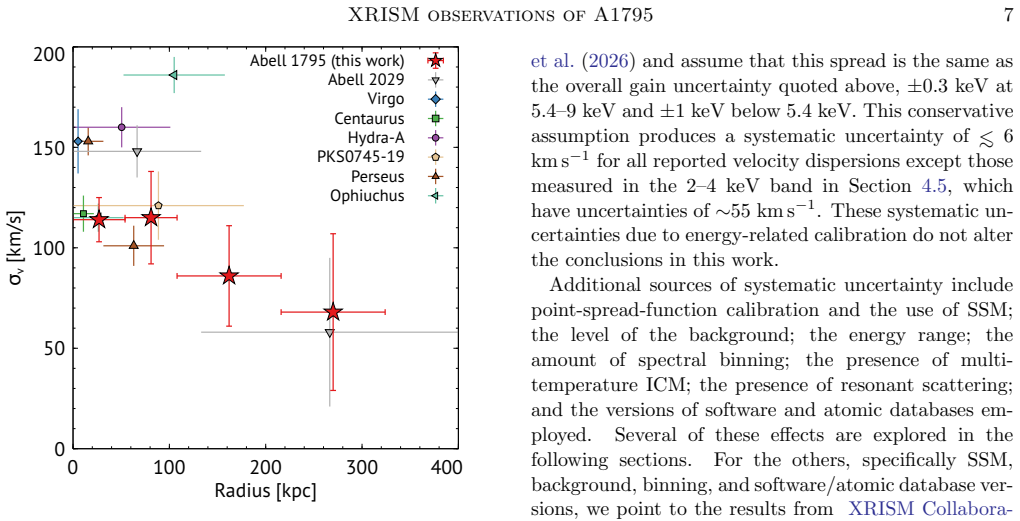
XRISM spectra of Abell 1795 show line-of-sight velocity dispersion falling from 114 km/s in the core to 68 km/s at 320 kpc, with 14 percent resonant suppression of the Fe XXV w line.
A machine-rendered reading of the paper's core claim, the machinery that carries it, and where it could break.
Core claim
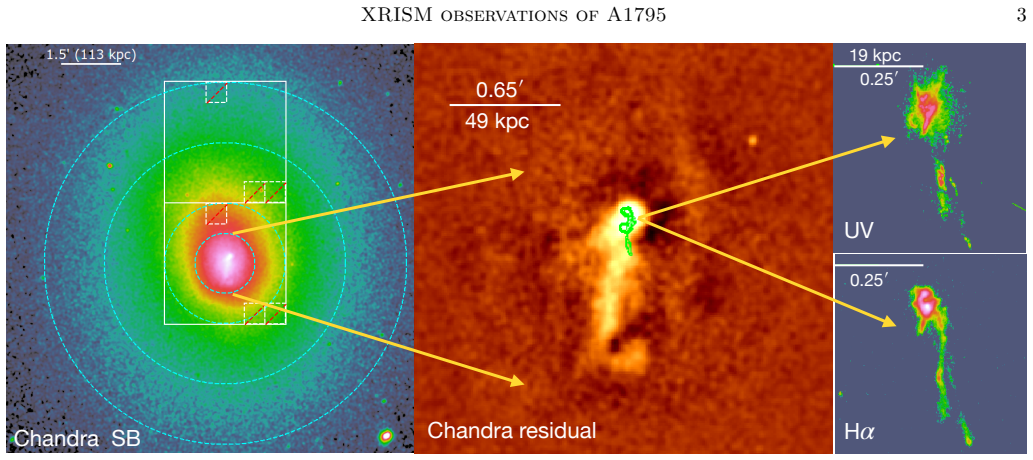
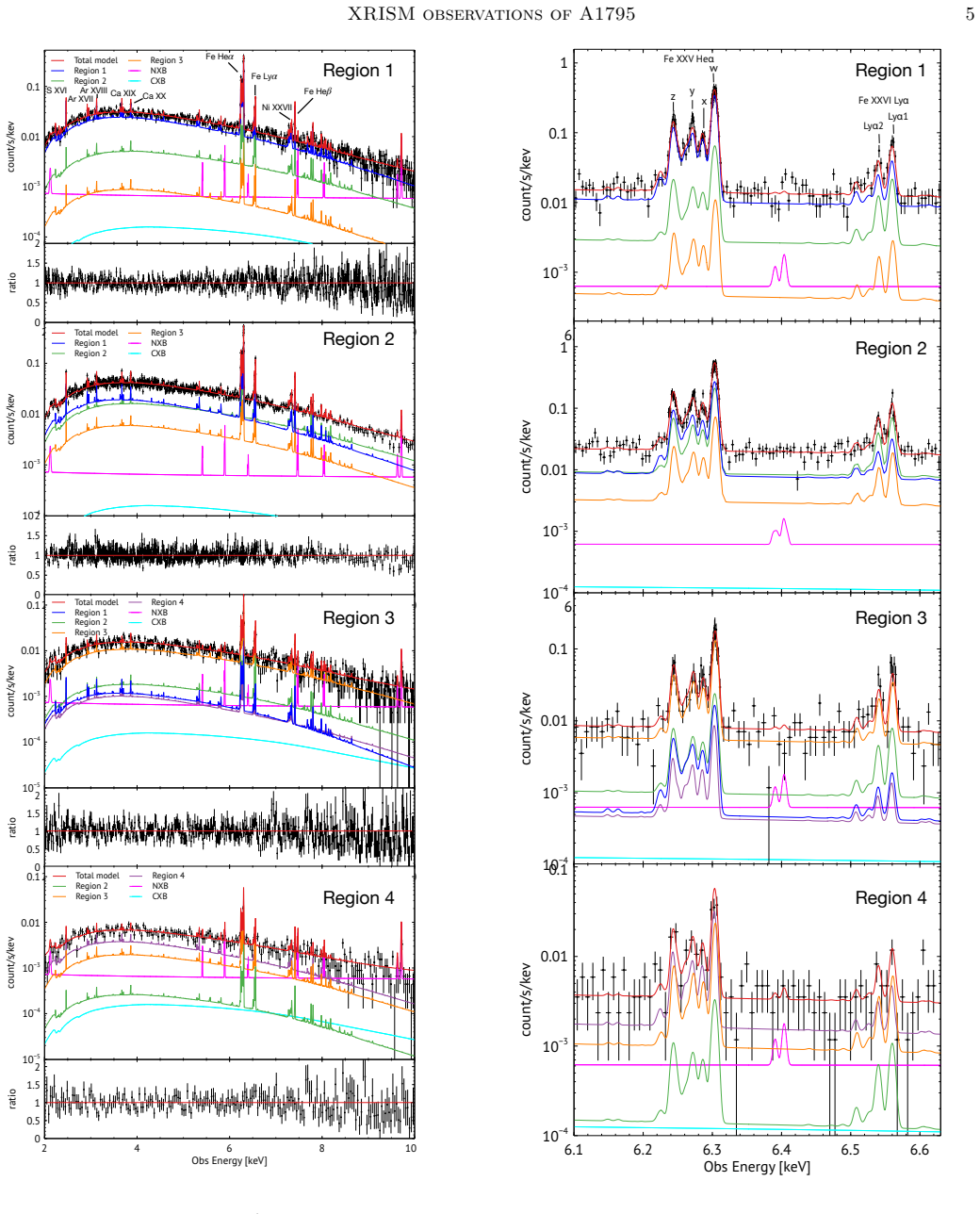
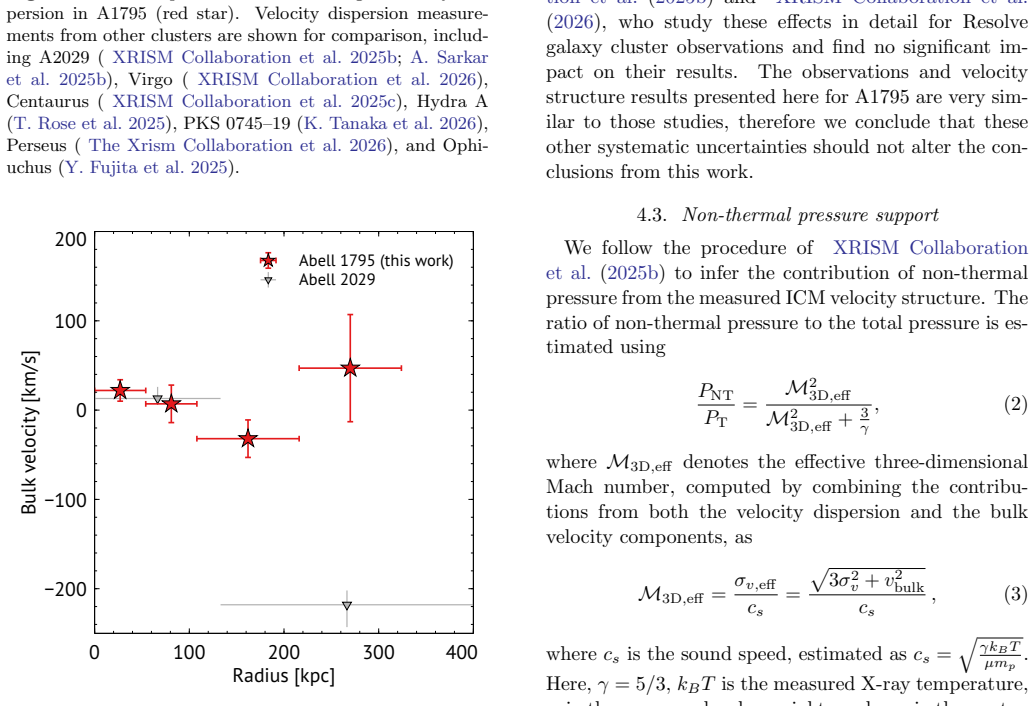
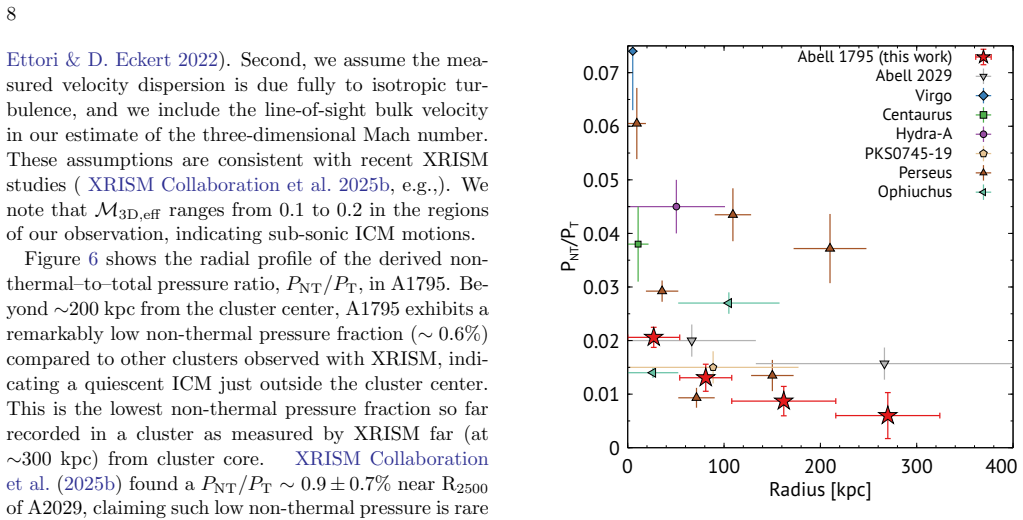
Single-temperature spectral fits to the central 225 ks and northern 113 ks XRISM pointings reveal a radial gradient in line-of-sight velocity dispersion decreasing outward, with bulk velocities of only 22 plus or minus 12 km/s and 7 plus or minus 21 km/s in the core indicating no significant BCG-ICM motion. The nonthermal pressure fraction declines with radius. Resonant scattering produces a 14 percent suppression of the Fe XXV w line in the center, while an excess in the y line flux is partly reconciled by atomic data uncertainties. Two-temperature fits confirm multiphase gas in the core, and the overall picture favors an AGN-uplift origin for the southward cool gas tail over a cooling-wake
What carries the argument
Doppler line broadening extracted from single-temperature and two-temperature fits to the Fe XXV complex and other emission lines in XRISM/Resolve spectra, combined with resonant-scattering optical-depth modeling that predicts suppression of the optically thick w line relative to thin-line expectations.
If this is right
- The northern ICM is largely quiescent, with nonthermal pressure support falling to 0.6 percent at 330 kpc.
- Central bulk velocities near zero disfavor the cooling-wake scenario for the cool gas tail and favor AGN uplift.
- Two gas phases exist within the central 1.5 arcmin, providing direct evidence for multiphase gas.
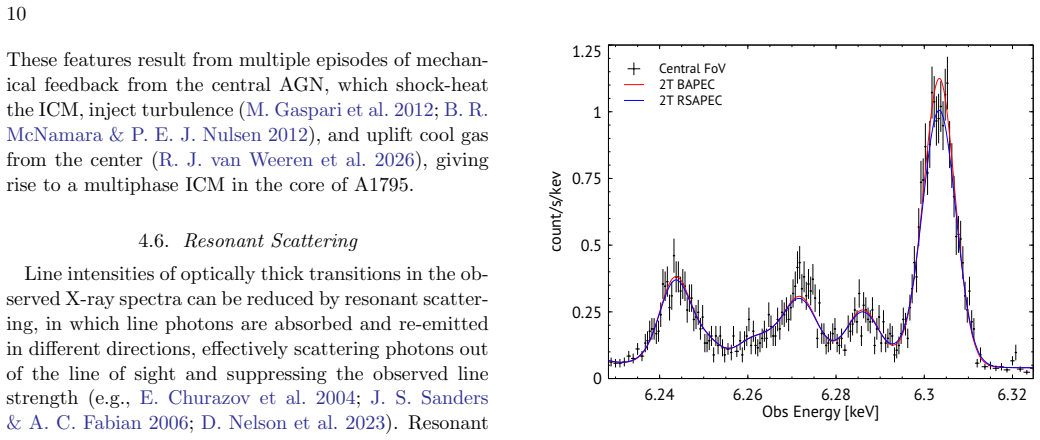
- Resonant scattering produces a 14 percent reduction in the Fe XXV w line flux in the core.
Where Pith is reading between the lines
- High-resolution spectroscopy can now map turbulence profiles across entire cluster radii to test whether low nonthermal pressure is typical of relaxed cool cores.
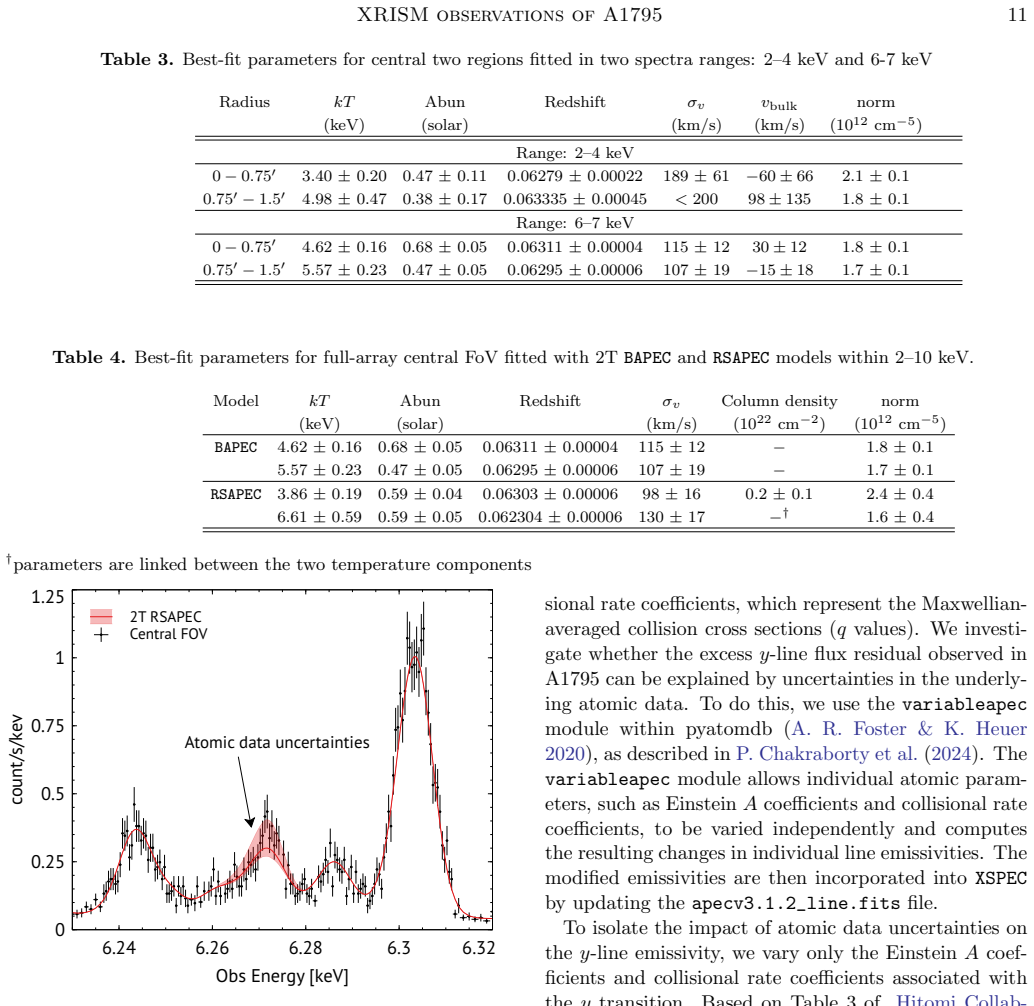
- Residual discrepancies in the Fe XXV y line after atomic-data adjustments highlight the need for refined plasma models before applying the same analysis to other clusters.
- Central generation of turbulence followed by radial decline implies that AGN activity is the dominant driver of ICM motions on these scales.
Load-bearing premise
Line widths after subtraction of thermal and instrumental contributions are produced by bulk gas motions, and atomic models for Fe XXV emissivities and optical depths are accurate enough to attribute the observed w-line suppression specifically to resonant scattering.
What would settle it
A new observation at 320 kpc that measures a velocity dispersion statistically consistent with the core value of 114 km/s, or a central spectrum showing no measurable flux deficit in the Fe XXV w line relative to predictions from optically thin models.
Figures
read the original abstract
We present high-resolution X-ray spectroscopic observations of the cool-core galaxy cluster Abell~1795 obtained with XRISM/Resolve. The cluster was observed with two deep pointings: a 225 ks central exposure and a 113 ks northern exposure, extending to a projected radius of 320 kpc from the cluster center. Single-temperature fits reveal a clear radial gradient in the line-of-sight velocity dispersion, decreasing from 114 $\pm$ 11 km/s in the core to 68 $\pm$ 39 km/s at 320 kpc. The bulk velocities in the central regions are very low (22 $\pm$ 12 and 7 $\pm$ 21 km/s), indicating no significant relative motion between the brightest cluster galaxy (BCG) and the intracluster medium (ICM). Given that the central region includes the southward extending cool gas tail, this result disfavors the ``cooling-wake'' scenario and instead supports an AGN-uplift origin. We find that the nonthermal pressure fraction decreases with radius, from $P_{\rm NT}/P_{\rm T}\approx2\%$ in the core to $\sim0.6\%$ at 330 kpc, suggesting that the northern ICM of A1795 is largely quiescent. Two-temperature and split energy-band (2--4 keV and 6--7 keV) fits identify two gas phases within the central $<1.5'$ region, providing strong evidence for multiphase gas in the cluster core. We detect a $\sim14\%$ resonant suppression of the optically thick Fe XXV $w$ line in the center. Additionally, we observe a significant excess in the Fe XXV $y$ line-flux relative to models. Accounting for uncertainties in the atomic data reduces this discrepancy, suggesting that atomic data uncertainties may contribute to the observed residual flux.
Editorial analysis
A structured set of objections, weighed in public.
Referee Report
Summary. The manuscript reports XRISM/Resolve high-resolution X-ray observations of Abell 1795 from a 225 ks central pointing and 113 ks northern pointing out to 320 kpc. Single-temperature fits yield a radial decline in line-of-sight velocity dispersion (114 ± 11 km/s core to 68 ± 39 km/s at 320 kpc), low bulk velocities (22 ± 12 and 7 ± 21 km/s), a decreasing nonthermal pressure fraction (P_NT/P_T ≈ 2% core to ~0.6% at 330 kpc), evidence for multiphase gas from two-temperature and split-band fits, a ~14% resonant suppression of the Fe XXV w line in the core, and a y-line excess whose discrepancy is reduced by atomic-data uncertainties.
Significance. If robust, the results supply direct constraints on ICM turbulence and dynamics in a cool-core cluster, favoring AGN uplift over cooling-wake scenarios and demonstrating XRISM's utility for velocity and resonant-scattering measurements. Radial coverage to 320 kpc and explicit discussion of atomic-data uncertainties are strengths; the work adds to the small sample of high-resolution cluster spectroscopy.
major comments (2)
- [Abstract and resonant-scattering analysis] Abstract and resonant-scattering section: The ~14% suppression of the optically thick Fe XXV w line is attributed to resonant scattering, but the same atomic models whose uncertainties are invoked to explain the y-line excess also enter the w-line emissivity and optical-depth calculations. No quantitative assessment is provided of how those uncertainties propagate into the measured suppression fraction; if model error can produce a comparable residual, the resonant-scattering detection is not yet isolated from atomic-data systematics.
- [Spectral fitting and results sections] Spectral-fitting and results sections: The central claims (velocity-dispersion gradient, nonthermal pressure fraction, line-flux ratios) rest on single-temperature fits whose background modeling, exact extraction regions, and full systematic-error budget are only summarized in the abstract. A complete tabulation of these choices and their effect on the reported uncertainties (e.g., the 114 ± 11 km/s and 68 ± 39 km/s values) is required to evaluate whether the gradient and P_NT/P_T trend remain significant after systematics.
minor comments (2)
- [Results on velocity dispersion] The outer-bin velocity dispersion (68 ± 39 km/s) has an uncertainty comparable to the central value; the text should state the formal significance of the reported radial gradient after accounting for parameter covariances.
- [Figures and methods] Figure captions and text should explicitly list the energy bands and atomic databases used for the Fe XXV line modeling to allow direct comparison with future work.
Simulated Author's Rebuttal
We thank the referee for their careful and constructive review of our manuscript. We address each major comment below and have incorporated revisions to improve the presentation of systematic uncertainties and atomic data effects.
read point-by-point responses
-
Referee: [Abstract and resonant-scattering analysis] Abstract and resonant-scattering section: The ~14% suppression of the optically thick Fe XXV w line is attributed to resonant scattering, but the same atomic models whose uncertainties are invoked to explain the y-line excess also enter the w-line emissivity and optical-depth calculations. No quantitative assessment is provided of how those uncertainties propagate into the measured suppression fraction; if model error can produce a comparable residual, the resonant-scattering detection is not yet isolated from atomic-data systematics.
Authors: We agree that explicit propagation of atomic-data uncertainties into the resonant-scattering measurement is needed to isolate the effect from systematics. In the revised manuscript we have added a dedicated subsection that perturbs the key atomic parameters (oscillator strengths, collision strengths) within their published uncertainties, recomputes the line emissivities and optical depths, and shows that the maximum variation in the predicted suppression fraction is ~6%. The observed 14% suppression therefore remains significant at >2 sigma even after these variations. We have also updated the abstract to reference this test. revision: yes
-
Referee: [Spectral fitting and results sections] Spectral-fitting and results sections: The central claims (velocity-dispersion gradient, nonthermal pressure fraction, line-flux ratios) rest on single-temperature fits whose background modeling, exact extraction regions, and full systematic-error budget are only summarized in the abstract. A complete tabulation of these choices and their effect on the reported uncertainties (e.g., the 114 ± 11 km/s and 68 ± 39 km/s values) is required to evaluate whether the gradient and P_NT/P_T trend remain significant after systematics.
Authors: We accept that a consolidated tabulation of analysis choices and their impact on the reported values improves transparency. The original manuscript already details the extraction regions and background model in Section 3, but we have now added Table 4 that lists every region, the precise background components, and the results of systematic tests (alternative background normalizations, gain offsets, and response variations). These tests show that the core velocity dispersion shifts by at most 9 km/s and the outer value by at most 25 km/s, preserving the radial gradient at >2.5 sigma. The P_NT/P_T decline is likewise robust. The revised text refers readers to this table for the full error budget. revision: yes
Circularity Check
No significant circularity; purely observational results
full rationale
The paper reports direct measurements from XRISM/Resolve spectra of Abell 1795, including line-of-sight velocity dispersions obtained via single-temperature spectral fits and a ~14% suppression of the Fe XXV w line attributed to resonant scattering. No claimed derivations, predictions, or first-principles results are present that reduce by the paper's own equations to quantities defined in terms of the fitted parameters themselves. The analysis relies on standard fitting procedures and external atomic models without internal self-definition, fitted-input-as-prediction, or self-citation load-bearing steps. The central claims remain independent of any circular reduction within the manuscript.
Axiom & Free-Parameter Ledger
free parameters (2)
- line-of-sight velocity dispersion =
114 km/s (core) to 68 km/s (outer)
- bulk velocity =
22 km/s and 7 km/s
axioms (1)
- domain assumption Atomic data for Fe XXV transitions are known to sufficient precision to identify lines and interpret resonant suppression versus model residuals
Reference graph
Works this paper leans on
-
[1]
Arnaud, K. A. 1996, in Astronomical Society of the Pacific Conference Series, Vol. 101, Astronomical Data Analysis Software and Systems V, ed. G. H. Jacoby & J. Barnes, 17
1996
-
[2]
Bautz, M. W., Miller, E. D., Sanders, J. S., et al. 2009, PASJ, 61, 1117, doi: 10.1093/pasj/61.5.1117
-
[3]
1979, ApJ, 228, 939, doi: 10.1086/156922
Cash, W. 1979, ApJ, 228, 939, doi: 10.1086/156922
-
[4]
Center, N. H. E. A. S. A. R. 2014, HEAsoft: Unified Release of FTOOLS and XANADU,, Astrophysics Source Code Library, record ascl:1408.004 http://ascl.net/1408.004
2014
-
[5]
2023, ApJ, 959, 126, doi: 10.3847/1538-4357/acfe10
Raymond, J. 2023, ApJ, 959, 126, doi: 10.3847/1538-4357/acfe10
-
[6]
Chakraborty, P., Hemmer, R., Foster, A. R., et al. 2024, ApJ, 962, 192, doi: 10.3847/1538-4357/ad17be
-
[7]
Churazov, E., Forman, W., Jones, C., Sunyaev, R., & B¨ ohringer, H. 2004, MNRAS, 347, 29, doi: 10.1111/j.1365-2966.2004.07201.x XRISM observations of A179513
-
[8]
Eckart, M. E., Brown, G. V., Chiao, M. P., et al. 2025, Journal of Astronomical Telescopes, Instruments, and Systems, 11, 042018, doi: 10.1117/1.JATIS.11.4.042018
-
[9]
Bautz, M. W. 2015, ApJ, 799, 174, doi: 10.1088/0004-637X/799/2/174
-
[10]
Ettori, S., & Eckert, D. 2022, A&A, 657, L1, doi: 10.1051/0004-6361/202142638
-
[11]
2001, MNRAS, 322, 231, doi: 10.1046/j.1365-8711.2001.04022.x
Fabian, A. C., Sanders, J. S., Ettori, S., et al. 2001, MNRAS, 321, L33, doi: 10.1046/j.1365-8711.2001.04243.x
-
[12]
Foster, A. R., & Heuer, K. 2020, Atoms, 8, doi: 10.3390/atoms8030049
-
[13]
doi:10.1093/pasj/psaf089 , archiveprefix =
Kondo, M. 2025, PASJ, 77, S270, doi: 10.1093/pasj/psaf089
-
[14]
2004, ApJL, 612, L9, doi: 10.1086/424483
Fujita, Y., Matsumoto, T., & Wada, K. 2004, ApJL, 612, L9, doi: 10.1086/424483
-
[15]
2012, ApJ, 746, 94, doi: 10.1088/0004-637X/746/1/94
Gaspari, M., Ruszkowski, M., & Sharma, P. 2012, ApJ, 746, 94, doi: 10.1088/0004-637X/746/1/94
-
[16]
Heinrich, A., Zhuravleva, I., Zhang, C., et al. 2024, MNRAS, 528, 7274, doi: 10.1093/mnras/stae208 HI4PI Collaboration, Ben Bekhti, N., Fl¨ oer, L., et al. 2016, A&A, 594, A116, doi: 10.1051/0004-6361/201629178 Hitomi Collaboration, Aharonian, F., Akamatsu, H., et al. 2016a, Nature, 535, 117, doi: 10.1038/nature18627 Hitomi Collaboration, Aharonian, F., A...
-
[17]
Hogan, M. T., McNamara, B. R., Pulido, F. A., et al. 2017, ApJ, 851, 66, doi: 10.3847/1538-4357/aa9af3
-
[18]
L., Ishisaki, Y., Costantini, E., et al
Kelley, R. L., Ishisaki, Y., Costantini, E., et al. 2025, Journal of Astronomical Telescopes, Instruments, and Systems, 11, 042026
2025
-
[20]
Kokotanekov, G., Wise, M. W., de Vries, M., & Intema, H. T. 2018b, A&A, 618, A152, doi: 10.1051/0004-6361/201833222
-
[21]
Leutenegger, M. A., Brown, G. V., Chiao, M. P., et al. 2025, Journal of Astronomical Telescopes, Instruments, and Systems, 11, 042024, doi: 10.1117/1.JATIS.11.4.042024
-
[22]
2009, Meteoritics and Planetary Science Supplement, 72, 5154
Lodders, K., & Palme, H. 2009, Meteoritics and Planetary Science Supplement, 72, 5154
2009
-
[23]
2001, ApJL, 562, L153, doi: 10.1086/337973
Markevitch, M., Vikhlinin, A., & Mazzotta, P. 2001, ApJL, 562, L153, doi: 10.1086/337973
-
[24]
2009, ApJL, 703, L172, doi: 10.1088/0004-637X/703/2/L172
McDonald, M., & Veilleux, S. 2009, ApJL, 703, L172, doi: 10.1088/0004-637X/703/2/L172
-
[25]
Are X-ray Atmospheres Heated by Turbulent Dissipation? XRISM Constraints
McNamara, B. R., Fabian, A. C., Russell, H. R., et al. 2026, arXiv e-prints, arXiv:2604.19607, doi: 10.48550/arXiv.2604.19607
work page internal anchor Pith review Pith/arXiv arXiv doi:10.48550/arxiv.2604.19607 2026
-
[26]
New Journal of Physics , volume =
McNamara, B. R., & Nulsen, P. E. J. 2012, New Journal of Physics, 14, 055023, doi: 10.1088/1367-2630/14/5/055023
-
[27]
2023, MNRAS, 522, 3665, doi: 10.1093/mnras/stad1195
Nelson, D., Byrohl, C., Ogorzalek, A., et al. 2023, MNRAS, 522, 3665, doi: 10.1093/mnras/stad1195
-
[28]
2026, ApJL, 996, L15, doi: 10.3847/2041-8213/ae2a28
Omiya, Y., Ichinohe, Y., Nakazawa, K., et al. 2026, ApJL, 996, L15, doi: 10.3847/2041-8213/ae2a28
-
[29]
Pulido, F. A., McNamara, B. R., Edge, A. C., et al. 2018, ApJ, 853, 177, doi: 10.3847/1538-4357/aaa54b
-
[30]
Wise, M. W. 2006, ApJ, 652, 216, doi: 10.1086/507672
-
[31]
Rose, T., McNamara, B. R., Meunier, J., et al. 2025, ApJ, 990, 42, doi: 10.3847/1538-4357/adf32d
-
[33]
Russell, H. R., McNamara, B. R., Fabian, A. C., et al. 2017b, MNRAS, 472, 4024, doi: 10.1093/mnras/stx2255
-
[34]
Sanders, J. S., & Fabian, A. C. 2006, MNRAS, 370, 63, doi: 10.1111/j.1365-2966.2006.10497.x
-
[35]
Sanders, J. S., & Fabian, A. C. 2007, MNRAS, 381, 1381, doi: 10.1111/j.1365-2966.2007.12347.x
-
[36]
Sanders, J. S., Fabian, A. C., Russell, H. R., Walker, S. A., & Blundell, K. M. 2016, MNRAS, 460, 1898, doi: 10.1093/mnras/stw1119
-
[37]
2022, ApJL, 935, L23, doi: 10.3847/2041-8213/ac86d4
Sarkar, A., Randall, S., Su, Y., et al. 2022, ApJL, 935, L23, doi: 10.3847/2041-8213/ac86d4
-
[38]
2023, ApJ, 944, 132, doi: 10.3847/1538-4357/acae9f
Sarkar, A., Randall, S., Su, Y., et al. 2023, ApJ, 944, 132, doi: 10.3847/1538-4357/acae9f
-
[39]
2025a, ApJL, 984, L63, doi: 10.3847/2041-8213/adc676
Sarkar, A., McDonald, M., Bleem, L., et al. 2025a, ApJL, 984, L63, doi: 10.3847/2041-8213/adc676
-
[40]
doi:10.1093/pasj/psaf093 , archiveprefix =
Sarkar, A., Miller, E., Ota, N., et al. 2025b, PASJ, 77, S254, doi: 10.1093/pasj/psaf093
-
[41]
2019, SSRv, 215, 24, doi: 10.1007/s11214-019-0590-1
Simionescu, A., ZuHone, J., Zhuravleva, I., et al. 2019, SSRv, 215, 24, doi: 10.1007/s11214-019-0590-1
-
[42]
Simionescu, A., Kilbourne, C., Russell, H. R., et al. 2026, A&A, 707, A124, doi: 10.1051/0004-6361/202558423
-
[43]
, archivePrefix = "arXiv", eprint =
Snowden, S. L., Mushotzky, R. F., Kuntz, K. D., & Davis, D. S. 2008, A&A, 478, 615, doi: 10.1051/0004-6361:20077930
-
[45]
Tamhane, P. D., McNamara, B. R., Russell, H. R., et al. 2023b, MNRAS, 519, 3338, doi: 10.1093/mnras/stac3803
-
[46]
Tamura, T., Kaastra, J. S., Peterson, J. R., et al. 2001, A&A, 365, L87, doi: 10.1051/0004-6361:20000038 14
-
[47]
2026, PASJ, arXiv:2603.16263, doi: 10.1093/pasj/psag028
Tanaka, K., Eckart, M., Fukushima, K., et al. 2026, PASJ, arXiv:2603.16263, doi: 10.1093/pasj/psag028
-
[48]
doi:10.1093/pasj/psaf023 , adsurl =
Tashiro, M., Kelley, R., Watanabe, S., et al. 2025, PASJ, 77, S1, doi: 10.1093/pasj/psaf023 The Xrism Collaboration, Audard, M., Awaki, H., et al. 2026, Nature, 650, 309, doi: 10.1038/s41586-025-10017-x van Weeren, R. J., Osinga, E., Brunetti, G., et al. 2026, MNRAS, doi: 10.1093/mnras/stag054
-
[49]
Vazza, F., Angelinelli, M., Jones, T. W., et al. 2018, MNRAS, 481, L120, doi: 10.1093/mnrasl/sly172
-
[50]
2009, A&A, 504, 33, doi: 10.1051/0004-6361/200912535
Vazza, F., Brunetti, G., Kritsuk, A., et al. 2009, A&A, 504, 33, doi: 10.1051/0004-6361/200912535
-
[51]
Vikhlinin, A., Kravtsov, A., Forman, W., et al. 2006, The Astrophysical Journal, 640, 691, doi: 10.1086/500288
-
[52]
Walker, S. A., Fabian, A. C., & Kosec, P. 2014, MNRAS, 445, 3444, doi: 10.1093/mnras/stu1996 XRISM Collaboration, Audard, M., Awaki, H., et al. 2025a, ApJL, 982, L5, doi: 10.3847/2041-8213/ada7cd XRISM Collaboration, Audard, M., Awaki, H., et al. 2025b, PASJ, 77, S242, doi: 10.1093/pasj/psaf055 XRISM Collaboration, Audard, M., Awaki, H., et al. 2025c, Nat...
-
[53]
Zhuravleva, I., Chen, M. C., Churazov, E., et al. 2023, MNRAS, 520, 5157, doi: 10.1093/mnras/stad470
discussion (0)
Sign in with ORCID, Apple, or X to comment. Anyone can read and Pith papers without signing in.