Semantic Smoothing via Novel View Synthesis for Robust SAR Image Classification
Pith reviewed 2026-05-20 20:10 UTC · model grok-4.3
The pith
Semantic smoothing replaces isotropic noise with geometry-conditioned novel views to defend SAR classifiers against attacks.
A machine-rendered reading of the paper's core claim, the machinery that carries it, and where it could break.
Core claim
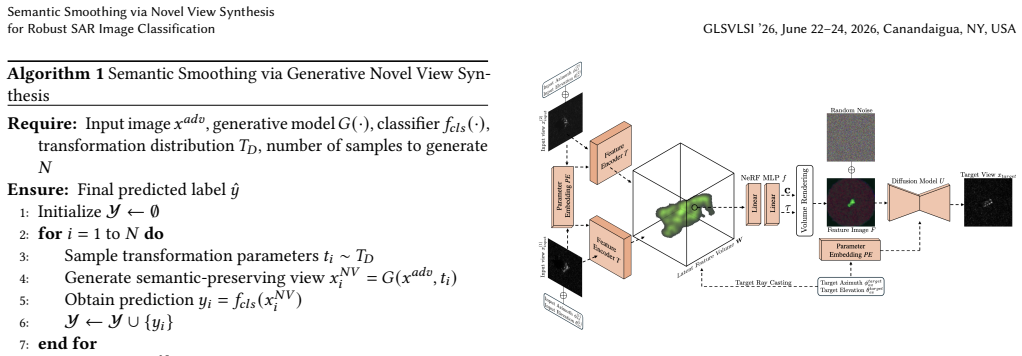
Semantic smoothing replaces isotropic noise perturbations with structured randomized transformations generated by a novel view synthesis model conditioned on acquisition geometry. Predictions across the generated randomized views are aggregated to form a robust classifier for SAR imagery.
What carries the argument
A geometry-conditioned novel view synthesis model that generates multiple plausible SAR views while preserving semantic structure, enabling robust prediction aggregation.
If this is right
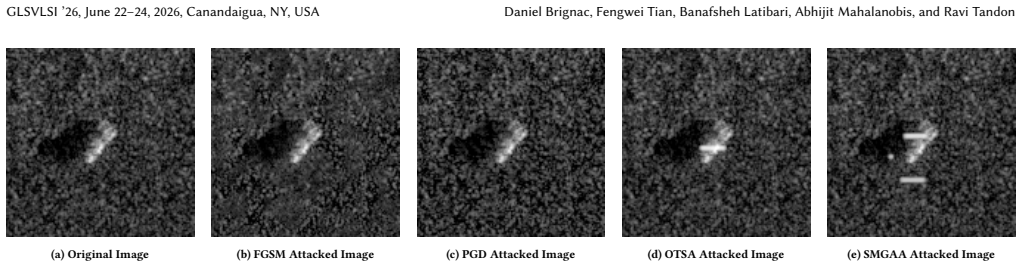
- Robustness improves against standard attacks such as FGSM and PGD.
- Robustness also improves against SAR-specific attacks such as OTSA and SMGAA.
- Clean classification accuracy increases alongside the robustness gains.
- Structured geometric transformations serve as a viable substitute for isotropic noise in structured sensing domains.
Where Pith is reading between the lines
- The same replacement of noise by domain-preserving transformations could be tested in other geometrically structured modalities such as ultrasound or LiDAR.
- One could measure whether removing the geometry conditioning still yields most of the robustness benefit.
- Integration with existing certified-defense pipelines might extend the range of certified radii achievable in SAR settings.
Load-bearing premise
The novel view synthesis model generates multiple plausible radar views that preserve the semantic structure of the original SAR imagery sufficiently well to enable effective robust aggregation.
What would settle it
If aggregating predictions over the synthesized views produces no measurable gain in accuracy under FGSM, PGD, OTSA, or SMGAA attacks compared with standard randomized smoothing on the same SAR data, the central claim would not hold.
Figures

read the original abstract
Deep neural networks are vulnerable to adversarial perturbations, limiting deployment in safety-critical applications such as synthetic aperture radar (SAR) automatic target recognition (ATR). Randomized smoothing improves robustness by averaging predictions over noisy inputs, but isotropic noise often fails to preserve the semantic structure of SAR imagery. We propose semantic smoothing, a defense that replaces noised-based perturbations with structured randomized transformations generated by a novel view synthesis model. For SAR, we condition on acquisition geometry to synthesize multiple plausible radar views. Predictions across generated randomized views are aggregated to form a robust classifier. Experiments show that semantic smoothing improves robustness against standard attacks, such as FGSM and PGD, and SAR-specific attacks, such as OTSA and SMGAA, while also increasing clean classification accuracy. These results demonstrate that randomized smoothing via semantically preserving geometric transformations is a promising alternative to isotropic noise for adversarial defense in structured sensing domains.
Editorial analysis
A structured set of objections, weighed in public.
Referee Report
Summary. The manuscript proposes semantic smoothing as an adversarial defense for deep neural networks in SAR automatic target recognition. It replaces isotropic noise from randomized smoothing with structured randomized transformations produced by a novel view synthesis model conditioned on acquisition geometry. Multiple plausible radar views are synthesized and predictions are aggregated (e.g., via majority vote or averaging) to obtain a robust classifier. The central claim is that this yields improved robustness to both standard attacks (FGSM, PGD) and SAR-specific attacks (OTSA, SMGAA) while simultaneously increasing clean accuracy.
Significance. If the empirical claims are substantiated with quantitative results and verification of semantic preservation, the work could offer a domain-appropriate alternative to isotropic-noise smoothing for structured sensing modalities such as SAR. The idea of leveraging geometry-conditioned view synthesis to maintain semantic content while randomizing inputs is conceptually appealing for radar imagery dominated by specular returns and speckle.
major comments (2)
- [Abstract] Abstract: The abstract asserts that 'Experiments show that semantic smoothing improves robustness against standard attacks, such as FGSM and PGD, and SAR-specific attacks, such as OTSA and SMGAA, while also increasing clean classification accuracy' yet supplies no numerical results, datasets, model architectures, training details, or evaluation protocols. This omission is load-bearing for the central claim because the reported gains cannot be verified or reproduced from the given text.
- [Abstract] Abstract / Method: The key assumption that geometry-conditioned novel view synthesis produces randomized views whose semantic content (target identity and scattering properties) remains sufficiently preserved for aggregation to improve both clean accuracy and robustness is stated but not supported by any verification, semantic-equivalence metrics, or ablation studies. SAR imagery is dominated by geometry-dependent specular returns and multiplicative speckle; without evidence that the synthesized views are semantically equivalent to real acquisitions, the observed robustness could be an artifact of attack implementations or implicit regularization rather than true semantic smoothing.
minor comments (2)
- [Abstract] Abstract: The acronym ATR is introduced without expansion on first use.
- [Abstract] Abstract: Consider briefly indicating the specific novel-view-synthesis architecture or training objective to allow readers to assess feasibility for SAR data.
Simulated Author's Rebuttal
We thank the referee for the constructive and detailed report. The comments highlight important aspects of presentation and evidence that we will address through targeted revisions. Below we respond point by point to the major comments.
read point-by-point responses
-
Referee: [Abstract] Abstract: The abstract asserts that 'Experiments show that semantic smoothing improves robustness against standard attacks, such as FGSM and PGD, and SAR-specific attacks, such as OTSA and SMGAA, while also increasing clean classification accuracy' yet supplies no numerical results, datasets, model architectures, training details, or evaluation protocols. This omission is load-bearing for the central claim because the reported gains cannot be verified or reproduced from the given text.
Authors: We agree that the abstract would benefit from concise quantitative anchors. In the revised version we will incorporate key numerical highlights (e.g., clean-accuracy gains and robustness improvements under FGSM, PGD, OTSA, and SMGAA on the MSTAR dataset) while respecting length limits. Full experimental protocols, architectures, and training details already appear in Sections 4 and 5; the abstract update will simply surface the most salient results for immediate assessment. revision: yes
-
Referee: [Abstract] Abstract / Method: The key assumption that geometry-conditioned novel view synthesis produces randomized views whose semantic content (target identity and scattering properties) remains sufficiently preserved for aggregation to improve both clean accuracy and robustness is stated but not supported by any verification, semantic-equivalence metrics, or ablation studies. SAR imagery is dominated by geometry-dependent specular returns and multiplicative speckle; without evidence that the synthesized views are semantically equivalent to real acquisitions, the observed robustness could be an artifact of attack implementations or implicit regularization rather than true semantic smoothing.
Authors: We accept that explicit verification strengthens the central claim. The current manuscript shows that semantic smoothing simultaneously raises clean accuracy and robustness, an outcome that would be improbable if semantic content were not largely preserved. Nevertheless, we did not report dedicated semantic-equivalence metrics or ablations. In revision we will add (i) quantitative comparisons (SSIM, feature cosine similarity) between synthesized and real views, (ii) an ablation removing the geometry-conditioning to isolate its contribution, and (iii) qualitative radar-image examples illustrating preservation of target scattering centers. These additions will directly address the concern that robustness gains might stem from other factors. revision: yes
Circularity Check
No circularity; method depends on external novel view synthesis without internal derivations or self-referential fits
full rationale
The provided abstract and description contain no equations, parameter fits, or derivation steps that could reduce to self-definition, fitted inputs renamed as predictions, or load-bearing self-citations. The proposal introduces semantic smoothing by conditioning a novel view synthesis model on acquisition geometry to generate randomized SAR views, then aggregates predictions; this relies on an assumed external model whose semantic preservation properties are not internally derived or verified within the text. No uniqueness theorems, ansatzes smuggled via citation, or renaming of known results appear. The central claim rests on experimental outcomes rather than a closed mathematical chain, rendering the approach self-contained against external benchmarks with no detectable circular reductions.
Axiom & Free-Parameter Ledger
axioms (1)
- domain assumption Conditioning a novel view synthesis model on SAR acquisition geometry produces plausible views that preserve semantic content for robust prediction aggregation.
invented entities (1)
-
Semantic smoothing
no independent evidence
Lean theorems connected to this paper
-
IndisputableMonolith/Foundation/RealityFromDistinctionreality_from_one_distinction unclear?
unclearRelation between the paper passage and the cited Recognition theorem.
We propose semantic smoothing, a defense that replaces noise-based perturbations with structured randomized transformations generated by a novel view synthesis model. For SAR, we condition on acquisition geometry to synthesize multiple plausible radar views.
-
IndisputableMonolith/Foundation/AbsoluteFloorClosureabsolute_floor_iff_bare_distinguishability unclear?
unclearRelation between the paper passage and the cited Recognition theorem.
Predictions across generated randomized views are aggregated to form a robust classifier.
What do these tags mean?
- matches
- The paper's claim is directly supported by a theorem in the formal canon.
- supports
- The theorem supports part of the paper's argument, but the paper may add assumptions or extra steps.
- extends
- The paper goes beyond the formal theorem; the theorem is a base layer rather than the whole result.
- uses
- The paper appears to rely on the theorem as machinery.
- contradicts
- The paper's claim conflicts with a theorem or certificate in the canon.
- unclear
- Pith found a possible connection, but the passage is too broad, indirect, or ambiguous to say the theorem truly supports the claim.
Reference graph
Works this paper leans on
-
[1]
Ian J Goodfellow et al. 2015. Explaining and harnessing adversarial examples. International Conference on Learning Representations(2015)
work page 2015
-
[2]
Aleksander Madry et al. 2018. Towards deep learning models resistant to adver- sarial attacks.International Conference on Learning Representations(2018)
work page 2018
-
[3]
Tian Ye et al. 2023. Realistic scatterer based adversarial attacks on SAR image classifiers. In2023 IEEE International Radar Conference (RADAR). IEEE, 1–6
work page 2023
-
[4]
Bowen Peng et al. 2022. Scattering model guided adversarial examples for SAR target recognition: Attack and defense.IEEE Transactions on Geoscience and Remote Sensing60 (2022), 1–17
work page 2022
-
[5]
Jeremy Cohen et al. 2019. Certified adversarial robustness via randomized smooth- ing. InInternational Conference on Machine Learning. PMLR, 1310–1320
work page 2019
-
[6]
Eric R Chan et al . 2022. Efficient geometry-aware 3d generative adversarial networks. InProceedings of the IEEE/CVF conference on computer vision and pattern recognition. 16123–16133
work page 2022
-
[7]
Ben Mildenhall et al. 2021. Nerf: Representing scenes as neural radiance fields for view synthesis.Commun. ACM65, 1 (2021), 99–106
work page 2021
-
[8]
Eric R Chan et al. 2023. Generative novel view synthesis with 3d-aware diffusion models. InProceedings of the IEEE/CVF International Conference on Computer Vision. 4217–4229
work page 2023
-
[9]
Pouya Samangouei et al. 2018. Defense-gan: Protecting classifiers against ad- versarial attacks using generative models.International Conference on Learning Representations(2018)
work page 2018
-
[10]
Weili Nie et al. 2022. Diffusion models for adversarial purification.International Conference on Machine Learning(2022)
work page 2022
-
[11]
Aditi Raghunathan et al. 2018. Certified defenses against adversarial examples. International Conference on Learning Representations(2018)
work page 2018
-
[12]
Matthias Hein et al. 2017. Formal guarantees on the robustness of a classifier against adversarial manipulation.Advances in neural information processing systems30 (2017)
work page 2017
-
[13]
Mathias Lecuyer et al. 2019. Certified Robustness to Adversarial Examples with Differential Privacy. In2019 IEEE Symposium on Security and Privacy (SP). Semantic Smoothing via Novel View Synthesis for Robust SAR Image Classification GLSVLSI ’26, June 22–24, 2026, Canandaigua, NY, USA
work page 2019
-
[14]
Elan Rosenfeld et al . 2020. Certified robustness to label-flipping attacks via randomized smoothing. InInternational Conference on Machine Learning. PMLR
work page 2020
-
[15]
Steven M Seitz et al . 1996. View morphing. InProceedings of the 23rd annual conference on Computer graphics and interactive techniques. 21–30
work page 1996
-
[16]
Paul E Debevec et al . 2023. Modeling and rendering architecture from pho- tographs: A hybrid geometry-and image-based approach. InSeminal Graphics Papers: Pushing the Boundaries, Volume 2. 465–474
work page 2023
-
[17]
Alex Yu et al. 2021. pixelnerf: Neural radiance fields from one or few images. In Proceedings of the IEEE/CVF conference on computer vision and pattern recognition. 4578–4587
work page 2021
-
[18]
Katja Schwarz et al. 2020. Graf: Generative radiance fields for 3d-aware image synthesis.Advances in neural information processing systems33 (2020), 20154– 20166
work page 2020
-
[19]
Junjie Hou et al. 2026. Adversarial Attack Method Against SAR ATR Based on Superimposed Phase Modulation.IEEE Transactions on Antennas and Propagation 74, 1 (2026), 995–1006
work page 2026
-
[20]
Amir Hosein Oveis et al. 2025. Efficient Ensemble Pruning for Robust Adversarial Defense in SAR-ATR. In2025 22nd European Radar Conference (EuRAD). 149–152
work page 2025
-
[21]
2009.Remote sensing with imaging radar
John A Richards et al. 2009.Remote sensing with imaging radar. Vol. 1. Springer
work page 2009
-
[22]
Jonathan Ho et al. 2020. Denoising diffusion probabilistic models.Advances in neural information processing systems33 (2020), 6840–6851
work page 2020
-
[23]
Timothy D Ross et al. 1998. Standard SAR ATR evaluation experiments using the MSTAR public release data set. InAlgorithms for synthetic aperture radar imagery V, Vol. 3370. SPIE, 566–573
work page 1998
discussion (0)
Sign in with ORCID, Apple, or X to comment. Anyone can read and Pith papers without signing in.