Control-Certified Wireless Resource Allocation for Digital-Twin-Enabled UAV Swarms
Pith reviewed 2026-05-20 09:49 UTC · model grok-4.3
The pith
Digital-twin QoS certificates and Lyapunov drift tests enable certifiably safe wireless scheduling for UAV swarm control.
A machine-rendered reading of the paper's core claim, the machinery that carries it, and where it could break.
Core claim
The framework maps predicted states into five-dimensional QoS certificates covering uplink and downlink delay bounds, directional delivery guarantees, and a certified upper bound on the interval between successful bidirectional interactions. A state-conditioned stochastic drift test admits only certificates for which the augmented Lyapunov drift is nonpositive. These certificates are reduced to certified supply frontiers by discarding dominated route-slot configurations, and the online scheduler uses exact dynamic programming to maximize Lyapunov-drift reduction subject to a shared TDMA slot budget.
What carries the argument
The five-dimensional QoS certificate produced by the digital twin and filtered by a state-conditioned stochastic drift test that enforces nonpositive augmented Lyapunov drift.
If this is right
- Wireless actions that differ in route, retransmission depth, blocklength, and bidirectional delay can be ranked by their certified effect on controller stability rather than by scalar network metrics.
- Under a fixed TDMA slot budget the scheduler can still guarantee stability by admitting only actions that pass the drift test and then optimizing for maximum drift reduction.
- Dominated multi-hop configurations are eliminated before optimization, leaving a compact set of certified supply options for the dynamic program.
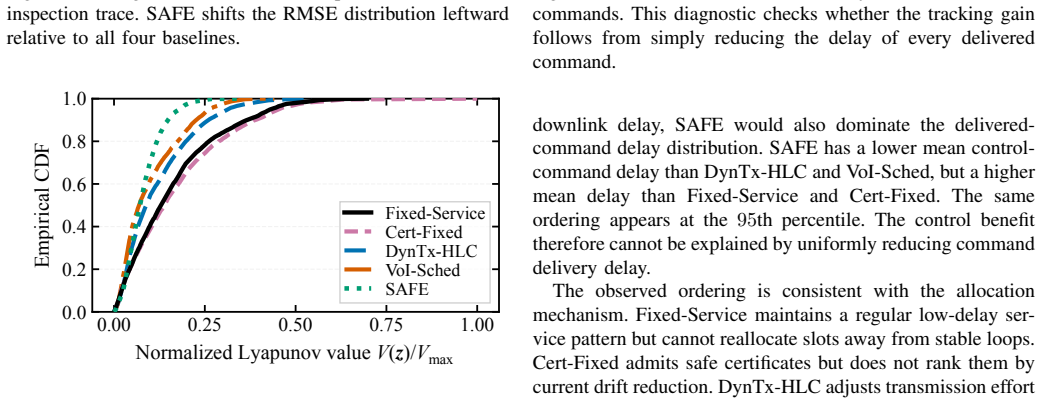
- Closed-loop simulations show measurable gains in tracking accuracy and high-risk state suppression relative to fixed-service, fixed-priority, dynamic-transmission-count, and value-of-information baselines.
Where Pith is reading between the lines
- The same certificate-plus-drift structure could be applied to other wireless cyber-physical systems where a prediction model of the plant is available.
- If digital-twin accuracy improves, the framework could safely operate with tighter communication budgets while still meeting the nonpositive-drift condition.
- The approach supplies a concrete mechanism for embedding control-theoretic stability constraints directly into real-time network scheduling decisions.
Load-bearing premise
The digital twin must produce sufficiently accurate predictions of topology, channel conditions, routes, and controller state so that the resulting QoS certificates and drift test correctly identify actions that preserve closed-loop stability.
What would settle it
An ns-3 experiment in which the digital twin's predictions are intentionally mismatched with actual topology or channel realizations, checking whether the number of high-risk states rises above the levels seen with the fixed-service and dynamic-transmission-count baselines.
Figures




read the original abstract
Wireless resource allocation in digital-twin-enabled unmanned aerial vehicle (UAV) swarms must be both network-feasible and certifiably safe for closed-loop control. Existing packet-level or scalar-priority schedulers cannot meaningfully compare heterogeneous multi-hop actions that differ simultaneously in route, retransmission depth, blocklength, bidirectional delay, delivery probability, and TDMA slot cost. This paper introduces a certificate-guided resource allocation framework for low-altitude multi-hop UAV swarms. A digital twin maps predicted topology, channel, route, and controller-side state into a shared five-dimensional quality-of-service (QoS) certificate comprising uplink/downlink delay bounds, directional delivery guarantees, and a certified upper bound on the interval between successful bidirectional interactions. A state-conditioned stochastic drift test then admits only certificates whose augmented Lyapunov drift is nonpositive under the current controller state. Admitted actions are reduced to certified supply frontiers by removing dominated route-slot configurations, and the online scheduler maximizes Lyapunov-drift reduction under a shared TDMA slot budget via exact dynamic programming. Closed-loop ns-3 simulations demonstrate that the proposed framework outperforms fixed-service, certificate-filtered fixed-priority, dynamic-transmission-count, and value-of-information baselines in both tracking accuracy and high-risk state suppression under identical communication budgets.
Editorial analysis
A structured set of objections, weighed in public.
Referee Report
Summary. The manuscript proposes a certificate-guided resource allocation framework for digital-twin-enabled UAV swarms. A digital twin maps predicted topology, channel, route, and controller state into five-dimensional QoS certificates (uplink/downlink delay bounds, directional delivery guarantees, and a certified upper bound on bidirectional interaction intervals). A state-conditioned stochastic drift test admits only certificates whose augmented Lyapunov drift is nonpositive. Admitted actions are reduced to certified supply frontiers, and an online scheduler maximizes Lyapunov-drift reduction under a shared TDMA slot budget via exact dynamic programming. Closed-loop ns-3 simulations claim that the framework outperforms fixed-service, certificate-filtered fixed-priority, dynamic-transmission-count, and value-of-information baselines in tracking accuracy and high-risk state suppression under identical communication budgets.
Significance. If the digital-twin predictions and drift test are shown to be robust, the work could advance safe, certifiable resource allocation for networked control in multi-hop UAV systems by enabling principled comparison of heterogeneous actions. The use of exact dynamic programming and the reduction to supply frontiers are concrete strengths that support reproducibility and optimality under the budget constraint.
major comments (3)
- [§III.B] The stochastic drift test is central to the certification pipeline, yet the manuscript provides no derivation or explicit conditions under which the augmented Lyapunov drift is guaranteed to be nonpositive for stabilizing actions. This directly affects whether the admitted certificates reliably support closed-loop stability.
- [§V] The ns-3 closed-loop results (reported in §V) claim consistent outperformance in tracking accuracy and high-risk state suppression, but include no error bars, variance measures, or statistical significance tests on the outcomes. Without these, it is difficult to assess whether the gains over the four baselines are robust.
- [§IV and §V] The framework assumes the digital twin produces sufficiently accurate predictions of topology, channel, route, and controller state to generate reliable five-dimensional QoS certificates. The manuscript reports no validation experiments, prediction-error injection, or sensitivity analysis on how such errors would affect the drift test and the resulting performance claims.
minor comments (2)
- [Abstract and §II] The abstract and §II could benefit from an explicit equation or table defining the five-dimensional QoS certificate components and their mapping from twin outputs.
- [§III.C] Notation for the augmented Lyapunov function and the exact dynamic programming recursion could be clarified to improve readability for readers outside the immediate subfield.
Simulated Author's Rebuttal
We thank the referee for the constructive comments and the recommendation for major revision. We address each major comment point by point below, indicating where revisions will be made to improve clarity, statistical rigor, and robustness analysis.
read point-by-point responses
-
Referee: [§III.B] The stochastic drift test is central to the certification pipeline, yet the manuscript provides no derivation or explicit conditions under which the augmented Lyapunov drift is guaranteed to be nonpositive for stabilizing actions. This directly affects whether the admitted certificates reliably support closed-loop stability.
Authors: We appreciate the referee drawing attention to this central element. The stochastic drift test in §III.B is constructed from the standard stochastic Lyapunov drift theorem for controlled Markov processes, where the augmented drift is formed by taking the conditional expectation of the Lyapunov function change plus a penalty term on the certificate violation. While the manuscript states the nonpositivity condition for admission, we acknowledge that a self-contained derivation of the explicit inequalities (including the state-dependent bounds on the drift under the five-dimensional QoS certificate) was omitted. In the revised manuscript we will insert a new paragraph in §III.B that derives the nonpositive-drift condition step by step from the one-step expectation, showing the precise requirements on the delay bounds, delivery probabilities, and bidirectional interval that guarantee the drift is ≤ 0 for stabilizing controller actions. revision: yes
-
Referee: [§V] The ns-3 closed-loop results (reported in §V) claim consistent outperformance in tracking accuracy and high-risk state suppression, but include no error bars, variance measures, or statistical significance tests on the outcomes. Without these, it is difficult to assess whether the gains over the four baselines are robust.
Authors: The referee is correct that the absence of variability measures limits the strength of the empirical claims. The original simulations were run for a fixed number of independent trials, yet only mean values were reported. In the revision we will augment all plots and tables in §V with error bars showing one standard deviation across 50 independent Monte-Carlo runs. We will also add a short statistical analysis subsection that reports the results of paired t-tests (or Wilcoxon signed-rank tests where normality assumptions are violated) between the proposed scheduler and each baseline, confirming that the observed improvements in tracking RMSE and high-risk state occupancy are statistically significant at the 5 % level under the same communication budget. revision: yes
-
Referee: [§IV and §V] The framework assumes the digital twin produces sufficiently accurate predictions of topology, channel, route, and controller state to generate reliable five-dimensional QoS certificates. The manuscript reports no validation experiments, prediction-error injection, or sensitivity analysis on how such errors would affect the drift test and the resulting performance claims.
Authors: We agree that a sensitivity study is necessary to substantiate the practical utility of the certificate pipeline. The current manuscript relies on the digital twin’s internal error bounds being folded into the certificate margins, but does not quantify how larger prediction errors propagate through the drift test. In the revised version we will add a dedicated sensitivity subsection to §V. This subsection will inject controlled additive Gaussian noise (with increasing variance) into the predicted channel gains, topology, and controller state, recompute the five-dimensional certificates, re-run the drift test, and plot the resulting degradation in tracking accuracy and high-risk state suppression. The analysis will identify the prediction-error threshold beyond which the drift test begins to reject otherwise stabilizing actions, thereby providing quantitative guidance on the required digital-twin fidelity. revision: yes
Circularity Check
No significant circularity; derivation relies on standard Lyapunov drift and external digital-twin mapping
full rationale
The paper constructs a certificate-guided allocator by mapping digital-twin outputs (predicted topology, channel, route, controller state) into five-dimensional QoS certificates, then applies a state-conditioned stochastic drift test requiring nonpositive augmented Lyapunov drift to admit actions. Admitted certificates are pruned to supply frontiers and scheduled via exact dynamic programming to maximize drift reduction under a TDMA budget. These steps follow established Lyapunov-drift arguments from control theory and standard digital-twin concepts; they do not reduce any claimed performance gain or stability certificate to a parameter fitted inside the paper or to a self-citation whose content is itself unverified. Closed-loop ns-3 results compare the framework against explicit baselines under identical budgets, providing an independent empirical check rather than a tautological re-expression of inputs. The derivation chain is therefore self-contained against external benchmarks.
Axiom & Free-Parameter Ledger
free parameters (1)
- TDMA slot budget
axioms (1)
- domain assumption Non-positive augmented Lyapunov drift under the current controller state certifies that the chosen communication action preserves closed-loop stability.
invented entities (1)
-
five-dimensional QoS certificate
no independent evidence
Lean theorems connected to this paper
-
IndisputableMonolith/Cost/FunctionalEquation.leanwashburn_uniqueness_aczel unclear?
unclearRelation between the paper passage and the cited Recognition theorem.
A state-conditioned stochastic drift test then admits only certificates whose augmented Lyapunov drift is nonpositive under the current controller state... Φ(ζ,q)≜(ᾱ(q,c(ζ))−1)V(z)+λΣΨΣ(ζ,q)
-
IndisputableMonolith/Foundation/AbsoluteFloorClosure.leanabsolute_floor_iff_bare_distinguishability unclear?
unclearRelation between the paper passage and the cited Recognition theorem.
The certificate order supports allocation only if stronger certificates imply no larger closed-loop drift... q⪰q̃ implies Φ(ζ,q)≤Φ(ζ,q̃)
What do these tags mean?
- matches
- The paper's claim is directly supported by a theorem in the formal canon.
- supports
- The theorem supports part of the paper's argument, but the paper may add assumptions or extra steps.
- extends
- The paper goes beyond the formal theorem; the theorem is a base layer rather than the whole result.
- uses
- The paper appears to rely on the theorem as machinery.
- contradicts
- The paper's claim conflicts with a theorem or certificate in the canon.
- unclear
- Pith found a possible connection, but the passage is too broad, indirect, or ambiguous to say the theorem truly supports the claim.
Reference graph
Works this paper leans on
-
[1]
W. P. M. H. Heemelset al., “Networked control systems with communi- cation constraints: Tradeoffs between transmission intervals, delays and performance,”IEEE Transactions on Automatic Control, vol. 55, no. 8, pp. 1781–1796, 2010
work page 2010
-
[2]
Z. Menget al., “Communication, sensing and control integrated closed- loop system: modeling, control design and resource allocation,”Science China Information Sciences, vol. 69, no. 3, p. 132301, 2026
work page 2026
-
[3]
Integrated sensing, communication, and control driven multi-agv closed-loop control,
Y . Zhouet al., “Integrated sensing, communication, and control driven multi-agv closed-loop control,”IEEE Transactions on Vehicular Tech- nology, vol. 74, no. 7, pp. 10 853–10 868, 2025
work page 2025
-
[4]
Y . Wanget al., “Toward realization of low-altitude economy networks: Core architecture, integrated technologies, and future directions,”IEEE Transactions on Cognitive Communications and Networking, vol. 11, no. 5, pp. 2788–2820, 2025
work page 2025
-
[5]
Computing power in the sky: Digital twin-assisted collaborative computing with multi-uav networks,
W. Chaoet al., “Computing power in the sky: Digital twin-assisted collaborative computing with multi-uav networks,”IEEE Transactions on Vehicular Technology, vol. 74, no. 9, pp. 14 466–14 482, 2025
work page 2025
-
[6]
Digital Twin Networks: A survey,
Y . Wuet al., “Digital Twin Networks: A survey,”IEEE Internet of Things Journal, vol. 8, no. 18, pp. 13 789–13 804, 2021
work page 2021
-
[7]
Digital Twin of wireless systems: Overview, taxon- omy, challenges, and opportunities,
L. U. Khanet al., “Digital Twin of wireless systems: Overview, taxon- omy, challenges, and opportunities,”IEEE Communications Surveys & Tutorials, vol. 24, no. 4, pp. 2230–2254, 2022
work page 2022
-
[8]
Digital Network Twins for next-generation wireless: Creation, optimization, and challenges,
Z. Zhanget al., “Digital Network Twins for next-generation wireless: Creation, optimization, and challenges,”IEEE Network, pp. 1–9, 2025
work page 2025
-
[9]
Application-driven network-aware Digital Twin management in industrial edge environments,
P. Bellavistaet al., “Application-driven network-aware Digital Twin management in industrial edge environments,”IEEE Transactions on Industrial Informatics, vol. 17, no. 11, pp. 7791–7801, 2021
work page 2021
-
[10]
Adaptive edge association for wireless Digital Twin networks in 6G,
Y . Luet al., “Adaptive edge association for wireless Digital Twin networks in 6G,”IEEE Internet of Things Journal, vol. 8, no. 22, pp. 16 219–16 230, 2021
work page 2021
-
[11]
A joint communication and computation framework for Digital Twin over wireless networks,
Z. Yanget al., “A joint communication and computation framework for Digital Twin over wireless networks,”IEEE Journal of Selected Topics in Signal Processing, vol. 18, no. 1, pp. 6–17, 2024
work page 2024
-
[12]
Task-oriented semantics-aware communication for wire- less UA V control and command transmission,
Y . Xuet al., “Task-oriented semantics-aware communication for wire- less UA V control and command transmission,”IEEE Communications Letters, vol. 27, no. 8, pp. 2232–2236, 2023
work page 2023
-
[13]
V oI-driven joint optimization of control and communica- tion in vehicular digital twin network,
L. Leiet al., “V oI-driven joint optimization of control and communica- tion in vehicular digital twin network,”IEEE Network, vol. 39, no. 5, pp. 155–164, 2025
work page 2025
-
[14]
X. Fanget al., “Sensing-communication-computing-control closed-loop optimization for 6G digital twin-empowered robotic systems,”IEEE Journal on Selected Areas in Communications, vol. 43, no. 10, pp. 3330– 3346, 2025
work page 2025
-
[15]
Joint routing and scheduling for deterministic transmis- sion in drone swarm systems,
C. Wanget al., “Joint routing and scheduling for deterministic transmis- sion in drone swarm systems,” in2024 10th International Conference on Computer and Communications (ICCC). IEEE, 2024, pp. 2510–2515
work page 2024
-
[16]
On the latency, rate, and reliability tradeoff in wireless networked control systems for iiot,
W. Liuet al., “On the latency, rate, and reliability tradeoff in wireless networked control systems for iiot,”IEEE Internet of Things Journal, vol. 8, no. 2, pp. 723–733, 2021
work page 2021
-
[17]
Optimal dynamic transmission scheduling for wireless networked control systems,
Y . Maet al., “Optimal dynamic transmission scheduling for wireless networked control systems,”IEEE Transactions on Control Systems Technology, vol. 30, no. 6, pp. 2360–2376, 2022
work page 2022
-
[18]
Optimal downlink–uplink scheduling of wireless networked control for industrial iot,
K. Huanget al., “Optimal downlink–uplink scheduling of wireless networked control for industrial iot,”IEEE Internet of Things Journal, vol. 7, no. 3, pp. 1756–1772, 2020
work page 2020
-
[19]
Age-of-information vs. value-of-information schedul- ing for cellular networked control systems,
O. Ayanet al., “Age-of-information vs. value-of-information schedul- ing for cellular networked control systems,” inProceedings of the 10th ACM/IEEE International Conference on Cyber-Physical Systems. ACM, 2019, pp. 109–117
work page 2019
-
[20]
Semantic and logical communication-control codesign for correlated dynamical systems,
A. M. Girgiset al., “Semantic and logical communication-control codesign for correlated dynamical systems,”IEEE Internet of Things Journal, vol. 11, no. 7, pp. 12 631–12 648, 2024
work page 2024
-
[21]
Goal-oriented communication, estimation, and control over bidirectional wireless links,
J. Caoet al., “Goal-oriented communication, estimation, and control over bidirectional wireless links,”IEEE Transactions on Communica- tions, vol. 73, no. 5, pp. 3031–3045, 2025
work page 2025
-
[22]
Communication-control codesign for large-scale wire- less networked control systems,
G. Panget al., “Communication-control codesign for large-scale wire- less networked control systems,”IEEE Journal on Selected Areas in Communications, vol. 43, no. 10, pp. 3295–3312, 2025
work page 2025
-
[23]
S. Y . Yanget al., “A multipolicy deep reinforcement learning approach for multiobjective joint routing and scheduling in deterministic net- works,”IEEE Internet of Things Journal, vol. 11, no. 10, pp. 17 402– 17 418, 2024
work page 2024
-
[24]
A mean field game-theoretic cross-layer optimization for multi-hop swarm uav communications,
T. Liet al., “A mean field game-theoretic cross-layer optimization for multi-hop swarm uav communications,”Journal of Communications and Networks, vol. 24, no. 1, pp. 68–82, 2021
work page 2021
-
[25]
Flying ad-hoc networks (fanets): A survey,
I. Bekmezciet al., “Flying ad-hoc networks (fanets): A survey,”Ad Hoc Networks, vol. 11, no. 3, pp. 1254–1270, 2013
work page 2013
-
[26]
B. D. O. Andersonet al.,Optimal Control: Linear Quadratic Methods. Englewood Cliffs, NJ: Prentice-Hall, 1989
work page 1989
-
[27]
A tutorial on conformal prediction,
G. Shaferet al., “A tutorial on conformal prediction,”Journal of Machine Learning Research, vol. 9, pp. 371–421, 2008
work page 2008
-
[28]
A. Ben-Talet al., “Robust convex optimization,”Mathematics of Oper- ations Research, vol. 23, no. 4, pp. 769–805, 1998
work page 1998
-
[29]
Effective capacity: A wireless link model for support of quality of service,
Dapeng Wuet al., “Effective capacity: A wireless link model for support of quality of service,”IEEE Transactions on Wireless Communications, vol. 2, no. 5, pp. 630–643, 2003
work page 2003
-
[30]
Capacity of a burst-noise channel,
E. N. Gilbert, “Capacity of a burst-noise channel,”Bell System Technical Journal, vol. 39, no. 5, pp. 1253–1265, 1960
work page 1960
-
[31]
Estimates of error rates for codes on burst-noise channels,
E. O. Elliott, “Estimates of error rates for codes on burst-noise channels,” Bell System Technical Journal, vol. 42, no. 5, pp. 1977–1997, 1963
work page 1977
-
[32]
O. L. V . do Costaet al.,Discrete-Time Markov Jump Linear Systems, ser. Probability and Its Applications. Springer London, 2005
work page 2005
-
[33]
A minimal algorithm for the multiple-choice knapsack problem,
D. Pisinger, “A minimal algorithm for the multiple-choice knapsack problem,”European Journal of Operational Research, vol. 83, no. 2, pp. 394–410, 1995
work page 1995
-
[34]
Gusts encountered by flying vehicles in proximity to buildings,
A. Mohamedet al., “Gusts encountered by flying vehicles in proximity to buildings,”Drones, vol. 7, no. 1, p. 22, 2023
work page 2023
discussion (0)
Sign in with ORCID, Apple, or X to comment. Anyone can read and Pith papers without signing in.