Beyond DAGs: Modeling Causal Feedback with Fuzzy Cognitive Maps
Pith reviewed 2026-05-25 15:16 UTC · model grok-4.3
The pith
Fuzzy cognitive maps model causal feedback with fuzzy signed directed graphs that allow cycles and expert matrix combination.
A machine-rendered reading of the paper's core claim, the machinery that carries it, and where it could break.
Core claim
Fuzzy cognitive maps model feedback causal relations in interwoven webs of causality and policy variables as fuzzy signed directed graphs that allow degrees of causal influence and event occurrence. Such models simulate policy scenarios through nonlinear dynamics and forward-chaining inference. Users fuse FCMs from multiple experts by weighting and adding the fuzzy edge matrices, and the combined FCM tends to better represent domain knowledge as the expert sample size increases if the expert sample approximates a random sample. FCM causal influence is transitive whereas probabilistic causal influence is not. The paper applies this to public support for insurgency and US-China conflict in the
What carries the argument
Fuzzy signed directed graphs with matrix addition for expert combination and nonlinear dynamics for inference.
Load-bearing premise
Expert-provided fuzzy edge weights accurately capture causal strengths and their matrix addition improves representation with larger random expert samples.
What would settle it
A demonstration that the accuracy of predictions from combined FCMs does not increase or decreases as more experts are added in a domain where the true causal structure is known.
Figures




read the original abstract
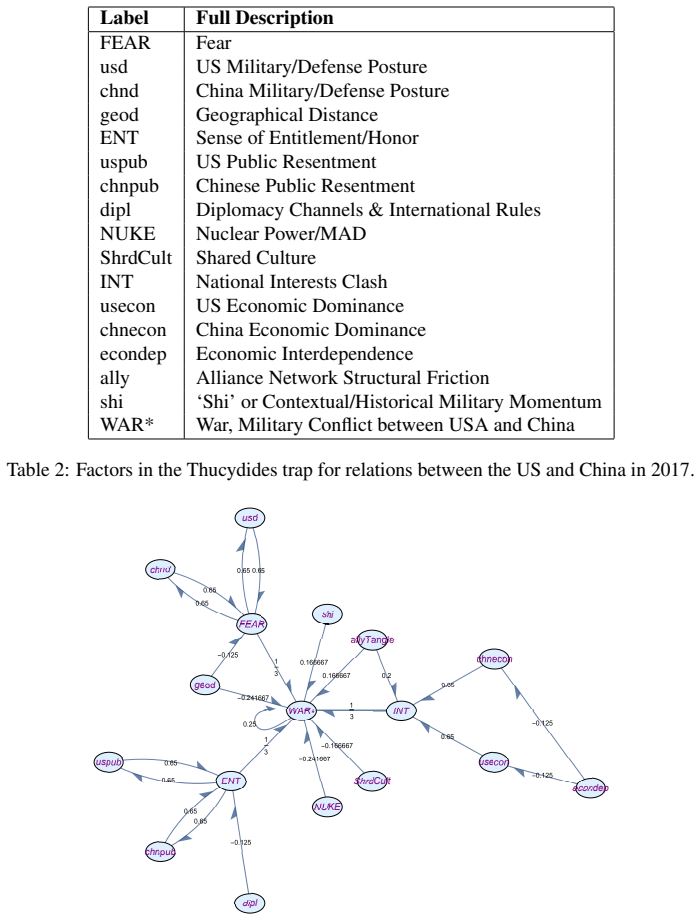
Fuzzy cognitive maps (FCMs) model feedback causal relations in interwoven webs of causality and policy variables. FCMs are fuzzy signed directed graphs that allow degrees of causal influence and event occurrence. Such causal models can simulate a wide range of policy scenarios and decision processes. Their directed loops or cycles directly model causal feedback. Their nonlinear dynamics permit forward-chaining inference from input causes and policy options to output effects. Users can add detailed dynamics and feedback links directly to the causal model or infer them with statistical learning laws. Users can fuse or combine FCMs from multiple experts by weighting and adding the underlying fuzzy edge matrices and do so recursively if needed. The combined FCM tends to better represent domain knowledge as the expert sample size increases if the expert sample approximates a random sample. Many causal models use more restrictive directed acyclic graphs (DAGs) and Bayesian probabilities. DAGs do not model causal feedback because they do not contain closed loops. Combining DAGs also tends to produce cycles and thus tends not to produce a new DAG. Combining DAGs tends to produce a FCM. FCM causal influence is also transitive whereas probabilistic causal influence is not transitive in general. Overall: FCMs trade the numerical precision of probabilistic DAGs for pattern prediction, faster and scalable computation, ease of combination, and richer feedback representation. We show how FCMs can apply to problems of public support for insurgency and terrorism and to US-China conflict relations in Graham Allison's Thucydides-trap framework. The appendix gives the textual justification of the Thucydides-trap FCM. It also extends our earlier theorem [Osoba-Kosko2017] to a more general result that shows the transitive and total causal influence that upstream concept nodes exert on downstream nodes.
Editorial analysis
A structured set of objections, weighed in public.
Referee Report
Summary. The paper argues that Fuzzy Cognitive Maps (FCMs) provide advantages over Directed Acyclic Graphs (DAGs) for modeling causal feedback in complex systems. FCMs are presented as fuzzy signed directed graphs that capture degrees of influence, support nonlinear dynamics and forward inference, allow direct combination of multiple expert models via weighted matrix addition (which tends to improve representation with larger random expert samples), and exhibit transitive causal influence (unlike probabilistic influence in general). The work extends a prior theorem on transitive influence, provides applications to public support for insurgency/terrorism and the Thucydides trap in US-China relations, and includes an appendix with textual justification and the theorem extension.
Significance. If the central claims hold, the framework offers a scalable, feedback-capable alternative for causal modeling and policy simulation that prioritizes pattern prediction, expert fusion, and computational ease over the numerical precision of probabilistic DAGs. The explicit extension of the transitive-influence theorem supplies a formal strengthening of the approach, and the two applications demonstrate concrete utility in conflict and policy domains.
major comments (2)
- [Abstract] Abstract: the claim that 'the combined FCM tends to better represent domain knowledge as the expert sample size increases if the expert sample approximates a random sample' is asserted without quantitative validation, simulation results, error analysis, or supporting derivation; this conditional improvement is load-bearing for the stated advantage of FCM combination over DAGs.
- [Appendix] Appendix: the extension of the earlier theorem [Osoba-Kosko2017] to a more general result on transitive and total causal influence exerted by upstream nodes is described but the full derivation steps, assumptions, and proof details are not supplied in the visible text, preventing direct verification of the generalized claim.
minor comments (1)
- The abstract and introduction could more explicitly separate the modeling advantages (feedback, combination) from the theorem extension to improve readability.
Simulated Author's Rebuttal
We thank the referee for the detailed and constructive report. The comments highlight areas where the presentation of key claims can be strengthened. We address each major comment below and indicate planned revisions.
read point-by-point responses
-
Referee: [Abstract] Abstract: the claim that 'the combined FCM tends to better represent domain knowledge as the expert sample size increases if the expert sample approximates a random sample' is asserted without quantitative validation, simulation results, error analysis, or supporting derivation; this conditional improvement is load-bearing for the stated advantage of FCM combination over DAGs.
Authors: The claim follows from the standard FCM combination procedure of weighted matrix addition, which is equivalent to averaging expert edge weights. Under the assumption of unbiased random sampling from the expert population, the law of large numbers implies convergence in probability to the population mean edge weights, thereby improving representation of domain knowledge. This is a direct consequence of the linear algebra of the method rather than a new empirical result. We agree the abstract states the property concisely without supporting material. In revision we will qualify the statement, add a short explanatory sentence referencing the averaging property, and include a brief simulation or citation to prior FCM aggregation results to make the conditional improvement explicit. revision: partial
-
Referee: [Appendix] Appendix: the extension of the earlier theorem [Osoba-Kosko2017] to a more general result on transitive and total causal influence exerted by upstream nodes is described but the full derivation steps, assumptions, and proof details are not supplied in the visible text, preventing direct verification of the generalized claim.
Authors: The appendix outlines the extension of the transitive-influence result to total causal influence along all paths. We agree that the current description is high-level and that full derivation steps, assumptions (e.g., on the activation function and convergence), and the complete proof would allow direct verification. In the revised version we will expand the appendix to supply the full proof, including all intermediate steps and explicit assumptions. revision: yes
Circularity Check
Minor self-citation in theorem extension; central claims remain independent
specific steps
-
self citation load bearing
[Abstract]
"It also extends our earlier theorem [Osoba-Kosko2017] to a more general result that shows the transitive and total causal influence that upstream concept nodes exert on downstream nodes."
Transitivity of FCM causal influence is supported solely by extension of prior work by the same authors rather than an independent external result, though this property is not load-bearing for the core modeling and combination claims.
full rationale
The paper presents FCMs as a modeling framework defined directly by fuzzy signed directed graphs and matrix addition for combination. The improvement claim is explicitly conditional on expert samples approximating random samples, with no fitting of parameters to target outcomes. The only self-citation is the appendix extension of the authors' prior theorem on transitivity, which supports a secondary property but is not invoked to justify or derive the primary advantages over DAGs. No self-definitional loops, fitted predictions, or load-bearing self-citation chains appear in the derivation.
Axiom & Free-Parameter Ledger
free parameters (1)
- fuzzy edge weights
axioms (2)
- domain assumption Causal systems can be represented as fuzzy signed directed graphs that permit cycles and nonlinear dynamics
- domain assumption Matrix addition of expert FCMs yields a combined model whose quality improves with random expert sample size
Forward citations
Cited by 1 Pith paper
-
Agentic Chunking and Bayesian De-chunking of AI Generated Fuzzy Cognitive Maps: A Model of the Thucydides Trap
Agentic chunking generates overlapping fuzzy cognitive maps from text that mix into a representative FCM, with Bayesian de-chunking producing posterior maps; applied to Thucydides Trap, 7/8 maps predict war upon stimu...
Reference graph
Works this paper leans on
-
[1]
Fuzzy cognitive maps of public support for insur- gency and terrorism
O. A. Osoba and B. Kosko, “Fuzzy cognitive maps of public support for insur- gency and terrorism”, The Journal of Defense Modeling and Simulation, vol. 14, no. 1, pp. 17–32, 2017
work page 2017
-
[2]
B. Kosko, “Fuzzy cognitive maps”,International Journal of man-machine studies, vol. 24, no. 1, pp. 65–75, 1986
work page 1986
-
[3]
A review of fuzzy cognitive maps research during the last decade
E. I. Papageorgiou and J. L. Salmeron, “A review of fuzzy cognitive maps research during the last decade”, IEEE Transactions on Fuzzy Systems, vol. 21, no. 1, pp. 66–79, 2013
work page 2013
-
[4]
Glykas, Ed., Fuzzy cognitive maps
M. Glykas, Ed., Fuzzy cognitive maps. Springer, 2010
work page 2010
-
[5]
E. Papageorgiou, Fuzzy cognitive maps for applied sciences and engineering: From fundamentals to extensions and learning algorithms, ser. Intelligent Sys- tems Reference Library. Springer Berlin Heidelberg, 2013,ISBN : 9783642397394. [Online]. Available: https : / / books . google . com / books ? id = S3LGBAAAQBAJ. 38
work page 2013
-
[6]
A review of fuzzy cognitive maps in medicine: Taxonomy, methods, and applications
A. Amirkhani, E. I. Papageorgiou, A. Mohseni, and M. R. Mosavi, “A review of fuzzy cognitive maps in medicine: Taxonomy, methods, and applications”, Computer methods and programs in biomedicine, vol. 142, pp. 129–145, 2017
work page 2017
-
[7]
G. Ziv, E. Watson, D. Young, D. C. Howard, S. T. Larcom, and A. J. Tanentzap, “The potential impact of brexit on the energy, water and food nexus in the uk: A fuzzy cognitive mapping approach”, Applied Energy, vol. 210, pp. 487–498, 2018
work page 2018
-
[8]
Analyzing the impact of social factors on homelessness: A fuzzy cognitive map approach
V . K. Mago, H. K. Morden, C. Fritz, T. Wu, S. Namazi, P. Geranmayeh, R. Chattopadhyay, and V . Dabbaghian, “Analyzing the impact of social factors on homelessness: A fuzzy cognitive map approach”, BMC medical informatics and decision making, vol. 13, no. 1, p. 94, 2013
work page 2013
-
[9]
L. A. Zadeh, “Fuzzy sets”, Information and Control, vol. 8, pp. 338–353, 1965
work page 1965
-
[10]
B. Kosko and S. Isaka, “Fuzzy logic”,Scientific American, vol. 269, no. 1, pp. 62– 7, 1993
work page 1993
-
[11]
Abstraction and pattern classification
R. Bellman, R. Kalaba, and L Zadeh, “Abstraction and pattern classification”, Journal of Mathematical Analysis and Applications, vol. 13, no. 1, pp. 1–7, 1966
work page 1966
-
[12]
J. D. Sterman, Business dynamics: Systems thinking and modeling for a complex world, HD30. 2 S7835 2000. 2000
work page 2000
-
[13]
H. Abdelbari and K. Shafi, “Learning structures of conceptual models from observed dynamics using evolutionary echo state networks”, Journal of Artificial Intelligence and Soft Computing Research, vol. 8, no. 2, pp. 133–154, 2018
work page 2018
- [14]
-
[15]
Quantization effects on the equi- librium behavior of combined fuzzy cognitive maps
R. Taber, R. R. Yager, and C. M. Helgason, “Quantization effects on the equi- librium behavior of combined fuzzy cognitive maps”, International Journal of Intelligent Systems, vol. 22, no. 2, pp. 181–202, 2007
work page 2007
-
[16]
Fuzzy cognitive map architectures for medical decision support systems
C. D. Stylios, V . C. Georgopoulos, G. A. Malandraki, and S. Chouliara, “Fuzzy cognitive map architectures for medical decision support systems”, Applied Soft Computing, vol. 8, no. 3, pp. 1243–1251, 2008
work page 2008
-
[17]
Virtual worlds as fuzzy cognitive maps
J. A. Dickerson and B. Kosko, “Virtual worlds as fuzzy cognitive maps”, in Virtual Reality Annual International Symposium, 1993., 1993 IEEE, IEEE, 1993, pp. 471–477
work page 1993
-
[18]
Fuzzy Systems as Universal Approximators
B. Kosko, “Fuzzy Systems as Universal Approximators”, IEEE Transactions on Computers, vol. 43, no. 11, pp. 1329–1333, Nov. 1994. 39
work page 1994
- [19]
-
[20]
Bayesian inference with adaptive fuzzy priors and likelihoods
O. Osoba, S. Mitaim, and B. Kosko, “Bayesian inference with adaptive fuzzy priors and likelihoods”, IEEE Transactions on Systems, Man, and Cybernetics, Part B (Cybernetics), vol. 41, no. 5, pp. 1183–1197, Oct. 2011, ISSN : 1083-4419. DOI: 10.1109/TSMCB.2011.2114879
-
[21]
Causal inference using potential outcomes: Design, modeling, decisions
D. B. Rubin, “Causal inference using potential outcomes: Design, modeling, decisions”, Journal of the American Statistical Association, vol. 100, no. 469, pp. 322–331, 2005
work page 2005
-
[22]
G. W. Imbens and D. B. Rubin,Causal inference in statistics, social, and biomed- ical sciences. Cambridge University Press, 2015
work page 2015
-
[23]
P. K. Davis, D. Manheim, W. L. Perry, and J. S. Hollywood,Causal models and exploratory analysis in heterogeneous information fusion for detecting potential terrorists. RAND Corporation, 2015
work page 2015
-
[24]
Using causal mod- els in heterogeneous information fusion to detect terrorists
P. K. Davis, D. Manheim, W. L. Perry, and J. Hollywood, “Using causal mod- els in heterogeneous information fusion to detect terrorists”, in 2015 WINTER SIMULATION CONFERENCE (WSC), IEEE, 2015, pp. 2586–2597
work page 2015
-
[25]
B. Kosko, “Fuzzy knowledge combination”, International Journal of Intelligent Systems, vol. 1, no. 4, pp. 293–320, 1986
work page 1986
-
[26]
Hidden patterns in combined and adaptive knowledge networks
——, “Hidden patterns in combined and adaptive knowledge networks”, Interna- tional Journal of Approximate Reasoning, vol. 2, no. 4, pp. 377–393, 1988
work page 1988
-
[27]
Knowledge processing with fuzzy cognitive maps
R. Taber, “Knowledge processing with fuzzy cognitive maps”,Expert Systems with Applications, vol. 2, no. 1, pp. 83–87, 1991
work page 1991
-
[28]
Generalized mixture representations and combinations for additive fuzzy systems
B. Kosko, “Generalized mixture representations and combinations for additive fuzzy systems”, in Neural Networks (IJCNN), 2017 International Joint Confer- ence on, IEEE, 2017, pp. 3761–3768
work page 2017
-
[29]
Additive Fuzzy Systems: From Generalized Mixtures to Rule Continua
——, “Additive Fuzzy Systems: From Generalized Mixtures to Rule Continua”, International Journal of Intelligent Systems, vol. 33, no. 8, pp. 1573–1623, 2018
work page 2018
-
[30]
Generalized belief propagation
J. S. Yedidia, W. T. Freeman, and Y . Weiss, “Generalized belief propagation”, in Advances in Neural Information Processing Systems, 2001, pp. 689–695
work page 2001
-
[31]
Dynamic bayesian networks: Representation, inference and learning
K. P. Murphy, “Dynamic bayesian networks: Representation, inference and learning”, PhD thesis, UNIVERSITY OF CALIFORNIA, BERKELEY, 2002
work page 2002
-
[32]
Graphical models, exponential families, and variational inference
M. J. Wainwright and M. I. Jordan, “Graphical models, exponential families, and variational inference”, Foundations and TrendsR⃝ in Machine Learning, vol. 1, no. 1–2, pp. 1–305, 2008. 40
work page 2008
-
[33]
Approximating probabilistic inference in bayesian belief networks is np-hard
P. Dagum and M. Luby, “Approximating probabilistic inference in bayesian belief networks is np-hard”, Artificial intelligence, vol. 60, no. 1, pp. 141–153, 1993
work page 1993
-
[34]
S. Russell, P. Norvig, and E. Davis,Artificial intelligence : A modern approach, ser. Always learning. Pearson Education, Limited, 2016, ISBN : 9781292153964. [Online]. Available: https : / / books . google . com / books ? id = XS9CjwEACAAJ
work page 2016
-
[35]
Learning bayesian networks is np-complete
D. M. Chickering, “Learning bayesian networks is np-complete”, in Learning from data, Springer, 1996, pp. 121–130
work page 1996
-
[36]
Large-sample learning of bayesian networks is np-hard
D. M. Chickering, D. Heckerman, and C. Meek, “Large-sample learning of bayesian networks is np-hard”, Journal of Machine Learning Research, vol. 5, no. Oct, pp. 1287–1330, 2004
work page 2004
-
[37]
Pearl, Probabilistic reasoning in intelligent systems: Networks of plausible inference, ser
J. Pearl, Probabilistic reasoning in intelligent systems: Networks of plausible inference, ser. Morgan Kaufmann series in representation and reasoning. Elsevier Science, 2014, ISBN : 9780080514895. [Online]. Available: https://books. google.com/books?id=mn2jBQAAQBAJ
work page 2014
-
[38]
M. J. Beal and Z. Ghahramani, “The variational bayesian em algorithm for in- complete data: With application to scoring graphical model structures”, Bayesian statistics, vol. 7, J. Bernardo, M. Bayarri, J. Berger, A. Dawid, D Heckerman, A. Smith, M West, et al., Eds., pp. 453–464, 2003
work page 2003
-
[39]
Variational bayesian learning of directed graphical models with hidden variables
——, “Variational bayesian learning of directed graphical models with hidden variables”, Bayesian Analysis, vol. 1, no. 4, pp. 793–831, 2006
work page 2006
-
[40]
Kosko, Neural networks and fuzzy systems: A dynamical systems approach to machine intelligence
B. Kosko, Neural networks and fuzzy systems: A dynamical systems approach to machine intelligence. Prentice Hall, 1991
work page 1991
-
[41]
Probability measures of fuzzy events
L. A. Zadeh, “Probability measures of fuzzy events”, Journal of mathematical analysis and applications, vol. 23, no. 2, pp. 421–427, 1968
work page 1968
-
[42]
Probabilities of conditionals and conditional probabilities
D. Lewis, “Probabilities of conditionals and conditional probabilities”, The Philo- sophical Review, vol. 85, pp. 297–315, 1976
work page 1976
-
[43]
Probabilities of conditionals and conditional probabilities–part two
——, “Probabilities of conditionals and conditional probabilities–part two”, The Philosophical Review, vol. 95, no. 4, pp. 581–589, 1986
work page 1986
-
[44]
Probable Equality, Superpower Sets, and Superconditionals
B. Kosko, “Probable Equality, Superpower Sets, and Superconditionals”,Interna- tional Journal of Intelligent Systems, vol. 19, pp. 1151–1171, Dec. 2004. 41
work page 2004
-
[45]
Outline of a new approach to the analysis of complex systems and decision analysis
L. A. Zadeh, “Outline of a new approach to the analysis of complex systems and decision analysis”, IEEE Transactions on Systems, Man, and Cybernetics, vol. 3, no. 1, pp. 28–44, 1973
work page 1973
-
[46]
The noisy expectation-maximization algorithm for multiplicative noise injection
O. Osoba and B. Kosko, “The noisy expectation-maximization algorithm for multiplicative noise injection”, Fluctuation and Noise Letters, p. 1 650 007, 2016
work page 2016
-
[47]
Fuzzy Entropy and Conditioning
B. Kosko, “Fuzzy Entropy and Conditioning”, Information Sciences, vol. 40, no. 2, pp. 165–174, 1986
work page 1986
-
[48]
Virtual worlds as fuzzy cognitive maps
J. A. Dickerson and B. Kosko, “Virtual worlds as fuzzy cognitive maps”,Pres- ence, vol. 3, no. 2, pp. 173–189, 1994
work page 1994
-
[49]
M. W. Hirsch, S. Smale, and R. L. Devaney,Differential equations, dynamical systems, and an introduction to chaos. Academic press, 2012
work page 2012
-
[50]
Aggregating probabilistic forecasts from incoherent and abstaining experts
J. B. Predd, D. N. Osherson, S. R. Kulkarni, and H. V . Poor, “Aggregating probabilistic forecasts from incoherent and abstaining experts”,Decision Analysis, vol. 5, no. 4, pp. 177–189, 2008
work page 2008
-
[51]
Preference functions that score rankings and maximum likelihood estimation
V . Conitzer, M. Rognlie, and L. Xia, “Preference functions that score rankings and maximum likelihood estimation.”, in IJCAI, vol. 9, 2009, pp. 109–115
work page 2009
-
[52]
When do noisy votes reveal the truth?
I. Caragiannis, A. D. Procaccia, and N. Shah, “When do noisy votes reveal the truth?”, in PROCEEDINGS OF THE FOURTEENTH ACM CONFERENCE ON ELECTRONIC COMMERCE, ACM, 2013, pp. 143–160
work page 2013
-
[53]
Stochastic optimal linear estimation and control
J. S. Meditch, “Stochastic optimal linear estimation and control”, 1969
work page 1969
-
[54]
D. O. Hebb, The organization of behavior: A neuropsychological approach. John Wiley & Sons, 1949
work page 1949
-
[55]
B. Kosko, “Differential Hebbian learning”, in AIP Conference Proceedings , vol. 151, 1986, pp. 277–282
work page 1986
-
[56]
J. Mill, A system of logic, ratiocinative and inductive: Being a connected view of the principles of evidence and the methods of scientific investigation, ser. A System of Logic, Ratiocinative and Inductive: Being a Connected View of the Principles of Evidence and the Methods of Scientific Investigation v. 1. John W. Parker, 1843. [Online]. Available: https...
-
[57]
Unsupervised learning in noise
B. Kosko, “Unsupervised learning in noise”, IEEE Transactions on Neural Net- works, vol. 1, no. 1, pp. 44–57, 1990. 42
work page 1990
-
[58]
N. Friedman and D. Koller, “Being bayesian about network structure. a bayesian approach to structure discovery in bayesian networks”, Machine learning, vol. 50, no. 1-2, pp. 95–125, 2003
work page 2003
-
[59]
P. K. Davis and A. O’Mahony, “A computational model of public support for insurgency and terrorism: A prototype for more-general social-science modeling”, RAND Corporation, 2013
work page 2013
-
[60]
P. K. Davis, E. V . Larson, Z. Haldeman, M. Oguz, and Y . Rana,Understanding and influencing public support for insurgency and terrorism. RAND Corporation, 2012
work page 2012
-
[61]
D. A. Snow, S. A. Soule, and H. Kriesi, The Blackwell companion to social movements. John Wiley & Sons, 2008
work page 2008
-
[62]
Ibrahim, The Al Qaeda reader: The essential texts of osama bin laden’s terrorist organization
R. Ibrahim, The Al Qaeda reader: The essential texts of osama bin laden’s terrorist organization. Broadway Books, 2007
work page 2007
-
[63]
Nawaz, Radical: My journey from Islamist extremism to a democratic awak- ening
M. Nawaz, Radical: My journey from Islamist extremism to a democratic awak- ening. Random House, 2015
work page 2015
-
[64]
P. K. Davis and K. Cragin,Social science for counterterrorism: Putting the pieces together. RAND Corporation, 2009
work page 2009
-
[65]
Experiments in multiresolution modeling (MRM)
P. K. Davis and J. H. Bigelow, “Experiments in multiresolution modeling (MRM)”, RAND Corporation, 1998
work page 1998
-
[66]
Primer for building factor trees to represent social-science knowl- edge
P. K. Davis, “Primer for building factor trees to represent social-science knowl- edge”, in PROCEEDINGS OF THE WINTER SIMULATION CONFERENCE, Winter Simulation Conference, 2011, pp. 3121–3135
work page 2011
-
[67]
The Thucydides Trap: Are the US and China headed for war?
G. Allison, “The Thucydides Trap: Are the US and China headed for war?”, The Atlantic, vol. 24, 2015
work page 2015
- [68]
-
[69]
Thucydides, History of the Peloponnesian War; Translated by Benjamin Jowett, 1998
work page 1998
-
[70]
S. P. Huntington, “The clash of civilizations?”,Foreign affairs, pp. 22–49, 1993
work page 1993
-
[71]
——, The clash of civilizations and the remaking of world order. Penguin Books India, 1997. 43 Mathematical Appendix: FCM Causal Influence Theo- rems This appendix states and proves the two main theorems on downstream causal influence in a FCM. Both theorems apply to any two concept nodes in a FCM. Theorem 1 shows the transitive effect that upstream concept ...
work page 1997
discussion (0)
Sign in with ORCID, Apple, or X to comment. Anyone can read and Pith papers without signing in.