The Absolute Age of the Open Cluster NGC 6791 and Its Implications for Galactic Archaeology and Asteroseismic Calibration
Pith reviewed 2026-05-22 08:10 UTC · model grok-4.3
The pith
NGC 6791 formed 8.46 billion years ago with super-solar metallicity, according to Monte Carlo isochrone fits to Gaia photometry and eclipsing binaries.
A machine-rendered reading of the paper's core claim, the machinery that carries it, and where it could break.
Core claim
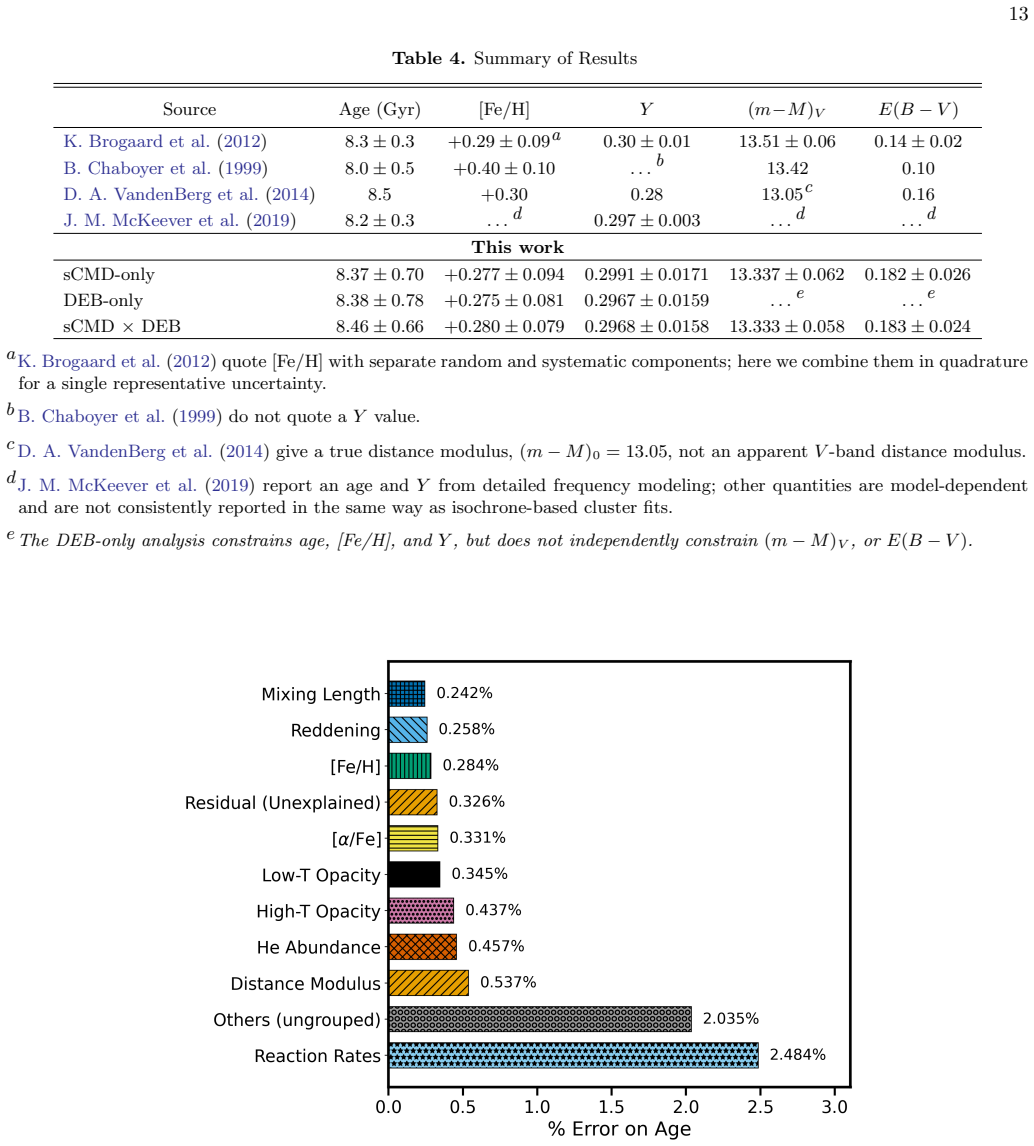
NGC 6791 has an age of 8.46 ± 0.66 Gyr, [Fe/H] = +0.280 ± 0.079, Y = 0.2968 ± 0.0158, (m-M)_V = 13.333 ± 0.058, and E(B-V) = 0.183 ± 0.024. These values come from combining Gaia DR3 photometry with detached eclipsing binary constraints and assessing 10,000 Monte Carlo isochrone sets through a bootstrap-calibrated two-dimensional Kolmogorov-Smirnov statistic on synthetic CMDs plus a nearest-point metric in mass-luminosity space for the binaries.
What carries the argument
Monte Carlo isochrone sets weighted by bootstrap-resampled two-dimensional Kolmogorov-Smirnov comparisons of synthetic color-magnitude diagrams to the observed data, supplemented by a coeval detached-eclipsing-binary statistic.
If this is right
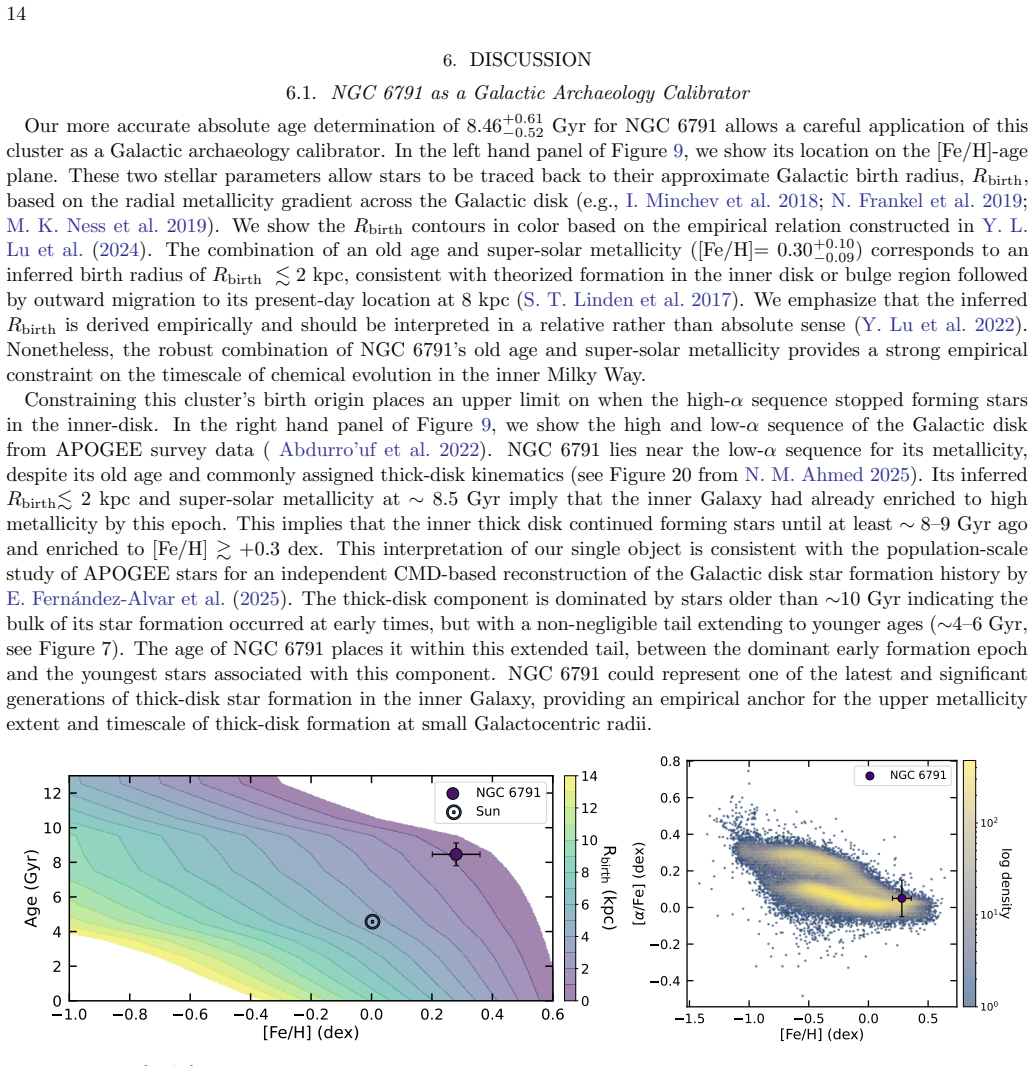
- The combination of old age and super-solar metallicity favors an inner-Galaxy birth site for NGC 6791 followed by outward migration.
- The cluster supplies a benchmark for calibrating asteroseismic age estimates at high metallicity.
- The absolute cluster age-metallicity relation now includes an old, metal-rich open cluster.
- The error budget contains no single dominant contributor, unlike typical globular-cluster age determinations.
Where Pith is reading between the lines
- The same Monte Carlo weighting approach could be applied to other open clusters whose ages are currently uncertain because of similar degeneracies between distance, reddening, and model physics.
- Kinematic data from Gaia for NGC 6791 members could test whether the implied migration orbit is consistent with known dynamical mechanisms in the Milky Way disk.
- If the models remain accurate at still higher metallicities, the technique may help date individual metal-rich field stars without cluster membership.
Load-bearing premise
The stellar isochrone models and the chosen variations in convective mixing, opacities, diffusion, and nuclear rates correctly describe the behavior of stars at super-solar metallicity without systematic shifts that would change the best-fit age.
What would settle it
Additional detached eclipsing binaries whose measured masses and luminosities fall outside the narrow band allowed by an 8.46 Gyr isochrone at the derived metallicity and distance would falsify the reported age.
Figures






read the original abstract
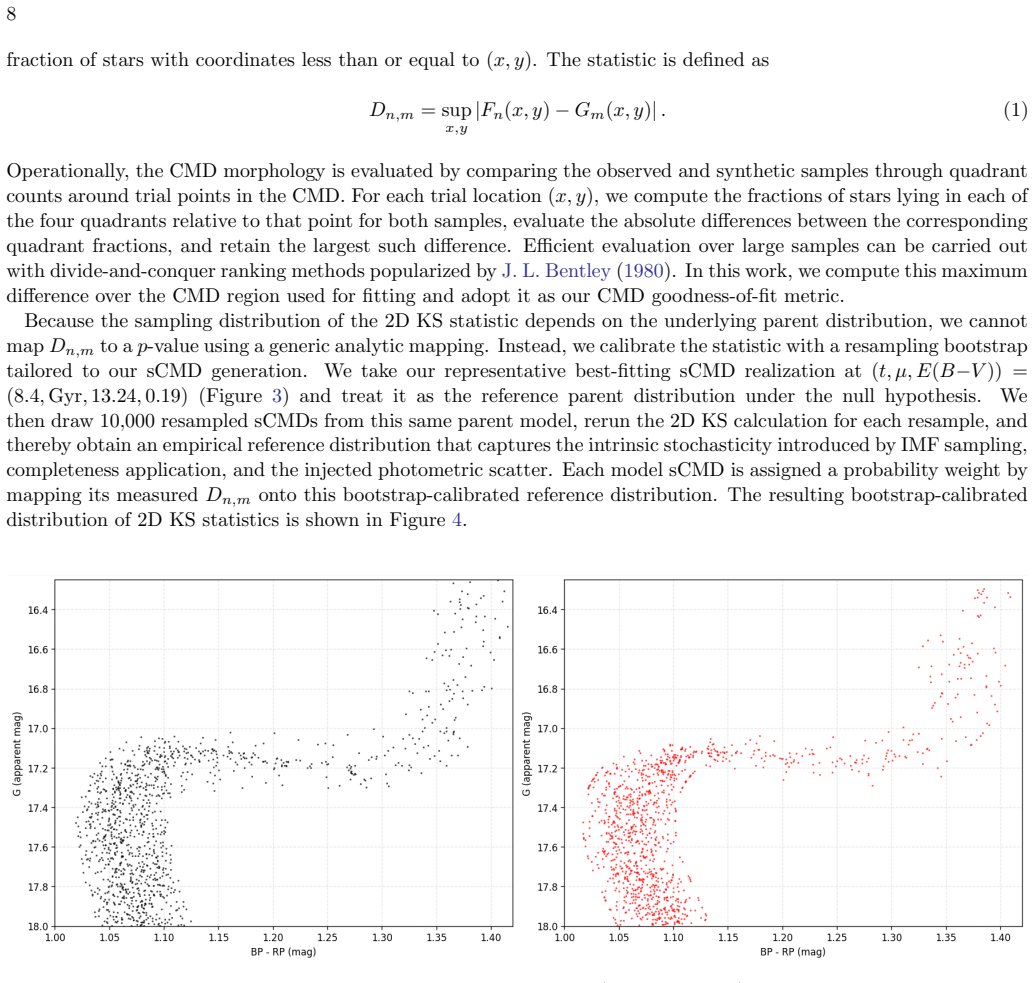
We present a new absolute age determination for NGC 6791, one of the Milky Way's oldest and most metal-rich open clusters. Its unusual properties make it an important probe of inner-disk evolution and asteroseismic calibration, but its age has remained difficult to determine because of coupled uncertainties in reddening, distance, photometry, and stellar-model physics. Gaia DR3 photometry together with detached eclipsing binaries (DEBs) in NGC 6791 are combined with 10,000 Monte Carlo isochrone sets (marginalizing over uncertainties in composition, convective mixing processes, opacities, diffusion, nuclear reaction-rates, distance modulus, and reddening) to determine the age of NGC 6791. For each isochrone we build a synthetic color-magnitude diagram (CMD) that matches the observed star count in the MSTO and subgiant-branch window and injects empirical photometric scatter perpendicular to the ridgeline, enabling CMD comparisons without artificial-star tests. We assess CMD morphology using a bootstrap-calibrated two-dimensional Kolmogorov-Smirnov statistic, and add an external check based on the nearest-point metric: a coeval DEB statistic in $(M,L)$ space. These statistics are mapped to probability-density weights via bootstrap-resampling and combined into a single isochrone weight. NGC 6791 is determined to have an age of $8.46\pm0.66$ Gyr, $[\mathrm{Fe/H}]=+0.280\pm0.079$, $Y=0.2968\pm0.0158$, $(m{-}M)_V=13.333\pm0.058$, and $E(B{-}V)=0.183\pm0.024$. Our error budget shows no single dominant contributor, and highlights differences between open-cluster and globular-cluster age errors. Combined with its super-solar metallicity, our age estimate favors an inner-Galaxy origin for NGC 6791 and subsequent outward migration, provides a benchmark for asteroseismic calibration at high metallicity, and extends the absolute cluster age--metallicity relation to an old, metal-rich open cluster.
Editorial analysis
A structured set of objections, weighed in public.
Referee Report
Summary. The paper claims a new absolute age for the open cluster NGC 6791 of 8.46 ± 0.66 Gyr (with [Fe/H] = +0.280 ± 0.079, Y = 0.2968 ± 0.0158, (m-M)_V = 13.333 ± 0.058, E(B-V) = 0.183 ± 0.024) derived from Gaia DR3 photometry and detached eclipsing binaries combined with 10,000 Monte Carlo isochrone realizations. These realizations marginalize over composition, convective mixing, opacities, diffusion, nuclear rates, distance, and reddening; synthetic CMDs are compared via bootstrap-calibrated 2D KS statistics in the MSTO/subgiant region plus a DEB nearest-point metric in (M, L) space, with weights mapped to a joint probability density. The result is interpreted as favoring inner-Galaxy origin followed by outward migration and as a high-metallicity benchmark for asteroseismic calibration.
Significance. If the central age holds, the work supplies a rare absolute anchor for the old, super-solar end of the open-cluster age-metallicity relation and thereby strengthens evidence for radial migration in the Galactic disk. The methodological strengths—large-scale Monte Carlo marginalization over multiple physics inputs, dual independent statistics (2D KS and DEB metric), and an error budget showing no single dominant term—are genuine advances over traditional isochrone fitting and merit citation in future galactic-archaeology and asteroseismology studies.
major comments (2)
- [Monte Carlo isochrone construction and weighting procedure] The age and parameter posteriors rest on the premise that the chosen ranges of convective mixing, opacities, diffusion, and nuclear rates, together with the base evolutionary code, generate an ensemble whose CMD morphologies bracket the true behavior of stars at [Fe/H] ≈ +0.28. If unvaried systematic errors persist in the high-Z opacity tables or mixing-length calibration, the probability weights assigned via the bootstrap-calibrated 2D KS and DEB metrics will be mis-calibrated and the reported 8.46 ± 0.66 Gyr age can shift outside the quoted uncertainty even though the internal error budget identifies no dominant contributor. This assumption is load-bearing for the central claim and requires either expanded physics variations or an external validation test.
- [Synthetic CMD generation and 2D KS statistic] The synthetic CMD construction injects empirical photometric scatter perpendicular to the ridgeline to enable direct comparison without artificial-star tests. While this avoids one common source of bias, the effectiveness of the scatter model in the MSTO + subgiant window must be shown to reproduce the observed density distribution at the level required by the bootstrap-calibrated 2D KS statistic; otherwise the weighting can systematically favor isochrones whose morphology matches the scatter prescription rather than the true stellar distribution.
minor comments (2)
- [Abstract] The abstract states that the error budget 'highlights differences between open-cluster and globular-cluster age errors'; a short quantitative comparison (e.g., fractional contributions from distance/reddening versus physics) would make this claim more concrete for readers.
- [DEB nearest-point metric] Notation for the DEB nearest-point metric in (M, L) space is introduced without an explicit equation; adding a one-line definition would improve reproducibility.
Simulated Author's Rebuttal
We thank the referee for their careful reading and constructive major comments, which identify important assumptions in our methodology. We respond to each point below and indicate the revisions we will make to strengthen the manuscript.
read point-by-point responses
-
Referee: [Monte Carlo isochrone construction and weighting procedure] The age and parameter posteriors rest on the premise that the chosen ranges of convective mixing, opacities, diffusion, and nuclear rates, together with the base evolutionary code, generate an ensemble whose CMD morphologies bracket the true behavior of stars at [Fe/H] ≈ +0.28. If unvaried systematic errors persist in the high-Z opacity tables or mixing-length calibration, the probability weights assigned via the bootstrap-calibrated 2D KS and DEB metrics will be mis-calibrated and the reported 8.46 ± 0.66 Gyr age can shift outside the quoted uncertainty even though the internal error budget identifies no dominant contributor. This assumption is load-bearing for the central claim and requires either expanded physics variations or an external validation test.
Authors: We agree that the coverage of systematic uncertainties in the input physics is a load-bearing assumption. The ranges adopted (mixing-length parameter varied by ±0.15 around the solar-calibrated value, OPAL/OP opacities with high-Z adjustments drawn from recent tabulations, diffusion included or excluded, and nuclear rates varied within published 1σ uncertainties) follow standard practice for Monte Carlo isochrone studies at super-solar metallicity. Our 10,000 realizations and the resulting error budget (no single term dominating) provide internal support for robustness. Nevertheless, we acknowledge that unaccounted systematics in high-Z opacities or mixing-length calibration could shift the posterior. In the revised manuscript we will add a new subsection (Section 4.3) that (i) tabulates the exact prior ranges and their literature sources, (ii) discusses the limitations of current high-Z opacity tables, and (iii) explicitly states that the quoted uncertainty is conditional on the adopted physics variations. We will also note that a fully independent code comparison lies beyond the scope of the present work but would be valuable for future calibration. This constitutes a partial revision focused on transparency rather than new computations. revision: partial
-
Referee: [Synthetic CMD generation and 2D KS statistic] The synthetic CMD construction injects empirical photometric scatter perpendicular to the ridgeline to enable direct comparison without artificial-star tests. While this avoids one common source of bias, the effectiveness of the scatter model in the MSTO + subgiant window must be shown to reproduce the observed density distribution at the level required by the bootstrap-calibrated 2D KS statistic; otherwise the weighting can systematically favor isochrones whose morphology matches the scatter prescription rather than the true stellar distribution.
Authors: We appreciate this point. The empirical scatter is measured directly from the Gaia DR3 photometric uncertainties of stars in the magnitude range of the MSTO and subgiant branch and is injected perpendicular to the ridgeline to preserve the intrinsic morphology. To demonstrate that this prescription reproduces the observed density distribution at the precision demanded by the bootstrap-calibrated 2D KS test, we will add a new figure (Figure 8) and accompanying text in Section 3.2. The figure will show (i) the observed versus synthetic Hess diagram in the MSTO/subgiant window for the maximum-weight isochrone and (ii) a quantitative residual map together with a supplementary one-dimensional KS test on the magnitude and color marginals. If the residuals are consistent with Poisson noise, this will confirm that the scatter model does not systematically bias the weighting. We will implement this addition in the revised manuscript. revision: yes
Circularity Check
No significant circularity; age derived from independent data-model comparison
full rationale
The derivation generates 10,000 Monte Carlo isochrone realizations by varying composition, mixing, opacities, diffusion, nuclear rates, distance, and reddening; builds synthetic CMDs matched to observed star counts in the MSTO/subgiant window with empirical scatter; applies bootstrap-calibrated 2D KS statistics plus DEB nearest-point metric in (M,L); and maps the combined statistics to probability weights for the output parameters. This is a standard forward-modeling fit where inputs are varied physics and external photometry/DEB data, and the age 8.46±0.66 Gyr is an output posterior. No equation or step reduces by construction to a fitted quantity renamed as prediction, no self-definitional loop, and no load-bearing self-citation chain that replaces external verification. The method remains self-contained against the Gaia CMD and DEB constraints without importing uniqueness theorems or ansatzes from prior author work.
Axiom & Free-Parameter Ledger
free parameters (5)
- age =
8.46 Gyr
- [Fe/H] =
+0.280
- Y =
0.2968
- (m-M)_V =
13.333
- E(B-V) =
0.183
axioms (2)
- domain assumption Stellar evolution models with varied convective mixing, opacities, diffusion, and nuclear rates accurately represent stars at super-solar metallicity.
- domain assumption The detached eclipsing binaries are cluster members and coeval with the single-star population.
Lean theorems connected to this paper
-
IndisputableMonolith/Foundation/AbsoluteFloorClosure.leanreality_from_one_distinction unclear?
unclearRelation between the paper passage and the cited Recognition theorem.
We sample broad ranges of stellar physics inputs... 10,000 Monte Carlo isochrone sets... bootstrap-calibrated two-dimensional Kolmogorov-Smirnov statistic... nearest-point metric: a coeval DEB statistic in (M,L) space.
-
IndisputableMonolith/Cost/FunctionalEquation.leanwashburn_uniqueness_aczel unclear?
unclearRelation between the paper passage and the cited Recognition theorem.
marginalizing over uncertainties in composition, convective mixing processes, opacities, diffusion, nuclear reaction-rates
What do these tags mean?
- matches
- The paper's claim is directly supported by a theorem in the formal canon.
- supports
- The theorem supports part of the paper's argument, but the paper may add assumptions or extra steps.
- extends
- The paper goes beyond the formal theorem; the theorem is a base layer rather than the whole result.
- uses
- The paper appears to rely on the theorem as machinery.
- contradicts
- The paper's claim conflicts with a theorem or certificate in the canon.
- unclear
- Pith found a possible connection, but the passage is too broad, indirect, or ambiguous to say the theorem truly supports the claim.
Reference graph
Works this paper leans on
-
[1]
2022, ApJS, 259, 35, doi: 10.3847/1538-4365/ac4414
Abdurro’uf, Accetta, K., Aerts, C., et al. 2022, ApJS, 259, 35, doi: 10.3847/1538-4365/ac4414
-
[2]
2016, Physics Letters B, 760, 584, doi: 10.1016/j.physletb.2016.07.032
Platter, L. 2016, Physics Letters B, 760, 584, doi: 10.1016/j.physletb.2016.07.032
-
[3]
G., Garc´ ıa, A., Robertson, R
Adelberger, E. G., Garc´ ıa, A., Robertson, R. G. H., et al. 2011, Reviews of Modern Physics, 83, 195, doi: 10.1103/RevModPhys.83.195
-
[4]
Ahmed, N. M. 2025, MNRAS, 543, 1584, doi: 10.1093/mnras/staf1469
-
[5]
Avidan, S., & Shamir, A. 2007, ACM Trans. Graph., 26, 10–es, doi: 10.1145/1276377.1276390
-
[6]
M., Protopapas, P., Sandvik, H
Bedin, L. R., Cassisi, S., Castelli, F., et al. 2005, MNRAS, 357, 1038, doi: 10.1111/j.1365-2966.2005.08735.x
-
[7]
2006, A&A, 460, L27, doi: 10.1051/0004-6361:20066085
Anderson, J. 2006, A&A, 460, L27, doi: 10.1051/0004-6361:20066085
-
[8]
R., Salaris, M., Piotto, G., et al
Bedin, L. R., Salaris, M., Piotto, G., et al. 2008, ApJL, 679, L29, doi: 10.1086/589151
-
[9]
2024, MNRAS, 528, 3198, doi: 10.1093/mnras/stad3920
Belokurov, V., & Kravtsov, A. 2024, MNRAS, 528, 3198, doi: 10.1093/mnras/stad3920
-
[10]
Bentley, J. L. 1980, Commun. ACM, 23, 214–229, doi: 10.1145/358841.358850 Bijavara Seshashayana, S., J¨ onsson, H., D’Orazi, V., et al. 2024, A&A, 683, A218, doi: 10.1051/0004-6361/202349068
-
[11]
2023, fidanka, 0.5 https://github.com/tboudreaux/fidanka
Boudreaux, E., & Ying, M. 2023, fidanka, 0.5 https://github.com/tboudreaux/fidanka
work page 2023
-
[12]
2011, A&A, 525, A2, doi: 10.1051/0004-6361/201015503
Brogaard, K., Bruntt, H., Grundahl, F., et al. 2011, A&A, 525, A2, doi: 10.1051/0004-6361/201015503
-
[13]
Brogaard, K., VandenBerg, D. A., Bruntt, H., et al. 2012, A&A, 543, A106, doi: 10.1051/0004-6361/201219196
-
[14]
1970, ApJ, 159, 641, doi: 10.1086/150338
Canuto, V. 1970, ApJ, 159, 641, doi: 10.1086/150338
-
[15]
2006, ApJ, 643, 1151, doi: 10.1086/500801
Carraro, G., Villanova, S., Demarque, P., et al. 2006, ApJ, 643, 1151, doi: 10.1086/500801
-
[16]
1995, ApJL, 444, L9, doi: 10.1086/187847
Chaboyer, B. 1995, ApJL, 444, L9, doi: 10.1086/187847
-
[17]
Chaboyer, B., Demarque, P., Kernan, P. J., Krauss, L. M., & Sarajedini, A. 1996, MNRAS, 283, 683, doi: 10.1093/mnras/283.2.683 18
-
[18]
Chaboyer, B., Green, E. M., & Liebert, J. 1999, AJ, 117, 1360, doi: 10.1086/300794
-
[19]
1995, ApJ, 454, 767, doi: 10.1086/176529
Chaboyer, B., & Kim, Y.-C. 1995, ApJ, 454, 767, doi: 10.1086/176529
-
[20]
2015, PhRvC, 91, 045801, doi: 10.1103/PhysRevC.91.045801
Chakraborty, S., deBoer, R., Mukherjee, A., & Roy, S. 2015, PhRvC, 91, 045801, doi: 10.1103/PhysRevC.91.045801
-
[21]
MESA Isochrones and Stellar Tracks (MIST). I: Solar-Scaled Models
Choi, J., Dotter, A., Conroy, C., et al. 2016, ApJ, 823, 102, doi: 10.3847/0004-637X/823/2/102
work page internal anchor Pith review doi:10.3847/0004-637x/823/2/102 2016
-
[22]
2004, A&A, 424, 919, doi: 10.1051/0004-6361:20040470
Claret, A. 2004, A&A, 424, 919, doi: 10.1051/0004-6361:20040470
-
[23]
Cunha, K., Smith, V. V., Johnson, J. A., et al. 2015, ApJL, 798, L41, doi: 10.1088/2041-8205/798/2/L41
-
[24]
2015, MNRAS, 449, 1811, doi: 10.1093/mnras/stv395 deBoer, R
Moitinho, A. 2015, MNRAS, 449, 1811, doi: 10.1093/mnras/stv395 deBoer, R. J., G¨ orres, J., Smith, K., et al. 2014, PhRvC, 90, 035804, doi: 10.1103/PhysRevC.90.035804
-
[25]
Demarque, P., Woo, J.-H., Kim, Y.-C., & Yi, S. K. 2004, ApJS, 155, 667, doi: 10.1086/424966
-
[26]
Donor, J., Frinchaboy, P. M., Cunha, K., et al. 2018, AJ, 156, 142, doi: 10.3847/1538-3881/aad635
-
[27]
MESA Isochrones and Stellar Tracks (MIST) 0: Methods for the construction of stellar isochrones
Dotter, A. 2016, ApJS, 222, 8, doi: 10.3847/0067-0049/222/1/8
work page internal anchor Pith review doi:10.3847/0067-0049/222/1/8 2016
-
[28]
2008, ApJS, 178, 89, doi: 10.1086/589654
Dotter, A., Chaboyer, B., Jevremovi´ c, D., et al. 2008, ApJS, 178, 89, doi: 10.1086/589654
-
[29]
Dufresne, G. 2026, isochronetoolbox: Monte Carlo isochrones and synthetic CMD fitting tools,, GitHub repository https://github.com/georgedufresne/isochrone-toolbox
work page 2026
-
[30]
Eddington, A. S. 1926, The Internal Constitution of the Stars
work page 1926
-
[31]
W., Riello, M., De Angeli, F., et al
Evans, D. W., Riello, M., De Angeli, F., et al. 2018, A&A, 616, A4, doi: 10.1051/0004-6361/201832756
-
[32]
1987, MNRAS, 225, 155, doi: 10.1093/mnras/225.1.155
Fasano, G., & Franceschini, A. 1987, MNRAS, 225, 155, doi: 10.1093/mnras/225.1.155
-
[33]
Ferguson, J. W., Alexander, D. R., Allard, F., et al. 2005, ApJ, 623, 585, doi: 10.1086/428642 Fern´ andez-Alvar, E., Ruiz-Lara, T., Gallart, C., et al. 2025, A&A, 704, A258, doi: 10.1051/0004-6361/202553814
-
[34]
2019, ApJ, 884, 99, doi: 10.3847/1538-4357/ab4254
Frankel, N., Sanders, J., Rix, H.-W., Ting, Y.-S., & Ness, M. 2019, ApJ, 884, 99, doi: 10.3847/1538-4357/ab4254
-
[35]
Friel, E. D. 1995, ARA&A, 33, 381, doi: 10.1146/annurev.aa.33.090195.002121 Gaia Collaboration, Vallenari, A., Brown, A. G. A., et al. 2023, A&A, 674, A1, doi: 10.1051/0004-6361/202243940
-
[36]
2016, ApJ, 832, 121, doi: 10.3847/0004-637X/832/2/121
Gaulme, P., McKeever, J., Jackiewicz, J., et al. 2016, ApJ, 832, 121, doi: 10.3847/0004-637X/832/2/121
-
[37]
Guenther, D. B., & Demarque, P. 2000, ApJ, 531, 503, doi: 10.1086/308446
-
[38]
1994, ApJ, 425, 222, doi: 10.1086/173978
Haft, M., Raffelt, G., & Weiss, A. 1994, ApJ, 425, 222, doi: 10.1086/173978
-
[39]
Hauschildt, P. H., Allard, F., & Baron, E. 1999, ApJ, 512, 377, doi: 10.1086/306745
-
[40]
Henyey, L., Vardya, M. S., & Bodenheimer, P. 1965, ApJ, 142, 841, doi: 10.1086/148357
-
[41]
Hubbard, W. B., & Lampe, M. 1969, ApJS, 18, 297, doi: 10.1086/190192
-
[42]
Hunt, E. L., & Reffert, S. 2024, A&A, 686, A42, doi: 10.1051/0004-6361/202348662
-
[43]
O., Wende-von Berg, S., Dreizler, S., et al
Husser, T. O., Wende-von Berg, S., Dreizler, S., et al. 2013, A&A, 553, A6, doi: 10.1051/0004-6361/201219058
work page internal anchor Pith review doi:10.1051/0004-6361/201219058 2013
-
[44]
Iglesias, C. A., & Rogers, F. J. 1996, ApJ, 464, 943, doi: 10.1086/177381
-
[45]
Irwin, A. W. 2012, FreeEOS: Equation of State for stellar interiors calculations,, Astrophysics Source Code Library, record ascl:1211.002
work page 2012
-
[46]
Johnson, J. W. 2000, Multivariate Behavioral Research, 35, 1, doi: 10.1207/S15327906MBR3501 1
-
[47]
2018, ApJ, 856, 10, doi: 10.3847/1538-4357/aab200
Joyce, M., & Chaboyer, B. 2018, ApJ, 856, 10, doi: 10.3847/1538-4357/aab200
-
[48]
Kalirai, J. S., & Richer, H. B. 2010, Philosophical Transactions of the Royal Society of London Series A, 368, 755, doi: 10.1098/rsta.2009.0257
-
[49]
2005, AJ, 130, 626, doi: 10.1086/431327 Krishna Swamy, K
Anderson, J. 2005, AJ, 130, 626, doi: 10.1086/431327 Krishna Swamy, K. S. 1966, ApJ, 145, 174, doi: 10.1086/148752
-
[50]
Lardo, C., Valcin, D., & Jimenez, R. 2026, arXiv e-prints, arXiv:2603.11814, doi: 10.48550/arXiv.2603.11814
work page internal anchor Pith review Pith/arXiv arXiv doi:10.48550/arxiv.2603.11814 2026
-
[51]
1991, IEEE Transactions on Information Theory, 37, 145, doi: 10.1109/18.61115
Lin, J. 1991, IEEE Transactions on Information Theory, 37, 145, doi: 10.1109/18.61115
-
[52]
Lindeman, R. H., Merenda, P. F., & Gold, R. Z. 1980, Introduction to Bivariate and Multivariate Analysis (Glenview, Ill.: Scott, Foresman), 444
work page 1980
-
[53]
Linden, S. T., Pryal, M., Hayes, C. R., et al. 2017, ApJ, 842, 49, doi: 10.3847/1538-4357/aa6f17
-
[54]
Lindsay, C. J., Ong, J. M. J., & Basu, S. 2022, ApJ, 931, 116, doi: 10.3847/1538-4357/ac67ed
-
[55]
Lindsay, C. J., Ong, J. M. J., & Basu, S. 2024, ApJ, 965, 171, doi: 10.3847/1538-4357/ad2ae5
-
[56]
Lu, Y., Buck, T., Minchev, I., & Ness, M. K. 2022, MNRAS, 515, L34, doi: 10.1093/mnrasl/slac065
-
[57]
Lu, Y. L., Minchev, I., Buck, T., et al. 2024, MNRAS, 535, 392, doi: 10.1093/mnras/stae2364
-
[58]
E., Schiavilla, R., & Viviani, M
Marcucci, L. E., Schiavilla, R., & Viviani, M. 2013, PhRvL, 110, 192503, doi: 10.1103/PhysRevLett.110.192503
-
[59]
2011, PhRvC, 83, 045804, doi: 10.1103/PhysRevC.83.045804 19
Marta, M., Formicola, A., Bemmerer, D., et al. 2011, PhRvC, 83, 045804, doi: 10.1103/PhysRevC.83.045804 19
-
[60]
2023, A&A, 680, A20, doi: 10.1051/0004-6361/202347289
Massari, D., Aguado-Agelet, F., Monelli, M., et al. 2023, A&A, 680, A20, doi: 10.1051/0004-6361/202347289
-
[61]
2026, arXiv e-prints, arXiv:2601.18896, doi: 10.48550/arXiv.2601.18896
Massari, D., Zerbinati, C., Fanelli, C., et al. 2026, arXiv e-prints, arXiv:2601.18896, doi: 10.48550/arXiv.2601.18896
-
[62]
McKeever, J. M., Basu, S., & Corsaro, E. 2019, ApJ, 874, 180, doi: 10.3847/1538-4357/ab0c04
-
[63]
Milone, A. P., Marino, A. F., Renzini, A., et al. 2018, MNRAS, 481, 5098, doi: 10.1093/mnras/sty2573
-
[64]
2018, MNRAS, 481, 1645, doi: 10.1093/mnras/sty2033
Minchev, I., Anders, F., Recio-Blanco, A., et al. 2018, MNRAS, 481, 1645, doi: 10.1093/mnras/sty2033
-
[65]
2012, A&A, 541, A41, doi: 10.1051/0004-6361/201117749
Mowlavi, N., Eggenberger, P., Meynet, G., et al. 2012, A&A, 541, A41, doi: 10.1051/0004-6361/201117749
-
[66]
Ness, M. K., Johnston, K. V., Blancato, K., et al. 2019, ApJ, 883, 177, doi: 10.3847/1538-4357/ab3e3c O’Malley, E. M., McWilliam, A., Chaboyer, B., &
-
[67]
2017, ApJ, 838, 90, doi: 10.3847/1538-4357/aa62a2
Thompson, I. 2017, ApJ, 838, 90, doi: 10.3847/1538-4357/aa62a2
-
[68]
Peacock, J. A. 1983, MNRAS, 202, 615, doi: 10.1093/mnras/202.3.615
-
[69]
2004, ApJ, 612, 168, doi: 10.1086/422498
Pietrinferni, A., Cassisi, S., Salaris, M., & Castelli, F. 2004, ApJ, 612, 168, doi: 10.1086/422498
-
[70]
Pinsonneault, M. H., Elsworth, Y. P., Tayar, J., et al. 2018, ApJS, 239, 32, doi: 10.3847/1538-4365/aaebfd
-
[71]
Pinsonneault, M. H., Zinn, J. C., Tayar, J., et al. 2025, ApJS, 276, 69, doi: 10.3847/1538-4365/ad9fef
-
[72]
Piotto, G. 2018, HST UV Globular Cluster Survey (”HUGS”), STScI/MAST, doi: 10.17909/T9810F Planck Collaboration, Aghanim, N., Akrami, Y., et al. 2020, A&A, 641, A6, doi: 10.1051/0004-6361/201833910
-
[73]
M., Kozhurina-Platais, V., et al
Platais, I., Cudworth, K. M., Kozhurina-Platais, V., et al. 2011, ApJL, 733, L1, doi: 10.1088/2041-8205/733/1/L1
-
[74]
2024, ApJ, 975, 89, doi: 10.3847/1538-4357/ad78e1
Sinha, A., Zasowski, G., Frinchaboy, P., et al. 2024, ApJ, 975, 89, doi: 10.3847/1538-4357/ad78e1
-
[75]
2017, AJ, 153, 19, doi: 10.3847/1538-3881/153/1/19
Soto, M., Bellini, A., Anderson, J., et al. 2017, AJ, 153, 19, doi: 10.3847/1538-3881/153/1/19
-
[76]
2025, ApJL, 984, L56, doi: 10.3847/2041-8213/adcd6f
Tayar, J., & Joyce, M. 2025, ApJL, 984, L56, doi: 10.3847/2041-8213/adcd6f
-
[77]
Theodoridis, A. T., Morales, L., & Tayar, J. 2026, ApJS, 283, 4, doi: 10.3847/1538-4365/ae315a
-
[78]
Thoul, A. A., Bahcall, J. N., & Loeb, A. 1994, ApJ, 421, 828, doi: 10.1086/173695
-
[79]
2014, ApJ, 794, 72, doi: 10.1088/0004-637X/794/1/72
Edvardsson, B. 2014, ApJ, 794, 72, doi: 10.1088/0004-637X/794/1/72
-
[80]
2018, ApJ, 867, 34, doi: 10.3847/1538-4357/aae4e5
Assmann, P. 2018, ApJ, 867, 34, doi: 10.3847/1538-4357/aae4e5
discussion (0)
Sign in with ORCID, Apple, or X to comment. Anyone can read and Pith papers without signing in.