The AI-Native Large-Scale Agile Software Development Manifesto
Pith reviewed 2026-05-25 06:24 UTC · model grok-4.3
The pith
A manifesto redefines large-scale agile development by making AI a first-class participant instead of a peripheral tool.
A machine-rendered reading of the paper's core claim, the machinery that carries it, and where it could break.
Core claim
The AI-Native Large-Scale Agile Software Development Manifesto consists of six principles—parallel processes, intent-driven teams, living knowledge, verification-first assurance, orchestrated agent workforces, and reusable blueprints—that together replace meeting-driven, document-heavy, sequential processes with an intelligent, adaptive, continuously learning system in which AI acts as a first-class participant.
What carries the argument
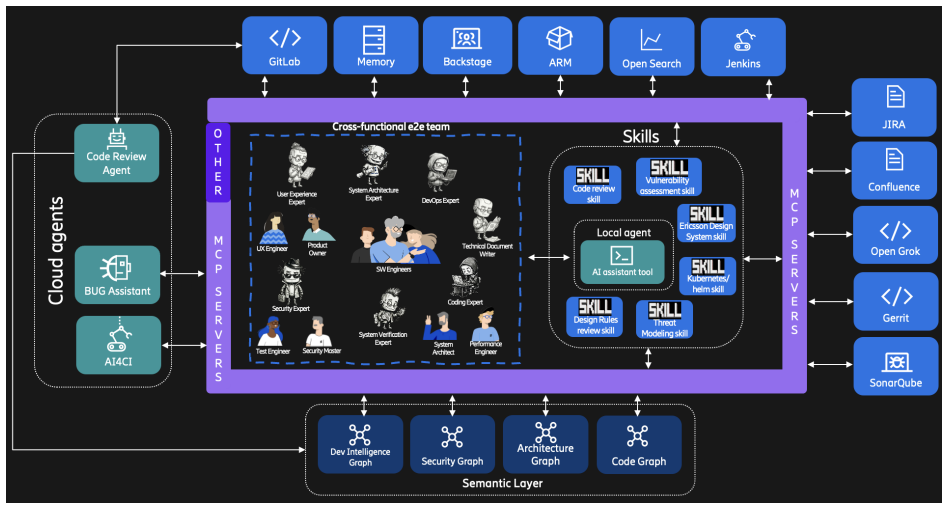
The six principles of the manifesto, which redefine organization when AI becomes a first-class participant.
If this is right
- Coordination shifts from scheduled meetings to intent-driven interactions mediated by AI.
- Knowledge artifacts become continuously updated living systems rather than static documents.
- Verification occurs first and continuously instead of at the end of phases.
- Agent workforces are orchestrated as reusable, scalable components.
- Development processes gain the capacity for real-time adaptation through parallel AI-supported flows.
Where Pith is reading between the lines
- Team roles would likely evolve from role-based handoffs to oversight of AI-orchestrated workflows.
- Existing large-scale frameworks such as SAFe or LeSS would require substantial redesign to incorporate the six principles rather than incremental AI tool adoption.
- Training data for the AI components would need to capture not only code but also intent and verification history to sustain the living-knowledge principle.
- Organizations adopting the manifesto might first test it on greenfield projects before retrofitting legacy scaled-agile setups.
Load-bearing premise
AI systems can reliably handle coordination, knowledge maintenance, verification, and orchestration at scale without creating new coordination or verification problems.
What would settle it
A controlled deployment in which AI agents attempt to maintain living knowledge and orchestrate work across multiple teams for six months while measuring the rate of introduced coordination failures or verification gaps against a human-only baseline.
Figures


read the original abstract
Despite the widespread adoption of agile methods, achieving true agility at scale remains elusive. Large-scale agile frameworks remain largely human-centric and manual, relying on coordination meetings, artifact synchronization, and role-based handoffs that inhibit real-time adaptation. Meanwhile, rapid advances in AI, particularly large language models, have begun transforming software engineering, yet their potential for organizational-level agility remains underexplored. We present the AI-Native Large-Scale Agile Software Development Manifesto: a set of values and principles that redefine how large-scale software development is organized when AI becomes a first-class participant rather than a peripheral tool. The manifesto is grounded in six principles, parallel processes, intent-driven teams, living knowledge, verification-first assurance, orchestrated agent workforces, and reusable blueprints, that together shift development from a meeting-driven, document-heavy, sequential process to an intelligent, adaptive, continuously learning system.
Editorial analysis
A structured set of objections, weighed in public.
Referee Report
Summary. The paper presents the AI-Native Large-Scale Agile Software Development Manifesto, which consists of six principles—parallel processes, intent-driven teams, living knowledge, verification-first assurance, orchestrated agent workforces, and reusable blueprints—intended to redefine large-scale software development by making AI a first-class participant, shifting from meeting-driven, document-heavy processes to an intelligent, adaptive, continuously learning system.
Significance. If the proposed principles prove effective in practice, the manifesto could serve as a foundational document for integrating AI into agile methodologies at scale, potentially influencing software engineering practices and research directions. As a conceptual contribution without empirical data or formal validation, its significance lies in stimulating debate and guiding future implementations rather than providing immediately actionable or tested guidance.
major comments (1)
- [Abstract] Abstract: The central assumption that AI systems can reliably act as first-class participants in coordination, knowledge maintenance, verification, and orchestration without introducing new coordination or verification problems is presented as a premise but lacks any supporting analysis, references to related work on multi-agent systems challenges, or discussion of potential pitfalls; this assumption is load-bearing for the manifesto's claims of achieving true agility.
Simulated Author's Rebuttal
We thank the referee for the constructive comment on the abstract. We address the point below and propose targeted revisions to strengthen the presentation of the manifesto's foundational assumptions.
read point-by-point responses
-
Referee: [Abstract] Abstract: The central assumption that AI systems can reliably act as first-class participants in coordination, knowledge maintenance, verification, and orchestration without introducing new coordination or verification problems is presented as a premise but lacks any supporting analysis, references to related work on multi-agent systems challenges, or discussion of potential pitfalls; this assumption is load-bearing for the manifesto's claims of achieving true agility.
Authors: We agree that the assumption regarding AI systems acting as reliable first-class participants is central to the manifesto and is presented without explicit supporting analysis or caveats in the abstract. As a conceptual manifesto rather than an empirical study, the paper's purpose is to articulate a forward-looking vision grounded in observed trends in AI and agile practices. However, we recognize that referencing challenges from multi-agent systems literature (e.g., coordination failures, verification overheads, and emergent behaviors) and briefly noting potential pitfalls would provide necessary balance and context. We will revise the abstract to acknowledge the assumption explicitly and add a dedicated subsection in the full manuscript discussing related work on multi-agent challenges along with potential limitations of the proposed principles. revision: partial
Circularity Check
No significant circularity
full rationale
The paper is a conceptual manifesto that defines six principles for AI-native large-scale agile development without any formal derivations, equations, quantitative predictions, or self-referential definitions. The central claim consists solely in proposing the principles themselves as a shift from human-centric processes; no load-bearing step reduces by construction to fitted parameters, prior self-citations, or renamed inputs. The document contains no derivation chain that could be inspected for circularity.
Axiom & Free-Parameter Ledger
axioms (2)
- domain assumption AI systems (particularly LLMs) can function as reliable first-class participants in coordination, knowledge, and verification tasks at organizational scale.
- domain assumption Current large-scale agile frameworks are limited by human-centric manual processes that inhibit real-time adaptation.
Reference graph
Works this paper leans on
-
[1]
Adapting Behavior Driven Development (BDD) for large-scale software systems , journal =. 2021 , issn =. doi:https://doi.org/10.1016/j.jss.2021.110944 , author =
-
[2]
Empirical Software Engineering , volume =
Dingsøyr, Torgeir and Moe, Nils Brede and Fægri, Tor Erlend and Seim, Eva Amdahl , title =. Empirical Software Engineering , volume =
-
[3]
Journal of Systems and Software , volume =
Rolland, Colette and Prakash, Naveen and Ben Achour, Camille , title =. Journal of Systems and Software , volume =
- [4]
-
[5]
Larman, Craig and Vodde, Bas , title =
-
[6]
2020 , howpublished =
work page 2020
- [7]
- [8]
-
[9]
Dingsøyr, Torgeir and Moe, Nils Brede and Seim, Eva Amdahl and Fægri, Tor Erlend , title =. arXiv preprint , year =
-
[10]
Behavior-Driven Development , howpublished =
- [11]
-
[12]
Agent Skills , howpublished =
-
[13]
T. Dingsøyr, N. B. Moe, T. E. Fægri, and E. A. Seim, ``Exploring software development at the very large scale: a revelatory case study and research agenda for agile method adaptation,'' Empirical Software Engineering, vol. 23, no. 1, pp. 490--520, 2018
work page 2018
-
[14]
C. Rolland, N. Prakash, and C. Ben Achour, ``Challenges of large-scale agile: a systems perspective,'' Journal of Systems and Software, vol. 125, pp. 1--14, 2016
work page 2016
-
[15]
, `` SAFe 5.0 framework overview,'' https://scaledagileframework.com, 2020
Scaled Agile Inc. , `` SAFe 5.0 framework overview,'' https://scaledagileframework.com, 2020
work page 2020
-
[16]
C. Larman and B. Vodde, Large-Scale Scrum: More with LeSS. 1em plus 0.5em minus 0.4em Addison-Wesley, 2016
work page 2016
-
[17]
S. W. Ambler and M. Lines, Disciplined Agile Delivery: A Practitioner's Guide to Agile Software Delivery in the Enterprise. 1em plus 0.5em minus 0.4em IBM Press, 2012
work page 2012
-
[18]
P. J. Guo, ``The state of AI -assisted programming: emerging opportunities and challenges,'' Communications of the ACM, vol. 66, no. 11, pp. 68--77, 2023
work page 2023
- [19]
-
[20]
AgentSkills , ``Agent skills,'' https://agentskills.io/
discussion (0)
Sign in with ORCID, Apple, or X to comment. Anyone can read and Pith papers without signing in.