Automorphism groups and Distinguishing Colorings of Central and Middle Graphs
Pith reviewed 2026-05-19 03:50 UTC · model grok-4.3
The pith
If a graph G has at least four vertices, then Aut(G) is isomorphic to Aut(C(G)) and Aut(M(G)).
A machine-rendered reading of the paper's core claim, the machinery that carries it, and where it could break.
Core claim
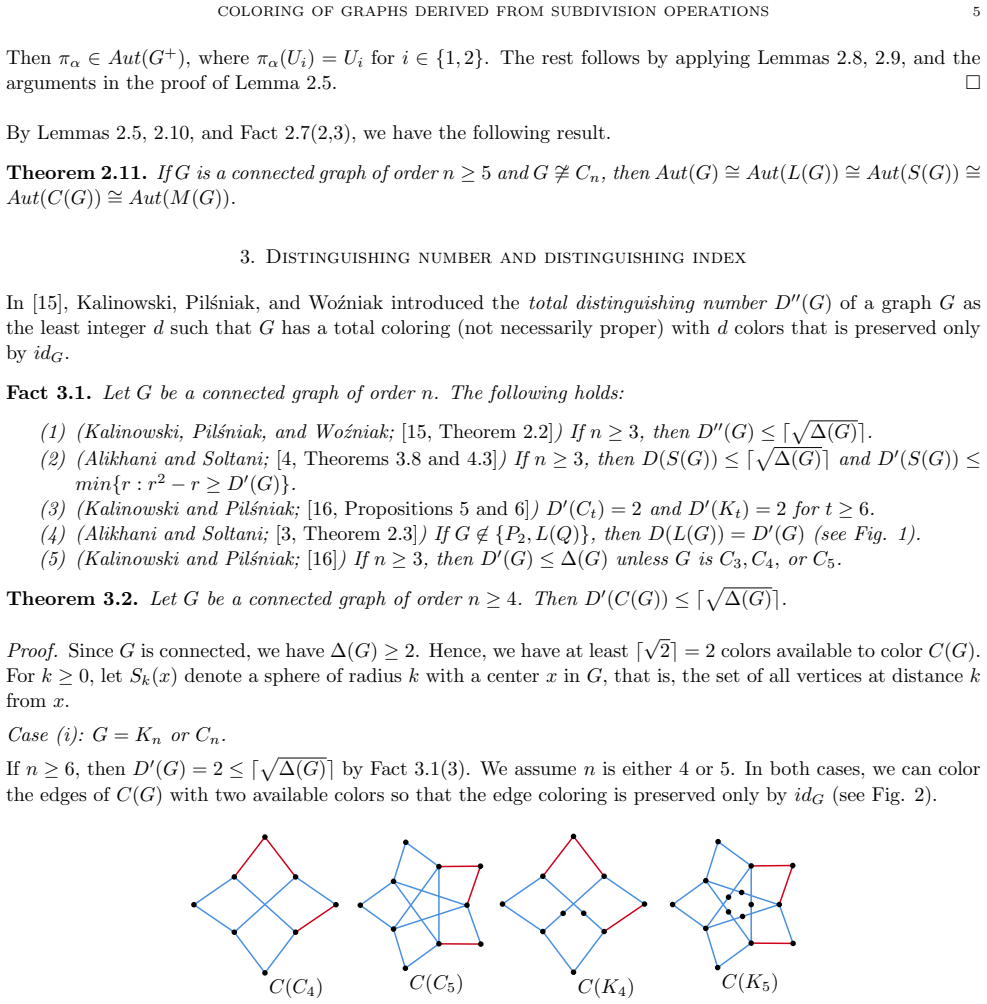
We show that if the order of G is at least 4, then Aut(G), Aut(C(G)), and Aut(M(G)) are isomorphic as abstract groups. We apply these results to obtain new upper bounds of the distinguishing number and the distinguishing index of C(G) and M(G) inspired by an algorithm due to Kalinowski, Pilsniak, and Wozniak from 2016.
What carries the argument
The isomorphism between Aut(G), Aut(C(G)), and Aut(M(G)) induced by the constructions of the central graph and middle graph from the subdivision graph S(G).
If this is right
- The distinguishing number of C(G) satisfies the same upper bounds that the 2016 algorithm yields for G itself.
- The distinguishing index of M(G) inherits upper bounds directly from those established for the automorphism group of G.
- Any distinguishing coloring of G induces corresponding colorings on C(G) and M(G) via the group isomorphism.
- The results extend the reach of existing distinguishing algorithms to the classes of central graphs and middle graphs without additional symmetry-breaking cost.
Where Pith is reading between the lines
- The group preservation may mean that other symmetry-related parameters, such as the fixing number, behave identically under these two constructions for large enough base graphs.
- Direct computational checks on all connected graphs of order exactly four would either confirm the isomorphism or reveal the smallest counterexample.
- Similar isomorphism statements could be tested for other common derived graphs that add edges to a subdivision, such as certain line graphs or total graphs.
Load-bearing premise
The specific edge additions that define C(G) and M(G) from S(G) introduce no automorphisms beyond those already present in G, when G has four or more vertices.
What would settle it
A connected graph G on four vertices together with an explicit automorphism of C(G) or M(G) that moves an original vertex of G to a subdivided vertex and cannot be matched to any automorphism of G.
Figures



read the original abstract
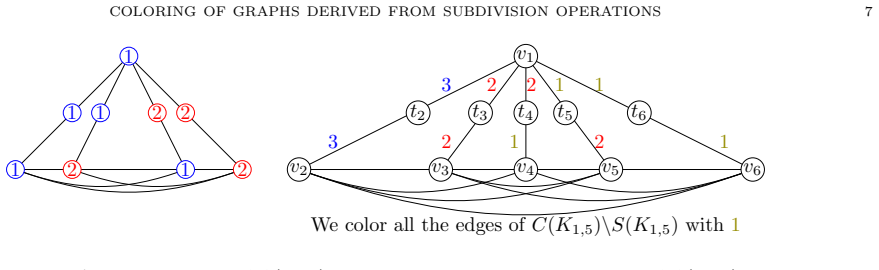
Let G be a simple, finite, connected, and undirected graph. The middle graph M(G) of G is obtained from the subdivision graph S(G) after joining pairs of subdivided vertices that lie on adjacent edges of G and the central graph C(G) of G is obtained from S(G) after joining all non-adjacent vertices of G. We show that if the order of G is at least 4, then Aut(G), Aut(C(G)), and Aut(M(G)) are isomorphic (as abstract groups) and apply this result to obtain new upper bounds of the distinguishing number and the distinguishing index of C(G) and M(G) and provide examples showing that these bounds cannot be improved in general. Moreover, we use idempotent commutative Latin squares and a theorem of Galvin on list edge colorings of bipartite graphs to study the total distinguishing chromatic number of central graphs.
Editorial analysis
A structured set of objections, weighed in public.
Referee Report
Summary. The paper claims that for any connected simple undirected graph G with |V(G)| ≥ 4, the groups Aut(G), Aut(C(G)), and Aut(M(G)) are isomorphic as abstract groups. It then applies these isomorphisms to derive new upper bounds on the distinguishing number D and distinguishing index D' of C(G) and M(G), drawing on the 2016 algorithm of Kalinowski, Pilśniak, and Woźniak.
Significance. If the isomorphisms are established rigorously, the result provides a uniform way to relate the symmetry groups of G to those of its central and middle graphs, which in turn yields concrete, transferable bounds on distinguishing colorings. This extends the literature on automorphism-preserving graph constructions and distinguishing parameters for derived graphs.
major comments (2)
- [Section 3 (isomorphism for middle graphs)] The proof that Aut(M(G)) ≅ Aut(G) must supply a uniform, non-degree argument that the original-vertex set O is preserved by every automorphism of M(G). The degree-based separation used for C(G) (original vertices have degree n−1) does not carry over, since deg_M(v) for v ∈ O equals the original degree while deg_M(e) for e ∈ E equals deg(u)+deg(v), and these ranges overlap for many graphs (e.g., any G containing both a degree-4 vertex and an edge whose endpoints sum to 4). Without an invariant that works for arbitrary degree sequences, it is possible that some automorphisms mix O and E, making |Aut(M(G))| strictly larger than |Aut(G)|.
- [Theorem 3.2 and its proof] The manuscript states the isomorphism for all connected G with n ≥ 4 but provides no explicit case-by-case verification or additional structural invariant (e.g., adjacency to the subdivided edges or parity arguments) that rules out mixing when degrees coincide. This is load-bearing for both the group-isomorphism claim and the subsequent distinguishing-number bounds that inherit the group order.
minor comments (2)
- [Abstract] The abstract refers to “new upper bounds” without indicating whether they improve on known bounds for the same graphs or merely transfer existing bounds from G; a short comparative sentence would clarify the contribution.
- [Section 2 (definitions)] Notation for the partition of V(M(G)) into original vertices and subdivision vertices is introduced but not used uniformly in later sections; consistent symbols (e.g., O and E) would improve readability.
Simulated Author's Rebuttal
We thank the referee for the thorough review and for identifying a potential weakness in the presentation of the isomorphism for middle graphs. We address the major comments point by point below. We agree that the current argument requires strengthening and will revise the manuscript to supply a uniform structural invariant.
read point-by-point responses
-
Referee: [Section 3 (isomorphism for middle graphs)] The proof that Aut(M(G)) ≅ Aut(G) must supply a uniform, non-degree argument that the original-vertex set O is preserved by every automorphism of M(G). The degree-based separation used for C(G) (original vertices have degree n−1) does not carry over, since deg_M(v) for v ∈ O equals the original degree while deg_M(e) for e ∈ E equals deg(u)+deg(v), and these ranges overlap for many graphs (e.g., any G containing both a degree-4 vertex and an edge whose endpoints sum to 4). Without an invariant that works for arbitrary degree sequences, it is possible that some automorphisms mix O and E, making |Aut(M(G))| strictly larger than |Aut(G)|.
Authors: We agree that a purely degree-based separation is insufficient for middle graphs when degree sequences permit overlaps, and the manuscript's current presentation does not explicitly rule out mixing in such cases. We will revise Section 3 to include a uniform structural argument: the set O consists exactly of the vertices whose entire neighborhood lies in the independent-set complement of the clique cover formed by the edge-vertex adjacencies. More precisely, we will prove that any automorphism must map O to O by showing that vertices in O are the unique vertices that are non-adjacent to all other vertices in their closed neighborhood except through the subdivided structure, combined with the fact that the induced subgraph on the image of O must reproduce the original adjacency via the incident edge-vertices. This invariant holds independently of specific degree values and will be stated and proved in full detail. revision: yes
-
Referee: [Theorem 3.2 and its proof] The manuscript states the isomorphism for all connected G with n ≥ 4 but provides no explicit case-by-case verification or additional structural invariant (e.g., adjacency to the subdivided edges or parity arguments) that rules out mixing when degrees coincide. This is load-bearing for both the group-isomorphism claim and the subsequent distinguishing-number bounds that inherit the group order.
Authors: We acknowledge that the proof of Theorem 3.2 currently lacks an explicit additional invariant or case analysis for degree-coincidence situations. We will expand the proof to incorporate the structural characterization described above, which serves as the required uniform invariant. No case-by-case verification on degree sequences will be needed once the invariant is established, but we will add a short remark confirming that the argument covers all connected graphs with n ≥ 4. The revised proof will directly support the subsequent bounds on D and D'. revision: yes
Circularity Check
No significant circularity; direct structural proof of group isomorphisms
full rationale
The paper establishes Aut(G) ≅ Aut(C(G)) ≅ Aut(M(G)) for connected G with n ≥ 4 via explicit constructions of C(G) and M(G) from the subdivision graph S(G), followed by case analysis showing that any automorphism of the derived graphs must map original vertices to original vertices and subdivision vertices to subdivision vertices while inducing an automorphism of G. This chain relies on degree sequences, adjacency relations, and partition preservation arguments that are verified directly from the definitions rather than reducing to a fitted parameter, self-referential definition, or load-bearing self-citation. The distinguishing-number bounds are presented as straightforward applications of an external 2016 algorithm once the isomorphisms are in hand. No equation or claim in the derivation is equivalent to its own input by construction.
Axiom & Free-Parameter Ledger
axioms (1)
- domain assumption G is simple, finite, connected, and undirected
discussion (0)
Sign in with ORCID, Apple, or X to comment. Anyone can read and Pith papers without signing in.