The Impact of Non-Gaussian Line Spread Functions on Stellar Kinematic Recovery: Consequences for Dynamical Models
Pith reviewed 2026-06-30 04:55 UTC · model grok-4.3
The pith
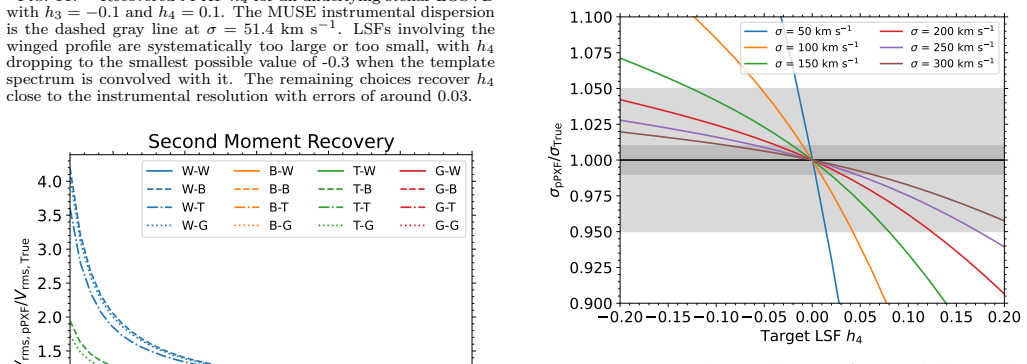
Non-Gaussian line spread functions introduce up to 7 percent uncertainty in stellar velocity dispersion even at 300 km/s.
A machine-rendered reading of the paper's core claim, the machinery that carries it, and where it could break.
Core claim
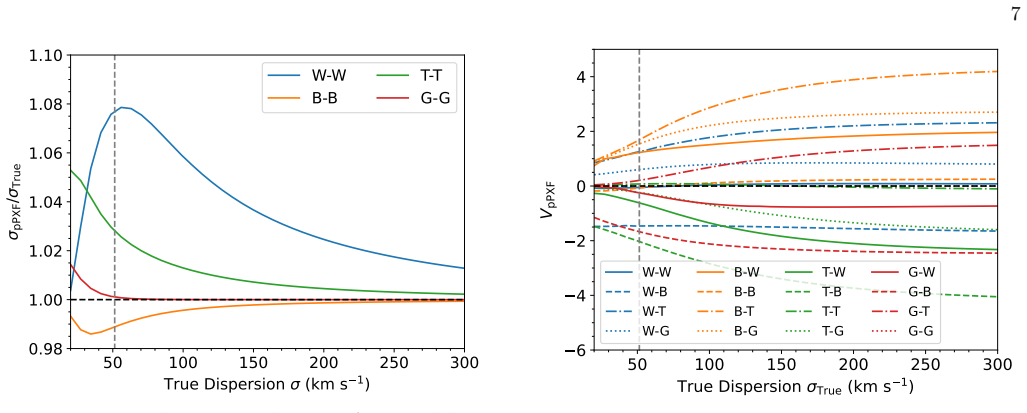
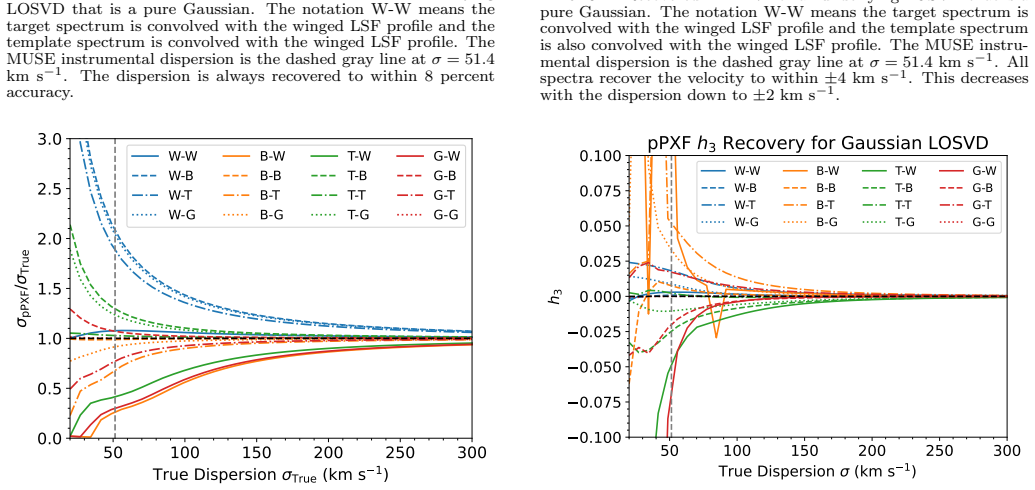
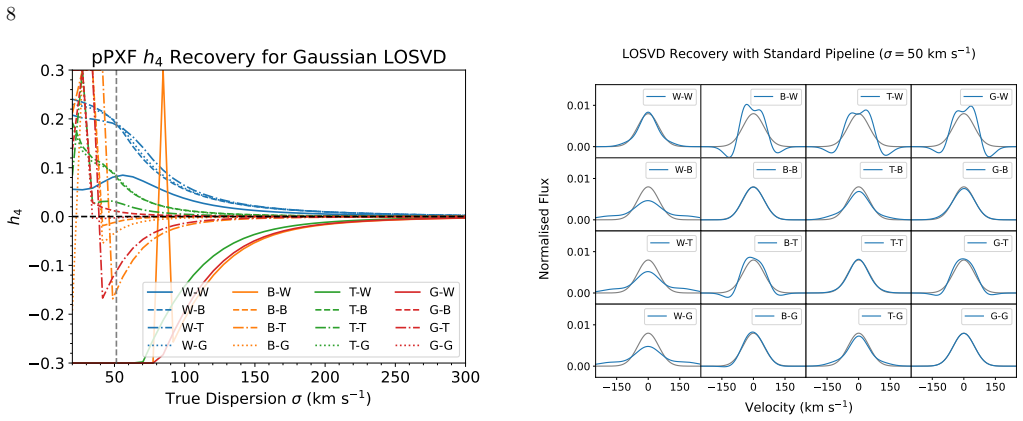
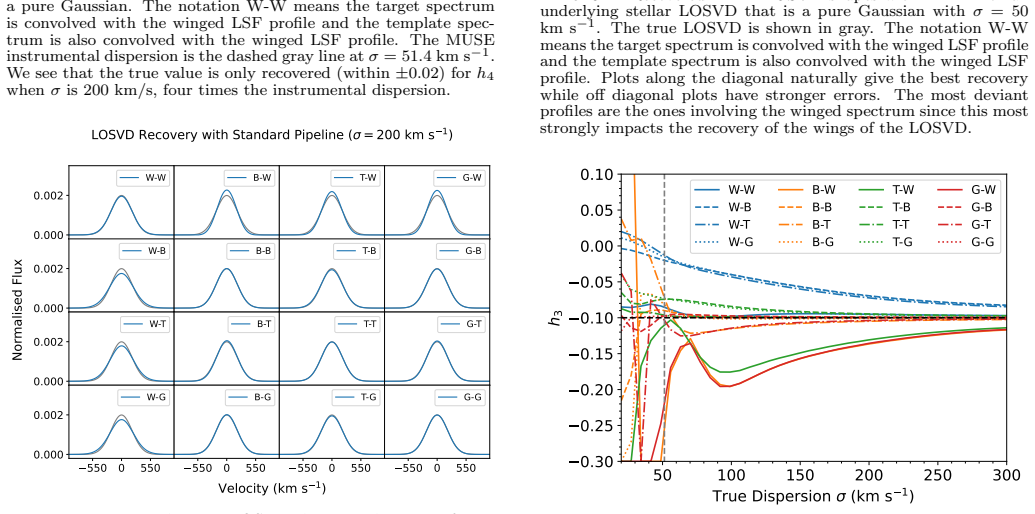
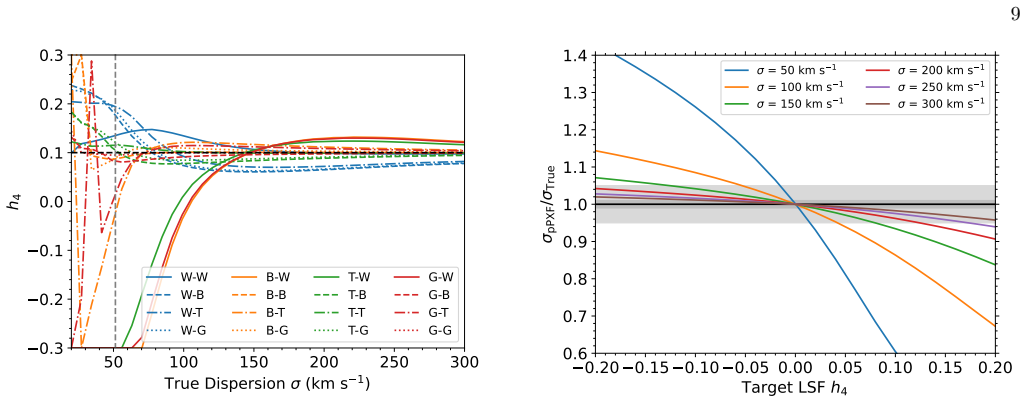
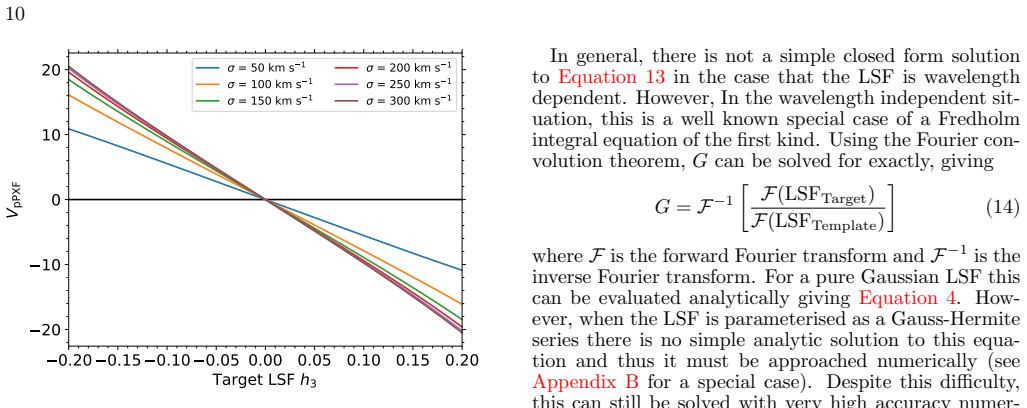
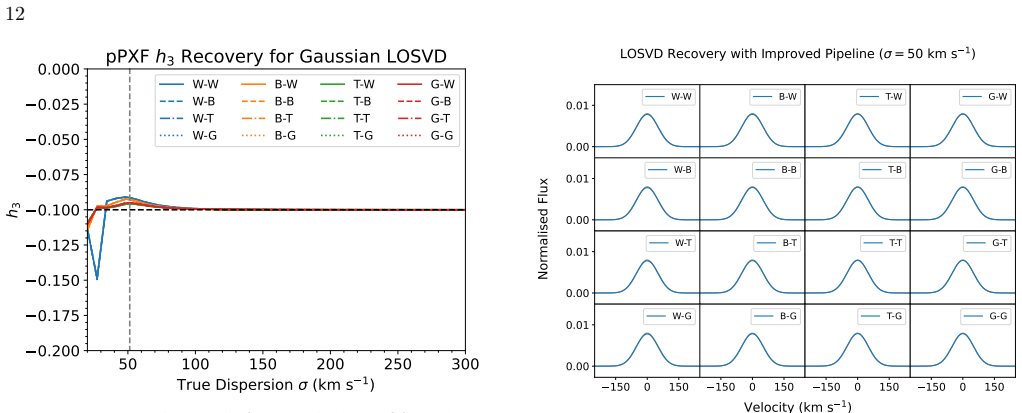
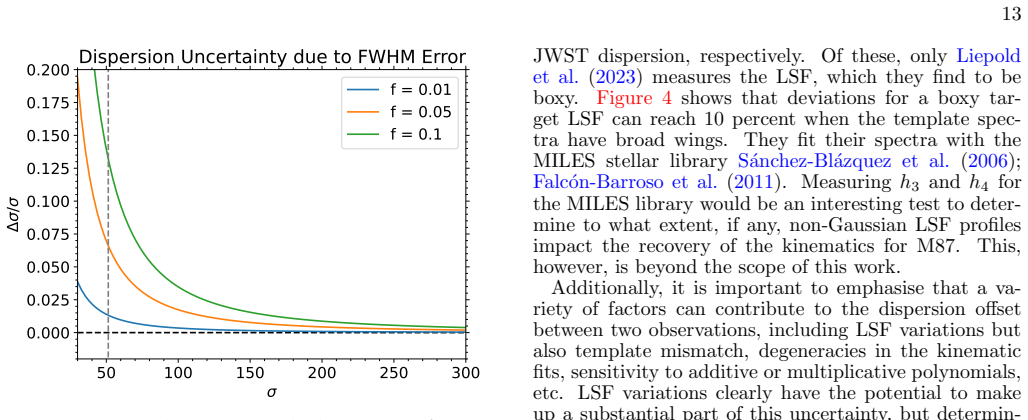
Even in the high-dispersion regime of 300 km s^{-1}, non-Gaussian LSF profiles create up to 7 percent uncertainty in the recovered velocity dispersion and biases of up to ±0.1 in the Gauss-Hermite moments h3 and h4. A method that explicitly matches the LSF of the template spectra to the LSF of the target spectrum reduces the dispersion bias to less than 1 percent all the way down to the instrumental resolution limit.
What carries the argument
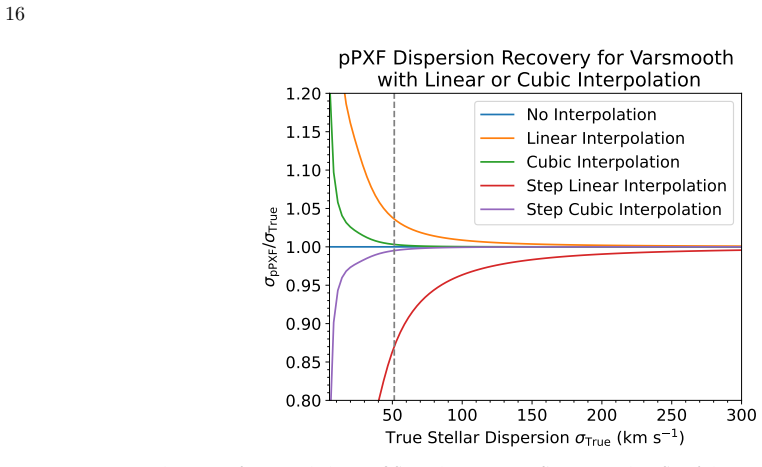
An LSF-matching procedure that adjusts template spectra so their effective line spread function matches the (possibly non-Gaussian) LSF of the target spectrum before kinematic fitting.
If this is right
- Stellar kinematic maps from integral-field surveys carry previously unquantified systematic errors unless non-Gaussian LSF shapes are accounted for.
- Higher-order Gauss-Hermite moments are more sensitive to LSF mismatch than the first two moments.
- The matching technique allows kinematic recovery to remain reliable down to the native instrumental resolution.
- Public code implementing the matching step makes the correction immediately usable on existing datasets.
Where Pith is reading between the lines
- Many published velocity-dispersion maps may need re-reduction with LSF-matched templates before being used in dynamical models.
- Reporting only the resolving power R is insufficient; full LSF profiles should become standard metadata for future instruments.
- The same matching logic could be tested on emission-line or absorption-line fitting in other wavelength regimes.
Load-bearing premise
The particular mock spectra and non-Gaussian LSF shapes examined are representative of actual integral-field spectrograph data and do not hide extra systematics when the matching method is used.
What would settle it
Apply the LSF-matching method and the standard Gaussian assumption to the same set of real galaxy spectra that also have independent, high-resolution kinematic measurements; the two approaches should converge once matching is performed.
Figures





read the original abstract
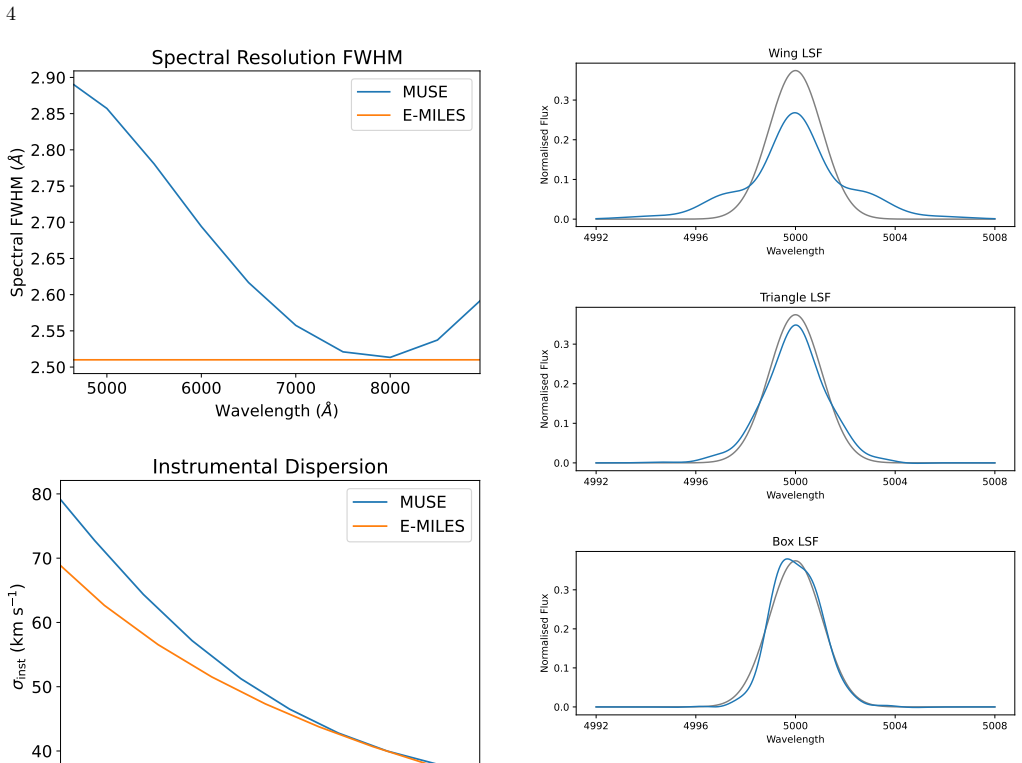
The line spread function (LSF) of a spectrograph encodes the inherent broadening of a single spectral line. It is typically reported as a single number, the resolving power $R = \lambda/\Delta\lambda$ with $\Delta \lambda$ the FWHM of the LSF. In standard pipelines for extracting stellar kinematics the LSF is assumed to be a wavelength dependent Gaussian. However, detailed LSF measurements from real integral field spectrographs reveal a variety of shapes, some close to Gaussian, others with large wings or that appear boxy. I have studied the impact that these non-Gaussian LSF profiles have on the recovery of the stellar kinematics of a mock spectrum and find that even in the high dispersion case of 300 km s$^{-1}$, there is up to a 7 percent uncertainty in the dispersion due to non-Gaussian LSF profiles. Additionally, higher order Gauss-Hermite moments $h_3$ and $h_4$ can be biased by up to $\pm$0.1. To resolve this bias, I developed a method to match the LSF of the template spectra to the LSF of a target spectrum when the LSF of either one or both is non-Gaussian and show that it can reduce bias in the dispersion to less than a percent down to the instrumental resolution. A Python implementation of this method has been made publicly available.
Editorial analysis
A structured set of objections, weighed in public.
Referee Report
Summary. The manuscript claims that non-Gaussian line spread functions (LSFs) in integral-field spectrographs introduce biases in stellar kinematic recovery from mock spectra, with up to 7% uncertainty in velocity dispersion and ±0.1 bias in Gauss-Hermite moments h3 and h4 even at 300 km s^{-1}. It presents a method to match non-Gaussian LSFs between templates and targets that reduces dispersion bias to <1% down to instrumental resolution, and releases a public Python implementation.
Significance. If the tested LSF profiles and mocks prove representative, the work identifies a relevant systematic for kinematic measurements that underpin dynamical galaxy models. The open-source code release is a concrete strength that could facilitate adoption of the matching approach.
major comments (2)
- [Mock spectra construction and LSF application (methods/results sections)] The central quantitative claims (7% dispersion uncertainty and ±0.1 bias in h3/h4 at 300 km s^{-1}) rest on the representativeness of the chosen non-Gaussian LSF profiles and mock spectra for real IFS data. The manuscript must supply explicit validation—such as direct comparisons to observed LSFs from instruments, tests of wavelength dependence, and spatial variation across the field—to establish that these profiles capture the dominant systematics rather than serving as illustrative cases only.
- [LSF matching method description and validation tests] The performance of the LSF-matching method (bias reduced to <1%) requires additional tests that include realistic template mismatch, noise properties, and cases where both template and target LSFs are non-Gaussian; without these, it is unclear whether the reported improvement generalizes or introduces compensating systematics.
minor comments (1)
- [Abstract] The abstract reports bias magnitudes but does not list the exact functional forms or parameter ranges of the non-Gaussian LSFs tested; adding this would improve clarity.
Simulated Author's Rebuttal
We thank the referee for their thorough and constructive comments. We address each major point below and have revised the manuscript to incorporate additional validation as requested.
read point-by-point responses
-
Referee: [Mock spectra construction and LSF application (methods/results sections)] The central quantitative claims (7% dispersion uncertainty and ±0.1 bias in h3/h4 at 300 km s^{-1}) rest on the representativeness of the chosen non-Gaussian LSF profiles and mock spectra for real IFS data. The manuscript must supply explicit validation—such as direct comparisons to observed LSFs from instruments, tests of wavelength dependence, and spatial variation across the field—to establish that these profiles capture the dominant systematics rather than serving as illustrative cases only.
Authors: We agree that explicit validation strengthens the claims. The revised manuscript adds a dedicated subsection with direct comparisons of the tested LSF shapes to published measurements from instruments including MUSE and SAMI. We also include new tests of wavelength dependence and a discussion of spatial LSF variations, showing that position-dependent matching can be applied. These additions confirm the profiles capture representative systematics. revision: yes
-
Referee: [LSF matching method description and validation tests] The performance of the LSF-matching method (bias reduced to <1%) requires additional tests that include realistic template mismatch, noise properties, and cases where both template and target LSFs are non-Gaussian; without these, it is unclear whether the reported improvement generalizes or introduces compensating systematics.
Authors: The original work already covers cases with non-Gaussian LSFs on both template and target. In response, the revised manuscript adds tests incorporating realistic template mismatch (via alternate stellar libraries) and representative noise levels. These confirm the dispersion bias remains below 1% with no significant compensating systematics introduced. The public code release has been updated to support such extended tests. revision: yes
Circularity Check
Numerical experiment on mock spectra exhibits no circular derivation
full rationale
The paper's central results (quantified biases up to 7% in dispersion and ±0.1 in h3/h4, plus a matching method reducing bias to <1%) arise from direct numerical experiments on constructed mock spectra with chosen non-Gaussian LSF profiles. No derivation chain, parameter fitting, or uniqueness claim reduces by construction to its own inputs; the reported quantities are simulation outputs, not self-referential definitions or renamed fits. The representativeness assumption is a standard external-validity concern, not a circularity issue.
Axiom & Free-Parameter Ledger
Reference graph
Works this paper leans on
-
[1]
Boletin de la Asociacion Argentina de Astronomia La Plata Argentina , year = 1963, month = feb, volume =
Influence of the atmospheric and instrumental dispersion on the brightness distribution in a galaxy. Boletin de la Asociacion Argentina de Astronomia La Plata Argentina , year = 1963, month = feb, volume =
1963
-
[2]
Adaptive Optics Systems III , year = 2012, editor =
GALACSI system design and analysis. Adaptive Optics Systems III , year = 2012, editor =. doi:10.1117/12.926110 , adsurl =
-
[3]
SDSS-IV MaNGA: The intrinsic shape of slow rotator early-type galaxies
SDSS-IV MaNGA: The Intrinsic Shape of Slow Rotator Early-type Galaxies. , keywords =. doi:10.3847/2041-8213/aad54b , archivePrefix =. 1807.08872 , primaryClass =
work page internal anchor Pith review Pith/arXiv arXiv doi:10.3847/2041-8213/aad54b 2041
-
[4]
Impact of Accretion Flow Dynamics on Gas-dynamical Black Hole Mass Estimates. , keywords =. doi:10.3847/1538-4357/ab3221 , archivePrefix =. 1810.05238 , primaryClass =
-
[5]
and Haberland, Matt and Reddy, Tyler and Cournapeau, David and Burovski, Evgeni and Peterson, Pearu and Weckesser, Warren and Bright, Jonathan and
Virtanen, Pauli and Gommers, Ralf and Oliphant, Travis E. and Haberland, Matt and Reddy, Tyler and Cournapeau, David and Burovski, Evgeni and Peterson, Pearu and Weckesser, Warren and Bright, Jonathan and. Nature Methods , year =
-
[7]
Hubbell Confirms View That They Are `Island Universes' , journal =
Finds Spiral Nebulae Are Stellar Systems; Dr. Hubbell Confirms View That They Are `Island Universes' , journal =. 1924 , month = nov, day =
1924
-
[8]
, Title =
P\'erez, Fernando and Granger, Brian E. , Title =. Computing in Science and Engineering , Volume =
-
[9]
ZAP -- Enhanced PCA Sky Subtraction for Integral Field Spectroscopy
ZAP - enhanced PCA sky subtraction for integral field spectroscopy. , keywords =. doi:10.1093/mnras/stw474 , archivePrefix =. 1602.08037 , primaryClass =
work page internal anchor Pith review Pith/arXiv arXiv doi:10.1093/mnras/stw474
-
[10]
Dynamical Models of Elliptical Galaxies -- II. M87 and its Globular Clusters
Dynamical models of elliptical galaxies - II. M87 and its globular clusters. , keywords =. doi:10.1093/mnras/stu960 , archivePrefix =. 1401.4461 , primaryClass =
work page internal anchor Pith review Pith/arXiv arXiv doi:10.1093/mnras/stu960
-
[11]
The Black Hole in the Most Massive Ultracompact Dwarf Galaxy M59-UCD3
The Black Hole in the Most Massive Ultracompact Dwarf Galaxy M59-UCD3. , keywords =. doi:10.3847/1538-4357/aabc57 , archivePrefix =. 1804.02399 , primaryClass =
work page internal anchor Pith review Pith/arXiv arXiv doi:10.3847/1538-4357/aabc57
-
[12]
First M87 Event Horizon Telescope Results. VI. The Shadow and Mass of the Central Black Hole. , keywords =. doi:10.3847/2041-8213/ab1141 , archivePrefix =. 1906.11243 , primaryClass =
work page internal anchor Pith review Pith/arXiv arXiv doi:10.3847/2041-8213/ab1141 2041
-
[13]
Mapping the Stellar Kinematics in the Central 240 Parsecs of M87 with the James Webb Space Telescope. arXiv e-prints , keywords =. doi:10.48550/arXiv.2510.02439 , archivePrefix =. 2510.02439 , primaryClass =
-
[14]
A Cusp Slope -- Central Anisotropy Theorem
A Cusp Slope-Central Anisotropy Theorem. , keywords =. doi:10.1086/501040 , archivePrefix =. astro-ph/0511686 , primaryClass =
work page internal anchor Pith review Pith/arXiv arXiv doi:10.1086/501040
-
[15]
Adaptive Optics Systems , year = 2008, editor =
ESO adaptive optics facility. Adaptive Optics Systems , year = 2008, editor =
2008
-
[16]
Astropy: A Community Python Package for Astronomy
Astropy: A community Python package for astronomy. , keywords =. doi:10.1051/0004-6361/201322068 , archivePrefix =. 1307.6212 , primaryClass =
work page internal anchor Pith review Pith/arXiv arXiv doi:10.1051/0004-6361/201322068
-
[17]
The Astropy Project: Building an inclusive, open-science project and status of the v2.0 core package
The Astropy Project: Building an Open-science Project and Status of the v2.0 Core Package. , keywords =. doi:10.3847/1538-3881/aabc4f , archivePrefix =. 1801.02634 , primaryClass =
work page internal anchor Pith review Pith/arXiv arXiv doi:10.3847/1538-3881/aabc4f
-
[18]
Lick Observatory Bulletin , keywords =
The rotation of the Andromeda Nebula. Lick Observatory Bulletin , keywords =. doi:10.5479/ADS/bib/1939LicOB.19.41B , adsurl =
-
[19]
, keywords =
Anisotropic models of elliptical galaxies. , keywords =
-
[20]
Anisotropic models of elliptical galaxies. II. The case of flattened isophotes. , keywords =
-
[21]
Very Large Telescopes and their Instrumentation, Volume 2 , year = 1988, editor =
The Integral Field Spectrograph TIGER. Very Large Telescopes and their Instrumentation, Volume 2 , year = 1988, editor =
1988
-
[22]
Sub-arcsecond 2D photometry and spectroscopy of the nucleus of M 31 : the supermassive black hole revisited. , keywords =. doi:10.48550/arXiv.astro-ph/9309008 , archivePrefix =. astro-ph/9309008 , primaryClass =
work page internal anchor Pith review Pith/arXiv arXiv doi:10.48550/arxiv.astro-ph/9309008
-
[23]
3D spectrography at high spatial resolution. I. Concept and realization of the integral field spectrograph TIGER. , keywords =
-
[24]
2001, MNRAS, 328, 237, doi: 10.1046/j.1365-8711.2001.04860.x
The SAURON project - I. The panoramic integral-field spectrograph. , keywords =. doi:10.1046/j.1365-8711.2001.04612.x , archivePrefix =. astro-ph/0103451 , primaryClass =
-
[25]
Ground-based and Airborne Instrumentation for Astronomy III , year = 2010, editor =
The MUSE second-generation VLT instrument. Ground-based and Airborne Instrumentation for Astronomy III , year = 2010, editor =
2010
-
[26]
2017 , publisher=
Optical 3D-spectroscopy for Astronomy , author=. 2017 , publisher=
2017
-
[27]
From TIGER to WST: scientific impact of four decades of developments in integral field spectroscopy. , keywords =. doi:10.1007/s10509-024-04369-5 , archivePrefix =. 2410.02399 , primaryClass =
-
[28]
Dynamical models with a general anisotropy profile
Dynamical models with a general anisotropy profile. , keywords =. doi:10.1051/0004-6361:20077672 , archivePrefix =. 0705.4109 , primaryClass =
work page internal anchor Pith review Pith/arXiv arXiv doi:10.1051/0004-6361:20077672
-
[29]
2010 , publisher=
The day we found the universe , author=. 2010 , publisher=
2010
-
[30]
Isophote shapes of elliptical galaxies. I. The data. , keywords =
-
[31]
, keywords =
Velocity anisotropies and isophote shapes in elliptical galaxies. , keywords =
-
[32]
Presentation of a new method and its application to NGC 4621
Unraveling the kinematics of early-type galaxies. Presentation of a new method and its application to NGC 4621. , keywords =
-
[33]
Dynamics of early type galaxies. I. The rotation curve of the elliptical galaxy NGC 4697. , keywords =. doi:10.1086/153808 , adsurl =
-
[34]
Is the flattening of elliptical galaxies necessarily due to rotation?. , keywords =. doi:10.1093/mnras/177.1.19 , adsurl =
-
[35]
On the rotation of elliptical galaxies. , keywords =. doi:10.1093/mnras/183.3.501 , adsurl =
-
[36]
M/L and velocity anisotropy from observations of spherical galaxies, of must M 87 have a massive black hole ?. , keywords =. doi:10.1093/mnras/200.2.361 , adsurl =
-
[37]
Dynamics of elliptical galaxies and other spheroidal components. , keywords =. doi:10.1146/annurev.aa.20.090182.002151 , adsurl =
-
[38]
2011 , publisher=
Galactic dynamics , author=. 2011 , publisher=
2011
-
[39]
Bell System Technical Journal , volume=
The measurement of power spectra from the point of view of communications engineering—Part I , author=. Bell System Technical Journal , volume=. 1958 , publisher=
1958
-
[40]
The Near-Infrared Spectrograph (NIRSpec) on the James Webb Space Telescope. III. Integral-field spectroscopy. , keywords =. doi:10.1051/0004-6361/202142589 , archivePrefix =. 2202.03308 , primaryClass =
-
[41]
, keywords =
The stellar kinematics of the spiral galaxies NGC 3198 and NGC 3938. , keywords =
-
[42]
Instrumentation in astronomy V , year = 1984, editor =
First results from CIGALE scanning Perot-Fabry interferometer. Instrumentation in astronomy V , year = 1984, editor =. doi:10.1117/12.966123 , adsurl =
-
[43]
Publications of the Astronomical Institute of the Czechoslovak Academy of Sciences , keywords =
About the first spectrum of a galaxy. Publications of the Astronomical Institute of the Czechoslovak Academy of Sciences , keywords =
-
[44]
Stellar population synthesis at the resolution of 2003. , keywords =. doi:10.1046/j.1365-8711.2003.06897.x , archivePrefix =. astro-ph/0309134 , primaryClass =
-
[45]
Overview of the SDSS-IV MaNGA Survey: Mapping Nearby Galaxies at Apache Point Observatory
Overview of the SDSS-IV MaNGA Survey: Mapping nearby Galaxies at Apache Point Observatory. , keywords =. doi:10.1088/0004-637X/798/1/7 , archivePrefix =. 1412.1482 , primaryClass =
work page internal anchor Pith review Pith/arXiv arXiv doi:10.1088/0004-637x/798/1/7
-
[46]
2026 , isbn =
Machine Learning for Astrophysics 2024: Proceedings of the 2nd ML4ASTRO International Conference 8-12 July 2024 , series =. 2026 , isbn =
2024
-
[47]
The Counterrotating Core and the Black Hole Mass of IC 1459. , keywords =. doi:10.1086/342653 , adsurl =
-
[48]
Efficient multi-Gaussian expansion of galaxies. , keywords =. doi:10.1046/j.1365-8711.2002.05412.x , archivePrefix =. astro-ph/0201430 , primaryClass =
-
[49]
Adaptive spatial binning of integral-field spectroscopic data using Voronoi tessellations. , keywords =. doi:10.1046/j.1365-8711.2003.06541.x , archivePrefix =. astro-ph/0302262 , primaryClass =
-
[50]
Parametric Recovery of Line-of-Sight Velocity Distributions from Absorption-Line Spectra of Galaxies via Penalized Likelihood. , keywords =. doi:10.1086/381875 , archivePrefix =. astro-ph/0312201 , primaryClass =
work page internal anchor Pith review Pith/arXiv arXiv doi:10.1086/381875
-
[51]
The nuclear orbital distribution in galaxies as a fossil record of black hole formation from integral-field spectroscopy. Classical and Quantum Gravity , keywords =. doi:10.1088/0264-9381/22/10/028 , archivePrefix =. astro-ph/0412433 , primaryClass =
work page internal anchor Pith review Pith/arXiv arXiv doi:10.1088/0264-9381/22/10/028
-
[52]
The SAURON project - IV. The mass-to-light ratio, the virial mass estimator and the Fundamental Plane of elliptical and lenticular galaxies. , keywords =. doi:10.1111/j.1365-2966.2005.09981.x , archivePrefix =. astro-ph/0505042 , primaryClass =
-
[53]
The SAURON project - X. The orbital anisotropy of elliptical and lenticular galaxies: revisiting the (V/ , ) diagram with integral-field stellar kinematics. , keywords =. doi:10.1111/j.1365-2966.2007.11963.x , archivePrefix =. astro-ph/0703533 , primaryClass =
-
[54]
Measuring the inclination and mass-to-light ratio of axisymmetric galaxies via anisotropic Jeans models of stellar kinematics. , keywords =. doi:10.1111/j.1365-2966.2008.13754.x , archivePrefix =. astro-ph/0806.0042 , primaryClass =
-
[55]
Supermassive black holes from OASIS and SAURON integral-field kinematics
Supermassive black holes from OASIS and SAURON integral-field kinematics. Formation and Evolution of Galaxy Bulges , year = 2008, editor =. doi:10.1017/S1743921308017687 , archivePrefix =. 0709.2861 , primaryClass =
work page internal anchor Pith review Pith/arXiv arXiv doi:10.1017/s1743921308017687 2008
-
[56]
The mass of the black hole in Centaurus A from SINFONI AO-assisted integral-field observations of stellar kinematics. , keywords =. doi:10.1111/j.1365-2966.2008.14377.x , archivePrefix =. 0812.1000 , primaryClass =
-
[57]
Testing Mass Determinations of Supermassive Black Holes via Stellar Kinematics
Testing Mass Determinations of Supermassive Black Holes via Stellar Kinematics. Hunting for the Dark: the Hidden Side of Galaxy Formation , year = 2010, editor =. doi:10.1063/1.3458489 , archivePrefix =. 1001.3233 , primaryClass =
work page internal anchor Pith review Pith/arXiv arXiv doi:10.1063/1.3458489 2010
-
[58]
The ATLAS ^ 3D project - VII. A new look at the morphology of nearby galaxies: the kinematic morphology-density relation. , keywords =. doi:10.1111/j.1365-2966.2011.18600.x , archivePrefix =. 1104.3545 , primaryClass =
-
[59]
21cmfast: a fast, seminumerical simulation of the high-redshift 21-cm signal: 21cmfast , volume=
The ATLAS ^ 3D project - I. A volume-limited sample of 260 nearby early-type galaxies: science goals and selection criteria. , keywords =. doi:10.1111/j.1365-2966.2010.18174.x , adsurl =
-
[60]
A systematic variation of the stellar initial mass function in early-type galaxies
Systematic variation of the stellar initial mass function in early-type galaxies. , keywords =. doi:10.1038/nature10972 , archivePrefix =. 1202.3308 , primaryClass =
work page internal anchor Pith review Pith/arXiv arXiv doi:10.1038/nature10972
-
[61]
The ATLAS ^ 3D project - XV. Benchmark for early-type galaxies scaling relations from 260 dynamical models: mass-to-light ratio, dark matter, Fundamental Plane and Mass Plane. , keywords =. doi:10.1093/mnras/stt562 , archivePrefix =. 1208.3522 , primaryClass =
work page internal anchor Pith review Pith/arXiv arXiv doi:10.1093/mnras/stt562
-
[62]
Small Scatter and Nearly Isothermal Mass Profiles to Four Half-light Radii from Two-dimensional Stellar Dynamics of Early-type Galaxies. , keywords =. doi:10.1088/2041-8205/804/1/L21 , archivePrefix =. 1504.00075 , primaryClass =
work page internal anchor Pith review Pith/arXiv arXiv doi:10.1088/2041-8205/804/1/l21 2041
-
[63]
Structure and Kinematics of Early-Type Galaxies from Integral-Field Spectroscopy
Structure and Kinematics of Early-Type Galaxies from Integral Field Spectroscopy. , keywords =. doi:10.1146/annurev-astro-082214-122432 , archivePrefix =. 1602.04267 , primaryClass =
work page internal anchor Pith review Pith/arXiv arXiv doi:10.1146/annurev-astro-082214-122432
-
[64]
Improving the full spectrum fitting method: accurate convolution with Gauss-Hermite functions
Improving the full spectrum fitting method: accurate convolution with Gauss-Hermite functions. , keywords =. doi:10.1093/mnras/stw3020 , archivePrefix =. 1607.08538 , primaryClass =
work page internal anchor Pith review Pith/arXiv arXiv doi:10.1093/mnras/stw3020
-
[65]
Efficient solution of the anisotropic spherically aligned axisymmetric Jeans equations of stellar hydrodynamics for galactic dynamics. , keywords =. doi:10.1093/mnras/staa959 , archivePrefix =. 1907.09894 , primaryClass =
-
[66]
Full spectrum fitting with photometry in PPXF: stellar population versus dynamical masses, non-parametric star formation history and metallicity for 3200 LEGA-C galaxies at redshift z 0.8. , keywords =. doi:10.1093/mnras/stad2597 , archivePrefix =. 2208.14974 , primaryClass =
-
[67]
Encyclopedia of Astrophysics, Volume 4 , year = 2026, volume =
Early-type galaxies: Elliptical and S0 galaxies, or fast and slow rotators. Encyclopedia of Astrophysics, Volume 4 , year = 2026, volume =. doi:10.1016/B978-0-443-21439-4.00109-7 , archivePrefix =. 2503.02746 , primaryClass =
-
[68]
2001, MNRAS, 328, 237, doi: 10.1046/j.1365-8711.2001.04860.x
Empirical calibration of the near-infrared Ca ii triplet - I. The stellar library and index definition. , keywords =. doi:10.1046/j.1365-8711.2001.04688.x , archivePrefix =. astro-ph/0109157 , primaryClass =
-
[69]
The X-shooter Spectral Library (XSL). I. DR1: Near-ultraviolet through optical spectra from the first year of the survey. , keywords =. doi:10.1051/0004-6361/201322505 , archivePrefix =. 1403.7009 , primaryClass =
work page internal anchor Pith review Pith/arXiv arXiv doi:10.1051/0004-6361/201322505
-
[70]
Marvin: A Tool Kit for Streamlined Access and Visualization of the SDSS-IV MaNGA Data Set. , keywords =. doi:10.3847/1538-3881/ab2634 , archivePrefix =. 1812.03833 , primaryClass =
-
[71]
Galaxy stellar and total mass estimation using machine learning. , keywords =. doi:10.1093/mnras/stae406 , archivePrefix =. 2311.10351 , primaryClass =
-
[72]
Semi-empirical analysis of Sloan Digital Sky Survey galaxies - I. Spectral synthesis method. , keywords =. doi:10.1111/j.1365-2966.2005.08752.x , archivePrefix =. astro-ph/0412481 , primaryClass =
-
[73]
The Propagation of Uncertainties in Stellar Population Synthesis Modeling. I. The Relevance of Uncertain Aspects of Stellar Evolution and the Initial Mass Function to the Derived Physical Properties of Galaxies. , keywords =. doi:10.1088/0004-637X/699/1/486 , archivePrefix =. 0809.4261 , primaryClass =
work page internal anchor Pith review Pith/arXiv arXiv doi:10.1088/0004-637x/699/1/486
-
[74]
The Propagation of Uncertainties in Stellar Population Synthesis Modeling. III. Model Calibration, Comparison, and Evaluation. , keywords =. doi:10.1088/0004-637X/712/2/833 , archivePrefix =. 0911.3151 , primaryClass =
work page internal anchor Pith review Pith/arXiv arXiv doi:10.1088/0004-637x/712/2/833
-
[75]
and Tukey, John W
Cooley, James W. and Tukey, John W. , title =. Mathematics of Computation , volume =. 1965 , publisher =
1965
-
[76]
The ACS Virgo Cluster Survey. I. Introduction to the Survey. , keywords =. doi:10.1086/421490 , archivePrefix =. astro-ph/0404138 , primaryClass =
work page internal anchor Pith review Pith/arXiv arXiv doi:10.1086/421490
-
[77]
, year =
Courtès, G. , year =. Application de la Photométrie Bidimensionelle à l'Astronomie , pages =
-
[78]
Instrumentation for Ground-Based Optical Astronomy , year = 1988, editor =
A New Device for Faint Objects High Resolution Imagery and Bidimensional Spectrography - First Observational Results with TIGER at CFHT 3.6-METER Telescope. Instrumentation for Ground-Based Optical Astronomy , year = 1988, editor =
1988
-
[79]
Axisymmetric Three-Integral Models for Galaxies
Axisymmetric Three-Integral Models for Galaxies. , keywords =. doi:10.1086/313264 , archivePrefix =. astro-ph/9902034 , primaryClass =
work page internal anchor Pith review Pith/arXiv arXiv doi:10.1086/313264
-
[80]
The Sydney-AAO Multi-object Integral field spectrograph. , keywords =. doi:10.1111/j.1365-2966.2011.20365.x , archivePrefix =. 1112.3367 , primaryClass =
-
[81]
1918 , publisher=
Studies of the Nebulae: Made at the Lick Observatory, University of California, at Mount Hamilton, California, and Santiago, Chile , author=. 1918 , publisher=
1918
discussion (0)
Sign in with ORCID, Apple, or X to comment. Anyone can read and Pith papers without signing in.