Defects in skein theory and TQFT
Pith reviewed 2026-06-27 20:08 UTC · model grok-4.3
The pith
The skein module for a 3-manifold with line and point defects equals the boundary state space in the defect TQFT when all labels are semisimple.
A machine-rendered reading of the paper's core claim, the machinery that carries it, and where it could break.
Core claim
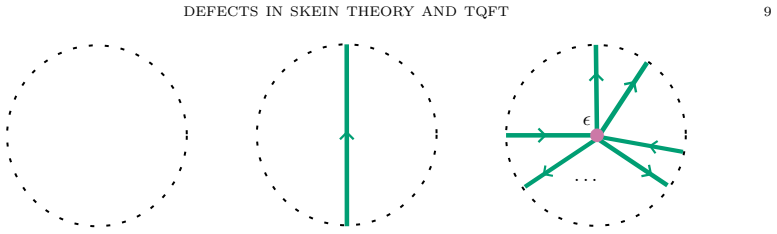
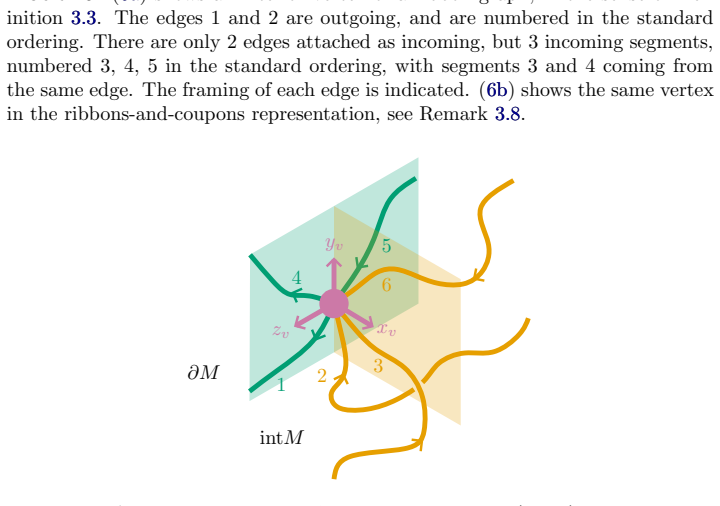
Given a 3-manifold M with a network of line and point defects in its boundary, the skein module of this configuration is defined by globalizing the graphical calculus of module categories and functors thereof. When all defects are labelled by semisimple data, this skein module is isomorphic to the state space of ∂M in the defect version of the Reshetikhin-Turaev TQFT.
What carries the argument
Skein module obtained by globalizing the graphical calculus of module categories and functors thereof.
If this is right
- The skein module supplies a combinatorial model for the state space of the boundary in the presence of defects.
- The definition extends previous skein modules by allowing networks that include line defects as well as point defects.
- The isomorphism holds precisely when the defect labels are semisimple.
- The same globalizing procedure applies to defect data that are not restricted to the semisimple case.
Where Pith is reading between the lines
- Skein relations could be used to compute explicit values of defect TQFT invariants on concrete manifolds.
- The same globalization technique might be adapted to produce skein modules for other TQFT constructions that include defects.
- If a non-semisimple defect TQFT can be defined by other means, a parallel skein-module description may exist.
Load-bearing premise
The defect TQFT is already defined and satisfies the required gluing and functoriality properties for manifolds with line and point defects.
What would settle it
Direct computation of both the skein module and the TQFT state space for the 3-ball with a single line defect connecting two semisimple point defects on the boundary sphere, checking whether the resulting vector spaces are isomorphic.
Figures








read the original abstract
Given a 3-manifold $M$ with a network of line and point defects in its boundary, we define the skein module of this configuration, generalizing the well-studied case of 3-manifolds which only admit point defects in the boundary. We prove that when all defects are labelled by semisimple data, our skein module is isomorphic to the state space of $\partial M$ in the defect version of the Reshetikhin-Turaev TQFT constructed by Carqueville-Runkel-Schaumann. Our defect skein modules follow naturally by globalizing the graphical calculus of module categories and functors thereof, and generalize the possible defect data considered in the defect TQFT beyond the semisimple case.
Editorial analysis
A structured set of objections, weighed in public.
Referee Report
Summary. The paper defines a skein module for a 3-manifold M with a network of line and point defects on its boundary by globalizing the graphical calculus of module categories and their functors. It proves that, when all defects are labelled by semisimple data, this skein module is isomorphic to the state space of ∂M in the defect Reshetikhin-Turaev TQFT of Carqueville-Runkel-Schaumann.
Significance. If the isomorphism holds, the result supplies a combinatorial model for the state spaces of the CRS defect TQFT via skein relations, extending the point-defect case. The globalization construction also permits non-semisimple labels on the skein side even though the isomorphism statement is restricted to semisimple data.
major comments (1)
- [Main theorem statement (abstract and §1)] The central isomorphism is obtained by identifying the independently defined skein module with the state space of the CRS defect TQFT; the argument therefore presupposes that the CRS construction already supplies well-defined gluing maps and functoriality for arbitrary networks of line and point defects on the boundary. No independent check or reduction verifying these properties for the defect configurations considered here is supplied.
minor comments (1)
- [Introduction] Clarify in the introduction whether the skein-module definition itself extends verbatim to non-semisimple labels or whether additional restrictions appear in the globalization step.
Simulated Author's Rebuttal
We thank the referee for their careful reading of the manuscript and for highlighting this structural aspect of the proof. We respond to the major comment below.
read point-by-point responses
-
Referee: The central isomorphism is obtained by identifying the independently defined skein module with the state space of the CRS defect TQFT; the argument therefore presupposes that the CRS construction already supplies well-defined gluing maps and functoriality for arbitrary networks of line and point defects on the boundary. No independent check or reduction verifying these properties for the defect configurations considered here is supplied.
Authors: The referee is correct that the main theorem identifies our skein module with the state space of the CRS defect TQFT and therefore relies on the gluing maps and functoriality already established in the Carqueville-Runkel-Schaumann construction for arbitrary networks of line and point defects. Our contribution is the independent definition of the skein module via globalization of the graphical calculus and the proof that it coincides with the CRS state space when all labels are semisimple; we do not reprove the TQFT axioms. To clarify this reliance, we will revise the introduction and the statement of the main theorem (in §1) to explicitly reference the relevant theorems in CRS that guarantee the required gluing and functoriality. revision: yes
Circularity Check
Minor self-citation to overlapping-author CRS defect TQFT; isomorphism proven from independent skein definition
full rationale
The paper defines its defect skein module independently by globalizing the graphical calculus of module categories. It then proves (rather than assumes) an isomorphism to the state space of the prior CRS defect RT TQFT when labels are semisimple. The citation to Carqueville-Runkel-Schaumann overlaps in authorship but is to a separate prior construction whose gluing/functoriality properties are invoked as given; the current work supplies the matching proof for the skein side. No equation reduces the skein module to a fitted quantity or renames an input as output. This is a standard minor self-citation that does not make the central claim circular by construction.
Axiom & Free-Parameter Ledger
axioms (2)
- domain assumption The defect TQFT of Carqueville-Runkel-Schaumann is well-defined on manifolds with line and point defects and satisfies the required functoriality and gluing axioms.
- standard math Graphical calculus for module categories and functors extends globally to the skein module construction.
Reference graph
Works this paper leans on
-
[1]
Factorization homology of stratified spaces
Factorization Homology of Stratified Spaces , author =. Selecta Mathematica , volume =. doi:10.1007/s00029-016-0242-1 , url =. arXiv , langid =:1409.0848 , pages =
work page internal anchor Pith review Pith/arXiv arXiv doi:10.1007/s00029-016-0242-1
-
[2]
Integrating quantum groups over surfaces
Integrating Quantum Groups over Surfaces , author =. Journal of Topology , volume =. doi:10.1112/topo.12072 , url =. arXiv , langid =:1501.04652 , pages =
work page internal anchor Pith review Pith/arXiv arXiv doi:10.1112/topo.12072
-
[3]
Selecta Mathematica , volume =
Skein Categories in Non-Semisimple Settings , author =. Selecta Mathematica , volume =. doi:10.1007/s00029-026-01143-z , url =. arXiv , langid =:2406.08956 , publisher =
-
[4]
Topological Quantum Field Theories Derived from the Kauffman Bracket , author =. Topology , volume =. doi:10.1016/0040-9383(94)00051-4 , url =
-
[5]
doi:10.48550/arXiv.2505.14836 , url =
Parabolic Skein Modules , author =. doi:10.48550/arXiv.2505.14836 , url =. arXiv , langid =:2505.14836 , primaryclass =
-
[6]
Compositio Mathematica , volume =
On Dualizability of Braided Tensor Categories , author =. Compositio Mathematica , volume =. doi:10.1112/S0010437X20007630 , url =. arXiv , langid =:1804.07538 , pages =
-
[7]
Symmetry, Integrability and Geometry: Methods and Applications , eprint =
Skein (3+1)-TQFTs from Non-Semisimple Ribbon Categories , author =. Symmetry, Integrability and Geometry: Methods and Applications , eprint =. doi:10.3842/SIGMA.2026.034 , url =
-
[8]
arXiv , langid =:2302.04493 , publisher =
Admissible Skein Modules , author =. arXiv , langid =:2302.04493 , publisher =
-
[9]
Communications in Mathematical Physics , volume =
Orbifold Completion of 3-Categories , author =. Communications in Mathematical Physics , volume =. doi:10.1007/s00220-025-05434-y , url =. arXiv , langid =:2307.06485 , pages =
-
[10]
doi:10.48550/arXiv.2101.02482 , url =
Orbifold Graph TQFTs , author =. doi:10.48550/arXiv.2101.02482 , url =. arXiv , keywords =:2101.02482 , primaryclass =
-
[11]
Advances in Mathematics , volume =
3-Dimensional Defect TQFTs and Their Tricategories , author =. Advances in Mathematics , volume =. doi:10.1016/j.aim.2020.107024 , url =. arXiv , keywords =:1603.01171 , primaryclass =
-
[12]
Excision of Skein Categories and Factorisation Homology , author =. Advances in Mathematics , volume =. doi:10.1016/j.aim.2022.108848 , url =. arXiv , langid =:1910.02630 , pages =
-
[13]
Line and Surface Defects in Reshetikhin-Turaev TQFT , author =. Quantum Topology , volume =. doi:10.4171/QT/121 , url =. arXiv , keywords =:1710.10214 , primaryclass =
-
[14]
Orbifolds of n-dimensional defect TQFTs
Orbifolds of N-Dimensional Defect TQFTs , author =. Geometry & Topology , volume =. doi:10.2140/gt.2019.23.781 , url =. arXiv , keywords =:1705.06085 , primaryclass =
work page internal anchor Pith review Pith/arXiv arXiv doi:10.2140/gt.2019.23.781 2019
-
[15]
Theory and Applications of Categories , volume =
Orbifolds of Reshetikhin-Turaev TQFTs , author =. Theory and Applications of Categories , volume =. doi:10.48550/arXiv.1809.01483 , url =. arXiv , keywords =:1809.01483 , primaryclass =
-
[16]
A categorical construction of 4D TQFTs
Crane, Louis and Yetter, David , editor =. A Categorical Construction of 4d Topological Quantum Field Theories , booktitle =. doi:10.1142/9789812796387_0005 , url =. arXiv , isbn =:hep-th/9301062 , pages =
work page internal anchor Pith review Pith/arXiv arXiv doi:10.1142/9789812796387_0005
-
[17]
Deligne, P. , editor =. Cat\'egories Tannakiennes , booktitle =. doi:10.1007/978-0-8176-4575-5_3 , url =
-
[18]
Selecta Mathematica , volume =
3-Dimensional TQFTs from Non-Semisimple Modular Categories , author =. Selecta Mathematica , volume =. arXiv , langid =:1912.02063 , doi =
arXiv 1912
-
[19]
Tensor Categories , author =
-
[20]
Fusion categories and homotopy theory
Fusion Categories and Homotopy Theory , author =. Quantum Topology , volume =. doi:10.4171/qt/6 , url =. arXiv , file =:0909.3140 , pages =
work page internal anchor Pith review Pith/arXiv arXiv doi:10.4171/qt/6
-
[21]
Kramers-Wannier duality from conformal defects
Kramers-Wannier Duality from Conformal Defects , author =. Physical Review Letters , volume =. doi:10.1103/PhysRevLett.93.070601 , url =. arXiv , langid =:cond-mat/0404051 , pages =
work page internal anchor Pith review Pith/arXiv arXiv doi:10.1103/physrevlett.93.070601
-
[22]
Topological symmetry in quantum field theory
Topological Symmetry in Quantum Field Theory , author =. Quantum Topology , volume =. doi:10.4171/QT/223 , url =. arXiv , langid =:2209.07471 , pages =
work page internal anchor Pith review Pith/arXiv arXiv doi:10.4171/qt/223
-
[23]
Bicategories for boundary conditions and for surface defects in 3-d TFT
Bicategories for Boundary Conditions and for Surface Defects in 3-d TFT , author =. Communications in Mathematical Physics , volume =. doi:10.1007/s00220-013-1723-0 , url =. arXiv , copyright =:1203.4568 , pages =
work page internal anchor Pith review Pith/arXiv arXiv doi:10.1007/s00220-013-1723-0
-
[24]
Theory and Applications of Categories , volume =
String-Net Models for Pivotal Bicategories , author =. Theory and Applications of Categories , volume =. arXiv , langid =:2302.01468 , pages =
-
[25]
doi:10.48550/arXiv.2601.03196 , url =
HOMFLY Parabolic Restriction, Defect Skein Theory and the Turaev Coproduct , author =. doi:10.48550/arXiv.2601.03196 , url =. arXiv , keywords =:2601.03196 , primaryclass =
-
[26]
Generalized Global Symmetries , author =. Journal of High Energy Physics , volume =. doi:10.1007/JHEP02(2015)172 , url =. arXiv , langid =:1412.5148 , primaryclass =
work page internal anchor Pith review Pith/arXiv arXiv doi:10.1007/jhep02(2015)172 2015
-
[27]
Basic Concepts of Enriched Category Theory , author =
-
[28]
Bulletin of the Australian Mathematical Society , volume =
Elementary Observations on 2-Categorical Limits , author =. Bulletin of the Australian Mathematical Society , volume =. doi:10.1017/S0004972700002781 , url =
-
[29]
Communications in Mathematical Physics , volume =
Domain Walls Between 3d Phases of Reshetikhin--Turaev TQFTs , author =. Communications in Mathematical Physics , volume =. doi:10.1007/s00220-022-04489-5 , url =. arXiv , langid =:2105.04613 , pages =
-
[30]
Tensor products of finitely cocomplete and abelian categories
Tensor Products of Finitely Cocomplete and Abelian Categories , author =. Journal of Algebra , volume =. doi:10.1016/j.jalgebra.2013.08.015 , url =. arXiv , copyright =:1212.1545 , pages =
work page internal anchor Pith review Pith/arXiv arXiv doi:10.1016/j.jalgebra.2013.08.015 2013
-
[31]
doi:10.1017/9781108778657 , url =
(Co)End Calculus , author =. doi:10.1017/9781108778657 , url =. arXiv , isbn =:1501.02503 , publisher =
-
[32]
Advances in Mathematics , volume =
State Sum Models with Defects Based on Spherical Fusion Categories , author =. Advances in Mathematics , volume =. doi:10.1016/j.aim.2023.109177 , url =. arXiv , langid =:2205.06874 , pages =
-
[33]
The Blob Complex , author =. Geometry & Topology , volume =. doi:10.2140/gt.2012.16.1481 , url =. arXiv , keywords =:1009.5025 , primaryclass =
work page internal anchor Pith review Pith/arXiv arXiv doi:10.2140/gt.2012.16.1481 2012
-
[34]
Module categories, weak Hopf algebras and modular invariants
Module Categories, Weak Hopf Algebras and Modular Invariants , author =. Transformation Groups , volume =. doi:10.1007/s00031-003-0515-6 , url =. arXiv , langid =:math/0111139 , pages =
work page internal anchor Pith review Pith/arXiv arXiv doi:10.1007/s00031-003-0515-6
-
[35]
Kauffman bracket skein module of a connected sum of 3-manifolds
Kauffman Bracket Skein Module of a Connected Sum of 3-Manifolds , author =. Manuscripta Mathematica , volume =. doi:10.1007/s002290050014 , url =. arXiv , langid =:math/9911120 , pages =
work page internal anchor Pith review Pith/arXiv arXiv doi:10.1007/s002290050014
-
[36]
doi:10.48550/arXiv.2407.09302 , url =
Excision for Spaces of Admissible Skeins , author =. doi:10.48550/arXiv.2407.09302 , url =. arXiv , keywords =:2407.09302 , primaryclass =
-
[37]
arXiv , langid =:2407.09302 , primaryclass =
Excision for Spaces of Admissible Skeins , author =. arXiv , langid =:2407.09302 , primaryclass =
-
[38]
Communications in Mathematical Physics , volume =
Ribbon Graphs and Their Invaraints Derived from Quantum Groups , author =. Communications in Mathematical Physics , volume =. doi:10.1007/BF02096491 , url =
-
[39]
Traces on Module Categories over Fusion Categories
Traces on Module Categories over Fusion Categories , author =. Journal of Algebra , volume =. doi:10.1016/j.jalgebra.2013.01.013 , url =. arXiv , langid =:1206.5716 , primaryclass =
work page internal anchor Pith review Pith/arXiv arXiv doi:10.1016/j.jalgebra.2013.01.013 2013
-
[40]
doi:10.48550/arXiv.2108.13467 , url =
On the Category of Boundary Values in the Extended Crane-Yetter TQFT , author =. doi:10.48550/arXiv.2108.13467 , url =. arXiv , school =:2108.13467 , primaryclass =
-
[41]
Quantum Invariants of Knots and 3-Manifolds , author =
discussion (0)
Sign in with ORCID, Apple, or X to comment. Anyone can read and Pith papers without signing in.