SPHEREx 0.75 to 5 μm Spectra for a Sequence of Nearby Brown Dwarfs
Pith reviewed 2026-07-02 06:21 UTC · model grok-4.3
The pith
SPHEREx spectra of 37 nearby brown dwarfs favor weak vertical mixing Elf Owl models over strong mixing.
A machine-rendered reading of the paper's core claim, the machinery that carries it, and where it could break.
Core claim
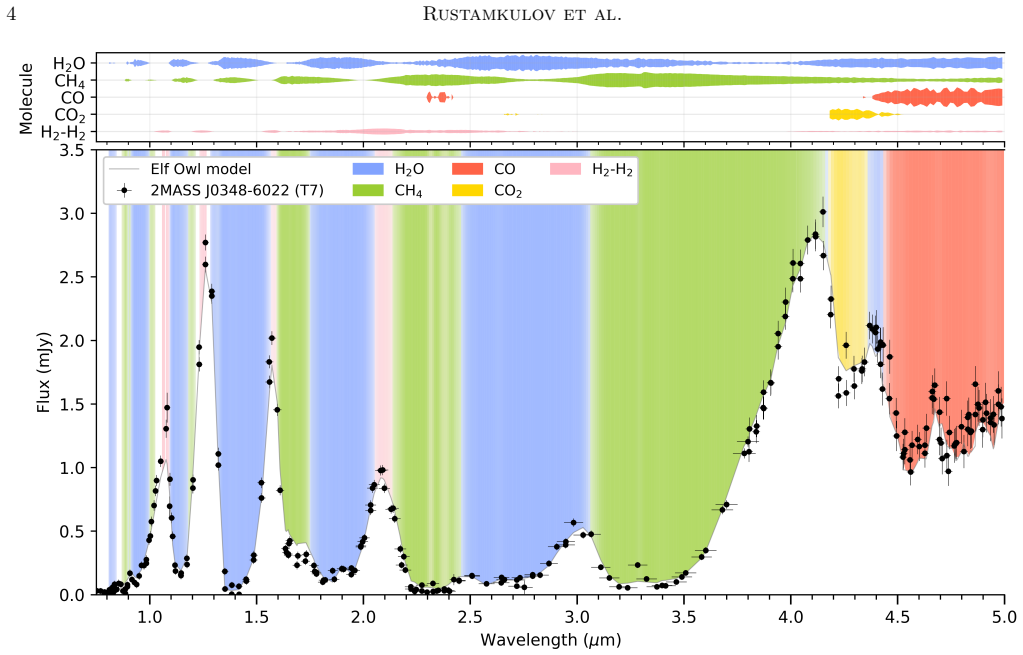
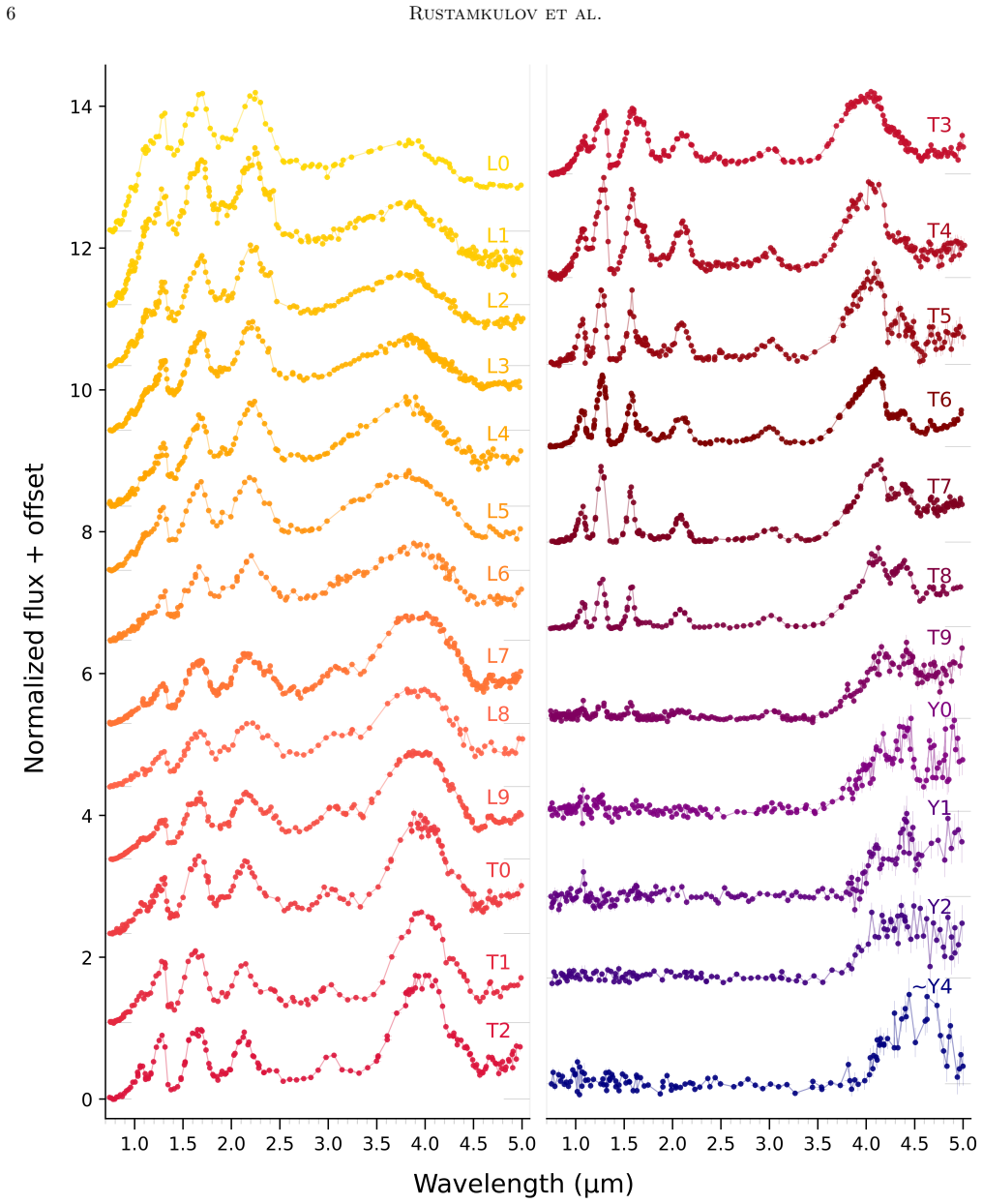
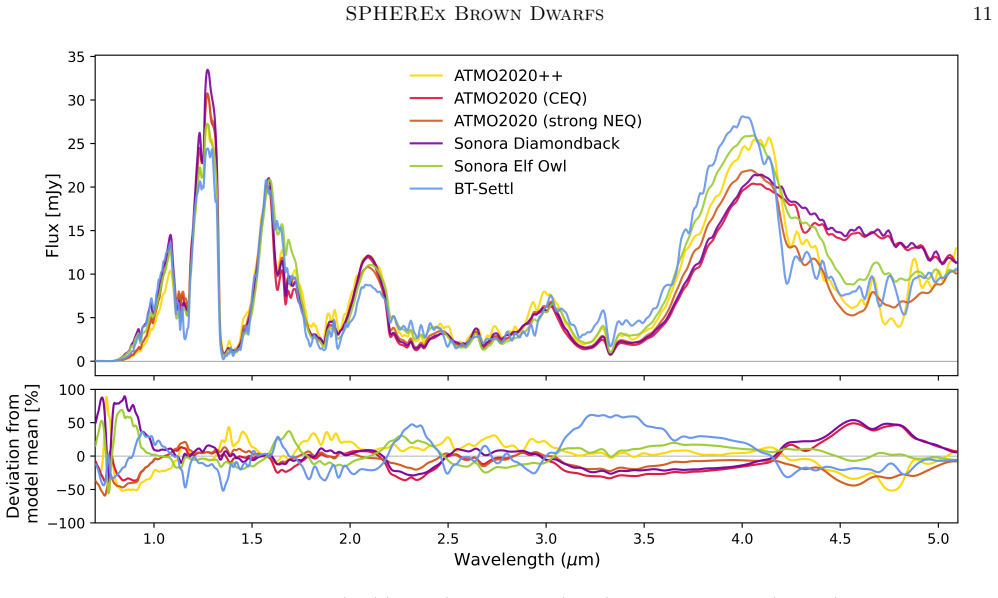
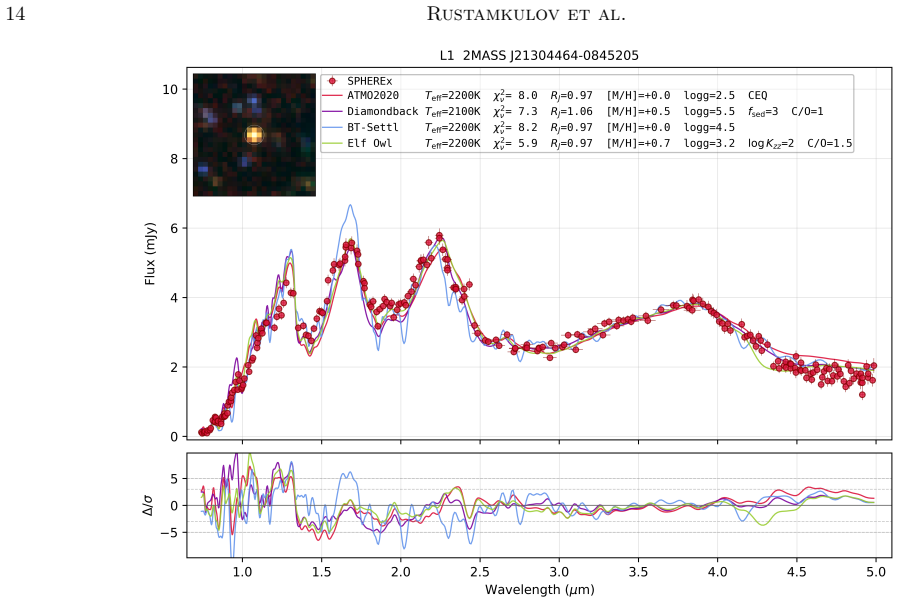
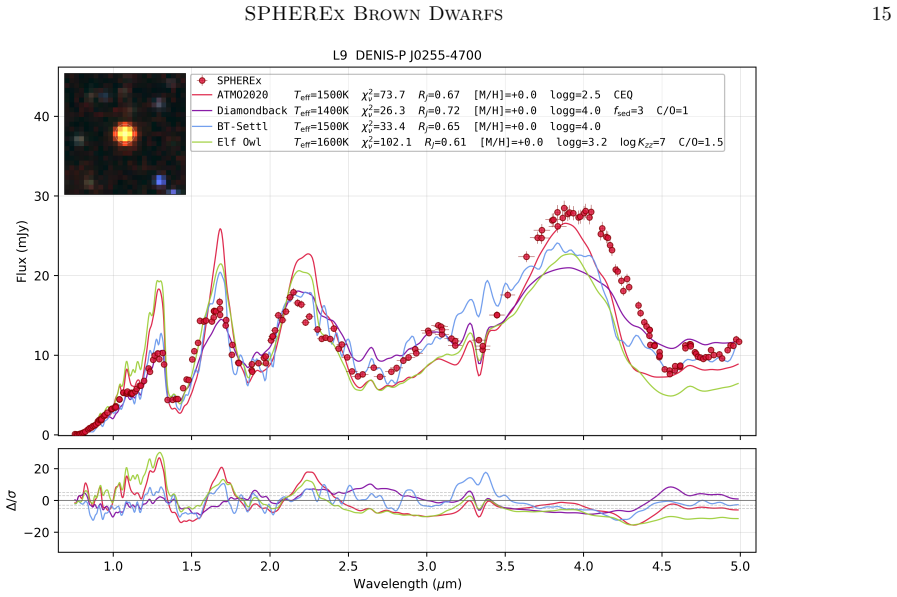
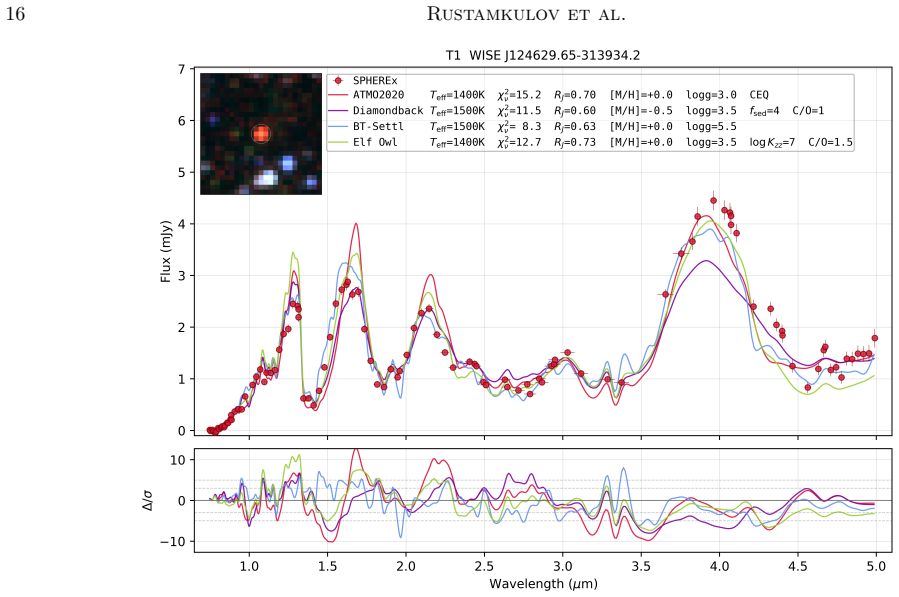
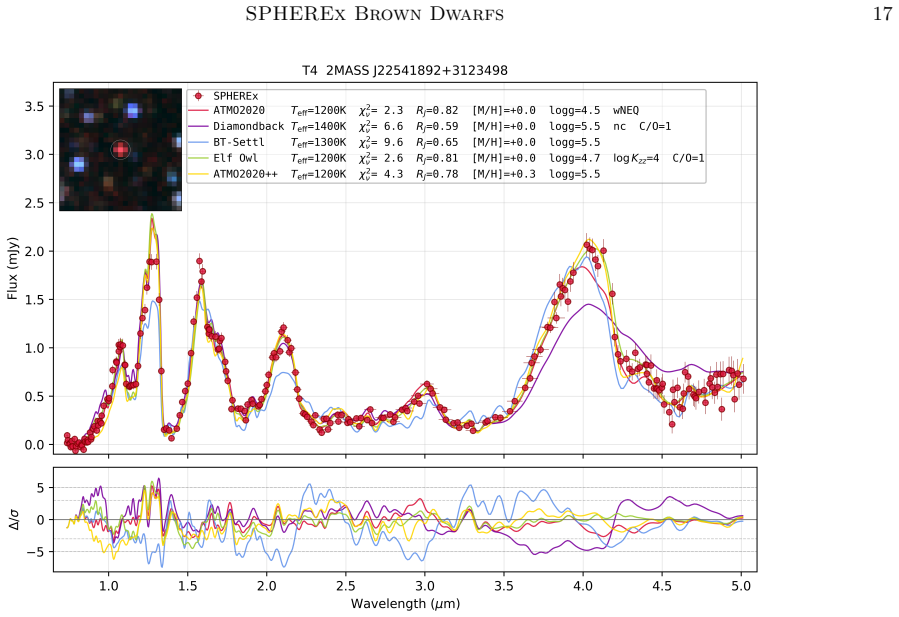
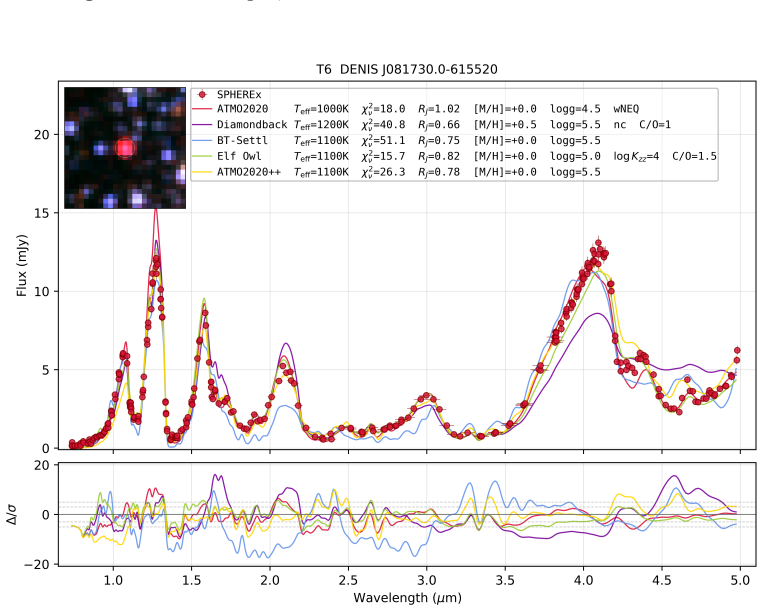
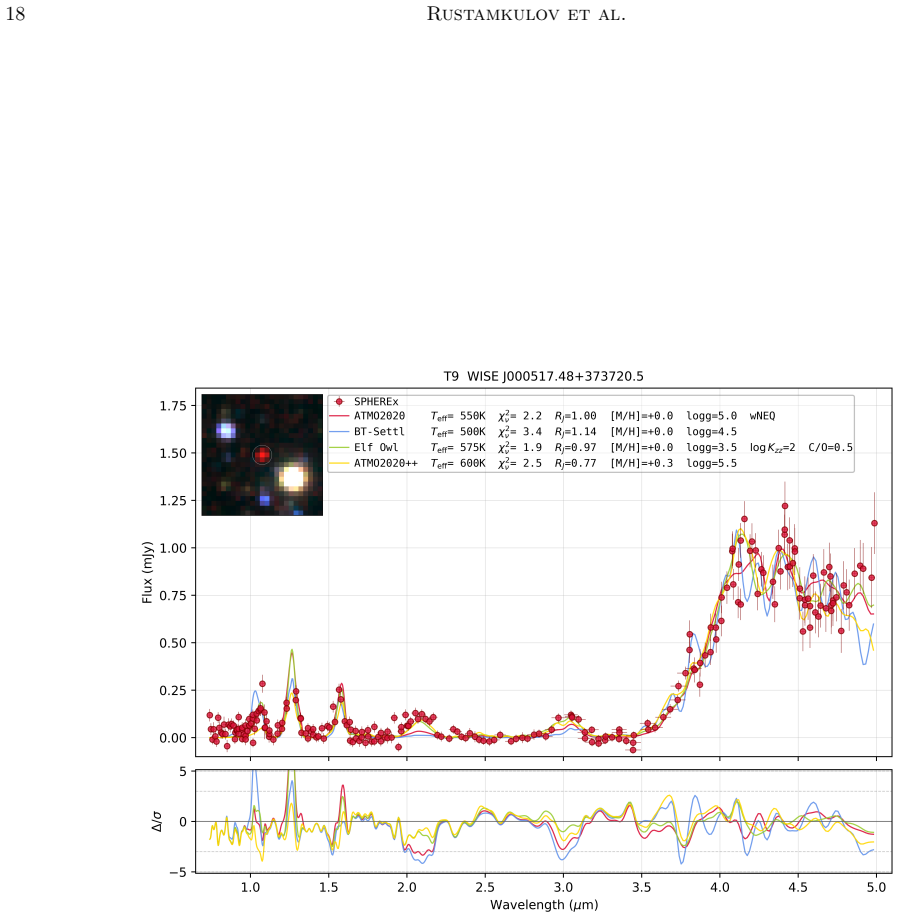
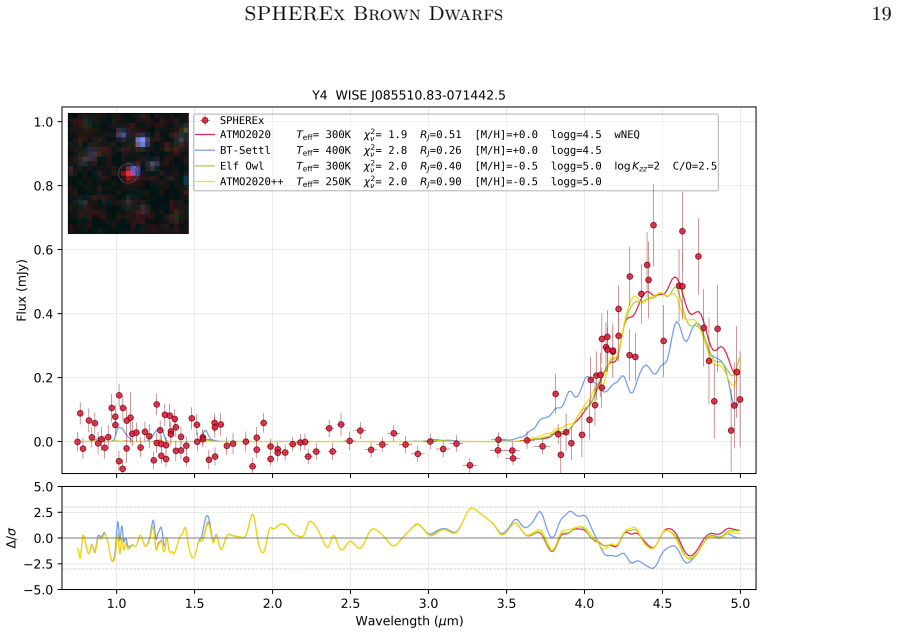
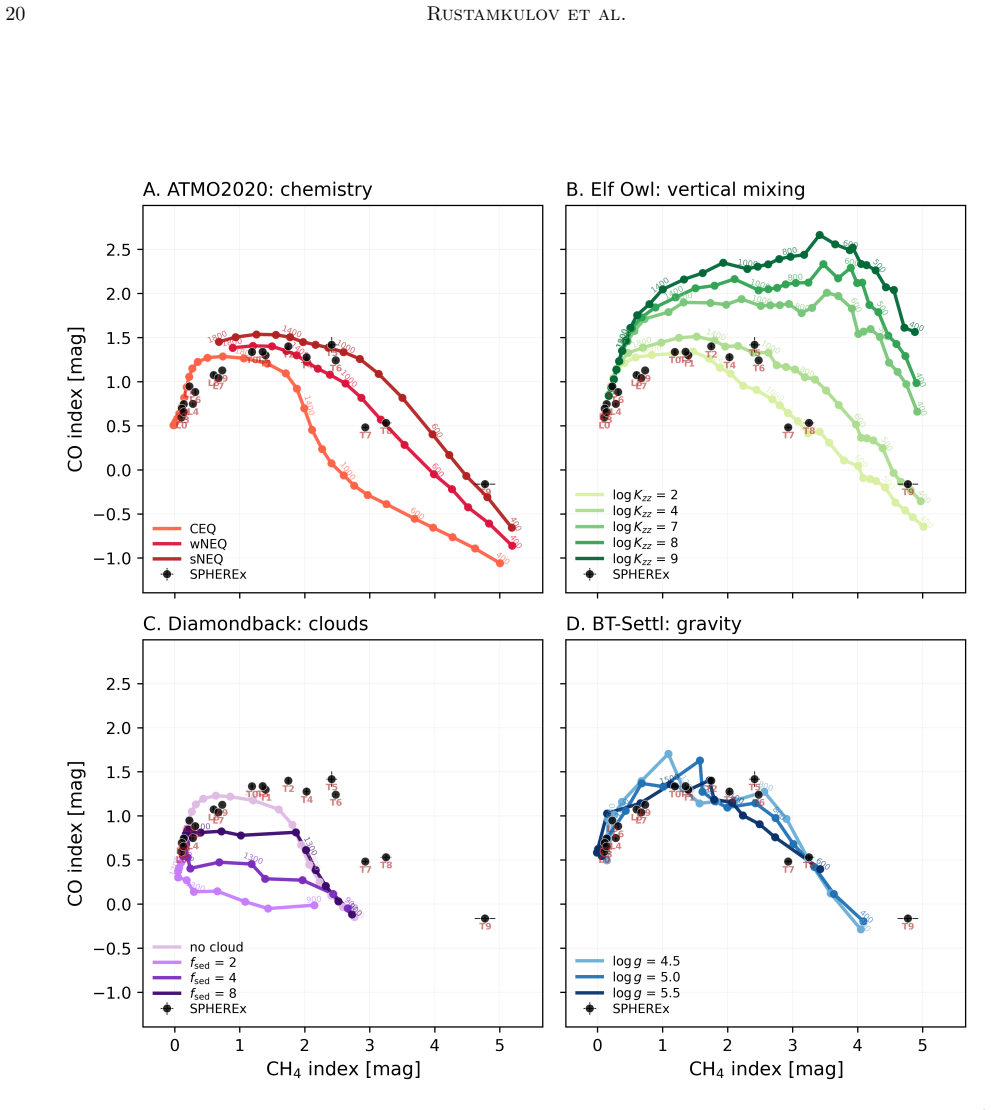
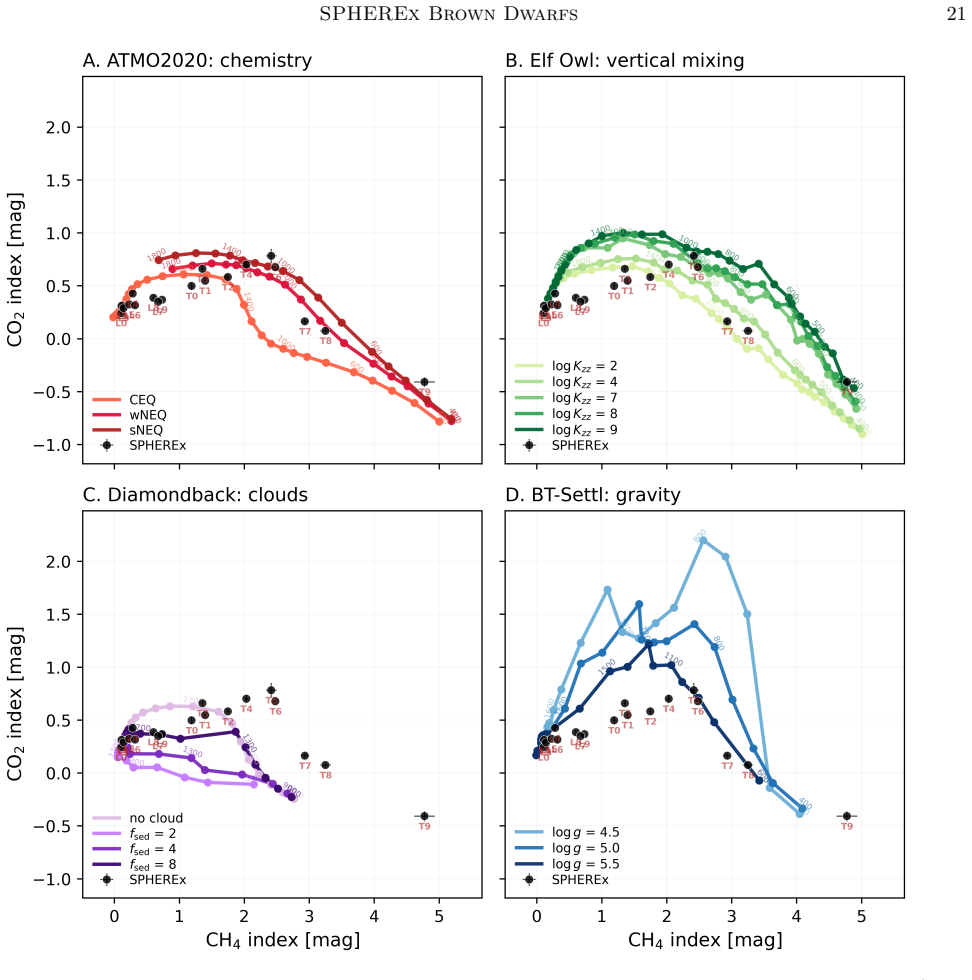
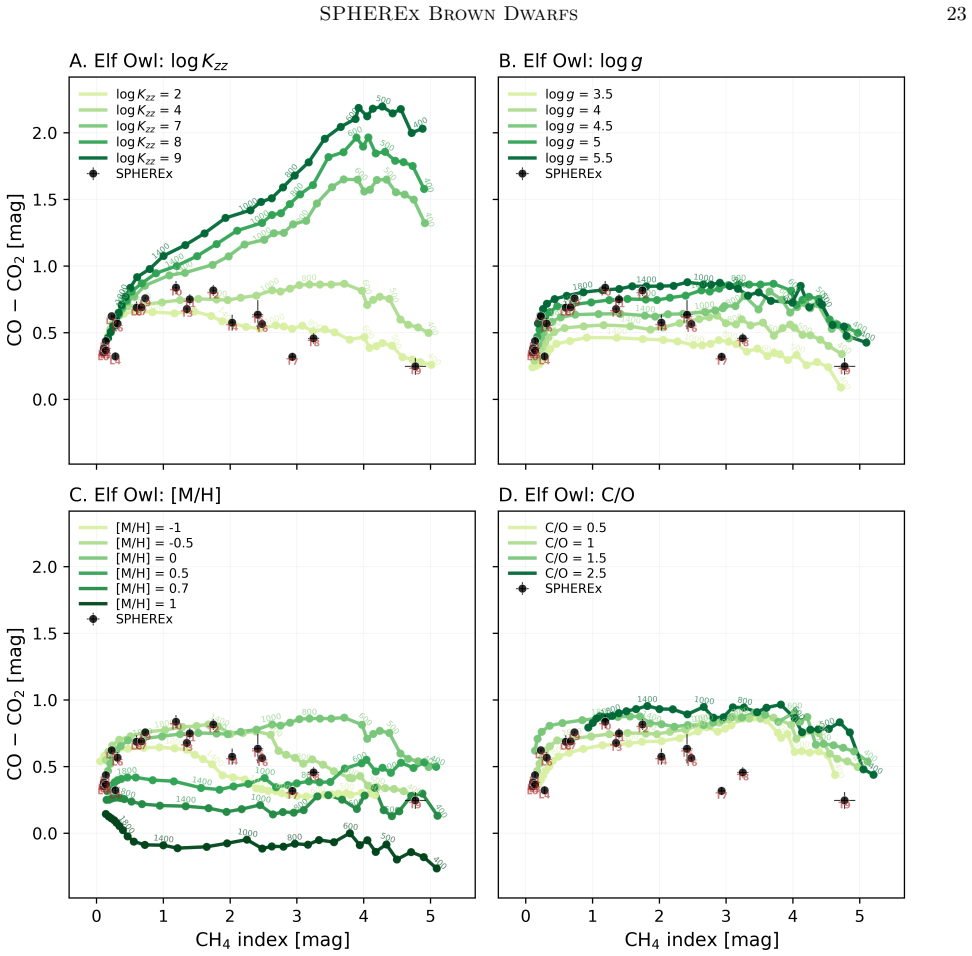
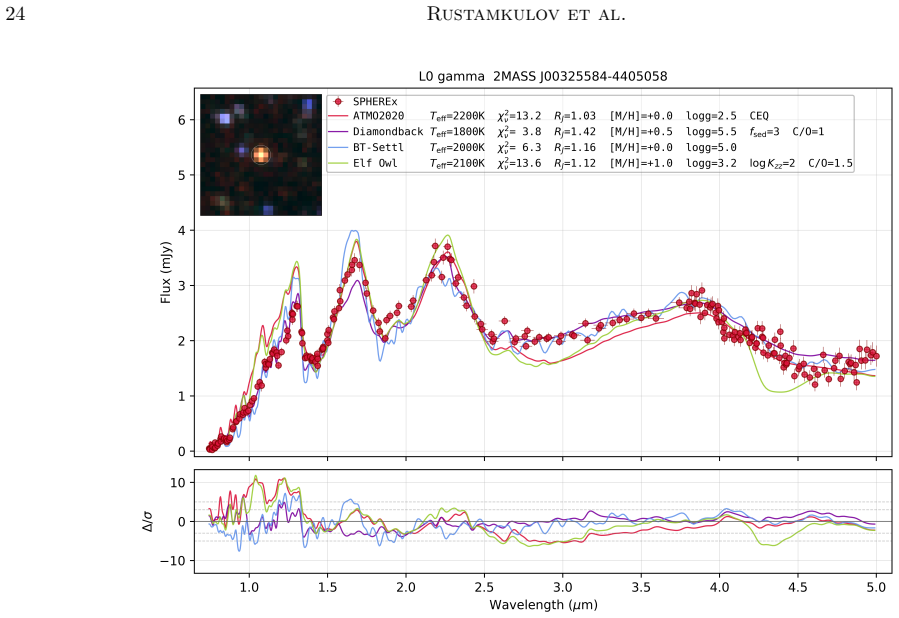
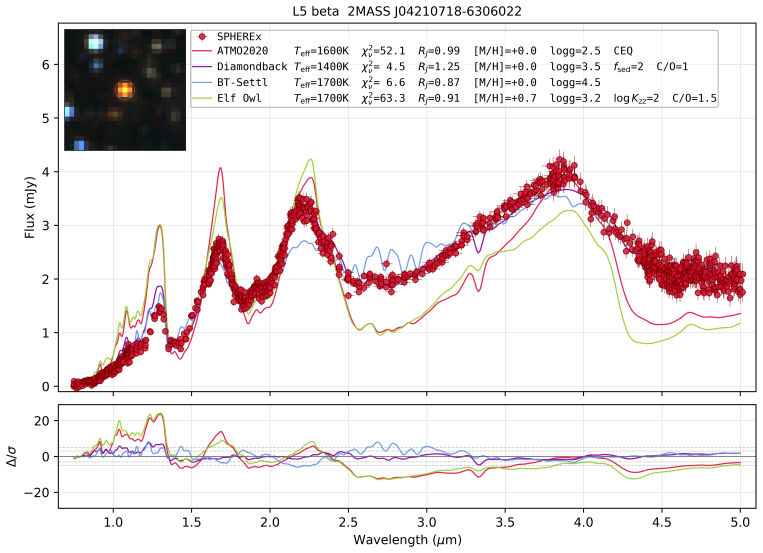
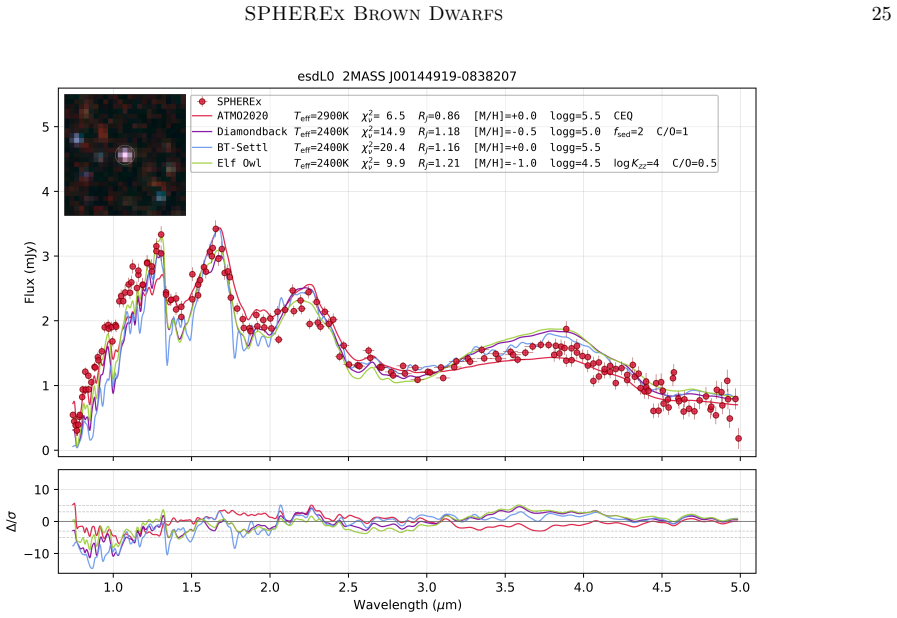
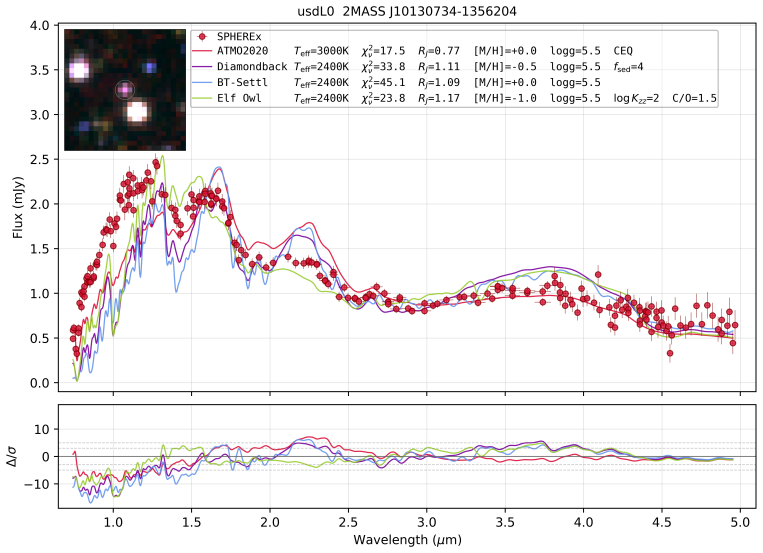
The observed sample of field dwarfs strongly preferring the weak vertical mixing (k_zz = 10^4 cm^2 s^{-1}) Elf Owl models over strong mixing. Spectra are presented across the full L/T/Y sequence and fitted to Sonora Diamondback, Elf Owl, BT-Settl, ATMO2020 and ATMO2020++ grids; the largest deviations appear around chemistry-sensitive CO2 and CO features, yet the models still capture the overall trends across the L/T transition.
What carries the argument
Elf Owl atmospheric model grids with the vertical mixing parameter k_zz fixed at 10^4 cm^2 s^{-1}, used to compute goodness-of-fit to the measured 0.75-5 micron spectra as a function of wavelength and spectral type.
If this is right
- Models continue to capture broad trends across the L/T transition even with the noted offsets.
- The largest model-data mismatches occur near the chemistry-sensitive CO2 and CO features.
- Future SPHEREx data on additional brown dwarfs will help guide improvements to the model grids.
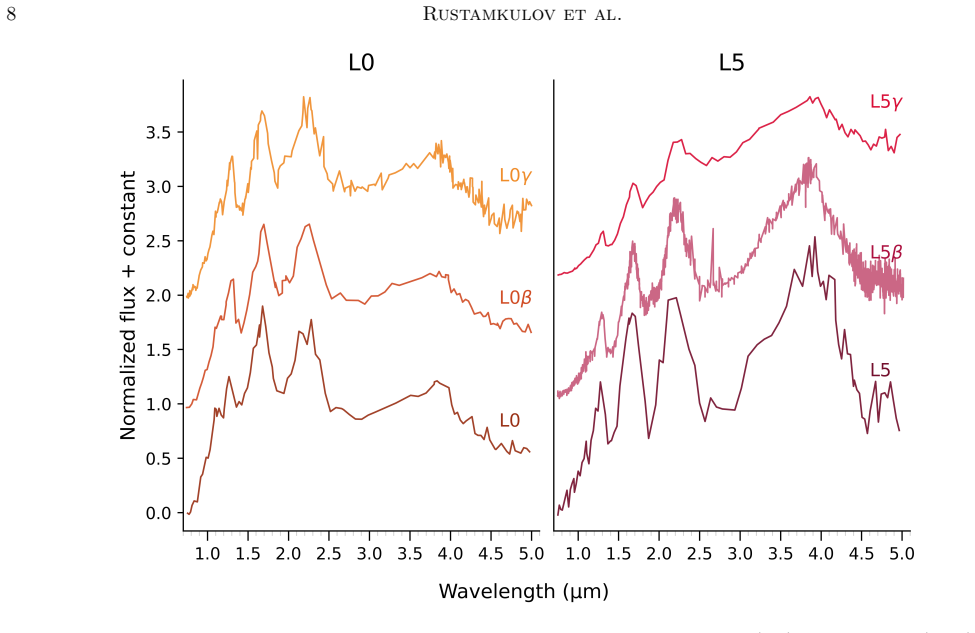
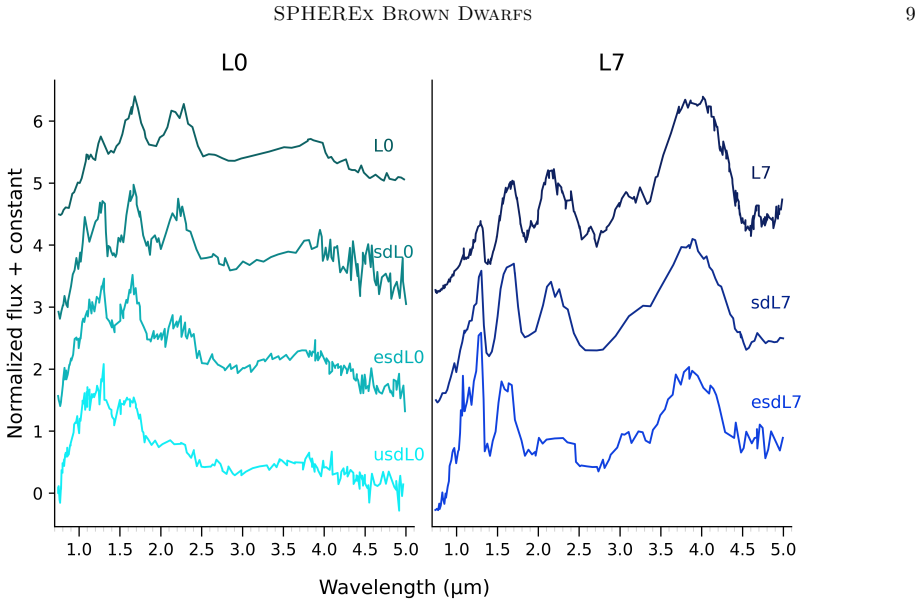
- Separate low-gravity and low-metallicity sequences show distinct trends at fixed spectral type.
Where Pith is reading between the lines
- If the weak-mixing preference holds, it would imply that the dominant vertical transport in most field brown dwarf atmospheres is slower than the strong-mixing runs commonly used.
- The same spectra could be used to test whether the preference for low k_zz persists when the same objects are observed at higher spectral resolution or in different wavelength windows.
Load-bearing premise
That differences in goodness-of-fit between model grids directly indicate the correctness of the vertical mixing parameter rather than unaccounted systematics in data reduction, spectral type assignments, or other unvaried model ingredients such as cloud properties.
What would settle it
A re-reduction of the SPHEREx spectra or a change in the adopted spectral types or cloud prescriptions that removes the statistical preference for the k_zz = 10^4 Elf Owl grid would falsify the claim that the data favor weak mixing.
Figures
read the original abstract
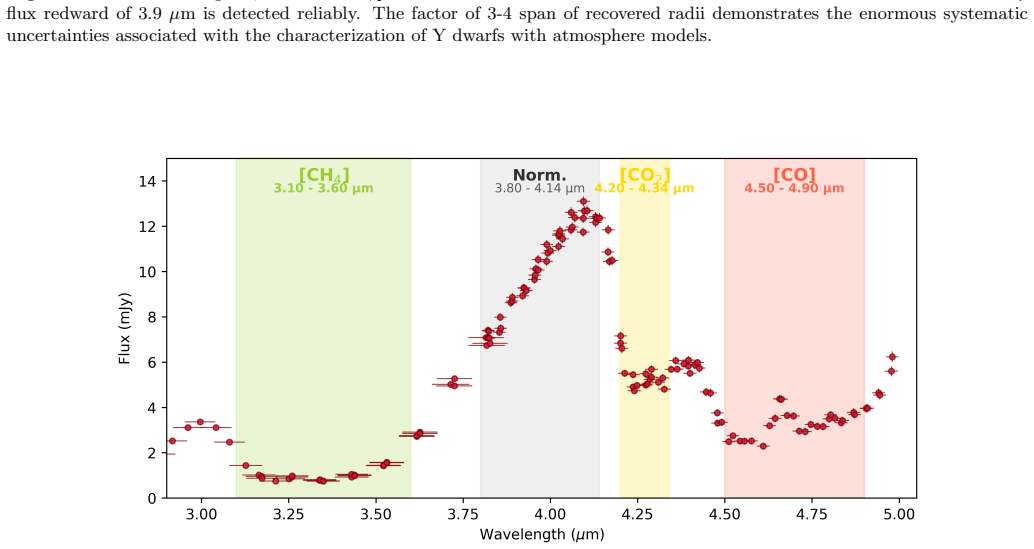
The SPHEREx all-sky survey has now measured the R$\sim$40-100 infrared spectra of thousands of nearby brown dwarfs in the chemically rich 0.75-5 $\mu$m range. The survey's wide spectral coverage and high S/N permits flux measurements that capture several broadband molecular absorption features, and upwards of 80$\%$ of the total bolometric luminosity of most brown dwarfs. Atmospheric models are known to yield systematic disagreements in the inferred temperatures and radii of brown dwarfs, necessitating benchmarking against observations. In this work, we present SPHEREx spectra across a broad sequence of 37 nearby field brown dwarfs, ranging from L0 to Y4 ($\sim$2500-250 K) and compare them to theoretical expectations. We additionally compile spectra for separate low-gravity and low-metallicity objects, and show how they trend with constant spectral type. We fit the measured spectra to the well-known forward model grids Sonora Diamondback, Elf Owl, BT-Settl, ATMO2020 and ATMO2020++ and compare their goodness-of-fit as a function of wavelength, spectral type, and treatment of clouds and chemistry. We find that the models continue to struggle to simultaneously fit the J/H/K peaks and the 4 $\mu$m opacity window, especially in L/T transition objects. The largest deviations appear around the chemistry-sensitive CO$_2$ and CO features. Despite these offsets, the models broadly capture their trends across the L/T transition, with the observed sample of field dwarfs strongly preferring the weak vertical mixing ($k_\mathrm{zz}$ = 10$^4$ cm$^2$s$^{-1}$) Elf Owl models over strong mixing. The spectra shown here along with future SPHEREx data will help guide improvements to models.
Editorial analysis
A structured set of objections, weighed in public.
Referee Report
Summary. The paper presents new SPHEREx R~40-100 spectra covering 0.75-5 μm for 37 nearby field brown dwarfs spanning L0 to Y4 (~2500-250 K), plus separate low-gravity and low-metallicity objects. These are compared to five forward-model grids (Sonora Diamondback, Elf Owl, BT-Settl, ATMO2020, ATMO2020++). The models are assessed via wavelength-dependent goodness-of-fit, revealing persistent mismatches in the J/H/K peaks and 4 μm window (especially at the L/T transition) and largest residuals near CO/CO₂ bands, yet the data are reported to capture overall trends across the sequence. The central result is that the field-dwarf sample shows a strong preference for the weak vertical mixing (k_zz = 10^4 cm² s⁻¹) Elf Owl models over the strong-mixing versions.
Significance. If the reported preference for weak mixing holds after addressing the interpretation concern below, the work supplies new, high-S/N, wide-wavelength observational benchmarks that directly constrain vertical mixing and chemistry in brown-dwarf atmospheres. The systematic multi-grid comparison and inclusion of non-field objects add value for guiding future model development. The manuscript ships reproducible spectral data and explicit fit-quality metrics, which are strengths.
major comments (1)
- [Results on Elf Owl model fits] Results section on Elf Owl comparisons (where the 'strongly preferring' statement appears): the central claim that χ² differences isolate the effect of k_zz rests on the Elf Owl grid holding cloud properties, metallicity, and chemistry fixed while varying only k_zz. Because the largest residuals occur precisely in the mixing-sensitive CO/CO₂ bands and because J/H/K and 4 μm mismatches persist across all grids, the reported preference could be driven by those unvaried ingredients rather than k_zz itself. An explicit test (or quantitative discussion) of how jointly varying clouds or gravity alters the relative χ² ranking is needed to support the claim that the data specifically validate the weak-mixing parameter.
minor comments (2)
- [Abstract] Abstract: the phrasing 'upwards of 80% of the total bolometric luminosity' is vague; replace with a quantitative range or median value across the sample.
- [Abstract] Abstract and text: the spectral resolution is stated as 'R∼40-100'; clarify whether this range is wavelength-dependent or object-dependent and how it was determined.
Simulated Author's Rebuttal
We thank the referee for their careful reading, positive overall assessment, and recommendation for minor revision. The single major comment identifies a valid point regarding the interpretation of the Elf Owl χ² comparisons. We address it directly below and will revise the manuscript accordingly.
read point-by-point responses
-
Referee: [Results on Elf Owl model fits] Results section on Elf Owl comparisons (where the 'strongly preferring' statement appears): the central claim that χ² differences isolate the effect of k_zz rests on the Elf Owl grid holding cloud properties, metallicity, and chemistry fixed while varying only k_zz. Because the largest residuals occur precisely in the mixing-sensitive CO/CO₂ bands and because J/H/K and 4 μm mismatches persist across all grids, the reported preference could be driven by those unvaried ingredients rather than k_zz itself. An explicit test (or quantitative discussion) of how jointly varying clouds or gravity alters the relative χ² ranking is needed to support the claim that the data specifically validate the weak-mixing parameter.
Authors: The Elf Owl grid is constructed to hold cloud properties, metallicity, and chemistry fixed while varying only k_zz, so the χ² difference between its weak- and strong-mixing realizations isolates the mixing effect by design; the unvaried parameters are identical in both cases and therefore cannot drive the relative ranking. The J/H/K and 4 μm mismatches are common to both mixing versions (and to the other grids), confirming they are orthogonal to the k_zz choice. The largest residuals indeed lie in the CO/CO₂ bands, which are physically sensitive to vertical mixing, and the data's preference for k_zz = 10^4 cm² s⁻¹ is consistent with improved reproduction of those features. We acknowledge that the published grid does not permit an explicit joint variation of clouds or gravity with k_zz, so a full test of parameter covariances is not possible with existing models. In the revised manuscript we will add a quantitative discussion section that (i) tabulates the wavelength-dependent χ² contributions for the two Elf Owl cases, (ii) notes the limitation of fixed parameters, and (iii) explains why the observed preference still provides evidence for weak mixing within the available model space. revision: yes
Circularity Check
No circularity; new spectra fitted to external pre-existing model grids
full rationale
The paper reports new SPHEREx observations of 37 brown dwarfs and performs goodness-of-fit comparisons against independent, pre-existing model grids (Sonora Diamondback, Elf Owl, BT-Settl, ATMO2020). The stated preference for weak-mixing Elf Owl models (k_zz = 10^4) arises directly from χ² values on these fresh data rather than any self-referential definition, fitted parameter renamed as prediction, or load-bearing self-citation chain. No equations or steps reduce the central claim to the paper's own inputs by construction. The result remains externally falsifiable via the presented spectra.
Axiom & Free-Parameter Ledger
axioms (1)
- domain assumption The model grids (Sonora Diamondback, Elf Owl, BT-Settl, ATMO2020, ATMO2020++) correctly implement the underlying radiative transfer and chemistry under the stated assumptions of the grids.
Reference graph
Works this paper leans on
-
[1]
Observations of Disequilibrium CO Chemistry in the Coldest Brown Dwarfs. , keywords =. doi:10.3847/1538-3881/ab9114 , archivePrefix =. 2004.10770 , primaryClass =
-
[2]
A warm Neptune's methane reveals core mass and vigorous atmospheric mixing. , keywords =. doi:10.1038/s41586-024-07395-z , archivePrefix =. 2405.11027 , primaryClass =
-
[3]
Beyond Equilibrium Temperature: How the Atmosphere/Interior Connection Affects the Onset of Methane, Ammonia, and Clouds in Warm Transiting Giant Planets. , keywords =. doi:10.3847/1538-3881/abc5bd , archivePrefix =. 2010.00146 , primaryClass =
-
[4]
Exoplanet Reflected Light Spectroscopy with PICASO
Exoplanet Reflected-light Spectroscopy with PICASO. , keywords =. doi:10.3847/1538-4357/ab1b51 , archivePrefix =. 1904.09355 , primaryClass =
work page internal anchor Pith review Pith/arXiv arXiv doi:10.3847/1538-4357/ab1b51 1904
-
[5]
Absolute Flux Calibration of the Spectro-Photometer for the History of the Universe, Epoch of Reionization, and Ices Explorer (SPHEREx) Mission
-
[6]
The Wide-field Infrared Survey Explorer (WISE): Mission Description and Initial On-orbit Performance
The Wide-field Infrared Survey Explorer (WISE): Mission Description and Initial On-orbit Performance. , keywords =. doi:10.1088/0004-6256/140/6/1868 , archivePrefix =. 1008.0031 , primaryClass =
work page internal anchor Pith review Pith/arXiv arXiv doi:10.1088/0004-6256/140/6/1868
-
[7]
The Two Micron All Sky Survey (2MASS). , keywords =. doi:10.1086/498708 , adsurl =
-
[8]
Young L Dwarfs Identified in the Field: A Preliminary Low-Gravity, Optical Spectral Sequence from L0 to L5. , keywords =. doi:10.1088/0004-6256/137/2/3345 , archivePrefix =. 0812.0364 , primaryClass =
work page internal anchor Pith review Pith/arXiv arXiv doi:10.1088/0004-6256/137/2/3345
-
[9]
Ultracool Dwarfs Observed with the Spitzer Infrared Spectrograph. I. An Accurate Look at the L-to-T Transition at 300 Myr from Optical Through Mid-infrared Spectrophotometry. , keywords =. doi:10.3847/1538-4357/ac1418 , archivePrefix =. 2107.14282 , primaryClass =
-
[10]
The JWST Early Release Science Program for Direct Observations of Exoplanetary Systems. V. Do Self-consistent Atmospheric Models Represent JWST Spectra? A Showcase with VHS 1256─1257 b. , keywords =. doi:10.3847/2041-8213/ad3e7c , archivePrefix =. 2312.03852 , primaryClass =
-
[11]
Individual Dynamical Masses of Ultracool Dwarfs
Individual Dynamical Masses of Ultracool Dwarfs. , keywords =. doi:10.3847/1538-4365/aa5e4c , archivePrefix =. 1703.05775 , primaryClass =
work page internal anchor Pith review Pith/arXiv arXiv doi:10.3847/1538-4365/aa5e4c
-
[12]
Fundamental Parameters and Spectral Energy Distributions of Young and Field Age Objects with Masses Spanning the Stellar to Planetary Regime. , keywords =. doi:10.1088/0004-637X/810/2/158 , archivePrefix =. 1508.01767 , primaryClass =
work page internal anchor Pith review Pith/arXiv arXiv doi:10.1088/0004-637x/810/2/158
-
[13]
The Sonora Brown Dwarf Atmosphere and Evolution Models. I. Model Description and Application to Cloudless Atmospheres in Rainout Chemical Equilibrium. , keywords =. doi:10.3847/1538-4357/ac141d , archivePrefix =. 2107.07434 , primaryClass =
-
[14]
The Evolution of L and T Dwarfs in Color-Magnitude Diagrams
The Evolution of L and T Dwarfs in Color-Magnitude Diagrams. , keywords =. doi:10.1086/592734 , archivePrefix =. 0808.2611 , primaryClass =
work page internal anchor Pith review Pith/arXiv arXiv doi:10.1086/592734
-
[15]
Evolutionary models for cool brown dwarfs and extrasolar giant planets. The case of HD 20945
Evolutionary models for cool brown dwarfs and extrasolar giant planets. The case of HD 209458. , keywords =. doi:10.1051/0004-6361:20030252 , archivePrefix =. astro-ph/0302293 , primaryClass =
work page internal anchor Pith review Pith/arXiv arXiv doi:10.1051/0004-6361:20030252
-
[16]
The Theory of Brown Dwarfs and Extrasolar Giant Planets
The theory of brown dwarfs and extrasolar giant planets. Reviews of Modern Physics , keywords =. doi:10.1103/RevModPhys.73.719 , archivePrefix =. astro-ph/0103383 , primaryClass =
work page internal anchor Pith review Pith/arXiv arXiv doi:10.1103/revmodphys.73.719
-
[17]
Atmospheric Chemistry in Giant Planets, Brown Dwarfs, and Low-Mass Dwarf Stars. I. Carbon, Nitrogen, and Oxygen. , year = 2002, month = feb, volume =. doi:10.1006/icar.2001.6740 , adsurl =
-
[18]
Spitzer/IRAC Photometry of M, L, and T Dwarfs
Spitzer IRAC Photometry of M, L, and T Dwarfs. , keywords =. doi:10.1086/507264 , archivePrefix =. astro-ph/0606432 , primaryClass =
work page internal anchor Pith review Pith/arXiv arXiv doi:10.1086/507264
-
[19]
and Kothari, Harshil , title =
Brooks, Hunter and Cushing, Michael C. and Kothari, Harshil , title =. Research Notes of the AAS , abstract =. 2026 , month =. doi:10.3847/2515-5172/ae6257 , url =
-
[20]
2026 , eprint=
A SPHEREx Pipeline and Spectral Library for Ultracool Dwarfs , author=. 2026 , eprint=
2026
-
[21]
2026 , eprint=
SPHEREx Ultracool Dwarf spectral Atlas (SUDA): Atmospheric and Fundamental Parameters of Ultracool Dwarfs , author=. 2026 , eprint=
2026
-
[22]
2025 , publisher =. doi:10.26131/IRSA652 , url =
-
[23]
Precise Bolometric Luminosities and Effective Temperatures of 23 Late-T and Y Dwarfs Obtained with JWST. , keywords =. doi:10.3847/1538-4357/ad6301 , archivePrefix =. 2407.08518 , primaryClass =
-
[24]
Clouds and chemistry across the brown dwarf T-Y sequence: Insights from JWST atmospheric retrievals. , keywords =. doi:10.1051/0004-6361/202556207 , archivePrefix =. 2601.12575 , primaryClass =
-
[25]
Chromospheric Activity, Rotation, and Rotational Braking in M and L Dwarfs
Chromospheric Activity, Rotation, and Rotational Braking in M and L Dwarfs. , keywords =. doi:10.1086/590073 , archivePrefix =. 0805.1059 , primaryClass =
work page internal anchor Pith review Pith/arXiv arXiv doi:10.1086/590073
-
[26]
Methane emission from a cool brown dwarf. , keywords =. doi:10.1038/s41586-024-07190-w , archivePrefix =. 2404.10977 , primaryClass =
-
[27]
2026 , eprint=
Two Exciting High-redshift Galaxy Candidates Turn Out to Be Two Exciting Ultra-cool Brown Dwarfs , author=. 2026 , eprint=
2026
-
[28]
A 1.46-2.48 m spectroscopic atlas of a T6 dwarf (1060 K) atmosphere with IGRINS: first detections of H _ 2 S and H _ 2 , and verification of H _ 2 O, CH _ 4 , and NH _ 3 line lists. , keywords =. doi:10.1093/mnras/stac1412 , archivePrefix =. 2206.03519 , primaryClass =
-
[29]
Observation of undepleted phosphine in the atmosphere of a low-temperature brown dwarf. Science , keywords =. doi:10.1126/science.adu0401 , archivePrefix =. 2510.03916 , primaryClass =
-
[30]
The Hawaii Infrared Parallax Program. VI. The Fundamental Properties of 1000+ Ultracool Dwarfs and Planetary-mass Objects Using Optical to Mid-infrared Spectral Energy Distributions and Comparison to BT-Settl and ATMO 2020 Model Atmospheres. , keywords =. doi:10.3847/1538-4357/acff66 , archivePrefix =. 2309.03082 , primaryClass =
-
[31]
The Library of Exoplanet Atmospheric Composition Measurements: Population-level Trends in Exoplanet Composition with ExoComp. , keywords =. doi:10.3847/1538-3881/ae1b8e , archivePrefix =. 2510.26785 , primaryClass =
-
[32]
Aerosol composition of hot giant exoplanets dominated by silicates and hydrocarbon hazes. Nature Astronomy , keywords =. doi:10.1038/s41550-020-1114-3 , archivePrefix =. 2005.11939 , primaryClass =
-
[33]
Ultracool dwarfs observed with the Spitzer infrared spectrograph - II. Emergence and sedimentation of silicate clouds in L dwarfs, and analysis of the full M5-T9 field dwarf spectroscopic sample. , keywords =. doi:10.1093/mnras/stac1205 , archivePrefix =. 2205.00168 , primaryClass =
-
[34]
Spitzer Light Curves of the Young, Planetary-mass TW Hya Members 2MASS J11193254-1137466AB and WISEA J114724.10-204021.3. , keywords =. doi:10.3847/1538-3881/aabfc2 , archivePrefix =. 1804.06917 , primaryClass =
work page internal anchor Pith review Pith/arXiv arXiv doi:10.3847/1538-3881/aabfc2
-
[35]
Spitzer Variability Properties of Low-gravity L Dwarfs. , keywords =. doi:10.3847/1538-3881/ab9642 , archivePrefix =. 2005.12854 , primaryClass =
-
[36]
A comprehensive survey of transiting close-in gas giant exoplanets with warm-Spitzer/IRAC
Evidence for disequilibrium chemistry from vertical mixing in hot Jupiter atmospheres. A comprehensive survey of transiting close-in gas giant exoplanets with warm-Spitzer/IRAC. , keywords =. doi:10.1051/0004-6361/202039708 , archivePrefix =. 2103.07185 , primaryClass =
-
[37]
2025 , eprint=
Optimized Observation Sequencing in Low-Earth Orbit with the SPHEREx Survey Planning Software , author=. 2025 , eprint=
2025
-
[38]
Atmospheric Retrievals of the Phase-resolved Spectra of Irradiated Brown Dwarfs WD-0137B and EPIC-2122B. , keywords =. doi:10.3847/1538-4357/ad43da , archivePrefix =. 2404.16813 , primaryClass =
-
[39]
Uniform Atmospheric Retrieval Analysis of Ultracool Dwarfs. II. Properties of 11 T dwarfs. , keywords =. doi:10.3847/1538-4357/aa7ff0 , archivePrefix =. 1612.02809 , primaryClass =
work page internal anchor Pith review Pith/arXiv arXiv doi:10.3847/1538-4357/aa7ff0
-
[40]
Uniform Forward-modeling Analysis of Ultracool Dwarfs. I. Methodology and Benchmarking. , keywords =. doi:10.3847/1538-4357/abf8b2 , archivePrefix =. 2011.12294 , primaryClass =
-
[41]
Constructing A Flexible Likelihood Function For Spectroscopic Inference
Constructing a Flexible Likelihood Function for Spectroscopic Inference. , keywords =. doi:10.1088/0004-637X/812/2/128 , archivePrefix =. 1412.5177 , primaryClass =
work page internal anchor Pith review Pith/arXiv arXiv doi:10.1088/0004-637x/812/2/128
-
[42]
A Non-Gray Theory of Extrasolar Giant Planets and Brown Dwarfs
A Nongray Theory of Extrasolar Giant Planets and Brown Dwarfs. , keywords =. doi:10.1086/305002 , archivePrefix =. astro-ph/9705201 , primaryClass =
work page internal anchor Pith review Pith/arXiv arXiv doi:10.1086/305002
-
[43]
Stellar Spectral Classification
-
[44]
PICASO 3.0: A One-dimensional Climate Model for Giant Planets and Brown Dwarfs. , keywords =. doi:10.3847/1538-4357/ac9f48 , archivePrefix =. 2208.07836 , primaryClass =
-
[45]
The Sonora Substellar Atmosphere Models. IV. Elf Owl: Atmospheric Mixing and Chemical Disequilibrium with Varying Metallicity and C/O Ratios. , keywords =. doi:10.3847/1538-4357/ad18c2 , archivePrefix =. 2402.00756 , primaryClass =
-
[46]
The 0.8-14.5 m Spectra of Mid-L to Mid-T Dwarfs: Diagnostics of Effective Temperature, Grain Sedimentation, Gas Transport, and Surface Gravity. , keywords =. doi:10.1088/0004-637X/702/1/154 , archivePrefix =. 0906.2991 , primaryClass =
work page internal anchor Pith review Pith/arXiv arXiv doi:10.1088/0004-637x/702/1/154
-
[47]
WiseView: Visualizing motion and variability of faint WISE sources
-
[48]
An atlas of stellar spectra, with an outline of spectral classification
-
[49]
The Initial Mass Function Based on the Full-sky 20 pc Census of 3600 Stars and Brown Dwarfs. , keywords =. doi:10.3847/1538-4365/ad24e2 , archivePrefix =. 2312.03639 , primaryClass =
-
[50]
The Field Substellar Mass Function Based on the Full-sky 20 pc Census of 525 L, T, and Y Dwarfs. , keywords =. doi:10.3847/1538-4365/abd107 , archivePrefix =. 2011.11616 , primaryClass =
-
[51]
Precipitating Condensation Clouds in Substellar Atmospheres
Precipitating Condensation Clouds in Substellar Atmospheres. , keywords =. doi:10.1086/321540 , archivePrefix =. astro-ph/0103423 , primaryClass =
work page internal anchor Pith review Pith/arXiv arXiv doi:10.1086/321540
-
[52]
The Sonora Substellar Atmosphere Models. III. Diamondback: Atmospheric Properties, Spectra, and Evolution for Warm Cloudy Substellar Objects. , keywords =. doi:10.3847/1538-4357/ad71d5 , archivePrefix =. 2402.00758 , primaryClass =
-
[53]
The role of convection, overshoot, and gravity waves for the transport of dust in M dwarf and brown dwarf atmospheres. , keywords =. doi:10.1051/0004-6361/200913354 , archivePrefix =. 1002.3437 , primaryClass =
work page internal anchor Pith review Pith/arXiv arXiv doi:10.1051/0004-6361/200913354
-
[54]
Cloud Microphysics: Analysis of the Clouds of Earth, Venus, Mars, and Jupiter. , keywords =. doi:10.1016/0019-1035(78)90072-6 , adsurl =
-
[55]
Philosophical Transactions of the Royal Society of London Series A , keywords =
Models of very-low-mass stars, brown dwarfs and exoplanets. Philosophical Transactions of the Royal Society of London Series A , keywords =. doi:10.1098/rsta.2011.0269 , archivePrefix =. 1112.3591 , primaryClass =
-
[56]
Progress in Modeling Very Low Mass Stars, Brown Dwarfs, and Planetary Mass Objects
Progress in modeling very low mass stars, brown dwarfs, and planetary mass objects. Memorie della Societa Astronomica Italiana Supplementi , keywords =. doi:10.48550/arXiv.1302.6559 , archivePrefix =. 1302.6559 , primaryClass =
work page internal anchor Pith review Pith/arXiv arXiv doi:10.48550/arxiv.1302.6559
-
[57]
A high-accuracy computed water line list. , keywords =. doi:10.1111/j.1365-2966.2006.10184.x , archivePrefix =. astro-ph/0601236 , primaryClass =
-
[58]
Exploring the Formation and Evolution of Planetary Systems , year = 2014, editor =
The BT-Settl Model Atmospheres for Stars, Brown Dwarfs and Planets. Exploring the Formation and Evolution of Planetary Systems , year = 2014, editor =. doi:10.1017/S1743921313008545 , adsurl =
-
[59]
The Y-type Brown Dwarfs: Estimates of Mass and Age from New Astrometry, Homogenized Photometry, and Near-infrared Spectroscopy. , keywords =. doi:10.3847/1538-4357/aa6fb5 , archivePrefix =. 1704.03573 , primaryClass =
work page internal anchor Pith review Pith/arXiv arXiv doi:10.3847/1538-4357/aa6fb5
-
[60]
A new set of atmosphere and evolution models for cool T-Y brown dwarfs and giant exoplanets. , keywords =. doi:10.1051/0004-6361/201937381 , archivePrefix =. 2003.13717 , primaryClass =
-
[61]
The First Y Dwarf Data from JWST Show that Dynamic and Diabatic Processes Regulate Cold Brown Dwarf Atmospheres. , keywords =. doi:10.3847/1538-4357/acfdad , archivePrefix =. 2309.14567 , primaryClass =
-
[62]
Atmospheric Parameters of Field L and T Dwarfs
Atmospheric Parameters of Field L and T Dwarfs. , keywords =. doi:10.1086/526489 , archivePrefix =. 0711.0801 , primaryClass =
work page internal anchor Pith review Pith/arXiv arXiv doi:10.1086/526489
-
[63]
Research Notes of the American Astronomical Society , keywords =
James Webb Space Telescope Spectra of Cold Brown Dwarfs are Well-reproduced by Phosphine-free, Diabatic, ATMO2020++ Models. Research Notes of the American Astronomical Society , keywords =. doi:10.3847/2515-5172/ad1b61 , adsurl =
-
[64]
The SPHEREx Image and Spectrophotometry Processing Pipeline. arXiv e-prints , keywords =. doi:10.48550/arXiv.2511.15823 , archivePrefix =. 2511.15823 , primaryClass =
-
[65]
The SPHEREx Satellite Mission. arXiv e-prints , keywords =. doi:10.48550/arXiv.2511.02985 , archivePrefix =. 2511.02985 , primaryClass =
-
[66]
New limits on the surface density of M dwarfs. I. Photographic survey and preliminary CCD data. , keywords =. doi:10.1086/113791 , adsurl =
-
[67]
Collision-induced absorption coefficients of H _ 2 pairs at temperatures from 60 K to 1000 K. , keywords =. doi:10.1051/0004-6361:20020555 , adsurl =
-
[68]
A Unified Near Infrared Spectral Classification Scheme for T Dwarfs
A Unified Near-Infrared Spectral Classification Scheme for T Dwarfs. , keywords =. doi:10.1086/498563 , archivePrefix =. astro-ph/0510090 , primaryClass =
work page internal anchor Pith review Pith/arXiv arXiv doi:10.1086/498563
-
[69]
The Discovery of Y Dwarfs Using Data from the Wide-field Infrared Survey Explorer (WISE)
The Discovery of Y Dwarfs using Data from the Wide-field Infrared Survey Explorer (WISE). , keywords =. doi:10.1088/0004-637X/743/1/50 , archivePrefix =. 1108.4678 , primaryClass =
work page internal anchor Pith review Pith/arXiv arXiv doi:10.1088/0004-637x/743/1/50
-
[70]
Further Defining Spectral Type ``Y'' and Exploring the Low-mass End of the Field Brown Dwarf Mass Function. , keywords =. doi:10.1088/0004-637X/753/2/156 , archivePrefix =. 1205.2122 , primaryClass =
work page internal anchor Pith review Pith/arXiv arXiv doi:10.1088/0004-637x/753/2/156
-
[71]
A Standard Stellar Spectral Sequence in the Red/Near-Infrared: Classes K5 to M9. , keywords =. doi:10.1086/191611 , adsurl =
-
[72]
Dwarfs Cooler than ``M``: The Definition of Spectral Type ``L'' Using Discoveries from the 2 Micron All-Sky Survey (2MASS). , keywords =. doi:10.1086/307414 , adsurl =
-
[73]
, year = 2005, month = sep, volume =
New Spectral Types L and T. , year = 2005, month = sep, volume =. doi:10.1146/annurev.astro.42.053102.134017 , adsurl =
-
[74]
Discoveries from a Near-infrared Proper Motion Survey using Multi-epoch 2MASS Data
Discoveries from a Near-infrared Proper Motion Survey Using Multi-epoch Two Micron All-Sky Survey Data. , keywords =. doi:10.1088/0067-0049/190/1/100 , archivePrefix =. 1008.3591 , primaryClass =
work page internal anchor Pith review Pith/arXiv arXiv doi:10.1088/0067-0049/190/1/100
-
[75]
Probing the Heights and Depths of Y Dwarf Atmospheres: A Retrieval Analysis of the JWST Spectral Energy Distribution of WISE J035934.06─540154.6. , keywords =. doi:10.3847/1538-4357/ad583b , archivePrefix =. 2406.06493 , primaryClass =
-
[76]
Revised Metallicity Classes for Low-Mass Stars: Dwarfs (dM), Subdwarfs (sdM), Extreme Subdwarfs (esdM), and Ultrasubdwarfs (usdM). , keywords =. doi:10.1086/521614 , archivePrefix =. 0707.2993 , primaryClass =
work page internal anchor Pith review Pith/arXiv arXiv doi:10.1086/521614
-
[77]
The Carbon-to-oxygen Ratio in Cool Brown Dwarfs and Giant Exoplanets. I. The Benchmark Late-T Dwarfs GJ 570D, HD 3651B, and Ross 458C. , keywords =. doi:10.3847/1538-4357/ad06ba , archivePrefix =. 2312.02001 , primaryClass =
-
[78]
Cool Zero-Metallicity Stellar Atmospheres. , keywords =. doi:10.1086/173892 , adsurl =
-
[79]
Ammonia as a tracer of chemical equilibrium in the T7.5 dwarf Gliese 570D
Ammonia as a Tracer of Chemical Equilibrium in the T7.5 Dwarf Gliese 570D. , keywords =. doi:10.1086/505419 , archivePrefix =. astro-ph/0605563 , primaryClass =
work page internal anchor Pith review Pith/arXiv arXiv doi:10.1086/505419
-
[80]
Primeval very low-mass stars and brown dwarfs - I. Six new L subdwarfs, classification and atmospheric properties. , keywords =. doi:10.1093/mnras/stw2438 , archivePrefix =. 1609.07181 , primaryClass =
work page internal anchor Pith review Pith/arXiv arXiv doi:10.1093/mnras/stw2438
discussion (0)
Sign in with ORCID, Apple, or X to comment. Anyone can read and Pith papers without signing in.