Democratising Optical Orbital Angular Momentum: a Set of Cost-Effective Tools
Pith reviewed 2026-05-25 02:15 UTC · model grok-4.3
The pith
A fork diffraction grating printed on photographic slide film paired with a laser pointer generates optical vortex beams carrying orbital angular momentum.
A machine-rendered reading of the paper's core claim, the machinery that carries it, and where it could break.
Core claim
A simple setup with a fork diffraction grating and a laser pointer successfully produces vortex beams that possess orbital angular momentum, allowing for orbital angular momentum to be easily observed and investigated in a teaching environment. The gratings are created on photographic slide film by outsourcing, making them easy and cheap to produce, and the setup functions as either a demonstration or an investigative student activity.
What carries the argument
The fork diffraction grating on photographic slide film, which diffracts the incident laser light to impose a helical phase structure that carries orbital angular momentum.
If this is right
- Quantum mechanics teaching can move from purely mathematical derivations to direct observation of orbital angular momentum.
- The same inexpensive grating can serve either as a quick demonstration or as the basis for student-designed measurements.
- Access to spatial light modulator experiments becomes possible without purchasing commercial equipment.
- Concepts from quantum communication and optical information processing become tangible in standard classroom settings.
Where Pith is reading between the lines
- Similar low-cost grating methods could be tested for producing other structured light modes beyond simple vortices.
- If the film-based gratings prove repeatable across batches, schools without optics budgets could adopt the activity as a standard lab.
- The approach might extend to demonstrating superposition or entanglement analogs by combining multiple gratings.
Load-bearing premise
Outsourced photographic slide film gratings will produce clean fork patterns without defects that reliably generate stable vortex beams with measurable orbital angular momentum.
What would settle it
If the beam after the grating shows a bright central spot instead of a dark core and doughnut profile, or if no interference signature of orbital angular momentum appears, the claim that the setup produces usable vortex beams would be false.
Figures





read the original abstract
Classical and quantum optical communication has gained popularity and momentum in recent years, with growing investment and innovation in quantum technologies. However, the main teaching method in the education of quantum mechanics include mathematically intensive derivations or abstract analogies for the complex systems. We propose a "poor man's" spatial light modulator experiment that is an engaging and interactive learning aid for teaching quantum mechanics and optical orbital angular momentum. Fork diffraction gratings were created on photographic slide film by outsourcing to an external company, and so the gratings were easy and cheap to produce. A simple setup with a fork diffraction grating and a laser pointer successfully produces vortex beams that possess orbital angular momentum, allowing for orbital angular momentum to be easily observed and investigated in a teaching environment. How the tools can be used effectively to enhance learning is discussed, either as a demonstration or as an investigative scientific learning environment activity.
Editorial analysis
A structured set of objections, weighed in public.
Referee Report
Summary. The manuscript describes the production of fork diffraction gratings on photographic slide film via outsourcing to an external company, and claims that a simple optical setup combining one such grating with a laser pointer successfully generates vortex beams carrying orbital angular momentum. The work positions these low-cost components as accessible tools for classroom demonstrations or student investigations of OAM in quantum-mechanics education.
Significance. If the experimental claim is substantiated, the approach would provide a genuinely inexpensive route to OAM demonstrations that avoids the cost of spatial light modulators, thereby lowering barriers to hands-on teaching of structured light and quantum optics. The explicit outsourcing step for grating fabrication is a practical strength that could aid reproducibility across institutions.
major comments (2)
- [Abstract] Abstract: the central claim that the setup 'successfully produces vortex beams that possess orbital angular momentum' is presented without any supporting data, beam-profile images, far-field intensity measurements, interference verification, or metrology of the delivered gratings. This absence directly prevents evaluation of whether the outsourced photographic-film gratings achieve the spatial resolution and phase-dislocation fidelity needed for clean topological charge.
- [Abstract] Abstract / Methods description: the manuscript supplies no quantitative check (e.g., measured fork angle, line-spacing uniformity, or centering of the dislocation) on the gratings received from the external vendor. Without such verification, the assumption that commercial photographic-slide output will reliably impart a well-defined helical phase front remains untested and load-bearing for the educational-utility claim.
minor comments (1)
- [Abstract] The abstract contains a minor grammatical issue ('the main teaching method in the education of quantum mechanics include').
Simulated Author's Rebuttal
We thank the referee for their detailed and constructive report. The comments correctly highlight the absence of supporting experimental evidence in the submitted manuscript. We will revise the paper to include the requested data, images, and quantitative checks on the gratings.
read point-by-point responses
-
Referee: [Abstract] Abstract: the central claim that the setup 'successfully produces vortex beams that possess orbital angular momentum' is presented without any supporting data, beam-profile images, far-field intensity measurements, interference verification, or metrology of the delivered gratings. This absence directly prevents evaluation of whether the outsourced photographic-film gratings achieve the spatial resolution and phase-dislocation fidelity needed for clean topological charge.
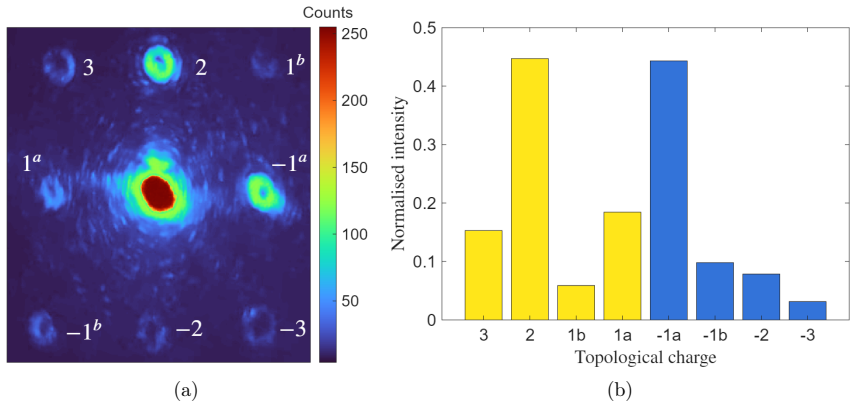
Authors: We agree that the submitted manuscript does not contain the supporting data, images or metrology needed to substantiate the claim. In the revised version we will add far-field beam profiles, interference verification (e.g., fork fringes or spiral patterns), and any available metrology of the delivered gratings to demonstrate that the phase dislocation produces the expected helical wavefront. revision: yes
-
Referee: [Abstract] Abstract / Methods description: the manuscript supplies no quantitative check (e.g., measured fork angle, line-spacing uniformity, or centering of the dislocation) on the gratings received from the external vendor. Without such verification, the assumption that commercial photographic-slide output will reliably impart a well-defined helical phase front remains untested and load-bearing for the educational-utility claim.
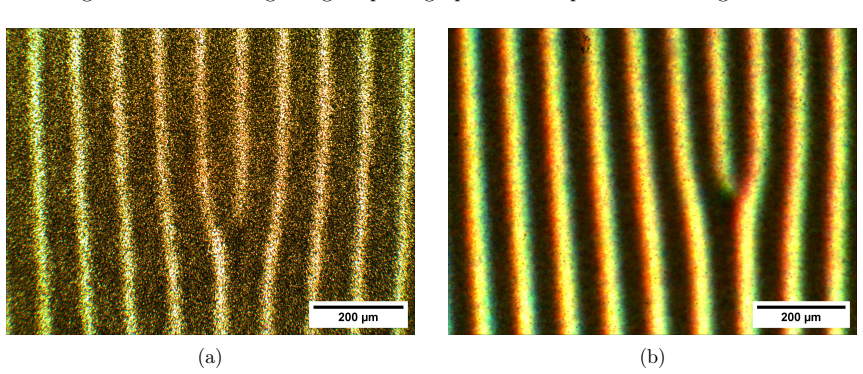
Authors: The referee is correct that no such quantitative characterisation of the received gratings is reported. We will add a dedicated methods subsection that includes microscope images and measurements of fork angle, line-spacing uniformity and dislocation centering for the gratings obtained from the vendor, together with a brief discussion of how these parameters affect the quality of the generated OAM beams. revision: yes
Circularity Check
No circularity: experimental description with no derivations or self-referential predictions
full rationale
The paper presents an experimental setup using outsourced fork gratings on photographic film and a laser pointer to generate vortex beams. No mathematical derivations, parameter fittings, predictions of related quantities, or self-citation chains appear in the provided text. The central claim rests on physical demonstration rather than any reduction of outputs to inputs by construction. This is the expected outcome for a purely descriptive educational tool paper.
Axiom & Free-Parameter Ledger
axioms (1)
- standard math Standard diffraction theory for fork gratings produces beams carrying orbital angular momentum
Reference graph
Works this paper leans on
-
[1]
F. Seifollahi and C. Singh, “Preparing students for the quantum information revolu- tion: Interdisciplinary teaching, curriculum development, and advising in quantum information science and engineering,”European Journal of Physics, vol. 46, no. 5, p. 055709, 2025,issn: 0143-0807, 1361-6404.doi:10.1088/1361-6404/ae0200
-
[2]
Preparing for the quantum rev- olution: What is the role of higher education?
M. F. Fox, B. M. Zwickl, and H. Lewandowski, “Preparing for the quantum rev- olution: What is the role of higher education?”Physical Review Physics Educa- tion Research, vol. 16, no. 2, p. 020131, 2020,issn: 2469-9896.doi:10 . 1103 / PhysRevPhysEducRes.16.020131
2020
-
[3]
Future quantum workforce: Competences, requirements, and forecasts,
F. Greinert, R. Müller, P. Bitzenbauer, M. S. Ubben, and K.-A. Weber, “Future quantum workforce: Competences, requirements, and forecasts,”Physical Review Physics Education Research, vol. 19, no. 1, p. 010137, 2023,issn: 2469-9896.doi: 10.1103/PhysRevPhysEducRes.19.010137
-
[4]
Achieving a quantum smart workforce,
C. D. Aiello et al., “Achieving a quantum smart workforce,”Quantum Science and Technology, vol. 6, no. 3, p. 030501, 2021,issn: 2058-9565.doi:10 . 1088 / 2058 - 9565/abfa64
2021
-
[5]
Available: https://link.aps.org/doi/10.1103/PhysRevA
L. Allen, M. W. Beijersbergen, R. J. C. Spreeuw, and J. P. Woerdman, “Orbital an- gular momentum of light and the transformation of Laguerre-Gaussian laser modes,” Physical Review A, vol. 45, no. 11, pp. 8185–8189, 1992.doi:10.1103/PhysRevA. 45.8185
-
[6]
Orbital Angular Momentum Waves: Generation, Detection, and Emerging Applications,
R. Chen, H. Zhou, M. Moretti, X. Wang, and J. Li, “Orbital Angular Momentum Waves: Generation, Detection, and Emerging Applications,”IEEE Communications Surveys & Tutorials, vol. 22, no. 2, pp. 840–868, 2020,issn: 1553-877X.doi:10. 1109/COMST.2019.2952453
-
[7]
Optical communications using orbital angular momentum beams,
A. E. Willner et al., “Optical communications using orbital angular momentum beams,”Advances in Optics and Photonics, vol. 7, no. 1, p. 66, 2015,issn: 1943- 8206.doi:10.1364/AOP.7.000066
-
[8]
Free-space information transfer using light beams carrying orbital angular momentum,
G. Gibson et al., “Free-space information transfer using light beams carrying orbital angular momentum,”Optics Express, vol. 12, no. 22, pp. 5448–5456, 2004,issn: 1094-4087.doi:10.1364/OPEX.12.005448
-
[9]
High-dimensional quantum cryptography with twisted light,
M. Mirhosseini et al., “High-dimensional quantum cryptography with twisted light,” New Journal of Physics, vol. 17, no. 3, p. 033033, 2015,issn: 1367-2630.doi:10. 1088/1367-2630/17/3/033033
2015
-
[10]
H. Larocque et al., “Generalized optical angular momentum sorter and its applica- tion to high-dimensional quantum cryptography,”Optics Express, vol. 25, no. 17, pp. 19832–19843, 2017,issn: 1094-4087.doi:10.1364/OE.25.019832
-
[11]
M. Malik et al., “Influence of atmospheric turbulence on optical communications using orbital angular momentum for encoding,”Optics Express, vol. 20, no. 12, p. 13195, 2012,issn: 1094-4087.doi:10.1364/OE.20.013195
-
[12]
A. Muñoz-Losa and I. Corbacho-Cuello, “Impact of Interactive Science Workshops Participation on Primary School Children’s Emotions and Attitudes Towards Sci- ence,”International Journal of Science and Mathematics Education, vol. 23, no. 7, pp. 2689–2706, 2025,issn: 1573-1774.doi:10.1007/s10763-024-10539-2
-
[13]
Inquiry with Laser Printer Diffraction Gratings,
S. J. Van Hook, “Inquiry with Laser Printer Diffraction Gratings,”The Physics Teacher, vol. 45, no. 6, pp. 340–343, 2007,issn: 0031-921X.doi:10.1119/1.2768688
-
[14]
M. R. R. Vaziri, A. Hosseini, E. G. Hatam, and R. A. Sorodi, “A simple method to prepare and characterize optical fork-shaped diffraction gratings for generation of orbital angular momentum beams,”Journal of Optics, 2024,issn: 0974-6900.doi: 10.1007/s12596-024-02154-9
-
[15]
Measuring OAM states of light beams with gradually-changing-period gratings,
K. Dai, C. Gao, L. Zhong, Q. Na, and Q. Wang, “Measuring OAM states of light beams with gradually-changing-period gratings,”Optics Letters, vol. 40, no. 4, p. 562, 2015,issn: 0146-9592, 1539-4794.doi:10.1364/OL.40.000562
-
[16]
Fabrication of slits for Young’s experiment using graphic arts films,
C. Lee, K. Shin, S. Lee, and J. Lee, “Fabrication of slits for Young’s experiment using graphic arts films,”American Journal of Physics, vol. 78, no. 1, pp. 71–74, 2010,issn: 0002-9505.doi:10.1119/1.3230035
-
[17]
Teaching Diffraction of Light and Electrons: Classroom Analogies to Classic Experiments,
A. Velentzas, “Teaching Diffraction of Light and Electrons: Classroom Analogies to Classic Experiments,”The Physics Teacher, vol. 52, no. 8, pp. 493–496, 2014,issn: 0031-921X, 1943-4928.doi:10.1119/1.4897589
-
[18]
Orbital angular momentum: Origins, behavior and applications,
A. M. Yao and M. J. Padgett, “Orbital angular momentum: Origins, behavior and applications,”Advances in Optics and Photonics, vol. 3, no. 2, p. 161, 2011,issn: 1943-8206.doi:10.1364/AOP.3.000161
-
[19]
Helical-wavefront laser beams produced with a spiral phaseplate,
M. W. Beijersbergen, R. P. C. Coerwinkel, M. Kristensen, and J. P. Woerdman, “Helical-wavefront laser beams produced with a spiral phaseplate,”Optics Commu- nications, vol. 112, no. 5, pp. 321–327, 1994,issn: 0030-4018.doi:10.1016/0030- 4018(94)90638-6
-
[20]
Production and characterization of spiral phase plates for optical wavelengths,
S. S. R. Oemrawsingh et al., “Production and characterization of spiral phase plates for optical wavelengths,”Applied Optics, vol. 43, no. 3, p. 688, 2004,issn: 0003-6935, 1539-4522.doi:10.1364/AO.43.000688
-
[21]
Generation of optical phase singularities by computer-generated holograms,
N. R. Heckenberg, R. McDuff, C. P. Smith, and A. G. White, “Generation of optical phase singularities by computer-generated holograms,”Optics Letters, vol. 17, no. 3, pp. 221–223, 1992,issn: 1539-4794.doi:10.1364/OL.17.000221
-
[22]
Far field diffraction of an optical vortex beam by a fork-shaped grating,
L. Stoyanov, S. Topuzoski, I. Stefanov, L. Janicijevic, and A. Dreischuh, “Far field diffraction of an optical vortex beam by a fork-shaped grating,”Optics Communica- tions, vol. 350, pp. 301–308, 2015,issn: 00304018.doi:10.1016/j.optcom.2015. 04.020
-
[23]
A review of liquid crystal spatial light modulators: Devices and applications,
Y. Yang, A. Forbes, and L. Cao, “A review of liquid crystal spatial light modulators: Devices and applications,”Opto-Electronic Science, vol. 2, no. 8, pp. 230026–29, 2023,issn: 2097-0382.doi:10.29026/oes.2023.230026
-
[24]
Measuring Orbital Angular Momentum (OAM) States of Vortex Beams with Annular Gratings,
S. Zheng and J. Wang, “Measuring Orbital Angular Momentum (OAM) States of Vortex Beams with Annular Gratings,”Scientific Reports, vol. 7, no. 1, p. 40781, 2017,issn: 2045-2322.doi:10.1038/srep40781
-
[25]
Increasing the data density of free-space optical communications using orbital an- gular momentum,
G. G. Ii, J. Courtial, M. Vasnetsov, S. Barnett, S. Franke-Arnold, and M. Padgett, “Increasing the data density of free-space optical communications using orbital an- gular momentum,” inFree-Space Laser Communications IV, vol. 5550, SPIE, 2004, pp. 367–373.doi:10.1117/12.557176
-
[26]
Digital Slides
“Digital Slides. ”[Online]. Available:https://www.digitalslides.co.uk/product- category/35mm/
-
[27]
Chemistry and Processes of Color Photography,
R. D. Theys and G. Sosnovsky, “Chemistry and Processes of Color Photography,” Chemical Reviews, vol. 97, no. 1, pp. 83–132, 1997,issn: 0009-2665, 1520-6890.doi: 10.1021/cr941191p
-
[28]
Processing solutions and their effects,
“Processing solutions and their effects,” inUsing KODAK chemicals, Process E-6, ser. Z-119, 6th ed., Kodak, 2001
2001
-
[29]
62, (1999) 1035, doi:10.1088/0034- 4885/62/7/201
R. W. G. Hunt, “Colour reproduction by photography,”Reports on Progress in Physics, vol. 40, no. 9, p. 1071, 1977,issn: 0034-4885.doi:10.1088/0034- 4885/ 40/9/003
-
[30]
Enhancing Student Interest to Promote Learning in Science: The Case of the Concept of Energy,
G. Toli and M. Kallery, “Enhancing Student Interest to Promote Learning in Science: The Case of the Concept of Energy,”Education Sciences, vol. 11, no. 5, p. 220, 2021, issn: 2227-7102.doi:10.3390/educsci11050220
-
[31]
Active learning increases student performance in science, engineer- ing, and mathematics,
S. Freeman et al., “Active learning increases student performance in science, engineer- ing, and mathematics,”Proceedings of the National Academy of Sciences, vol. 111, no. 23, pp. 8410–8415, 2014,issn: 0027-8424, 1091-6490.doi:10 . 1073 / pnas . 1319030111
2014
-
[32]
Role of physics lecture demonstrations in conceptual learning,
K. Miller, N. Lasry, K. Chu, and E. Mazur, “Role of physics lecture demonstrations in conceptual learning,”Physical Review Special Topics - Physics Education Research, vol. 9, no. 2, p. 020113, 2013,issn: 1554-9178.doi:10 . 1103 / PhysRevSTPER . 9 . 020113
2013
-
[33]
Investigative Science Learning Envi- ronment: Learn Physics by Practicing Science,
E. Etkina, D. T. Brookes, and G. Planinsic, “Investigative Science Learning Envi- ronment: Learn Physics by Practicing Science,” inActive Learning in College Sci- ence: The Case for Evidence-Based Practice, J. J. Mintzes and E. M. Walter, Eds., Springer International Publishing, 2020, pp. 359–383,isbn: 978-3-030-33600-4.doi: 10.1007/978-3-030-33600-4_23
-
[34]
Games for Quantum Physics Education,
M. L. Chiofalo et al., “Games for Quantum Physics Education,”Journal of Physics: Conference Series, vol. 2727, no. 1, p. 012010, 2024-03,issn: 1742-6596.doi:10. 1088/1742-6596/2727/1/012010
2024
-
[35]
Virtual Learning Environment for Interactive Engagement with Advanced Quantum Mechanics,
M. K. Pedersen et al., “Virtual Learning Environment for Interactive Engagement with Advanced Quantum Mechanics,”Physical Review Physics Education Research, vol. 12, no. 1, p. 013102, 2016,issn: 2469-9896.doi:10.1103/PhysRevPhysEducRes. 12.013102
-
[36]
M. T. Wilson, S. Seshadri, L. V. Streeter, and J. B. Scott, “Teaching physics con- cepts without much mathematics: Ensuring physics is available to students of all backgrounds,”Australasian Journal of Engineering Education, vol. 25, no. 1, pp. 39– 54, 2020,issn: 2205-4952, 1325-4340.doi:10.1080/22054952.2020.1776027 A Laguerre-Gaussian modes The amplitude...
discussion (0)
Sign in with ORCID, Apple, or X to comment. Anyone can read and Pith papers without signing in.