REVIEW 4 major objections 4 minor 27 references
Failure Probability Estimation for Black-Box Autonomous Systems using State-Dependent Importance Sampling Proposals
T0 review · 4 major / 4 minor · reviewed 2026-08-11 · deepseek-v4-flash
Pith's one-line read SPAIS estimates rare failure probabilities in black-box sequential systems by training a state-dependent importance sampling proposal with a forward-KL objective, achieving under 10% bias and at least 2x lower variance than baselines on…
desk verdict A practically promising adaptive IS method for black-box failure probability, but the paper's theoretical justification has an unaddressed stale-weight problem in its MCMC step. read the letter →
The pith
A machine-rendered reading of the paper's core claim, the machinery that carries it, and where it could break.
The reading
What carries the argument
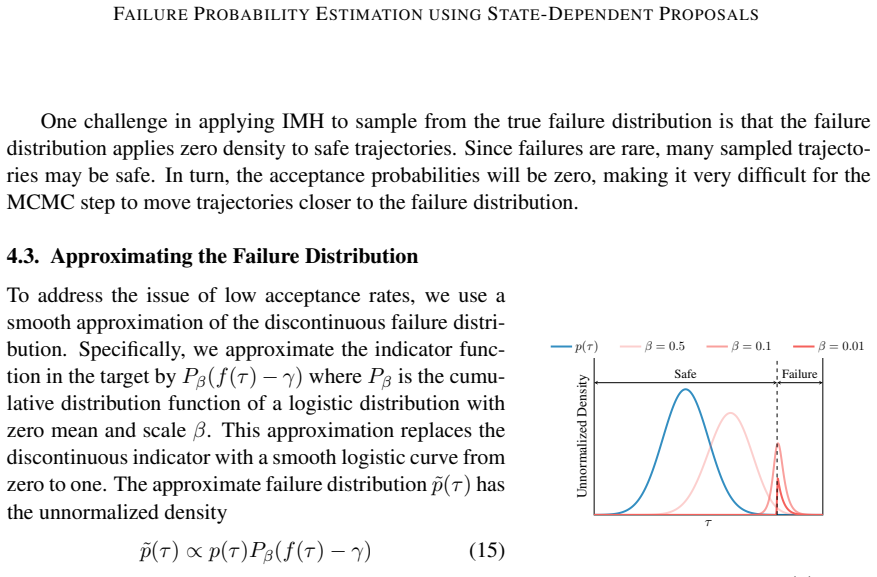
The central object is the sequential state-dependent proposal $q_\theta(x \mid s)$, a multivariate Gaussian whose mean and covariance are neural networks of the state; it makes importance weights factorize across timesteps, turning the trajectory-fitting problem into conditional density estimation. The mechanism carrying the argument is the forward-KL objective with the relaxed failure distribution $\tilde p(\tau) \propto p(\tau)P_\beta(f(\tau)-\gamma)$, where $P_\beta$ is the logistic CDF with scale $\beta$, optimized via Markov score ascent using an Independent Metropolis-Hastings kernel. The IMH acceptance ratio $\min(1, \tilde w(\tau')/\tilde w(\tau))$ uses unnormalized weights under the relaxed target, avoiding any need for the normalizing constant, and the logistic relaxation keeps acceptance rates from collapsing to zero when proposed trajectories are safe.
What would settle it
Re-run the algorithm with a control variant that recomputes all particle weights under the current proposal $\theta_k$ before every IMH acceptance step and compare the resulting failure probability estimates and acceptance rates on the four benchmark problems; if they differ materially, the stale-weight shortcut is load-bearing rather than harmless.
Extended reading notes
Core claim
The central claim is that a state-conditioned proposal $q_\theta(x \mid s)$, where $x$ is a disturbance and $s$ is the current state, can be trained to approximate the optimal importance sampling distribution over failure trajectories by minimizing the forward KL divergence to the relaxed target $\tilde p(\tau) \propto p(\tau)P_\beta(f(\tau)-\gamma)$. Because the nominal trajectory density and the proposal density share all transition, observation, and policy factors, the importance weight collapses to $\prod_t d(x_t \mid s_t)/q_\theta(x_t \mid s_t)$, so learning the proposal reduces to fitting a per-timestep conditional density. Markov score ascent supplies low-variance gradients by running a single-step IMH kernel whose acceptance ratio uses unnormalized weights under the relaxed target, and the same MCMC samples are used to form the final importance sampling estimate. The experiments report that SPAIS achieves under 10% empirical bias and at least 2x lower variance than the baselines on all four systems, including two where a state-independent CEM proposal misses failure modes through mode collapse.
Load-bearing premise
The load-bearing premise is that reusing importance weights computed under older versions of the proposal in the acceptance step does not bias the accepted trajectories away from the failure distribution the algorithm is trying to sample.
Editorial extensions
If this is right
- Failure probability estimates with under 10% bias and at least 2x lower variance than baselines become practical for sequential systems with continuous state spaces and horizons up to 200 timesteps, where naive Monte Carlo would need billions of samples.
- Because the proposal is state-dependent, SPAIS can cover multiple failure modes (e.g., the pendulum falling left and right) rather than collapsing onto a single mode as CEM and PG-AIS do in the reported experiments.
- Since the systems are treated as black boxes, the method applies to non-differentiable simulators and controllers whose internal logic is unknown, provided disturbances can be injected and trajectories scored.
- The IS buffer formed from all training proposals provides the final estimate, so no separate evaluation phase is required after training completes.
- The paper states that the implementation is open sourced, allowing others to reproduce the experiments and apply the method to new systems.
Reading between the lines
- The algorithm's correctness rests on the IMH step reusing weights computed under earlier proposal parameters; a version that recomputes all stored weights under the current proposal at each iteration would reveal whether the reported accuracy depends on this stale-weight shortcut, and the paper does not demonstrate that the MCMC chain actually mixes to the relaxed failure distribution.
- Pooling samples from multiple proposals into a single IS buffer is a valid multiple importance sampling estimator only when every sample is weighted by its own proposal density, a property the paper does not state explicitly or analyze for variance.
- The same state-dependent proposal and forward-KL objective could be extended to proposals conditioned on observations or actions, or to non-Gaussian families such as normalizing flows, which would likely help on highly multimodal failure distributions.
- A testable extension is to vary the relaxation scale $\beta$ and the number of MCMC steps per iteration; the paper fixes $\beta = 10^{-2}$ and one step, so the sensitivity of the bias and variance claims to these choices remains unknown.
Signed reviews
Editorial analysis
A structured set of objections, weighed in public.
Referee Report
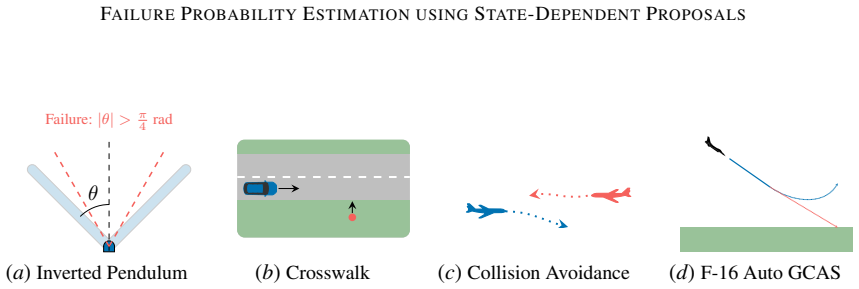
Summary. The paper proposes SPAIS, an adaptive importance sampling method for estimating failure probabilities of sequential black-box systems. The method uses a state-dependent Gaussian proposal q_theta(x|s), optimized by minimizing the forward KL divergence to a relaxed failure distribution via a Markov score ascent procedure that employs Independent Metropolis-Hastings steps. The final estimate is an importance sampling average over a buffer of all proposed trajectories, weighted by p(τ)/q_theta(τ). The authors evaluate on four systems (inverted pendulum, crosswalk, collision avoidance, F-16 GCAS) and report lower relative and absolute errors than Monte Carlo, the cross-entropy method, and a policy-gradient-based AIS baseline.
Significance. If the method is sound, it addresses a practically important problem: rare-event probability estimation for high-dimensional sequential systems with black-box dynamics. The paper's strengths include an open-source implementation, a clear decomposition of the proposal into state-dependent components, and empirical results on four diverse benchmarks that show substantial improvements over baselines. The final importance-sampling estimator is unbiased if the proposals have full support, which is a valuable property. However, the central theoretical justification is undermined by a flaw in the MCMC update (detailed below), so the paper's claimed link between the optimized proposal and the forward-KL objective is not established as written.
major comments (4)
- [Algorithm 1 and §4.3, eq. (14)] The same issue appears in §4.3 where the text says the acceptance probability can be computed using w̃(τ) = p̃(τ)/q_θ(τ); this is only true if the q_θ used to compute both numerator and denominator is the same. The algorithm violates this condition.
- [Algorithm 1 in general] The theoretical claims in Section 4.2 should be rewritten to accurately describe what the algorithm guarantees, given this issue.
- [Section 5.1 and Table 2] The evaluation metric labeled 'absolute error' is actually absolute relative error (ϵ_abs = |μ̂ − μ|/μ). While the definition is given correctly, the text and table caption call it 'absolute error,' which is misleading. This is a presentation issue, but it affects the interpretation of Table 2 in the main results.
- [Section 4.4, hyperparameters] The paper states that 'any small value of β in the range [10^{-4}, 10^{-2}] gives good performance' but provides no sensitivity analysis. Since the relaxed target p̃ is used both for the MCMC kernel and for the loss, the choice of β may affect both the optimization trajectory and the quality of the final IS estimate. A brief sensitivity study or at least a plot of performance vs. β would strengthen the empirical claims.
minor comments (4)
- [Abstract and Section 1] The abstract says the method is 'more accurate with fewer samples than MC,' but all methods in Table 2 use the same number of samples (50,000 per trial). The claim of 'fewer samples' appears to refer to the left panel of Figure 1, which shows training progress, but this is not a direct sample-efficiency comparison. Consider clarifying the statement.
- [Section 4.2, eq. (13)] The expansion of the loss to eq. (13) is correct, but it would be helpful to explicitly state that the term log p(s1) and the transition probabilities cancel or do not depend on θ, to avoid confusion for readers unfamiliar with the sequential factorization.
- [Section 6, Figure 4] The figure captions describe the CEM and SPAIS proposals, but the color bars are not labeled in the main text; adding explicit colorbar labels (e.g., 'disturbance magnitude' in each subplot) would improve readability.
- [General] There are a few grammatical slips, such as 'We find using any small value of β in the range [10^{-4}, 10^{-2}] gives good performance' (missing 'that') and 'the algorithm samples N new proposal trajectories τ′' (the symbols should be τ'_n). These do not affect correctness but should be cleaned up.
Circularity Check
No significant circularity: SPAIS's failure-probability estimate is an unbiased IS average, and proposal training targets an externally defined relaxed failure distribution; self-citations are not load-bearing.
full rationale
SPAIS's estimator is the standard unbiased IS average of eq. (6) with weights w(τ)=p(τ)/qθ(τ), where qθ is the sequential proposal defined in eqs. (7)-(8). The proposal is trained by minimizing the forward-KL/cross-entropy objective eq. (16) against p̃ ∝ p(τ)Pβ(f(τ)-γ), a relaxation of the failure distribution that is defined externally in terms of p, f, and γ, not in terms of the output estimate. No fitted parameter is renamed as a prediction: β is a hand-set smoothing constant, and θ is optimized before the IS estimate is computed, with the estimate itself being an unbiased Monte Carlo average over buffered samples. The only self-referential aspect is the standard adaptive-IS/Markov-score-ascent loop in which the current proposal generates MCMC samples used to improve the proposal; this is a training dynamics, not a definitional reduction. Self-citations (e.g., prior work from the same lab on adaptive stress testing and baselines) appear in related work and baseline comparisons, but they are not load-bearing for the derivation. A possible technical concern about stale IMH weights in Algorithm 1 is a correctness/detailed-balance issue, not a circularity, and does not make the estimator definitionally dependent on its own output.
Assumptions & free parameters
free parameters (3)
- Logistic scale beta =
1e-2
- Proposal network architecture =
two hidden layers of size 64 and 32
- Particle count N and iterations Niter =
not reported, total 5e4 samples per trial
assumptions (5)
- standard math Importance sampling weights require qθ(x|s)>0 wherever d(x|s)1{failure}>0
- domain assumption The disturbance distribution d(x|s) is known
- ad hoc to paper The logistic relaxation Pβ(f(τ)-γ) with small β is a faithful surrogate for the true indicator
- ad hoc to paper Stored MH weights remain valid after proposal updates
- standard math Markov score ascent theory applies to this IMH-based estimator
Cite this review
Pith. "Pith review of Failure Probability Estimation for Black-Box Autonomous Systems using State-Dependent Importance Sampling Proposals." pith.science (2026). https://pith.science/paper/6ZQJCDOY
@misc{pith2026241202154,
  author       = {Pith},
  title        = {Pith review of: Failure Probability Estimation for Black-Box Autonomous Systems using State-Dependent Importance Sampling Proposals},
  year         = {2026},
  howpublished = {\url{https://pith.science/paper/6ZQJCDOY}},
  note         = {Machine review of arXiv:2412.02154}
}
read the original abstract
Estimating the probability of failure is a critical step in developing safety-critical autonomous systems. Direct estimation methods such as Monte Carlo sampling are often impractical due to the rarity of failures in these systems. Existing importance sampling approaches do not scale to sequential decision-making systems with large state spaces and long horizons. We propose an adaptive importance sampling algorithm to address these limitations. Our method minimizes the forward Kullback-Leibler divergence between a state-dependent proposal distribution and a relaxed form of the optimal importance sampling distribution. Our method uses Markov score ascent methods to estimate this objective. We evaluate our approach on four sequential systems and show that it provides more accurate failure probability estimates than baseline Monte Carlo and importance sampling techniques. This work is open sourced.
Figures

Figures from the paper (1 more)

Reference graph
Works this paper leans on
-
[1]
Falsification of cyber-physical systems using deep reinforcement learning
Takumi Akazaki, Shuang Liu, Yoriyuki Yamagata, Yihai Duan, and Jianye Hao. Falsification of cyber-physical systems using deep reinforcement learning. In International Symposium on Formal Methods (FM), pages 456--465. Springer, 2018
work page 2018
-
[2]
Claudine Badue, R \^a nik Guidolini, Raphael Vivacqua Carneiro, Pedro Azevedo, Vinicius B Cardoso, Avelino Forechi, Luan Jesus, Rodrigo Berriel, Thiago M Paixao, Filipe Mutz, et al. Self-driving cars: A survey. Expert Systems with Applications, 165: 0 113816, 2021
work page 2021
-
[3]
Adaptive importance sampling: The past, the present, and the future
Monica F Bugallo, Victor Elvira, Luca Martino, David Luengo, Joaquin Miguez, and Petar M Djuric. Adaptive importance sampling: The past, the present, and the future. IEEE Signal Processing Magazine, 34 0 (4): 0 60--79, 2017
work page 2017
-
[4]
Olivier Capp \'e , Arnaud Guillin, Jean-Michel Marin, and Christian P Robert. Population M onte C arlo. Journal of Computational and Graphical Statistics, 13 0 (4): 0 907--929, 2004
work page 2004
-
[5]
James P. Chryssanthacopoulos, Mykel J. Kochenderfer, and Richard E. Williams. Improved Monte Carlo sampling for conflict probability estimation. In AIAA Non-Deterministic Approaches Conference, 2010. doi:10.2514/6.2010-3012
-
[6]
Edmund M. Clarke, Thomas A. Henzinger, Helmut Veith, and Roderick Bloem. Handbook of Model Checking . Springer, 2018
work page 2018
-
[7]
A survey of algorithms for black-box safety validation of cyber-physical systems
Anthony Corso, Robert Moss, Mark Koren, Ritchie Lee, and Mykel Kochenderfer. A survey of algorithms for black-box safety validation of cyber-physical systems. Journal of Artificial Intelligence Research, 72: 0 377--428, 2021
work page 2021
-
[8]
A Deep Reinforcement Learning Approach to Rare Event Estimation
Anthony Corso, Kyu-Young Kim, Shubh Gupta, Grace Gao, and Mykel J Kochenderfer. A deep reinforcement learning approach to rare event estimation. arXiv preprint arXiv:2211.12470, 2022
work page Pith review arXiv 2022
Show all 27 references
-
[9]
Testing cyber-physical systems through B ayesian optimization
Jyotirmoy Deshmukh, Marko Horvat, Xiaoqing Jin, Rupak Majumdar, and Vinayak S Prabhu. Testing cyber-physical systems through B ayesian optimization. ACM Transactions on Embedded Computing Systems (TECS), 16 0 (5s): 0 1--18, 2017
2017
-
[10]
W. K. Hastings. M onte C arlo sampling methods using M arkov chains and their applications. Biometrika, 57: 0 97--109, 1970
1970
-
[11]
Verification challenges in F -16 ground collision avoidance and other automated maneuvers
Peter Heidlauf, Alexander Collins, Michael Bolender, and Stanley Bak. Verification challenges in F -16 ground collision avoidance and other automated maneuvers. In I nternational W orkshop on A pplied V erification for C ontinuous and H ybrid S ystems at the C onference on A n...
2018
-
[12]
Markov chain score ascent: A unifying framework of variational inference with markovian gradients
Kyurae Kim, Jisu Oh, Jacob Gardner, Adji Bousso Dieng, and Hongseok Kim. Markov chain score ascent: A unifying framework of variational inference with markovian gradients. In Advances in Neural Information Processing Systems (NeurIPS), volume 35, 2022
2022
-
[13]
Kochenderfer, Jessica E
Mykel J. Kochenderfer, Jessica E. Holland, and James P. Chryssanthacopoulos. Next-Generation Airborne Collision Avoidance System . Lincoln Laboratory Journal, 19 0 (1), 2012
2012
-
[14]
Adaptive stress testing for autonomous vehicles
Mark Koren, Saud Alsaif, Ritchie Lee, and Mykel J Kochenderfer. Adaptive stress testing for autonomous vehicles. In IEEE Intelligent Vehicles Symposium (IV), pages 1--7. IEEE, 2018
2018
-
[15]
Mengshoel, Anshu Saksena, Ryan Gardner, Daniel Genin, Joshua Silbermann, Michael Owen, and Mykel J
Ritchie Lee, Ole J. Mengshoel, Anshu Saksena, Ryan Gardner, Daniel Genin, Joshua Silbermann, Michael Owen, and Mykel J. Kochenderfer. Adaptive stress testing: Finding likely failure events with reinforcement learning. Journal of Artificial Intelligence Research, 69: 0 1165--1201, 2020
2020
-
[16]
Markovian score climbing: Variational inference with kl(p q)
Christian Naesseth, Fredrik Lindsten, and David Blei. Markovian score climbing: Variational inference with kl(p q) . In Advances in Neural Information Processing Systems (NeurIPS), volume 33, 2020
2020
-
[17]
Efficient black-box assessment of autonomous vehicle safety
Justin Norden, Matthew O'Kelly, and Aman Sinha. Efficient black-box assessment of autonomous vehicle safety. arXiv preprint arXiv:1912.03618, 2019
1912 arXiv
-
[18]
Safe and effective importance sampling
Art Owen and Yi Zhou. Safe and effective importance sampling. Journal of the American Statistical Association, 95 0 (449): 0 135--143, 2000
2000
-
[19]
Owen, Adam Panken, Robert Moss, Luis Alvarez, and Charles Leeper
Michael P. Owen, Adam Panken, Robert Moss, Luis Alvarez, and Charles Leeper. ACAS Xu: Integrated Collision Avoidance and Detect and Avoid Capability for UAS . In IEEE/AIAA Digital Avionics Systems Conference (DASC), pages 1--10, 2019
2019
-
[20]
The Cross-Entropy Method: A Unified Approach to Combinatorial Optimization, M onte- C arlo Simulation, and Machine Learning
Reuven Y Rubinstein and Dirk P Kroese. The Cross-Entropy Method: A Unified Approach to Combinatorial Optimization, M onte- C arlo Simulation, and Machine Learning . Springer, 2004
2004
-
[21]
Automated Theorem Proving in Software Engineering
Johann M Schumann. Automated Theorem Proving in Software Engineering . Springer, 2001
2001
-
[22]
Neural bridge sampling for evaluating safety-critical autonomous systems
Aman Sinha, Matthew O'Kelly, Russ Tedrake, and John C Duchi. Neural bridge sampling for evaluating safety-critical autonomous systems. Advances in Neural Information Processing Systems (NeurIPS), 33: 0 6402--6416, 2020
2020
-
[23]
AVOIDDS : Aircraft vision-based intruder detection dataset and simulator
Elysia Smyers, Sydney Katz, Anthony Corso, and Mykel J Kochenderfer. AVOIDDS : Aircraft vision-based intruder detection dataset and simulator. In Advances in Neural Information Processing Systems (NeurIPS), volume 36, 2023
2023
-
[24]
Congested traffic states in empirical observations and microscopic simulations
Martin Treiber, Ansgar Hennecke, and Dirk Helbing. Congested traffic states in empirical observations and microscopic simulations. Physical Review E, 62: 0 1805, 2000
2000
-
[25]
Rapidly-exploring random trees for testing automated vehicles
Cumhur Erkan Tuncali and Georgios Fainekos. Rapidly-exploring random trees for testing automated vehicles. In IEEE International Conference on Intelligent Transportation Systems (ITSC), pages 661--666, 2019
2019
-
[26]
Rigorous agent evaluation: An adversarial approach to uncover catastrophic failures
Jonathan Uesato, Ananya Kumar, Csaba Szepesv \' a ri, Tom Erez, Avraham Ruderman, Keith Anderson, Krishnamurthy Dvijotham, Nicolas Heess, and Pushmeet Kohli. Rigorous agent evaluation: An adversarial approach to uncover catastrophic failures. In International Conference on Lea...
2019
-
[27]
A survey on the application trends of home service robotics
Georgios A Zachiotis, George Andrikopoulos, Randy Gornez, Keisuke Nakamura, and George Nikolakopoulos. A survey on the application trends of home service robotics. In IEEE International Conference on Robotics and Biomimetics (ROBIO), pages 1999--2006, 2018
1999
Reviewed August 11, 2026 · model on record in the stance chip above.
Discussion (0). Continue with ORCID to comment.