REVIEW 3 major objections 4 minor 259 references
A charge-migration fix to JWST NIRISS yields a metal-rich ultra-hot Jupiter with H2O, CO2 and TiO, not H- or clouds.
Reviewed by Pith at T0; open to challenge. T0 means a machine referee read the full paper against a public rubric. the ladder, T0–T4 →
T0 review · grok-4.5
2026-07-10 22:56 UTC pith:77GNWEX5
load-bearing objection Solid multi-instrument UHJ spectrum with a practical charge-migration fix that resolves prior HST/JWST tensions; high-M/H claim is data-driven but rests on the late-ramp-fit continuum and still-unreconciled C/O. the 3 major comments →
Mitigating Charge Migration in JWST NIRISS Reveals That KELT-7 b is a Metal-enriched Ultra-hot Jupiter Orbiting a Young Metal-rich Star
The pith
A machine-rendered reading of the paper's core claim, the machinery that carries it, and where it could break.
Core claim
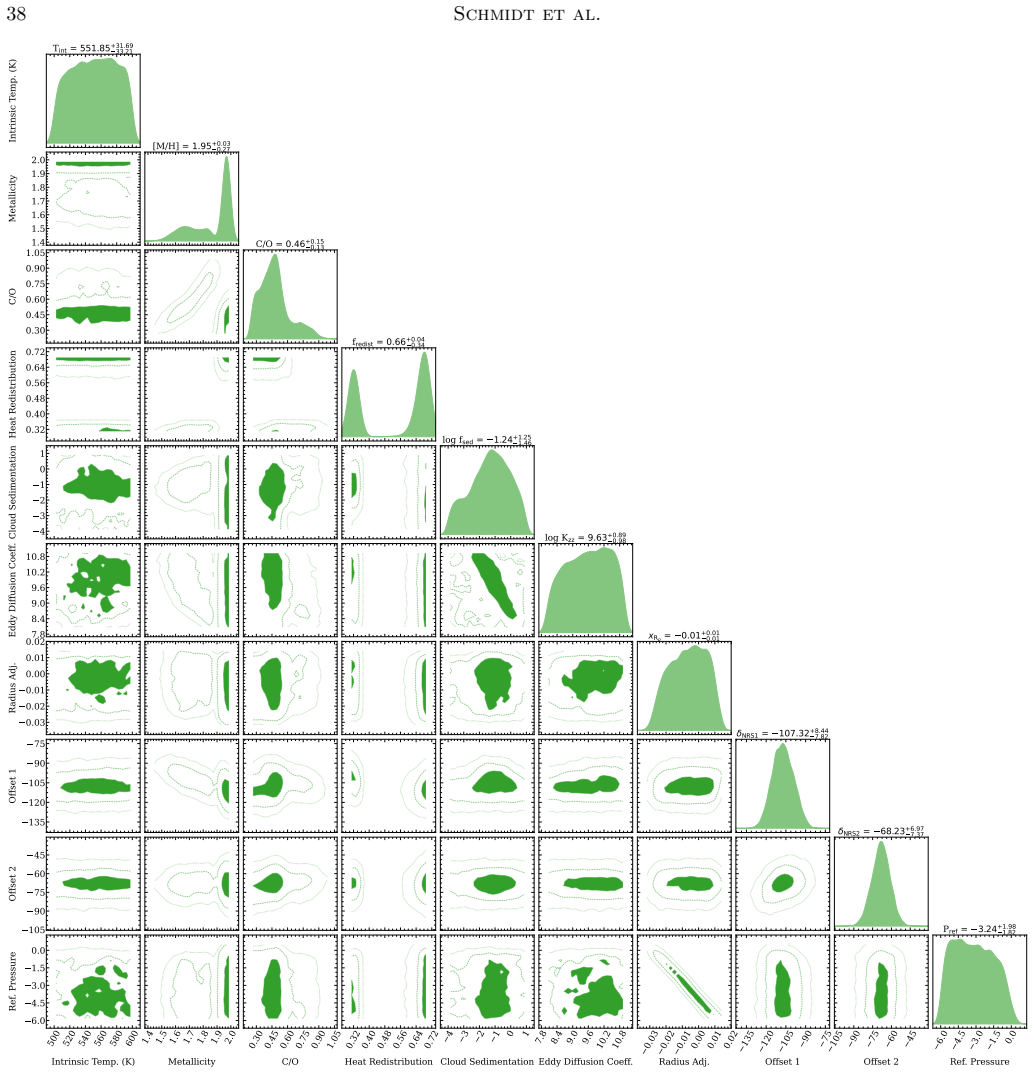
After correcting NIRISS charge migration with a late-ramp-fit, the first full 0.2-5 µm transmission spectrum of the ultra-hot Jupiter KELT-7 b yields decisive evidence for H2O, strong evidence for CO2 and high-temperature species dominated by TiO, no detection of enhanced H- or clouds, and an agglomerated atmospheric metallicity of 92+24-23 times solar with C/O ≤ 0.9.
What carries the argument
The late-ramp-fit: extract 1-D stellar spectra by summing the cross-dispersion direction at the individual-group level, then perform the ramp fit on the resulting 1-D reads so that vertically migrated charges are counted in their correct wavelength bins.
Load-bearing premise
That simply summing the detector columns before the ramp fit fully recovers the true photon counts and leaves no residual nonlinearity or new systematics in the 1-1.5 µm baseline that drives the high-metallicity and no-H- conclusions.
What would settle it
An independent reduction of the same NIRISS SOSS data that either (a) applies a different charge-migration model and recovers significantly shallower 1-1.5 µm depths, or (b) obtains a low-metallicity, cloudy or H--rich atmosphere when the corrected spectrum is re-retrieved.
Editorial analysis
A structured set of objections, weighed in public.
Referee Report
Summary. The paper presents the first panchromatic (HST WFC3/UVIS G280 + JWST NIRISS/SOSS + NIRSpec/G395H) transmission spectrum of the ultra-hot Jupiter KELT-7 b. It identifies charge migration (brighter-fatter effect) in the NIRISS data between 1–1.5 μm, mitigates it via a “late-ramp-fit” (group-level 1-D spectral extraction before ramp fitting), and obtains a higher-S/N continuum in that range. Updated stellar inference using the transit-derived mean density yields a young (640 ± 100 Myr), metal-rich ([Fe/H] = 0.46 ± 0.02) host. Free retrievals (POSEIDON) find decisive evidence for H2O, strong evidence for CO2 and high-temperature species (dominated by TiO), but no enhanced H− or clouds; equilibrium retrievals (POSEIDON, petitRADTRANS) plus a PICASO self-consistent grid fit jointly prefer super-stellar M/H ≈ 92× Solar and C/O ≤ 0.9. GCMs attribute the lack of limb asymmetry to a super-rotating jet. The work argues that prior HST G141 analyses were biased by unaccounted systematics and that broad wavelength coverage is essential.
Significance. If the late-ramp-fit continuum and the resulting high-metallicity, cloud-free, H−-free atmosphere hold, the paper delivers both a methodological advance (a practical, pipeline-agnostic correction for charge migration near detector limits, shown to apply also to NIRSpec) and a scientifically important atmospheric characterization of an UHJ. The multi-pipeline (FIREFLy/Eureka!) agreement, nested free-retrieval Bayes factors, three independent equilibrium frameworks, and supporting GCMs constitute a thorough analysis that resolves prior tensions between HST and NIRSpec subsets. The super-stellar metallicity and young metal-rich host have clear formation implications (late-stage metal accretion). These strengths—reproducible dual reductions, multi-code consistency checks, and falsifiable GCM predictions of limb symmetry—make the result high-impact for JWST exoplanet spectroscopy if the continuum recovery is robust.
major comments (3)
- [Section 2, Figures 1–3] Section 2 and Figures 1–3: The late-ramp-fit is the load-bearing step that sets the 1–1.5 μm continuum against which high M/H, the absence of H−, and the molecular detections are measured. The paper demonstrates qualitative charge conservation and agreement with early reads, yet provides no quantitative residual budget: (i) fraction of migrated charge falling outside the extraction apertures (31 px FIREFLy / 37 px Eureka!), (ii) residual A/D or pedestal nonlinearity after summation, or (iii) any wavelength-dependent kernel that survives the sum. A residual shallowing of even 20–50 ppm would systematically lower the inferred metallicity and reopen the H− solution preferred by prior G141 work. A controlled injection-recovery test or aperture-growth residual map is required before the continuum (and therefore the central atmospheric claim) can be trusted at the claimed precision.
- [Section 6.5, Table 4, Figure 11] Section 6.5 and Table 4 / Figure 11: The three equilibrium analyses (POSEIDON, petitRADTRANS, PICASO) agree on high metallicity but return discrepant C/O posteriors (0.21, 0.73, and a broad uninformative range). The paper attributes this to differences in temperature, included oxygen-bearing species, and metallicity definitions, then “agglomerates” by equal weighting to claim C/O ≤ 0.9. Equal weighting of mutually inconsistent posteriors is not statistically justified; either a hierarchical combination that marginalizes over model differences or an explicit statement that C/O remains unconstrained is needed. Without it the formation interpretation (late metal accretion) rests on an incompletely justified upper limit.
- [Section 6.2] Section 6.2 free-retrieval results: The decisive stellar-contamination detection (log10 B = 8.96) is driven almost entirely by the bluest UVIS points and yields f_het ≈ 0.25 with T_het > T_phot, which the authors themselves flag as “likely unphysical.” Because the free retrieval also supplies the TiO detection that motivates the PICASO grid, residual UVIS systematics (or an incomplete stellar-contamination model) could bias the high-temperature species abundances. A retrieval that freezes stellar contamination to zero (or uses only NIRISS+NIRSpec) should be shown to confirm that the TiO and metallicity posteriors are robust.
minor comments (4)
- [Table 1] Table 1: Eureka! and FIREFLy white-light orbital parameters differ at several sigma (a/R*, b, i). The text attributes this to limb-darkening choice; a short quantitative test (common limb-darkening law) would clarify whether the spectroscopic spectra remain consistent under a shared ephemeris.
- [Figure 15, Section 8] Figure 15 and Section 8: The claim that many WFC3/IR G141 spectra of hot Jupiters show a similar 1.5–1.7 μm shallowing is intriguing but currently supported only by a qualitative reference to Edwards et al. (2023). A quantitative residual plot or citation of a re-reduction campaign would strengthen the instrumental-systematic interpretation.
- [Appendix A] Appendix A / Figure 16: The NIRSpec PRISM charge-migration demonstration is useful; stating the extraction aperture used and whether the late-ramp-fit was actually applied to TOI-5205 would make the generality claim more concrete.
- Throughout: minor typographical inconsistencies (e.g., “KEL T-7”, “Y oung”, “Gasc´ on”) and occasional missing units in figure axes should be cleaned for production.
Circularity Check
No significant circularity: metallicity and species detections are driven by new NIRISS continuum plus multi-code retrievals on independent data; late-ramp-fit is an empirical correction, not a definitional loop.
full rationale
The paper's central atmospheric claims (super-stellar M/H ~92x Solar, decisive H2O, strong CO2/TiO, no enhanced H- or clouds) rest on the panchromatic spectrum after the late-ramp-fit correction for charge migration. That correction is an empirical data-reduction step: group-level 1-D extraction before ramp fitting is justified by observed vertical charge redistribution (Figs. 1-2) and validated by agreement of early reads with the final spectrum (Fig. 3) plus cross-pipeline consistency (FIREFLy vs Eureka!, Fig. 5). It does not define metallicity or species abundances; those are free parameters (or equilibrium chemistry parameters) fitted to the corrected spectrum plus archival NIRSpec and re-reduced UVIS data using standard external opacity tables and nested sampling. Instrument offsets are free parameters, not forced to produce high M/H. Stellar density from a/R* is a standard Kepler-law constraint fed into isochrone fitting; GCMs are forward models that explain (not force) the lack of limb asymmetry. Self-citations are to pipelines, prior KELT-7 reductions, and opacity sources that are independently available; none close a definitional loop on the atmospheric result. The derivation chain is therefore self-contained against external benchmarks and does not reduce by construction to its inputs.
Axiom & Free-Parameter Ledger
free parameters (6)
- Instrumental transit-depth offsets (NIRISS-NIRSpec NRS1/NRS2, NIRISS-UVIS)
- T(P) profile parameters (Madhusudhan-Seager or Guillot)
- Atmospheric metallicity and C/O (equilibrium) or log VMRs of 15 species (free)
- Cloud/aerosol parameters (Al2O3 VMR, particle size, slab extent, fsed, Kzz)
- Stellar contamination (f_het, T_het, T_phot)
- Limb-darkening offsets and common-mode filter width
axioms (4)
- domain assumption Hydrostatic equilibrium with reference pressure fixed at 10^-3 bar (or similar) sets the radius scale
- domain assumption Opacity line lists (ExoMol POKAZATEL H2O, etc.) and continuum CIA/Rayleigh are complete and accurate at UHJ temperatures
- ad hoc to paper Vertical charge migration is the dominant nonlinearity and is fully captured by summing the spatial direction before ramp fit
- domain assumption Chemical equilibrium (or free VMR) plus the chosen high-T species set adequately describe the atmosphere
read the original abstract
We present the first panchromatic JWST transmission spectrum of an ultra-hot Jupiter, combining NIRISS and NIRSpec observations to constrain KELT-7\,b's atmospheric properties. We show evidence for charge migration in our NIRISS SOSS observation between 1--1.5~$\mu$m, a wavelength range crucial to test for enhanced H$^-$ previously inferred from HST WFC3/IR G141 observations. We mitigate charge migration by fitting the ramp after extracting 1D stellar spectra at the group level. This ``late-ramp-fit'' method accurately calculates KELT-7\,b's transmission spectrum between 1--1.5~$\mu$m at higher signal-to-noise. Using the transit-derived stellar mean density during stellar property inference reveals that KELT-7 is a $640\pm100$ Myr-old, $[\text{Fe}/\text{H}]=0.46\pm0.02$ star. Combined with NIRSpec and re-reduced WFC3/UVIS G280 data, our free retrieval analysis shows strong evidence for H$_2$O, CO$_2$, and TiO among high-temperature species, but not H$^-$ or clouds. Unaccounted-for systematics may therefore bias longer-wavelength WFC3/IR G141 transit depths shallower. Our free retrieval, two equilibrium retrievals, and self-consistent grid fit all prefer a high metallicity but find discrepant C/O ratios. Agglomerated together, we constrain a super-stellar $\text{M/H}=92^{+24}_{-23}\times$~Solar and C/O~$\leq0.9$, suggesting enhanced metal accretion in the later stages of KELT-7\,b's formation. Our GCMs explain the observed lack of limb asymmetry with superrotating jet-driven efficient horizontal mixing. The stark contrast between our panchromatic analysis and prior analyses on subsets of these data demonstrates the value of broad wavelength coverage for the comprehensive study of exoplanet atmospheres.
Figures


Reference graph
Works this paper leans on
-
[1]
The Revised TESS Input Catalog and Candidate Target List
The Revised TESS Input Catalog and Candidate Target List. , keywords =. doi:10.3847/1538-3881/ab3467 , archivePrefix =. 1905.10694 , primaryClass =
work page internal anchor Pith review Pith/arXiv arXiv doi:10.3847/1538-3881/ab3467 1905
-
[2]
Accurate, Empirical Radii and Masses of Planets and their Host Stars with Gaia Parallaxes
Accurate Empirical Radii and Masses of Planets and Their Host Stars with Gaia Parallaxes. , keywords =. doi:10.3847/1538-3881/aa5df3 , archivePrefix =. 1609.04389 , primaryClass =
work page internal anchor Pith review Pith/arXiv arXiv doi:10.3847/1538-3881/aa5df3
-
[3]
Implementation of Aerosol Mie Scattering in POSEIDON with Application to the Hot Jupiter HD 189733 b's Transmission, Emission, and Reflected Light Spectrum. , keywords =. doi:10.3847/1538-4357/ad8575 , archivePrefix =. 2410.19253 , primaryClass =
work page internal anchor Pith review Pith/arXiv arXiv doi:10.3847/1538-4357/ad8575
-
[4]
, title =. 1986 , month = jun, pages =. doi:10.1086/131801 , keywords =
-
[5]
Carbon-bearing Molecules in a Possible Hycean Atmosphere
, title =. 2023 , month = oct, number =. arXiv , doi =:2309.05566 , keywords =
work page internal anchor Pith review Pith/arXiv arXiv 2023
-
[6]
Space Telescopes and Instrumentation 2012: Optical, Infrared, and Millimeter Wave , title =. 2012 , editor =. doi:10.1117/12.926578 , eid =
-
[7]
, title =. 2023 , month = sep, number =. arXiv , doi =:2306.03277 , keywords =
work page internal anchor Pith review Pith/arXiv arXiv 2023
-
[8]
, title =. 2022 , month = feb, number =. arXiv , doi =:2202.01714 , keywords =
work page internal anchor Pith review Pith/arXiv arXiv 2022
-
[9]
, title =. 2023 , month = jul, number =. arXiv , doi =:2306.04572 , keywords =
work page internal anchor Pith review Pith/arXiv arXiv 2023
-
[10]
HD 209458b in New Light: Evidence of Nitrogen Chemistry, Patchy Clouds and Sub-Solar Water
HD 209458b in new light: evidence of nitrogen chemistry, patchy clouds and sub-solar water. , keywords =. 2017. doi:10.1093/mnras/stx804 , archivePrefix =. 1701.01113 , primaryClass =
work page internal anchor Pith review Pith/arXiv arXiv doi:10.1093/mnras/stx804 2017
-
[11]
TRIDENT: A Rapid 3D Radiative Transfer Model for Exoplanet Transmission Spectra
TRIDENT: A Rapid 3D Radiative-transfer Model for Exoplanet Transmission Spectra. , keywords =. doi:10.3847/1538-4357/ac47fe , archivePrefix =. 2111.05862 , primaryClass =
work page internal anchor Pith review Pith/arXiv arXiv doi:10.3847/1538-4357/ac47fe
-
[12]
The Journal of Open Source Software , keywords =
POSEIDON: A Multidimensional Atmospheric Retrieval Code for Exoplanet Spectra. The Journal of Open Source Software , keywords =. doi:10.21105/joss.04873 , adsurl =
-
[13]
Eureka!: An End-to-End Pipeline for JWST Time-Series Observations
The Journal of Open Source Software , title =. 2022 , month = nov, number =. arXiv , doi =:2207.03585 , keywords =
work page internal anchor Pith review Pith/arXiv arXiv 2022
-
[14]
, title =. 2022 , month = mar, number =. arXiv , doi =:2203.04173 , keywords =
work page internal anchor Pith review Pith/arXiv arXiv 2022
-
[15]
Astropy: A Community Python Package for Astronomy
, title =. 2013 , month = oct, pages =. doi:10.1051/0004-6361/201322068 , eid =. arXiv , bdsk-url-1 =:1307.6212 , groups =
work page internal anchor Pith review Pith/arXiv arXiv doi:10.1051/0004-6361/201322068 2013
-
[16]
The Astropy Project: Building an inclusive, open-science project and status of the v2.0 core package
, title =. 2018 , month = sep, number =. doi:10.3847/1538-3881/aabc4f , eid =. arXiv , creationdate =:1801.02634 , groups =
work page internal anchor Pith review Pith/arXiv arXiv doi:10.3847/1538-3881/aabc4f 2018
-
[17]
, title =. 2022 , month = aug, number =. arXiv , doi =:2206.14220 , keywords =
work page internal anchor Pith review Pith/arXiv arXiv 2022
-
[18]
Computing in Science and Engineering , title =. 2007 , month = jan, number =. doi:10.1109/MCSE.2007.53 , groups =
-
[19]
batman: BAsic Transit Model cAlculatioN in Python
batman: BAsic Transit Model cAlculatioN in Python. , keywords =. doi:10.1086/683602 , archivePrefix =. 1507.08285 , primaryClass =
work page internal anchor Pith review Pith/arXiv arXiv doi:10.1086/683602
-
[20]
emcee: The MCMC Hammer. , keywords =. doi:10.1086/670067 , archivePrefix =. 1202.3665 , primaryClass =
work page internal anchor Pith review Pith/arXiv arXiv doi:10.1086/670067
-
[21]
ExoTiC-LD: thirty seconds to stellar limb-darkening coefficients
The Journal of Open Source Software , title =. 2024 , month = aug, number =. arXiv , doi =:2408.10341 , keywords =
work page internal anchor Pith review Pith/arXiv arXiv 2024
-
[22]
MPS-ATLAS library of stellar model atmospheres and spectra
Research Notes of the American Astronomical Society , title =. 2023 , month = mar, number =. arXiv , doi =:2303.02685 , keywords =
work page internal anchor Pith review Pith/arXiv arXiv 2023
-
[23]
MultiNest: an efficient and robust Bayesian inference tool for cosmology and particle physics
, title =. 2009 , month = oct, number =. arXiv , doi =:0809.3437 , keywords =
work page internal anchor Pith review Pith/arXiv arXiv 2009
-
[24]
X-ray spectral modelling of the AGN obscuring region in the CDFS: Bayesian model selection and catalogue. , keywords =. doi:10.1051/0004-6361/201322971 , archivePrefix =. 1402.0004 , primaryClass =
work page internal anchor Pith review Pith/arXiv arXiv doi:10.1051/0004-6361/201322971
-
[25]
SciPy 1.0: Fundamental Algorithms for Scientific Computing in Python
Virtanen, Pauli and Gommers, Ralf and Oliphant, Travis E. and Haberland, Matt and Reddy, Tyler and Cournapeau, David and Burovski, Evgeni and Peterson, Pearu and Weckesser, Warren and Bright, Jonathan and. Nature Methods , title =. 2020 , pages =. doi:10.1038/s41592-019-0686-2 , groups =
-
[26]
Jones, Eric and Oliphant, Travis and Peterson, Pearu and others , title =. 2024 , added-at =
work page 2024
-
[27]
Matplotlib: A 2D graphics environment , year =
Hunter, John D , journal =. Matplotlib: A 2D graphics environment , year =
-
[28]
The Library of Exoplanet Atmospheric Composition Measurements: Population-level Trends in Exoplanet Composition with ExoComp. , keywords =. doi:10.3847/1538-3881/ae1b8e , archivePrefix =. 2510.26785 , primaryClass =
-
[29]
Early Release Science of the exoplanet WASP-39b with JWST NIRSpec PRISM
, title =. 2023 , month = feb, number =. arXiv , doi =:2211.10487 , keywords =
work page internal anchor Pith review Pith/arXiv arXiv 2023
-
[30]
doi:10.5281/zenodo.598352 , eid =
-
[31]
Cosmic-Ray Rejection by Laplacian Edge Detection
, title =. 2001 , month = nov, number =. arXiv , doi =:astro-ph/0108003 , keywords =
work page internal anchor Pith review Pith/arXiv arXiv 2001
-
[32]
Charles R. Harris and K. Jarrod Millman and St. Nature , title =. 2020 , month = sep, number =. doi:10.1038/s41586-020-2649-2 , groups =
-
[33]
A Comprehensive Reanalysis of K2-18 b's JWST NIRISS+NIRSpec Transmission Spectrum
A Comprehensive Reanalysis of K2-18 b's JWST NIRISS+NIRSpec Transmission Spectrum. , keywords =. doi:10.3847/1538-3881/ae019a , archivePrefix =. 2501.18477 , primaryClass =
work page internal anchor Pith review Pith/arXiv arXiv doi:10.3847/1538-3881/ae019a
-
[34]
Estimating Distances from Parallaxes. V. Geometric and Photogeometric Distances to 1.47 Billion Stars in Gaia Early Data Release 3. , keywords =. doi:10.3847/1538-3881/abd806 , archivePrefix =. 2012.05220 , primaryClass =
work page internal anchor Pith review Pith/arXiv arXiv doi:10.3847/1538-3881/abd806 2012
-
[35]
Revised Catalog of GALEX Ultraviolet Sources. I. The All-Sky Survey: GUVcat\_AIS. , keywords =. doi:10.3847/1538-4365/aa7053 , archivePrefix =. 1704.05903 , primaryClass =
work page internal anchor Pith review Pith/arXiv arXiv doi:10.3847/1538-4365/aa7053
-
[36]
Kepler Input Catalog: Photometric Calibration and Stellar Classification
Kepler Input Catalog: Photometric Calibration and Stellar Classification. , keywords =. doi:10.1088/0004-6256/142/4/112 , archivePrefix =. 1102.0342 , primaryClass =
work page internal anchor Pith review Pith/arXiv arXiv doi:10.1088/0004-6256/142/4/112
-
[37]
New constraints on the chemical evolution of the solar neighbourhood and Galactic disc(s). Improved astrophysical parameters for the Geneva-Copenhagen Survey. , keywords =. doi:10.1051/0004-6361/201016276 , archivePrefix =. 1103.4651 , primaryClass =
work page internal anchor Pith review Pith/arXiv arXiv doi:10.1051/0004-6361/201016276
-
[38]
Galactic Stellar and Substellar Initial Mass Function
Galactic Stellar and Substellar Initial Mass Function. , keywords =. doi:10.1086/376392 , archivePrefix =. astro-ph/0304382 , primaryClass =
work page internal anchor Pith review Pith/arXiv arXiv doi:10.1086/376392
-
[39]
The Pan-STARRS1 Surveys. arXiv e-prints , keywords =. doi:10.48550/arXiv.1612.05560 , archivePrefix =. 1612.05560 , primaryClass =
work page internal anchor Pith review Pith/arXiv arXiv doi:10.48550/arxiv.1612.05560
-
[40]
Mesa Isochrones and Stellar Tracks (MIST). I. Solar-scaled Models. , keywords =. doi:10.3847/0004-637X/823/2/102 , archivePrefix =. 1604.08592 , primaryClass =
work page internal anchor Pith review Pith/arXiv arXiv doi:10.3847/0004-637x/823/2/102
-
[41]
Photometric Response Functions of the SDSS Imager
Photometric Response Functions of the Sloan Digital Sky Survey Imager. , keywords =. doi:10.1088/0004-6256/139/4/1628 , archivePrefix =. 1002.3701 , primaryClass =
work page internal anchor Pith review Pith/arXiv arXiv doi:10.1088/0004-6256/139/4/1628
-
[42]
MESA Isochrones and Stellar Tracks (MIST) 0: Methods for the construction of stellar isochrones
MESA Isochrones and Stellar Tracks (MIST) 0: Methods for the Construction of Stellar Isochrones. , keywords =. doi:10.3847/0067-0049/222/1/8 , archivePrefix =. 1601.05144 , primaryClass =
work page internal anchor Pith review Pith/arXiv arXiv doi:10.3847/0067-0049/222/1/8
-
[43]
Multimodal nested sampling: an efficient and robust alternative to Markov Chain Monte Carlo methods for astronomical data analyses. , keywords =. doi:10.1111/j.1365-2966.2007.12353.x , archivePrefix =. 0704.3704 , primaryClass =
-
[44]
2009, title Clustering of luminous red galaxies - III
MULTINEST: an efficient and robust Bayesian inference tool for cosmology and particle physics. , keywords =. doi:10.1111/j.1365-2966.2009.14548.x , archivePrefix =. 0809.3437 , primaryClass =
-
[45]
Importance Nested Sampling and the MultiNest Algorithm
Importance Nested Sampling and the MultiNest Algorithm. The Open Journal of Astrophysics , keywords =. doi:10.21105/astro.1306.2144 , archivePrefix =. 1306.2144 , primaryClass =
work page internal anchor Pith review Pith/arXiv arXiv doi:10.21105/astro.1306.2144
-
[46]
Hypercalibration: A Pan-STARRS1-based recalibration of the Sloan Digital Sky Survey
Hypercalibration: A Pan-STARRS1-based Recalibration of the Sloan Digital Sky Survey Photometry. , keywords =. doi:10.3847/0004-637X/822/2/66 , archivePrefix =. 1512.01214 , primaryClass =
work page internal anchor Pith review Pith/arXiv arXiv doi:10.3847/0004-637x/822/2/66
-
[47]
The Pan-STARRS1 Database and Data Products
The Pan-STARRS1 Database and Data Products. , keywords =. doi:10.3847/1538-4365/abb82d , archivePrefix =. 1612.05243 , primaryClass =
work page internal anchor Pith review Pith/arXiv arXiv doi:10.3847/1538-4365/abb82d
-
[48]
The Sloan Digital Sky Survey Photometric System. , keywords =. doi:10.1086/117915 , adsurl =
-
[51]
dustmaps: A Python interface for maps of interstellar dust. The Journal of Open Source Software , year = "2018", month = "Jun", volume =. doi:10.21105/joss.00695 , adsurl =
-
[52]
A 3D Dust Map Based on Gaia, Pan-STARRS 1 and 2MASS
A 3D Dust Map Based on Gaia, Pan-STARRS 1, and 2MASS. , keywords =. doi:10.3847/1538-4357/ab5362 , archivePrefix =. 1905.02734 , primaryClass =
work page internal anchor Pith review Pith/arXiv arXiv doi:10.3847/1538-4357/ab5362 1905
-
[53]
The 2.5 m Telescope of the Sloan Digital Sky Survey
The 2.5 m Telescope of the Sloan Digital Sky Survey. , keywords =. doi:10.1086/500975 , archivePrefix =. astro-ph/0602326 , primaryClass =
work page internal anchor Pith review Pith/arXiv arXiv doi:10.1086/500975
-
[54]
The Sloan Digital Sky Survey Photometric Camera
The Sloan Digital Sky Survey Photometric Camera. , keywords =. doi:10.1086/300645 , archivePrefix =. astro-ph/9809085 , primaryClass =
work page internal anchor Pith review Pith/arXiv arXiv doi:10.1086/300645
- [55]
-
[56]
Modules for Experiments in Stellar Astrophysics (MESA): Time-dependent Convection, Energy Conservation, Automatic Differentiation, and Infrastructure. , keywords =. doi:10.3847/1538-4365/acae8d , archivePrefix =. 2208.03651 , primaryClass =
work page internal anchor Pith review Pith/arXiv arXiv doi:10.3847/1538-4365/acae8d
-
[57]
Updated Gaia-2MASS 3D maps of Galactic interstellar dust
Updated Gaia-2MASS 3D maps of Galactic interstellar dust. , keywords =. doi:10.1051/0004-6361/202142846 , archivePrefix =. 2203.01627 , primaryClass =
work page internal anchor Pith review Pith/arXiv arXiv doi:10.1051/0004-6361/202142846
-
[58]
Gaia Early Data Release 3: Parallax bias versus magnitude, colour, and position
Gaia Early Data Release 3. Parallax bias versus magnitude, colour, and position. , keywords =. doi:10.1051/0004-6361/202039653 , archivePrefix =. 2012.01742 , primaryClass =
work page internal anchor Pith review Pith/arXiv arXiv doi:10.1051/0004-6361/202039653 2012
-
[59]
Gaia Early Data Release 3: The astrometric solution
Gaia Early Data Release 3. The astrometric solution. , keywords =. doi:10.1051/0004-6361/202039709 , archivePrefix =. 2012.03380 , primaryClass =
work page internal anchor Pith review Pith/arXiv arXiv doi:10.1051/0004-6361/202039709 2012
-
[60]
The Pan-STARRS Data Processing System
The Pan-STARRS Data-processing System. , keywords =. doi:10.3847/1538-4365/abb829 , archivePrefix =. 1612.05240 , primaryClass =
work page internal anchor Pith review Pith/arXiv arXiv doi:10.3847/1538-4365/abb829
-
[61]
Pan-STARRS Photometric and Astrometric Calibration
Pan-STARRS Photometric and Astrometric Calibration. , keywords =. doi:10.3847/1538-4365/abb82a , archivePrefix =. 1612.05242 , primaryClass =
work page internal anchor Pith review Pith/arXiv arXiv doi:10.3847/1538-4365/abb82a
-
[62]
Pan-STARRS Pixel Analysis : Source Detection and Characterization
Pan-STARRS Pixel Analysis: Source Detection and Characterization. , keywords =. doi:10.3847/1538-4365/abb82c , archivePrefix =. 1612.05244 , primaryClass =
work page internal anchor Pith review Pith/arXiv arXiv doi:10.3847/1538-4365/abb82c
-
[63]
Preliminary Results from NEOWISE: An Enhancement to the Wide-field Infrared Survey Explorer for Solar System Science. , keywords =. doi:10.1088/0004-637X/731/1/53 , archivePrefix =. 1102.1996 , primaryClass =
work page internal anchor Pith review Pith/arXiv arXiv doi:10.1088/0004-637x/731/1/53 1996
-
[64]
The Galaxy Evolution Explorer: A Space Ultraviolet Survey Mission
The Galaxy Evolution Explorer: A Space Ultraviolet Survey Mission. , keywords =. doi:10.1086/426387 , archivePrefix =. astro-ph/0411302 , primaryClass =
work page internal anchor Pith review Pith/arXiv arXiv doi:10.1086/426387
-
[65]
A cross-calibration between Tycho-2 photometry and HST spectrophotometry
A Cross-Calibration between Tycho-2 Photometry and Hubble Space Telescope Spectrophotometry. , keywords =. doi:10.1086/430370 , archivePrefix =. astro-ph/0504085 , primaryClass =
work page internal anchor Pith review Pith/arXiv arXiv doi:10.1086/430370
- [66]
-
[67]
The VizieR database of Astronomical Catalogues
The VizieR database of astronomical catalogues. , keywords =. doi:10.1051/aas:2000169 , archivePrefix =. astro-ph/0002122 , primaryClass =
work page internal anchor Pith review Pith/arXiv arXiv doi:10.1051/aas:2000169
-
[68]
Deep GALEX UV Survey of the Kepler Field. I. Point Source Catalog. , keywords =. doi:10.1088/0004-637X/813/2/100 , archivePrefix =. 1510.00748 , primaryClass =
work page internal anchor Pith review Pith/arXiv arXiv doi:10.1088/0004-637x/813/2/100
-
[69]
SkyMapper Southern Survey: Data release 4. , keywords =. doi:10.1017/pasa.2024.53 , archivePrefix =. 2402.02015 , primaryClass =
-
[70]
Modules for Experiments in Stellar Astrophysics (MESA)
Modules for Experiments in Stellar Astrophysics (MESA). , keywords =. doi:10.1088/0067-0049/192/1/3 , archivePrefix =. 1009.1622 , primaryClass =
work page internal anchor Pith review Pith/arXiv arXiv doi:10.1088/0067-0049/192/1/3
-
[71]
Modules for Experiments in Stellar Astrophysics (MESA): Planets, Oscillations, Rotation, and Massive Stars. , keywords =. doi:10.1088/0067-0049/208/1/4 , archivePrefix =. 1301.0319 , primaryClass =
work page internal anchor Pith review Pith/arXiv arXiv doi:10.1088/0067-0049/208/1/4
-
[72]
Modules for Experiments in Stellar Astrophysics (MESA): Binaries, Pulsations, and Explosions
Modules for Experiments in Stellar Astrophysics (MESA): Binaries, Pulsations, and Explosions. , keywords =. doi:10.1088/0067-0049/220/1/15 , archivePrefix =. 1506.03146 , primaryClass =
work page internal anchor Pith review Pith/arXiv arXiv doi:10.1088/0067-0049/220/1/15
-
[73]
Modules for Experiments in Stellar Astrophysics (MESA): Convective Boundaries, Element Diffusion, and Massive Star Explosions. , keywords =. doi:10.3847/1538-4365/aaa5a8 , archivePrefix =. 1710.08424 , primaryClass =
work page internal anchor Pith review Pith/arXiv arXiv doi:10.3847/1538-4365/aaa5a8
-
[74]
Modules for Experiments in Stellar Astrophysics (MESA): Pulsating Variable Stars, Rotation, Convective Boundaries, and Energy Conservation. , keywords =. doi:10.3847/1538-4365/ab2241 , archivePrefix =. 1903.01426 , primaryClass =
work page internal anchor Pith review Pith/arXiv arXiv doi:10.3847/1538-4365/ab2241 1903
-
[75]
R: A Language and Environment for Statistical Computing , author =. 2025 , url =
work page 2025
-
[76]
Gaia Early Data Release 3: Modelling and calibration of Gaia's point and line spread functions
Gaia Early Data Release 3. Modelling and calibration of Gaia's point and line spread functions. , keywords =. doi:10.1051/0004-6361/202039448 , archivePrefix =. 2012.02069 , primaryClass =
work page internal anchor Pith review Pith/arXiv arXiv doi:10.1051/0004-6361/202039448 2012
-
[77]
, year = 1955, month = jan, volume =
The Luminosity Function and Stellar Evolution. , year = 1955, month = jan, volume =. doi:10.1086/145971 , adsurl =
-
[78]
The Two Micron All Sky Survey (2MASS). , keywords =. doi:10.1086/498708 , adsurl =
-
[79]
Astronomical Data Analysis Software and Systems XIV , year = 2005, editor =
TOPCAT & STIL: Starlink Table/VOTable Processing Software. Astronomical Data Analysis Software and Systems XIV , year = 2005, editor =
work page 2005
-
[80]
Gaia Early Data Release 3. Building the Gaia DR3 source list -- Cross-match of Gaia observations
Gaia Early Data Release 3. Building the Gaia DR3 source list - Cross-match of Gaia observations. , keywords =. doi:10.1051/0004-6361/202039637 , archivePrefix =. 2012.06420 , primaryClass =
work page internal anchor Pith review Pith/arXiv arXiv doi:10.1051/0004-6361/202039637 2012
-
[81]
Three-dimensional extinction maps: Inverting inter-calibrated extinction catalogues
Three-dimensional extinction maps: Inverting inter-calibrated extinction catalogues. , keywords =. doi:10.1051/0004-6361/202243319 , archivePrefix =. 2205.09087 , primaryClass =
work page internal anchor Pith review Pith/arXiv arXiv doi:10.1051/0004-6361/202243319
-
[82]
Pan-STARRS Pixel Processing: Detrending, Warping, Stacking
Pan-STARRS Pixel Processing: Detrending, Warping, Stacking. , keywords =. doi:10.3847/1538-4365/abb82b , archivePrefix =. 1612.05245 , primaryClass =
work page internal anchor Pith review Pith/arXiv arXiv doi:10.3847/1538-4365/abb82b
discussion (0)
Sign in with ORCID, Apple, or X to comment. Anyone can read and Pith papers without signing in.