The Physics of Topological Defects in Glasses
Pith reviewed 2026-06-25 22:24 UTC · model grok-4.3
The pith
Topological defects appear in glasses and correlate with sites of plastic activity and shear bands.
A machine-rendered reading of the paper's core claim, the machinery that carries it, and where it could break.
Core claim
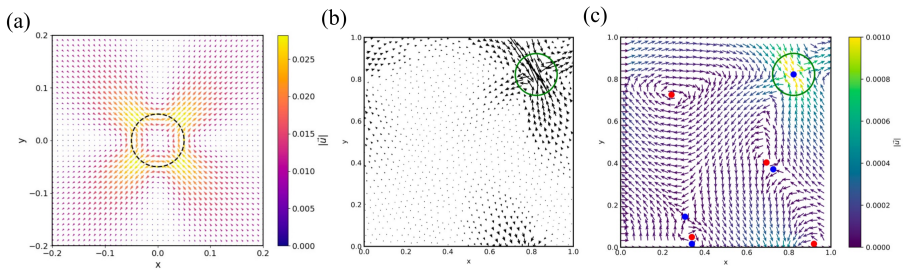
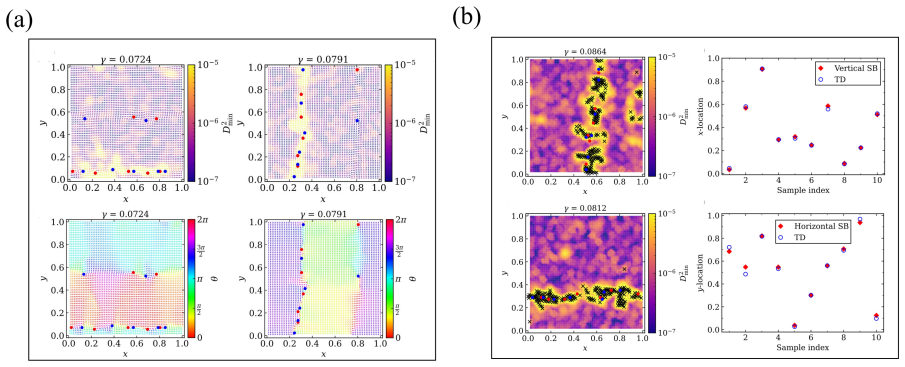
Topological defects play a central role in the mechanical behavior of crystalline materials, yet their relevance to amorphous solids has only recently begun to emerge. Over the last few years, theoretical, computational, and experimental studies have revealed the presence of well-defined topological invariants in vibrational eigenmodes, non-affine displacement fields, and deformation-induced vector fields of glasses. These defects have been shown to correlate strongly with soft spots, localized plastic rearrangements, yielding, and shear-band formation, suggesting a new perspective on the microscopic origins of plasticity in disordered materials.
What carries the argument
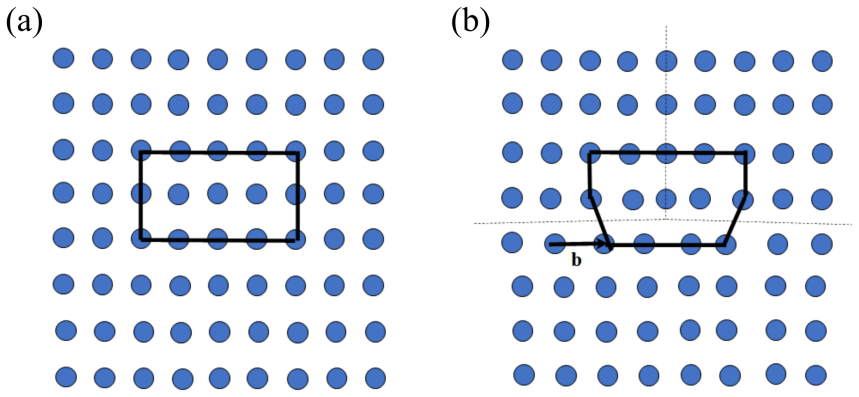
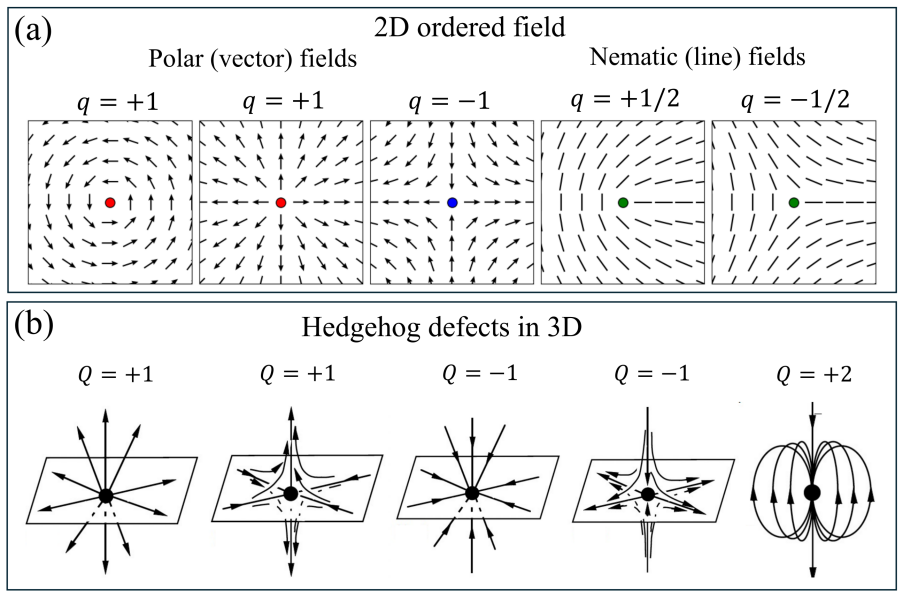
Topological invariants defined through Burgers vectors applied to non-affine displacement fields and vibrational eigenmodes.
If this is right
- Plastic events in glasses can be classified and predicted using the same topological quantities employed for crystals.
- Shear-band formation is expected to initiate at clusters of these defects.
- Yielding thresholds become linked to the density and arrangement of topological invariants rather than solely to local stress or free volume.
- A unified topological description of plasticity and mechanical failure becomes possible for both ordered and disordered solids.
Where Pith is reading between the lines
- If the defects prove causal, targeted annealing protocols might be designed to reduce their density and thereby increase glass toughness.
- The approach could be tested against existing theories of shear-transformation zones by checking whether topological charge predicts zone activation sites.
- Direct visualization of the invariants in colloidal glasses under shear would provide an independent experimental check.
Load-bearing premise
The topological invariants identified in modes and displacement fields are mechanistically tied to plastic events rather than incidental correlations.
What would settle it
High-resolution simulations or experiments that find no statistical spatial overlap between the locations of these topological invariants and the sites of subsequent plastic rearrangements or shear-band nucleation.
Figures






read the original abstract
Topological defects play a central role in the mechanical behavior of crystalline materials, yet their relevance to amorphous solids has only recently begun to emerge. Over the last few years, theoretical, computational, and experimental studies have revealed the presence of well-defined topological invariants in vibrational eigenmodes, non-affine displacement fields, and deformation-induced vector fields of glasses. These defects have been shown to correlate strongly with soft spots, localized plastic rearrangements, yielding, and shear-band formation, suggesting a new perspective on the microscopic origins of plasticity in disordered materials. In this review, we provide a comprehensive overview of recent developments in the rapidly growing field of topological defects in glasses. We discuss the underlying theoretical concepts, including Burgers vectors, non-affine plasticity, vibrational modes, and topological invariants, and review recent numerical and experimental advances. Finally, we assess the current achievements, limitations, and open questions, and discuss future directions toward a unified topological description of plasticity and mechanical failure in amorphous solids.
Editorial analysis
A structured set of objections, weighed in public.
Referee Report
Summary. The manuscript is a review article surveying recent theoretical, computational, and experimental studies on topological defects in glasses. It covers underlying concepts including Burgers vectors, non-affine plasticity, vibrational modes, and topological invariants (such as winding numbers) identified in eigenmodes, displacement fields, and deformation-induced vector fields. The review summarizes reported correlations between these defects and soft spots, localized plastic rearrangements, yielding, and shear-band formation, and suggests this body of work offers a new perspective on the microscopic origins of plasticity in disordered materials. It concludes by assessing achievements, limitations, and open questions while outlining future directions.
Significance. If the correlations summarized from the cited literature prove to be mechanistically relevant rather than incidental, the review could help consolidate an emerging topological framework for plasticity in amorphous solids, analogous to the role of dislocations in crystals. The manuscript's value lies in its synthesis of independent studies across theory, simulation, and experiment, providing a consolidated reference that may guide further work toward a unified description of mechanical failure in glasses.
major comments (1)
- [Abstract] Abstract: The claim that the defects 'suggest a new perspective on the microscopic origins of plasticity' rests on correlations reported in the underlying studies. The review should more explicitly evaluate the risk that these invariants are incidental rather than causal, particularly since the abstract and closing sections note that mechanistic relevance remains to be established beyond correlation.
minor comments (2)
- [Abstract] Abstract: The phrase 'well-defined topological invariants' is used without immediate enumeration of the specific invariants (Burgers vectors, winding numbers); adding a short parenthetical list would improve immediate clarity for readers.
- The review states it assesses limitations and open questions; ensure that the discussion of potential alternative explanations (e.g., that observed correlations arise from shared underlying disorder rather than topology per se) is proportionate to the strength of the cited evidence.
Simulated Author's Rebuttal
We thank the referee for the positive assessment of our review and the constructive comment on the abstract. We agree that the language should more explicitly distinguish correlation from potential causality and will revise accordingly.
read point-by-point responses
-
Referee: [Abstract] Abstract: The claim that the defects 'suggest a new perspective on the microscopic origins of plasticity' rests on correlations reported in the underlying studies. The review should more explicitly evaluate the risk that these invariants are incidental rather than causal, particularly since the abstract and closing sections note that mechanistic relevance remains to be established beyond correlation.
Authors: We agree with the referee that the abstract should frame the claim more cautiously. The manuscript already states in the closing sections that mechanistic relevance remains to be established, but the abstract's phrasing can be tightened to emphasize that the reported correlations do not yet demonstrate causality and that the risk of incidental invariants must be evaluated in future work. We will revise the abstract to read along the lines of: 'These defects have been shown to correlate strongly with soft spots, localized plastic rearrangements, yielding, and shear-band formation; whether these correlations reflect causal mechanisms or incidental associations remains an open question that the field must address.' Parallel clarifications will be ensured in the discussion of limitations. revision: yes
Circularity Check
Review paper with no internal derivation chain
full rationale
This is a review article summarizing correlations reported in prior independent studies on topological defects in glasses. It presents no new derivations, equations, predictions, or fitted parameters of its own; the abstract and structure explicitly frame the content as an overview of existing theoretical, computational, and experimental work. No load-bearing steps reduce to self-citations, self-definitions, or fitted inputs called predictions within the manuscript itself. The central suggestion of a 'new perspective' is attributed to the strength of the cited literature rather than any internal argument constructed here.
Axiom & Free-Parameter Ledger
Reference graph
Works this paper leans on
-
[1]
P. G. Debenedetti and F. H. Stillinger.Supercooled Liquids and the Glass Transi- tion. Nature 410 (2001), 259–267.https://doi.org/10.1038/35065704
-
[2]
L. Berthier and G. Biroli.Theoretical Perspective on the Glass Transition and Amorphous Materials. Rev. Mod. Phys. 83 (2011), 587–645.https://doi.org/ 10.1103/RevModPhys.83.587
-
[3]
A. Nicolas, E. E. Ferrero, K. Martens, and J.-L. Barrat.Deformation and flow of amorphous solids: Insights from elastoplastic models. Rev. Mod. Phys. 90 (2018), 045006.https://doi.org/10.1103/RevModPhys.90.045006
-
[4]
J. P. Hirth and J. Lothe.Theory of Dislocations. 2nd. New York: Wiley, 1982
1982
-
[5]
Mura.Micromechanics of Defects in Solids
T. Mura.Micromechanics of Defects in Solids. 2nd. Dordrecht: Martinus Nijhoff, 1987.https://doi.org/10.1007/978-94-009-3489-4
-
[6]
M. H. Cohen and D. Turnbull.Molecular Transport in Liquids and Glasses. J. Chem. Phys. 31 (1959), 1164–1169.https://doi.org/10.1063/1.1730566
-
[7]
Spaepen.A Microscopic Mechanism for Steady State Inhomogeneous Flow in Metallic Glasses
F. Spaepen.A Microscopic Mechanism for Steady State Inhomogeneous Flow in Metallic Glasses. Acta Metall. 25 (1977), 407–415.https://doi.org/10.1016/ 0001-6160(77)90232-2
1977
-
[8]
A. S. Argon.Plastic Deformation in Metallic Glasses. Acta Metallurgica 27 (1979), 47–58.https://doi.org/10.1016/0001-6160(79)90055-5. 32
-
[9]
M. L. Falk and J. S. Langer.Dynamics of Viscoplastic Deformation in Amorphous Solids. Physical Review E 57 (1998), 7192–7205.https://doi.org/10.1103/ PhysRevE.57.7192
1998
-
[10]
J. Lin, T. Gueudr´ e, A. Rosso, and M. Wyart.Criticality in the Approach to Failure in Amorphous Solids. Phys. Rev. Lett. 115 (2015), 168001.https://doi.org/ 10.1103/PhysRevLett.115.168001
-
[11]
E. E. Ferrero and E. A. Jagla.Properties of the density of shear transformations in driven amorphous solids. J. Phys.: Condens. Matter 33 (2021), 124001.https: //doi.org/10.1088/1361-648X/abd73a
-
[12]
J. D. Eshelby.The Determination of the Elastic Field of an Ellipsoidal Inclusion, and Related Problems. Proc. R. Soc. A 241 (1957), 376–396.https://doi.org/ 10.1098/rspa.1957.0133
-
[13]
Picard, A
G. Picard, A. Ajdari, L. Bocquet, and F. Lequeux.Elastic Consequences of a Single Plastic Event: A Step Towards the Microscopic Modeling of the Flow of Yield Stress Fluids. Eur. Phys. J. E 15 (2004), 371–381.https://doi.org/10. 1140/epje/i2004-10054-8
2004
-
[14]
F. C. Frank.Supercooling of Liquids. Proc. R. Soc. A 215 (1952), 43–46.https: //doi.org/10.1098/rspa.1952.0194
-
[15]
H. Tanaka, H. Tong, R. Shi, and J. Russo.Revealing Key Structural Features Hidden in Liquids and Glasses. Nat. Rev. Phys. 1 (2019), 333–348.https://doi. org/10.1038/s42254-019-0053-3
-
[16]
A. Widmer-Cooper and P. Harrowell.Predicting the Long-Time Dynamic Hetero- geneity in a Supercooled Liquid on the Basis of Short-Time Heterogeneities. Phys. Rev. Lett. 96 (2006), 185701.https://doi.org/10.1103/PhysRevLett.96. 185701
-
[17]
M. L. Manning and A. J. Liu.Vibrational Modes Identify Soft Spots in a Sheared Disordered Packing. Phys. Rev. Lett. 107 (2011), 108302.https://doi.org/10. 1103/PhysRevLett.107.108302
2011
-
[18]
S. Patinet, D. Vandembroucq, and M. L. Falk.Connecting Local Yield Stresses with Plastic Activity in Amorphous Solids. Phys. Rev. Lett. 117 (2016), 045501. https://doi.org/10.1103/PhysRevLett.117.045501
-
[20]
E. Cubuk and et al.Structure-property relationships from universal signatures of plasticity in disordered solids. Science 358 (2017), 1033–1037.https://doi.org/ 10.1126/science.aai8830
-
[21]
E. D. Cubuk, S. S. Schoenholz, J. M. Rieser, B. D. Malone, J. Rottler, D. J. Durian, E. Kaxiras, and A. J. Liu.Identifying Structural Flow Defects in Disordered Solids Using Machine-Learning Methods. Phys. Rev. Lett. 114 (2015), 108001.https: //doi.org/10.1103/PhysRevLett.114.108001. 33
-
[22]
V. Bapst, T. Keck, A. Grabska-Barwi´ nska, C. Donner, E. D. Cubuk, S. S. Schoen- holz, A. Obika, A. W. R. Nelson, T. Back, D. Hassabis, and P. Kohli.Unveiling the predictive power of static structure in glassy systems. Nat. Phys. 16 (2020), 448–454.https://doi.org/10.1038/s41567-020-0842-8
-
[23]
E. Boattini, S. Mar´ ın-Aguilar, S. Mitra, G. Foffi, F. Smallenburg, and L. Filion. Autonomously revealing hidden local structures in supercooled liquids. Nat. Com- mun. 11 (2020), 5479.https://doi.org/10.1038/s41467-020-19286-8
-
[24]
Zaccone.Explicit Analytical Solution for Random Close Packing ind= 2and d= 3
A. Zaccone.Explicit Analytical Solution for Random Close Packing ind= 2and d= 3. Phys. Rev. Lett. 128 (2022), 028002.https : / / doi . org / 10 . 1103 / PhysRevLett.128.028002
2022
-
[25]
S. Torquato, T. M. Truskett, and P. G. Debenedetti.Is Random Close Packing of Spheres Well Defined?Phys. Rev. Lett. 84 (2000), 2064–2067.https://doi. org/10.1103/PhysRevLett.84.2064
-
[26]
C. S. O’Hern, L. E. Silbert, A. J. Liu, and S. R. Nagel.Jamming at zero temperature and zero applied stress: The epitome of disorder. Phys. Rev. E 68 (2003), 011306. https://doi.org/10.1103/PhysRevE.68.011306
-
[27]
A. Zaccone and E. Scossa-Romano.Approximate Analytical Description of the Nonaffine Response of Amorphous Solids. Phys. Rev. B 83 (2011), 184205.https: //doi.org/10.1103/PhysRevB.83.184205
-
[28]
Zaccone.Complete mathematical theory of the jamming transition: A perspec- tive
A. Zaccone.Complete mathematical theory of the jamming transition: A perspec- tive. Journal of Applied Physics 137 (2025), 050901.https://doi.org/10.1063/ 5.0245684. [29]Soft Matter Physics: An Introduction. Ed. by M. Kleman and O. D. Lavrentovich. New York, NY: Springer New York, 2003, 434–471.https://doi.org/10.1007/ 978-0-387-21759-8_12
2025
-
[29]
Shankar, A
S. Shankar, A. Souslov, M. J. Bowick, M. C. Marchetti, and V. Vitelli.Topological Active Matter. Nat. Rev. Phys. 4 (2022), 380–398.https://doi.org/10.1038/ s42254-022-00445-3
2022
-
[30]
G. I. Taylor.The Mechanism of Plastic Deformation of Crystals. Part I. Theoret- ical. Proc. R. Soc. A 145 (1934), 362–387.https://doi.org/10.1098/rspa. 1934.0106
-
[31]
Orowan.Zur Kristallplastizit¨ at
E. Orowan.Zur Kristallplastizit¨ at. III. Zeitschrift f¨ ur Physik 89 (1934), 634–659. https://doi.org/10.1007/BF01341480
-
[32]
M. Polanyi. ¨Uber eine Art Gitterst¨ orung, die einen Kristall plastisch machen k¨ onnte. Zeitschrift f¨ ur Physik 89 (1934), 660–664.https://doi.org/10.1007/ BF01341481
1934
-
[33]
Volterra.Sur l’´ equilibre des corps ´ elastiques multiplement connexes
V. Volterra.Sur l’´ equilibre des corps ´ elastiques multiplement connexes. Annales Scientifiques de l’ ´Ecole Normale Sup´ erieure 24 (1907), 401–517.https://doi. org/10.24033/asens.583
-
[34]
J. M. Burgers.Some Considerations on the Fields of Stress Connected with Dis- locations in a Regular Crystal Lattice. Proc. K. Ned. Akad. Wet. 42 (1939), 293– 325
1939
-
[35]
F. C. Frank.The Resultant Content of Dislocations in an Arbitrary Intercrystalline Boundary. Symp. Plast. Deform. Cryst. Solids (1951), 150–154. 34
1951
-
[36]
F. R. N. Nabarro.Dislocations in a Simple Cubic Lattice. Proc. Phys. Soc. 59 (1947), 256–272.https://doi.org/10.1088/0959-5309/59/2/309
-
[37]
F. C. Frank.On the Theory of Liquid Crystals. Discussions of the Faraday Society 25 (1958), 19–28.https://doi.org/10.1039/DF9582500019
-
[38]
Kl´ eman.Points, Lines and Walls: In Liquid Crystals, Magnetic Systems and Various Ordered Media
M. Kl´ eman.Points, Lines and Walls: In Liquid Crystals, Magnetic Systems and Various Ordered Media. New York: Wiley, 1977
1977
-
[39]
Kl´ eman and J
M. Kl´ eman and J. Friedel.Disclinations, Dislocations, and Continuous Defects: A Reappraisal. Rev. Mod. Phys. 80 (2008), 61–115.https://doi.org/10.1103/ RevModPhys.80.61
2008
-
[40]
P. J. Steinhardt, D. R. Nelson, and M. Ronchetti.Icosahedral Bond Orientational Order in Supercooled Liquids. Phys. Rev. Lett. 47 (1981), 1297–1300.https:// doi.org/10.1103/PhysRevLett.47.1297
-
[41]
P. J. Steinhardt and P. Chaudhari.Point and line defects in glasses. Philos. Mag. A 44 (1981), 1375–1381.https://doi.org/10.1080/01418618108235816
-
[42]
P. J. Steinhardt, D. R. Nelson, and M. Ronchetti.Bond-orientational order in liquids and glasses. Phys. Rev. B 28 (1983), 784–805.https : / / doi . org / 10 . 1103/PhysRevB.28.784
1983
-
[43]
D. R. Nelson.Order, frustration, and defects in liquids and glasses. Phys. Rev. B 28 (1983), 5515–5535.https://doi.org/10.1103/PhysRevB.28.5515
-
[44]
P. W. Anderson.Through the Glass Lightly. Science 267 (1995), 1615–1616.https: //doi.org/10.1126/science.267.5204.1615.f
-
[45]
C. A. Angell.Formation of Glasses from Liquids and Biopolymers. Science 267 (1995), 1924–1935.https://doi.org/10.1126/science.267.5206.1924
-
[46]
M. D. Ediger.Spatially Heterogeneous Dynamics in Supercooled Liquids. Annu. Rev. Phys. Chem. 51 (2000), 99–128.https : / / doi . org / 10 . 1146 / annurev . physchem.51.1.99
2000
-
[47]
Tanaka, T
H. Tanaka, T. Kawasaki, H. Shintani, and K. Watanabe.Critical-like Behaviour of Glass-Forming Liquids. Nat. Mater. 9 (2010), 324–331.https://doi.org/10. 1038/nmat2634
2010
-
[48]
Schall, D
P. Schall, D. A. Weitz, and F. Spaepen.Structural Rearrangements That Govern Flow in Colloidal Glasses. Science 318 (2007), 1895–1899.https://doi.org/10. 1126/science.1149308
2007
-
[49]
D. Turnbull and M. H. Cohen.Free-Volume Model of the Amorphous Phase: Glass Transition. J. Chem. Phys. 34 (1961), 120–125.https://doi.org/10.1063/1. 1731549
work page doi:10.1063/1 1961
-
[50]
J. S. Langer.Shear-Transformation-Zone Theory of Plastic Deformation Near the Glass Transition. Phys. Rev. E 77 (2008), 021502.https://doi.org/10.1103/ PhysRevE.77.021502
2008
-
[51]
M. L. Manning, J. S. Langer, and J. M. Carlson.Strain Localization in a Shear Transformation Zone Model for Amorphous Solids. Physical Review E 76 (2007), 056106.https://doi.org/10.1103/PhysRevE.76.056106
-
[52]
A. L. Greer.Metallic Glasses. Science 267 (1995), 1947–1953.https://doi.org/ 10.1126/science.267.5206.1947. 35
-
[54]
W. H. Wang.The Elastic Properties, Elastic Models and Elastic Perspectives of Metallic Glasses. Prog. Mater. Sci. 57 (2012), 487–656.https://doi.org/10. 1016/j.pmatsci.2011.07.001
2012
-
[55]
W. L. Johnson and K. Samwer.A Universal Criterion for Plastic Yielding of Metallic Glasses with a(T /T g)2/3 Temperature Dependence. Phys. Rev. Lett. 95 (2005), 195501.https://doi.org/10.1103/PhysRevLett.95.195501
-
[56]
W. H. Wang.Dynamic relaxations and relaxation-property relationships in metallic glasses. Prog. Mater. Sci. 106 (2019), 100561.https://doi.org/10.1016/j. pmatsci.2019.03.006
work page doi:10.1016/j 2019
-
[57]
D. R. Nelson.Liquids and Glasses in Spaces of Incommensurate Curvature. Phys. Rev. Lett. 50 (1983), 982–985.https://doi.org/10.1103/PhysRevLett.50.982
-
[58]
D. Kivelson, S. A. Kivelson, X. L. Zhao, Z. Nussinov, and G. Tarjus.A Ther- modynamic Theory of Supercooled Liquids. Physica A 219 (1995), 27–38.https: //doi.org/10.1016/0378-4371(95)00140-3
-
[59]
Tarjus and D
G. Tarjus and D. Kivelson.Breakdown of the Stokes-Einstein Relation in Super- cooled Liquids. J. Chem. Phys. 103 (1995), 3071–3073.https://doi.org/10. 1063/1.470495
1995
-
[60]
G. Tarjus, D. Kivelson, Z. Nussinov, and P. Viot.The Frustration-Based Approach of Supercooled Liquids and the Glass Transition: A Review and Critical Assess- ment. J. Phys.: Condens. Matter 17 (2005), R1143–R1182.https://doi.org/ 10.1088/0953-8984/17/50/R01
-
[61]
D. B. Miracle.A Structural Model for Metallic Glasses. Nat. Mater. 3 (2004), 697– 702.https://doi.org/10.1038/nmat1219
-
[62]
H. W. Sheng, W. K. Luo, F. M. Alamgir, J. M. Bai, and E. Ma.Atomic Packing and Short-to-Medium-Range Order in Metallic Glasses. Nature 439 (2006), 419– 425.https://doi.org/10.1038/nature04421
-
[63]
A. Hirata, P. Guan, T. Fujita, Y. Hirotsu, A. Inoue, A. R. Yavari, T. Sakurai, and M. W. Chen.Direct observation of local atomic order in a metallic glass. Nat. Mater. 10 (2011), 28–33.https://doi.org/10.1038/nmat2897
-
[64]
Coslovich.Locally preferred structures and many-body static correlations in viscous liquids
D. Coslovich.Locally preferred structures and many-body static correlations in viscous liquids. Phys. Rev. E 83 (2011), 051505.https://doi.org/10.1103/ PhysRevE.83.051505
2011
-
[65]
Malins, S
A. Malins, S. R. Williams, J. Eggers, and C. P. Royall.Identification of structure in condensed matter with the topological cluster classification. The Journal of chemical physics 139 (2013)
2013
-
[66]
C. P. Royall and S. R. Williams.The Role of Local Structure in Dynamical Arrest. Phys. Rep. 560 (2015), 1–75.https://doi.org/10.1016/j.physrep.2014.11. 001
-
[67]
J. D. Eshelby.The Elastic Field Outside an Ellipsoidal Inclusion. Proc. R. Soc. A 252 (1959), 561–569.https://doi.org/10.1098/rspa.1959.0173. 36
-
[68]
A. Bera, I. Regev, A. Zaccone, and M. Baggioli.Burgers rings as topological sig- natures of Eshelby-like plastic events in glasses. arXiv preprint arXiv:2505.23069 (2025).https://doi.org/10.48550/arXiv.2505.23069
-
[69]
C. E. Maloney and A. Lemaˆ ıtre.Subextensive Scaling in the Athermal, Quasistatic Limit of Amorphous Matter in Plastic Shear Flow. Phys. Rev. Lett. 93 (2004), 016001.https://doi.org/10.1103/PhysRevLett.93.016001
-
[71]
Tanguy, F
A. Tanguy, F. Leonforte, and J.-L. Barrat.Plastic Response of a 2D Lennard- Jones Amorphous Solid: Detailed Analysis of the Local Rearrangements at Very Slow Strain Rate. Eur. Phys. J. E 20 (2006), 355–364.https://doi.org/10. 1140/epje/i2006-10024-2
2006
-
[72]
E. P. Willmarth, W. Jin, D. Wang, A. Datye, U. D. Schwarz, M. D. Shattuck, and C. S. O’Hern.Particle-scale origin of quadrupolar nonaffine displacement fields in granular solids. Phys. Rev. E 112 (2025), 055402.https://doi.org/10.1103/ 42dk-54hl
2025
-
[73]
Bouchbinder and J
E. Bouchbinder and J. S. Langer.Nonequilibrium Thermodynamics of Driven Amorphous Materials. I. Internal Degrees of Freedom and Volume Deformation. Phys. Rev. E 80 (2009), 031131.https : / / doi . org / 10 . 1103 / PhysRevE . 80 . 031131
2009
-
[74]
Lerner and I
E. Lerner and I. Procaccia.Locality and Nonlocality in Elastoplastic Responses of Amorphous Solids. Phys. Rev. E 79 (2009), 066109.https://doi.org/10.1103/ PhysRevE.79.066109
2009
-
[75]
R. Dasgupta, O. Gendelman, P. Mishra, I. Procaccia, and C. A. B. Z. Shor. Shear localization in three-dimensional amorphous solids. Phys. Rev. E 88 (2013), 032401.https://doi.org/10.1103/PhysRevE.88.032401
-
[76]
Dasgupta, H
R. Dasgupta, H. G. E. Hentschel, and I. Procaccia.Yield Strain in Shear Banding Amorphous Solids. Phys. Rev. Lett. 109 (2012), 255502.https://doi.org/10. 1103/PhysRevLett.109.255502
2012
-
[77]
H. G. E. Hentschel, S. Karmakar, E. Lerner, and I. Procaccia.Do Athermal Amor- phous Solids Exist?Phys. Rev. E 83 (2011), 061101.https://doi.org/10.1103/ PhysRevE.83.061101
2011
-
[78]
Alexander.Amorphous Solids: Their Structure, Lattice Dynamics and Elasticity
S. Alexander.Amorphous Solids: Their Structure, Lattice Dynamics and Elasticity. Phys. Rep. 296 (1998), 65–236.https://doi.org/10.1016/S0370- 1573(97) 00069-0
-
[79]
A. Tanguy, J. P. Wittmer, F. Leonforte, and J.-L. Barrat.Continuum Limit of Amorphous Elastic Bodies: A Finite-Size Study of Low-Frequency Harmonic Vi- brations. Phys. Rev. B 66 (2002), 174205.https://doi.org/10.1103/PhysRevB. 66.174205
-
[80]
F. Leonforte, R. Boissi` ere, A. Tanguy, J. P. Wittmer, and J.-L. Barrat.Continuum Limit of Amorphous Elastic Bodies. III. Three-Dimensional Systems. Phys. Rev. B 72 (2005), 224206.https://doi.org/10.1103/PhysRevB.72.224206. 37
-
[81]
B. A. DiDonna and T. C. Lubensky.Nonaffine Correlations in Random Elastic Media. Phys. Rev. E 72 (2005), 066619.https://doi.org/10.1103/PhysRevE. 72.066619
-
[82]
W. G. Ellenbroek, Z. Zeravcic, W. van Saarloos, and M. van Hecke.Non-affine Re- sponse: Jammed Packings vs. Spring Networks. Europhys. Lett. 87 (2009), 34004. https://doi.org/10.1209/0295-5075/87/34004
-
[83]
A. Zaccone and E. M. Terentjev.Disorder-Assisted Melting and the Glass Tran- sition in Amorphous Solids. Phys. Rev. Lett. 110 (2013), 178002.https://doi. org/10.1103/PhysRevLett.110.178002
discussion (0)
Sign in with ORCID, Apple, or X to comment. Anyone can read and Pith papers without signing in.