A Distributed Lag Approach to the Generalised Dynamic Factor Model
Pith reviewed 2026-05-23 19:25 UTC · model grok-4.3
The pith
The dynamic common component in the GDFM equals a finite number of lags of contemporaneously pervasive factors obtained by static principal components.
A machine-rendered reading of the paper's core claim, the machinery that carries it, and where it could break.
Core claim
Under reasonable conditions the dynamic common component admits a finite-lag representation in terms of contemporaneously pervasive factors. Consequently the dynamic factor decomposition of the GDFM reduces to the OLS regression of each observed variable on the factors estimated by static principal components together with a finite number of their lags.
What carries the argument
Finite distributed-lag representation of the dynamic common component using contemporaneously pervasive factors obtained via static principal components.
If this is right
- Estimation reduces to static principal components followed by ordinary least squares.
- Weak factors inside the dynamic common space are recovered without additional assumptions.
- Consistency and asymptotic normality hold for both dynamic and weak common-component estimators.
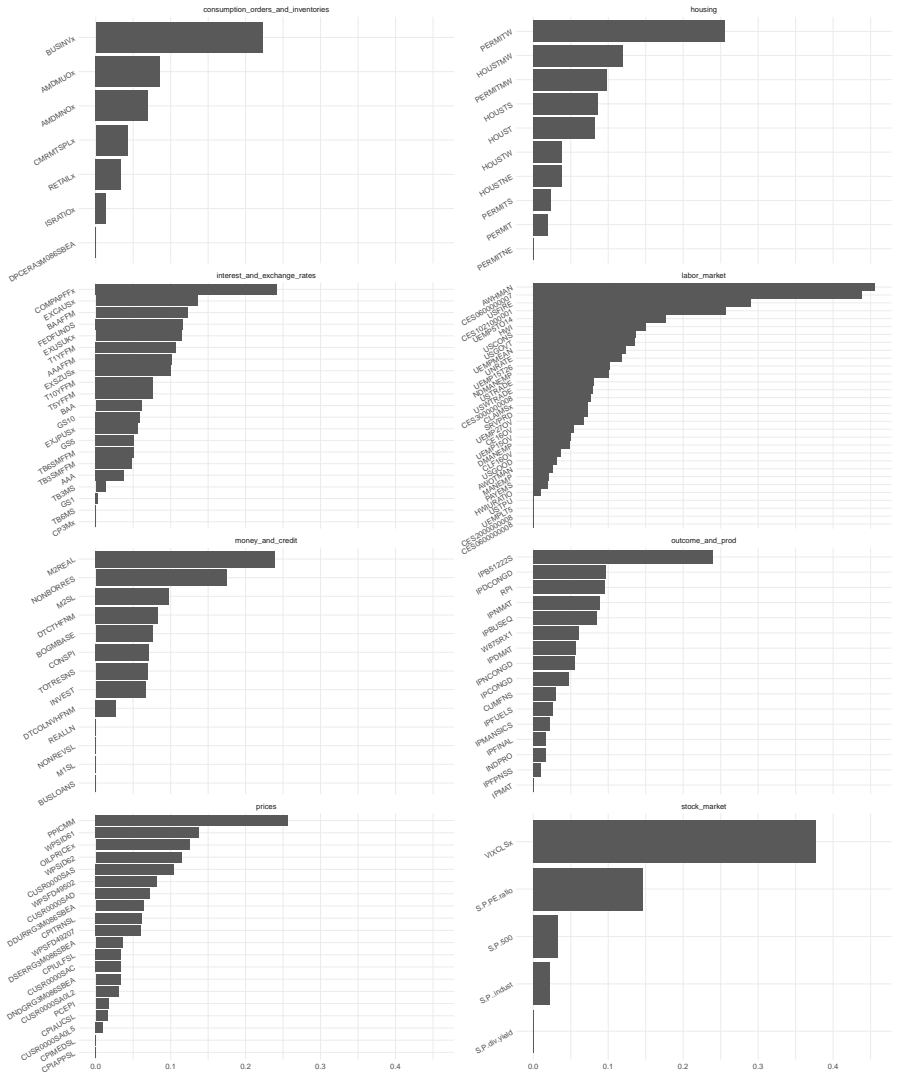
- Application to European macro data isolates a sizeable weak common component missed by pervasive-factor methods.
Where Pith is reading between the lines
- The simplification may allow routine inclusion of dynamic factor models inside real-time nowcasting systems that currently avoid spectral methods.
- The documented weak component suggests that many macro series share low-dimensional dynamics that are not captured when only pervasive factors are retained.
- If the finite-lag condition holds more generally, existing static-factor toolkits can be repurposed for dynamic analysis with minimal modification.
Load-bearing premise
The dynamic common component must admit a representation as a finite number of lags of contemporaneously pervasive factors.
What would settle it
A large macroeconomic panel in which the finite-lag OLS approximation differs materially from the dynamic common component recovered by established frequency-domain estimators.
Figures


read the original abstract
We propose a simple estimator for the dynamic decomposition of the Generalized Dynamic Factor Model that avoids frequency-domain methods. First, we show that it is a reasonable approximation to assume that the dynamic common component of the Generalized Dynamic Factor Model admits a representation in terms of current and lagged statically pervasive factors. Then, assuming finite lag order, this simplification reduces estimation to a regression of the observed variables on estimated factors and their lags, where the factors are extracted via static principal components. The proposed approach naturally accommodates weak, non-pervasive factors within the dynamic common space. We establish consistency and asymptotic normality for both the dynamic and weak common components under a new asymptotic framework that allows for such weak factors. In an application to three high-dimensional time series panels of European macroeconomic data we detect a sizeable weak common component share in several key macroeconomic indicators.
Editorial analysis
A structured set of objections, weighed in public.
Referee Report
Summary. The paper proposes a distributed-lag estimator for the Generalised Dynamic Factor Model (GDFM) that avoids frequency-domain methods. Its central claim is that, under reasonable conditions, the dynamic common component admits a finite-lag representation in terms of contemporaneously pervasive factors; this reduces the GDFM decomposition to static principal components followed by OLS regression on the estimated factors and their lags. The approach is asserted to accommodate weak (non-pervasive) factors, with consistency and asymptotic normality established for both dynamic and weak common components, and an empirical application to European macroeconomic data is presented.
Significance. If the finite-lag representation can be rigorously justified with explicit conditions that hold for typical macro persistence, the method would simplify GDFM estimation while addressing the limitation of existing approaches in handling weak factors. The provision of consistency and asymptotic normality results together with an empirical illustration is a strength; the ability to recover a sizeable weak common component in sentiment indicators is potentially useful for applied macroeconometrics.
major comments (3)
- [§2] §2 (theoretical insight on finite-lag representation): the assertion that the dynamic common component χ_it admits χ_it = ∑_{k=0}^K λ_{i,k}' f_{t-k} with finite K and contemporaneously pervasive f_t is stated to hold 'under reasonable conditions,' yet no explicit decay rate on the tail ∑_{k>K} ||λ_{i,k}|| or spectral-density condition is supplied to guarantee that the truncation error is o_p(1) uniformly. This assumption is load-bearing for the reduction to static PCA + OLS and for the subsequent consistency claims.
- [§3] §3 (consistency and asymptotic normality): the proofs of consistency for the dynamic common component and asymptotic normality for the weak common component rest on the finite-K representation; if near-unit-root dynamics (common in macro series) force K to grow with T or violate contemporaneous pervasiveness once lags are folded in, the rates derived under fixed K would not apply. The manuscript does not provide a uniform bound or a data-driven rule for K that preserves the o_p(1) property.
- [Section 5] Empirical application (Section 5): the claim that a 'sizeable weak common component' is uncovered, especially in sentiment indicators, depends on the chosen K and on the precise definition of weak versus strong factors after the lag augmentation; without reported robustness checks on K or explicit data-exclusion rules, it is unclear whether the finding is robust to the truncation that underpins the estimator.
minor comments (2)
- [§2] Notation for the lag loadings λ_{i,k} is introduced without an explicit statement of how the static factor loadings are recovered from the dynamic ones; a short clarifying paragraph would improve readability.
- The abstract and introduction refer to 'weak (non-pervasive) factors within the dynamic common space' but the precise definition (e.g., the rate at which the eigenvalue contribution vanishes) is not restated when the estimator is introduced; cross-reference to the relevant assumption would help.
Simulated Author's Rebuttal
We thank the referee for the constructive and detailed comments. We address each major comment below, indicating revisions where appropriate to clarify assumptions and strengthen the presentation.
read point-by-point responses
-
Referee: [§2] §2 (theoretical insight on finite-lag representation): the assertion that the dynamic common component χ_it admits χ_it = ∑_{k=0}^K λ_{i,k}' f_{t-k} with finite K and contemporaneously pervasive f_t is stated to hold 'under reasonable conditions,' yet no explicit decay rate on the tail ∑_{k>K} ||λ_{i,k}|| or spectral-density condition is supplied to guarantee that the truncation error is o_p(1) uniformly. This assumption is load-bearing for the reduction to static PCA + OLS and for the subsequent consistency claims.
Authors: The finite-lag representation follows directly from the absolute summability of the dynamic loadings that defines the GDFM (as in Forni et al., 2000, 2005). Under the standard condition ∑_k ||λ_{i,k}|| < ∞ together with uniform boundedness of the loadings, the tail can be made smaller than any ε > 0 by a sufficiently large but fixed K, uniformly in i. We will revise §2 to state this summability condition explicitly and note its implication for uniform o_p(1) truncation error. revision: partial
-
Referee: [§3] §3 (consistency and asymptotic normality): the proofs of consistency for the dynamic common component and asymptotic normality for the weak common component rest on the finite-K representation; if near-unit-root dynamics (common in macro series) force K to grow with T or violate contemporaneous pervasiveness once lags are folded in, the rates derived under fixed K would not apply. The manuscript does not provide a uniform bound or a data-driven rule for K that preserves the o_p(1) property.
Authors: The theory is derived under the maintained stationarity assumption of the GDFM, where summability guarantees that a fixed K delivers the required approximation uniformly. Near-unit-root behavior is typically addressed by separate treatment of stochastic trends outside the standard GDFM. We will add a paragraph in §3 discussing the choice of K and noting that information criteria applied to the OLS step can be used in practice to verify that the truncation error remains negligible, while the fixed-K rates continue to hold under the summability condition. revision: partial
-
Referee: [Section 5] Empirical application (Section 5): the claim that a 'sizeable weak common component' is uncovered, especially in sentiment indicators, depends on the chosen K and on the precise definition of weak versus strong factors after the lag augmentation; without reported robustness checks on K or explicit data-exclusion rules, it is unclear whether the finding is robust to the truncation that underpins the estimator.
Authors: The selected K is motivated by the decay pattern of the estimated dynamic loadings and the improvement in OLS fit. We will augment Section 5 with a robustness table showing results for K = 2, 4, and 6; the weak common component in sentiment indicators remains sizeable and statistically distinguishable from zero across these values. We will also clarify the post-augmentation definition of weak factors. revision: yes
Circularity Check
No circularity; derivation rests on independent theoretical representation
full rationale
The paper's central step is the claim that, under reasonable conditions, the dynamic common component admits a finite-lag representation in terms of contemporaneously pervasive factors. This is presented as an external theoretical condition (not derived from fitted quantities or self-referential definitions) that then permits reduction to static PCA plus OLS. No load-bearing self-citations, ansatzes smuggled via prior work, or fitted inputs renamed as predictions appear in the abstract or description. The consistency results follow from this representation as an assumption rather than a tautology, making the chain self-contained.
Axiom & Free-Parameter Ledger
axioms (1)
- domain assumption reasonable conditions allow the dynamic common component to be represented by a finite number of lags of contemporaneously pervasive factors
discussion (0)
Sign in with ORCID, Apple, or X to comment. Anyone can read and Pith papers without signing in.