L-Proto: Language-Aware Episodic Prototypical Training for Multilingual Speaker Verification
Pith reviewed 2026-06-26 23:26 UTC · model grok-4.3
The pith
Sampling speakers from one language per episode disentangles speaker identity from language cues in embeddings.
A machine-rendered reading of the paper's core claim, the machinery that carries it, and where it could break.
Core claim
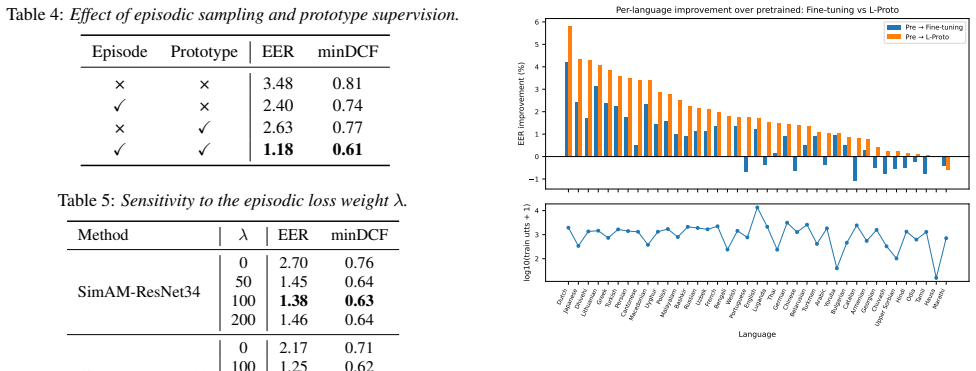
L-Proto is a language-aware episodic prototypical training strategy that constructs language-consistent episodes. By sampling speakers from a single language per episode, L-Proto reduces language-driven variation during training and encourages embeddings to focus more directly on speaker identity.
What carries the argument
Language-consistent episodes, formed by sampling all speakers in each episode from one language to minimize language variation inside the prototypical loss.
If this is right
- Consistent performance gains over conventional fine-tuning on the TidyVoice Challenge benchmark.
- Outperformance relative to random episodic sampling.
- Improvements hold across multiple backbone architectures.
Where Pith is reading between the lines
- The single-language episode rule could be applied to other domain labels such as accent or recording channel to reduce their entanglement with speaker identity.
- The method may allow larger-scale multilingual datasets to be used without the usual cross-language performance penalty.
- Similar episode construction could be tested in related tasks like language identification or diarization where domain cues interfere with the target identity.
Load-bearing premise
Forcing language-consistent episodes during training will disentangle speaker identity from language cues without limiting generalization to mixed-language test conditions or introducing new selection biases.
What would settle it
If models trained with L-Proto show lower accuracy than random episodic sampling on the TidyVoice mixed-language test sets, the central claim would be falsified.
Figures

read the original abstract
Multilingual speaker verification remains challenging because language-dependent acoustic variability causes speaker identity to become entangled with linguistic characteristics, degrading generalization across languages. In multilingual training, embeddings often encode language cues with speaker identity, causing speakers to form language-specific clusters. We propose L-Proto, a language-aware episodic prototypical training strategy that constructs language-consistent episodes. By sampling speakers from a single language per episode, L-Proto reduces language-driven variation during training and encourages embeddings to focus more directly on speaker identity. Experiments on the TidyVoice Challenge benchmark demonstrate consistent performance improvements over conventional fine-tuning and random episodic sampling across multiple backbone architectures.
Editorial analysis
A structured set of objections, weighed in public.
Referee Report
Summary. The manuscript proposes L-Proto, a language-aware episodic prototypical training strategy for multilingual speaker verification. By constructing episodes that sample speakers exclusively from a single language, the method aims to reduce language-driven acoustic variation during training so that embeddings focus more directly on speaker identity rather than linguistic cues. The central empirical claim is that this yields consistent performance gains over both conventional fine-tuning and random episodic sampling on the TidyVoice Challenge benchmark, and that the gains hold across multiple backbone architectures.
Significance. If the reported gains prove robust and generalize to cross-language test conditions, the approach supplies a lightweight, architecture-agnostic training modification that could help mitigate language entanglement in multilingual speaker verification without requiring additional data or architectural changes. The evaluation across several backbones is a positive feature.
major comments (2)
- [Results section] Results section (and abstract): the claim of consistent improvements is stated without any quantitative metrics, statistical tests, dataset sizes, or implementation details on how speaker sampling probabilities are normalized when language corpora are imbalanced. This information is load-bearing for assessing whether gains arise from reduced intra-episode variance or from sampling bias.
- [Experiments section] Method and Experiments sections: it is not specified whether the TidyVoice test set contains language-mismatched trials. Without this, it is impossible to determine whether the language-consistent training actually improves generalization to the mixed-language conditions that the introduction identifies as the core challenge.
Simulated Author's Rebuttal
We thank the referee for the constructive feedback on our manuscript. We address each major comment below, indicating revisions where appropriate to improve clarity and completeness.
read point-by-point responses
-
Referee: [Results section] Results section (and abstract): the claim of consistent improvements is stated without any quantitative metrics, statistical tests, dataset sizes, or implementation details on how speaker sampling probabilities are normalized when language corpora are imbalanced. This information is load-bearing for assessing whether gains arise from reduced intra-episode variance or from sampling bias.
Authors: We agree that the abstract and results section would be strengthened by including specific quantitative metrics (e.g., EER improvements), statistical significance tests, dataset sizes, and details on speaker sampling probability normalization for imbalanced language corpora. These additions will help readers evaluate whether observed gains stem from reduced language variance or sampling effects. We will incorporate this information in the revised manuscript. revision: yes
-
Referee: [Experiments section] Method and Experiments sections: it is not specified whether the TidyVoice test set contains language-mismatched trials. Without this, it is impossible to determine whether the language-consistent training actually improves generalization to the mixed-language conditions that the introduction identifies as the core challenge.
Authors: We acknowledge that explicitly describing the TidyVoice test set composition, including the presence or absence of language-mismatched trials, is necessary to assess generalization to cross-language conditions. We will add this specification to the Experiments section in the revision. revision: yes
Circularity Check
No circularity: empirical training modification with no derivation chain
full rationale
The paper describes an empirical training strategy (language-consistent episodic sampling) and reports benchmark improvements. No equations, fitted parameters renamed as predictions, or load-bearing self-citations appear in the provided text. The central claim rests on experimental comparison against baselines rather than any self-referential construction or ansatz smuggled via citation. The method is self-contained against external benchmarks.
discussion (0)
Sign in with ORCID, Apple, or X to comment. Anyone can read and Pith papers without signing in.