Small Denominators and Subresonant Accumulation in Weakly Nonlinear Dispersive Dynamics
Pith reviewed 2026-07-03 17:44 UTC · model grok-4.3
The pith
Infinite families of near-resonant Fourier interactions produce power-law growth in time for weakly nonlinear dispersive equations.
A machine-rendered reading of the paper's core claim, the machinery that carries it, and where it could break.
Core claim
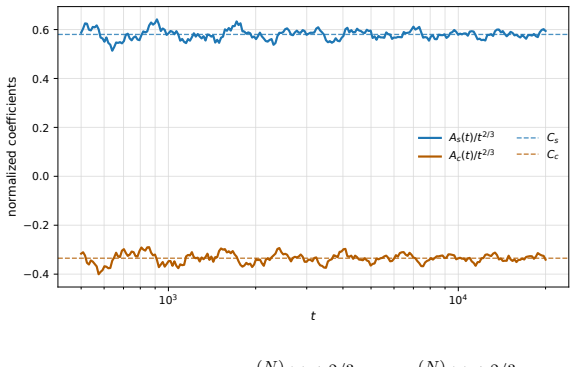
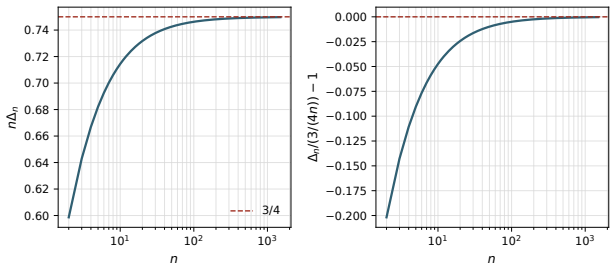
If the detuning and coefficients have the form Δ_n∼c n^{-p} and B_n∼b n^{-κ}, then the accumulated contribution grows as t^{1-α}, where α=(κ-1)/p. For the full nonlinear partial differential equation we formulate a conditional approximation result: provided that all remaining resonant and almost resonant interactions are controlled, the subresonant term gives the leading long-time correction.
What carries the argument
The abstract subresonant Duhamel sum over an infinite family of nonresonant interactions whose detunings tend to zero.
If this is right
- In the forced-oscillator model the infinite sum of subresonant terms grows exactly as t to the power 1 minus alpha.
- The same growth law appears inside the quartic Fourier family associated with the Klein-Gordon dispersion law.
- Under the stated control of other interactions, the subresonant contribution dominates the long-time asymptotics of the full nonlinear PDE.
- Standard resonant normal-form reductions miss this secular effect because they discard the entire family once exact resonance is ruled out.
Where Pith is reading between the lines
- The mechanism suggests that similar power-law corrections could appear in other dispersive models such as the nonlinear Schrödinger equation or capillary-gravity waves whenever detuning families of the same scaling arise.
- High-resolution numerical integration of the model sum for varying p and kappa would provide an immediate test of the predicted exponent without solving the full PDE.
- If the control assumption can be verified, the result indicates that effective equations for long-time dynamics must retain at least one infinite family of near-resonant terms rather than truncating after exact resonances.
Load-bearing premise
All remaining resonant and almost-resonant interactions can be controlled independently of the subresonant family.
What would settle it
A direct numerical evaluation of the model Duhamel sum for concrete values of p and kappa that yields a growth exponent different from 1 minus (kappa minus 1) over p would disprove the accumulation formula.
Figures
read the original abstract
We study a small-denominator mechanism in weakly nonlinear dispersive dynamics. After Fourier decomposition, a nonlinear dispersive equation becomes an infinite system of weakly coupled oscillators. Higher-order correction terms may then contain infinite families of nonresonant Fourier interactions whose detunings tend to zero. Such families do not produce exact secular terms, but their accumulated contribution may grow as a power of time. We call this effect subresonant accumulation. The rigorous part of the paper is the analysis of a model forced oscillator and of an abstract subresonant Duhamel sum. If the detuning and coefficients have the form $\Delta_n\sim c n^{-p}$ and $B_n\sim b n^{-\kappa}$, then the accumulated contribution grows as $t^{1-\alpha}$, where $\alpha=(\kappa-1)/p$. We then show how this mechanism appears in a quartic Fourier family for the Klein--Gordon dispersion law. For the full nonlinear partial differential equation we formulate a conditional approximation result: provided that all remaining resonant and almost resonant interactions are controlled, the subresonant term gives the leading long-time correction.
Editorial analysis
A structured set of objections, weighed in public.
Referee Report
Summary. The paper studies small-denominator effects in weakly nonlinear dispersive dynamics, identifying 'subresonant accumulation' from infinite families of nonresonant Fourier interactions with detunings tending to zero. It rigorously analyzes a model forced oscillator and an abstract subresonant Duhamel sum, showing that under Δ_n ∼ c n^{-p} and B_n ∼ b n^{-κ}, the accumulated contribution grows as t^{1-α} with α = (κ-1)/p. It applies this to a quartic Fourier family for the Klein-Gordon equation and formulates a conditional approximation result for the full nonlinear PDE, stating that the subresonant term gives the leading long-time correction provided other resonant interactions are controlled.
Significance. If the conditional result can be substantiated, the work identifies a new polynomial growth mechanism in dispersive systems arising from accumulating near-resonances. The rigorous treatment of the model oscillator and abstract Duhamel sum, which derives the explicit growth exponent directly from the power-law assumptions without fitting, is a clear technical strength and provides a self-contained foundation.
major comments (1)
- [Abstract, final sentence] Abstract, final sentence (and the corresponding formulation of the conditional approximation result): the claim that the subresonant term produces the leading long-time correction rests on the premise that all remaining resonant and almost-resonant interactions can be controlled independently of the subresonant family. No separation estimate, bootstrap closure, or explicit bound is supplied showing that this control remains valid when the subresonant accumulation is present and grows as t^{1-α}; this assumption is load-bearing for extending the model result to the full Klein-Gordon PDE.
Simulated Author's Rebuttal
We thank the referee for the careful reading and the constructive comment on the conditional formulation. We respond to the major comment below.
read point-by-point responses
-
Referee: [Abstract, final sentence] Abstract, final sentence (and the corresponding formulation of the conditional approximation result): the claim that the subresonant term produces the leading long-time correction rests on the premise that all remaining resonant and almost-resonant interactions can be controlled independently of the subresonant family. No separation estimate, bootstrap closure, or explicit bound is supplied showing that this control remains valid when the subresonant accumulation is present and grows as t^{1-α}; this assumption is load-bearing for extending the model result to the full Klein-Gordon PDE.
Authors: We agree that the conditional approximation result for the full PDE rests on the unproven premise that other resonant and almost-resonant interactions remain controllable when the subresonant term grows as t^{1-α}. The manuscript does not supply a separation estimate, bootstrap closure, or explicit bound for this control; the result is presented as conditional precisely because such an estimate lies outside the paper's scope. The abstract and the relevant section already qualify the statement with the proviso that the other interactions are controlled. We will revise the abstract's final sentence and add a short clarifying paragraph in the introduction to emphasize that verifying the control assumption under the accumulated growth remains open and is not addressed here. revision: yes
Circularity Check
No circularity; growth law derived directly from assumed power laws
full rationale
The core derivation computes the accumulated contribution t^{1-α} with α=(κ-1)/p from the explicit assumptions Δ_n∼c n^{-p} and B_n∼b n^{-κ} inside the model forced oscillator and abstract Duhamel sum; this is a direct summation estimate, not a fit or self-definition. The PDE statement is labeled conditional on independent control of remaining resonances and supplies no unconditional claim or self-citation chain that would reduce the result to its inputs. No steps match the enumerated circularity patterns.
Axiom & Free-Parameter Ledger
free parameters (2)
- p
- κ
axioms (1)
- domain assumption Fourier decomposition converts the nonlinear dispersive PDE into an infinite system of weakly coupled oscillators whose higher-order corrections contain infinite families of nonresonant interactions.
invented entities (1)
-
subresonant accumulation
no independent evidence
Reference graph
Works this paper leans on
-
[1]
Lindstedt, Beitrag zur Integration der Differentialgleichungen der Störungstheorie,Mémoires de l’Académie Impériale des Sciences de St
A. Lindstedt, Beitrag zur Integration der Differentialgleichungen der Störungstheorie,Mémoires de l’Académie Impériale des Sciences de St. Pétersbourg, 31(4), 1883
-
[2]
Poincaré,Les méthodes nouvelles de la mécanique céleste, Vols
H. Poincaré,Les méthodes nouvelles de la mécanique céleste, Vols. 1–3, Gauthier–Villars, Paris, 1892–1899
-
[3]
V.I. Arnold, Small denominators and problems of stability of motion in classical and celestial mechanics,Russian Mathematical Surveys, 18(6), 85–191, 1963. doi:10.1070/RM1963v018n06ABEH001143
-
[4]
Nayfeh,Perturbation Methods, Wiley, New York, 1973
A.H. Nayfeh,Perturbation Methods, Wiley, New York, 1973
1973
-
[5]
Kevorkian and J.D
J. Kevorkian and J.D. Cole,Multiple Scale and Singular Perturbation Methods, Springer, New York, 1996
1996
-
[6]
Whitham,Linear and Nonlinear Waves, Wiley-Interscience, New York, 1974
G.B. Whitham,Linear and Nonlinear Waves, Wiley-Interscience, New York, 1974
1974
-
[7]
Kuksin,Nearly Integrable Infinite-Dimensional Hamiltonian Sys- tems, Lecture Notes in Mathematics, Vol
S.B. Kuksin,Nearly Integrable Infinite-Dimensional Hamiltonian Sys- tems, Lecture Notes in Mathematics, Vol. 1556, Springer, Berlin, 1993
1993
-
[8]
W. Craig and C.E. Wayne, Newton’s method and periodic solutions of nonlinear wave equations,Communications on Pure and Applied Mathematics, 46(11), 1409–1498, 1993. doi:10.1002/cpa.3160461102. 16
-
[9]
J. Shatah, Normal forms and quadratic nonlinear Klein–Gordon equa- tions,Communications on Pure and Applied Mathematics, 38(5), 685– 696, 1985. doi:10.1002/cpa.3160380516
-
[10]
D. Bambusi and B. Grebert, Birkhoff normal form for partial differential equations with tame modulus,Duke Mathematical Journal, 135(3), 507–567, 2006. doi:10.1215/S0012-7094-06-13534-2
-
[11]
J.-M. Delort and J. Szeftel, Long-time existence for semi-linear Klein–Gordon equations with small Cauchy data on Zoll mani- folds,American Journal of Mathematics, 128(5), 1187–1218, 2006. doi:10.1353/ajm.2006.0038
-
[12]
D. Bambusi, J.-M. Delort, B. Grebert and J. Szeftel, Almost global existence for Hamiltonian semilinear Klein–Gordon equations with small Cauchy data on Zoll manifolds,Communications on Pure and Applied Mathematics, 60(11), 1665–1690, 2007. doi:10.1002/cpa.20181
-
[13]
Kiselev, Asymptotics of the solution of the Cauchy problem for the perturbed Klein–Gordon–Fock equation,Zap
O.M. Kiselev, Asymptotics of the solution of the Cauchy problem for the perturbed Klein–Gordon–Fock equation,Zap. Nauchn. Semin. LOMI, 165, 115–121, 1987
1987
-
[14]
Non- linearity, Information and Robotics
P.Yu. Astafyeva and O.M. Kiselev, Subresonant solutions of the linear oscillator equation, in2021 International Conference “Non- linearity, Information and Robotics” (NIR), IEEE, 1–4, 2021. doi:10.1109/NIR52917.2021.9666062
-
[15]
P.Yu. Astafyeva and O.M. Kiselev, Formal asymptotics of para- metric subresonance,Nelineinaya Dinamika, 18(5), 927–937, 2022. doi:10.20537/nd221220. 17
discussion (0)
Sign in with ORCID, Apple, or X to comment. Anyone can read and Pith papers without signing in.