An extremely bright slow-rising afterglow from an off-axis jet in GRB 260310A
Pith reviewed 2026-05-25 03:09 UTC · model grok-4.3
The pith
GRB 260310A's weak prompt emission and bright delayed afterglow result from an off-axis jet view.
A machine-rendered reading of the paper's core claim, the machinery that carries it, and where it could break.
Core claim
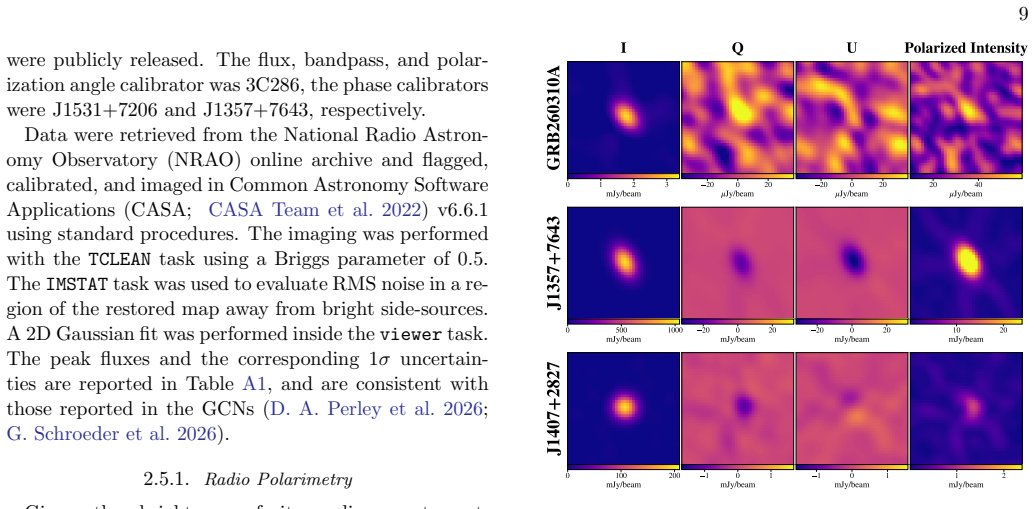
The paper argues that the combination of weak prompt emission, hard peak energy, and late afterglow onset with slow rise is naturally explained by a GRB jet viewed off-axis. Radio spectral energy distributions are consistent with synchrotron radiation and indicate both reverse- and forward-shock components, providing a test of reverse-shock models in off-axis geometry. The X-ray rebrightening monitored to 68 days with no spectral evolution and the measured polarization of about 1.7 percent at 15 GHz suggest forward-shock dominance from radio to X-rays at late times.
What carries the argument
Off-axis viewing of a relativistic GRB jet, which reduces observed prompt emission and delays afterglow onset through relativistic beaming effects.
If this is right
- The extreme afterglow brightness is only apparent and would appear different to an on-axis observer.
- Radio observations supply the first test of reverse-shock models under off-axis conditions.
- The late X-ray rebrightening may mark the emergence of a narrow jet core viewed at a larger angle, implying high on-axis energetics.
- Low polarization at late times confirms forward-shock dominance across bands.
Where Pith is reading between the lines
- Events like this may be missed by prompt gamma-ray triggers yet found through wide-field afterglow searches.
- Accounting for off-axis viewing could revise estimates of the true GRB rate and typical jet structure.
- The supernova association remains intact even when the jet is seen off-axis.
Load-bearing premise
Standard synchrotron afterglow models describe the radio data without other emission processes contributing substantially.
What would settle it
Detection of strong spectral evolution during the X-ray rebrightening or absence of a reverse-shock signature in the radio spectral energy distributions would challenge the off-axis interpretation.
Figures





read the original abstract
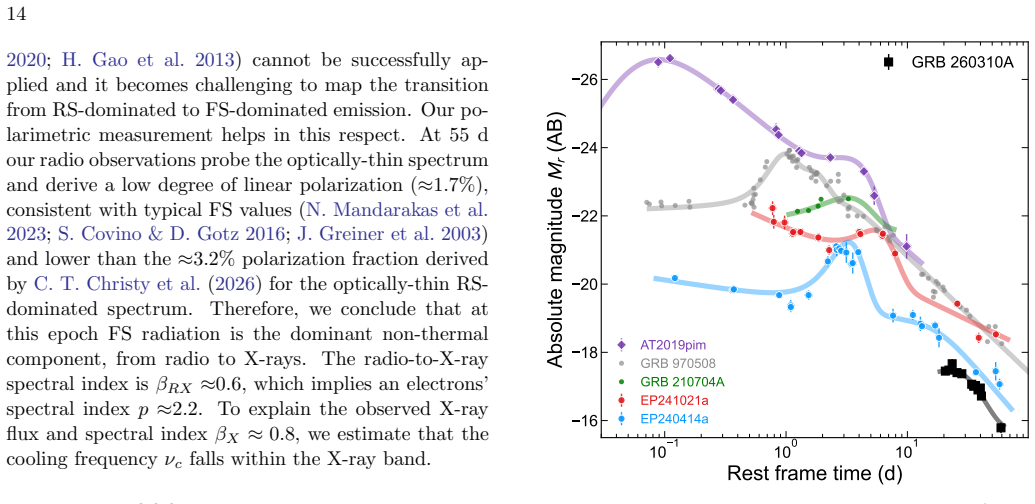
We present a multi-wavelength study of GRB 260310A, a nearby long-duration gamma-ray burst at $z\simeq0.153$ associated with a broad-lined Type Ic supernova. Despite its modest prompt gamma-ray output, $E_{\gamma,\rm iso}\simeq3.5\times10^{50}$ erg, GRB\,260310A exhibits one of the brightest afterglows ever observed in the X-ray, optical, and radio bands. Its apparent brightness is not its only remarkable feature. The optical afterglow displays a delayed onset, characterized by a slow rising phase, with slope $\alpha\approx-1$, and a late peak at $\approx$0.1 d. We argue that the combination of weak prompt emission, hard peak energy, and late afterglow onset is naturally explained by a GRB jet viewed off-axis. The radio spectral energy distributions are consistent with synchrotron radiation and indicate the presence of both reverse- and forward-shock components, thus providing a first test of reverse-shock models in an off-axis geometry. The X-ray afterglow displays a prominent rebrightening, monitored for up to $\approx$68 d with no evidence of spectral evolution. A low level of linear polarization, $\Pi\approx1.7\%$, is measured at 15 GHz at $T_0+55$ d and suggests that, at these late times, the forward-shock is the dominant emission component from radio to X-rays. This late-time rebrightening represents a critical test for the two-component jet model. If interpreted as the emergence of a narrow jet core viewed further off-axis, it would imply extreme luminosities and energetics for an on-axis observer.
Editorial analysis
A structured set of objections, weighed in public.
Referee Report
Summary. The manuscript reports multi-wavelength observations of the nearby long GRB 260310A (z≈0.153) associated with a broad-lined Ic supernova. Despite modest prompt emission (Eγ,iso≈3.5×10^50 erg), the afterglow is extremely bright across X-ray, optical, and radio bands, with a slow optical rise (α≈−1) peaking at ≈0.1 d. The authors interpret the weak prompt emission, hard Epeak, and delayed afterglow onset as signatures of an off-axis jet. Radio SEDs are fitted with synchrotron emission from both reverse- and forward-shock components; the X-ray light curve shows a rebrightening persisting to ≈68 d without spectral evolution, and a low polarization (Π≈1.7%) is measured at 15 GHz at T0+55 d, taken to indicate forward-shock dominance at late times.
Significance. If the off-axis interpretation holds, the work supplies one of the first observational tests of reverse-shock models in an off-axis geometry and illustrates how viewing angle can reconcile apparently discrepant prompt and afterglow properties. The combination of radio component separation, late rebrightening, and polarization provides a multi-probe consistency check on jet structure that is rare in the literature.
major comments (2)
- [Radio SED analysis] Radio SED analysis (section discussing multi-frequency radio data): the two-component (reverse+forward shock) identification rests on the direct applicability of standard synchrotron spectral indices and temporal slopes derived for on-axis or spherical outflows. Off-axis Doppler boosting, angle-dependent shock dynamics, and possible jet-structure effects are not quantitatively modeled, so the SED decomposition does not uniquely establish the off-axis geometry or rule out alternative emission processes.
- [X-ray rebrightening discussion] X-ray rebrightening discussion: the suggestion that the late rebrightening represents the emergence of a narrow jet core viewed further off-axis is presented as a critical test, yet no quantitative calculation of the implied on-axis isotropic energy or Lorentz factor is provided to demonstrate consistency with the observed flux and timing.
minor comments (2)
- The abstract states the optical rise slope as α≈−1; the sign convention for the temporal index should be stated explicitly in the text to avoid ambiguity with the usual F∝t^α notation.
- Polarization measurement timing (T0+55 d) and frequency (15 GHz) are given only in the abstract; repeating these values in the relevant results section would improve readability.
Simulated Author's Rebuttal
We thank the referee for their thorough review and insightful comments on our manuscript. We address each major comment below and have revised the manuscript to incorporate clarifications and additional discussion where appropriate.
read point-by-point responses
-
Referee: [Radio SED analysis] Radio SED analysis (section discussing multi-frequency radio data): the two-component (reverse+forward shock) identification rests on the direct applicability of standard synchrotron spectral indices and temporal slopes derived for on-axis or spherical outflows. Off-axis Doppler boosting, angle-dependent shock dynamics, and possible jet-structure effects are not quantitatively modeled, so the SED decomposition does not uniquely establish the off-axis geometry or rule out alternative emission processes.
Authors: We acknowledge that the SED decomposition relies on standard synchrotron relations derived primarily for on-axis or spherical cases and does not include a full numerical treatment of off-axis Doppler effects or structured jet dynamics. This is a valid limitation. The off-axis interpretation is primarily motivated by the prompt emission properties (weak E_gamma,iso and hard Epeak) combined with the delayed afterglow onset, with the radio SED providing supporting consistency rather than standalone proof. We have added a dedicated paragraph in the discussion section noting these caveats, emphasizing that the decomposition is an approximation, and highlighting the need for future hydrodynamic simulations to quantitatively test uniqueness against alternatives. revision: partial
-
Referee: [X-ray rebrightening discussion] X-ray rebrightening discussion: the suggestion that the late rebrightening represents the emergence of a narrow jet core viewed further off-axis is presented as a critical test, yet no quantitative calculation of the implied on-axis isotropic energy or Lorentz factor is provided to demonstrate consistency with the observed flux and timing.
Authors: We agree that explicit estimates strengthen the argument. In the revised manuscript we have added order-of-magnitude calculations in the X-ray rebrightening section. Assuming the rebrightening marks the point at which the narrow core becomes visible at a smaller viewing angle, the required on-axis E_iso is approximately 5 x 10^52 to 10^53 erg (depending on the exact core opening angle and efficiency), which is within the range of typical long GRBs. The implied initial Lorentz factor of the core (~100-200) is also consistent with the observed rebrightening timescale of ~10-20 days when accounting for the off-axis viewing geometry and deceleration. These estimates are now included with the relevant equations and assumptions stated. revision: yes
Circularity Check
No significant circularity; interpretation grounded in new observations and standard models
full rationale
The paper reports new multi-wavelength data for GRB 260310A and interprets the weak prompt emission, hard E_peak, delayed afterglow onset, and radio SEDs (showing reverse+forward shock components) as consistent with an off-axis jet viewed at an angle. These conclusions rest on direct comparison of observed light curves, spectra, and polarization to standard synchrotron afterglow predictions without any quoted equations or steps that reduce a claimed prediction to a fitted input by construction, self-definition, or load-bearing self-citation. The radio two-component identification is presented as a test of existing models in a new geometry rather than a renaming or ansatz smuggled from prior author work. No self-citation chains or uniqueness theorems are invoked in the provided text to force the off-axis conclusion. The derivation chain is therefore self-contained against external benchmarks.
Axiom & Free-Parameter Ledger
free parameters (2)
- viewing angle
- jet isotropic energy and Lorentz factor
axioms (2)
- domain assumption Synchrotron emission from forward and reverse shocks in relativistic jets
- domain assumption Standard afterglow models apply without dominant alternative emission mechanisms
Lean theorems connected to this paper
-
IndisputableMonolith/Cost/FunctionalEquation.leanwashburn_uniqueness_aczel unclear?
unclearRelation between the paper passage and the cited Recognition theorem.
The radio spectral energy distributions are consistent with synchrotron radiation and indicate the presence of both reverse- and forward-shock components... We model the radio SED using a smoothly broken power-law based on a synchrotron spectrum... slopes of -2, -1/3, and (p-1)/2
-
IndisputableMonolith/Foundation/AlexanderDuality.leanalexander_duality_circle_linking unclear?
unclearRelation between the paper passage and the cited Recognition theorem.
A viewing angle θ_v ≈2-3θ_c... would be sufficient to reconcile the observed prompt emission properties with the Amati relation
What do these tags mean?
- matches
- The paper's claim is directly supported by a theorem in the formal canon.
- supports
- The theorem supports part of the paper's argument, but the paper may add assumptions or extra steps.
- extends
- The paper goes beyond the formal theorem; the theorem is a base layer rather than the whole result.
- uses
- The paper appears to rely on the theorem as machinery.
- contradicts
- The paper's claim conflicts with a theorem or certificate in the canon.
- unclear
- Pith found a possible connection, but the passage is too broad, indirect, or ambiguous to say the theorem truly supports the claim.
Reference graph
Works this paper leans on
-
[1]
Abbott, B. P., Abbott, R., Abbott, T. D., et al. 2017, PhRvL, 119, 161101, doi: 10.1103/PhysRevLett.119.161101
-
[2]
Amati, L. 2006, Monthly Notices of the Royal Astronomical Society, 372, 233–245, doi: 10.1111/j.1365-2966.2006.10840.x
-
[3]
Amati, L., Frontera, F., Tavani, M., et al. 2002, A&A, 390, 81, doi: 10.1051/0004-6361:20020722
-
[4]
Arnaud, K. A. 1996, in Astronomical Society of the Pacific Conference Series, Vol. 101, Astronomical Data Analysis Software and Systems V, ed. G. H. Jacoby & J. Barnes, 17 Astropy Collaboration, Robitaille, T. P., Tollerud, E. J., et al. 2013, A&A, 558, A33, doi: 10.1051/0004-6361/201322068 Astropy Collaboration, Price-Whelan, A. M., Sip˝ ocz, B. M., et a...
-
[5]
2026, GRB Coordinates Network, 1
Atteia, J.-L., Moreno M´ endez, E., Lincetto, M., et al. 2026, GRB Coordinates Network, 1
2026
-
[6]
Balasubramanian, A., Corsi, A., Mooley, K. P., et al. 2022, ApJ, 938, 12, doi: 10.3847/1538-4357/ac9133
-
[7]
Becerra, R. L., Troja, E., Watson, A. M., et al. 2023, MNRAS, 522, 5204, doi: 10.1093/mnras/stad1372
-
[8]
2015, HOTPANTS: High Order Transform of PSF ANd Template Subtraction,, Astrophysics Source Code Library, record ascl:1504.004 http://ascl.net/1504.004
Becker, A. 2015, HOTPANTS: High Order Transform of PSF ANd Template Subtraction,, Astrophysics Source Code Library, record ascl:1504.004 http://ascl.net/1504.004
2015
-
[9]
2022, MNRAS, 515, 555, doi: 10.1093/mnras/stac1821
Beniamini, P., Gill, R., & Granot, J. 2022, MNRAS, 515, 555, doi: 10.1093/mnras/stac1821
-
[10]
2007, ApJ, 670, 1254, doi: 10.1086/522195
Berger, E. 2007, ApJ, 670, 1254, doi: 10.1086/522195
-
[11]
1996, A&AS, 117, 393, doi: 10.1051/aas:1996164
Bertin, E., & Arnouts, S. 1996, A&AS, 117, 393, doi: 10.1051/aas:1996164
-
[12]
2026, A&A, 706, A145, doi: 10.1051/0004-6361/202556805
Birenbaum, G., Granot, J., & Beniamini, P. 2026, A&A, 706, A145, doi: 10.1051/0004-6361/202556805
-
[13]
Bloom, J. S., Frail, D. A., & Sari, R. 2001, AJ, 121, 2879, doi: 10.1086/321093
-
[14]
Bloom, J. S., Kulkarni, S. R., & Djorgovski, S. G. 2002, AJ, 123, 1111, doi: 10.1086/338893
-
[15]
2026, GRB Coordinates Network, 44004, 1
Brivio, R., Malesani, D., Izzo, L., et al. 2026, GRB Coordinates Network, 44004, 1
2026
-
[16]
2014, A&A, 564, A125, doi: 10.1051/0004-6361/201322971
Buchner, J., Georgakakis, A., Nandra, K., et al. 2014, A&A, 564, A125, doi: 10.1051/0004-6361/201322971
work page internal anchor Pith review doi:10.1051/0004-6361/201322971 2014
-
[17]
2025, A&A, 701, A225, doi: 10.1051/0004-6361/202554626
Busmann, M., O’Connor, B., Sommer, J., et al. 2025, A&A, 701, A225, doi: 10.1051/0004-6361/202554626
-
[18]
2017, A&A, 605, A107, doi: 10.1051/0004-6361/201731005 CASA Team, Bean, B., Bhatnagar, S., et al
Cano, Z., Izzo, L., de Ugarte Postigo, A., et al. 2017, A&A, 605, A107, doi: 10.1051/0004-6361/201731005 CASA Team, Bean, B., Bhatnagar, S., et al. 2022, PASP, 134, 114501, doi: 10.1088/1538-3873/ac9642
-
[19]
Castro-Tirado, A. J. 2023, Nature Astronomy, 7, 1136, doi: 10.1038/s41550-023-02075-w
-
[20]
Chakyar, S. P., & Resmi, L. 2025, ApJ, 983, 111, doi: 10.3847/1538-4357/adb626 22
-
[21]
Chambers, K. C., Magnier, E. A., Metcalfe, N., et al. 2016, arXiv e-prints, arXiv:1612.05560, doi: 10.48550/arXiv.1612.05560
work page internal anchor Pith review Pith/arXiv arXiv doi:10.48550/arxiv.1612.05560 2016
-
[22]
Chandra, P., & Frail, D. A. 2012, ApJ, 746, 156, doi: 10.1088/0004-637X/746/2/156
-
[23]
Chevalier, R. A., & Fransson, C. 2006, ApJ, 651, 381, doi: 10.1086/507606
-
[24]
Christy, C. T., Laskar, T., Alexander, K. D., et al. 2026, arXiv e-prints, arXiv:2604.27480, doi: 10.48550/arXiv.2604.27480
work page internal anchor Pith review Pith/arXiv arXiv doi:10.48550/arxiv.2604.27480 2026
-
[25]
1997, Nature, 387, 783, doi: 10.1038/42885
Costa, E., Frontera, F., Heise, J., et al. 1997, Nature, 387, 783, doi: 10.1038/42885
-
[26]
Polarization of prompt and afterglow emission of Gamma-Ray Bursts
Covino, S., & Gotz, D. 2016, Astronomical and Astrophysical Transactions, 29, 205, doi: 10.48550/arXiv.1605.03588
work page internal anchor Pith review Pith/arXiv arXiv doi:10.48550/arxiv.1605.03588 2016
-
[27]
G., De Simone, B., Mohideen Malik, R
Dainotti, M. G., De Simone, B., Mohideen Malik, R. F., et al. 2024, MNRAS, 533, 4023, doi: 10.1093/mnras/stae1484 D’Avanzo, P., Salvaterra, R., Sbarufatti, B., et al. 2012, MNRAS, 425, 506, doi: 10.1111/j.1365-2966.2012.21489.x de Ugarte Postigo, A., Geier, S., Izzo, L., et al. 2026, GRB Coordinates Network, 44124, 1
-
[28]
Decleir, M., Gordon, K. D., Andrews, J. E., et al. 2022, ApJ, 930, 15, doi: 10.3847/1538-4357/ac5dbe
-
[29]
Delchambre, L., Bailer-Jones, C. A. L., Bellas-Velidis, I., et al. 2023, A&A, 674, A31, doi: 10.1051/0004-6361/202243423 D’Elia, V., Campana, S., D’A` ı, A., et al. 2018, A&A, 619, A66, doi: 10.1051/0004-6361/201833847
-
[30]
D., Chiang, J., & B¨ ottcher, M
Dermer, C. D., Chiang, J., & B¨ ottcher, M. 1999, ApJ, 513, 656, doi: 10.1086/306871
-
[31]
Dey, A., Schlegel, D. J., Lang, D., et al. 2019, AJ, 157, 168, doi: 10.3847/1538-3881/ab089d
-
[32]
Dichiara, S., Troja, E., Lipunov, V., et al. 2022, MNRAS, 512, 2337, doi: 10.1093/mnras/stac454 Escudero Pedrosa, J., Agudo, I., Morcuende, D., et al. 2024, AJ, 168, 84, doi: 10.3847/1538-3881/ad5a80
-
[33]
Evans, P. A., Beardmore, A. P., Page, K. L., et al. 2009, MNRAS, 397, 1177, doi: 10.1111/j.1365-2966.2009.14913.x Fermi GBM team. 2026, GRB Coordinates Network, 43951, 1
-
[34]
Clayton, G. C. 2019, ApJ, 886, 108, doi: 10.3847/1538-4357/ab4c3a
-
[35]
Fong, W.-f., Nugent, A. E., Dong, Y., et al. 2022, ApJ, 940, 56, doi: 10.3847/1538-4357/ac91d0
-
[36]
Taylor, G. B. 1997, Nature, 389, 261, doi: 10.1038/38451
-
[37]
Fruscione, A., McDowell, J. C., Allen, G. E., et al. 2006, in Society of Photo-Optical Instrumentation Engineers (SPIE) Conference Series, Vol. 6270, Observatory Operations: Strategies, Processes, and Systems, ed. D. R. Silva & R. E. Doxsey, 62701V, doi: 10.1117/12.671760 Gaia Collaboration, Vallenari, A., Brown, A. G. A., et al. 2023, A&A, 674, A1, doi: ...
-
[38]
Galama, T. J., Vreeswijk, P. M., van Paradijs, J., et al. 1998a, Nature, 395, 670, doi: 10.1038/27150
-
[39]
Galama, T. J., Groot, P. J., van Paradijs, J., et al. 1998b, ApJL, 497, L13, doi: 10.1086/311268
-
[40]
2013, NewAR, 57, 141, doi: 10.1016/j.newar.2013.10.001
Gao, H., Lei, W.-H., Zou, Y.-C., Wu, X.-F., & Zhang, B. 2013, NewAR, 57, 141, doi: 10.1016/j.newar.2013.10.001
-
[41]
2012, Science, 337, 932, doi: 10.1126/science.1216793
Gehrels, N., & M´ esz´ aros, P. 2012, Science, 337, 932, doi: 10.1126/science.1216793
-
[42]
Gehrels, N., Norris, J. P., Barthelmy, S. D., et al. 2006, Nature, 444, 1044, doi: 10.1038/nature05376
-
[43]
2025, A&A, 703, A92, doi: 10.1051/0004-6361/202555450
Gianfagna, G., Piro, L., Bruni, G., et al. 2025, A&A, 703, A92, doi: 10.1051/0004-6361/202555450
-
[44]
2026, GRB Coordinates Network, 44045, 1
Giarratana, S., Giroletti, M., Ghirlanda, G., et al. 2026, GRB Coordinates Network, 44045, 1
2026
-
[45]
2017, ApJL, 848, L14, doi: 10.3847/2041-8213/aa8f41
Goldstein, A., Veres, P., Burns, E., et al. 2017, ApJL, 848, L14, doi: 10.3847/2041-8213/aa8f41
-
[46]
Golkhou, V. Z., & Butler, N. R. 2014, ApJ, 787, 90, doi: 10.1088/0004-637X/787/1/90
-
[47]
Golkhou, V. Z., Butler, N. R., & Littlejohns, O. M. 2015, ApJ, 811, 93, doi: 10.1088/0004-637X/811/2/93
-
[48]
2008, ApJ, 687, 443, doi: 10.1086/592062
Gomboc, A., Kobayashi, S., Guidorzi, C., et al. 2008, ApJ, 687, 443, doi: 10.1086/592062
-
[49]
Gordon, K. D. 2024, Journal of Open Source Software, 9, 7023, doi: 10.21105/joss.07023
-
[50]
D., Cartledge, S., & Clayton, G
Gordon, K. D., Cartledge, S., & Clayton, G. C. 2009, ApJ, 705, 1320, doi: 10.1088/0004-637X/705/2/1320
-
[51]
Gordon, K. D., Clayton, G. C., Decleir, M., et al. 2023, ApJ, 950, 86, doi: 10.3847/1538-4357/accb59
-
[52]
Gordon, K. D., Misselt, K. A., Bouwman, J., et al. 2021, ApJ, 916, 33, doi: 10.3847/1538-4357/ac00b7
-
[53]
Gottlieb, O., Bromberg, O., Singh, C. B., & Nakar, E. 2020, MNRAS, 498, 3320, doi: 10.1093/mnras/staa2567
-
[54]
2022, MNRAS, 517, 1640, doi: 10.1093/mnras/stac2699
Gottlieb, O., & Nakar, E. 2022, MNRAS, 517, 1640, doi: 10.1093/mnras/stac2699
-
[55]
2021, MNRAS, 500, 3511, doi: 10.1093/mnras/staa3501
Gottlieb, O., Nakar, E., & Bromberg, O. 2021, MNRAS, 500, 3511, doi: 10.1093/mnras/staa3501
-
[56]
2018, MNRAS, 481, 1597, doi: 10.1093/mnras/sty2308
Granot, J., Gill, R., Guetta, D., & De Colle, F. 2018, MNRAS, 481, 1597, doi: 10.1093/mnras/sty2308
-
[57]
Granot, J., Panaitescu, A., Kumar, P., & Woosley, S. E. 2002, ApJL, 570, L61, doi: 10.1086/340991
-
[58]
2002, ApJ, 568, 820, doi: 10.1086/338966 23
Granot, J., & Sari, R. 2002, ApJ, 568, 820, doi: 10.1086/338966 23
-
[59]
2018, The Journal of Open Source Software, 3, 695, doi: 10.21105/joss.00695
Green, G. 2018, The Journal of Open Source Software, 3, 695, doi: 10.21105/joss.00695
-
[60]
2003, Nature, 426, 157, doi: 10.1038/nature02077
Greiner, J., Klose, S., Reinsch, K., et al. 2003, Nature, 426, 157, doi: 10.1038/nature02077
-
[61]
2007, ApJL, 657, L73, doi: 10.1086/511417
Guetta, D., & Della Valle, M. 2007, ApJL, 657, L73, doi: 10.1086/511417
-
[62]
2009, A&A, 499, 439, doi: 10.1051/0004-6361/200911719
Guidorzi, C., Clemens, C., Kobayashi, S., et al. 2009, A&A, 499, 439, doi: 10.1051/0004-6361/200911719
-
[63]
Gulati, A., Murphy, T., Kaplan, D. L., et al. 2026, ApJ, 1000, 118, doi: 10.3847/1538-4357/ae4351
-
[64]
Hallinan, G., Corsi, A., Mooley, K. P., et al. 2017, Science, 358, 1579, doi: 10.1126/science.aap9855
-
[65]
Harris, C. R., Millman, K. J., van der Walt, S. J., et al. 2020, Nature, 585, 357, doi: 10.1038/s41586-020-2649-2
-
[66]
Harrison, F. A., Craig, W. W., Christensen, F. E., et al. 2013, ApJ, 770, 103, doi: 10.1088/0004-637X/770/2/103
-
[67]
Ho, A. Y. Q., Perley, D. A., Yao, Y., et al. 2022, ApJ, 938, 85, doi: 10.3847/1538-4357/ac8bd0
-
[68]
2022, ApJ, 936, 157, doi: 10.3847/1538-4357/ac7394
Hu, L., Wang, L., Chen, X., & Yang, J. 2022, ApJ, 936, 157, doi: 10.3847/1538-4357/ac7394
-
[69]
Hu, Y.-D., Fern´ andez-Garc´ ıa, E., Caballero-Garc´ ıa, M. D., et al. 2023, Frontiers in Astronomy and Space Sciences, 10, 952887, doi: 10.3389/fspas.2023.952887
-
[70]
Huang, Y. F., Dai, Z. G., & Lu, T. 2002, MNRAS, 332, 735, doi: 10.1046/j.1365-8711.2002.05334.x
-
[71]
Hunter, J. D. 2007, Computing in Science & Engineering, 9, 90, doi: 10.1109/MCSE.2007.55
-
[72]
2019, Nature, 565, 324, doi: 10.1038/s41586-018-0826-3
Izzo, L., de Ugarte Postigo, A., Maeda, K., et al. 2019, Nature, 565, 324, doi: 10.1038/s41586-018-0826-3
-
[73]
Jayaraman, R., Ho, A. Y. Q., Hinds, K.-R., et al. 2026, GRB Coordinates Network, 43994, 1 Jel´ ınek, M. 2023, Contributions of the Astronomical Observatory Skalnate Pleso, 53, 127, doi: 10.31577/caosp.2023.53.4.127
-
[74]
Jones, T. W., & O’Dell, S. L. 1977, ApJ, 214, 522, doi: 10.1086/155278
-
[75]
A., & Mandel, E
Joye, W. A., & Mandel, E. 2003, in Astronomical Society of the Pacific Conference Series, Vol. 295, Astronomical Data Analysis Software and Systems XII, ed. H. E
2003
-
[76]
Kammoun, E., Waratkar, G., Jayaraman, R., Hinds, K.-R., & Ho, A. Y. Q. 2026, GRB Coordinates Network, 44063, 1
2026
-
[77]
A., Klose, S., Zhang, B., et al
Kann, D. A., Klose, S., Zhang, B., et al. 2010, ApJ, 720, 1513, doi: 10.1088/0004-637X/720/2/1513
-
[78]
2018, MNRAS, 473, L121, doi: 10.1093/mnrasl/slx175
Kathirgamaraju, A., Barniol Duran, R., & Giannios, D. 2018, MNRAS, 473, L121, doi: 10.1093/mnrasl/slx175
-
[79]
2000, ApJ, 545, 807, doi: 10.1086/317869
Kobayashi, S. 2000, ApJ, 545, 807, doi: 10.1086/317869
-
[80]
A., et al
Konno, R., Garrappa, S., Zimmerman, E. A., et al. 2026, GRB Coordinates Network, 1
2026
discussion (0)
Sign in with ORCID, Apple, or X to comment. Anyone can read and Pith papers without signing in.