Balanced Twins: Causal Inference on Time Series with Hidden Confounding
Pith reviewed 2026-06-26 20:06 UTC · model grok-4.3
The pith
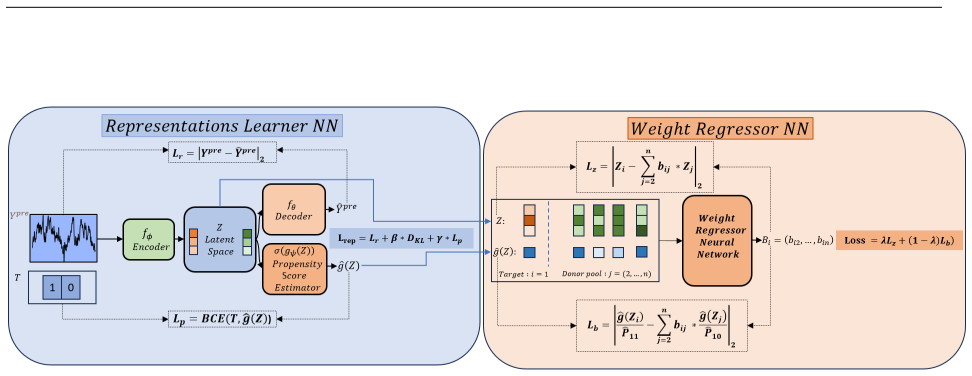
Neural framework learns latent time series representations and propensity scores for individual matching to estimate treatment effects despite hidden confounding.
A machine-rendered reading of the paper's core claim, the machinery that carries it, and where it could break.
Core claim
The paper claims that by training a neural network to produce both low-dimensional latent encodings of individual time series and propensity scores, one can perform matching at the unit level to recover individual treatment effects and thus the ATT, even with staggered adoption and latent bias, and without needing to model time dynamics explicitly or enforce convex weights as in synthetic control.
What carries the argument
A neural network that jointly learns low-dimensional latent representations of time series and propensity scores for use in flexible individual-level matching.
If this is right
- Staggered interventions across units with different pre-treatment histories can be accommodated directly.
- Counterfactuals can be estimated more accurately when latent confounding is present.
- The average treatment effect on the treated can be obtained by averaging the individual estimates.
- Application to non-stationary series in energy and clinical domains becomes feasible.
Where Pith is reading between the lines
- If the joint learning succeeds in disentangling confounding, the framework could be adapted to other observational data settings with high-dimensional covariates.
- Future work might explore sensitivity to the choice of latent dimension or matching distance metric.
- Comparisons with methods that do model temporal structure explicitly could reveal when the assumption-free approach is preferable.
Load-bearing premise
The low-dimensional latent representations capture the hidden confounding structure sufficiently well to allow accurate matching for counterfactual recovery.
What would settle it
Generate semi-synthetic time series data with known hidden confounders and known true counterfactuals, apply the method, and check whether the estimated individual effects match the ground truth within expected error.
Figures






read the original abstract
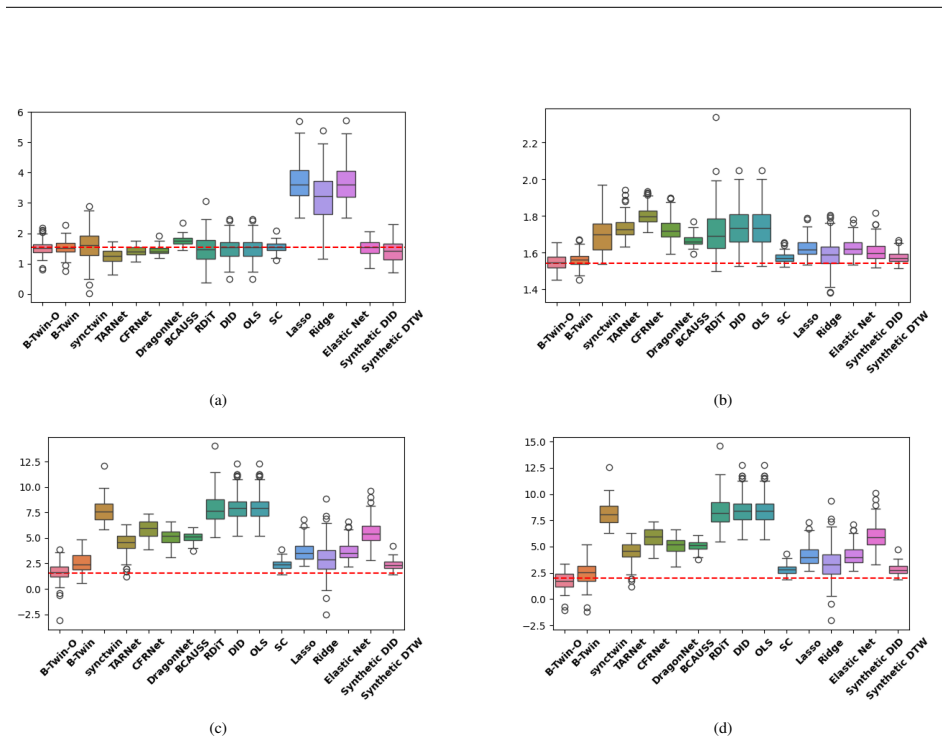
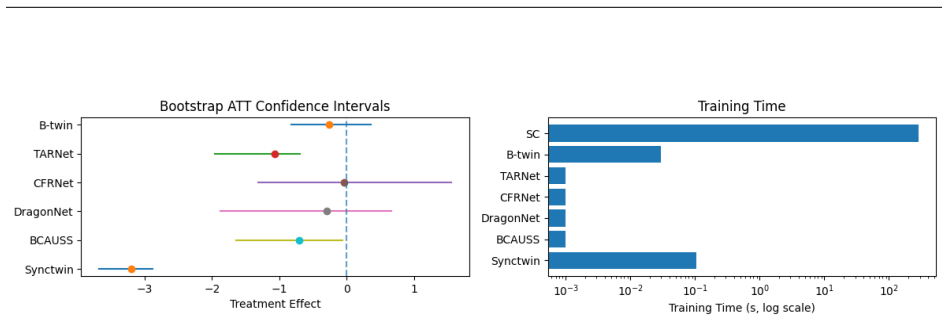
Accurately estimating treatment effects in time series is essential for evaluating interventions in real-world applications, especially when treatment assignment is biased by unobserved factors. In many practical settings, interventions are adopted at different times across individuals, leading to staggered treatment exposure and heterogeneous pre-treatment histories. In such cases, aggregating outcome trajectories across treated units is ill-defined, making individual treatment effect (ITE) estimation a prerequisite for reliable causal inference. We therefore study the problem of estimating the average treatment effect for the treated (ATT) by first recovering individual-level counterfactuals. We introduce a neural framework that learns simultaneously low-dimensional latent representations of individual time series and propensity scores. These estimates are then used to approximate the individual treatment effects through a flexible matching procedure that avoids classical convexity constraints commonly used in synthetic control methods. By operating at the individual level, our approach naturally accommodates staggered interventions and improves counterfactual estimation under latent bias, without relying on explicit temporal modeling assumptions. We illustrate our approach on both real-world energy consumption data and clinical time series, including high-frequency electricity demand-response programs and semi-synthetic data for individuals in intensive care unit (ICU), where hidden confounding, staggered treatment adoption, and non-stationary dynamics are prevalent.
Editorial analysis
A structured set of objections, weighed in public.
Referee Report
Summary. The paper introduces Balanced Twins, a neural framework for estimating individual treatment effects (ITE) and the average treatment effect for the treated (ATT) in time series data subject to hidden confounding and staggered interventions. It jointly learns low-dimensional latent representations of individual time series along with propensity scores, then applies a flexible (non-convex) matching procedure to recover counterfactuals at the individual level. The approach is claimed to improve counterfactual estimation under latent bias without explicit temporal modeling assumptions and is illustrated on energy consumption data and semi-synthetic ICU clinical time series.
Significance. If the joint latent-propensity learning reliably recovers the hidden confounding structure, the method would relax the convexity constraints of classical synthetic control while naturally accommodating staggered adoption and individual-level heterogeneity, offering a practical advance for causal inference in non-stationary time series settings common in energy and clinical domains.
major comments (2)
- [Method (neural framework and matching procedure)] The central claim that the jointly learned low-dimensional latents suffice to block all hidden confounding paths and support consistent individual-level matching rests on an unstated identification assumption. No data-generating process is specified, and no recovery guarantee or identifiability result is provided showing that the joint objective recovers the true confounders rather than spurious correlations (see the description of the neural framework and the matching step).
- [Introduction and Method] In the presence of staggered, non-stationary interventions, the absence of any theoretical result establishing that the learned latents span the confounder space undermines the claim of improved counterfactual estimation. If the latents fail to capture the confounding, the subsequent propensity-weighted matching cannot yield consistent ITEs even if propensity scores are well-calibrated.
minor comments (2)
- [Abstract] The abstract states that the method operates 'without relying on explicit temporal modeling assumptions,' yet the precise form of the neural architecture and loss function (including any implicit temporal structure in the encoder) is not contrasted with existing recurrent or state-space approaches.
- [Experiments] Details on how the semi-synthetic ICU data were constructed (e.g., the mechanism used to inject hidden confounding) are referenced but not fully specified, making it difficult to assess whether the reported gains are robust to different confounding structures.
Simulated Author's Rebuttal
We thank the referee for the constructive comments on the identification assumptions underlying Balanced Twins. We address each major comment below and will revise the manuscript to improve clarity on these points.
read point-by-point responses
-
Referee: [Method (neural framework and matching procedure)] The central claim that the jointly learned low-dimensional latents suffice to block all hidden confounding paths and support consistent individual-level matching rests on an unstated identification assumption. No data-generating process is specified, and no recovery guarantee or identifiability result is provided showing that the joint objective recovers the true confounders rather than spurious correlations (see the description of the neural framework and the matching step).
Authors: We agree that the manuscript does not provide a formal identifiability result, recovery guarantee, or explicit data-generating process. The method is motivated by the practical benefits of joint latent-propensity learning for representation-based matching, but this implicitly assumes the learned latents are sufficient to block confounding paths. In revision we will add a new subsection in Methods that (i) states the identification assumption explicitly, (ii) specifies a simple DGP for the semi-synthetic experiments, and (iii) discusses conditions under which the joint objective may recover spurious rather than true confounders. We will not add new theoretical guarantees, as that lies outside the paper's scope. revision: yes
-
Referee: [Introduction and Method] In the presence of staggered, non-stationary interventions, the absence of any theoretical result establishing that the learned latents span the confounder space undermines the claim of improved counterfactual estimation. If the latents fail to capture the confounding, the subsequent propensity-weighted matching cannot yield consistent ITEs even if propensity scores are well-calibrated.
Authors: We acknowledge that the lack of a theoretical result on the latents spanning the confounder space weakens claims of consistency for staggered, non-stationary settings. The current manuscript relies on empirical evidence from real and semi-synthetic data. In revision we will (i) temper language in the Introduction and Method sections to emphasize that performance depends on the empirical quality of the learned representations rather than proven recovery of the full confounder space, and (ii) add a short discussion of how the flexible (non-convex) matching can still be useful under partial capture of confounders. No new theoretical results will be derived. revision: yes
Circularity Check
No circularity: framework relies on joint neural optimization and matching without self-referential reductions
full rationale
The abstract and provided text describe a neural architecture that jointly optimizes low-dimensional latents and propensity scores, followed by a matching step for ITE estimation. No equation or procedure is shown to define a quantity in terms of itself, rename a fitted parameter as a prediction, or rest the central claim on a self-citation chain that itself lacks independent verification. The derivation chain (latent learning → propensity estimation → matching) is presented as a modeling choice whose validity rests on empirical performance and the stated assumption that latents capture confounding, rather than on any algebraic identity or fitted-input renaming. This is the common case of a self-contained empirical method whose correctness can be assessed externally.
Axiom & Free-Parameter Ledger
axioms (1)
- domain assumption Low-dimensional latent representations jointly learned with propensity scores capture the relevant hidden confounding for matching
Reference graph
Works this paper leans on
-
[1]
1984 , publisher=
Using the longitudinal structure of earnings to estimate the effect of training programs , author=. 1984 , publisher=
1984
-
[2]
arXiv preprint arXiv:1412.6980 , year=
Adam: A method for stochastic optimization , author=. arXiv preprint arXiv:1412.6980 , year=
-
[3]
Ilr Review , volume=
The impact of the Mariel boatlift on the Miami labor market , author=. Ilr Review , volume=. 1990 , publisher=
1990
-
[4]
2009 , publisher=
Causality , author=. 2009 , publisher=
2009
-
[5]
Econometrica: Journal of the Econometric Society , pages=
Bayesian estimates of equation system parameters: an application of integration by Monte Carlo , author=. Econometrica: Journal of the Econometric Society , pages=. 1978 , publisher=
1978
-
[6]
The Quarterly Journal of Economics , author=
How Much Should We Trust Differences-In-Differences Estimates?* , volume=. The Quarterly Journal of Economics , author=. 2004 , month=feb, pages=. doi:10.1162/003355304772839588 , abstractNote=
-
[7]
The Review of Economic Studies , volume=
Semiparametric difference-in-differences estimators , author=. The Review of Economic Studies , volume=. 2005 , publisher=
2005
-
[8]
, author=
Estimating causal effects of treatments in randomized and nonrandomized studies. , author=. Journal of Educational Psychology , volume=. 1974 , publisher=
1974
-
[9]
2009 , publisher=
Mostly harmless econometrics , author=. 2009 , publisher=
2009
-
[10]
Journal of Economic Surveys , volume=
Some practical guidance for the implementation of propensity score matching , author=. Journal of Economic Surveys , volume=. 2008 , publisher=
2008
-
[11]
American Economic Review , volume=
The economic costs of conflict: A case study of the Basque Country , author=. American Economic Review , volume=. 2003 , publisher=
2003
-
[12]
Journal of the American statistical Association , volume=
Synthetic control methods for comparative case studies: Estimating the effect of California’s tobacco control program , author=. Journal of the American statistical Association , volume=. 2010 , publisher=
2010
-
[13]
Swiss Journal of Economics and Statistics , volume=
Comparative politics and the synthetic control method revisited: A note on Abadie et al.(2015) , author=. Swiss Journal of Economics and Statistics , volume=. 2018 , publisher=
2015
-
[14]
Journal of the American Statistical Association , volume=
A penalized synthetic control estimator for disaggregated data , author=. Journal of the American Statistical Association , volume=. 2021 , publisher=
2021
-
[15]
American Economic Review , volume=
Synthetic difference-in-differences , author=. American Economic Review , volume=. 2021 , publisher=
2021
-
[16]
2023 , journal=
Synthetic difference-in-differences estimation , author=. 2023 , journal=
2023
-
[17]
Advances in Neural Information Processing Systems , volume=
Adapting neural networks for the estimation of treatment effects , author=. Advances in Neural Information Processing Systems , volume=
-
[18]
Journal of Biomedical Informatics , volume=
Learning end-to-end patient representations through self-supervised covariate balancing for causal treatment effect estimation , author=. Journal of Biomedical Informatics , volume=. 2023 , publisher=
2023
-
[19]
International Conference on Machine Learning , pages=
Estimating individual treatment effect: generalization bounds and algorithms , author=. International Conference on Machine Learning , pages=. 2017 , organization=
2017
-
[20]
Advances in Neural Information Processing Systems , volume=
Causal effect inference with deep latent-variable models , author=. Advances in Neural Information Processing Systems , volume=
-
[21]
Advances in Neural Information Processing Systems , volume=
Synctwin: Treatment effect estimation with longitudinal outcomes , author=. Advances in Neural Information Processing Systems , volume=
-
[22]
Biometrika , volume=
The central role of the propensity score in observational studies for causal effects , author=. Biometrika , volume=. 1983 , publisher=
1983
-
[23]
Advances in Neural Information Processing Systems , volume=
A recurrent latent variable model for sequential data , author=. Advances in Neural Information Processing Systems , volume=
-
[24]
2013 , publisher=
Auto-encoding variational bayes , author=. 2013 , publisher=
2013
-
[25]
2009 , publisher=
Mostly harmless econometrics: An empiricist's companion , author=. 2009 , publisher=
2009
-
[26]
Annual Review of Resource Economics , volume=
Regression discontinuity in time: Considerations for empirical applications , author=. Annual Review of Resource Economics , volume=. 2018 , publisher=
2018
-
[27]
arXiv preprint arXiv:1206.3239 , year=
On identifying total effects in the presence of latent variables and selection bias , author=. arXiv preprint arXiv:1206.3239 , year=
-
[28]
Emerging Themes in Epidemiology , volume=
Causal diagrams in systems epidemiology , author=. Emerging Themes in Epidemiology , volume=. 2012 , publisher=
2012
-
[29]
2016 , institution=
Balancing, regression, difference-in-differences and synthetic control methods: A synthesis , author=. 2016 , institution=
2016
-
[30]
Proceedings of the 3rd International Conference on Knowledge Discovery and Data Mining , pages=
Using dynamic time warping to find patterns in time series , author=. Proceedings of the 3rd International Conference on Knowledge Discovery and Data Mining , pages=
-
[31]
International Conference on Machine Learning , pages=
Time series deconfounder: Estimating treatment effects over time in the presence of hidden confounders , author=. International Conference on Machine Learning , pages=. 2020 , organization=
2020
-
[32]
Proceedings of The 33rd International Conference on Machine Learning , pages =
Learning Representations for Counterfactual Inference , author =. Proceedings of The 33rd International Conference on Machine Learning , pages =. 2016 , editor =
2016
-
[33]
International Conference on Learning Representations , year=
GANITE: Estimation of individualized treatment effects using generative adversarial nets , author=. International Conference on Learning Representations , year=
-
[34]
Research Methods in Medicine & Health Sciences , volume=
Measuring the sensitivity of difference-in-difference estimates to the parallel trends assumption , author=. Research Methods in Medicine & Health Sciences , volume=. 2021 , publisher=
2021
-
[35]
Proceedings of the AAAI Conference on Artificial Intelligence , volume=
Estimating treatment effects from irregular time series observations with hidden confounders , author=. Proceedings of the AAAI Conference on Artificial Intelligence , volume=
-
[36]
2020 IEEE international conference on data mining (ICDM) , pages=
Estimating individual treatment effects with time-varying confounders , author=. 2020 IEEE international conference on data mining (ICDM) , pages=. 2020 , organization=
2020
-
[37]
Scientific data , volume=
MIMIC-III, a freely accessible critical care database , author=. Scientific data , volume=. 2016 , publisher=
2016
discussion (0)
Sign in with ORCID, Apple, or X to comment. Anyone can read and Pith papers without signing in.