REVIEW 5 major objections 5 minor 2 cited by
On the Reasoning Capacity of AI Models and How to Quantify It
T0 review · 5 major / 5 minor · reviewed 2026-08-10 · deepseek-v4-flash
Pith's one-line read Accuracy alone overstates AI reasoning; a strategy decomposition shows memorization carries much of the apparent success.
desk verdict The descriptive positional-bias finding is solid, but the PMM decomposition is underidentified and its fig. 7 validation is an algebraic identity, so the quantitative claims about reasoning versus memorization do not survive. read the letter →
The pith
A machine-rendered reading of the paper's core claim, the machinery that carries it, and where it could break.
The reading
What carries the argument
The load-bearing object is the Probabilistic Mixture Model (PMM), which writes the probability of a correct answer at position $o$ as $P_{\mathrm{correct}}(q,o) = P_M(q) P_M(o) + P_R(q) P_R + P_G(q) P_G$, with the memorization term concentrated on a single memorized position $o_m$. A second probe, the Information-Theoretic Consistency (ITC) analysis, compares each question's Shannon entropy to the ideal calibration frontier $H_{\mathrm{ideal}}(A) = -A\log_2 A - (1-A)\log_2((1-A)/(k-1))$ for $k$ options. The PMM turns the accuracy gap $\Delta A(q)$ between the memorized position and other positions into the memorization probability $P_M(q)=\Delta A(q)/(1-P_O)$; the ITC frontier turns deviations in entropy-accuracy space into a statement about overconfidence. Together they map each question to a point in the strategy simplex and show how that point moves as the positional randomization parameter $\theta$ increases.
What would settle it
Take the same questions at full position randomization ($\theta=1$) and compare per-position accuracy to $1/4$: if accuracy at any position differs from chance beyond sampling error, uniform guessing fails and the PMM's strategy numbers are not identifiable. Alternatively, present genuinely novel questions that cannot have been memorized and check whether the estimated $P_R$ matches the model's actual correct rate on those questions; if $P_R$ exceeds that rate, the perfect-reasoning assumption is contradicted.
Extended reading notes
Core claim
The central discovery the paper tries to establish is that observable accuracy is a mixture of three latent strategies, memorization, reasoning, and guessing, and that the mixture can be read off from position-dependent accuracy. Under the idealizing assumptions that reasoning, when used, is perfect and position-invariant, and guessing is uniform across options, the difference between accuracy at the memorized position and at other positions isolates the memorization probability; the remaining accuracy then yields reasoning and guessing probabilities. On the GPQA-Diamond questions tested with GPT-4o-mini, the estimated reasoning probability is near zero for many questions even where accuracy is moderate, and memorization contributes persistently across the whole strategy space. The paper concludes that current models rarely achieve true position-invariant logical deduction, that memorization and pattern matching account for much apparent success, and that entropy-accuracy relations show systematic overconfidence relative to ideal calibration.
Load-bearing premise
The decomposition assumes that when the model reasons it is perfectly correct regardless of position, that when it guesses it picks uniformly at random, and that the model's preferred memorized position is known; if any of these fails, the inferred strategy probabilities shift.
Editorial extensions
If this is right
- Benchmark scores on multiple-choice reasoning tasks should not be read as reasoning ability, because the same accuracy can arise from very different mixtures of reasoning, memorization, and guessing.
- Deployment criteria can be stated as thresholds on strategy probabilities, for example requiring $P_R > 0.7$ and entropy below $0.5$ bits, rather than relying on aggregate accuracy.
- Positional bias, usually treated as a flaw to eliminate, can serve as a controlled experimental probe for mechanistic evaluation of language models.
- Because memorization persists even in reasoning-dominated regimes, eliminating learned heuristics may be neither possible nor desirable; applications should specify acceptable ratios among strategies.
- The framework is general in principle: the same perturbation-and-decomposition protocol can be applied to other benchmarks and model families, not only to GPQA and GPT-4o-mini.
Reading between the lines
- The paper leaves open how the memorized position $o_m$ is chosen per question; a natural robustness check is to infer $o_m$ from the data and see whether the strategy decomposition survives.
- Because the paper assumes perfect reasoning, its $P_R$ is best read as the maximum share of responses that perfect position-invariant deduction could explain; imperfect reasoning would lower that bound.
- The same positional probe could be run with chain-of-thought prompting; one testable prediction is that CoT shifts probability mass from $P_M$ toward $P_R$ as $\theta$ increases.
- A finer-grained entropy frontier that tracks individual distractor probabilities rather than pooling all incorrect options could separate generic overconfidence from distractor-specific preferences.
Editorial analysis
A structured set of objections, weighed in public.
Referee Report
Summary. The paper proposes two phenomenological frameworks to study LLM reasoning on multiple-choice tasks: a Probabilistic Mixture Model (PMM) that decomposes responses into memorization, reasoning, and guessing, and an Information-Theoretic Consistency (ITC) analysis that relates prediction entropy to accuracy. Using GPT-4o-mini on GPQA-Diamond with controlled answer-position randomization, the authors report descriptive findings: accuracy varies strongly with answer position, position D is systematically disfavored, and accuracy degrades toward chance as positions are randomized. They further report that empirical entropy-accuracy pairs lie below a theoretical frontier, indicating overconfidence, and that estimated strategy probabilities correlate with accuracy and entropy. The overarching claim is that accuracy alone overstates reasoning ability and that apparent success relies substantially on memorization and pattern matching rather than genuine deduction.
Significance. The descriptive positional-bias results are plausible and potentially useful: the finding that accuracy depends strongly on answer position in a reasoning benchmark, and that randomization degrades performance, is an interesting empirical observation. The entropy-accuracy frontier is a sensible reference construction for studying calibration. However, the paper's principal quantitative contribution, the PMM decomposition, is not identified from the data, and the reported validation is an algebraic identity. The correlations used to support the framework are largely structural consequences of the estimation equations. If the PMM were properly identified and independently validated, the framework could be valuable for deployment decisions, but in its current form the central quantitative claims are unsupported. The paper does not provide code or machine-checked derivations, and the empirical experiments are described without the detail needed for independent reproduction.
major comments (5)
- [III.B, Eqs. (14)-(20)] The PMM solves three strategy probabilities PM, PR, PG from exactly two observed accuracies, A_om and A_other, using the normalization (5). The identifying assumptions that reasoning is perfect (PR = 1) and guessing is uniform (PG = PO) are not tested and are not innocuous. For example, if the true strategy shares are PM = 0.5, PR = 0, PG = 0.5 with memorization success 1 at the memorized position and 0.4 at other positions, then the observed accuracies would be A_om = 0.625 and A_other = 0.325; the paper's formulas would report PM = 0.4, PR = 0.1, PG = 0.5, falsely attributing 10% of decisions to reasoning. Because the decomposition has one more unknown than independent observations, it cannot be validated by the same data used to fit it.
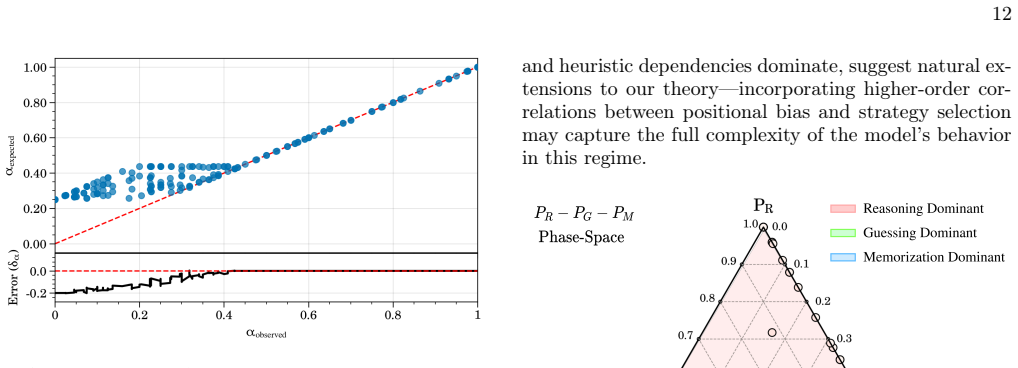
- [IV.B, Eqs. (35)-(37) and Fig. 7] The model validation in Fig. 7 is tautological. Substituting the estimators from Eqs. (17)-(20) back into the model equations (14)-(15) gives E[A_om] = A_om and E[A_other] = A_other for every question, so α_expected(q) in Eq. (36) equals α_observed(q) in Eq. (35) identically. The paper's claim of systematic deviations in the low-accuracy regime (α_observed < 0.4) is therefore mathematically impossible under the stated formulas. Either the figure was computed with a different procedure or the text misrepresents the calculation; either way, the reported validation does not provide evidence for the model.
- [III.B, Eq. (7)] The memorized position o_m is never defined. Equation (7) presumes a single memorized position per question, but the manuscript does not state how o_m is chosen from the data. If o_m is selected as the position with the highest observed accuracy for each question, then PM is inflated by a selection effect; if o_m is fixed a priori, that must be specified. Without a concrete rule, the reported strategy probabilities are not reproducible, and the interpretation of PM as a memorization probability is ambiguous.
- [IV.D, Table I] The reported correlations between PR and accuracy (0.912) and between PR and entropy (-0.849) are largely structural rather than empirical discoveries. Because PR is constructed as a deterministic function of A_om and A_other via Eqs. (17)-(20), a strong positive correlation with accuracy and a negative correlation with entropy are expected by construction. Presenting these correlations as validation of the framework is circular and does not independently confirm that the estimated strategies correspond to real cognitive processes.
- [IV.B, Eqs. (41)-(42) and Fig. 9] The dynamical-systems analysis assumes a conservative flow (div F = 0) on the strategy simplex without theoretical or empirical justification, and then identifies 'stable attractors' and 'vortices' from a symplectic interpolation of 198 data points. The number of questions is small relative to the complexity of the reconstructed vector field, and no uncertainty quantification or sensitivity analysis is provided. The claims about phase transitions and conserved quantities therefore go well beyond what the data can support.
minor comments (5)
- [Throughout] There are numerous typos and formatting errors, including 'LLama' instead of 'Llama' in the introduction and 'PPM' instead of 'PMM' in Section IV.D.
- [Eq. (2) and Section IV.A] The notation N(θ) in Eq. (2) and N_t in Eqs. (32)-(33) is not clearly defined; please specify the total number of trials and how it varies with θ.
- [Eq. (31)] The definition π(ow | oc) = N(ow | oc) / |Q| is dimensionally inconsistent with the text: N(ow | oc) counts trials, while |Q| is the number of questions. The denominator should be the total number of trials for the given condition, and the resulting quantity should sum to 1 over incorrect positions.
- [Section IV.B, Fig. 8] The ternary-plot clustering discussion would benefit from a statistical test or a null model; without one, the claim that points cluster along edges is subjective.
- [Section IV.D, after Eq. (43)] The interpolation of discrete measurements into scalar fields on the simplex is described only briefly; please specify the interpolation method and report its sensitivity to the choice of parameters.
Circularity Check
Fig. 7's 'validation' is an algebraic identity (predicted accuracy equals input accuracy by construction) and the Fig. 10 entropy-frontier comparison is a maximum-entropy tautology; the quantitative memorization/reasoning decomposition is therefore not independently supported.
-
fitted input called prediction
[Section IV.B, Eqs. (35)-(37) and Fig. 7]
"The model demonstrates near-perfect predictive accuracy across a wide range of questions, as evidenced by the close alignment between expected and observed accuracies shown in fig. 7, along with deviations δα = |αobserved(q) − αexpected(q)|, where δα quantifies how well our theoretical predictions match empirical observation. Particularly for questions with αobserved(q) > 0.4, the agreement validates our core assumptions of reasoning and uniform guessing."
Using Eqs. (17)-(20), E[α_om] = P_M + P_R + P_O·P_G and E[α_other] = P_O·P_M + P_R + P_O·P_G reduce identically to A_om(q) and A_other(q), respectively. Therefore α_expected(q) in Eq. (36) equals α_observed(q) in Eq. (35) for every question by construction. The reported 'validation' is an algebraic identity, not an empirical test; the claimed low-accuracy deviations cannot follow from the stated formulas and imply that α_expected was computed differently.
-
self definitional
[Section III.C, Eqs. (25)-(30) and Fig. 10]
"The frontier represents a reference curve where probability mass is optimally distributed between correct and incorrect options, given a particular accuracy level. ... All observed questions fall below this frontier, indicating systematic under-dispersion of probability mass compared to ideal calibration."
H_ideal(A) is defined as the entropy of the maximum-entropy distribution with correct-option probability c = A and the remaining mass uniform over k−1 options. By entropy maximization, every valid distribution with accuracy A satisfies H ≤ H_ideal(A). Hence the observation that all empirical points lie below the frontier is mathematically guaranteed, not an empirical discovery about the model. The paper's 'universal under-dispersion' finding restates the definition of the reference curve, although the size of the gap can still be used as a calibration measure.
1 more flagged steps
-
self definitional
[Section IV.D, Table I and Fig. 11(a1)]
"With PM(q) known from eq. (17), we can determine: PR(q) = (A_om(q) − P_O)/(1 − P_O) − PM(q) ... The strong positive correlation between reasoning probability and accuracy (ρ_{α,PR}=0.912) provides compelling evidence that reliable performance emerges from systematic deductive processes."
After substitution, P_R(q) = (A_other(q) − P_O)/(1 − P_O), an affine rescaling of accuracy at non-memorized positions. The accuracy measure with which P_R is correlated is a position average containing A_other as a component. Thus the high correlation and the statement that reasoning dominates high-accuracy regions are partly restatements of the defining relation between P_R and A_other, not independent confirmation of the cognitive interpretation. This does not by itself invalidate the model, but it removes Table I as external validation.
full rationale
The PMM is an openly phenomenological model, and the paper is not guilty of self-citation circularity: the only self-citation (Ref. 14) is related-work context, not load-bearing. The circularity is internal to the quantitative claims. The central quantitative support for the claim that apparent success is mostly memorization rests on the PM/PR/PG values, and those values are constructed from two per-question accuracies under untestable assumptions (P_R=1, P_G=P_O, and an unspecified o_m). Fig. 7 cannot validate the construction because the predicted accuracies are exactly the observed accuracies; substituting Eqs. (17)-(20) into Eqs. (14)-(15) gives identities. The reported low-accuracy deviations are therefore either unexplained or evidence that a different computation was used. Similarly, the entropy-accuracy frontier is the maximum-entropy curve for fixed accuracy, so lying below it is guaranteed for any probability distribution; the paper presents this mathematical necessity as an empirical 'systematic under-dispersion.' Finally, Table I's high P_R-accuracy correlation is a near-tautological consequence of expressing P_R as an affine function of A_other and correlating it with a position-averaged accuracy. These reductions mean that the quantitative 'validation' of the framework is by construction. The qualitative claim that current models rely on memorization and pattern matching is consistent with external literature, which is why the score is 7 rather than higher; but the paper's own quantitative evidence does not independently establish the decomposition it proposes.
Assumptions & free parameters
free parameters (2)
- Per-question memorized position o_m =
A, B, C, or D per question
- Interpolation parameters for strategy flow fields =
B-spline knots
assumptions (6)
- domain assumption Complete basis assumption: PM(q)+PR(q)+PG(q)=1 for every question
- ad hoc to paper Perfect reasoning when applied: PR = 1
- ad hoc to paper Uniform guessing when applied: PG = PO = 1/|O|
- ad hoc to paper Memorization success is 1 at the memorized position and PO elsewhere
- ad hoc to paper Conservative dynamics: div(F) = 0 on the strategy simplex
- domain assumption The entropy-accuracy frontier of eq. (30) is the appropriate calibration benchmark
invented entities (2)
-
Cognitive strategies (reasoning, memorization, guessing)
-
Strategy phase space attractors and vortices
Cite this review
Pith. "Pith review of On the Reasoning Capacity of AI Models and How to Quantify It." pith.science (2026). https://pith.science/paper/ACSB7O2R
@misc{pith2026250113833,
  author       = {Pith},
  title        = {Pith review of: On the Reasoning Capacity of AI Models and How to Quantify It},
  year         = {2026},
  howpublished = {\url{https://pith.science/paper/ACSB7O2R}},
  note         = {Machine review of arXiv:2501.13833}
}
read the original abstract
Recent advances in Large Language Models (LLMs) have intensified the debate surrounding the fundamental nature of their reasoning capabilities. While achieving high performance on benchmarks such as GPQA and MMLU, these models exhibit limitations in more complex reasoning tasks, highlighting the need for more rigorous evaluation methodologies. We propose a novel phenomenological approach that goes beyond traditional accuracy metrics to probe the underlying mechanisms of model behavior, establishing a framework that could broadly impact how we analyze and understand AI systems. Using positional bias in multiple-choice reasoning tasks as a case study, we demonstrate how systematic perturbations can reveal fundamental aspects of model decision-making. To analyze these behaviors, we develop two complementary phenomenological models: a Probabilistic Mixture Model (PMM) that decomposes model responses into reasoning, memorization, and guessing components and an Information-Theoretic Consistency (ITC) analysis that quantifies the relationship between model confidence and strategy selection. Through controlled experiments on reasoning benchmarks, we show that true reasoning remains challenging for current models, with apparent success often relying on sophisticated combinations of memorization and pattern matching rather than genuine logical deduction. More fundamentally, we demonstrate that accuracy alone often overstates a model's reasoning abilities, as model behavior can be characterized through underlying mechanisms in the phase space of cognitive strategies, revealing how models dynamically balance different approaches when responding to queries. This framework enables quantitative criteria for real-world deployments, allowing applications to specify reliability thresholds based on strategy distributions rather than aggregate performance metrics.
Figures


Figures from the paper (8 more)




Forward citations
Cited by 2 Pith papers
-
Adaptive Graph of Thoughts: Test-Time Adaptive Reasoning Unifying Chain, Tree, and Graph Structures
AGoT is a recursive graph-based prompting framework that decomposes LLM queries into nested subgraphs and reports large relative gains on some benchmarks, though headline GPQA gains rely on a shuffled subset.
-
Toward Edge General Intelligence with Multiple-Large Language Model (Multi-LLM): Architecture, Trust, and Orchestration
A survey of multi-LLM systems in edge computing, covering architectures, enabling technologies, trust mechanisms, applications, and open datasets for edge general intelligence.
Reference graph
Works this paper leans on
-
[1]
For intermediate values, θ represents the fraction of questions subject to position randomization. Example onsider two questions “What is 2 + 2?” and “What is 3 + 3?”: At θ = 0: Correct answers fixed in position A • Q1 always presented as: A:4, B:3, C:5, D:6 • Q2 always presented as: A:6, B:7, C:5, D:8 At θ = 0.5: Half the presentations maintain fixed pos...
-
[2]
OpenAI, Gpt-4 technical report
R. OpenAI, Gpt-4 technical report. arxiv 2303.08774, View in Article2 (2023)
arXiv 2023
-
[3]
H. Touvron, T. Lavril, G. Izacard, X. Martinet, M.-A. Lachaux, T. Lacroix, B. Rozière, N. Goyal, E. Ham- bro, F. Azhar,et al., Llama: Open and efficient founda- tion language models, arXiv preprint arXiv:2302.13971 (2023)
arXiv 2023
-
[4]
G. Team, R. Anil, S. Borgeaud, J.-B. Alayrac, J. Yu, R. Soricut, J. Schalkwyk, A. M. Dai, A. Hauth, K. Milli- can, et al.,Gemini: afamilyofhighlycapablemultimodal models, arXiv preprint arXiv:2312.11805 (2023)
arXiv 2023
- [5]
-
[6]
J. Wei, X. Wang, D. Schuurmans, M. Bosma, F. Xia, E. Chi, Q. V. Le, D. Zhou, et al. , Chain-of-thought prompting elicits reasoning in large language models, Advances in neural information processing systems35, 24824 (2022)
work page 2022
- [7]
-
[8]
D. Rein, B. L. Hou, A. C. Stickland, J. Petty, R. Y. Pang, J. Dirani, J. Michael, and S. R. Bowman, Gpqa: A graduate-level google-proof q&a benchmark, arXiv preprint arXiv:2311.12022 (2023)
arXiv 2023
Show all 40 references
-
[9]
Suzgun, N
M. Suzgun, N. Scales, N. Schärli, S. Gehrmann, Y. Tay, H. W. Chung, A. Chowdhery, Q. V. Le, E. H. Chi, D. Zhou, et al. , Challenging big-bench tasks and whether chain-of-thought can solve them, arXiv preprint arXiv:2210.09261 (2022)
2022 arXiv
-
[10]
Farajtabar, Gsm-symbolic: Understanding the limitations of mathematical reasoning in large lan- guage models, arXiv preprint arXiv:2410.05229 (2024)
I.Mirzadeh, K.Alizadeh, H.Shahrokhi, O.Tuzel, S.Ben- gio, and M. Farajtabar, Gsm-symbolic: Understanding the limitations of mathematical reasoning in large lan- guage models, arXiv preprint arXiv:2410.05229 (2024)
2024 arXiv
-
[11]
Y. Wan, W. Wang, Y. Yang, Y. Yuan, J.-t. Huang, P. He, W. Jiao, and M. R. Lyu, A & b== b & a: Triggering logical reasoning failures in large language models, arXiv preprint arXiv:2401.00757 (2024)
2024 arXiv
-
[12]
Z. Wu, L. Qiu, A. Ross, E. Akyürek, B. Chen, B. Wang, N. Kim, J. Andreas, and Y. Kim, Reasoning or reciting? exploring the capabilities and limitations of language models through counterfactual tasks, arXiv preprint arXiv:2307.02477 (2023)
2023 arXiv
-
[13]
Gunning and D
D. Gunning and D. Aha, Darpa’s explainable artificial intelligence (xai) program, AI magazine40, 44 (2019)
2019
-
[14]
Z. Z. Chen, J. Ma, X. Zhang, N. Hao, A. Yan, A. Nour- bakhsh, X. Yang, J. McAuley, L. Petzold, and W. Y. Wang, A survey on large language models for critical societal domains: Finance, healthcare, and law, arXiv preprint arXiv:2405.01769 (2024)
2024 arXiv
-
[15]
S. K. Radha, Y. N. Jelyani, A. Ghukasyan, and O. Gok- tas, Iteration of thought: Leveraging inner dialogue for autonomous large language model reasoning, arXiv preprint arXiv:2409.12618 (2024)
2024 arXiv
-
[16]
X. Wang, J. Wei, D. Schuurmans, Q. Le, E. Chi, S. Narang, A. Chowdhery, and D. Zhou, Self-consistency improves chain of thought reasoning in language models, arXiv preprint arXiv:2203.11171 (2022)
2022 arXiv
-
[17]
Dziri, X
N. Dziri, X. Lu, M. Sclar, X. L. Li, L. Jiang, B. Y. Lin, S. Welleck, P. West, C. Bhagavatula, R. Le Bras,et al., Faith and fate: Limits of transformers on compositional- ity, Advances in Neural Information Processing Systems 36 (2024)
2024
-
[18]
Razeghi, R
Y. Razeghi, R. L. Logan IV, M. Gardner, and S. Singh, Impact of pretraining term frequencies on few-shot rea- soning, arXiv preprint arXiv:2202.07206 (2022)
2022 arXiv
-
[19]
Jiang, Y
B. Jiang, Y. Xie, Z. Hao, X. Wang, T. Mallick, W. J. Su, C. J. Taylor, and D. Roth, A peek into token bias: Large language models are not yet genuine reasoners, arXiv preprint arXiv:2406.11050 (2024)
2024 arXiv
-
[20]
Gendron, Q
G. Gendron, Q. Bao, M. Witbrock, and G. Dobbie, Large language models are not strong abstract reasoners, arXiv preprint arXiv:2305.19555 (2023)
2023 arXiv
-
[21]
Tovey, S
S. Tovey, S. Krippendorf, K. Nikolaou, and C. Holm, To- wards a phenomenological understanding of neural net- works: data, Machine Learning: Science and Technology 4, 035040 (2023)
2023
-
[22]
S. Mei, T. Misiakiewicz, and A. Montanari, Mean-field theory of two-layers neural networks: dimension-free bounds and kernel limit, inConference on learning theory (PMLR, 2019) pp. 2388–2464
2019
-
[23]
Golgoon, K
A. Golgoon, K. Filom, and A. Ravi Kannan, Mechanistic interpretability of large language models with applica- tions to the financial services industry, inProceedings of the 5th ACM International Conference on AI in Finance (2024) pp. 660–668
2024
-
[24]
Bereska and E
L. Bereska and E. Gavves, Mechanistic interpretabil- ity for ai safety–a review, 2024, URL https://arxiv. org/abs/2404.14082
2024 arXiv
-
[25]
S. Yao, D. Yu, J. Zhao, I. Shafran, T. Griffiths, Y. Cao, and K. Narasimhan, Tree of thoughts: Deliberate prob- lemsolvingwithlargelanguagemodels,AdvancesinNeu- ral Information Processing Systems36 (2024)
2024
-
[26]
Valmeekam, A
K. Valmeekam, A. Olmo, S. Sreedharan, and S. Kamb- hampati, Large language models still can’t plan (a bench- mark for llms on planning and reasoning about change), in NeurIPS 2022 Foundation Models for Decision Making Workshop (2022)
2022
-
[27]
Dasgupta, A
I. Dasgupta, A. K. Lampinen, S. C. Chan, A. Creswell, D. Kumaran, J. L. McClelland, and F. Hill, Language models show human-like content effects on reasoning, arXiv preprint arXiv:2207.070512 (2022)
2022 arXiv
-
[28]
Jia and P
R. Jia and P. Liang, Adversarial examples for eval- uating reading comprehension systems, arXiv preprint arXiv:1707.07328 (2017)
2017 arXiv
-
[29]
McCoy, Right for the wrong reasons: Diagnosing syntactic heuristics in natural language inference, arXiv preprint arXiv:1902.01007 (2019)
R. McCoy, Right for the wrong reasons: Diagnosing syntactic heuristics in natural language inference, arXiv preprint arXiv:1902.01007 (2019)
2019 arXiv
-
[30]
Z. Wang, H. Zhang, X. Li, K.-H. Huang, C. Han, S. Ji, S. M. Kakade, H. Peng, and H. Ji, Eliminating position bias of language models: A mechanistic approach, arXiv preprint arXiv:2407.01100 (2024)
2024 arXiv
-
[31]
Pezeshkpour and E
P. Pezeshkpour and E. Hruschka, Large language mod- els sensitivity to the order of options in multiple-choice questions, arXiv preprint arXiv:2308.11483 (2023)
2023 arXiv
-
[32]
Guo and S
X. Guo and S. Vosoughi, Serial position effects of large language models, arXiv preprint arXiv:2406.15981 (2024). 20
2024 arXiv
-
[33]
Zheng, H
C. Zheng, H. Zhou, F. Meng, J. Zhou, and M. Huang, Large language models are not robust multiple choice selectors, in The Twelfth International Conference on Learning Representations (2023)
2023
-
[34]
H. K. Choi, W. Xu, C. Xue, S. Eckman, and C. K. Reddy, Mitigating selection bias with node pruning and auxiliary options, arXiv preprint arXiv:2409.18857 (2024)
2024 arXiv
-
[35]
Y. Yu, H. Jiang, X. Luo, Q. Wu, C.-Y. Lin, D. Li, Y. Yang, Y. Huang, and L. Qiu, Mitigate position bias in large language models via scaling a single dimension, arXiv preprint arXiv:2406.02536 (2024)
2024 arXiv
-
[36]
Huang, Q
D. Huang, Q. Bu, J. Zhang, X. Xie, J. Chen, and H. Cui, Bias assessment and mitigation in llm-based code gener- ation, arXiv preprint arXiv:2309.14345 (2023)
2023 arXiv
-
[37]
Blumenfeld, D
Y. Blumenfeld, D. Gilboa, and D. Soudry, A mean field theory of quantized deep networks: The quantization- depth trade-off, Advances in Neural Information Process- ing Systems32 (2019)
2019
-
[38]
Feng and Y
Y. Feng and Y. Tu, Phases of learning dynamics in arti- ficial neural networks: with or without mislabeled data, arXiv preprint arXiv:2101.06509 (2021)
2021 arXiv
-
[39]
B. Wang, X. Jiang, G. Huo, C. Su, D. Yan, and Z. Zheng, Key-point interpolation: A sparse data interpolation algorithm based on b-splines, in Journal of Physics: Conference Series, Vol. 2068 (IOP Publishing, 2021) p. 012010
2021
-
[40]
In our case, the questions predominantly involve queries that are heavily reliant onreasoning
These curves are likely specific to the distribution of the dataset and the characteristics of the model. In our case, the questions predominantly involve queries that are heavily reliant onreasoning
Reviewed August 10, 2026 · model on record in the stance chip above.
Discussion (0). Continue with ORCID to comment.