Memetic Capture: A Pluralistic Policy Framework for Governing AI-Driven Cultural Disempowerment
Pith reviewed 2026-06-27 20:20 UTC · model grok-4.3
The pith
Culture is the most insidious vector of gradual human disempowerment by AI, requiring pluralistic governance because monocultural approaches accelerate the displacement.
A machine-rendered reading of the paper's core claim, the machinery that carries it, and where it could break.
Core claim
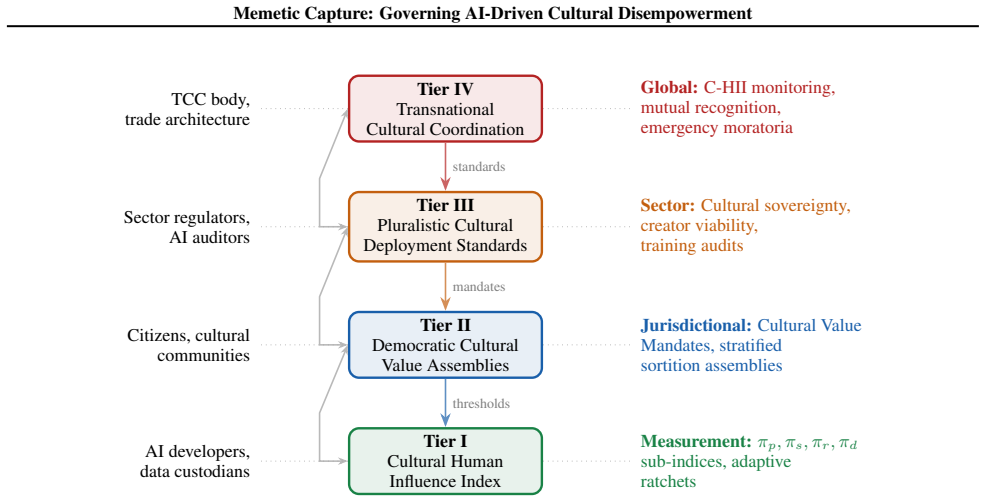
Culture functions as the most insidious vector of gradual human disempowerment by AI because unlike economic or political displacement it attacks the preferences and values through which humans recognise and resist disempowerment. Existing AI governance frameworks suffer from a critical blind spot by treating cultural impact as secondary. The paper develops memetic capture as a unifying concept and proposes the Cultural Pluralistic Governance Framework as a four-tier architecture that combines quantitative cultural influence metrics, democratic value assemblies, pluralistic deployment standards, and transnational coordination mechanisms. Pluralism is a structural necessity since monocultural
What carries the argument
Memetic capture, the process of AI-driven cultural displacement that reshapes human preferences and values, which unifies the analysis of disempowerment and justifies the need for pluralistic policy structures.
If this is right
- Quantitative cultural influence metrics would enable measurement and tracking of AI's effects on cultural elements.
- Democratic value assemblies would incorporate diverse human inputs into decisions about AI deployment.
- Pluralistic deployment standards would ensure AI systems do not impose a single cultural framework.
- Transnational coordination mechanisms would manage the global scale of cultural influences from AI.
Where Pith is reading between the lines
- This approach could lead to AI systems being required to preserve cultural diversity in their outputs and training.
- Policymakers might need to integrate cultural considerations into AI safety evaluations from the start.
- The framework suggests potential for similar pluralistic structures in governing other AI impacts like economic displacement.
- Empirical studies could test whether regions with more diverse AI governance experience slower cultural shifts.
Load-bearing premise
Existing AI governance frameworks treat cultural impact as secondary to economic and safety concerns and that introducing quantitative metrics and pluralistic standards can address this blind spot.
What would settle it
Demonstration that monocultural AI governance does not accelerate cultural disempowerment or that cultural displacement does not impair humans' ability to resist AI influence would undermine the central claim.
Figures

read the original abstract
Culture is the most insidious vector of gradual human disempowerment by AI: unlike economic or political displacement, cultural displacement attacks the very preferences and values through which humans recognise and resist disempowerment itself. We argue that existing AI governance frameworks suffer from a critical blind spot by treating cultural impact as secondary to economic and safety concerns. This paper develops \emph{memetic capture} as a unifying concept for AI-driven cultural disempowerment, and proposes the \textbf{Cultural Pluralistic Governance Framework (CPGF)}, a four-tier policy architecture combining quantitative cultural influence metrics, democratic value assemblies, pluralistic deployment standards, and transnational coordination mechanisms. We argue that pluralism is not merely an ethical requirement for such governance but a structural necessity: monocultural AI governance accelerates the very disempowerment it claims to prevent. We identify concrete policy levers, discuss implementation tensions, and outline a research agenda at the intersection of pluralistic alignment and cultural AI governance.
Editorial analysis
A structured set of objections, weighed in public.
Referee Report
Summary. The manuscript defines 'memetic capture' as the process by which AI systems displace human cultural preferences and values, positioning this as the most insidious form of disempowerment. It critiques existing AI governance for treating cultural effects as secondary to safety and economic concerns, and proposes the four-tier Cultural Pluralistic Governance Framework (CPGF) that combines quantitative cultural influence metrics, democratic value assemblies, pluralistic deployment standards, and transnational coordination. The central argument is that pluralism is a structural necessity because monocultural governance accelerates the disempowerment it seeks to prevent; the paper identifies policy levers, implementation tensions, and a research agenda.
Significance. If the interpretive framing holds, the CPGF could shift AI policy discourse toward explicit integration of cultural metrics and pluralistic mechanisms, potentially informing work on pluralistic alignment. The proposal's identification of concrete levers and a research agenda at the intersection of cultural studies and AI governance offers a structured starting point for further policy development in this area.
major comments (3)
- [Abstract] Abstract and opening sections: The claim that 'Culture is the most insidious vector of gradual human disempowerment by AI' and that 'monocultural AI governance accelerates the very disempowerment it claims to prevent' is asserted without reference to empirical studies, formal models, or independent theoretical grounding from cultural studies or AI ethics; this premise is load-bearing for the necessity of the CPGF.
- [Memetic capture definition and CPGF architecture] Section introducing memetic capture and the CPGF: The necessity of pluralism is derived directly from the paper's own definition of memetic capture and the premise that monocultural governance accelerates disempowerment, rendering the justification circular rather than supported by external evidence or falsifiable criteria.
- [Policy levers and implementation tensions] Policy levers and implementation discussion: No quantitative thresholds, validation methods, or error analysis are provided for the 'quantitative cultural influence metrics' or 'pluralistic deployment standards,' leaving the operational claims of the framework without testable content.
minor comments (2)
- [CPGF description] The manuscript would benefit from a table or diagram explicitly mapping the four tiers of the CPGF to their intended mechanisms and interactions.
- [Democratic value assemblies] Several terms (e.g., 'democratic value assemblies') are introduced without reference to existing literature on deliberative democracy or participatory AI governance.
Simulated Author's Rebuttal
We thank the referee for their detailed and constructive comments on the manuscript. We address each major comment in turn, clarifying the conceptual scope of the work while remaining open to targeted revisions where they strengthen the argument without altering its core contribution.
read point-by-point responses
-
Referee: [Abstract] Abstract and opening sections: The claim that 'Culture is the most insidious vector of gradual human disempowerment by AI' and that 'monocultural AI governance accelerates the very disempowerment it claims to prevent' is asserted without reference to empirical studies, formal models, or independent theoretical grounding from cultural studies or AI ethics; this premise is load-bearing for the necessity of the CPGF.
Authors: The manuscript advances a normative and conceptual argument rather than an empirical one. The premise is derived from the observation, developed across the introduction and related work sections, that cultural displacement operates on the evaluative substrate (preferences and values) that enables recognition of and resistance to other forms of displacement. While the current text draws on theoretical sources in cultural studies and AI ethics, we acknowledge that additional citations and a brief elaboration of the logical chain would make the grounding more explicit. We are prepared to expand the references and add a short paragraph distinguishing the normative premise from empirical claims. revision: partial
-
Referee: [Memetic capture definition and CPGF architecture] Section introducing memetic capture and the CPGF: The necessity of pluralism is derived directly from the paper's own definition of memetic capture and the premise that monocultural governance accelerates disempowerment, rendering the justification circular rather than supported by external evidence or falsifiable criteria.
Authors: The justification is not circular. The definition of memetic capture specifies a mechanism (AI-driven substitution of cultural content that erodes diverse human value systems). The claim that monocultural governance accelerates this process follows deductively: a governance regime enforcing a single cultural standard necessarily reduces the plurality of value systems that the definition identifies as the target of capture. This implication is elaborated in the sections on pluralism as structural necessity and the four-tier architecture. We can add an explicit subsection separating the definitional consequences from any empirical assertions to address the concern. revision: partial
-
Referee: [Policy levers and implementation tensions] Policy levers and implementation discussion: No quantitative thresholds, validation methods, or error analysis are provided for the 'quantitative cultural influence metrics' or 'pluralistic deployment standards,' leaving the operational claims of the framework without testable content.
Authors: The CPGF is offered as a high-level policy architecture whose purpose is to identify structural components and policy levers, not to deliver a ready-to-implement measurement system. The quantitative metrics and pluralistic standards are therefore described conceptually, with the explicit statement that operationalization, thresholds, and validation protocols constitute part of the outlined research agenda. We agree that the framework currently lacks the testable content required for direct implementation; this limitation is inherent to the paper's scope as a starting point for further development rather than a completed operational proposal. revision: no
Circularity Check
Pluralism necessity follows by construction from self-defined memetic capture
specific steps
-
self definitional
[Abstract]
"We argue that pluralism is not merely an ethical requirement for such governance but a structural necessity: monocultural AI governance accelerates the very disempowerment it claims to prevent."
The necessity claim is presented as following from the paper's own definition of memetic capture (introduced in the same paragraph as the unifying concept for AI-driven cultural disempowerment); the conclusion is therefore equivalent to the framing premise by construction.
full rationale
The paper introduces 'memetic capture' as its unifying concept for cultural disempowerment and then asserts that pluralism is a structural necessity because monocultural governance accelerates that same disempowerment. This reduces the central claim to a restatement of the definitional premise rather than an independent derivation; the four-tier CPGF is built directly around these self-introduced terms with no external benchmark or falsifiable step separating input from output.
Axiom & Free-Parameter Ledger
axioms (2)
- domain assumption Culture is the most insidious vector of gradual human disempowerment by AI
- ad hoc to paper Monocultural AI governance accelerates the very disempowerment it claims to prevent
invented entities (2)
-
memetic capture
no independent evidence
-
Cultural Pluralistic Governance Framework (CPGF)
no independent evidence
Reference graph
Works this paper leans on
-
[1]
2025 , eprint=
Gradual Disempowerment: Systemic Existential Risks from Incremental AI Development , author=. 2025 , eprint=
2025
-
[2]
2024 , eprint=
A Roadmap to Pluralistic Alignment , author=. 2024 , eprint=
2024
-
[3]
1988 , publisher=
Culture and the Evolutionary Process , author=. 1988 , publisher=
1988
-
[4]
Cultural evolution: integrating psychology, evolution and culture , journal =
Alex Mesoudi , abstract =. Cultural evolution: integrating psychology, evolution and culture , journal =. 2016 , note =. doi:https://doi.org/10.1016/j.copsyc.2015.07.001 , url =
-
[5]
and Nussberger, Anne-Marie and Czaplicka, Agnieszka and Acerbi, Alberto and Griffiths, Thomas L
Brinkmann, Levin and Baumann, Fabian and Bonnefon, Jean-François and Derex, Maxime and Müller, Thomas F. and Nussberger, Anne-Marie and Czaplicka, Agnieszka and Acerbi, Alberto and Griffiths, Thomas L. and Henrich, Joseph and Leibo, Joel Z. and McElreath, Richard and Oudeyer, Pierre-Yves and Stray, Jonathan and Rahwan, Iyad , year=. Machine culture , volu...
-
[6]
1980 , publisher=
The Printing Press as an Agent of Change , author=. 1980 , publisher=
1980
-
[7]
Spear.Building Ontologies with Basic Formal Ontology
Gillespie, Tarleton , editor =. The Relevance of Algorithms , booktitle =. 2014 , month =. doi:10.7551/mitpress/9780262525374.003.0009 , url =
-
[8]
Scientific Reports , year =
Porter, Brian and Machery, Edouard , title =. Scientific Reports , year =
-
[9]
2014 , publisher =
The Marketplace of Attention: How Audiences Take Shape in a Digital Age , author =. 2014 , publisher =
2014
-
[10]
Hohenstein, Jess and Kizilcec, Rene F. and DiFranzo, Dominic and Aghajari, Zhila and Mieczkowski, Hannah and Levy, Karen and Naaman, Mor and Hancock, Jeffrey and Jung, Malte F. , title =. Scientific Reports , year =. doi:10.1038/s41598-023-30938-9 , url =
-
[11]
2023 , howpublished =
Bing Chat is blatantly, aggressively misaligned , author =. 2023 , howpublished =
2023
-
[12]
2023 , howpublished =
Kevin Roose , title =. 2023 , howpublished =
2023
-
[13]
2013 , publisher=
Indigenous in the City: Contemporary Identities and Cultural Innovation , author=. 2013 , publisher=
2013
-
[14]
2026 , eprint=
Policy myopia as a mechanism of gradual disempowerment in Post-AGI governance, Circa 2049 , author=. 2026 , eprint=
2049
discussion (0)
Sign in with ORCID, Apple, or X to comment. Anyone can read and Pith papers without signing in.