OSSMM: An Open-Source Sleep Monitor and Modulator
Pith reviewed 2026-05-20 08:30 UTC · model grok-4.3
The pith
A low-cost open-source headband using two frontal electrodes without ground reference captures biosignals for four-stage sleep classification by machine learning.
A machine-rendered reading of the paper's core claim, the machinery that carries it, and where it could break.
Core claim
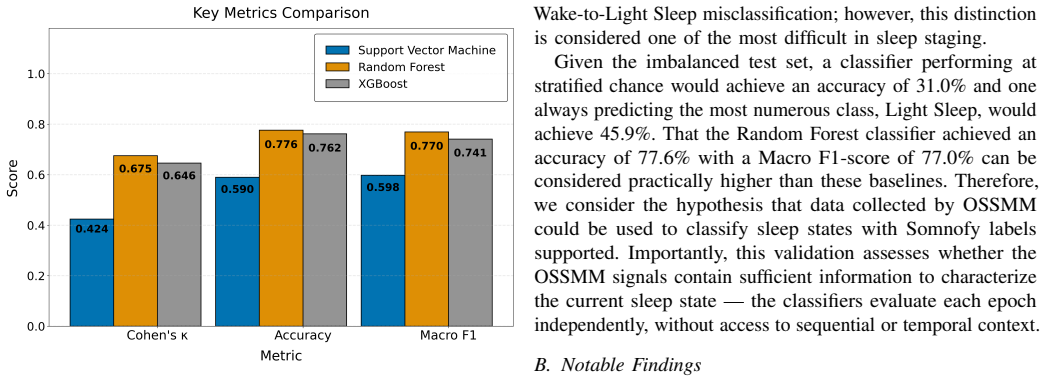
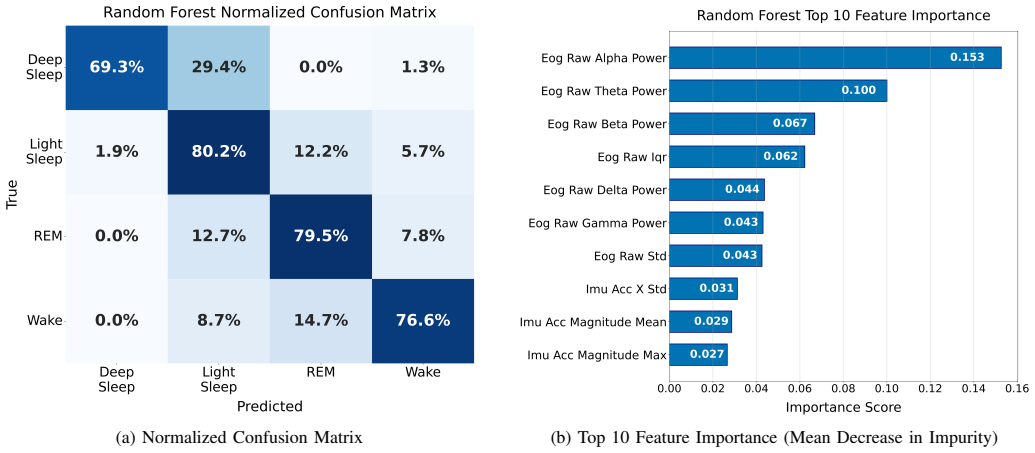
The central claim is that inexpensive reusable CTPU electrodes from fitness straps, placed frontally to record a differential signal without a ground reference, produce a biosignal whose power spectrum in standard frequency bands supplies the dominant features for conventional machine learning to achieve four-stage sleep staging at macro F1 of 0.770 and accuracy of 0.776 over 15 nights in one subject, with the signal also showing spindle-like signatures.
What carries the argument
The two frontal CTPU electrodes recording a ground-reference-free differential biosignal whose spectral content in EEG bands serves as the primary input driving the sleep-stage classifier.
If this is right
- Sleep staging becomes feasible with far fewer electrodes and simpler wiring than conventional multi-channel EEG setups.
- The fully open hardware and software let researchers build, modify, and deploy their own low-cost monitors without commercial licensing barriers.
- Wireless capture of multiple biosignals including putative EEG supports extended home recordings without daily electrode replacement.
- An onboard vibration motor creates the possibility of closed-loop experiments that both monitor and attempt to modulate sleep in real time.
Where Pith is reading between the lines
- The minimal electrode count could shorten setup time and improve comfort for users conducting multi-week sleep studies at home.
- Replicating the device across different age groups or clinical populations would test whether the same spectral features remain discriminative.
- Pairing the monitor with the vibration modulator invites experiments on whether targeted stimulation during specific sleep stages alters next-day cognitive measures.
Load-bearing premise
That the classification performance seen in a single participant across 15 nights shows the two-electrode frontal configuration works for practical sleep staging beyond this one case.
What would settle it
Collecting data from several additional participants with simultaneous polysomnography and finding macro F1 scores well below 0.7 would indicate the minimal electrode setup does not generalize reliably.
Figures


read the original abstract
We present the Open-Source Sleep Monitor and Modulator (OSSMM), an open-source hardware and software platform for accessible sleep research. The OSSMM comprises a small wearable headband built from 3D prints and affordable commercial-off-the-shelf (COTS) components at a material cost under 40 euros, supported by a companion Android application. The system requires no conductive gels, disposable electrodes, or specialized equipment, and captures multiple biosignals movement, pulse, electrooculography (EOG), and putative electroencephalography (EEG) with wireless connectivity for data storage and potential sleep modulation capability via an onboard vibration motor. A proof-of-concept single-participant evaluation across 15 nights demonstrated that the captured biosignals support four-stage sleep classification (Wake, Light Sleep, Deep Sleep, REM) using conventional machine learning methods, with the best-performing model achieving a Macro F1-score of 0.770 and accuracy of 0.776 against a validated non-contact sleep monitor ($\kappa$=0.63 with PSG). Two technical findings are of particular note. First, inexpensive, reusable conductive thermoplastic polyurethane (CTPU) electrodes from commercial fitness chest straps captured a differential signal whose spectral properties in canonical EEG frequency bands, including signatures consistent with sleep spindles, are the principal features driving classification. Second, this signal is obtained from just two frontal electrodes without a dedicated ground reference, suggesting that practical sleep staging is achievable with simpler configurations than typically employed. All hardware designs, software, and build instructions are openly available to support replication and modification by the research community.
Editorial analysis
A structured set of objections, weighed in public.
Referee Report
Summary. The paper presents OSSMM, an open-source low-cost wearable headband (<40 euros in COTS parts) with 3D-printed components, an Android companion app, and wireless data handling for capturing movement, pulse, EOG, and putative EEG biosignals. A proof-of-concept single-participant study over 15 nights shows that a differential signal from two frontal reusable CTPU electrodes (no dedicated ground) yields spectral features in canonical bands, including spindle-like signatures, that support conventional ML-based four-stage sleep classification (Wake, Light Sleep, Deep Sleep, REM) with best-model Macro F1 of 0.770 and accuracy of 0.776 against a non-contact reference (κ=0.63 vs PSG). All designs, software, and instructions are released openly.
Significance. If the empirical findings hold under broader testing, the work supplies a genuinely accessible, modifiable platform that could expand sleep research beyond specialized labs by demonstrating usable staging signals from a minimal two-electrode frontal montage. The open-source release of hardware, firmware, and analysis code is a concrete strength that directly supports replication and community-driven improvement.
major comments (2)
- [Abstract and proof-of-concept evaluation] Abstract and proof-of-concept evaluation: the reported Macro F1 of 0.770 and accuracy of 0.776 rest entirely on within-subject cross-validation from one participant across 15 nights. Anatomical factors (frontal bone thickness, hair density, contact impedance) can alter common-mode rejection and spectral content; without data from additional subjects the claim that this two-electrode configuration without ground reference supports practical, generalizable sleep staging remains untested and load-bearing for the central contribution.
- [Evaluation section] Evaluation section: the reference standard is a non-contact monitor whose own agreement with PSG is only moderate (κ=0.63). This introduces an upper bound on achievable performance metrics and should be accompanied by explicit discussion of how label noise affects the reported F1 and accuracy figures.
minor comments (3)
- [Methods] The manuscript would benefit from a supplementary table listing the exact feature set (band powers, spindle detection metrics, etc.) and the hyper-parameter search ranges used for each classifier.
- [Hardware description] Figure showing electrode placement should include measured inter-electrode distance and a note on how the differential signal is obtained without an explicit ground.
- [Data and code availability] The repository link and commit hash for the analysis code should be stated in the main text to facilitate immediate replication.
Simulated Author's Rebuttal
We thank the referee for the constructive and detailed comments. We address each major comment below and outline the revisions we will make to strengthen the manuscript.
read point-by-point responses
-
Referee: [Abstract and proof-of-concept evaluation] Abstract and proof-of-concept evaluation: the reported Macro F1 of 0.770 and accuracy of 0.776 rest entirely on within-subject cross-validation from one participant across 15 nights. Anatomical factors (frontal bone thickness, hair density, contact impedance) can alter common-mode rejection and spectral content; without data from additional subjects the claim that this two-electrode configuration without ground reference supports practical, generalizable sleep staging remains untested and load-bearing for the central contribution.
Authors: We agree that the evaluation is confined to a single participant and constitutes a proof-of-concept rather than a demonstration of generalizability. The manuscript already frames the work in these terms, but we will revise the abstract and add an explicit limitations paragraph in the discussion to state that inter-subject anatomical variability may affect signal quality and that multi-subject validation is required before any claim of practical, generalizable sleep staging can be made. The primary contribution remains the open-source platform intended to enable such validation by the community. revision: yes
-
Referee: [Evaluation section] Evaluation section: the reference standard is a non-contact monitor whose own agreement with PSG is only moderate (κ=0.63). This introduces an upper bound on achievable performance metrics and should be accompanied by explicit discussion of how label noise affects the reported F1 and accuracy figures.
Authors: We accept this point. The moderate agreement of the reference device with PSG introduces label noise that bounds the attainable metrics. We will revise the evaluation section to include a dedicated discussion of this limitation, explaining how the reported κ=0.63 constrains interpretation of the Macro F1 and accuracy values and noting the implications of label noise for the observed performance. revision: yes
Circularity Check
No circularity: empirical ML results on collected biosignals
full rationale
The paper reports hardware design and a proof-of-concept evaluation consisting of data collection over 15 nights from one participant followed by standard supervised machine-learning classification of four sleep stages. Performance figures (Macro F1 0.770, accuracy 0.776) are obtained by training and testing models on spectral features extracted from the recorded signals and comparing against a non-contact reference; no equations, fitted parameters, or self-citations are invoked that would make these metrics equivalent to the inputs by construction. The derivation chain is therefore self-contained empirical measurement rather than a closed logical loop.
Axiom & Free-Parameter Ledger
axioms (1)
- domain assumption A differential signal recorded from two frontal CTPU electrodes without dedicated ground reference contains spectral content in canonical EEG bands sufficient for four-stage sleep classification.
Lean theorems connected to this paper
-
IndisputableMonolith/Foundation/AbsoluteFloorClosure.leanreality_from_one_distinction unclear?
unclearRelation between the paper passage and the cited Recognition theorem.
inexpensive CTPU electrodes... differential signal from just two frontal electrodes without a dedicated ground reference whose spectral properties drive classification... Macro F1-score of 0.770
-
IndisputableMonolith/Cost/FunctionalEquation.leanwashburn_uniqueness_aczel unclear?
unclearRelation between the paper passage and the cited Recognition theorem.
five power features in neurophysiologically relevant ranges... delta, theta, alpha, beta, and gamma
What do these tags mean?
- matches
- The paper's claim is directly supported by a theorem in the formal canon.
- supports
- The theorem supports part of the paper's argument, but the paper may add assumptions or extra steps.
- extends
- The paper goes beyond the formal theorem; the theorem is a base layer rather than the whole result.
- uses
- The paper appears to rely on the theorem as machinery.
- contradicts
- The paper's claim conflicts with a theorem or certificate in the canon.
- unclear
- Pith found a possible connection, but the passage is too broad, indirect, or ambiguous to say the theorem truly supports the claim.
Reference graph
Works this paper leans on
-
[1]
Cerebral states during sleep, as studied by human brain potentials
A. L. Loomis, E. N. Harvey, and G. A. Hobart, “Cerebral states during sleep, as studied by human brain potentials.”Journal of experimental psychology, vol. 21, no. 2, p. 127, 1937
work page 1937
-
[2]
Regularly occurring periods of eye motility, and concomitant phenomena, during sleep,
E. Aserinsky and N. Kleitman, “Regularly occurring periods of eye motility, and concomitant phenomena, during sleep,”Science, vol. 118, no. 3062, pp. 273–274, 1953
work page 1953
-
[3]
REM sleep reduction effects on depression syndromes,
G. W. V ogel, A. Thurmond, P. Gibbons, K. Sloan, M. Boyd, and M. Walker, “REM sleep reduction effects on depression syndromes,” Archives of General Psychiatry, vol. 32, no. 6, pp. 765–777, 1975
work page 1975
-
[4]
History of the development of sleep medicine in the united states,
J. W. Shepard, D. J. Buysse, A. L. Chesson, W. C. Dement, R. Goldberg, C. Guilleminault, C. D. Harris, C. Iber, E. Mignot, M. M. Mitleret al., “History of the development of sleep medicine in the united states,” Journal of clinical sleep medicine, vol. 1, no. 01, pp. 61–82, 2005
work page 2005
-
[5]
REM sleep dysregulation in depression: state of the art,
L. Palagini, C. Baglioni, A. Ciapparelli, A. Gemignani, and D. Riemann, “REM sleep dysregulation in depression: state of the art,”Sleep medicine reviews, vol. 17, no. 5, pp. 377–390, 2013
work page 2013
-
[6]
P. Sikka, A. Revonsuo, V . Noreika, and K. Valli, “EEG frontal alpha asymmetry and dream affect: Alpha oscillations over the right frontal cortex during rem sleep and presleep wakefulness predict anger in REM sleep dreams,”Journal of Neuroscience, vol. 39, no. 24, pp. 4775–4784, 2019
work page 2019
-
[7]
N. Ketz, A. P. Jones, N. B. Bryant, V . P. Clark, and P. K. Pilly, “Closed- loop slow-wave tACS improves sleep-dependent long-term memory generalization by modulating endogenous oscillations,”Journal of Neuroscience, vol. 38, no. 33, pp. 7314–7326, 2018
work page 2018
-
[8]
Darien, IL: American Academy of Sleep Medicine, 2023
AASM,AASM Manual for the Scoring of Sleep and Associated Events, version 3 ed. Darien, IL: American Academy of Sleep Medicine, 2023
work page 2023
-
[9]
An economic evaluation of home versus laboratory-based diagnosis of obstructive sleep apnea,
R. D. Kim, V . K. Kapur, J. Redline-Bruch, M. Rueschman, D. H. Auckley, R. M. Benca, N. R. Foldvary-Schafer, C. Iber, P. C. Zee, C. L. Rosenet al., “An economic evaluation of home versus laboratory-based diagnosis of obstructive sleep apnea,”Sleep, vol. 38, no. 7, pp. 1027–1037, 2015
work page 2015
-
[10]
M. Gr ¨ozinger, P. K ¨ogel, and J. R ¨oschke, “Effects of REM sleep awakenings and related wakening paradigms on the ultradian sleep cycle and the symptoms in depression,”Journal of psychiatric research, vol. 36, no. 5, pp. 299–308, 2002
work page 2002
-
[11]
D. J. Miller, C. Sargent, and G. D. Roach, “A validation of six wearable devices for estimating sleep, heart rate and heart rate variability in healthy adults,”Sensors, vol. 22, no. 16, p. 6317, 2022
work page 2022
-
[12]
Deepsleepnet: A model for automatic sleep stage scoring based on raw single-channel EEG,
A. Supratak, H. Dong, C. Wu, and Y . Guo, “Deepsleepnet: A model for automatic sleep stage scoring based on raw single-channel EEG,”IEEE transactions on neural systems and rehabilitation engineering, vol. 25, no. 11, pp. 1998–2008, 2017
work page 1998
-
[13]
S. Toften, S. Pallesen, M. Hrozanova, F. Moen, and J. Grønli, “Validation of sleep stage classification using non-contact radar technology and machine learning (somnofy®),”Sleep Medicine, vol. 75, pp. 54–61, 2020
work page 2020
-
[14]
A deep learning method approach for sleep stage classification with EEG spectrogram,
C. Li, Y . Qi, X. Ding, J. Zhao, T. Sang, and M. Lee, “A deep learning method approach for sleep stage classification with EEG spectrogram,” International journal of environmental research and public health, vol. 19, no. 10, p. 6322, 2022
work page 2022
-
[15]
Accuracy of three commercial wearable devices for sleep tracking in healthy adults,
R. Robbins, M. D. Weaver, J. P. Sullivan, S. F. Quan, K. Gilmore, S. Shaw, A. Benz, S. Qadri, L. K. Barger, C. A. Czeisleret al., “Accuracy of three commercial wearable devices for sleep tracking in healthy adults,” Sensors, vol. 24, no. 20, p. 6532, 2024
work page 2024
-
[16]
A.-M. Schyvens, B. Peters, N. C. Van Oost, J.-M. Aerts, F. Masci, A. Neven, H. Dirix, G. Wets, V . Ross, and J. Verbraecken, “A performance validation of six commercial wrist-worn wearable sleep-tracking devices for sleep stage scoring compared to polysomnography,”Sleep Advances, vol. 6, no. 2, p. zpaf021, 2025
work page 2025
-
[17]
E. C. Landsness, M. R. Goldstein, M. J. Peterson, G. Tononi, and R. M. Benca, “Antidepressant effects of selective slow wave sleep deprivation in major depression: a high-density EEG investigation,”Journal of psychiatric research, vol. 45, no. 8, pp. 1019–1026, 2011
work page 2011
-
[18]
REM sleep reduction, mood regulation and remission in untreated depression,
R. Cartwright, E. Baehr, J. Kirkby, S. Pandi-Perumal, and J. Kabat, “REM sleep reduction, mood regulation and remission in untreated depression,” Psychiatry Research, vol. 121, no. 2, pp. 159–167, 2003
work page 2003
-
[19]
Induction of self awareness in dreams through frontal low current stimulation of gamma activity,
U. V oss, R. Holzmann, A. Hobson, W. Paulus, J. Koppehele-Gossel, A. Klimke, and M. A. Nitsche, “Induction of self awareness in dreams through frontal low current stimulation of gamma activity,”Nature neuroscience, vol. 17, no. 6, pp. 810–812, 2014
work page 2014
-
[20]
Enhanced emotional reactivity after selective REM sleep deprivation in humans: an fMRI study,
A. Rosales-Lagarde, J. L. Armony, Y . del R´ıo-Portilla, D. Trejo-Mart´ınez, R. Conde, and M. Corsi-Cabrera, “Enhanced emotional reactivity after selective REM sleep deprivation in humans: an fMRI study,”Frontiers in behavioral neuroscience, vol. 6, p. 25, 2012
work page 2012
-
[21]
IEEE, “IEEE code of ethics,” https://www.ieee.org/content/dam/ieee-org/ ieee/web/org/about/corporate/ieee-code-of-ethics.pdf, June 2020, adopted by the IEEE Board of Directors, June 2020. Accessed: 2025-10-02
work page 2020
-
[22]
The consensus sleep diary: standardizing prospective sleep self-monitoring,
C. E. Carney, D. J. Buysse, S. Ancoli-Israel, J. D. Edinger, A. D. Krystal, K. L. Lichstein, and C. M. Morin, “The consensus sleep diary: standardizing prospective sleep self-monitoring,”Sleep, vol. 35, no. 2, pp. 287–302, 2012
work page 2012
- [23]
- [24]
-
[25]
Analog Devices,Single-Lead, Heart Rate Monitor Front End AD8232, Analog Devices, Inc., Norwood, MA, USA, 2012, rev. C. [Online]. Available: https://www.analog.com/media/en/technical-documentation/ data-sheets/AD8232.pdf
work page 2012
-
[26]
Heart rate monitor - AD8232: Schematic,
SparkFun Electronics, “Heart rate monitor - AD8232: Schematic,” SparkFun Electronics, Boulder, CO, USA, Technical Drawing, 2014, cardiac monitor configuration for the AD8232. [Online]. Avail- able: https://cdn.sparkfun.com/datasheets/Sensors/Biometric/AD8232 Heart Rate Monitor v10.pdf
work page 2014
-
[27]
Ten-twenty electrode system of the international federation,
H. H. Jasper, “Ten-twenty electrode system of the international federation,” Electroencephalogr Clin Neurophysiol, vol. 10, pp. 371–375, 1958
work page 1958
-
[28]
Jiangsu Kerbio Medical Technology Group Co., Ltd., “Skin irritation test,” Jiangsu Kerbio Medical Technology Group Co., Ltd., Changzhou, Jiangsu, China, Tech. Rep. SSMT-R-2024-02665-02A, Jun. 2024, biocompatibility test report for Siraya Tech Flex TPU filament, conducted according to ISO 10993-23:2021 standard
work page 2024
-
[29]
——, “In vitro cytotoxicity test,” Jiangsu Kerbio Medical Technology Group Co., Ltd., Changzhou, Jiangsu, China, Tech. Rep. SSMT-R-2024- 02665-01A, Jun. 2024, biocompatibility test report for Siraya Tech Flex TPU filament, conducted according to ISO 10993-5:2009 standard
work page 2024
-
[30]
——, “Skin sensitization test,” Jiangsu Kerbio Medical Technology Group Co., Ltd., Changzhou, Jiangsu, China, Tech. Rep. SSMT-R-2024-02665- 03A, Jun. 2024, biocompatibility test report for Siraya Tech Flex TPU filament , conducted according to ISO 10993-10:2021 standard
work page 2024
-
[31]
Scikit-learn: Machine learning in python,
F. Pedregosa, G. Varoquaux, A. Gramfort, V . Michel, B. Thirion, O. Grisel, M. Blondel, P. Prettenhofer, R. Weiss, V . Dubourget al., “Scikit-learn: Machine learning in python,”the Journal of machine Learning research, vol. 12, pp. 2825–2830, 2011
work page 2011
-
[32]
Xgboost: A scalable tree boosting system,
T. Chen and C. Guestrin, “Xgboost: A scalable tree boosting system,” inProceedings of the 22nd acm sigkdd international conference on knowledge discovery and data mining, 2016, pp. 785–794
work page 2016
-
[33]
SMOTE: synthetic minority over-sampling technique,
N. V . Chawla, K. W. Bowyer, L. O. Hall, and W. P. Kegelmeyer, “SMOTE: synthetic minority over-sampling technique,”Journal of artificial intelligence research, vol. 16, pp. 321–357, 2002
work page 2002
-
[34]
C. S. Nayak and A. C. Anilkumar, “EEG normal sleep,” inStatPearls [Internet]. Treasure Island, FL: StatPearls Publishing, May 2023, last updated May 23, 2023. Bookshelf ID: NBK537023. [Online]. Available: https://www.ncbi.nlm.nih.gov/books/NBK537023/
work page 2023
-
[35]
Comparison of a single-channel EEG sleep study to polysomnography,
B. P. Lucey, J. S. Mcleland, C. D. Toedebusch, J. Boyd, J. C. Morris, E. C. Landsness, K. Yamada, and D. M. Holtzman, “Comparison of a single-channel EEG sleep study to polysomnography,”Journal of sleep research, vol. 25, no. 6, pp. 625–635, 2016
work page 2016
-
[36]
M. Tashakori, M. Rusanen, T. Karhu, L. Grote, R. K. Nath, T. Lepp ¨anen, and S. Nikkonen, “Interhemispheric differences of electroencephalogra- phy signal characteristics in different sleep stages,”Sleep Medicine, vol. 117, pp. 201–208, 2024
work page 2024
discussion (0)
Sign in with ORCID, Apple, or X to comment. Anyone can read and Pith papers without signing in.