Grain-size evolution and rapid dust growth in high-redshift galaxies
Pith reviewed 2026-06-28 00:41 UTC · model grok-4.3
The pith
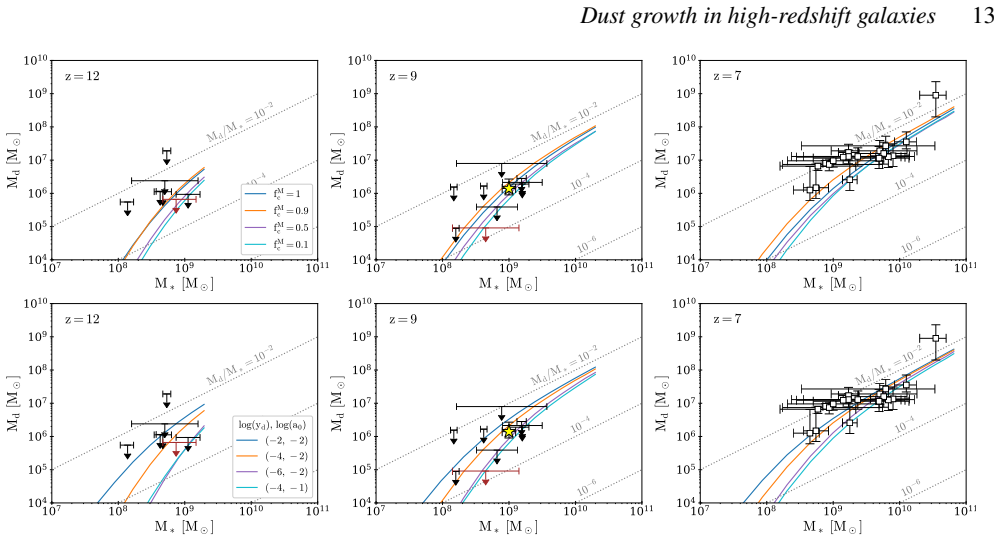
Even with supernova dust yields as low as 10^{-4} solar masses and initial grains of 0.01 micrometers, massive galaxies reach dust-to-stellar mass ratios near 10^{-2} by redshift 7 through rapid ISM accretion seeded by small grains.
A machine-rendered reading of the paper's core claim, the machinery that carries it, and where it could break.
Core claim
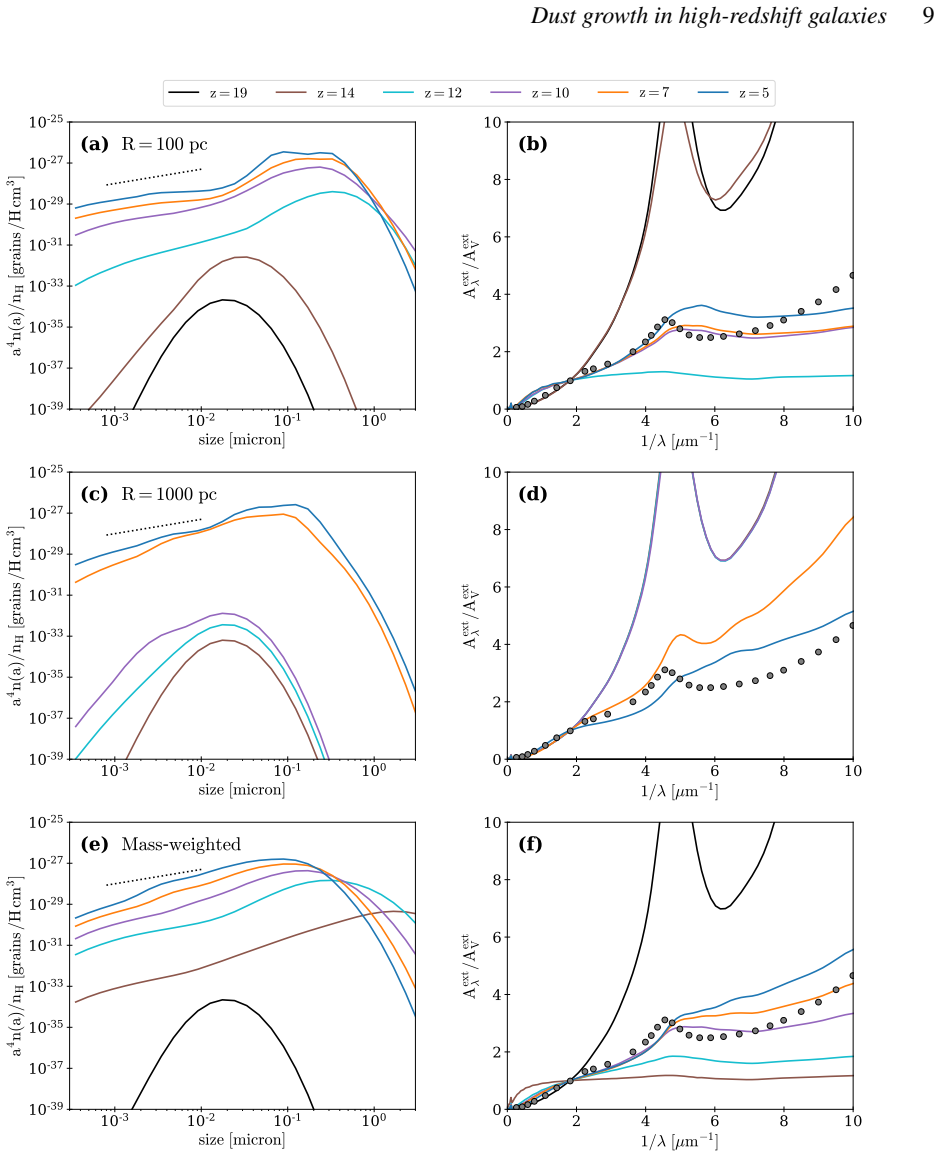
With a dust yield of 10^{-4} solar masses per supernova and an initial grain size of 0.01 micrometers, the model produces dust-to-stellar mass ratios of order 10^{-2} in galaxies above 10^9 solar masses by z~7. Small supernova grains efficiently seed metal accretion in the ISM; growth accelerates when the interstellar medium is mostly cold and dense but retains a modest warm component that supplies additional small grains via shattering. Dust growth lags star formation, leaving outer disks dust-poor and permitting non-negligible ultraviolet escape. The resulting dust masses and ultraviolet luminosity functions align with constraints on both dust-rich systems at z~7 and blue galaxies at z gre
What carries the argument
Grain-size evolution inside a multiphase ISM, in which shattering in warm gas creates small seeds and accretion in cold dense gas grows them, with the two processes coupled through the evolving gas-phase fractions.
If this is right
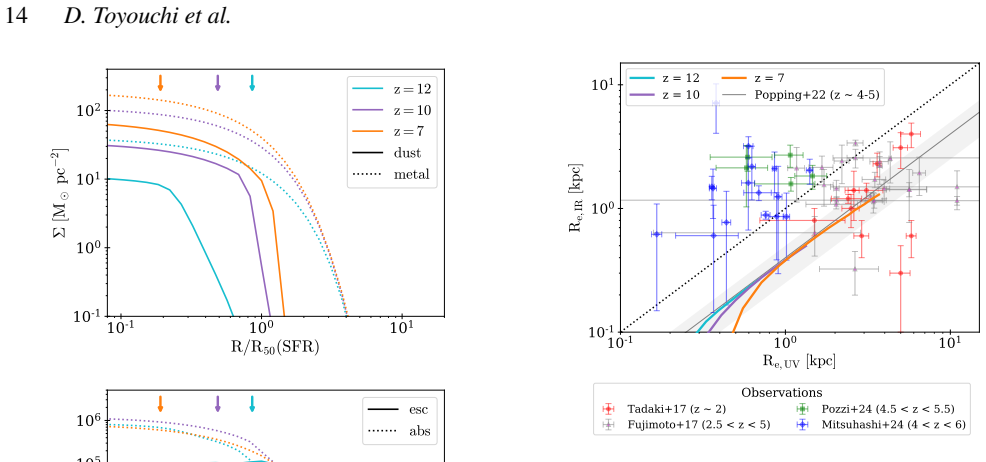
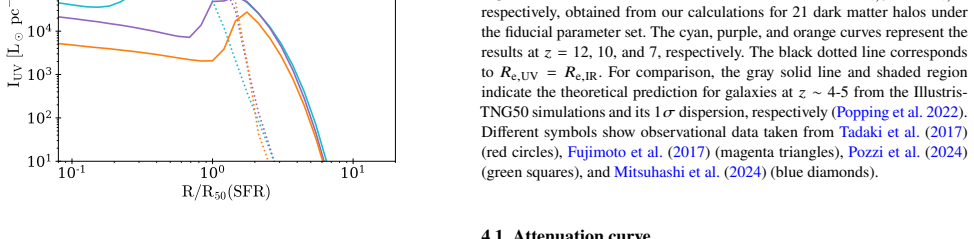
- Dust-to-stellar ratios become high only after significant star formation has already occurred, so half-star-formation-rate radii remain relatively dust-poor.
- Dust growth peaks when the cold dense gas fraction is near 90 percent and a warm component still supplies fresh small grains through shattering.
- The same parameters that match dust masses at z~7 also reproduce the observed ultraviolet luminosity functions at both z=7 and z=12.
- Upper limits on dust content in blue galaxies at z greater than or equal to 10 remain satisfied because growth has not yet had time to operate.
Where Pith is reading between the lines
- Dust content at high redshift may be set more by the timing and efficiency of ISM processing than by the exact stellar dust yield.
- Models that assume a single-phase ISM would under-predict the seed population available for accretion and therefore under-estimate early dust masses.
- Higher ultraviolet escape fractions in outer disks could alter the ionizing photon budget available for reionization if the radial dust gradient is common.
Load-bearing premise
Reverse shocks in dense supernova remnants destroy most newly formed dust, leaving only a small yield of tiny grains that must then grow rapidly in the ISM.
What would settle it
A direct measurement showing that galaxies with stellar masses above 10^9 solar masses at z~7 have dust-to-stellar mass ratios well below 10^{-3} would falsify the claim that low-yield supernova seeds plus ISM accretion suffice.
Figures


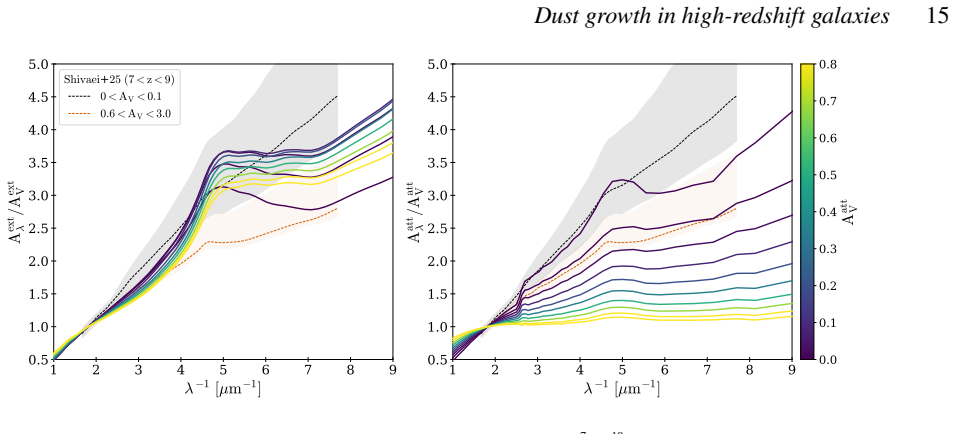


read the original abstract
We present a galaxy evolution model that incorporates grain-size evolution in a multiphase interstellar medium (ISM) to investigate dust attenuation in galaxies at $z \geq 5$. Our fiducial setup assumes a low dust yield of $y_{\rm d} = 10^{-4}~\rm M_\odot$ and a small characteristic size of stellar dust of $a_0 = 0.01~\mu$m, motivated by efficient dust destruction by reverse shocks in dense ISM environments. Our model demonstrates that, even with such low dust yields, massive galaxies with $M_\ast > 10^9~\rm M_\odot$ reach high dust-to-stellar mass ratios of $M_{\rm d}/M_\ast \sim 10^{-2}$ by $z \sim 7$ because small grains supplied by SNe efficiently serve as seeds for metal accretion in the ISM. Because dust growth significantly lags behind star formation, the outer regions beyond the half-star-formation-rate radius remain relatively dust poor, allowing a non-negligible fraction of UV photons to escape without strong attenuation. We further find that dust growth becomes most efficient when the ISM is dominated by cold dense gas but still contains a modest warm component, as the former promotes metal accretion while the latter supplies additional small grains through shattering, thereby further enhancing subsequent grain growth. In particular, with a cold dense gas fraction of $\sim 90~\%$, our model predictions become broadly consistent with the dust-to-stellar mass ratios inferred for dust-rich galaxies at $z \sim 7$, as well as the upper limits for blue galaxies at $z \gtrsim 10$. Self-consistently, the model successfully reproduces the UV luminosity functions observed at both $z = 7$ and $z = 12$. Overall, this study demonstrates that a physically motivated treatment of grain growth in a multiphase ISM is essential for linking the dust content of high-redshift galaxies to their radiative properties during cosmic dawn.
Editorial analysis
A structured set of objections, weighed in public.
Referee Report
Summary. The paper presents a galaxy evolution model with grain-size evolution in a multiphase ISM to explain dust attenuation at z ≥ 5. Using fiducial low dust yield y_d = 10^{-4} M_⊙ and initial grain size a0 = 0.01 μm (motivated by reverse-shock destruction), it claims that massive galaxies (M* > 10^9 M_⊙) reach Md/M* ~ 10^{-2} by z ~ 7 via small SN grains seeding efficient metal accretion, provided the ISM is ~90% cold dense gas with a modest warm component for shattering. The model reproduces UV luminosity functions at z=7 and z=12, and notes that outer regions remain dust-poor, permitting UV escape.
Significance. If the results hold, the work demonstrates that grain-size evolution and multiphase ISM treatment can reconcile low supernova dust yields with observed high-redshift dust-to-stellar ratios, while linking dust growth lags to radiative properties relevant for reionization. The self-consistent reproduction of UV LFs at two redshifts is a positive feature, as is the emphasis on shattering and accretion in mixed-phase gas.
major comments (3)
- [Multiphase ISM and results] Multiphase ISM and results section: the claim that massive galaxies reach Md/M* ~ 10^{-2} by z ~ 7 even with low y_d and a0 holds only for a cold dense gas fraction of ~90%; the text states dust growth is efficient only under this condition, yet no systematic exploration of lower fractions (which the skeptic note indicates would reduce accretion efficiency and fall short of observations) is shown, leaving the central result dependent on this ad-hoc choice rather than a first-principles derivation.
- [Abstract and fiducial setup] Fiducial setup and abstract: y_d = 10^{-4} M_⊙ and a0 = 0.01 μm are presented as motivated by reverse-shock arguments but are free parameters (per the axiom ledger) selected to achieve consistency with z ~ 7 dust-rich galaxy ratios after fixing the 90% cold fraction; this introduces a circularity risk for the claim that low yields suffice, as the match is achieved post-tuning rather than predicted a priori.
- [Results] Results: model outputs for Md/M* and UV LFs lack error bars, uncertainty quantification, or variation with cold-gas fraction beyond the single 90% case, weakening assessment of robustness for the quoted matches to z ~ 7 observations and z ≳ 10 upper limits.
minor comments (1)
- [Abstract] Notation for y_d and a0 should be defined at first use and used consistently; the abstract introduces them without prior reference to the multiphase ISM equations.
Simulated Author's Rebuttal
We thank the referee for their constructive and detailed report. We address each major comment below, agreeing where additional analysis is warranted and clarifying our physical motivations where appropriate. Revisions will be made to improve robustness and clarity.
read point-by-point responses
-
Referee: [Multiphase ISM and results] Multiphase ISM and results section: the claim that massive galaxies reach Md/M* ~ 10^{-2} by z ~ 7 even with low y_d and a0 holds only for a cold dense gas fraction of ~90%; the text states dust growth is efficient only under this condition, yet no systematic exploration of lower fractions (which the skeptic note indicates would reduce accretion efficiency and fall short of observations) is shown, leaving the central result dependent on this ad-hoc choice rather than a first-principles derivation.
Authors: We thank the referee for this point. The 90% cold dense fraction is not presented as arbitrary but as the regime where accretion in cold gas is combined with shattering in a modest warm component to maximize growth efficiency, as stated in the abstract and results. We acknowledge, however, that the manuscript does not systematically vary this fraction. In revision we will add model runs for cold-gas fractions of 70%, 80%, 90%, and 95%, showing the resulting Md/M* evolution and UV LF predictions. This will quantify the threshold behavior and demonstrate that lower fractions fall short of the z~7 dust-rich observations while still allowing discussion of plausible ISM conditions at high redshift. revision: yes
-
Referee: [Abstract and fiducial setup] Fiducial setup and abstract: y_d = 10^{-4} M_⊙ and a0 = 0.01 μm are presented as motivated by reverse-shock arguments but are free parameters (per the axiom ledger) selected to achieve consistency with z ~ 7 dust-rich galaxy ratios after fixing the 90% cold fraction; this introduces a circularity risk for the claim that low yields suffice, as the match is achieved post-tuning rather than predicted a priori.
Authors: The adopted y_d and a0 are chosen within the range motivated by reverse-shock destruction calculations in the literature, as referenced in the manuscript. We recognize that these values, together with the cold-gas fraction, are selected to explore whether low supernova yields remain viable once grain-size evolution is included. The scientific claim is therefore that such low yields can reproduce the observed ratios under these physically motivated conditions, rather than that the model uniquely predicts them a priori. We will revise the abstract and Section 2 to state the parameter choices and their motivations more explicitly, reducing any appearance of circularity while preserving the demonstration that grain-size evolution enables efficient growth. revision: partial
-
Referee: [Results] Results: model outputs for Md/M* and UV LFs lack error bars, uncertainty quantification, or variation with cold-gas fraction beyond the single 90% case, weakening assessment of robustness for the quoted matches to z ~ 7 observations and z ≳ 10 upper limits.
Authors: We agree that the presentation would benefit from explicit uncertainty ranges. In the revised manuscript we will add shaded bands to the Md/M* and UV LF figures that reflect the variation obtained when the cold-gas fraction is changed by ±10% around the fiducial 90% value. We will also include a short discussion of additional uncertainties arising from star-formation efficiency and metal yield. These additions will allow a clearer assessment of how robust the agreement with z=7 data and z>10 limits remains under modest parameter variations. revision: yes
Circularity Check
Dust-to-stellar ratio match at z~7 requires setting cold dense ISM fraction to ~90%
specific steps
-
fitted input called prediction
[Abstract]
"We further find that dust growth becomes most efficient when the ISM is dominated by cold dense gas but still contains a modest warm component... In particular, with a cold dense gas fraction of ∼90 %, our model predictions become broadly consistent with the dust-to-stellar mass ratios inferred for dust-rich galaxies at z ∼ 7"
The cold dense gas fraction is varied until the model output matches the target Md/M* observations; the quoted consistency is therefore produced by construction of this input rather than emerging as a prediction from the grain-size equations alone.
full rationale
The paper assumes low dust yield y_d=10^{-4} M_⊙ and a0=0.01 μm motivated by reverse-shock destruction. It then demonstrates that Md/M*~10^{-2} is reached via small-grain seeding for accretion, but only when the ISM has a cold dense gas fraction of ~90% (with modest warm component for shattering). This fraction is not derived from first principles or external measurement but is the specific value that produces consistency with z~7 observations. The quantitative match to dust ratios is therefore forced by the input choice. The model does reproduce UV luminosity functions at z=7 and z=12 as an independent check, and the grain-size evolution mechanism itself contains non-trivial physics. No self-citation chains or self-definitional loops appear in the text. This yields partial circularity (one fitted parameter called prediction) but the central seeding claim retains independent content.
Axiom & Free-Parameter Ledger
free parameters (3)
- y_d =
10^{-4} M_sun
- a0 =
0.01 um
- cold_dense_gas_fraction =
~90 %
axioms (3)
- domain assumption Reverse shocks in dense ISM destroy most supernova dust, justifying the low y_d value.
- standard math Metal accretion rate depends on grain surface area and local gas density and temperature in the cold phase.
- domain assumption Shattering in the warm phase continuously supplies small grains that act as new accretion seeds.
Reference graph
Works this paper leans on
-
[1]
The bright end of the galaxy luminosity function at z ≃ 7 from the VISTA VIDEO survey. , keywords =. doi:10.1093/mnras/stad2081 , archivePrefix =. 2304.02494 , primaryClass =
-
[2]
The ALMA REBELS Survey: dust continuum detections at z > 6.5. , keywords =. doi:10.1093/mnras/stac1779 , archivePrefix =. 2203.15136 , primaryClass =
-
[3]
Reionization Era Bright Emission Line Survey: Selection and Characterization of Luminous Interstellar Medium Reservoirs in the z > 6.5 Universe. , keywords =. doi:10.3847/1538-4357/ac5a4a , archivePrefix =. 2106.13719 , primaryClass =
-
[4]
New Determinations of the UV Luminosity Functions from z 9 to 2 Show a Remarkable Consistency with Halo Growth and a Constant Star Formation Efficiency. , keywords =. doi:10.3847/1538-3881/abf83e , archivePrefix =. 2102.07775 , primaryClass =
-
[5]
Dust attenuation properties and obscured star formation at z 4.4-5.8
The ALPINE-ALMA [CII] survey. Dust attenuation properties and obscured star formation at z 4.4-5.8. , keywords =. doi:10.1051/0004-6361/202038163 , archivePrefix =. 2004.10760 , primaryClass =
-
[6]
Unveiling the nature of bright z ~ 7 galaxies with the Hubble Space Telescope
Unveiling the nature of bright z ≃ 7 galaxies with the Hubble Space Telescope. , keywords =. doi:10.1093/mnras/stw3296 , archivePrefix =. 1605.05325 , primaryClass =
work page internal anchor Pith review Pith/arXiv arXiv doi:10.1093/mnras/stw3296
-
[7]
Physical Characterization of Early Galaxies in the Webb's First Deep Field SMACS J0723.3-7323. , keywords =. doi:10.3847/2041-8213/acbf50 , archivePrefix =. 2207.11671 , primaryClass =
-
[8]
The ALMA REBELS Survey: the first infrared luminosity function measurement at z 7. , keywords =. doi:10.1093/mnras/stad1259 , archivePrefix =. 2303.11321 , primaryClass =
-
[9]
The ALMA REBELS Survey: Average [C II] 158 m Sizes of Star-forming Galaxies from z 7 to z 4. , keywords =. doi:10.3847/1538-4357/ac7a47 , archivePrefix =. 2206.01886 , primaryClass =
-
[10]
Bulge-forming galaxies with an extended rotating disk at z~2
Bulge-forming Galaxies with an Extended Rotating Disk at z -0.5ex 2. , keywords =. doi:10.3847/1538-4357/834/2/135 , archivePrefix =. 1608.05412 , primaryClass =
work page internal anchor Pith review Pith/arXiv arXiv doi:10.3847/1538-4357/834/2/135
-
[11]
Sub-kiloparsec ALMA Imaging of Compact Star-forming Galaxies at z -0.5ex 2.5: Revealing the Formation of Dense Galactic Cores in the Progenitors of Compact Quiescent Galaxies. , keywords =. doi:10.3847/2041-8205/827/2/L32 , archivePrefix =. 1607.01011 , primaryClass =
work page internal anchor Pith review Pith/arXiv arXiv doi:10.3847/2041-8205/827/2/l32 2041
-
[12]
Demonstrating a New Census of Infrared Galaxies with ALMA (DANCING-ALMA). I. FIR Size and Luminosity Relation at z = 0-6 Revealed with 1034 ALMA Sources. , keywords =. doi:10.3847/1538-4357/aa93e6 , archivePrefix =. 1703.02138 , primaryClass =
work page internal anchor Pith review Pith/arXiv arXiv doi:10.3847/1538-4357/aa93e6
-
[13]
The ALPINE-ALMA [C II] Survey: Size of Individual Star-forming Galaxies at z = 4-6 and Their Extended Halo Structure. , keywords =. doi:10.3847/1538-4357/ab94b3 , archivePrefix =. 2003.00013 , primaryClass =
-
[14]
The dust enrichment of early galaxies in the JWST and ALMA era. , keywords =. doi:10.1093/mnras/stad2734 , archivePrefix =. 2305.01681 , primaryClass =
-
[15]
The ALPINE-CRISTAL-JWST Survey: Gas-phase abundance gradients of main sequence star-forming galaxies and their kinematics at 4 < z < 6. arXiv e-prints , keywords =. doi:10.48550/arXiv.2603.13493 , archivePrefix =. 2603.13493 , primaryClass =
work page internal anchor Pith review Pith/arXiv arXiv doi:10.48550/arxiv.2603.13493
-
[16]
Metallicity Gradients in Modern Cosmological Simulations II: The Role of Bursty Versus Smooth Feedback at High-Redshift. arXiv e-prints , keywords =. doi:10.48550/arXiv.2510.26877 , archivePrefix =. 2510.26877 , primaryClass =
work page internal anchor Pith review Pith/arXiv arXiv doi:10.48550/arxiv.2510.26877
-
[17]
Dust enrichment from core-collapse supernovae and extinction curves in the high-redshift universe
Dust enrichment from core-collapse supernovae and extinction curves in the high-redshift universe. arXiv e-prints , keywords =. doi:10.48550/arXiv.2604.26750 , archivePrefix =. 2604.26750 , primaryClass =
work page internal anchor Pith review Pith/arXiv arXiv doi:10.48550/arxiv.2604.26750
-
[18]
Effective supernova dust yields from rotating and nonrotating stellar progenitors. , keywords =. doi:10.1051/0004-6361/202555906 , archivePrefix =. 2506.11931 , primaryClass =
-
[19]
The ALMA-CRISTAL survey: Widespread dust-obscured star formation in typical star-forming galaxies at z = 4─6. , keywords =. doi:10.1051/0004-6361/202348782 , archivePrefix =. 2311.17671 , primaryClass =
-
[20]
The dust content of galaxies from z = 0 to z = 9
The dust content of galaxies from z = 0 to z = 9. , keywords =. doi:10.1093/mnras/stx1545 , archivePrefix =. 1609.08622 , primaryClass =
work page internal anchor Pith review Pith/arXiv arXiv doi:10.1093/mnras/stx1545
-
[21]
The dust-continuum size of TNG50 galaxies at z = 1-5: a comparison with the distribution of stellar light, stars, dust, and H _ 2. , keywords =. doi:10.1093/mnras/stab3312 , archivePrefix =. 2101.12218 , primaryClass =
-
[22]
FSPS: Flexible Stellar Population Synthesis
-
[23]
Dust Dynamics in Compressible MHD Turbulence
Dust Dynamics in Compressible Magnetohydrodynamic Turbulence. , keywords =. doi:10.1086/425111 , archivePrefix =. astro-ph/0408173 , primaryClass =
work page internal anchor Pith review Pith/arXiv arXiv doi:10.1086/425111
-
[24]
Laboratory Experiments on Preplanetary Dust Aggregation. , keywords =. doi:10.1023/A:1005251414391 , adsurl =
-
[25]
Dust Coagulation. , keywords =. doi:10.1086/172562 , adsurl =
-
[26]
Shocks in dense clouds. III. Dust processing and feedback effects in C-type shocks. , keywords =. doi:10.1051/0004-6361/201015973 , adsurl =
-
[27]
Grain Shattering in Shocks: The Interstellar Grain Size Distribution. , keywords =. doi:10.1086/177823 , adsurl =
-
[28]
Dust coagulation and fragmentation in molecular clouds. I. How collisions between dust aggregates alter the dust size distribution. , keywords =. doi:10.1051/0004-6361/200811158 , archivePrefix =. 0906.1770 , primaryClass =
work page internal anchor Pith review Pith/arXiv arXiv doi:10.1051/0004-6361/200811158
-
[29]
Cosmic Abundances as Records of Stellar Evolution and Nucleosynthesis , year = 2005, editor =
The Solar Chemical Composition. Cosmic Abundances as Records of Stellar Evolution and Nucleosynthesis , year = 2005, editor =
2005
-
[30]
ROBO: a Model and a Code for the Study of the Interstellar Medium
ROBO: a model and a code for studying the interstellar medium. , keywords =. doi:10.1051/0004-6361/200913779 , archivePrefix =. 1012.1142 , primaryClass =
work page internal anchor Pith review Pith/arXiv arXiv doi:10.1051/0004-6361/200913779
-
[31]
Sticking coefficients for atoms and molecules at the surfaces of interstellar dust grains. , keywords =. doi:10.1093/mnras/213.2.295 , adsurl =
-
[32]
2012, MNRAS, 427, 1580, doi: 10.1111/j.1365-2966.2012.22030.x
Dust growth in the interstellar medium: how do accretion and coagulation interplay?. , keywords =. doi:10.1111/j.1365-2966.2012.20702.x , archivePrefix =. 1202.1345 , primaryClass =
-
[33]
Monthly Notices of the Royal Astronomical Society , volume =
Effects of grain size distribution on the interstellar dust mass growth. , keywords =. doi:10.1111/j.1365-2966.2011.19131.x , archivePrefix =. 1105.4930 , primaryClass =
-
[34]
The formation and cosmic evolution of dust in the early Universe: I. Dust sources. , keywords =. doi:10.1007/s00159-024-00151-2 , archivePrefix =. 2310.00053 , primaryClass =
-
[35]
Shattering and coagulation of dust grains in interstellar turbulence. , keywords =. doi:10.1111/j.1365-2966.2009.14405.x , archivePrefix =. 0812.3451 , primaryClass =
-
[36]
Remodeling the evolution of grain size distribution in galaxies
Remodelling the evolution of grain size distribution in galaxies. , keywords =. doi:10.1093/mnras/sty2838 , archivePrefix =. 1810.07962 , primaryClass =
work page internal anchor Pith review Pith/arXiv arXiv doi:10.1093/mnras/sty2838
-
[37]
Simulating the dust content of galaxies: successes and failures
Simulating the dust content of galaxies: successes and failures. , keywords =. doi:10.1093/mnras/stx467 , archivePrefix =. 1606.02714 , primaryClass =
work page internal anchor Pith review Pith/arXiv arXiv doi:10.1093/mnras/stx467
-
[38]
Simulating galactic dust grain evolution on a moving mesh
Simulating galactic dust grain evolution on a moving mesh. , keywords =. doi:10.1093/mnras/sty1248 , archivePrefix =. 1805.04521 , primaryClass =
work page internal anchor Pith review Pith/arXiv arXiv doi:10.1093/mnras/sty1248
-
[39]
Delay Time Distribution Measurement of Type Ia Supernovae by the Subaru/XMM-Newton Deep Survey and Implications for the Progenitor. , keywords =. doi:10.1093/pasj/60.6.1327 , archivePrefix =. 0804.0909 , primaryClass =
work page internal anchor Pith review Pith/arXiv arXiv doi:10.1093/pasj/60.6.1327
-
[40]
Nucleosynthesis in Chandrasekhar Mass Models for Type IA Supernovae and Constraints on Progenitor Systems and Burning-Front Propagation. , keywords =. doi:10.1086/313278 , archivePrefix =. astro-ph/0002337 , primaryClass =
work page internal anchor Pith review Pith/arXiv arXiv doi:10.1086/313278
-
[41]
Bridging Theory and Observations: Insights into Star Formation Efficiency and Dust Attenuation in z > 5 Galaxies. , keywords =. doi:10.1093/mnras/staf1182 , archivePrefix =. 2502.12538 , primaryClass =
-
[42]
Connecting the Gamma Ray Burst Rate and the Cosmic Star Formation History: Implications for Reionization and Galaxy Evolution. , keywords =. doi:10.1088/0004-637X/744/2/95 , archivePrefix =. 1109.0990 , primaryClass =
work page internal anchor Pith review Pith/arXiv arXiv doi:10.1088/0004-637x/744/2/95
-
[43]
The Star Formation Rate in the Reionization Era as Indicated by Gamma-ray Bursts
The Star Formation Rate in the Reionization Era as Indicated by Gamma-Ray Bursts. , keywords =. doi:10.1088/0004-637X/705/2/L104 , archivePrefix =. 0906.0590 , primaryClass =
work page internal anchor Pith review Pith/arXiv arXiv doi:10.1088/0004-637x/705/2/l104
-
[44]
Galaxy Simulation with Dust Formation and Destruction
Galaxy simulation with dust formation and destruction. , keywords =. doi:10.1093/mnras/stw3061 , archivePrefix =. 1609.07547 , primaryClass =
work page internal anchor Pith review Pith/arXiv arXiv doi:10.1093/mnras/stw3061
-
[45]
Galaxy simulation with the evolution of grain size distribution. , keywords =. doi:10.1093/mnras/stz3253 , archivePrefix =. 1906.01917 , primaryClass =
-
[46]
Evolution of dust extinction curves in galaxy simulation
Evolution of dust extinction curves in galaxy simulation. , keywords =. doi:10.1093/mnras/stx877 , archivePrefix =. 1704.01769 , primaryClass =
work page internal anchor Pith review Pith/arXiv arXiv doi:10.1093/mnras/stx877
-
[47]
A ^ 3 COSMOS: Measuring the cosmic dust-attenuated star formation rate density at 4 < z < 5. , keywords =. doi:10.1051/0004-6361/202450081 , archivePrefix =. 2405.18086 , primaryClass =
-
[48]
A first systematic study of [OIII] 88 μ m at z>8 : two luminous oxygen lines and a powerful ionized outflow in the first 600 million years. arXiv e-prints , keywords =. doi:10.48550/arXiv.2512.14486 , archivePrefix =. 2512.14486 , primaryClass =
-
[49]
The ALMA REBELS survey: the dust-obscured cosmic star formation rate density at redshift 7. , keywords =. doi:10.1093/mnras/stac3195 , archivePrefix =. 2208.08243 , primaryClass =
-
[50]
An Ultra-deep Multiband Very Large Array (VLA) Survey of the Faint Radio Sky (COSMOS-XS): New Constraints on the Cosmic Star Formation History. , keywords =. doi:10.3847/1538-4357/ac99db , archivePrefix =. 2204.04167 , primaryClass =
-
[51]
COLDz: A High Space Density of Massive Dusty Starburst Galaxies 1 Billion Years after the Big Bang. , keywords =. doi:10.3847/1538-4357/ab8c48 , archivePrefix =. 2004.10204 , primaryClass =
-
[52]
A dominant population of optically invisible massive galaxies in the early Universe. , keywords =. doi:10.1038/s41586-019-1452-4 , archivePrefix =. 1908.02372 , primaryClass =
-
[53]
Obscured star formation rate density and main sequence of star-forming galaxies at z > 4
The ALPINE-ALMA [CII] survey. Obscured star formation rate density and main sequence of star-forming galaxies at z > 4. , keywords =. doi:10.1051/0004-6361/202038944 , archivePrefix =. 2007.08384 , primaryClass =
-
[54]
The nature, luminosity function, and star formation history of dusty galaxies up to z ≃ 6
The ALPINE-ALMA [CII] survey. The nature, luminosity function, and star formation history of dusty galaxies up to z ≃ 6. , keywords =. doi:10.1051/0004-6361/202038487 , archivePrefix =. 2006.04974 , primaryClass =
-
[55]
The star-formation rate density from z = 0-6
The star formation rate density from z = 1 to 6. , keywords =. doi:10.1093/mnras/stw1169 , archivePrefix =. 1605.03937 , primaryClass =
work page internal anchor Pith review Pith/arXiv arXiv doi:10.1093/mnras/stw1169
-
[56]
Outflows and extended [C II] haloes in high-redshift galaxies. , keywords =. doi:10.1093/mnras/staa1163 , archivePrefix =. 2001.10547 , primaryClass =
-
[57]
[C II] Haloes in ALPINE galaxies: smoking-gun of galactic outflows?. , keywords =. doi:10.1093/mnras/stac3816 , archivePrefix =. 2212.08083 , primaryClass =
-
[58]
A 13-Billion-Year View of Galaxy Growth: Metallicity Gradient Evolution from the Local Universe to z=9 with JWST and Archival Surveys. arXiv e-prints , keywords =. doi:10.48550/arXiv.2506.12129 , archivePrefix =. 2506.12129 , primaryClass =
-
[59]
A Cosmic Miracle: A Remarkably Luminous Galaxy at z_ spec =14.44 Confirmed with JWST. arXiv e-prints , keywords =. doi:10.48550/arXiv.2505.11263 , archivePrefix =. 2505.11263 , primaryClass =
-
[60]
The formation of hot gaseous haloes around galaxies
The formation of hot gaseous haloes around galaxies. , keywords =. doi:10.1093/mnras/stx2332 , archivePrefix =. 1709.01938 , primaryClass =
work page internal anchor Pith review Pith/arXiv arXiv doi:10.1093/mnras/stx2332
-
[61]
Monthly Notices of the Royal Astronomical Society , volume =
The rates and modes of gas accretion on to galaxies and their gaseous haloes. , keywords =. doi:10.1111/j.1365-2966.2011.18565.x , archivePrefix =. 1011.2491 , primaryClass =
-
[62]
Bimodal gas accretion in the Horizon-MareNostrum galaxy formation simulation. , keywords =. doi:10.1111/j.1365-2966.2008.13763.x , archivePrefix =. 0803.4506 , primaryClass =
-
[63]
Rest-frame Near-infrared Radial Light Profiles up to z = 3 from JWST/NIRCam: Wavelength Dependence of the S \'e rsic Index. , keywords =. doi:10.3847/1538-4357/acf716 , archivePrefix =. 2308.11392 , primaryClass =
-
[64]
Morphological Demographics of Galaxies at z 10-16 : Log-Normal Size Distribution and Exponential Profiles Consistent with the Disk Formation Scenario. arXiv e-prints , keywords =. doi:10.48550/arXiv.2502.08885 , archivePrefix =. 2502.08885 , primaryClass =
-
[65]
Galaxy Morphologies in the Hubble Ultra Deep Field: Dominance of Linear Structures at the Detection Limit. , keywords =. doi:10.1086/432502 , archivePrefix =. astro-ph/0508216 , primaryClass =
work page internal anchor Pith review Pith/arXiv arXiv doi:10.1086/432502
-
[66]
The structure of galactic disks: Studying late-type spiral galaxies using SDSS
The structure of galactic disks. Studying late-type spiral galaxies using SDSS. , keywords =. doi:10.1051/0004-6361:20064883 , archivePrefix =. astro-ph/0603682 , primaryClass =
work page internal anchor Pith review Pith/arXiv arXiv doi:10.1051/0004-6361:20064883
-
[67]
Λ CDM is still not broken: empirical constraints on the star formation efficiency at z 12-30. arXiv e-prints , keywords =. doi:10.48550/arXiv.2504.18618 , archivePrefix =. 2504.18618 , primaryClass =
-
[68]
CEERS: Forging the First Dust Grains in the Universe? A Population of Galaxies with spectroscopically-derived Extremely Low Dust Attenuation (GELDA) at 4.0<z<11.4. arXiv e-prints , keywords =. doi:10.48550/arXiv.2504.13118 , archivePrefix =. 2504.13118 , primaryClass =
-
[69]
Dust Evolution in Galaxy Cluster Simulations
Dust evolution in galaxy cluster simulations. , keywords =. doi:10.1093/mnras/sty1564 , archivePrefix =. 1804.06855 , primaryClass =
work page internal anchor Pith review Pith/arXiv arXiv doi:10.1093/mnras/sty1564
-
[70]
The rise of the galactic empire: luminosity functions at z 17 and z 25 estimated with the MIDIS + NGDEEP ultra-deep JWST/NIRCam dataset. arXiv e-prints , keywords =. doi:10.48550/arXiv.2503.15594 , archivePrefix =. 2503.15594 , primaryClass =
-
[71]
The Rise of Faint, Red AGN at z>4 : A Sample of Little Red Dots in the JWST Extragalactic Legacy Fields. arXiv e-prints , keywords =. doi:10.48550/arXiv.2404.03576 , archivePrefix =. 2404.03576 , primaryClass =
-
[72]
Quasars and the Intergalactic Medium at Cosmic Dawn. , keywords =. doi:10.1146/annurev-astro-052920-102455 , archivePrefix =. 2212.06907 , primaryClass =
-
[73]
First Detection of an Overmassive Black Hole Galaxy UHZ1: Evidence for Heavy Black Hole Seed Formation from Direct Collapse. , keywords =. doi:10.3847/2041-8213/ad0e76 , archivePrefix =. 2308.02654 , primaryClass =
-
[74]
Dust and Grain Size Evolution in Galaxy Simulations: What Matters and What Does Not
Dust and Grain Size Evolution in Galaxy Simulations: What Matters and What Does Not. arXiv e-prints , keywords =. doi:10.48550/arXiv.2604.06314 , archivePrefix =. 2604.06314 , primaryClass =
work page internal anchor Pith review Pith/arXiv arXiv doi:10.48550/arxiv.2604.06314
-
[75]
Dust evolution with MUPPI in cosmological volumes. , keywords =. doi:10.1093/mnras/stac1913 , archivePrefix =. 2204.11884 , primaryClass =
-
[76]
The z 1 drop of cosmic dust abundance in a semi-analytic framework. , keywords =. doi:10.1093/mnras/stad907 , archivePrefix =. 2302.03058 , primaryClass =
-
[77]
A Universal Density Profile from Hierarchical Clustering
A Universal Density Profile from Hierarchical Clustering. , keywords =. doi:10.1086/304888 , archivePrefix =. astro-ph/9611107 , primaryClass =
work page internal anchor Pith review Pith/arXiv arXiv doi:10.1086/304888
-
[78]
Ashes of FIRE: Modeling Dust Grain Size Evolution in the Local Group with FIRE
Ashes of FIRE: Modeling Dust Grain Size Evolution in the Local Group with FIRE. arXiv e-prints , keywords =. doi:10.48550/arXiv.2603.08504 , archivePrefix =. 2603.08504 , primaryClass =
work page internal anchor Pith review Pith/arXiv arXiv doi:10.48550/arxiv.2603.08504
-
[79]
The stellar population structure of the Galactic disk
The Stellar Population Structure of the Galactic Disk. , keywords =. doi:10.3847/0004-637X/823/1/30 , archivePrefix =. 1509.05796 , primaryClass =
work page internal anchor Pith review Pith/arXiv arXiv doi:10.3847/0004-637x/823/1/30
-
[80]
The Milky Way Tomography with SDSS. I. Stellar Number Density Distribution. , keywords =. doi:10.1086/523619 , archivePrefix =. astro-ph/0510520 , primaryClass =
work page internal anchor Pith review Pith/arXiv arXiv doi:10.1086/523619
discussion (0)
Sign in with ORCID, Apple, or X to comment. Anyone can read and Pith papers without signing in.