(Auto)formalization is supposed to be easy: Trellis process semantics for spelling out rigorous proofs
Pith reviewed 2026-06-27 16:27 UTC · model grok-4.3
The pith
A deterministically constrained workflow lets generalist LLM agents reliably turn natural language proofs into Lean formalizations.
A machine-rendered reading of the paper's core claim, the machinery that carries it, and where it could break.
Core claim
Trellis achieves reliable autoformalization on a modest budget and with generalist agents, with specialization coming from a meaning-of-rigor inspired workflow enforced by process semantics, as shown by an end-to-end Lean formalization of a recent Ramsey theory breakthrough.
What carries the argument
The deterministically constrained workflow based on process semantics, which enforces incremental progress by requiring routine elaboration of any part of a natural language proof into Lean.
If this is right
- Complex mathematical results can be formalized in Lean without custom agent training or large-scale fine-tuning.
- Autoformalization becomes feasible on modest computational budgets using only generalist LLM agents.
- The workflow ensures incremental progress and reliable elaboration for end-to-end formalization of advanced theorems.
- Specialization for formalization tasks arises from process design rather than model modification.
Where Pith is reading between the lines
- The same workflow approach could extend to other proof assistants or formal systems beyond Lean.
- Structured processes might improve reliability in other complex LLM agent tasks where incremental refinement matters.
- Testing the system on additional recent mathematical breakthroughs would clarify its scalability across domains.
Load-bearing premise
That a deterministically constrained workflow based on process semantics can enforce incremental progress and reliable elaboration in complex Lean autoformalization tasks when using unmodified generalist LLM agents.
What would settle it
Applying the Trellis workflow to the recent Ramsey theory breakthrough and observing whether it produces a complete, verified Lean formalization or gets stuck on unresolvable errors despite the constraints.
Figures
read the original abstract
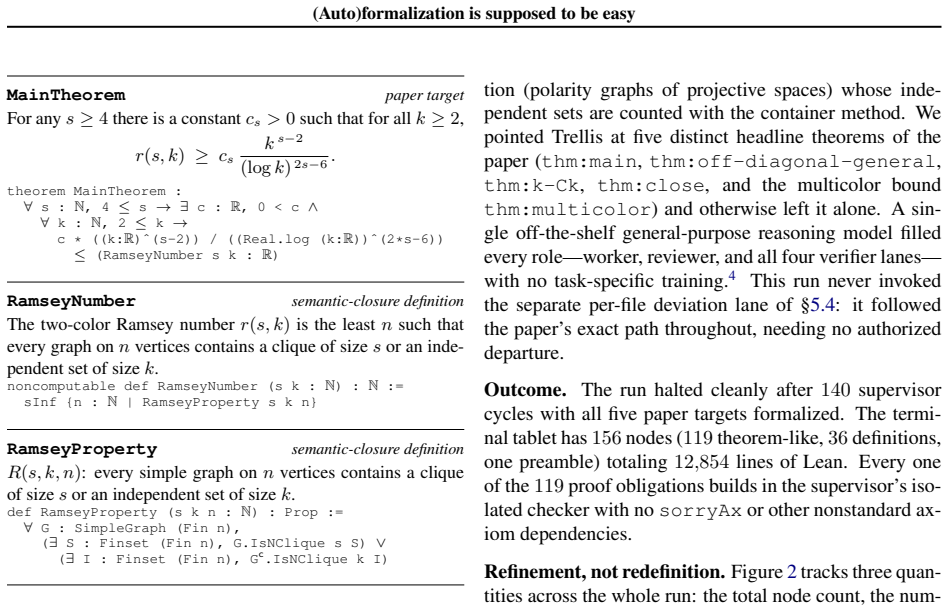
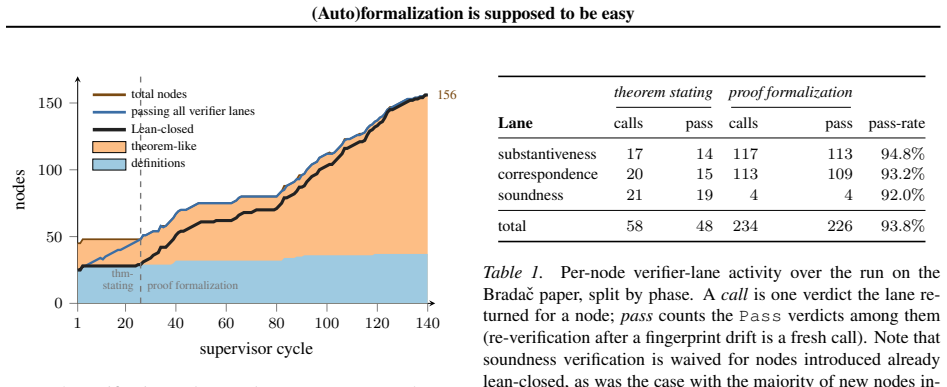
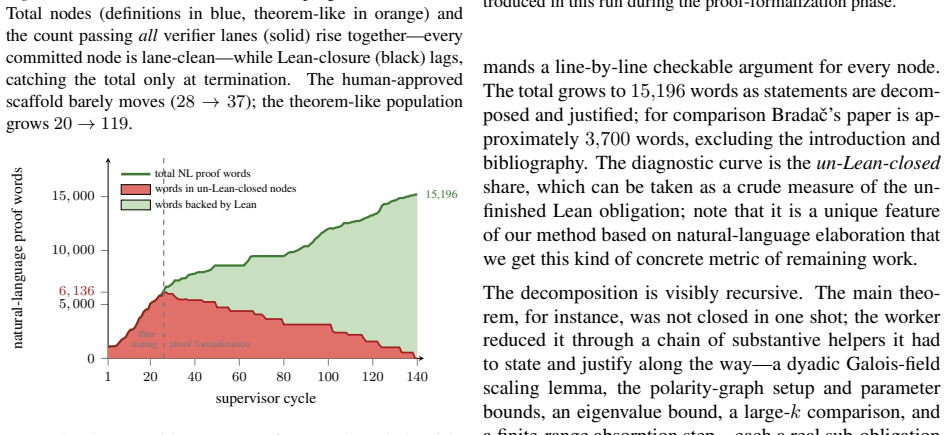
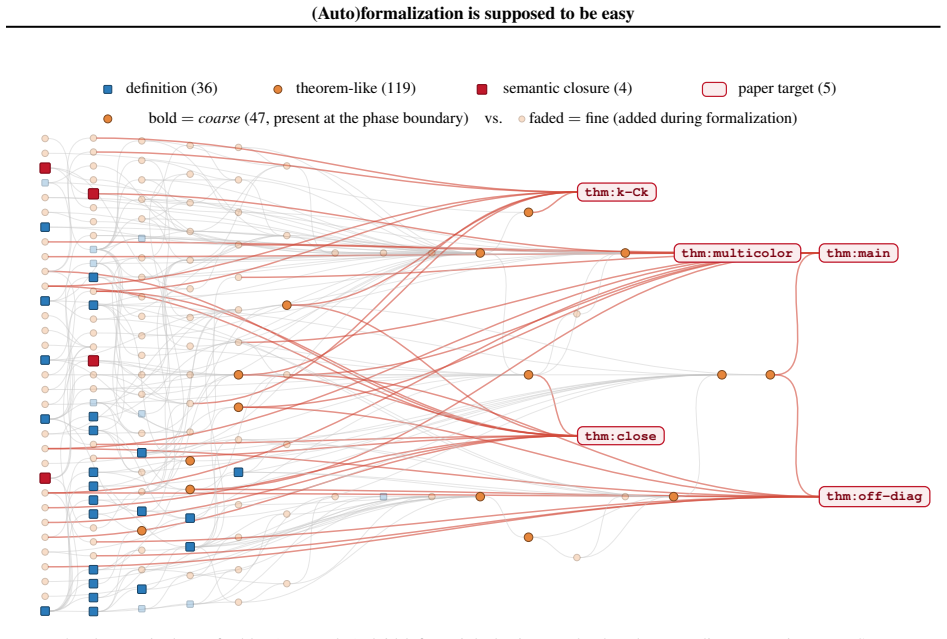
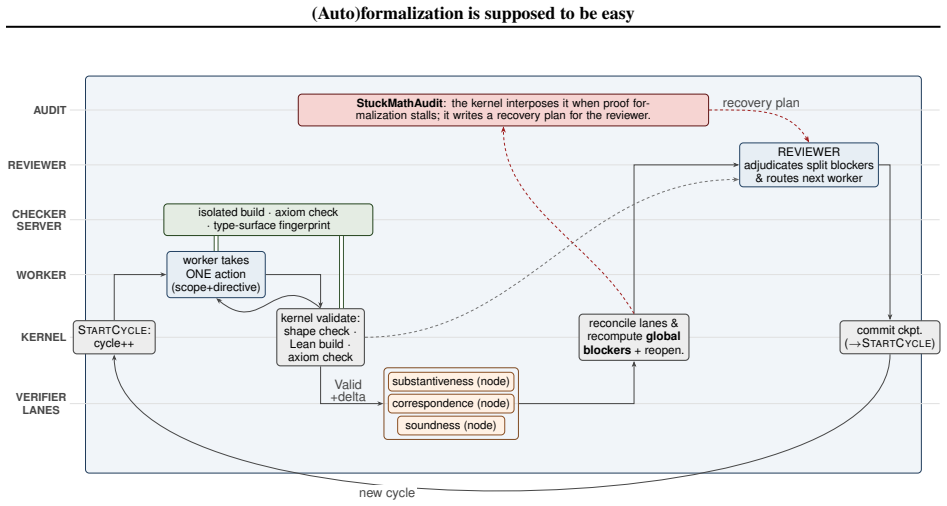
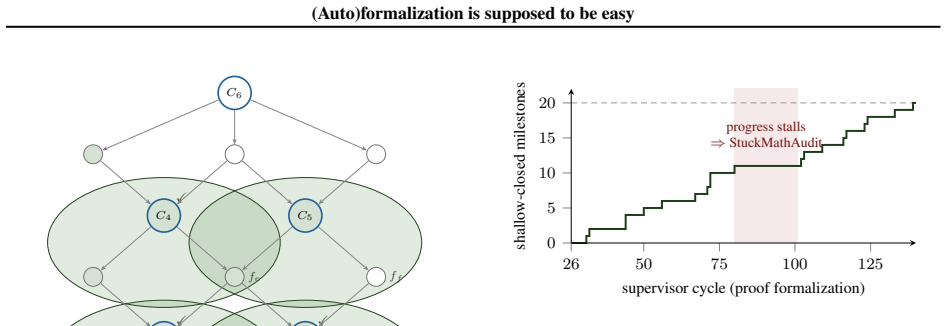
We present Trellis: an autoformalization system that leverages LLM agents in a deterministically constrained workflow to enforce incremental progress in Lean autoformalization tasks through iterative refinement of natural language proofs. Our approach is motivated by the common mathematician's notion of what it means to have a rigorous proof in the first place: namely, that it would be routine to elaborate any part of the proof in further detail. The result is a system which aims to achieve reliable autoformalization on a modest budget and with generalist agents, with specialization to autoformalization coming not from any task-specific agent training but instead from a meaning-of-rigor inspired workflow enforced by process semantics. We link to an end-to-end Lean formalization of a recent Ramsey theory breakthrough produced by the process.
Editorial analysis
A structured set of objections, weighed in public.
Referee Report
Summary. The paper presents Trellis, an autoformalization system that uses LLM agents within a deterministically constrained workflow based on process semantics. The workflow is motivated by the notion that a rigorous proof is one that can be routinely elaborated in further detail, and it aims to enforce incremental progress and reliable elaboration of natural language proofs into Lean formalizations. Specialization arises from the workflow rather than task-specific agent training or fine-tuning. The central demonstration is an end-to-end Lean formalization of a recent Ramsey theory breakthrough, which is linked in the paper.
Significance. If the process semantics can be shown to enforce the claimed incremental progress and reliability with unmodified generalist agents, the approach would offer a practical route to autoformalization that avoids heavy specialization or large-scale training. The linked machine-checked Lean formalization of a recent Ramsey theory result constitutes a concrete, verifiable achievement that strengthens the paper's applicability claim.
major comments (2)
- [Abstract] Abstract: The central claim that the deterministically constrained workflow (rather than agent pre-training or unmentioned steering) produces reliable results rests on the existence of one linked Lean formalization. No description is given of the formal definition of the process semantics, the mechanisms for their mechanical enforcement, examples of agents proposing invalid steps that were rejected, or recovery from dead-ends.
- [Abstract] Abstract: No quantitative evidence is supplied to support 'reliable autoformalization on a modest budget,' such as token counts, iteration statistics, success rates across multiple tasks, or ablation runs that disable the process-semantics constraints while keeping the same generalist agents.
minor comments (1)
- [Abstract] The abstract introduces 'process semantics' without a brief definition or pointer to the section where the semantics are formalized.
Simulated Author's Rebuttal
We thank the referee for their constructive comments, which highlight areas where the manuscript can be strengthened. We address each major comment below and outline our plans for revision.
read point-by-point responses
-
Referee: Abstract: The central claim that the deterministically constrained workflow (rather than agent pre-training or unmentioned steering) produces reliable results rests on the existence of one linked Lean formalization. No description is given of the formal definition of the process semantics, the mechanisms for their mechanical enforcement, examples of agents proposing invalid steps that were rejected, or recovery from dead-ends.
Authors: We agree that additional details are needed to support the central claim. The current manuscript motivates the use of process semantics but does not include the formal definition, enforcement mechanisms, or examples of invalid step rejections and dead-end recovery. We will revise the paper to include a formal definition of the process semantics, describe the mechanical enforcement in the workflow, and provide examples from the Ramsey theory case study. revision: yes
-
Referee: Abstract: No quantitative evidence is supplied to support 'reliable autoformalization on a modest budget,' such as token counts, iteration statistics, success rates across multiple tasks, or ablation runs that disable the process-semantics constraints while keeping the same generalist agents.
Authors: We agree that the paper lacks quantitative evidence beyond the single case study. We will add token counts and iteration statistics from the formalization process. However, success rates across multiple tasks and ablation runs were not performed. We will acknowledge this as a limitation and indicate that such evaluations are planned for future work, while maintaining that the linked Lean formalization provides concrete evidence of the approach's potential. revision: partial
- We did not perform ablation runs or multi-task evaluations, so we cannot supply the requested comparative data or success rates at this time.
Circularity Check
No circularity; empirical demonstration stands independent of inputs
full rationale
The paper presents Trellis as a workflow system motivated by an external philosophical definition of rigor (elaborability of proofs) and supports its claims via a linked external Lean artifact. No equations, fitted parameters, predictions, or self-citations appear in the provided text that would reduce the central claim to its own inputs by construction. The workflow description and the Ramsey formalization are presented as separate elements, with no reduction of one to the other via definition or self-reference. This is the common case of a self-contained empirical report.
Axiom & Free-Parameter Ledger
Reference graph
Works this paper leans on
-
[1]
The Lean mathematical library
[The mathlib Community(2020)] The mathlib Community. The Lean mathematical library. InProceedings of the 9th ACM SIGPLAN International Conference on Certified Programs and Proofs,
2020
-
[2]
Nearly tight exponents for off-diagonal Ramsey numbers
[Bradaˇc(2026)] Domagoj Brada ˇc. Nearly tight exponents for off-diagonal Ramsey numbers. arXiv preprint arXiv:2605.28793,
Pith/arXiv arXiv 2026
-
[3]
The Lean Theorem Prover (System Description)
[de Moura et al.(2015)] Leonardo de Moura, Soonho Kong, Jeremy Avigad, Floris van Doorn, and Jakob von Raumer. The Lean Theorem Prover (System Description). InAuto- mated Deduction - CADE-25,
2015
-
[4]
Rabe, Talia Ringer, and Yuriy Brun
[First et al.(2023)] Emily First, Markus N. Rabe, Talia Ringer, and Yuriy Brun. Baldur: Whole-proof generation and re- pair with large language models. InProceedings of the 31st ACM Joint European Software Engineering Confer- ence and Symposium on the Foundations of Software En- gineering,
2023
-
[5]
ImprovingR(3, k)in just two bites
[Hefty et al.(2025)] Zion Hefty, Paul Horn, Dylan King, and Florian Pfender. ImprovingR(3, k)in just two bites. arXiv preprint arXiv:2510.19718,
arXiv 2025
-
[6]
Jiang, Wenda Li, Szymon Tworkowski, Konrad Czechowski, Tomasz Odrzyg ´o´zd´z, Piotr Miło´s, Yuhuai Wu, and Mateja Jamnik
[Jiang et al.(2022)] Albert Q. Jiang, Wenda Li, Szymon Tworkowski, Konrad Czechowski, Tomasz Odrzyg ´o´zd´z, Piotr Miło´s, Yuhuai Wu, and Mateja Jamnik. Thor: Wield- ing hammers to integrate language models and automated theorem provers. InAdvances in Neural Information Pro- cessing Systems,
2022
-
[7]
[Kontorovich(2025)] Alex Kontorovich. The shape of math to come. arXiv preprint arXiv:2510.15924,
arXiv 2025
-
[8]
AI for Maths and Open Science
[Kontorovich(2026)] Alex Kontorovich. Interactions of AI with research math and formalization. Lecture at the “AI for Maths and Open Science” conference, Isaac Newton In- stitute, Cambridge;https://alexkontorovich. wordpress.com/2026/04/05/lecture-inter actions- of- ai- with- research- math- and -formalization-at-newton-insitute-cam bridge/,
2026
-
[9]
Addison-Wesley,
[Lamport(2002)] Leslie Lamport.Specifying Systems: The TLA+ Language and Tools for Hardware and Software Engineers. Addison-Wesley,
2002
-
[10]
Generative language modeling for automated theorem proving
[Polu and Sutskever(2020)] Stanislas Polu and Ilya Sutskever. Generative language modeling for automated theorem proving. arXiv preprint arXiv:2009.03393,
Pith/arXiv arXiv 2020
-
[11]
A promising path towards autoformalization and general artificial intelligence
[Szegedy(2020)] Christian Szegedy. A promising path towards autoformalization and general artificial intelligence. InIn- telligent Computer Mathematics,
2020
-
[12]
Jiang, Wenda Li, Markus N
[Wu et al.(2022)] Yuhuai Wu, Albert Q. Jiang, Wenda Li, Markus N. Rabe, Charles Staats, Mateja Jamnik, and Christian Szegedy. Autoformalization with large language models. InAdvances in Neural Information Processing Systems,
2022
-
[13]
Swope, Alex Gu, Rahul Chalamala, Peiyang Song, Shixing Yu, Saad Godil, Ryan J
[Yang et al.(2023)] Kaiyu Yang, Aidan M. Swope, Alex Gu, Rahul Chalamala, Peiyang Song, Shixing Yu, Saad Godil, Ryan J. Prenger, and Animashree Anandkumar. Lean- Dojo: Theorem proving with retrieval-augmented lan- guage models. InAdvances in Neural Information Pro- cessing Systems,
2023
-
[14]
miniF2F: A cross-system benchmark for formal Olympiad-level mathematics
[Zheng et al.(2022)] Kunhao Zheng, Jesse Michael Han, and Stanislas Polu. miniF2F: A cross-system benchmark for formal Olympiad-level mathematics. InInternational Conference on Learning Representations,
2022
discussion (0)
Sign in with ORCID, Apple, or X to comment. Anyone can read and Pith papers without signing in.