Learning Where to Look: A Reinforcement Learning Framework for Robust Micro-Ultrasound Prostate Cancer Detection
Pith reviewed 2026-07-01 01:31 UTC · model grok-4.3
The pith
Prost-RL trains a reinforcement learning policy to generate spatial attention maps that guide prostate cancer detection in micro-ultrasound images.
A machine-rendered reading of the paper's core claim, the machinery that carries it, and where it could break.
Core claim
Prost-RL reframes μUS PCa detection as a spatially aware, policy-driven inference problem by learning where to look before decoding, integrating a lightweight reinforcement-learning policy into a foundation-model encoder-decoder to generate interpretable spatial attention maps that act as soft prompts for both cancer-likelihood heatmap prediction and image-level classification, stabilized by Adaptive Policy Optimization and a noise-robust objective combining symmetric cross-entropy with negative-entropy regularization.
What carries the argument
The reinforcement-learning policy that produces spatial attention maps as soft prompts for the decoder.
If this is right
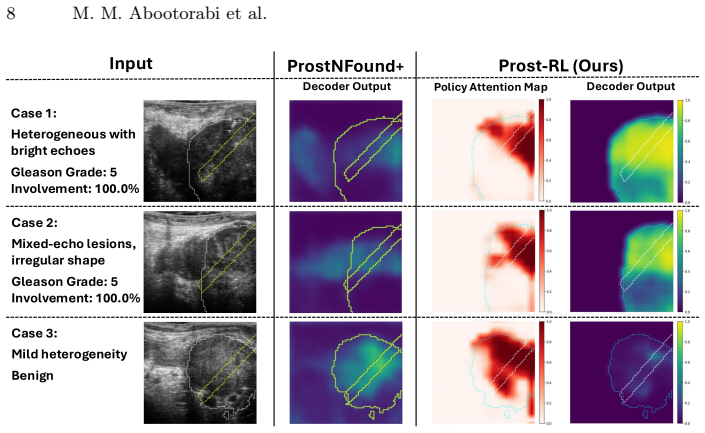
- The learned attention maps supply spatially grounded evidence alongside quantitative risk scores.
- Hybrid supervised-RL training with APO can stabilize learning under weak supervision and class imbalance.
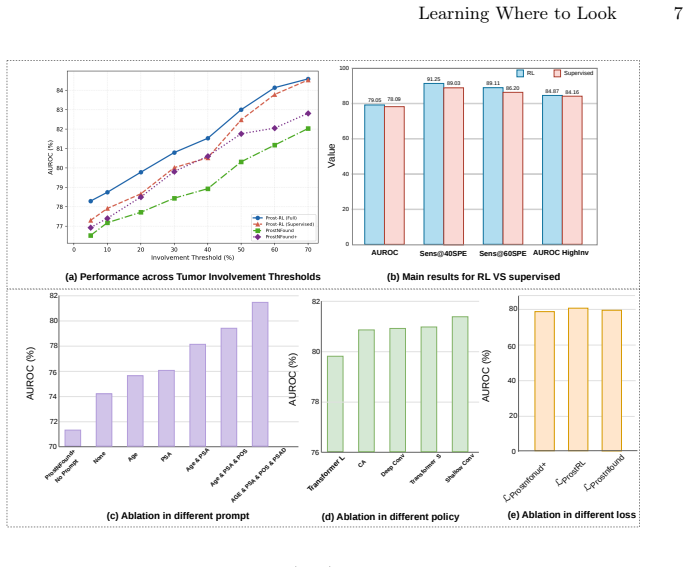
- Core-level detection reaches 79.0 AUROC and 64.6% sensitivity at 80% specificity, with a 2.1 AUROC gain over the strongest baseline.
- Clinically significant cancer classification reaches 79.3 AUROC.
Where Pith is reading between the lines
- The same policy-learning step could be tested on other ultrasound or MRI tasks that lack pixel-level annotations.
- If attention maps remain consistent across new clinical sites, the method could support standardized reading workflows that reduce inter-observer differences.
- Real-time inference speed of the lightweight policy would determine whether the approach fits inside existing biopsy procedures.
Load-bearing premise
A reinforcement learning policy trained only on core-level histopathology labels can produce attention maps that generalize across sites without overfitting to label noise or imaging artifacts.
What would settle it
Retraining the policy on the same multi-site data and finding that the resulting attention maps fail to highlight biopsy-aligned regions or that AUROC on held-out sites falls below the reported baseline.
Figures

read the original abstract
Micro-ultrasound ($\mu$US) is a new, emerging, and promising imaging modality for prostate cancer (PCa) detection, but accurate identification of suspicious tissue remains highly dependent on clinical experience, leading to substantial inter-observer variability. Machine-learning assistance can reduce this variability; however, training reliable deep models is challenging because supervision is sparse and noisy -- typically limited to core-level histopathology outcomes (e.g., cancer grade and its percentage in a biopsy core) without pixel-level lesion annotations and under severe class imbalance. We introduce Prost-RL, which reframes $\mu$US PCa detection as a spatially aware, policy-driven inference problem by learning where to look before decoding. Prost-RL integrates a lightweight reinforcement-learning policy into a foundation-model encoder-decoder to generate interpretable spatial attention maps that act as soft prompts for both cancer-likelihood heatmap prediction and image-level classification. We further propose Adaptive Policy Optimization (APO) to stabilize hybrid supervised-RL training and a noise-robust objective combining symmetric cross-entropy with negative-entropy regularization to mitigate weak-label noise and encourage sharp localization. On a cohort of 6,607 biopsy cores from 693 patients across five clinical sites, Prost-RL achieves $79.0\pm3.5$ AUROC with $64.6\pm6.3$% sensitivity at 80% specificity for core-level detection (+2.1 AUROC and +4.5 sensitivity points over the strongest baseline), and $79.3\pm5.8$ AUROC for clinically significant cancer classification. The learned policy highlights biopsy-aligned regions, providing transparent, spatially grounded evidence alongside quantitative risk predictions. Code is available at: https://github.com/DeepRCL/Prost-RL.
Editorial analysis
A structured set of objections, weighed in public.
Referee Report
Summary. The paper introduces Prost-RL, a reinforcement-learning framework that integrates a policy network into a foundation-model encoder-decoder to produce spatial attention maps for micro-ultrasound prostate cancer detection. These maps serve as soft prompts for core-level cancer-likelihood heatmaps and image-level classification. Training uses Adaptive Policy Optimization (APO) together with a symmetric cross-entropy plus negative-entropy regularization objective to handle sparse, noisy core-level histopathology labels. On a cohort of 6,607 biopsy cores from 693 patients across five clinical sites, the method reports 79.0±3.5 AUROC and 64.6±6.3% sensitivity at 80% specificity for core-level detection (+2.1 AUROC and +4.5 sensitivity over the strongest baseline) and 79.3±5.8 AUROC for clinically significant cancer classification, with public code released.
Significance. If the reported gains are shown to arise from the spatially-aware RL policy rather than site-specific cues, the work would supply a practical route to interpretable, weakly-supervised detection in μUS imaging. Notable strengths include the multi-site cohort size, reported standard deviations, patient-level held-out evaluation against external baselines, and public code release.
major comments (2)
- [Abstract] Abstract: the headline multi-site claim (79.0±3.5 AUROC across five clinical sites) is load-bearing on the assumption that the learned attention policy generalizes across sites rather than exploiting site-specific ultrasound artifacts (probe frequency, gain, labeling conventions). No information is supplied on the data partitioning strategy (patient-level, site-stratified, or leave-one-site-out), which is required to substantiate that the +2.1 AUROC improvement is attributable to the RL formulation.
- [Abstract] Abstract (hybrid training description): the central claim that APO stabilizes training of the RL policy on core-level labels alone rests on the unverified assumption that the resulting attention maps do not overfit to label noise or site artifacts; the abstract supplies neither ablation results on the loss-component weights nor sensitivity analysis of APO hyperparameters, leaving the robustness of the 79.0 AUROC figure only moderately anchored.
minor comments (1)
- [Abstract] Abstract: the phrase 'foundation-model encoder-decoder' is introduced without naming the specific backbone or its pre-training corpus, which affects reproducibility of the reported numbers.
Simulated Author's Rebuttal
We thank the referee for the constructive feedback. We address each major comment below and outline the revisions that will be made to clarify the evaluation protocol and strengthen the supporting analyses.
read point-by-point responses
-
Referee: [Abstract] Abstract: the headline multi-site claim (79.0±3.5 AUROC across five clinical sites) is load-bearing on the assumption that the learned attention policy generalizes across sites rather than exploiting site-specific ultrasound artifacts (probe frequency, gain, labeling conventions). No information is supplied on the data partitioning strategy (patient-level, site-stratified, or leave-one-site-out), which is required to substantiate that the +2.1 AUROC improvement is attributable to the RL formulation.
Authors: We agree that the data partitioning strategy is essential to substantiate the multi-site generalization claim. The current manuscript does not supply this information. We will revise the methods section to explicitly describe the partitioning as patient-level with site-stratified sampling and will add leave-one-site-out experiments to demonstrate that the reported gains arise from the RL policy rather than site-specific cues. revision: yes
-
Referee: [Abstract] Abstract (hybrid training description): the central claim that APO stabilizes training of the RL policy on core-level labels alone rests on the unverified assumption that the resulting attention maps do not overfit to label noise or site artifacts; the abstract supplies neither ablation results on the loss-component weights nor sensitivity analysis of APO hyperparameters, leaving the robustness of the 79.0 AUROC figure only moderately anchored.
Authors: We acknowledge that the manuscript does not currently include ablations on loss-component weights or sensitivity analysis of APO hyperparameters. We will add these analyses (varying the symmetric cross-entropy and negative-entropy weights as well as APO hyperparameters) to the revised manuscript or supplementary material to better anchor the robustness of the training procedure. revision: yes
Circularity Check
No circularity; empirical claims rest on held-out multi-site evaluation
full rationale
The paper describes a hybrid RL-supervised model (Prost-RL with APO) trained on core-level labels and reports AUROC/sensitivity on a held-out cohort of 6,607 cores from 693 patients across five sites, with explicit gains over external baselines. No equations, self-citations, or fitted parameters are presented that reduce the headline metrics or attention-map claims to quantities defined inside the paper by construction; the derivation chain remains independent of its own outputs.
Axiom & Free-Parameter Ledger
free parameters (2)
- loss-component weights for symmetric cross-entropy and negative-entropy regularization
- APO and RL policy hyperparameters
axioms (2)
- domain assumption A foundation-model encoder-decoder can be effectively conditioned by soft spatial attention maps generated by an RL policy.
- domain assumption Core-level histopathology labels supply sufficient supervisory signal for an RL policy to learn biopsy-aligned spatial attention without pixel-level ground truth.
Reference graph
Works this paper leans on
-
[1]
IEEE Access11, 118217–118228 (2023)
Alzate-Grisales, J.A., Mora-Rubio, A., García-García, F., Tabares-Soto, R., De La Iglesia-Vayá, M.: Sam-unetr: Clinically significant prostate cancer segmentation using transfer learning from large model. IEEE Access11, 118217–118228 (2023)
2023
-
[2]
IEEE Access11, 118217–118228 (2023)
Alzate-Grisales, J.A., Mora-Rubio, A., García-García, F., Tabares-Soto, R., De La Iglesia-Vayá, M.: Sam-unetr: Clinically significant prostate cancer segmentation using transfer learning from large model. IEEE Access11, 118217–118228 (2023). https://doi.org/10.1109/ACCESS.2023.3326882
-
[3]
CA: a cancer journal for clinicians pp
Bray, F., Laversanne, M., Sung, H., Ferlay, J., Siegel, R.L., Soerjomataram, I., Je- mal, A.: Global cancer statistics 2022: Globocan estimates of incidence and mor- tality worldwide for 36 cancers in 185 countries. CA: a cancer journal for clinicians pp. 229–263 (2024)
2022
-
[4]
arXiv preprint arXiv:2506.00711 (2025)
Dai, W., Chen, P., Ekbote, C., Liang, P.P.: Qoq-med: Building multimodal clinical foundation models with domain-aware grpo training. arXiv preprint arXiv:2506.00711 (2025)
-
[5]
Tomography11(7), 80 (2025)
DuBois, J., Smani, S., Golos, A., Rivera Lopez, C., Lokeshwar, S.D.: Micro- ultrasound in the detection of clinically significant prostate cancer: A compre- hensive review and comparison with multiparametric mri. Tomography11(7), 80 (2025)
2025
-
[6]
In: International Conference on Medical Image Computing and Computer-Assisted Intervention
Elghareb, T., Harmanani, M., To, M.N.N., Wilson, P., Jamzad, A., Fooladgar, F., Abdelsamad, B., Dzikunu, O., Sojoudi, S., Reznik, G., et al.: Proteus: A spatio- temporal enhanced ultrasound-based framework for prostate cancer detection. In: International Conference on Medical Image Computing and Computer-Assisted Intervention. pp. 405–414. Springer (2025)
2025
-
[7]
Computers12(8), 152 (2023)
Gavade, A.B., Nerli, R., Kanwal, N., Gavade, P.A., Pol, S.S., Rizvi, S.T.H.: Auto- mated diagnosis of prostate cancer using mpmri images: A deep learning approach for clinical decision support. Computers12(8), 152 (2023)
2023
-
[8]
In: International conference on medical image computing and computer-assisted intervention
Gilany, M., Wilson, P., Jamzad, A., Fooladgar, F., To, M.N.N., Wodlinger, B., Abolmaesumi, P., Mousavi, P.: Towards confident detection of prostate cancer using high resolution micro-ultrasound. In: International conference on medical image computing and computer-assisted intervention. pp. 411–420. Springer (2022)
2022
-
[9]
IEEE Transactions on Medical Imaging (2025)
Han, K., Wang, S., Chen, J., Qian, C., Lyu, C., Ma, S., Qiu, C., Sheng, V.S., Huang, Q., Liu, Z.: Region uncertainty estimation for medical image segmentation with noisy labels. IEEE Transactions on Medical Imaging (2025)
2025
-
[10]
In: 2025 IEEE 22nd International Symposium on Biomedical Imaging (ISBI)
Harmanani, M., Jamzad, A., To, M.N.N., Wilson, P.F., Guo, Z., Fooladgar, F., Sojoudi, S., Gilany, M., Chang, S., Black, P., et al.: Cinepro: Robust training of foundation models for cancer detection in prostate ultrasound cineloops. In: 2025 IEEE 22nd International Symposium on Biomedical Imaging (ISBI). pp. 1–5. IEEE (2025)
2025
-
[11]
Harmanani, M., Wilson, P.F., To, M.N.N., Gilany, M., Jamzad, A., Fooladgar, F., Wodlinger, B., Abolmaesumi, P., Mousavi, P.: Trusworthy: toward clinically appli- cable deep learning for confident detection of prostate cancer in micro-ultrasound. 10 M. M. Abootorabi et al. International Journal of Computer Assisted Radiology and Surgery20(5), 981–989 (2025)
2025
-
[12]
Translational andrology and urol- ogy6(3), 345 (2017)
Hutchinson, R., Lotan, Y.: Cost consideration in utilization of multiparametric magnetic resonance imaging in prostate cancer. Translational andrology and urol- ogy6(3), 345 (2017)
2017
-
[13]
Computerized Medical Imaging and Graphics112, 102326 (2024)
Jiang, H., Imran, M., Muralidharan, P., Patel, A., Pensa, J., Liang, M., Beni- dir, T., Grajo, J.R., Joseph, J.P., Terry, R., et al.: Microsegnet: A deep learning approach for prostate segmentation on micro-ultrasound images. Computerized Medical Imaging and Graphics112, 102326 (2024)
2024
-
[14]
Canadian Urological Association Journal15(1), E11 (2020)
Klotz, L., Lughezzani, G., Maffei, D., Sánchez, A., Pereira, J.G., Staerman, F., Cash, H., Luger, F., Lopez, L., Sanchez-Salas, R., et al.: Comparison of micro- ultrasound and multiparametric magnetic resonance imaging for prostate cancer: a multicenter, prospective analysis. Canadian Urological Association Journal15(1), E11 (2020)
2020
-
[15]
Nature Communications15, 654 (2024)
Ma, J., He, Y., Li, F., Han, L., You, C., Wang, B.: Segment anything in medical images. Nature Communications15, 654 (2024)
2024
-
[16]
Nature communications15(1), 654 (2024)
Ma, J., He, Y., Li, F., Han, L., You, C., Wang, B.: Segment anything in medical images. Nature communications15(1), 654 (2024)
2024
-
[17]
European Radiology28(3), 1016–1026 (2018)
Reisæter, L.A., Fütterer, J.J., Losnegård, A., Nygård, Y., Monssen, J., Gravdal, K., Halvorsen, O.J., Akslen, L.A., Biermann, M., Haukaas, S., et al.: Optimising preoperative risk stratification tools for prostate cancer using mpmri. European Radiology28(3), 1016–1026 (2018)
2018
-
[18]
Ultrasound in medicine & biology44(7), 1341–1354 (2018)
Rohrbach, D., Wodlinger, B., Wen, J., Mamou, J., Feleppa, E.: High-frequency quantitative ultrasound for imaging prostate cancer using a novel micro-ultrasound scanner. Ultrasound in medicine & biology44(7), 1341–1354 (2018)
2018
-
[19]
DeepSeekMath: Pushing the Limits of Mathematical Reasoning in Open Language Models
Shao, Z., Wang, P., Zhu, Q., Xu, R., Song, J., Bi, X., Zhang, H., Zhang, M., Li, Y., Wu, Y., et al.: Deepseekmath: Pushing the limits of mathematical reasoning in open language models, 2024. URL https://arxiv. org/abs/2402.033002(3), 5 (2024)
work page internal anchor Pith review Pith/arXiv arXiv 2024
-
[20]
IEEE Transactions on Medical Imaging (2025)
Wang, H., Huai, L., Li, W., Qi, L., Jiang, X., Shi, Y.: Weakmedsam: Weakly- supervised medical image segmentation via sam with sub-class exploration and prompt affinity mining. IEEE Transactions on Medical Imaging (2025)
2025
-
[21]
In: Proceedings of the IEEE/CVF international conference on computer vision
Wang, Y., Ma, X., Chen, Z., Luo, Y., Yi, J., Bailey, J.: Symmetric cross entropy for robust learning with noisy labels. In: Proceedings of the IEEE/CVF international conference on computer vision. pp. 322–330 (2019)
2019
-
[22]
Willis, E., Elghareb, T., Wilson, P.F.R., To, M.N.N., Abootorabi, M.M., Jamzad, A., Wodlinger, B., Mousavi, P., Abolmaesumi, P.: Guide-us: Grade-informed un- paired distillation of encoder knowledge from histopathology to micro-ultrasound (2026), https://arxiv.org/abs/2602.19005
-
[23]
International Journal of Computer Assisted Radiology and Surgery pp
Wilson, P.F., Harmanani, M., To, M.N.N., Jamzad, A., Elghareb, T., Guo, Z., Kinnaird, A., Wodlinger, B., Abolmaesumi, P., Mousavi, P.: Prostnfound+: A prospective study using medical foundation models for prostate cancer detection. International Journal of Computer Assisted Radiology and Surgery pp. 1–10 (2026)
2026
-
[24]
Wilson, P.F., To, M.N.N., Jamzad, A., Gilany, M., Harmanani, M., Elghareb, T., Fooladgar, F., Wodlinger, B., Abolmaesumi, P., Mousavi, P.: Prostnfound: Inte- grating foundation models with ultrasound domain knowledge and clinical context forrobustprostatecancerdetection.In:InternationalConferenceonMedicalImage Computing and Computer-Assisted Intervention....
2024
discussion (0)
Sign in with ORCID, Apple, or X to comment. Anyone can read and Pith papers without signing in.