Understanding the Broad-line Region of Active Galactic Nuclei with Photoionization. II. Slim disks, Self-shadowing, and BLR sizes
Pith reviewed 2026-06-28 17:19 UTC · model grok-4.3
The pith
Self-shadowing from slim disks shortens BLR lags in high-accretion AGNs.
A machine-rendered reading of the paper's core claim, the machinery that carries it, and where it could break.
Core claim
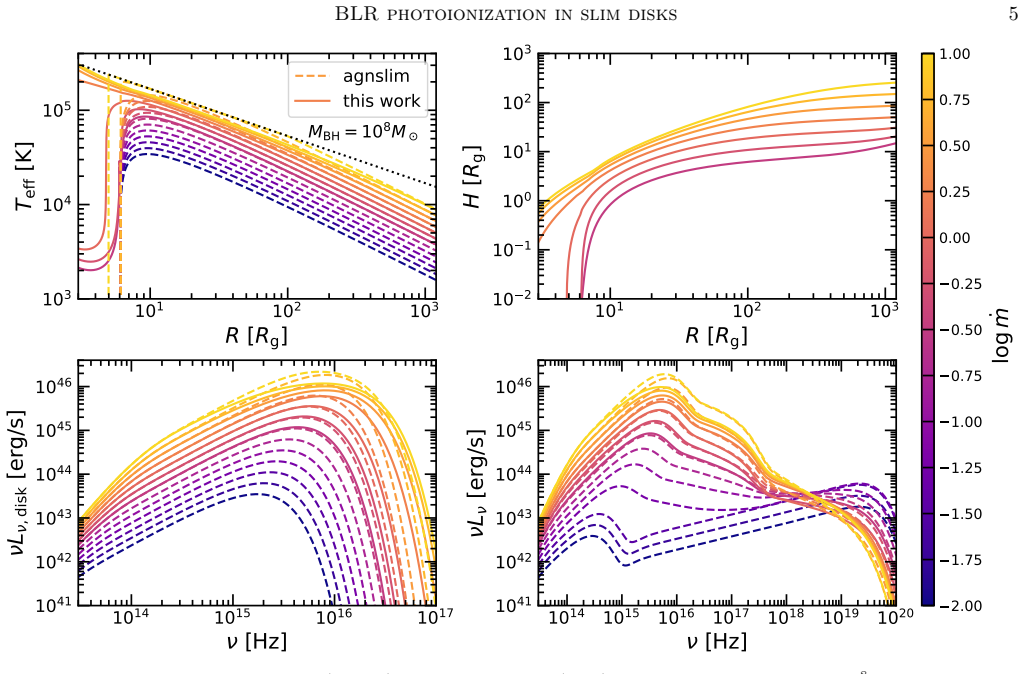
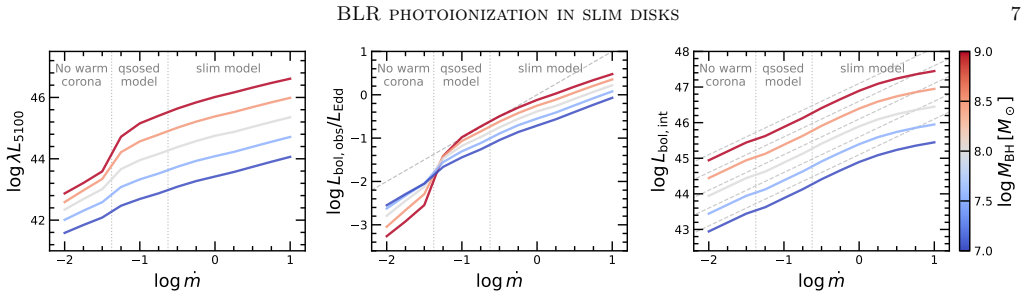
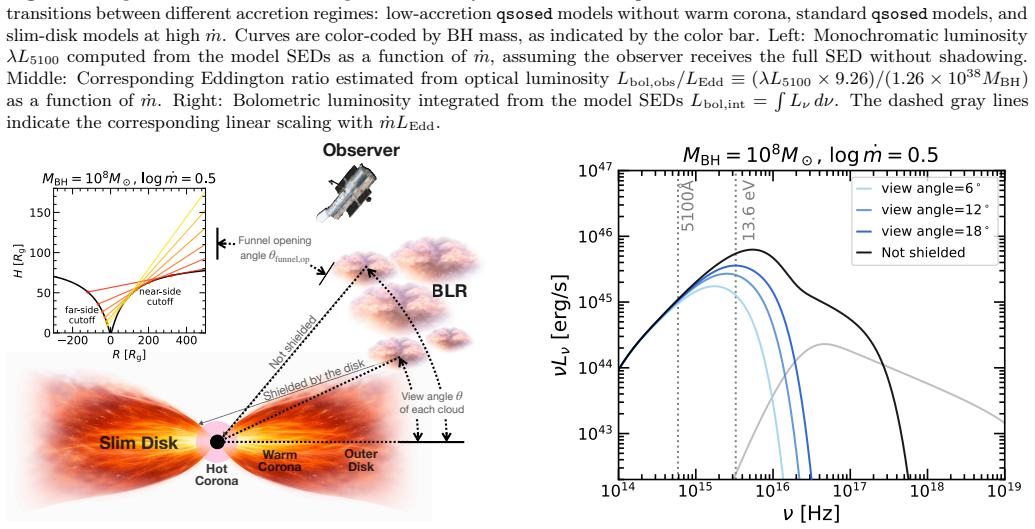
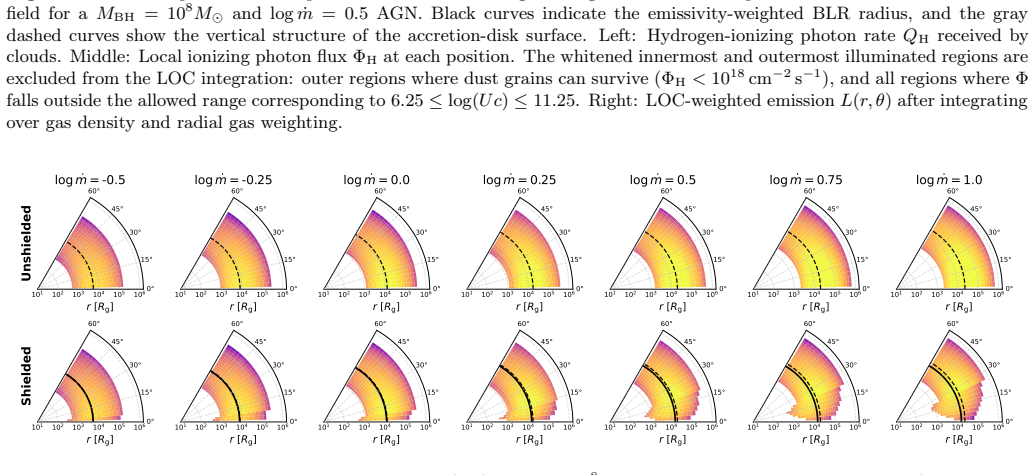
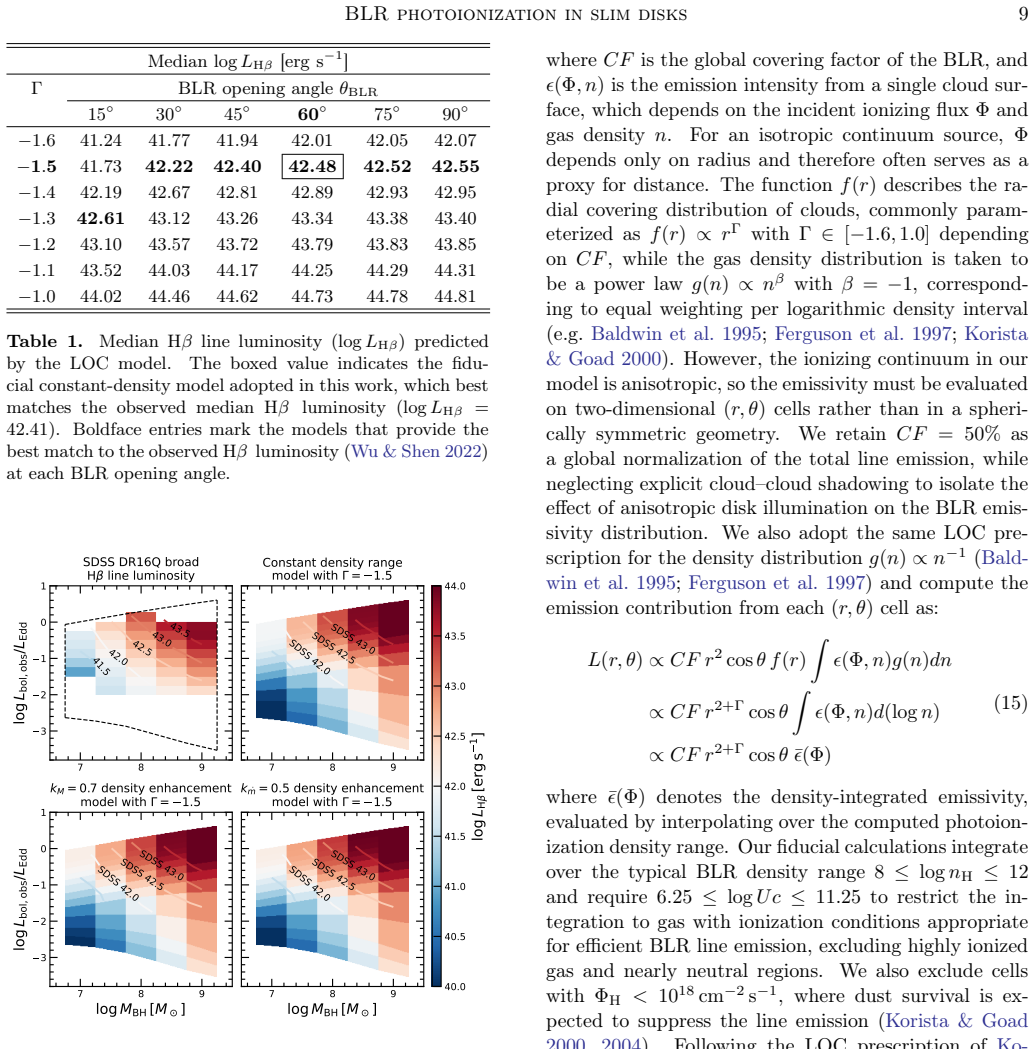
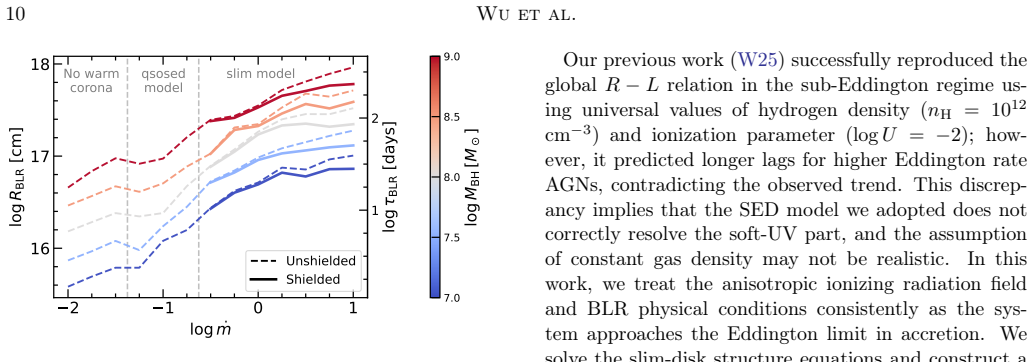
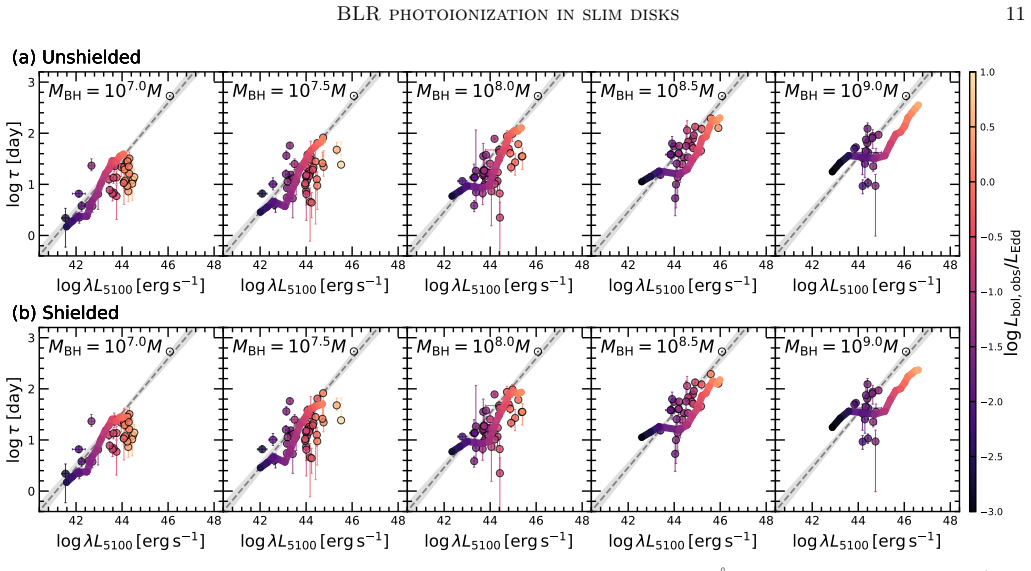
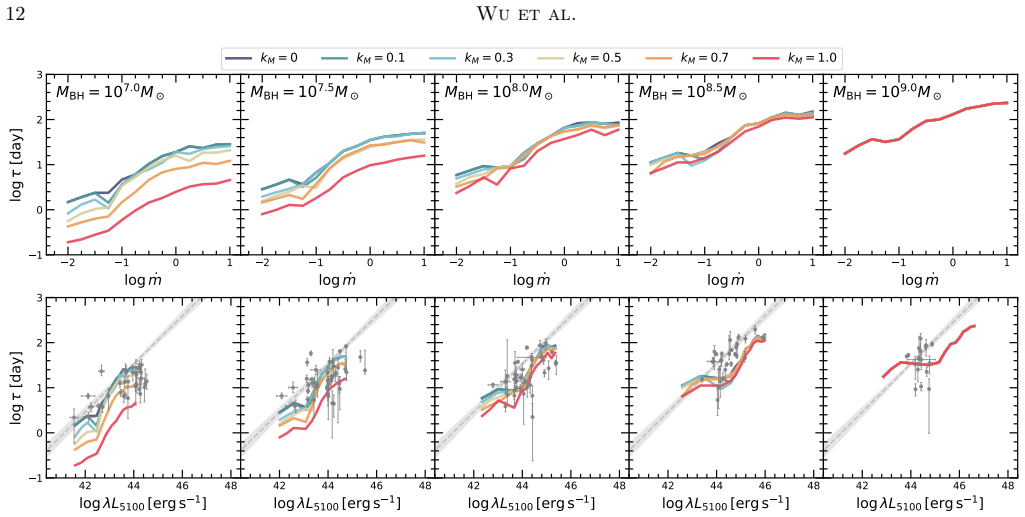
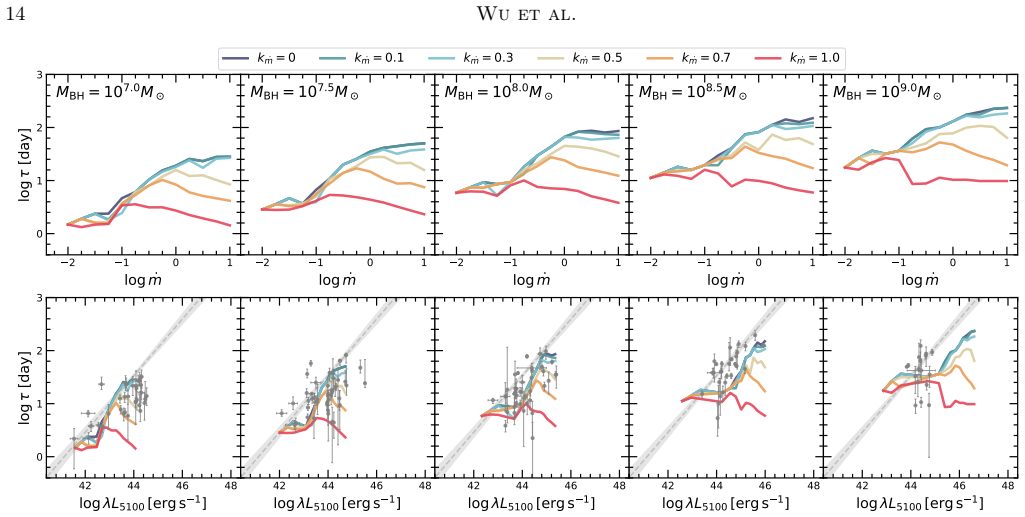
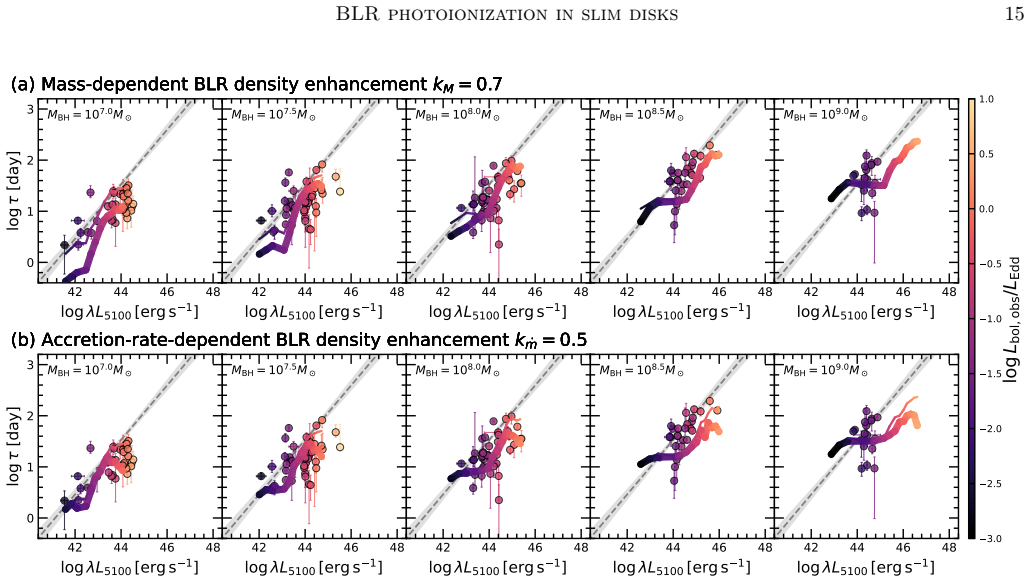
As the accretion rate approaches and exceeds the Eddington limit, geometric thickening of the inner disk produces anisotropic illumination and self-shadowing, reducing ionizing flux seen by low-latitude BLR clouds and flattening the R-L relation at high L/LEdd. Self-shadowing at high accretion rates reproduces the observed R-L trend in the RM AGN sample reasonably well, but this effect alone is insufficient to explain the observed lag offset in low-mass systems. An accretion-rate-dependent BLR density enhancement, increasing by a factor of 3-5 for one dex increase in mdot, further improves agreement. Self-consistent modeling of accretion disk SED, BLR illumination and photoionization, and ga
What carries the argument
Self-shadowing and anisotropic illumination from the geometrically thick inner slim disk, which reduces ionizing flux to the BLR.
If this is right
- Self-shadowing flattens the BLR radius-luminosity relation at high Eddington ratios.
- An accretion-rate-dependent increase in BLR gas density by a factor of 3-5 per dex matches data for low-mass systems.
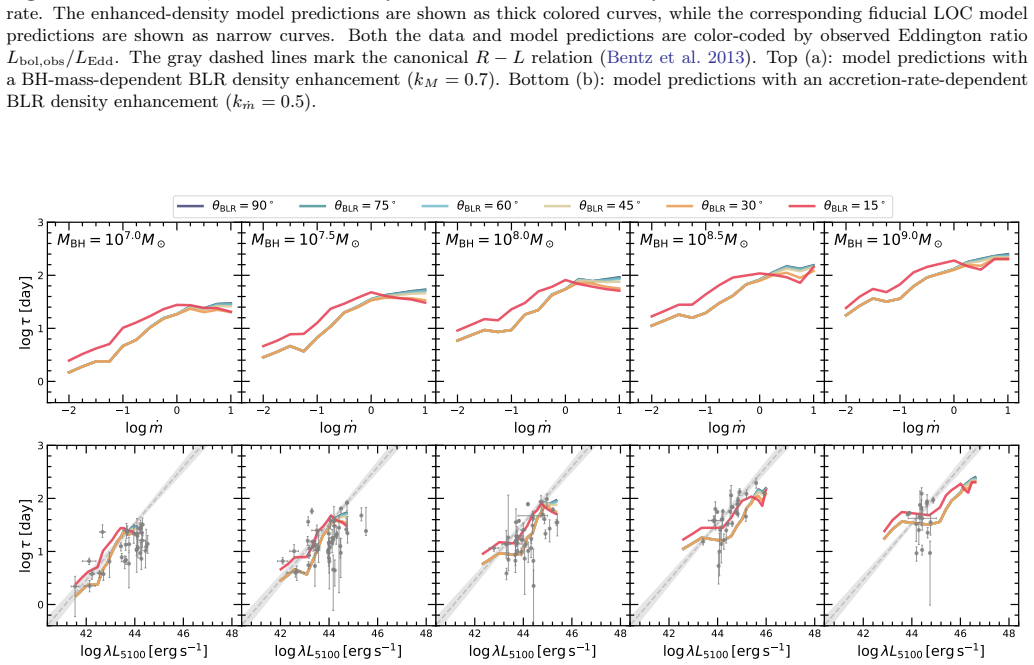
- BLR opening angle variations produce smaller effects on sizes compared to self-shadowing and density changes.
- This provides a physical link between accretion-flow structure and BLR observables across black hole masses.
Where Pith is reading between the lines
- Virial black hole mass estimates based on BLR size may need systematic corrections for accretion rate.
- Multi-wavelength monitoring could test the predicted reduction in ionizing flux due to self-shadowing.
- The density scaling could be checked with line ratio diagnostics in high-accretion AGNs.
- Similar effects may apply to the narrow-line region or other structures at larger radii.
Load-bearing premise
The BLR gas density increases by a factor of 3-5 for each dex increase in accretion rate.
What would settle it
Observations of BLR gas densities in low-mass high-accretion AGNs that fail to show the required density enhancement would falsify the need for this component.
Figures
read the original abstract
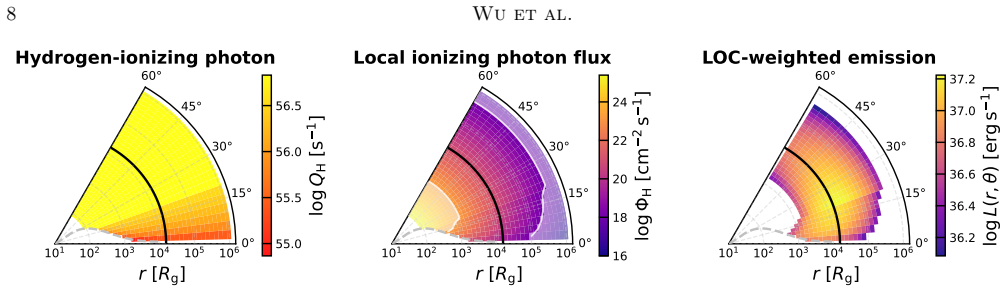
Reverberation-mapping (RM) measurements have revealed that high-accretion-rate active galactic nuclei (AGNs) systematically lie below the canonical broad-line region (BLR) radius - optical continuum luminosity (R-L) relation, exhibiting shorter lags than predicted for fixed 5100\AA luminosity. The physical origin of these offsets remains debated. We investigate how accretion-flow structure and BLR cloud properties affect the emissivity-weighted BLR radius using analytic slim-disk SEDs and photoionization calculations on a two-dimensional axisymmetric grid. As the accretion rate approaches and exceeds the Eddington limit, geometric thickening of the inner disk produces anisotropic illumination and self-shadowing, reducing ionizing flux seen by low-latitude BLR clouds and flattening the R-L relation at high L/LEdd. Self-shadowing at high accretion rates reproduces the observed R-L trend in the RM AGN sample reasonably well, but this effect alone is insufficient to explain the observed lag offset in low-mass ($\sim10^{7}M_\odot$) systems with high accretion rates. Motivated by accretion-disk density scalings, we further explore models in which the BLR gas density increases toward lower black hole mass or higher accretion rate. We find that an accretion-rate-dependent BLR density enhancement further improves agreement with observed RM data, where the BLR gas density increases by a factor of 3-5 for one dex increase in $\dot{m}$. Variations in BLR opening angles produce a less important effect on BLR sizes. These results demonstrate that self-consistent modeling of accretion disk SED, BLR illumination and photoionization, and gas density variations can fully explain the observed distribution of AGNs in the BLR size - optical luminosity plane. This framework provides a physically motivated link between accretion-flow structure and BLR observables across a broad range of black-hole properties.
Editorial analysis
A structured set of objections, weighed in public.
Referee Report
Summary. The manuscript models the BLR radius-luminosity relation in AGNs using analytic slim-disk SEDs, 2D axisymmetric photoionization grids, and anisotropic illumination from geometrically thick disks. It shows that self-shadowing at high Eddington ratios flattens the R-L relation, reproducing observed RM trends reasonably well, but requires an additional accretion-rate-dependent BLR density increase (factor of 3-5 per dex in ṁ) to account for residual offsets in low-mass (~10^7 M_⊙) high-accretion systems; the combined framework is claimed to fully explain the distribution of AGNs in the BLR size-optical luminosity plane.
Significance. If the density scaling can be shown to follow from the same slim-disk equations without tuning to RM data, the work would provide a valuable physically motivated link between accretion structure and BLR observables. The use of self-consistent SEDs and illumination on a 2D grid is a methodological strength that allows quantitative exploration of geometric effects. However, the current reliance on an adjusted parameter reduces the result from a first-principles prediction to a partly fitted description.
major comments (2)
- [Abstract] Abstract: the headline claim that the modeling 'can fully explain the observed distribution' rests on introducing a BLR density enhancement whose normalization (3-5 imes per dex in ṁ) is chosen specifically to close the residual offset in low-mass high-ṁ systems after self-shadowing is applied; this normalization is not derived from the slim-disk equations used for the SED and illumination.
- [Modeling description] Modeling description (abstract and methods): the density scaling is stated to be 'motivated by accretion-disk density scalings' yet its specific factor is adjusted to improve agreement with the RM sample; because this parameter is free and tuned to the validation data, the agreement for low-mass systems is partly by construction rather than an independent test of the slim-disk plus photoionization framework.
minor comments (1)
- [Abstract] The quantitative details of the photoionization grid resolution, error treatment on the emissivity-weighted radii, and the exact functional form of the density enhancement are not provided in the abstract; these should be added for reproducibility.
Simulated Author's Rebuttal
We thank the referee for the constructive comments. We respond point-by-point to the major comments on the abstract claim and density scaling, indicating where revisions will be made.
read point-by-point responses
-
Referee: [Abstract] Abstract: the headline claim that the modeling 'can fully explain the observed distribution' rests on introducing a BLR density enhancement whose normalization (3-5 times per dex in ṁ) is chosen specifically to close the residual offset in low-mass high-ṁ systems after self-shadowing is applied; this normalization is not derived from the slim-disk equations used for the SED and illumination.
Authors: We agree that the specific normalization (3-5 per dex) is chosen to close the residual offset after self-shadowing. The direction of increasing density with ṁ is motivated by accretion-disk theory, but the coefficient is not calculated from the slim-disk equations. We will revise the abstract to replace 'can fully explain' with 'provides a physically motivated description of' the observed distribution and note the calibration explicitly. This is a partial revision to moderate the claim. revision: partial
-
Referee: [Modeling description] Modeling description (abstract and methods): the density scaling is stated to be 'motivated by accretion-disk density scalings' yet its specific factor is adjusted to improve agreement with the RM sample; because this parameter is free and tuned to the validation data, the agreement for low-mass systems is partly by construction rather than an independent test of the slim-disk plus photoionization framework.
Authors: The referee correctly notes that the normalization is adjusted to the RM sample. The self-shadowing component is independent, but the density term involves calibration. We will expand the methods section to state explicitly that the normalization is tuned to RM data while the accretion-rate trend is theoretically motivated. This clarifies the nature of the test without altering the modeling. revision: yes
- Deriving the precise numerical normalization of the BLR density scaling (3-5 per dex in ṁ) directly from the slim-disk equations without reference to RM data.
Axiom & Free-Parameter Ledger
free parameters (1)
- BLR density enhancement factor =
3-5
axioms (2)
- domain assumption Analytic slim-disk SEDs accurately capture the geometric thickening and anisotropic illumination at high Eddington ratios.
- domain assumption Emissivity-weighted radius from 2D axisymmetric photoionization calculations gives the observable reverberation lag.
Reference graph
Works this paper leans on
-
[1]
, year = 1959, month = jul, volume =
Emission Nuclei in Galaxies. , year = 1959, month = jul, volume =. doi:10.1086/146694 , adsurl =
-
[2]
Response functions as diagnostics of the broad-line region in active galactic nuclei. , keywords =. doi:10.1093/mnras/263.1.149 , adsurl =
-
[3]
2012, MNRAS, 425, 1068, doi:10.1111/j.1365-2966.2012.21439.x
The broad emission-line region: the confluence of the outer accretion disc with the inner edge of the dusty torus. , keywords =. doi:10.1111/j.1365-2966.2012.21808.x , archivePrefix =. 1207.6339 , primaryClass =
-
[4]
Comparing Single-Epoch Virial Black Hole Mass Estimators for Luminous Quasars
Comparing Single-epoch Virial Black Hole Mass Estimators for Luminous Quasars. , keywords =. doi:10.1088/0004-637X/753/2/125 , archivePrefix =. 1203.0601 , primaryClass =
work page internal anchor Pith review Pith/arXiv arXiv doi:10.1088/0004-637x/753/2/125
-
[5]
A large population of over-massive black hole quasars at z=0.3-0.8 revealed by eROSITA. arXiv e-prints , keywords =. doi:10.48550/arXiv.2603.22425 , archivePrefix =. 2603.22425 , primaryClass =
-
[6]
The effect of nuclear gas distribution on the mass determination of supermassive black holes
The effect of nuclear gas distribution on the mass determination of supermassive black holes. Nature Astronomy , keywords =. doi:10.1038/s41550-017-0305-z , archivePrefix =. 1709.05345 , primaryClass =
work page internal anchor Pith review Pith/arXiv arXiv doi:10.1038/s41550-017-0305-z
-
[7]
Relativistic Beaming and Quasar Emission Lines. , keywords =. doi:10.1086/163973 , adsurl =
-
[8]
The Sloan Digital Sky Survey Reverberation Mapping Project: No Evidence for Evolution in the M - _ * Relation to z 1. , keywords =. doi:10.1088/0004-637X/805/2/96 , archivePrefix =. 1502.01034 , primaryClass =
work page internal anchor Pith review Pith/arXiv arXiv doi:10.1088/0004-637x/805/2/96
-
[9]
Reverberation mapping of the emission line regions of Seyfert galaxies and quasars. , keywords =. doi:10.1086/159843 , adsurl =
-
[10]
Reverberation Mapping of Active Galactic Nuclei. , keywords =. doi:10.1086/133140 , adsurl =
-
[11]
Reverberation Mapping of Luminous Quasars at High-z
Reverberation Mapping of Luminous Quasars at High z. , keywords =. doi:10.3847/1538-4357/aada45 , archivePrefix =. 1806.08358 , primaryClass =
work page internal anchor Pith review Pith/arXiv arXiv doi:10.3847/1538-4357/aada45
-
[12]
Kaspi, Shai and Brandt, WN and Maoz, Dan and Netzer, Hagai and Schneider, Donald P and Shemmer, Ohad and Grier, CJ , title = ". , keywords =. doi:10.3847/1538-4357/ac00aa , adsurl =
-
[13]
CIV Black Hole Mass Measurements with the Australian Dark Energy Survey (OzDES)
C IV black hole mass measurements with the Australian Dark Energy Survey (OzDES). , keywords =. doi:10.1093/mnras/stz1539 , archivePrefix =. 1902.04206 , primaryClass =
work page internal anchor Pith review Pith/arXiv arXiv doi:10.1093/mnras/stz1539 1902
-
[14]
The Seoul National University AGN Monitoring Project III: H lag measurements of 32 luminous AGNs and the high-luminosity end of the size--luminosity relation. arXiv e-prints , keywords =. doi:10.48550/arXiv.2311.15518 , archivePrefix =. 2311.15518 , primaryClass =
-
[15]
Eddington-limited accretion and the black hole mass function at redshift 6
Eddington-limited Accretion and the Black Hole Mass Function at Redshift 6. , keywords =. doi:10.1088/0004-6256/140/2/546 , archivePrefix =. 1006.1342 , primaryClass =
work page internal anchor Pith review Pith/arXiv arXiv doi:10.1088/0004-6256/140/2/546
-
[16]
Modelling reverberation mapping data - II. Dynamical modelling of the Lick AGN Monitoring Project 2008 data set. , keywords =. doi:10.1093/mnras/stu1419 , archivePrefix =. 1311.6475 , primaryClass =
work page internal anchor Pith review Pith/arXiv arXiv doi:10.1093/mnras/stu1419 2008
-
[17]
Galactic Black-Hole Candidates Shining at the Eddington Luminosity. , keywords =. doi:10.1093/pasj/52.1.133 , adsurl =
-
[18]
2021, The Astrophysical Journal Letters, 907, L1, doi: 10.3847/2041-8213/abd8c6
A Luminous Quasar at Redshift 7.642. , keywords =. doi:10.3847/2041-8213/abd8c6 , archivePrefix =. 2101.03179 , primaryClass =
-
[19]
The Sloan Digital Sky Survey Reverberation Mapping Project: Initial C IV Lag Results from Four Years of Data. , keywords =. doi:10.3847/1538-4357/ab4ea5 , archivePrefix =. 1904.03199 , primaryClass =
-
[20]
OzDES Reverberation Mapping Programme: the first Mg II lags from 5 yr of monitoring. , keywords =. doi:10.1093/mnras/stab2244 , archivePrefix =. 2103.01973 , primaryClass =
-
[21]
An extended size-luminosity relation for the reverberation-mapped AGNs: the role of the accretion rate. , keywords =. doi:10.1093/mnras/stz3387 , archivePrefix =. 1911.10802 , primaryClass =
-
[22]
The Open Journal of Astrophysics , keywords =
Multi-Phase Thermal Structure & The Origin of the Broad-Line Region, Torus, and Corona in Magnetically-Dominated Accretion Disks. The Open Journal of Astrophysics , keywords =. doi:10.33232/001c.137969 , archivePrefix =. 2407.00160 , primaryClass =
-
[23]
Super-Eddington Accretion Disks around Supermassive Black Holes. , keywords =. doi:10.3847/1538-4357/ab29ff , archivePrefix =. 1709.02845 , primaryClass =
-
[24]
A Note on the Slim Accretion Disk Model
A Note on the Slim Accretion Disk Model. , keywords =. doi:10.1086/512967 , archivePrefix =. astro-ph/0702185 , primaryClass =
work page internal anchor Pith review Pith/arXiv arXiv doi:10.1086/512967
-
[25]
Global Slim Accretion Disk Solutions Revisited
Global Slim Accretion Disk Solutions Revisited. , keywords =. doi:10.1088/0004-637X/693/1/670 , archivePrefix =. 0811.2451 , primaryClass =
work page internal anchor Pith review Pith/arXiv arXiv doi:10.1088/0004-637x/693/1/670
-
[26]
Progress of Theoretical Physics , year = 1977, month = oct, volume =
Basic Properties of a Stationary Accretion Disk Surrounding a Black Hole. Progress of Theoretical Physics , year = 1977, month = oct, volume =. doi:10.1143/PTP.58.1191 , adsurl =
-
[27]
Understanding the Broad-line Region of Active Galactic Nuclei with Photoionization. I. The Moderate-accretion Regime. , keywords =. doi:10.3847/1538-4357/ada386 , archivePrefix =. 2407.01737 , primaryClass =
-
[28]
The Sloan Digital Sky Survey Reverberation Mapping Project: Key Results. , keywords =. doi:10.3847/1538-4365/ad3936 , archivePrefix =. 2305.01014 , primaryClass =
-
[29]
Black Holes (Les Astres Occlus) , year = 1973, editor =
Astrophysics of black holes. Black Holes (Les Astres Occlus) , year = 1973, editor =
1973
-
[30]
Radiation pressure confinement - II. Application to the broad line region in active galactic nuclei
Radiation pressure confinement - II. Application to the broad-line region in active galactic nuclei. , keywords =. doi:10.1093/mnras/stt2230 , archivePrefix =. 1309.7953 , primaryClass =
work page internal anchor Pith review Pith/arXiv arXiv doi:10.1093/mnras/stt2230
-
[31]
The 2025 Release of Cloudy. arXiv e-prints , keywords =. doi:10.48550/arXiv.2508.01102 , archivePrefix =. 2508.01102 , primaryClass =
-
[32]
Black-Hole Accretion Disks --- Towards a New Paradigm ---
-
[33]
A Global Solution to a Slim Accretion Disk with Radiation-driven Outflows. , keywords =. doi:10.3847/1538-4357/ab4592 , archivePrefix =. 1909.07559 , primaryClass =
-
[34]
Slim Disks with Transition Regions and Applications to Microquasars and Narrow-Line Seyfert 1 Galaxies. , keywords =. doi:10.1086/423416 , archivePrefix =. astro-ph/0407125 , primaryClass =
work page internal anchor Pith review Pith/arXiv arXiv doi:10.1086/423416
-
[35]
The Sloan Digital Sky Survey Reverberation Mapping Project: Mg II Lag Results from Four Years of Monitoring. , keywords =. doi:10.3847/1538-4357/ababa9 , archivePrefix =. 2005.03663 , primaryClass =
-
[36]
The Sloan Digital Sky Survey Reverberation Mapping Project: H and H Reverberation Measurements from First-year Spectroscopy and Photometry. , keywords =. doi:10.3847/1538-4357/aa98dc , archivePrefix =. 1711.03114 , primaryClass =
work page internal anchor Pith review Pith/arXiv arXiv doi:10.3847/1538-4357/aa98dc
-
[37]
Weak Hard X-ray Emission from Broad Absorption Line Quasars: Evidence for Intrinsic X-ray Weakness
Weak Hard X-Ray Emission from Broad Absorption Line Quasars: Evidence for Intrinsic X-Ray Weakness. , keywords =. doi:10.1088/0004-637X/794/1/70 , archivePrefix =. 1408.3633 , primaryClass =
work page internal anchor Pith review Pith/arXiv arXiv doi:10.1088/0004-637x/794/1/70
-
[38]
A Population of X-ray Weak Quasars: PHL 1811 Analogs at High Redshift
A Population of X-Ray Weak Quasars: PHL 1811 Analogs at High Redshift. , keywords =. doi:10.1088/0004-637X/736/1/28 , archivePrefix =. 1104.3861 , primaryClass =
work page internal anchor Pith review Pith/arXiv arXiv doi:10.1088/0004-637x/736/1/28
-
[39]
Revisiting the H Size Luminosity Relation Using a Uniform Reverberation-mapping Analysis. , keywords =. doi:10.3847/1538-4365/ad74f2 , archivePrefix =. 2408.15872 , primaryClass =
-
[40]
Interpreting broad emission-line variations - II. Tensions between luminosity, characteristic size, and responsivity. , keywords =. doi:10.1093/mnras/stv1861 , archivePrefix =. 1508.02528 , primaryClass =
work page internal anchor Pith review Pith/arXiv arXiv doi:10.1093/mnras/stv1861
-
[41]
A dynamical measure of the black hole mass in a quasar 11 billion years ago. , keywords =. doi:10.1038/s41586-024-07053-4 , archivePrefix =. 2401.14567 , primaryClass =
-
[42]
Massive thin accretion discs. - I. Calculated spectra. , keywords =. doi:10.1093/mnras/238.3.897 , adsurl =
-
[43]
Sloan Digital Sky Survey IV: Mapping the Milky Way, Nearby Galaxies, and the Distant Universe
Sloan Digital Sky Survey IV: Mapping the Milky Way, Nearby Galaxies, and the Distant Universe. , keywords =. doi:10.3847/1538-3881/aa7567 , archivePrefix =. 1703.00052 , primaryClass =
work page internal anchor Pith review Pith/arXiv arXiv doi:10.3847/1538-3881/aa7567
-
[44]
The SOUX AGN sample: optical/UV/X-ray SEDs and the nature of the disc. , keywords =. doi:10.1093/mnras/stad1830 , archivePrefix =. 2210.11977 , primaryClass =
-
[45]
X-ray and Multiwavelength Insights into the Nature of Weak Emission-Line Quasars at Low Redshift
X-Ray and Multiwavelength Insights into the Nature of Weak Emission-line Quasars at Low Redshift. , keywords =. doi:10.1088/0004-637X/747/1/10 , archivePrefix =. 1112.2228 , primaryClass =
work page internal anchor Pith review Pith/arXiv arXiv doi:10.1088/0004-637x/747/1/10
-
[46]
X-ray Insights into the Nature of PHL 1811 Analogs and Weak Emission-line Quasars: Unification with a Geometrically Thick Accretion Disk?. , keywords =. doi:10.1088/0004-637X/805/2/122 , archivePrefix =. 1503.02085 , primaryClass =
work page internal anchor Pith review Pith/arXiv arXiv doi:10.1088/0004-637x/805/2/122
-
[47]
Connecting the X-ray properties of weak-line and typical quasars: testing for a geometrically thick accretion disk. , keywords =. doi:10.1093/mnras/sty1989 , archivePrefix =. 1807.08757 , primaryClass =
work page internal anchor Pith review Pith/arXiv arXiv doi:10.1093/mnras/sty1989
-
[48]
Detection of Rest-frame Optical Lines from X-shooter Spectroscopy of Weak Emission Line Quasars
Detection of Rest-frame Optical Lines from X-shooter Spectroscopy of Weak Emission Line Quasars. , keywords =. doi:10.1088/0004-637X/805/2/123 , archivePrefix =. 1503.07523 , primaryClass =
work page internal anchor Pith review Pith/arXiv arXiv doi:10.1088/0004-637x/805/2/123
-
[49]
The Lick AGN Monitoring Project 2016: Velocity-resolved H Lags in Luminous Seyfert Galaxies. , keywords =. doi:10.3847/1538-4357/ac3d26 , archivePrefix =. 2111.14849 , primaryClass =
-
[50]
OzDES Reverberation Mapping Program: H lags from the 6-yr survey. , keywords =. doi:10.1093/mnras/stad145 , archivePrefix =. 2210.03977 , primaryClass =
-
[51]
doi:10.1103/RevModPhys.56.255 , journal =
Theory of extragalactic radio sources. Reviews of Modern Physics , year = 1984, month = apr, volume =. doi:10.1103/RevModPhys.56.255 , adsurl =
-
[52]
Central Masses and Broad-Line Region Sizes of Active Galactic Nuclei. II. A Homogeneous Analysis of a Large Reverberation-Mapping Database. , keywords =. doi:10.1086/423269 , archivePrefix =. astro-ph/0407299 , primaryClass =
work page internal anchor Pith review Pith/arXiv arXiv doi:10.1086/423269
-
[53]
The M-sigma and M-L Relations in Galactic Bulges and Determinations of their Intrinsic Scatter
The M- and M-L Relations in Galactic Bulges, and Determinations of Their Intrinsic Scatter. , keywords =. doi:10.1088/0004-637X/698/1/198 , archivePrefix =. 0903.4897 , primaryClass =
work page internal anchor Pith review Pith/arXiv arXiv doi:10.1088/0004-637x/698/1/198
-
[54]
Coevolution (Or Not) of Supermassive Black Holes and Host Galaxies
Coevolution (Or Not) of Supermassive Black Holes and Host Galaxies. , keywords =. doi:10.1146/annurev-astro-082708-101811 , archivePrefix =. 1304.7762 , primaryClass =
work page internal anchor Pith review Pith/arXiv arXiv doi:10.1146/annurev-astro-082708-101811
-
[55]
Simulations of the OzDES AGN Reverberation Mapping Project
Simulations of the OzDES AGN reverberation mapping project. , keywords =. doi:10.1093/mnras/stv1718 , archivePrefix =. 1504.03031 , primaryClass =
work page internal anchor Pith review Pith/arXiv arXiv doi:10.1093/mnras/stv1718
-
[56]
A new cosmological distance measure using AGN
A New Cosmological Distance Measure Using Active Galactic Nuclei. , keywords =. doi:10.1088/2041-8205/740/2/L49 , archivePrefix =. 1109.4632 , primaryClass =
work page internal anchor Pith review Pith/arXiv arXiv doi:10.1088/2041-8205/740/2/l49 2041
-
[57]
The Demographics of Broad-line Quasars in the Mass-Luminosity Plane. II. Black Hole Mass and Eddington Ratio Functions. , keywords =. doi:10.1088/0004-637X/764/1/45 , archivePrefix =. 1209.0477 , primaryClass =
work page internal anchor Pith review Pith/arXiv arXiv doi:10.1088/0004-637x/764/1/45
-
[58]
Observational appearance
Black holes in binary systems. Observational appearance. , year = 1973, month = jan, volume =
1973
-
[59]
1988, ApJ, 332, 646, doi: 10.1086/166683
Slim Accretion Disks. , keywords =. doi:10.1086/166683 , adsurl =
-
[60]
Supermassive Black Holes with High Accretion Rates in Active Galactic Nuclei. I. First Results from a New Reverberation Mapping Campaign. , keywords =. doi:10.1088/0004-637X/782/1/45 , archivePrefix =. 1310.4107 , primaryClass =
work page internal anchor Pith review Pith/arXiv arXiv doi:10.1088/0004-637x/782/1/45
-
[61]
Foundations of Black Hole Accretion Disk Theory
Foundations of Black Hole Accretion Disk Theory. Living Reviews in Relativity , keywords =. doi:10.12942/lrr-2013-1 , archivePrefix =. 1104.5499 , primaryClass =
work page internal anchor Pith review Pith/arXiv arXiv doi:10.12942/lrr-2013-1 2013
-
[62]
Super- and sub-Eddington accreting massive black holes: a comparison of slim and thin accretion discs through study of the spectral energy distribution. , keywords =. doi:10.1093/mnras/stw445 , archivePrefix =. 1601.07177 , primaryClass =
work page internal anchor Pith review Pith/arXiv arXiv doi:10.1093/mnras/stw445
-
[63]
Supermassive Black Holes with High Accretion Rates in Active Galactic Nuclei. IV. H Time Lags and Implications for Super-Eddington Accretion. , keywords =. doi:10.1088/0004-637X/806/1/22 , archivePrefix =. 1504.01844 , primaryClass =
work page internal anchor Pith review Pith/arXiv arXiv doi:10.1088/0004-637x/806/1/22
-
[64]
Supermassive Black Holes with High Accretion Rates in Active Galactic Nuclei. IX. 10 New Observations of Reverberation Mapping and Shortened H Lags. , keywords =. doi:10.3847/1538-4357/aaae6b , archivePrefix =. 1802.03022 , primaryClass =
work page internal anchor Pith review Pith/arXiv arXiv doi:10.3847/1538-4357/aaae6b
-
[65]
Self-shadowing Effects of Slim Accretion Disks in Active Galactic Nuclei: The Diverse Appearance of the Broad-line Region. , keywords =. doi:10.1088/0004-637X/797/1/65 , archivePrefix =. 1410.5285 , primaryClass =
work page internal anchor Pith review Pith/arXiv arXiv doi:10.1088/0004-637x/797/1/65
-
[66]
Failed Radiatively Accelerated Dusty Outflow Model of the Broad Line Region in Active Galactic Nuclei. I. Analytical Solution. , keywords =. doi:10.3847/1538-4357/aa8810 , archivePrefix =. 1706.07958 , primaryClass =
work page internal anchor Pith review Pith/arXiv arXiv doi:10.3847/1538-4357/aa8810
-
[67]
The SDSS-V Black Hole Mapper Reverberation Mapping Project: Multiline Dynamical Modeling of a Highly Variable Active Galactic Nucleus with Decade-long Light Curves. , keywords =. doi:10.3847/1538-4357/adfd4c , archivePrefix =. 2408.04789 , primaryClass =
-
[68]
A New Approach to Constrain Black Hole Spins in Active Galaxies Using Optical Reverberation Mapping
A New Approach to Constrain Black Hole Spins in Active Galaxies Using Optical Reverberation Mapping. , keywords =. doi:10.1088/2041-8205/792/1/L13 , archivePrefix =. 1408.2341 , primaryClass =
work page internal anchor Pith review Pith/arXiv arXiv doi:10.1088/2041-8205/792/1/l13 2041
-
[69]
CLOUDY view of the warm corona
CLOUDY View of the Warm Corona. , keywords =. doi:10.3847/1538-4357/ab11cb , archivePrefix =. 1901.02962 , primaryClass =
work page internal anchor Pith review Pith/arXiv arXiv doi:10.3847/1538-4357/ab11cb 1901
-
[70]
The Quasar Main Sequence Explained by the Combination of Eddington Ratio, Metallicity, and Orientation. , keywords =. doi:10.3847/1538-4357/ab3292 , archivePrefix =. 1905.01729 , primaryClass =
-
[71]
Radial-dependent Responsivity of Broad-line Regions in Active Galactic Nuclei: Observational Consequences for Reverberation Mapping and Black Hole Mass Measurements. , keywords =. doi:10.3847/1538-4357/ad9fee , archivePrefix =. 2412.10777 , primaryClass =
-
[72]
Interpreting broad emission-line variations I : Factors influencing the emission-line response
Interpreting broad emission-line variations - I. Factors influencing the emission-line response. , keywords =. doi:10.1093/mnras/stu1456 , archivePrefix =. 1407.5004 , primaryClass =
work page internal anchor Pith review Pith/arXiv arXiv doi:10.1093/mnras/stu1456
-
[73]
Determining Central Black Hole Masses in Distant Active Galaxies and Quasars. II. Improved Optical and UV Scaling Relationships. , keywords =. doi:10.1086/500572 , archivePrefix =. astro-ph/0601303 , primaryClass =
work page internal anchor Pith review Pith/arXiv arXiv doi:10.1086/500572
-
[74]
What the Optical Recombination Lines Can Tell Us about the Broad-Line Regions of Active Galactic Nuclei. , keywords =. doi:10.1086/383193 , archivePrefix =. astro-ph/0402506 , primaryClass =
work page internal anchor Pith review Pith/arXiv arXiv doi:10.1086/383193
-
[75]
What controls the UV-to-X-ray continuum shape in quasars?. , keywords =. doi:10.1093/mnras/stab1217 , archivePrefix =. 2104.13938 , primaryClass =
-
[76]
Sensitive Chandra coverage of a representative sample of weak-line quasars: revealing the full range of X-ray properties. , keywords =. doi:10.1093/mnras/stac394 , archivePrefix =. 2202.05279 , primaryClass =
-
[77]
An Atlas of Computed Equivalent Widths of Quasar Broad Emission Lines
An Atlas of Computed Equivalent Widths of Quasar Broad Emission Lines. , keywords =. doi:10.1086/312966 , archivePrefix =. astro-ph/9611220 , primaryClass =
work page internal anchor Pith review Pith/arXiv arXiv doi:10.1086/312966
-
[78]
Broad-line Region Physical Conditions in Extreme Population A Quasars: A Method to Estimate Central Black Hole Mass at High Redshift. , keywords =. doi:10.1088/0004-637X/757/1/62 , archivePrefix =. 1107.3188 , primaryClass =
work page internal anchor Pith review Pith/arXiv arXiv doi:10.1088/0004-637x/757/1/62
-
[79]
Low-Ionization Emission Regions in Quasars: Gas Properties Probed with Broad O I and Ca II Lines
Low-Ionization Emission Regions in Quasars: Gas Properties Probed with Broad O I and Ca II Lines. , keywords =. doi:10.1086/524193 , archivePrefix =. 0710.2954 , primaryClass =
work page internal anchor Pith review Pith/arXiv arXiv doi:10.1086/524193
-
[80]
Predicted FeII Emission-Line Strengths from Active Galactic Nuclei
Predicted Fe II Emission-Line Strengths from Active Galactic Nuclei. , keywords =. doi:10.1086/345498 , archivePrefix =. astro-ph/0206096 , primaryClass =
work page internal anchor Pith review Pith/arXiv arXiv doi:10.1086/345498
discussion (0)
Sign in with ORCID, Apple, or X to comment. Anyone can read and Pith papers without signing in.