Bringing Managed Language Support to WebAssembly with External Library Linking
Pith reviewed 2026-06-26 11:59 UTC · model grok-4.3
The pith
WALL-E connects WebAssembly modules to managed language libraries through a client-server architecture to enable native-speed execution without runtime nesting.
A machine-rendered reading of the paper's core claim, the machinery that carries it, and where it could break.
Core claim
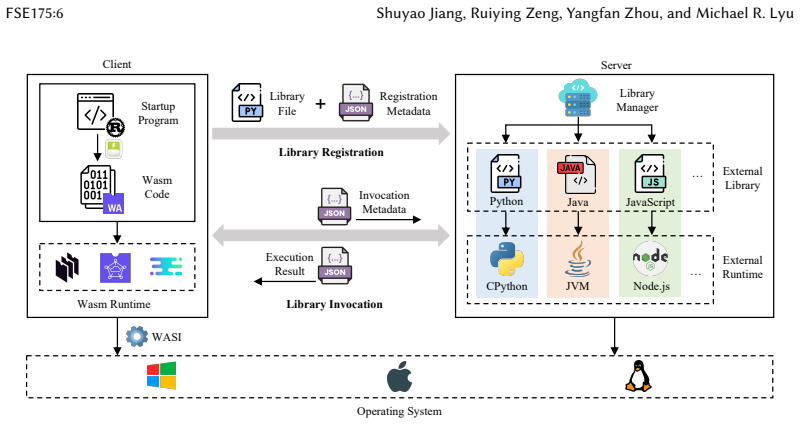
WALL-E employs a unique external library linking strategy, using a client-server architecture to connect Wasm modules with managed language libraries running in their native runtimes. This approach preserves the native execution speed and language feature compatibility of managed languages by eliminating the overhead associated with double-layer virtual machines. Evaluation shows that WALL-E supports ten managed languages without framework modifications and achieves a speedup of hundreds of times over the runtime nesting solution, with low communication overhead.
What carries the argument
external library linking strategy using a client-server architecture to connect Wasm modules with native managed language runtimes
If this is right
- Supports ten managed languages without any changes to the framework.
- Delivers speedups of hundreds of times compared to nesting runtimes.
- Keeps communication overhead low.
- Makes multi-language applications practical for cloud and edge computing.
- Maintains native speed and feature compatibility for the managed languages.
Where Pith is reading between the lines
- This could enable more mixed-language applications in portable environments without custom ports.
- The client-server split might introduce new ways to handle security boundaries between components.
- Developers might find it easier to reuse existing managed language codebases in Wasm projects.
- Testing on additional languages or larger applications could reveal scalability limits not covered in the evaluation.
Load-bearing premise
The client-server external linking architecture can deliver the claimed performance and compatibility without introducing hidden overheads, security issues, or language-specific incompatibilities that would require per-language changes.
What would settle it
A direct performance comparison on a concrete task in one supported language, measuring if WALL-E achieves hundreds of times faster execution than nesting while keeping overhead low.
Figures



read the original abstract
WebAssembly (Wasm) has emerged as a powerful bytecode format for running applications with near-native performance in portable and secure environments. However, while Wasm currently supports compiled languages like C, C++, and Rust, it lacks robust support for managed languages such as Python, Java, and JavaScript. This limitation hinders the deployment of applications in domains like machine learning and data processing that rely heavily on managed language ecosystems. To address this, we propose WALL-E, a novel framework to integrate managed languages into Wasm environments without complex runtime nesting or recompilation. WALL-E employs a unique external library linking strategy, using a client-server architecture to connect Wasm modules with managed language libraries running in their native runtimes. This approach preserves the native execution speed and language feature compatibility of managed languages by eliminating the overhead associated with double-layer virtual machines. Our evaluation shows that WALL-E supports ten managed languages without framework modifications and achieves a speedup of hundreds of times over the runtime nesting solution, with low communication overhead. WALL-E enhances the practicality of Wasm in cloud and edge computing, enabling efficient multi-language applications.
Editorial analysis
A structured set of objections, weighed in public.
Referee Report
Summary. The manuscript proposes WALL-E, a client-server external library linking framework to integrate managed languages (e.g., Python, Java, JavaScript) into WebAssembly without runtime nesting or recompilation. It claims support for ten managed languages without framework modifications, hundreds-of-times speedups over nesting solutions, and low communication overhead, with applications in cloud/edge computing and ML/data processing.
Significance. If substantiated, the approach would meaningfully expand Wasm applicability to managed-language ecosystems by avoiding double-VM overhead while preserving native speeds and compatibility. No machine-checked proofs, reproducible artifacts, or parameter-free derivations are described.
major comments (1)
- [Abstract] Abstract: the central claims of 'supports ten managed languages without framework modifications' and 'achieves a speedup of hundreds of times over the runtime nesting solution, with low communication overhead' are asserted without any description of evaluation methodology, benchmarks used, languages tested, measurement of communication overhead, error bars, or security analysis. These details are load-bearing for the practicality claim.
Simulated Author's Rebuttal
We thank the referee for their review of our manuscript. We address the major comment below.
read point-by-point responses
-
Referee: [Abstract] Abstract: the central claims of 'supports ten managed languages without framework modifications' and 'achieves a speedup of hundreds of times over the runtime nesting solution, with low communication overhead' are asserted without any description of evaluation methodology, benchmarks used, languages tested, measurement of communication overhead, error bars, or security analysis. These details are load-bearing for the practicality claim.
Authors: The abstract is a concise summary of the paper's contributions and results, as is conventional. The evaluation methodology, benchmarks (including ML and data-processing workloads), the ten managed languages tested without framework changes, communication-overhead measurements, performance results with error bars, and the comparison against nested runtimes are all described in detail in Section 5 (Evaluation). The client-server external-linking design and its security properties (leveraging Wasm isolation) are discussed in Section 4. These sections substantiate the practicality claims; the abstract simply reports the headline outcomes. revision: no
Circularity Check
No significant circularity
full rationale
The manuscript describes an engineering framework (WALL-E) using a client-server external linking architecture for managed-language support in WebAssembly. No equations, fitted parameters, self-citations as load-bearing premises, or uniqueness theorems appear in the provided text. Performance and compatibility claims rest on implementation and empirical benchmarks rather than any derivation that reduces to its own inputs by construction. The paper is self-contained against external benchmarks with no detectable circular steps.
Axiom & Free-Parameter Ledger
Reference graph
Works this paper leans on
-
[1]
Varun Agrawal, Abhiroop Dabral, Tapti Palit, Yongming Shen, and Michael Ferdman. 2015. Architectural support for dynamic linking. In Proceedings of the Twentieth International Conference on Architectural Support for Programming Languages and Operating Systems . 691–702. doi:10.1145/2694344.2694392
-
[2]
Asen Alexandrov. 2023. Adding Python WASI support to Wasm Language Runtimes. https://wasmlabs.dev/articles/ python-wasm32-wasi/
2023
-
[3]
Bytecode Alliance. 2025. Wasmtime. https://github.com/bytecodealliance/wasmtime
2025
-
[4]
Anil Altinay, Joseph Nash, Taddeus Kroes, Prabhu Rajasekaran, Dixin Zhou, Adrian Dabrowski, David Gens, Yeoul Na, Stijn Volckaert, Cristiano Giuffrida, et al. 2020. BinRec: dynamic binary lifting and recompilation. In Proceedings of the Fifteenth European Conference on Computer Systems . 1–16. doi:10.1145/3342195.3387550
-
[5]
Sean Bartell, Will Dietz, and Vikram S Adve. 2020. Guided linking: dynamic linking without the costs. Proceedings of the ACM on Programming Languages 4, OOPSLA (2020), 1–29. doi:10.1145/3428213
-
[6]
Jay Bosamiya, Wen Shih Lim, and Bryan Parno. 2022. {Provably-Safe} multilingual software sandboxing using {WebAssembly}. In 31st USENIX Security Symposium (USENIX Security 22) . 1975–1992. https://www.usenix.org/ conference/usenixsecurity22/presentation/bosamiya
2022
-
[7]
Weimin Chen, Zihan Sun, Haoyu Wang, Xiapu Luo, Haipeng Cai, and Lei Wu. 2022. WASAI: uncovering vulnerabilities in Wasm smart contracts. In Proceedings of the 31st ACM SIGSOFT International Symposium on Software Testing and Analysis (ISSTA). 703–715. doi:10.1145/3533767.3534218
-
[8]
Lin Clark. 2019. Standardizing WASI: A system interface to run WebAssembly outside the web.Mozilla Hacks–the Web developer blog (2019). https://hacks.mozilla.org/2019/03/standardizing-wasi-a-webassembly-system-interface/
2019
-
[9]
Bjorn De Sutter, Bruno De Bus, and Koen De Bosschere. 2005. Link-time binary rewriting techniques for program compaction. ACM Transactions on Programming Languages and Systems (TOPLAS) 27, 5 (2005), 882–945. doi:10.1145/ 1086642.1086645
arXiv 2005
-
[10]
Wei Dong, Chun Chen, Xue Liu, Jiajun Bu, and Yunhao Liu. 2009. Dynamic linking and loading in networked embedded systems. In 2009 IEEE 6th international conference on mobile adhoc and sensor systems . IEEE, 554–562. doi:10.1109/mobhoc.2009.5336957
-
[11]
Nicola Dragoni, Saverio Giallorenzo, Alberto Lluch Lafuente, Manuel Mazzara, Fabrizio Montesi, Ruslan Mustafin, and Larisa Safina. 2017. Microservices: yesterday, today, and tomorrow. Present and ulterior software engineering (2017), 195–216. doi:10.1007/978-3-319-67425-4_12
-
[12]
Adam Dunkels, Niclas Finne, Joakim Eriksson, and Thiemo Voigt. 2006. Run-time dynamic linking for reprogramming wireless sensor networks. In Proceedings of the 4th international conference on Embedded networked sensor systems . 15–28. doi:10.1145/1182807.1182810
-
[13]
Unreal Engine. 2025. Unreal Engine. https://www.unrealengine.com/
2025
-
[14]
FastAPI. 2025. FastAPI. https://fastapi.tiangolo.com/
2025
-
[15]
Michael Franz. 1997. Dynamic linking of software components. Computer 30, 3 (1997), 74–81. doi:10.1109/2.573670
-
[16]
Philipp Gackstatter, Pantelis A Frangoudis, and Schahram Dustdar. 2022. Pushing serverless to the edge with we- bassembly runtimes. In 2022 22nd IEEE International Symposium on Cluster, Cloud and Internet Computing (CCGrid) . IEEE, 140–149. doi:10.1109/ccgrid54584.2022.00023
-
[17]
Phani Kishore Gadepalli, Sean McBride, Gregor Peach, Ludmila Cherkasova, and Gabriel Parmer. 2020. Sledge: A serverless-first, light-weight wasm runtime for the edge. In Proceedings of the 21st international middleware conference . 265–279. doi:10.1145/3423211.3425680
-
[18]
Benchmarks Game. 2018. The Computer Language Benchmarks Game. https://benchmarksgame-team.pages.debian. net/benchmarksgame/
2018
-
[19]
Adam T Geller, Justin Frank, and William J Bowman. 2024. Indexed Types for a Statically Safe WebAssembly.Proceedings of the ACM on Programming Languages 8, POPL (2024), 2395–2424. doi:10.1145/3632922
-
[20]
Google. 2023. A new way to bring garbage collected programming languages efficiently to WebAssembly. https: //v8.dev/blog/wasm-gc-porting
2023
-
[21]
Google. 2025. V8 JavaScript Engine. https://v8.dev/
2025
-
[22]
Matthias Grimmer, Roland Schatz, Chris Seaton, Thomas Würthinger, Mikel Luján, and Hanspeter Mössenböck. 2018. Cross-language interoperability in a multi-language runtime. ACM Transactions on Programming Languages and Systems (TOPLAS) 40, 2 (2018), 1–43. doi:10.1145/3201898
-
[23]
Safia Guellil and Marc Sánchez-Artigas. 2025. Optimizing WebAssembly Garbage Collection in Go: Performance Insights, Tuning Tips, and Batch Execution Strategies. In 2025 IEEE 45th International Conference on Distributed Computing Systems (ICDCS). IEEE, 670–680. doi:10.1109/icdcs63083.2025.00071
-
[24]
Robbert Gurdeep Singh and Christophe Scholliers. 2019. WARDuino: a dynamic WebAssembly virtual machine for programming microcontrollers. In Proceedings of the 16th ACM SIGPLAN International Conference on Managed Programming Languages and Runtimes . 27–36. doi:10.1145/3357390.3361029 Proc. ACM Softw. Eng., Vol. 3, No. FSE, Article FSE175. Publication date:...
-
[25]
Andreas Haas, Andreas Rossberg, Derek L Schuff, Ben L Titzer, Michael Holman, Dan Gohman, Luke Wagner, Alon Zakai, and JF Bastien. 2017. Bringing the web up to speed with WebAssembly. InProceedings of the 38th ACM SIGPLAN Conference on Programming Language Design and Implementation . 185–200. doi:10.1145/3062341.3062363
-
[26]
Ningyu He, Zhehao Zhao, Jikai Wang, Yubin Hu, Shengjian Guo, Haoyu Wang, Guangtai Liang, Ding Li, Xiangqun Chen, and Yao Guo. 2023. Eunomia: enabling user-specified fine-grained search in symbolically executing WebAssembly binaries. In Proceedings of the 32nd ACM SIGSOFT International Symposium on Software Testing and Analysis (ISSTA) . 385–397. doi:10.11...
-
[27]
Aaron Hilbig, Daniel Lehmann, and Michael Pradel. 2021. An empirical study of real-world webassembly binaries: Security, languages, use cases. In Proceedings of the Web Conference 2021 . 2696–2708. doi:10.1145/3442381.3450138
-
[28]
W Wilson Ho and Ronald A Olsson. 1991. An approach to genuine dynamic linking. Software: Practice and Experience 21, 4 (1991), 375–390. doi:10.1002/spe.4380210404
-
[29]
Shashank Mohan Jain and Shashank Mohan Jain. 2022. Extending Istio with WebAssembly. WebAssembly for Cloud: A Basic Guide for Wasm-Based Cloud Apps (2022), 151–160. doi:10.1007/978-1-4842-7496-5_8
-
[30]
Abhinav Jangda, Bobby Powers, Emery D Berger, and Arjun Guha. 2019. Not so fast: Analyzing the performance of {WebAssembly} vs. native code. In 2019 USENIX Annual Technical Conference (USENIX ATC 19) . 107–120. https: //www.usenix.org/conference/atc19/presentation/jangda
2019
-
[31]
Shuyao Jiang, Ruiying Zeng, Zihao Rao, Jiazhen Gu, Yangfan Zhou, and Michael R. Lyu. 2023. Revealing Performance Issues in Server-side WebAssembly Runtimes via Differential Testing. InProceedings of the 38th IEEE/ACM International Conference on Automated Software Engineering (ASE) . IEEE, 661–672. doi:10.1109/ase56229.2023.00088
-
[32]
Shuyao Jiang, Ruiying Zeng, Yangfan Zhou, and Michael R. Lyu. 2025. Distinguishability-guided Test Program Generation for WebAssembly Runtime Performance Testing. InProceedings of the 32nd IEEE International Conference on Software Analysis, Evolution and Reengineering (SANER) . IEEE, 768–779. doi:10.1109/saner64311.2025.00078
-
[33]
Evan Johnson, Evan Laufer, Zijie Zhao, Dan Gohman, Shravan Narayan, Stefan Savage, Deian Stefan, and Fraser Brown
-
[34]
WaVe: a verifiably secure WebAssembly sandboxing runtime. In2023 IEEE Symposium on Security and Privacy (SP). IEEE, 2940–2955. doi:10.1109/sp46215.2023.10179357
-
[35]
VMware Labs. 2025. WebAssembly Language Runtimes. https://github.com/vmware-labs/webassembly-language- runtimes
2025
-
[36]
Daniel Lehmann, Johannes Kinder, and Michael Pradel. 2020. Everything old is new again: Binary security of {WebAssembly}. In 29th USENIX Security Symposium (USENIX Security 20) . 217–234. https://www.usenix.org/ conference/usenixsecurity20/presentation/lehmann
2020
-
[37]
Daniel Lehmann and Michael Pradel. 2019. Wasabi: A framework for dynamically analyzing webassembly. InProceedings of the Twenty-Fourth International Conference on Architectural Support for Programming Languages and Operating Systems. 1045–1058. doi:10.1145/3297858.3304068
-
[38]
Daniel Lehmann, Michelle Thalakottur, Frank Tip, and Michael Pradel. 2023. That’s a Tough Call: Studying the Challenges of Call Graph Construction for WebAssembly. In Proceedings of the 32nd ACM SIGSOFT International Symposium on Software Testing and Analysis (ISSTA). 892–903. doi:10.1145/3597926.3598104
-
[39]
Li Li, Wu Chou, Wei Zhou, and Min Luo. 2016. Design patterns and extensibility of REST API for networking applications. IEEE Transactions on Network and Service Management 13, 1 (2016), 154–167. doi:10.1109/tnsm.2016.2516946
-
[40]
Zhibo Liu, Dongwei Xiao, Zongjie Li, Shuai Wang, and Wei Meng. 2023. Exploring missed optimizations in webassembly optimizers. In Proceedings of the 32nd ACM SIGSOFT International Symposium on Software Testing and Analysis (ISSTA) . 436–448. doi:10.1145/3597926.3598068
-
[41]
Niko Mäkitalo, Victor Bankowski, Paulius Daubaris, Risto Mikkola, Oleg Beletski, and Tommi Mikkonen. 2021. Bringing webassembly up to speed with dynamic linking. InProceedings of the 36th Annual ACM Symposium on Applied Computing. 1727–1735. doi:10.1145/3412841.3442045
-
[42]
Niko Mäkitalo, Tommi Mikkonen, Cesare Pautasso, Victor Bankowski, Paulius Daubaris, Risto Mikkola, and Oleg Beletski. 2021. WebAssembly modules as lightweight containers for liquid IoT applications. In International Conference on Web Engineering. Springer, 328–336. doi:10.1007/978-3-030-74296-6_25
-
[43]
Scott Malabarba, Raju Pandey, Jeff Gragg, Earl Barr, and J Fritz Barnes. 2000. Runtime support for type-safe dynamic Java classes. In European Conference on Object-Oriented Programming . Springer, 337–361. doi:10.1007/3-540-45102-1_17
-
[44]
Pankaj Mendki. 2020. Evaluating webassembly enabled serverless approach for edge computing. In 2020 IEEE Cloud Summit. IEEE, 161–166. doi:10.1109/ieeecloudsummit48914.2020.00031
-
[45]
Jämes Ménétrey, Marcelo Pasin, Pascal Felber, and Valerio Schiavoni. 2021. Twine: An embedded trusted runtime for webassembly. In 2021 IEEE 37th International Conference on Data Engineering (ICDE) . IEEE, 205–216. doi:10.1109/ icde51399.2021.00025
arXiv 2021
-
[46]
Konrad Moron and Stefan Wallentowitz. 2023. Support for Just-in-Time Compilation of WebAssembly for Embedded Systems. In 2023 12th Mediterranean Conference on Embedded Computing (MECO) . IEEE, 1–4. doi:10.1109/meco58584. 2023.10155088 Proc. ACM Softw. Eng., Vol. 3, No. FSE, Article FSE175. Publication date: July 2026. Bringing Managed Language Support to ...
-
[47]
Mozilla. 2025. SpiderMonkey. https://spidermonkey.dev/
2025
-
[48]
Otoya Nakakaze, István Koren, Florian Brillowski, and Ralf Klamma. 2022. Retrofitting industrial machines with webassembly on the edge. In International Conference on Web Information Systems Engineering . Springer, 241–256. doi:10.1007/978-3-031-20891-1_18
-
[49]
Shravan Narayan, Craig Disselkoen, Daniel Moghimi, Sunjay Cauligi, Evan Johnson, Zhao Gang, Anjo Vahldiek- Oberwagner, Ravi Sahita, Hovav Shacham, Dean Tullsen, et al . 2021. Swivel: Hardening {WebAssembly} against spectre. In 30th USENIX Security Symposium (USENIX Security 21) . 1433–1450. https://www.usenix.org/conference/ usenixsecurity21/presentation/narayan
2021
-
[50]
Sam Newman. 2021. Building microservices: designing fine-grained systems . " O’Reilly Media, Inc. ". https://www.oreilly. com/library/view/building-microservices-2nd/9781492034018/
arXiv 2021
-
[51]
Mohammed Nurul-Hoque and Khaled A Harras. 2021. Nomad: Cross-Platform Computational Offloading and Migration in Femtoclouds Using WebAssembly. In 2021 IEEE International Conference on Cloud Engineering (IC2E) . IEEE, 168–178. doi:10.1109/ic2e52221.2021.00032
-
[52]
OpenJS. 2025. Express. https://expressjs.com/
2025
-
[53]
Pallets. 2025. Flask. https://flask.palletsprojects.com/en/stable/
2025
-
[54]
Michael P Papazoglou, Paolo Traverso, Schahram Dustdar, and Frank Leymann. 2007. Service-oriented computing: State of the art and research challenges. Computer 40, 11 (2007), 38–45. doi:10.1109/mc.2007.400
-
[55]
Python. 2025. CPython. https://github.com/python/cpython
2025
-
[56]
Python. 2025. jsonschema. https://python-jsonschema.readthedocs.io/en/stable/
2025
-
[57]
Python. 2025. Python-Markdown. https://pypi.org/project/Markdown/
2025
-
[58]
Python. 2025. The Python Performance Benchmark Suite. https://pyperformance.readthedocs.io/index.html
2025
-
[59]
RedMonk. 2022. The RedMonk Programming Language Rankings. https://redmonk.com/sogrady/2022/03/28/language- rankings-1-22/
2022
-
[60]
Micha Reiser and Luc Bläser. 2017. Accelerate JavaScript applications by cross-compiling to WebAssembly. In Proceedings of the 9th ACM SIGPLAN International Workshop on Virtual Machines and Intermediate Languages . 10–17. doi:10.1145/3141871.3141873
-
[61]
Yuxin Ren, Kang Zhou, Jianhai Luan, Yunfeng Ye, Shiyuan Hu, Xu Wu, Wenqin Zheng, Wenfeng Zhang, and Xinwei Hu. 2022. From dynamic loading to extensible transformation: An infrastructure for dynamic library transformation. In 16th USENIX Symposium on Operating Systems Design and Implementation (OSDI 22) . 649–666. https://www.usenix. org/conference/osdi22/...
2022
-
[62]
Alan Romano, Daniel Lehmann, Michael Pradel, and Weihang Wang. 2022. Wobfuscator: Obfuscating javascript malware via opportunistic translation to webassembly. In 2022 IEEE Symposium on Security and Privacy (SP) . IEEE, 1574–1589. doi:10.1109/sp46214.2022.9833626
-
[63]
Alan Romano and Weihang Wang. 2023. When Function Inlining Meets WebAssembly: Counterintuitive Impacts on Runtime Performance. In Proceedings of the 31st ACM Joint European Software Engineering Conference and Symposium on the Foundations of Software Engineering (ESEC/FSE) . ACM, 350–362. doi:10.1145/3611643.3616311
-
[64]
Merlijn Sebrechts, Tim Ramlot, Sander Borny, Tom Goethals, Bruno Volckaert, and Filip De Turck. 2022. Adapting Kubernetes controllers to the edge: on-demand control planes using Wasm and WASI. In 2022 IEEE 11th International Conference on Cloud Networking (CloudNet) . IEEE, 195–202. doi:10.1109/cloudnet55617.2022.9978884
-
[65]
Hovav Shacham, Matthew Page, Ben Pfaff, Eu-Jin Goh, Nagendra Modadugu, and Dan Boneh. 2004. On the effectiveness of address-space randomization. In Proceedings of the 11th ACM Conference on Computer and Communications Security . 298–307. doi:10.1145/1030083.1030124
-
[66]
Simon Shillaker and Peter Pietzuch. 2020. Faasm: Lightweight isolation for efficient stateful serverless computing. In 2020 USENIX Annual Technical Conference (USENIX ATC 20) . 419–433. https://www.usenix.org/conference/atc20/ presentation/shillaker
2020
-
[67]
Shopify. 2023. Bringing JavaScript to WebAssembly for Shopify Functions. https://shopify.engineering/javascript-in- webassembly-for-shopify-functions
2023
-
[68]
Mark Slee, Aditya Agarwal, and Marc Kwiatkowski. 2007. Thrift: Scalable cross-language services implementation. Facebook white paper 5, 8 (2007), 127. https://thrift.apache.org/static/files/thrift-20070401.pdf
2007
-
[69]
Spring. 2025. Spring Boot. https://spring.io/projects/spring-boot
2025
-
[70]
Second State. 2025. WasmEdge-QuickJS. https://github.com/second-state/wasmedge-quickjs
2025
-
[71]
Thomas Steiner. 2024. Toward Making Opaque Web Content More Accessible: Accessibility From Adobe Flash to Canvas- Rendered Apps. In Companion Proceedings of the ACM Web Conference 2024 . 1111–1114. doi:10.1145/3589335.3651999
-
[72]
Quentin Stiévenart, David W Binkley, and Coen De Roover. 2022. Static stack-preserving intra-procedural slicing of webassembly binaries. In Proceedings of the 44th International Conference on Software Engineering (ICSE) . 2031–2042. doi:10.1145/3510003.3510070 Proc. ACM Softw. Eng., Vol. 3, No. FSE, Article FSE175. Publication date: July 2026. FSE175:24 S...
-
[73]
Ben L Titzer. 2022. A fast in-place interpreter for WebAssembly. Proceedings of the ACM on Programming Languages 6, OOPSLA2 (2022), 646–672. doi:10.1145/3563311
-
[74]
Unity. 2025. Unity. https://unity.com/
2025
-
[75]
Luke Wagner. 2017. A WebAssembly milestone: Experimental support in multiple browsers. Mozilla Hacks (14 March 2016). (2017). https://hacks.mozilla.org/2016/03/a-webassembly-milestone/
2017
-
[76]
Dong Wang, Bo Jiang, and WK Chan. 2020. WANA: Symbolic execution of wasm bytecode for cross-platform smart contract vulnerability detection. arXiv preprint arXiv:2007.15510 (2020). doi:10.48550/arXiv.2007.15510
-
[77]
WasmEdge. 2025. WasmEdge. https://github.com/WasmEdge/WasmEdge
2025
-
[78]
WasmEdge. 2025. WasmEdge HTTP Services. https://wasmedge.org/docs/category/http-services
2025
-
[79]
Wasmer. 2025. Wasmer. https://github.com/wasmerio/wasmer
2025
-
[80]
Elliott Wen and Jens Dietrich. 2023. Wasmslim: Optimizing webassembly binary distribution via automatic module splitting. In 2023 IEEE International Conference on Software Analysis, Evolution and Reengineering (SANER) . IEEE, 673–677. doi:10.1109/saner56733.2023.00069
discussion (0)
Sign in with ORCID, Apple, or X to comment. Anyone can read and Pith papers without signing in.