A 0.03 Hz Radio Quasi-periodic Oscillation During the 2025 Flare of GRS 1915+105
Pith reviewed 2026-06-28 13:37 UTC · model grok-4.3
The pith
A 0.03 Hz QPO recurs in radio observations of GRS 1915+105 at two wavelengths during its 2025 flare.
A machine-rendered reading of the paper's core claim, the machinery that carries it, and where it could break.
Core claim
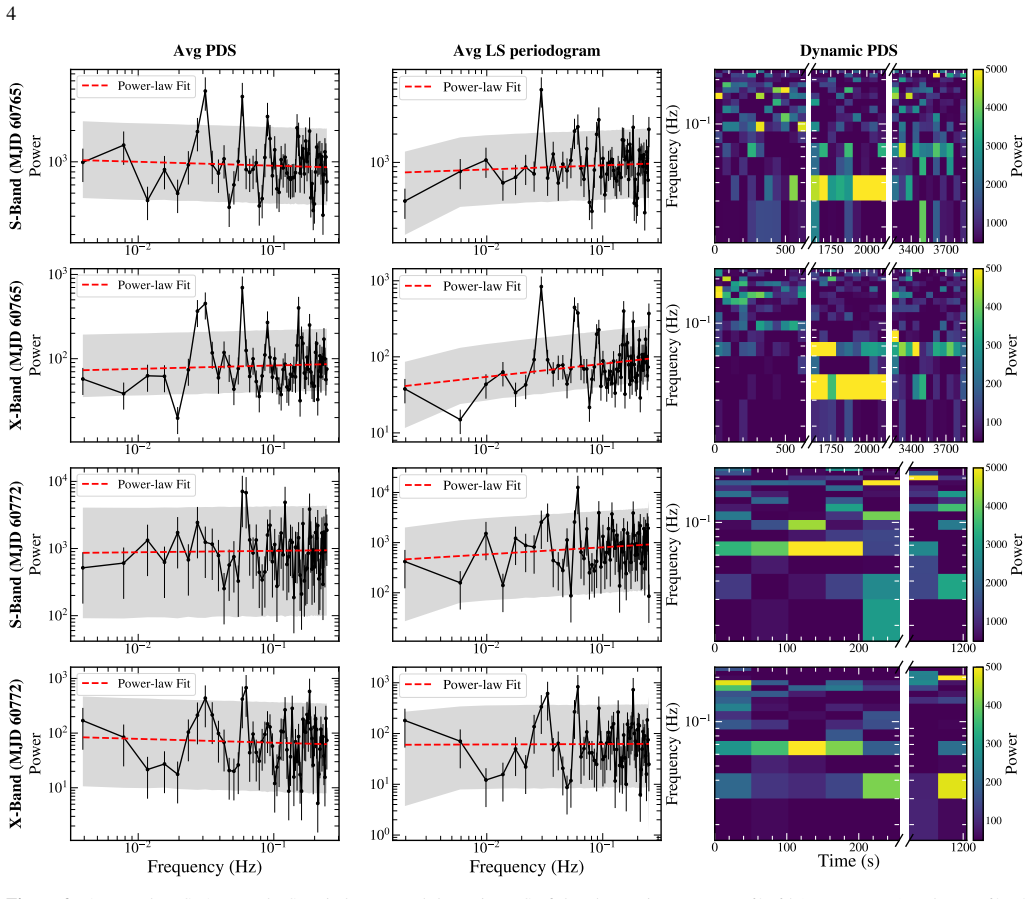
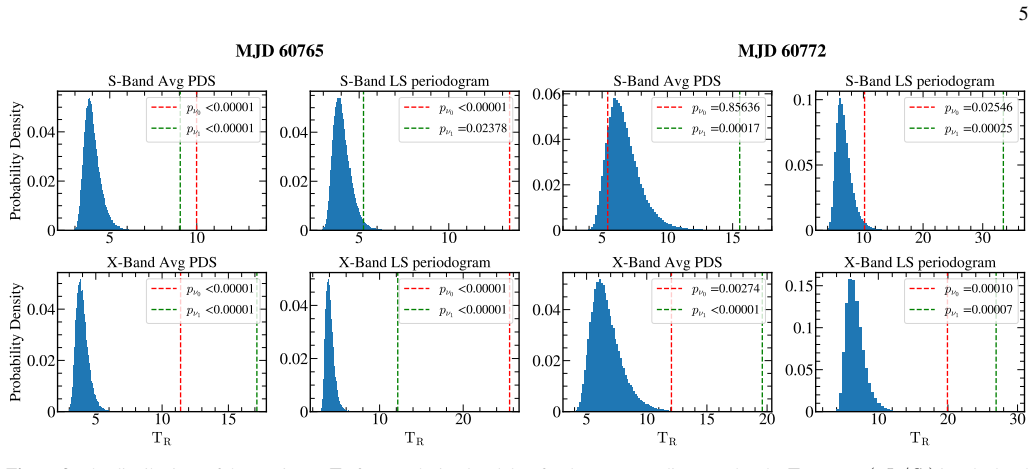
The central claim is that a significant QPO at ~0.03 Hz (and harmonic ~0.06 Hz) was detected in both radio bands on MJD 60765 (>5.9 sigma) and MJD 60772 (2.8 sigma), with the frequency identical across bands and consistent with prior observations. The recurrence and wavelength independence of the QPO frequency indicate an intrinsic characteristic timescale of the accretion-jet system.
What carries the argument
The QPO frequency and its measured constancy across radio wavelengths and observation epochs.
If this is right
- The QPO frequency represents a stable dynamical timescale that persists across different radio emission wavelengths.
- The same frequency in both bands indicates the oscillation originates upstream of the radio-emitting regions rather than in wavelength-dependent propagation effects.
- Continued monitoring can test whether this 0.03 Hz signal appears in future flares or other activity states of GRS 1915+105.
- The harmonic at 0.06 Hz suggests a nonlinear process that generates overtones of the fundamental timescale.
Where Pith is reading between the lines
- If the 0.03 Hz timescale corresponds to a dynamical frequency near the black hole, it could be compared with X-ray QPOs or timing features to map radial locations in the accretion flow.
- Detection of analogous low-frequency signals in other microquasars would test whether this timescale is universal or specific to GRS 1915+105 parameters.
- Simultaneous radio and X-ray observations during flares could check whether the radio QPO phase aligns with higher-energy variability at related frequencies.
Load-bearing premise
That the reported periodic signal is astrophysical and not produced by instrumental noise, baseline effects, or post-selection of flare epochs, given that only two consecutive observations are highlighted and full time-series analysis details are not provided in the abstract.
What would settle it
Re-processing the raw time series from the two telescopes and finding that the periodicity falls below 3 sigma significance when all available data are included without epoch selection or when alternative noise models are applied would falsify the intrinsic QPO claim.
Figures

read the original abstract
Our weekly-cadence radio monitoring campaign captured a bright flare in 2025 from the microquasar GRS 1915+105, observed simultaneously in the S- and X-bands (2.25 GHz and 8.42 GHz) with a short single baseline of two radio telescopes in Shanghai. Through high time resolution analysis, we detected a significant and short-lived quasi-periodic oscillation (QPO) at $\sim$0.03 Hz and its harmonic ($\sim$0.06 Hz) in both radio bands of two consecutive observations on MJD 60765 ($>5.9 \sigma$) and MJD 60772 (2.8$\sigma$). Crucially, the QPO frequency is identical in both radio bands and matches oscillations detected in previous years. The recurrence and wavelength independence of the QPO frequency suggest an intrinsic characteristic timescale of the accretion-jet system.
Editorial analysis
A structured set of objections, weighed in public.
Referee Report
Summary. The manuscript reports the detection of a ~0.03 Hz quasi-periodic oscillation (QPO) and its ~0.06 Hz harmonic in single-baseline radio observations of the microquasar GRS 1915+105 during its 2025 flare. The signal appears in both S-band (2.25 GHz) and X-band (8.42 GHz) during two consecutive epochs (MJD 60765 at >5.9σ and MJD 60772 at 2.8σ), matches the frequency seen in prior years, and is interpreted as evidence for an intrinsic characteristic timescale of the accretion-jet system.
Significance. If the detection is robust against instrumental artifacts, the result would be significant because it demonstrates recurrence of the same QPO frequency across multiple years and independence from observing wavelength in a microquasar, strengthening the case for a stable physical timescale tied to the accretion or jet-launching region.
major comments (3)
- [Abstract] Abstract: the claimed significances (>5.9σ on MJD 60765 and 2.8σ on MJD 60772) are stated without any accompanying power spectrum, description of the periodogram algorithm, red-noise model, false-alarm probability calculation, window function, or trial-factor correction. These elements are required to evaluate whether the low-frequency signal could arise from atmospheric or baseline effects that commonly affect single-baseline radio light curves.
- [Abstract] Abstract: the analysis is restricted to two consecutive observations selected from a weekly-cadence campaign, yet no information is given on the total number of epochs examined, the criteria used to identify the flare, or any correction for the look-elsewhere effect arising from post-hoc choice of the highlighted epochs.
- [Abstract] Abstract: the assertion that the QPO frequency is identical across bands and matches previous detections is presented without quoted frequency values, uncertainties, or the precise measurement method (e.g., Lorentzian centroid or peak-finding algorithm), preventing quantitative assessment of the claimed recurrence and wavelength independence.
Simulated Author's Rebuttal
We thank the referee for their careful reading of our manuscript and for providing constructive comments. We respond to each major comment below. We have revised the manuscript to address the concerns raised, primarily by enhancing the abstract with additional details on the analysis and results.
read point-by-point responses
-
Referee: [Abstract] Abstract: the claimed significances (>5.9σ on MJD 60765 and 2.8σ on MJD 60772) are stated without any accompanying power spectrum, description of the periodogram algorithm, red-noise model, false-alarm probability calculation, window function, or trial-factor correction. These elements are required to evaluate whether the low-frequency signal could arise from atmospheric or baseline effects that commonly affect single-baseline radio light curves.
Authors: The abstract is limited in length and therefore omits the detailed description of the analysis methods. These are fully described in the body of the manuscript, including the periodogram algorithm, red-noise model, false-alarm probability calculation, window function, and trial-factor correction. We have revised the abstract to include a concise statement on the significance determination and a reference to the relevant sections for readers seeking the technical details. revision: yes
-
Referee: [Abstract] Abstract: the analysis is restricted to two consecutive observations selected from a weekly-cadence campaign, yet no information is given on the total number of epochs examined, the criteria used to identify the flare, or any correction for the look-elsewhere effect arising from post-hoc choice of the highlighted epochs.
Authors: The abstract highlights the key detections but does not provide the full context of the observing campaign. The manuscript details the weekly-cadence monitoring, the total number of epochs observed, and the criteria for identifying the flare based on flux levels. We have updated the abstract to mention the campaign parameters and the selection of the epochs. We have also added a discussion of the look-elsewhere effect and the corrections applied in the analysis. revision: yes
-
Referee: [Abstract] Abstract: the assertion that the QPO frequency is identical across bands and matches previous detections is presented without quoted frequency values, uncertainties, or the precise measurement method (e.g., Lorentzian centroid or peak-finding algorithm), preventing quantitative assessment of the claimed recurrence and wavelength independence.
Authors: We agree that the abstract does not quote the precise frequency values or uncertainties. The manuscript reports the frequencies measured via Lorentzian fitting to the periodogram peaks, along with their uncertainties, and compares them to previous detections. We have revised the abstract to include the measured frequency values with uncertainties and to specify the measurement method. revision: yes
Circularity Check
No circularity: purely observational frequency measurement from data
full rationale
The paper presents a direct detection of ~0.03 Hz QPO and harmonic in radio light curves from two epochs, with the frequency stated as measured from the observations and noted to match prior detections. No equations, model fitting, or derivation chain are described that would reduce the reported frequency to a fitted parameter, self-citation, or input by construction. The claim of intrinsic timescale follows from the observational recurrence and band-independence, without any self-referential step. This is a standard observational report; the central result does not reduce to its own inputs.
Axiom & Free-Parameter Ledger
axioms (1)
- domain assumption Standard statistical thresholds for claiming QPO detection in unevenly sampled radio light curves
Reference graph
Works this paper leans on
-
[1]
An Accretion-Ejection Instability in magnetized disks
An accretion-ejection instability in magnetized disks. , keywords =. doi:10.48550/arXiv.astro-ph/9907267 , archivePrefix =. astro-ph/9907267 , primaryClass =
work page internal anchor Pith review Pith/arXiv arXiv doi:10.48550/arxiv.astro-ph/9907267
-
[2]
Magnetic floods: a scenario for the variability of the microquasar GRS 1915+105
Magnetic Floods: A Scenario for the Variability of the Microquasar GRS 1915+105. , keywords =. doi:10.1086/383232 , archivePrefix =. astro-ph/0401539 , primaryClass =
work page internal anchor Pith review Pith/arXiv arXiv doi:10.1086/383232 1915
-
[3]
RXTE Observations of QPOs in the Black Hole Candidate GRS 1915+105. , keywords =. doi:10.1086/304191 , adsurl =
-
[4]
Comprehensive X-ray Spectral-timing Analysis of GRS 1915+105 Based on Insight-HXMT Observations. arXiv e-prints , keywords =. doi:10.48550/arXiv.2510.10017 , archivePrefix =. 2510.10017 , primaryClass =
-
[5]
Electromagnetic extraction of energy from Kerr black holes. , keywords =. doi:10.1093/mnras/179.3.433 , adsurl =
-
[6]
Hydromagnetic flows from accretion disks and the production of radio jets. , keywords =. doi:10.1093/mnras/199.4.883 , adsurl =
-
[7]
Precise mass and spin measurements for a stellar-mass black hole through X-ray timing: the case of GRO J1655-40. , keywords =. doi:10.1093/mnras/stt2068 , archivePrefix =. 1309.3652 , primaryClass =
work page internal anchor Pith review Pith/arXiv arXiv doi:10.1093/mnras/stt2068
-
[8]
, year = 2009, month = mar, volume =
Accretion disk winds as the jet suppression mechanism in the microquasar GRS 1915+105. , year = 2009, month = mar, volume =. doi:10.1038/nature07680 , adsurl =
-
[9]
A jet model for the fast IR variability of the black hole X-ray binary GX 339-4
A jet model for the fast IR variability of the black hole X-ray binary GX 339-4. , keywords =. doi:10.1093/mnras/sty2006 , archivePrefix =. 1807.09835 , primaryClass =
work page internal anchor Pith review Pith/arXiv arXiv doi:10.1093/mnras/sty2006
-
[10]
DiFX: A Software Correlator for Very Long Baseline Interferometry Using Multiprocessor Computing Environments. , keywords =. doi:10.1086/513572 , archivePrefix =. astro-ph/0702141 , primaryClass =
work page internal anchor Pith review Pith/arXiv arXiv doi:10.1086/513572
-
[11]
First M87 Event Horizon Telescope Results. V. Physical Origin of the Asymmetric Ring. , keywords =. doi:10.3847/2041-8213/ab0f43 , archivePrefix =. 1906.11242 , primaryClass =
work page internal anchor Pith review Pith/arXiv arXiv doi:10.3847/2041-8213/ab0f43 2041
-
[12]
Bardeen-Petterson alignment, jets, and magnetic truncation in GRMHD simulations of tilted thin accretion discs. , keywords =. doi:10.1093/mnras/stz834 , archivePrefix =. 1810.00883 , primaryClass =
-
[13]
Disc tearing and Bardeen-Petterson alignment in GRMHD simulations of highly tilted thin accretion discs. , keywords =. doi:10.1093/mnras/staa099 , archivePrefix =. 1904.08428 , primaryClass =
-
[14]
Global General Relativistic MHD Simulation of a Tilted Black-Hole Accretion Disk
Global General Relativistic Magnetohydrodynamic Simulation of a Tilted Black Hole Accretion Disk. , keywords =. doi:10.1086/521092 , archivePrefix =. 0706.4303 , primaryClass =
work page internal anchor Pith review Pith/arXiv arXiv doi:10.1086/521092
-
[15]
Co-precession of a curved jet and compact accretion disk in M87. Nature Astronomy , keywords =. doi:10.1038/s41550-025-02580-0 , archivePrefix =. 2410.10965 , primaryClass =
-
[16]
Precessing jet nozzle connecting to a spinning black hole in M87. , keywords =. doi:10.1038/s41586-023-06479-6 , archivePrefix =. 2310.09015 , primaryClass =
-
[17]
U ber den Einflu der Eigenrotation der Zentralk \
\"U ber den Einflu der Eigenrotation der Zentralk \"o rper auf die Bewegung der Planeten und Monde nach der Einsteinschen Gravitationstheorie. Physikalische Zeitschrift , year = 1918, month = jan, volume =
1918
-
[18]
Optimal binning of X-ray spectra and response matrix design
Optimal binning of X-ray spectra and response matrix design. , keywords =. doi:10.1051/0004-6361/201527395 , archivePrefix =. 1601.05309 , primaryClass =
work page internal anchor Pith review Pith/arXiv arXiv doi:10.1051/0004-6361/201527395
-
[19]
The Astronomer's Telegram , keywords =
New short-time radio and X-ray flare from GRS1915+105. The Astronomer's Telegram , keywords =
-
[20]
The Astronomer's Telegram , keywords =
Giant radio flare from GRS1915+105. The Astronomer's Telegram , keywords =
-
[21]
The Astronomer's Telegram , keywords =
New radio flare from GRS 1915+105. The Astronomer's Telegram , keywords =
1915
-
[22]
Disc-jet coupling in the 2009 outburst of the black hole candidate H1743-322. , keywords =. doi:10.1111/j.1365-2966.2011.20326.x , archivePrefix =. 1201.1678 , primaryClass =
-
[23]
Transitions and Origin of the Type-B Quasi-periodic Oscillations in the Black Hole X-Ray Binary MAXI J1348-630. , keywords =. doi:10.3847/1538-4357/ac88c6 , archivePrefix =. 2208.07066 , primaryClass =
-
[24]
Fast transitions of X-ray variability in the black hole transient GX 339-4: comparison with MAXI J1820+070 and MAXI J1348-630. , keywords =. doi:10.1093/mnras/stad795 , archivePrefix =. 2303.07588 , primaryClass =
-
[25]
Intermittent properties of the quasi-periodic oscillations of MAXI J1820+070 revealed by Insight-HXMT. , keywords =. doi:10.1051/0004-6361/202346309 , archivePrefix =. 2307.07709 , primaryClass =
-
[26]
The Astronomer's Telegram , keywords =
The bright radio flare from microquasar GRS 1915+105. The Astronomer's Telegram , keywords =
1915
-
[27]
, year = 1992, month = aug, volume =
GRS 1915+105. , year = 1992, month = aug, volume =
1915
-
[28]
A Persistent Disk Wind in GRS 1915+105 with NICER
A Persistent Disk Wind in GRS 1915+105 with NICER. , keywords =. doi:10.3847/2041-8213/aaca96 , archivePrefix =. 1806.02342 , primaryClass =
work page internal anchor Pith review Pith/arXiv arXiv doi:10.3847/2041-8213/aaca96 1915
-
[29]
A NICER View of a Highly Absorbed Flare in GRS 1915+105. , keywords =. doi:10.3847/1538-4357/abb598 , archivePrefix =. 2010.14512 , primaryClass =
-
[30]
An Obscured, Seyfert 2-like State of the Stellar-mass Black Hole GRS 1915+105 Caused by Failed Disk Winds. , keywords =. doi:10.3847/1538-4357/abbb31 , archivePrefix =. 2007.07005 , primaryClass =
-
[31]
The Chandra HETGS and RXTE view of GRS 1915+105
High-Resolution Chandra HETGS and Rossi X-Ray Timing Explorer Observations of GRS 1915+105: A Hot Disk Atmosphere and Cold Gas Enriched in Iron and Silicon. , keywords =. doi:10.1086/338588 , archivePrefix =. astro-ph/0208187 , primaryClass =
work page internal anchor Pith review Pith/arXiv arXiv doi:10.1086/338588 1915
-
[32]
Particle acceleration in relativistic collisionless shocks: Fermi process at last?
Particle Acceleration in Relativistic Collisionless Shocks: Fermi Process at Last?. , keywords =. doi:10.1086/590248 , archivePrefix =. 0802.3216 , primaryClass =
work page internal anchor Pith review Pith/arXiv arXiv doi:10.1086/590248
-
[33]
A Parallax Distance to the Microquasar GRS 1915+105 and a Revised Estimate of its Black Hole Mass
A Parallax Distance to the Microquasar GRS 1915+105 and a Revised Estimate of its Black Hole Mass. , keywords =. doi:10.1088/0004-637X/796/1/2 , archivePrefix =. 1409.2453 , primaryClass =
work page internal anchor Pith review Pith/arXiv arXiv doi:10.1088/0004-637x/796/1/2 1915
-
[34]
Discovery of oscillations above 200 keV in a black hole X-ray binary with Insight-HXMT. Nature Astronomy , keywords =. doi:10.1038/s41550-020-1192-2 , archivePrefix =. 2009.10607 , primaryClass =
-
[35]
, year = 2025, month = feb, volume =
Rapid mid-infrared spectral timing with JWST: GRS 1915+105 during an MIR-bright and X-ray-obscured state. , year = 2025, month = feb, volume =. doi:10.1093/mnras/staf036 , adsurl =
-
[36]
An unstable central disk in the superluminal black-hole X-ray binary GRS 1915+105
An Unstable Central Disk in the Superluminal Black Hole X-Ray Binary GRS 1915+105. , keywords =. doi:10.1086/310595 , archivePrefix =. astro-ph/9702048 , primaryClass =
work page internal anchor Pith review Pith/arXiv arXiv doi:10.1086/310595 1915
-
[37]
A systematic analysis of the phase lags associated with the type-C quasi-periodic oscillation in GRS 1915+105. , keywords =. doi:10.1093/mnras/staa797 , archivePrefix =. 2003.08928 , primaryClass =
-
[38]
Extreme Jet Ejections from the Black Hole X-ray Binary V404 Cygni
Extreme jet ejections from the black hole X-ray binary V404 Cygni. , keywords =. doi:10.1093/mnras/stx1048 , archivePrefix =. 1704.08726 , primaryClass =
work page internal anchor Pith review Pith/arXiv arXiv doi:10.1093/mnras/stx1048
-
[39]
Comprehensive coverage of particle acceleration and kinetic feedback from the stellar mass black hole V404 Cygni. , keywords =. doi:10.1093/mnras/stac1836 , archivePrefix =. 2206.09831 , primaryClass =
-
[40]
On the Distances to the X-Ray Binaries Cygnus X-3 and GRS 1915+105. , keywords =. doi:10.3847/1538-4357/acfe0c , archivePrefix =. 2309.15027 , primaryClass =
-
[41]
, keywords =
On generating power law noise. , keywords =
-
[42]
A Bayesian test for periodic signals in red noise. , keywords =. doi:10.1111/j.1365-2966.2009.15868.x , archivePrefix =. 0910.2706 , primaryClass =
-
[43]
Low-frequency quasi-periodic oscillations spectra and Lense-Thirring precession. , keywords =. doi:10.1111/j.1745-3933.2009.00693.x , archivePrefix =. 0901.1238 , primaryClass =
-
[44]
Detection of Very Low-Frequency Quasi-Periodic Oscillations in the 2015 Outburst of V404 Cygni
Detection of Very Low-frequency, Quasi-periodic Oscillations in the 2015 Outburst of V404 Cygni. , keywords =. doi:10.3847/1538-4357/834/1/90 , archivePrefix =. 1610.08653 , primaryClass =
work page internal anchor Pith review Pith/arXiv arXiv doi:10.3847/1538-4357/834/1/90 2015
-
[45]
A Unified Description of the Timing Features of Accreting X-ray Binaries
A Unified Description of the Timing Features of Accreting X-Ray Binaries. , keywords =. doi:10.1086/340290 , archivePrefix =. astro-ph/0202213 , primaryClass =
work page internal anchor Pith review Pith/arXiv arXiv doi:10.1086/340290
-
[46]
Stingray: A Modern Python Library for Spectral Timing. , keywords =. doi:10.3847/1538-4357/ab258d , archivePrefix =. 1901.07681 , primaryClass =
-
[47]
Understanding the Lomb-Scargle Periodogram
Understanding the Lomb-Scargle Periodogram. , keywords =. doi:10.3847/1538-4365/aab766 , archivePrefix =. 1703.09824 , primaryClass =
work page internal anchor Pith review Pith/arXiv arXiv doi:10.3847/1538-4365/aab766
-
[48]
Synchrotron self-absorption and the minimum energy of optically thick radio flares from stellar mass black holes. , keywords =. doi:10.1093/mnras/stz2000 , archivePrefix =. 1907.07463 , primaryClass =
-
[49]
The low-frequency structure of powerful radio sources and limits to departures from equipartition. , keywords =. doi:10.1093/mnras/180.4.539 , adsurl =
-
[50]
MERLIN observations of relativistic ejections from GRS 1915+105. , keywords =. doi:10.1046/j.1365-8711.1999.02364.x , archivePrefix =. astro-ph/9812150 , primaryClass =
-
[51]
, year = 1966, month = sep, volume =
A Model for Variable Extragalactic Radio Sources. , year = 1966, month = sep, volume =. doi:10.1038/2111131a0 , adsurl =
-
[52]
Dimming GRS 1915+105 observed with NICER and Insight HXMT. , keywords =. doi:10.1051/0004-6361/202451558 , archivePrefix =. 2501.03804 , primaryClass =
-
[53]
An Unusual Change in the Radio Jets of GRS 1915+105. , keywords =. doi:10.3847/1538-4357/adda33 , archivePrefix =. 2503.01105 , primaryClass =
-
[54]
The variable radio emission from GRS 1915+105
The variable radio emission from GRS 1915+=105. , keywords =. doi:10.1093/mnras/292.4.925 , archivePrefix =. astro-ph/9708171 , primaryClass =
work page internal anchor Pith review Pith/arXiv arXiv doi:10.1093/mnras/292.4.925 1915
-
[55]
A rapidly-changing jet orientation in the stellar-mass black hole V404 Cygni
A rapidly changing jet orientation in the stellar-mass black-hole system V404 Cygni. , keywords =. doi:10.1038/s41586-019-1152-0 , archivePrefix =. 1906.05400 , primaryClass =
work page internal anchor Pith review Pith/arXiv arXiv doi:10.1038/s41586-019-1152-0 1906
-
[56]
, year = 1994, month = sep, volume =
A superluminal source in the Galaxy. , year = 1994, month = sep, volume =. doi:10.1038/371046a0 , adsurl =
-
[57]
Astronomy Letters , year = 1999, month = nov, volume =
The X-ray source GRS 1915 + 105: The low-luminosity state and transitions between the states during 1996-1997 (RXTE observations). Astronomy Letters , year = 1999, month = nov, volume =
1915
-
[58]
Mid-Infrared observations of GRS 1915+105 during plateau and flaring states
Mid-infrared observations of GRS 1915+105 during plateau and flaring states. , keywords =. doi:10.1051/0004-6361:20030562 , archivePrefix =. astro-ph/0304344 , primaryClass =
work page internal anchor Pith review Pith/arXiv arXiv doi:10.1051/0004-6361:20030562 1915
-
[59]
On the origin of the various types of radio emission in GRS 1915+105
On the Origin of the Various Types of Radio Emission in GRS 1915+105. , keywords =. doi:10.1086/378672 , archivePrefix =. astro-ph/0308096 , primaryClass =
work page internal anchor Pith review Pith/arXiv arXiv doi:10.1086/378672 1915
-
[60]
GRS 1915+105 and the Disc-Jet Coupling in Accreting Black Hole Systems. , keywords =. doi:10.1146/annurev.astro.42.053102.134031 , archivePrefix =. astro-ph/0406483 , primaryClass =
-
[61]
Lecture Notes in Physics, Berlin Springer Verlag , year = 2010, editor =
States and Transitions in Black Hole Binaries. Lecture Notes in Physics, Berlin Springer Verlag , year = 2010, editor =. doi:10.1007/978-3-540-76937-8_3 , adsurl =
-
[62]
Radio Frequency Timing Analysis of the Compact Jet in the Black Hole X-ray Binary Cygnus X-1
Radio frequency timing analysis of the compact jet in the black hole X-ray binary Cygnus X-1. , keywords =. doi:10.1093/mnras/stz165 , archivePrefix =. 1901.03751 , primaryClass =
work page internal anchor Pith review Pith/arXiv arXiv doi:10.1093/mnras/stz165 1901
-
[63]
A model-independent analysis of the variability of GRS 1915+105
A model-independent analysis of the variability of GRS 1915+105. , keywords =. doi:10.48550/arXiv.astro-ph/0001103 , archivePrefix =. astro-ph/0001103 , primaryClass =
work page internal anchor Pith review Pith/arXiv arXiv doi:10.48550/arxiv.astro-ph/0001103 1915
-
[64]
Observations of a radio-bright, X-ray obscured GRS 1915+105. , keywords =. doi:10.1093/mnras/stab511 , archivePrefix =. 2101.01187 , primaryClass =
-
[65]
Fast infrared winds during the radio-loud and X-ray obscured stages of the black hole transient GRS 1915+105. , keywords =. doi:10.1051/0004-6361/202348184 , archivePrefix =. 2311.12933 , primaryClass =
-
[66]
Subsecond periodic radio oscillations in a microquasar. , keywords =. doi:10.1038/s41586-023-06336-6 , archivePrefix =. 2307.14015 , primaryClass =
-
[67]
Nature Communications , keywords =
Quasi-periodic oscillations of GHz-band polarization in a black hole. Nature Communications , keywords =. doi:10.1038/s41467-025-59586-5 , adsurl =
-
[68]
Coupling between the accreting corona and the relativistic jet in the microquasar GRS 1915+105. Nature Astronomy , keywords =. doi:10.1038/s41550-022-01617-y , archivePrefix =. 2203.02963 , primaryClass =
-
[69]
Calibrated Estimates of the Energy in Major Flares of GRS 1915+105
Calibrated estimates of the energy in major flares of GRS 1915+105. , keywords =. doi:10.1093/mnras/stt1455 , archivePrefix =. 1308.0646 , primaryClass =
work page internal anchor Pith review Pith/arXiv arXiv doi:10.1093/mnras/stt1455 1915
-
[70]
Accretion instabilities and jet formation in GRS 1915+105
Accretion instabilities and jet formation in GRS 1915+105. , keywords =. doi:10.48550/arXiv.astro-ph/9711097 , archivePrefix =. astro-ph/9711097 , primaryClass =
work page internal anchor Pith review Pith/arXiv arXiv doi:10.48550/arxiv.astro-ph/9711097 1915
-
[71]
Giant repeated ejections from GRS 1915+105. , keywords =. doi:10.1046/j.1365-8711.2000.03847.x , archivePrefix =. astro-ph/0006278 , primaryClass =
-
[72]
Faint Infrared Flares from the Microquasar GRS 1915+105
Faint Infrared Flares from the Microquasar GRS 1915+105. , keywords =. doi:10.1086/312559 , archivePrefix =. astro-ph/0001472 , primaryClass =
work page internal anchor Pith review Pith/arXiv arXiv doi:10.1086/312559 1915
-
[73]
Radiation pressure instability as a variability mechanism in the microquasar GRS 1915+105
Radiation Pressure Instability as a Variability Mechanism in the Microquasar GRS 1915+105. , keywords =. doi:10.1086/312911 , archivePrefix =. astro-ph/0008354 , primaryClass =
work page internal anchor Pith review Pith/arXiv arXiv doi:10.1086/312911 1915
-
[74]
Time-Dependent Disk Models for the Microquasar GRS1915+105
Time-dependent Disk Models for the Microquasar GRS 1915+105. , keywords =. doi:10.1086/308860 , archivePrefix =. astro-ph/9905371 , primaryClass =
work page internal anchor Pith review Pith/arXiv arXiv doi:10.1086/308860 1915
-
[75]
Radiation Pressure and Mass Ejection in Rho-like States of GRS 1915+105
Radiation Pressure and Mass Ejection in -like States of GRS 1915+105. , keywords =. doi:10.1088/0004-637X/750/1/71 , archivePrefix =. 1203.0301 , primaryClass =
work page internal anchor Pith review Pith/arXiv arXiv doi:10.1088/0004-637x/750/1/71 1915
-
[76]
Lense-Thirring Precession and QPOs in Low Mass X-Ray Binaries
Lense-Thirring Precession and Quasi-periodic Oscillations in Low-Mass X-Ray Binaries. , keywords =. doi:10.1086/311075 , archivePrefix =. astro-ph/9709085 , primaryClass =
work page internal anchor Pith review Pith/arXiv arXiv doi:10.1086/311075
-
[77]
A Detailed View of Low-frequency Quasi-periodic Oscillation in the Broadband 0.2-200 keV with Insight-HXMT and NICER. , keywords =. doi:10.3847/1538-4357/acc4c3 , archivePrefix =. 2303.00481 , primaryClass =
-
[78]
A quasi-periodic modulation of the iron line centroid energy in the black hole binary H 1743-322
A quasi-periodic modulation of the iron line centroid energy in the black hole binary H1743-322. , keywords =. doi:10.1093/mnras/stw1245 , archivePrefix =. 1607.02866 , primaryClass =
work page internal anchor Pith review Pith/arXiv arXiv doi:10.1093/mnras/stw1245
-
[79]
A quantitative explanation of the type-B QPOs in GX 339-4. , keywords =. doi:10.1051/0004-6361/202038468 , archivePrefix =. 2008.02557 , primaryClass =
-
[80]
Interferometry and Synthesis in Radio Astronomy, 3rd Edition. doi:10.1007/978-3-319-44431-4 , adsurl =
discussion (0)
Sign in with ORCID, Apple, or X to comment. Anyone can read and Pith papers without signing in.