Cosmological inference from the eBOSS QSO full-shape analysis with optimal redshift weights
Pith reviewed 2026-06-30 09:02 UTC · model grok-4.3
The pith
Optimal redshift weights on eBOSS quasar spectra reduce H0 uncertainty by 43 percent in the CPL model.
A machine-rendered reading of the paper's core claim, the machinery that carries it, and where it could break.
Core claim
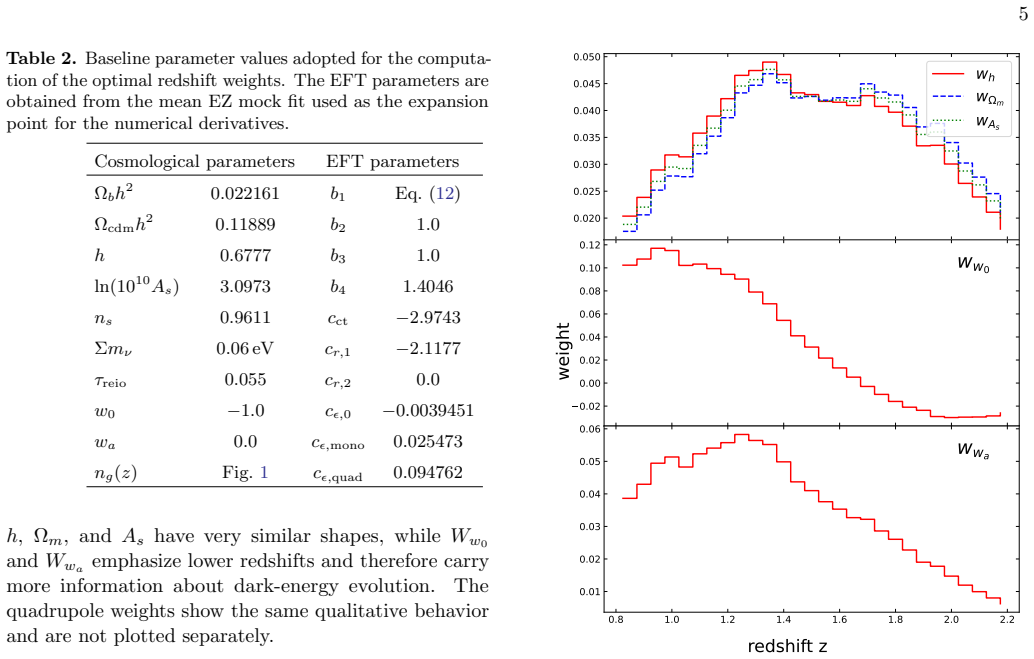
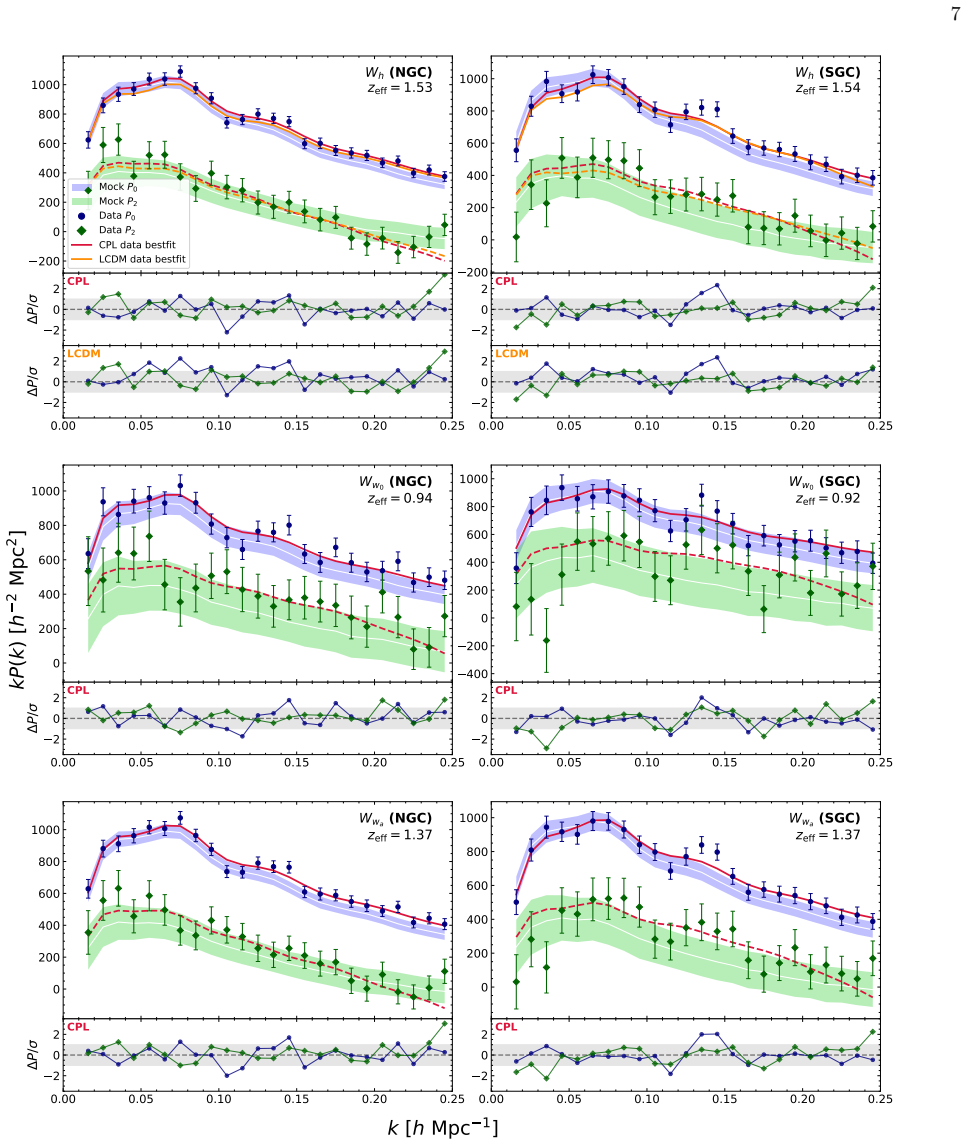
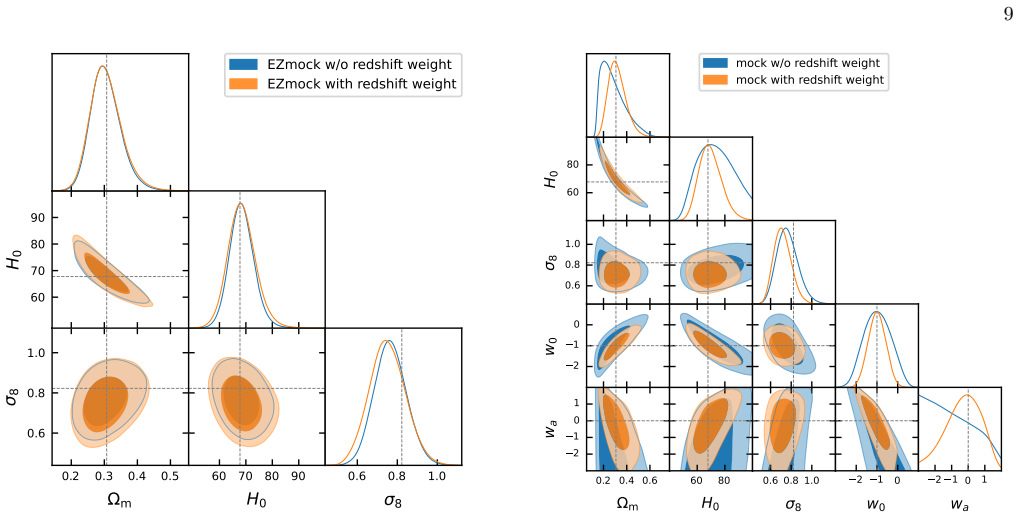
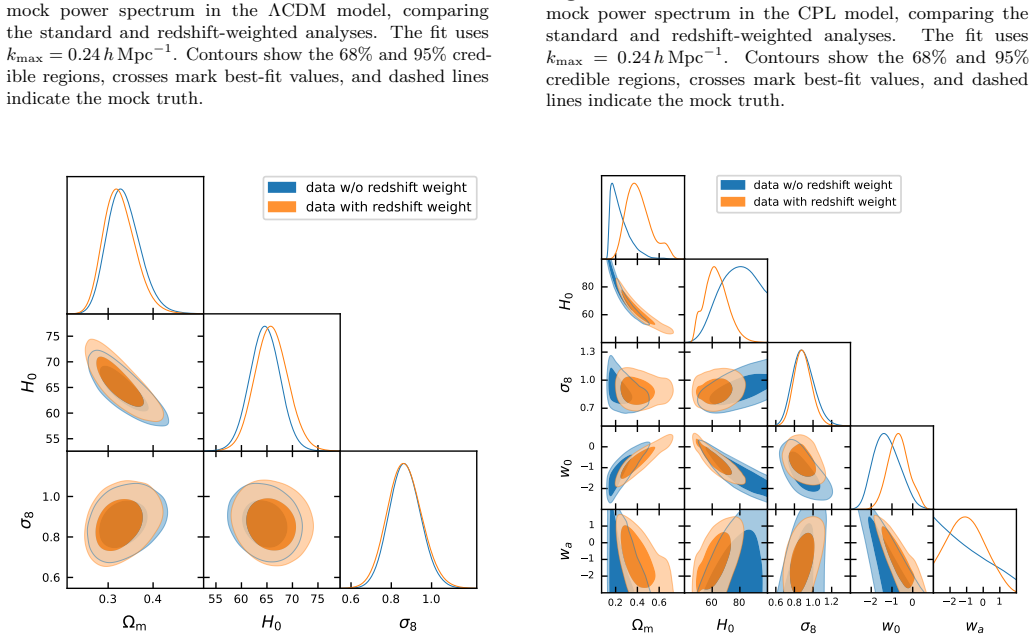
By targeting the parameters of interest with Karhunen-Loève weights, measuring the weighted spectra via a cross-correlation estimator, and convolving theory with the survey-window kernels, the redshift-weighted DR16 analysis reduces the marginalized uncertainties on H0, sigma8, and w0 by 43.3 percent, 19.7 percent, and 20.5 percent respectively in the CPL model and yields wa = -0.98 +1.0 -1.3, while both covariance and end-to-end validation rest on 1000 EZ light-cone mocks.
What carries the argument
Karhunen-Loève weights for the parameters of interest, applied to monopole and quadrupole via a cross-correlation estimator and convolved with measured Fourier-space survey-window kernels.
If this is right
- In Lambda CDM the weighted and standard analyses remain consistent because the weights target near-standard effective redshifts.
- The reported gains appear only in models that contain genuine redshift evolution of the dark energy equation of state.
- The full-shape data vector stays compact while still recovering tomographic information from the broad light cone.
- Both the covariance matrix and the validation of the pipeline rest on the same set of 1000 EZ light-cone mocks.
Where Pith is reading between the lines
- The same weighting construction could be applied to other wide-redshift surveys to test whether similar error reductions appear without splitting catalogs into bins.
- If the improvement is robust, future analyses might prefer parameter-targeted weights over conventional multi-bin tomography for computational simplicity.
- The bounded wa posterior opens a direct route to distinguish evolving dark energy from a cosmological constant using existing data vectors.
Load-bearing premise
The 1000 EZ light-cone mock catalogs accurately represent the covariance matrix and survey effects for the weighted measurements.
What would settle it
An independent tomographic analysis that splits the same quasar sample into multiple redshift bins and compares the resulting posterior widths and wa constraint directly to the weighted results would test whether the reported gains are recovered.
Figures


read the original abstract
We present a full-shape power-spectrum analysis of the eBOSS DR16 quasar sample with optimal redshift weights. The DR16 QSO catalog contains 343,708 quasars over $0.8<z<2.2$, a redshift interval broad enough to contain useful light-cone evolution but not naturally captured by a single effective-redshift measurement. We construct Karhunen--Lo\`eve weights for the parameters of interest and measure the resulting monopole and quadrupole with a cross-correlation estimator, which remains well defined for sign-changing weights. The theoretical spectra are convolved with the measured Fourier-space survey-window kernels for each Galactic cap and weighting scheme, and both the covariance matrix and the end-to-end validation are based on 1000 EZ light-cone mock catalogs. In $\Lambda$CDM, the redshift-weighted and standard analyses give consistent constraints, as expected from the near-standard effective redshifts of the weights targeting $h$, $\Omega_{\rm m}$, and $A_s$. In the Chevallier--Polarski--Linder (CPL) model, the redshift-weighted DR16 analysis reduces the marginalized uncertainties on $H_0$, $\sigma_8$, and $w_0$ by $43.3\%$, $19.7\%$, and $20.5\%$, respectively, and turns the standard one-sided constraint on $w_a$ into a bounded posterior, $w_a=-0.98^{+1.0}_{-1.3}$. The gain is therefore concentrated where the model contains genuine redshift evolution, demonstrating that optimal redshift weighting can recover tomographic information from a wide QSO light cone while keeping the full-shape data vector compact.
Editorial analysis
A structured set of objections, weighed in public.
Referee Report
Summary. The paper presents a full-shape power spectrum analysis of the eBOSS DR16 quasar sample (343708 objects, 0.8<z<2.2) using Karhunen-Loève optimal redshift weights targeting parameters of interest. Monopole and quadrupole are measured via a cross-correlation estimator (valid for sign-changing weights), theory spectra are convolved with measured Fourier-space window kernels per Galactic cap, and both the covariance matrix and end-to-end validation rely on 1000 EZ light-cone mocks. In ΛCDM the weighted and standard analyses are consistent; in the CPL model the weighted analysis reduces marginalized uncertainties on H0, σ8 and w0 by 43.3%, 19.7% and 20.5% respectively and converts the standard one-sided wa constraint into a bounded posterior wa=-0.98^{+1.0}_{-1.3}.
Significance. If the central results hold, the work demonstrates that optimal redshift weighting can recover useful tomographic information from a single wide-redshift QSO light-cone while keeping the data vector compact, with the largest gains appearing precisely where the model includes genuine redshift evolution. A clear strength is the consistent use of the same 1000 EZ mocks for both covariance estimation and end-to-end validation, together with the explicit handling of per-cap window kernels and sign-changing weights via the cross-correlation estimator.
major comments (1)
- [Abstract] Abstract: The headline quantitative gains (43.3% reduction on H0, 19.7% on σ8, 20.5% on w0; transition from one-sided to bounded wa posterior) are obtained from posteriors whose covariance matrix is estimated from the identical set of 1000 EZ light-cone mocks used for validation. Because the analysis employs sign-changing KL weights and a cross-correlation estimator, any under-representation in the mocks of light-cone evolution, mask-induced mode coupling or the variance of the weighted estimator directly affects both the reported error reductions and the shape of the wa posterior. No additional robustness tests (e.g., comparison with jackknife covariances or mocks with varied realism) are described in the abstract to support this assumption.
Simulated Author's Rebuttal
We thank the referee for their positive assessment of the work and for the constructive comment on the abstract. We address the point below.
read point-by-point responses
-
Referee: [Abstract] Abstract: The headline quantitative gains (43.3% reduction on H0, 19.7% on σ8, 20.5% on w0; transition from one-sided to bounded wa posterior) are obtained from posteriors whose covariance matrix is estimated from the identical set of 1000 EZ light-cone mocks used for validation. Because the analysis employs sign-changing KL weights and a cross-correlation estimator, any under-representation in the mocks of light-cone evolution, mask-induced mode coupling or the variance of the weighted estimator directly affects both the reported error reductions and the shape of the wa posterior. No additional robustness tests (e.g., comparison with jackknife covariances or mocks with varied realism) are described in the abstract to support this assumption.
Authors: We agree that the abstract does not mention additional robustness tests such as jackknife covariances or mocks with varied realism. The manuscript uses the same 1000 EZ light-cone mocks for covariance estimation and end-to-end validation because these mocks are constructed to incorporate light-cone evolution, mask effects, and the survey geometry relevant to the weighted estimator; consistency between weighted and standard analyses in ΛCDM provides an internal cross-check. We did not perform the suggested alternative covariance tests in this study. To address the concern, we will revise the abstract to note that the reported constraints are obtained from posteriors validated with the EZ mock suite (with full details in the main text). revision: yes
Circularity Check
No significant circularity; results from independent data analysis and mock validation
full rationale
The paper's central results (reduced uncertainties on H0, σ8, w0 and bounded wa posterior in CPL) are obtained from full-shape power spectrum measurements on the eBOSS DR16 QSO data using KL-optimal redshift weights, with theoretical predictions convolved by measured window kernels and covariance estimated from 1000 EZ light-cone mocks. No step reduces by the paper's equations to a fitted parameter renamed as prediction, a self-definitional loop, or a load-bearing self-citation chain; the mock-based covariance and validation are standard external inputs, and the comparison between weighted and standard analyses is performed on the same data vector without internal redefinition. The derivation chain remains self-contained against the external mock catalogs and observed data.
Axiom & Free-Parameter Ledger
axioms (2)
- domain assumption The Karhunen-Loève weights are optimal for the parameters of interest
- domain assumption The EZ light-cone mock catalogs accurately model the survey and covariance
Reference graph
Works this paper leans on
-
[1]
The Astropy Project: Sustaining and Growing a Community-oriented Open-source Project and the Latest Major Release (v5.0) of the Core Package. , keywords =. doi:10.3847/1538-4357/ac7c74 , archivePrefix =. 2206.14220 , primaryClass =
work page internal anchor Pith review Pith/arXiv arXiv doi:10.3847/1538-4357/ac7c74
-
[2]
The Astropy Project: Building an inclusive, open-science project and status of the v2.0 core package
The Astropy Project: Building an Open-science Project and Status of the v2.0 Core Package. , keywords =. doi:10.3847/1538-3881/aabc4f , archivePrefix =. 1801.02634 , primaryClass =
work page internal anchor Pith review Pith/arXiv arXiv doi:10.3847/1538-3881/aabc4f
-
[3]
Astropy: A Community Python Package for Astronomy
Astropy: A community Python package for astronomy. , keywords =. 2013. doi:10.1051/0004-6361/201322068 , archivePrefix =. 1307.6212 , primaryClass =
work page internal anchor Pith review Pith/arXiv arXiv doi:10.1051/0004-6361/201322068 2013
-
[4]
1996, A&AS, 117, 393, doi: 10.1051/aas:1996164
SExtractor: Software for source extraction. , keywords =. 1996. doi:10.1051/aas:1996164 , adsurl =
-
[5]
Quantifying the Observational Effort Required for the Radial Velocity Characterization of TESS Planets. , keywords =. 2018. doi:10.3847/1538-3881/aacea9 , archivePrefix =. 1807.01263 , primaryClass =
work page internal anchor Pith review Pith/arXiv arXiv doi:10.3847/1538-3881/aacea9 2018
-
[6]
X-Ray Scattering Echoes and Ghost Halos from the Intergalactic Medium: Relation to the Nature of AGN Variability. , keywords =. 2015. doi:10.1088/0004-637X/805/1/23 , archivePrefix =. 1503.01475 , primaryClass =
work page internal anchor Pith review Pith/arXiv arXiv doi:10.1088/0004-637x/805/1/23 2015
-
[7]
, keywords =
The 2013 Release of Cloudy. , keywords =. 2013
2013
-
[8]
1989", month =
T _ E X and LAT _ E X Macro Definition Files for Astronomical Publications. , year = "1989", month = "Mar", pages =
1989
-
[9]
LaTeX: A Document Preparation System. 1994
1994
-
[10]
Quasi-periodic Fast Propagating Magnetoacoustic Waves during the Magnetic Reconnection Between Solar Coronal Loops. , keywords =. 2018. doi:10.3847/2041-8213/aaf167 , archivePrefix =. 1811.08553 , primaryClass =
work page internal anchor Pith review Pith/arXiv arXiv doi:10.3847/2041-8213/aaf167 2018
-
[11]
Nominal values for selected solar and planetary quantities: IAU 2015 Resolution B3
Nominal Values for Selected Solar and Planetary Quantities: IAU 2015 Resolution B3. , keywords =. 2016. doi:10.3847/0004-6256/152/2/41 , archivePrefix =. 1605.09788 , primaryClass =
work page internal anchor Pith review Pith/arXiv arXiv doi:10.3847/0004-6256/152/2/41 2015
-
[12]
Swift X-Ray Observations of Classical Novae. II. The Super Soft Source Sample. , keywords =. 2011. doi:10.1088/0067-0049/197/2/31 , archivePrefix =. 1110.6224 , primaryClass =
work page internal anchor Pith review Pith/arXiv arXiv doi:10.1088/0067-0049/197/2/31 2011
-
[13]
Galaxy emission line classification using 3D line ratio diagrams
Galaxy Emission Line Classification Using Three-dimensional Line Ratio Diagrams. , keywords =. 2014. doi:10.1088/0004-637X/793/2/127 , archivePrefix =. 1406.5186 , primaryClass =
work page internal anchor Pith review Pith/arXiv arXiv doi:10.1088/0004-637x/793/2/127 2014
-
[14]
, year =
Sloan Digital Sky Survey IV: Mapping the Milky Way, Nearby Galaxies, and the Distant Universe. , year =
-
[15]
, year =
The SDSS-IV Extended Baryon Oscillation Spectroscopic Survey: Overview and Early Data. , year =
-
[16]
, year =
The 2.5 m Telescope of the Sloan Digital Sky Survey. , year =
-
[17]
, year =
The SDSS-IV Extended Baryon Oscillation Spectroscopic Survey: Quasar Target Selection. , year =
-
[18]
, year =
The Wide-field Infrared Survey Explorer (WISE): Mission Description and Initial On-orbit Performance. , year =
-
[19]
, year =
The Multi-object, Fiber-fed Spectrographs for the Sloan Digital Sky Survey and the Baryon Oscillation Spectroscopic Survey. , year =
-
[20]
, year =
The Completed SDSS-IV extended Baryon Oscillation Spectroscopic Survey: Large-scale structure catalogues for cosmological analysis. , year =
-
[21]
, year =
Power-Spectrum Analysis of Three-Dimensional Redshift Surveys. , year =
-
[22]
, year =
EZmocks: extending the Zel'dovich approximation to generate mock galaxy catalogues with accurate clustering statistics. , year =
-
[23]
, year =
The Completed SDSS-IV extended Baryon Oscillation Spectroscopic Survey: one thousand multi-tracer mock catalogues with redshift evolution and systematics for galaxies and quasars of the final data release. , year =
-
[24]
, year =
Detection of the Baryon Acoustic Peak in the Large-Scale Correlation Function of SDSS Luminous Red Galaxies. , year =
-
[25]
, year =
Clustering in real space and in redshift space. , year =
-
[26]
, year =
Karhunen-Loeve eigenvalue problems in cosmology: How should we tackle large data sets?. , year =
-
[27]
, year =
Optimal redshift weighting for redshift-space distortions. , year =
-
[28]
, year =
The extended Baryon Oscillation Spectroscopic Survey: testing a new approach to measure the evolution of the structure growth. , year =
-
[29]
, year =
The clustering of the SDSS-IV extended Baryon Oscillation Spectroscopic Survey DR14 quasar sample: anisotropic Baryon Acoustic Oscillations measurements in Fourier-space with optimal redshift weights. , year =
-
[30]
, year =
The completed SDSS-IV extended Baryon Oscillation Spectroscopic Survey: BAO and RSD measurements from the anisotropic power spectrum of the quasar sample between redshift 0.8 and 2.2. , year =
-
[31]
International Journal of Modern Physics D , year =
Accelerating Universes with Scaling Dark Matter. International Journal of Modern Physics D , year =
-
[32]
Exploring the Expansion History of the Universe. Phys. Rev. Lett. , year =
-
[33]
Biased Tracers in Redshift Space in the EFT of Large-Scale Structure
Perko, Ashley and Senatore, Leonardo and Jennings, Elise and Wechsler, Risa H. Biased Tracers in Redshift Space in the EFT of Large-Scale Structure. 2016. arXiv:1610.09321
work page internal anchor Pith review Pith/arXiv arXiv 2016
-
[34]
Cosmological Non-Linearities as an Effective Fluid
Baumann, Daniel and Nicolis, Alberto and Senatore, Leonardo and Zaldarriaga, Matias. Cosmological Non-Linearities as an Effective Fluid. JCAP. 2012. doi:10.1088/1475-7516/2012/07/051. arXiv:1004.2488
work page internal anchor Pith review Pith/arXiv arXiv doi:10.1088/1475-7516/2012/07/051 2012
-
[35]
The Effective Field Theory of Cosmological Large Scale Structures
Carrasco, John Joseph M. and Hertzberg, Mark P. and Senatore, Leonardo. The Effective Field Theory of Cosmological Large Scale Structures. JHEP. 2012. doi:10.1007/JHEP09(2012)082. arXiv:1206.2926
work page internal anchor Pith review Pith/arXiv arXiv doi:10.1007/jhep09(2012)082 2012
-
[36]
The 2-loop matter power spectrum and the IR-safe integrand
Carrasco, John Joseph M. and Foreman, Simon and Green, Daniel and Senatore, Leonardo. The 2-loop matter power spectrum and the IR-safe integrand. JCAP. 2014. doi:10.1088/1475-7516/2014/07/056. arXiv:1304.4946
work page internal anchor Pith review Pith/arXiv arXiv doi:10.1088/1475-7516/2014/07/056 2014
-
[37]
The Effective Field Theory of Large Scale Structures at Two Loops
Carrasco, John Joseph M. and Foreman, Simon and Green, Daniel and Senatore, Leonardo. The Effective Field Theory of Large Scale Structures at Two Loops. JCAP. 2014. doi:10.1088/1475-7516/2014/07/057. arXiv:1310.0464
work page internal anchor Pith review Pith/arXiv arXiv doi:10.1088/1475-7516/2014/07/057 2014
-
[38]
The IR-resummed Effective Field Theory of Large Scale Structures
Senatore, Leonardo and Zaldarriaga, Matias. The IR-resummed Effective Field Theory of Large Scale Structures. JCAP. 2015. doi:10.1088/1475-7516/2015/02/013. arXiv:1404.5954
work page internal anchor Pith review Pith/arXiv arXiv doi:10.1088/1475-7516/2015/02/013 2015
-
[39]
Bias in the Effective Field Theory of Large Scale Structures
Senatore, Leonardo. Bias in the Effective Field Theory of Large Scale Structures. JCAP. 2015. doi:10.1088/1475-7516/2015/11/007. arXiv:1406.7843
work page internal anchor Pith review Pith/arXiv arXiv doi:10.1088/1475-7516/2015/11/007 2015
-
[40]
Redshift Space Distortions in the Effective Field Theory of Large Scale Structures
Senatore, Leonardo and Zaldarriaga, Matias. Redshift Space Distortions in the Effective Field Theory of Large Scale Structures. 2014. arXiv:1409.1225
work page internal anchor Pith review Pith/arXiv arXiv 2014
-
[41]
JCAP , archivePrefix = "arXiv", eprint =
Precision Comparison of the Power Spectrum in the EFTofLSS with Simulations. JCAP , archivePrefix = "arXiv", eprint =. doi:10.1088/1475-7516/2016/05/027 , adsurl =
-
[42]
On the EFT of Large Scale Structures in Redshift Space
Lewandowski, Matthew and Senatore, Leonardo and Prada, Francisco and Zhao, Cheng and Chuang, Chia-Hsun. On the EFT of Large Scale Structures in Redshift Space. 2015. arXiv:1512.06831
work page internal anchor Pith review Pith/arXiv arXiv 2015
-
[43]
On the Statistics of Biased Tracers in the Effective Field Theory of Large Scale Structures
Angulo, Raul and Fasiello, Matteo and Senatore, Leonardo and Vlah, Zvonimir. On the Statistics of Biased Tracers in the Effective Field Theory of Large Scale Structures. JCAP. 2015. doi:10.1088/1475-7516/2015/09/029, 10.1088/1475-7516/2015/9/029. arXiv:1503.08826
work page internal anchor Pith review Pith/arXiv arXiv doi:10.1088/1475-7516/2015/09/029 2015
-
[44]
Very Massive Tracers and Higher Derivative Biases
Fujita, Tomohiro and Mauerhofer, Valentin and Senatore, Leonardo and Vlah, Zvonimir and Angulo, Raul. Very Massive Tracers and Higher Derivative Biases. JCAP. 2020. doi:10.1088/1475-7516/2020/01/009. arXiv:1609.00717
-
[45]
Large-Scale Structure of the Universe and Cosmological Perturbation Theory
Bernardeau, F. and Colombi, S. and Gaztanaga, E. and Scoccimarro, R. Large scale structure of the universe and cosmological perturbation theory. Phys. Rept. 2002. doi:10.1016/S0370-1573(02)00135-7. arXiv:astro-ph/0112551
work page internal anchor Pith review Pith/arXiv arXiv doi:10.1016/s0370-1573(02)00135-7 2002
-
[46]
Cosmological Perturbation Theory Using the FFTLog: Formalism and Connection to QFT Loop Integrals
Simonovi \'c , Marko and Baldauf, Tobias and Zaldarriaga, Matias and Carrasco, John Joseph and Kollmeier, Juna A. Cosmological perturbation theory using the FFTLog: formalism and connection to QFT loop integrals. JCAP. 2018. doi:10.1088/1475-7516/2018/04/030. arXiv:1708.08130
work page internal anchor Pith review Pith/arXiv arXiv doi:10.1088/1475-7516/2018/04/030 2018
-
[47]
Limits on w CDM from the EFTofLSS with the PyBird code
D'Amico, Guido and Senatore, Leonardo and Zhang, Pierre. Limits on w CDM from the EFTofLSS with the PyBird code. JCAP. 2021. doi:10.1088/1475-7516/2021/01/006. arXiv:2003.07956
-
[48]
Zhao, Ruiyang and others. A multitracer analysis for the eBOSS galaxy sample based on the effective field theory of large-scale structure. 2024. doi:10.1093/mnras/stae1452. arXiv:2308.06206
work page internal anchor Pith review Pith/arXiv arXiv doi:10.1093/mnras/stae1452 2024
-
[49]
The Cosmic Linear Anisotropy Solving System (CLASS) II: Approximation schemes
Blas, Diego and Lesgourgues, Julien and Tram, Thomas. The Cosmic Linear Anisotropy Solving System (CLASS) II: Approximation schemes. JCAP. 2011. doi:10.1088/1475-7516/2011/07/034. arXiv:1104.2933
work page internal anchor Pith review Pith/arXiv arXiv doi:10.1088/1475-7516/2011/07/034 2011
-
[50]
D'Amico, Guido and Gleyzes, J \'e r \^o me and Kokron, Nickolas and Markovic, Katarina and Senatore, Leonardo and Zhang, Pierre and Beutler, Florian and Gil-Mar \' n, H \'e ctor. The Cosmological Analysis of the SDSS/BOSS data from the Effective Field Theory of Large-Scale Structure. JCAP. 2020. doi:10.1088/1475-7516/2020/05/005. arXiv:1909.05271
-
[51]
Alcock, C. and Paczynski, B. An evolution free test for non-zero cosmological constant. Nature. 1979. doi:10.1038/281358a0
-
[52]
Interpreting measurements of the anisotropic galaxy power spectrum
Beutler, Florian and Castorina, Emanuele and Zhang, Pierre. Interpreting measurements of the anisotropic galaxy power spectrum. JCAP. 2019. doi:10.1088/1475-7516/2019/03/040. arXiv:1810.05051
-
[53]
Simon, Th \'e o and Zhang, Pierre and Poulin, Vivian and Smith, Tristan L. Updated constraints from the effective field theory analysis of the BOSS power spectrum on early dark energy. Phys. Rev. D. 2023. doi:10.1103/PhysRevD.107.063505. arXiv:2208.05930
-
[54]
Maus, M. and others. A comparison of effective field theory models of redshift space galaxy power spectra for DESI 2024 and future surveys. JCAP. 2025. doi:10.1088/1475-7516/2025/01/134. arXiv:2404.07272
-
[55]
Baryon Acoustic Oscillations in 2D: Modeling Redshift-space Power Spectrum from Perturbation Theory
Taruya, Atsushi and Nishimichi, Takahiro and Saito, Shun. Baryon Acoustic Oscillations in 2D: Modeling Redshift-space Power Spectrum from Perturbation Theory. Phys. Rev. D. 2010. doi:10.1103/PhysRevD.82.063522. arXiv:1006.0699
work page internal anchor Pith review Pith/arXiv arXiv doi:10.1103/physrevd.82.063522 2010
-
[56]
Zhao, Gong-Bo and others. The clustering of the SDSS-IV extended Baryon Oscillation Spectroscopic Survey DR14 quasar sample: a tomographic measurement of cosmic structure growth and expansion rate based on optimal redshift weights. 2019. doi:10.1093/mnras/sty2845. arXiv:1801.03043
work page internal anchor Pith review Pith/arXiv arXiv doi:10.1093/mnras/sty2845 2019
-
[57]
Clustering of quasars in SDSS-IV eBOSS : study of potential systematics and bias determination
Laurent, Pierre and others. Clustering of quasars in SDSS-IV eBOSS : study of potential systematics and bias determination. JCAP. 2017. doi:10.1088/1475-7516/2017/07/017. arXiv:1705.04718
work page internal anchor Pith review Pith/arXiv arXiv doi:10.1088/1475-7516/2017/07/017 2017
-
[58]
Optimal Redshift Weighting For Baryon Acoustic Oscillations
Zhu, Fangzhou and Padmanabhan, Nikhil and White, Martin. Optimal Redshift Weighting For Baryon Acoustic Oscillations. 2015. doi:10.1093/mnras/stv964. arXiv:1411.1424
work page internal anchor Pith review Pith/arXiv arXiv doi:10.1093/mnras/stv964 2015
-
[59]
Optimal Redshift Weighting For Redshift Space Distortions
Ruggeri, Rossana and Percival, Will and Gil-Mar \' n, H \'e ctor and Zhu, Fangzhou and Zhao, Gong-bo and Wang, Yuting. Optimal redshift weighting for redshift-space distortions. 2017. doi:10.1093/mnras/stw2422. arXiv:1602.05195
work page internal anchor Pith review Pith/arXiv arXiv doi:10.1093/mnras/stw2422 2017
-
[60]
Redshift Weights for Baryon Acoustic Oscillations : Application to Mock Galaxy Catalogs
Zhu, Fangzhou and Padmanabhan, Nikhil and White, Martin and Ross, Ashley J. and Zhao, Gongbo. Redshift weights for baryon acoustic oscillations: application to mock galaxy catalogues. 2016. doi:10.1093/mnras/stw1515. arXiv:1604.01050
work page internal anchor Pith review Pith/arXiv arXiv doi:10.1093/mnras/stw1515 2016
-
[61]
Ballinger, W. E. and Peacock, J. A. and Heavens, A. F. Measuring the cosmological constant with redshift surveys. 1996. doi:10.1093/mnras/282.3.877. arXiv:astro-ph/9605017
work page internal anchor Pith review Pith/arXiv arXiv doi:10.1093/mnras/282.3.877 1996
-
[62]
Alam, Shadab and others. Completed SDSS-IV extended Baryon Oscillation Spectroscopic Survey: Cosmological implications from two decades of spectroscopic surveys at the Apache Point Observatory. Phys. Rev. D. 2021. doi:10.1103/PhysRevD.103.083533. arXiv:2007.08991
work page internal anchor Pith review Pith/arXiv arXiv doi:10.1103/physrevd.103.083533 2021
-
[63]
Cosmological inference from the EFTofLSS: the eBOSS QSO full-shape analysis
Simon, Th \'e o and Zhang, Pierre and Poulin, Vivian. Cosmological inference from the EFTofLSS: the eBOSS QSO full-shape analysis. JCAP. 2023. doi:10.1088/1475-7516/2023/07/041. arXiv:2210.14931
-
[64]
Samushia, Lado and others. The clustering of galaxies in the SDSS-III Baryon Oscillation Spectroscopic Survey: measuring growth rate and geometry with anisotropic clustering. 2014. doi:10.1093/mnras/stu197. arXiv:1312.4899
work page internal anchor Pith review Pith/arXiv arXiv doi:10.1093/mnras/stu197 2014
-
[65]
Measuring line-of-sight dependent Fourier-space clustering using FFTs
Bianchi, Davide and Gil-Mar \' n, H \'e ctor and Ruggeri, Rossana and Percival, Will J. Measuring line-of-sight dependent Fourier-space clustering using FFTs. 2015. doi:10.1093/mnrasl/slv090. arXiv:1505.05341
work page internal anchor Pith review Pith/arXiv arXiv doi:10.1093/mnrasl/slv090 2015
-
[66]
An optimal FFT-based anisotropic power spectrum estimator
Hand, Nick and Li, Yin and Slepian, Zachary and Seljak, Uros. An optimal FFT-based anisotropic power spectrum estimator. JCAP. 2017. doi:10.1088/1475-7516/2017/07/002. arXiv:1704.02357
work page internal anchor Pith review Pith/arXiv arXiv doi:10.1088/1475-7516/2017/07/002 2017
-
[67]
Reeves, Alexander and Zhang, Pierre and Zheng, Henry. PyBird-JAX: Accelerated inference in large-scale structure with model-independent emulation of one-loop galaxy power spectra. 2025. arXiv:2507.20990
-
[68]
On the effect of the degeneracy between w_0 and w_a
Gong, Yungui and Gao, Qing. On the effect of the degeneracy among dark energy parameters. Eur. Phys. J. C. 2014. doi:10.1140/epjc/s10052-014-2729-2. arXiv:1301.1224
work page internal anchor Pith review Pith/arXiv arXiv doi:10.1140/epjc/s10052-014-2729-2 2014
-
[69]
Lee, Seokcheon. Assessing the robustness of the CPL parametrization to basis and prior variations: insights from DESI DR2 BAO data. Eur. Phys. J. C. 2026. doi:10.1140/epjc/s10052-026-15431-7. arXiv:2506.18230
-
[70]
Geometrical compression: a new method to enhance the BOSS galaxy bispectrum monopole constraints
Gualdi, Davide and Gil-Mar \' n, H \'e ctor and Manera, Marc and Joachimi, Benjamin and Lahav, Ofer. Geometrical compression: a new method to enhance the BOSS galaxy bispectrum monopole constraints. 2019. doi:10.1093/mnrasl/sly242. arXiv:1901.00987
work page internal anchor Pith review Pith/arXiv arXiv doi:10.1093/mnrasl/sly242 2019
-
[71]
Enhancing BOSS bispectrum cosmological constraints with maximal compression
Gualdi, Davide and Gil-Mar \' n, H \'e ctor and Schuhmann, Robert L. and Manera, Marc and Joachimi, Benjamin and Lahav, Ofer. Enhancing BOSS bispectrum cosmological constraints with maximal compression. 2019. doi:10.1093/mnras/stz051. arXiv:1806.02853
work page internal anchor Pith review Pith/arXiv arXiv doi:10.1093/mnras/stz051 2019
-
[72]
Generalized massive optimal data compression
Alsing, Justin and Wandelt, Benjamin. Generalized massive optimal data compression. 2018. doi:10.1093/mnrasl/sly029. arXiv:1712.00012
work page internal anchor Pith review Pith/arXiv arXiv doi:10.1093/mnrasl/sly029 2018
-
[73]
Unbiased estimation of the inverse covariance matrix
Why your model parameter confidences might be too optimistic. Unbiased estimation of the inverse covariance matrix. , year = 2007, month = mar, volume =
2007
-
[74]
, year = 2021, month = nov, volume =
Unified galaxy power spectrum measurements from 6dFGS, BOSS, and eBOSS. , year = 2021, month = nov, volume =
2021
-
[75]
Zhao, Cheng and others. The completed SDSS-IV extended Baryon Oscillation Spectroscopic Survey: 1000 multi-tracer mock catalogues with redshift evolution and systematics for galaxies and quasars of the final data release. Mon. Not. Roy. Astron. Soc. 2021. doi:10.1093/mnras/stab510. arXiv:2007.08997
-
[76]
Wang, Yuting and Zhao, Gong-Bo and Chuang, Chia-Hsun and Pellejero-Ibanez, Marcos and Zhao, Cheng and Kitaura, Francisco-Shu and Rodriguez-Torres, Sergio. The clustering of galaxies in the completed SDSS-III Baryon Oscillation Spectroscopic Survey: a tomographic analysis of structure growth and expansion rate from anisotropic galaxy clustering. Mon. Not. ...
work page internal anchor Pith review Pith/arXiv arXiv doi:10.1093/mnras/sty2449 2018
-
[77]
Zhao, Gong-Bo and others. The clustering of galaxies in the completed SDSS-III Baryon Oscillation Spectroscopic Survey: tomographic BAO analysis of DR12 combined sample in Fourier space. Mon. Not. Roy. Astron. Soc. 2017. doi:10.1093/mnras/stw3199. arXiv:1607.03153
work page internal anchor Pith review Pith/arXiv arXiv doi:10.1093/mnras/stw3199 2017
-
[78]
Wang, Yuting and others. The clustering of galaxies in the completed SDSS-III Baryon Oscillation Spectroscopic Survey: tomographic BAO analysis of DR12 combined sample in configuration space. Mon. Not. Roy. Astron. Soc. 2017. doi:10.1093/mnras/stx1090. arXiv:1607.03154
work page internal anchor Pith review Pith/arXiv arXiv doi:10.1093/mnras/stx1090 2017
-
[79]
Wilson, M. J. and Peacock, J. A. and Taylor, A. N. and de la Torre, S. Rapid modelling of the redshift-space power spectrum multipoles for a masked density field. Mon. Not. Roy. Astron. Soc. 2017. doi:10.1093/mnras/stw2576. arXiv:1511.07799
work page internal anchor Pith review Pith/arXiv arXiv doi:10.1093/mnras/stw2576 2017
-
[80]
M., Ward-Thompson, D., & Andr \'e , P.\ 2005, , 360, 4, 1506
The 2dF Galaxy Redshift Survey: Power-spectrum analysis of the final dataset and cosmological implications. , year =. doi:10.1111/j.1365-2966.2005.09318.x , eprint =
discussion (0)
Sign in with ORCID, Apple, or X to comment. Anyone can read and Pith papers without signing in.