REVIEW 5 major objections 4 minor 33 references
Port-Hamiltonian Approach to Neural Network Training
T0 review · 5 major / 4 minor · reviewed 2026-08-14 · deepseek-v4-flash
Pith's one-line read Training a neural network by treating its parameters as a port-Hamiltonian system yields a loss that falls continuously and, the paper argues, lands at a minimum.
desk verdict The paper's advertised convergence-to-a-minimum guarantee does not follow from its passivity argument; the dynamics are continuous-time momentum in port-Hamiltonian clothing, and the experiments are too thin to rescue it. read the letter →
The pith
A machine-rendered reading of the paper's core claim, the machinery that carries it, and where it could break.
The reading
What carries the argument
The central object is a port-Hamiltonian system, a dynamical system of the form $\dot{\xi}=(J(\xi)-R(\xi))\,\partial H(\xi)+g(\xi)v$ with skew-symmetric $J$, dissipative $R\succeq 0$, and Hamiltonian $H$; passivity gives $\dot{H}\le z^\top v$, and in the autonomous case $\dot{H}=-(\partial H)^\top R\,\partial H\le 0$. Here the Hamiltonian is the augmented loss $H=J^*$, and the specific structure $F=\begin{bmatrix}0&I\\-I&-B\end{bmatrix}$ produces mechanical-like second-order parameter dynamics with damping $B$. This carries the argument because monotone decay of $J^*$, together with Lyapunov stability of its strict minima, is what the authors invoke to conclude convergence to a minimum of the loss.
What would settle it
Construct a smooth lower-bounded loss with a strict saddle point, such as $J(x,y)=x^2-y^2+y^4$, initialize the port-Hamiltonian dynamics exactly at that saddle with zero velocity, and integrate. If the trajectory remains at the saddle instead of leaving it, the claim that the state will eventually land in a minimum fails without an extra assumption. A broader check is to run the dynamics on a loss with a continuum of critical points and observe whether the final point is always a local minimum.
Extended reading notes
Core claim
The central claim is that a neural network can be trained by making its parameters $\vartheta$ the position variables of a dissipative mechanical system. The paper sets $\xi=(\vartheta,\omega)$ with $\omega = M(\vartheta)\dot{\vartheta}$, defines the augmented Hamiltonian $J^*(\hat{u},\hat{y},\xi)=J(\hat{u},\hat{y},\vartheta)+\frac{1}{2}\omega^\top M^{-1}\omega$, and chooses the port-Hamiltonian structure $F=\begin{bmatrix}0&I\\-I&-B\end{bmatrix}$ with $B=B^\top>0$. The resulting dynamics $\dot{\xi}=F\,\partial J^*$ make $J^*$ strictly decrease until the state reaches a minimizer of $J^*$, i.e. a minimum of $J$ with zero velocity. The paper states this as an implicit guarantee: passivity excludes getting stuck at saddle points, so the state will eventually land in one minimum point. This convergence claim is the load-bearing result, with the experiments serving as demonstrations rather than proofs.
Load-bearing premise
The load-bearing premise is that an energy that never increases, together with stable minima, is enough to guarantee that training lands at a minimum rather than stalling at a saddle or another equilibrium.
Editorial extensions
If this is right
- Loss monotonicity is built in: along any training run the augmented loss never increases, so interrupting the integration at any time gives a network whose training loss is no worse than at the start.
- The dynamics are second-order and dissipative, so the scheme is a continuous-time analogue of momentum-based optimization, with the damping matrix $B$ playing the role of friction.
- In batch training, the gradient of the average loss is the average of the gradients, so the port-Hamiltonian optimizer integrates a single ordinary differential equation rather than iterating discrete updates.
- Damping injection $v=-k(t)\dot{\vartheta}$ provides a control port for reshaping basins of attraction, which the paper proposes as a path toward increasing the probability of reaching a global minimum.
- Computational complexity remains linear in the number of parameters, with one extra momentum variable per weight, so the method is comparable to gradient descent in cost.
Reading between the lines
- The paper's inference from passivity to landing in a minimum is stronger than monotone energy decrease alone supports: without extra strictness or isolatedness assumptions, trajectories can in principle end at saddle points or other invariant sets where damping vanishes.
- A concrete test would initialize the port-Hamiltonian dynamics exactly at a strict saddle of a lower-bounded loss and check whether the trajectory leaves; if it does not, the universal convergence claim needs qualifications.
- The framework suggests viewing continuous-time optimizers as energy-shaping problems, where the augmented loss, damping, and injection term are designed to steer basins of attraction.
- Because parameters evolve continuously, the training process defines a smooth path through weight space, which could make loss-landscape connectivity and model interpolation directly observable even though the paper does not explore that.
Signed reviews
Editorial analysis
A structured set of objections, weighed in public.
Referee Report
Summary. The paper proposes a port-Hamiltonian (PH) framework for neural network training in which the network parameters evolve continuously in time as the state of an autonomous PH system whose Hamiltonian is the training loss. The authors claim that the passivity property of PH systems guarantees asymptotic convergence of the parameters to a minimum of the loss, thereby providing an implicit convergence certificate and avoiding the saddle-point problem of discrete gradient methods. The framework is instantiated with mechanical-like second-order dynamics (Eq. 9) in which the loss is augmented with a kinetic term, and two training schemes are described: sequential data training and batch training. Numerical experiments are reported on a linear classification task and on a Duffing oscillator vector-field approximation task.
Significance. If the central convergence claim were valid, the paper would offer a genuinely attractive alternative to discrete optimizers: a continuous-time training dynamics with an automatic guarantee of reaching a loss minimum, together with a principled way to inject damping and shape energy. The authors provide a clear derivation of the passivity inequality and make their code publicly available, which are strengths. However, the advertised guarantee is not established: the passivity calculation only gives non-increase of the Hamiltonian, and the leap to asymptotic convergence to a minimum is a substantial unsupported step. Since the paper's main contribution rests on this guarantee, the significance of the work in its present form is largely conditional on a missing analysis.
major comments (5)
- [Section IV-A] The central claim that the state 'will eventually land in one minimum point' is not justified by the preceding argument. The passivity property only implies H-dot = -(∂H)^T R ∂H ≤ 0, which for the mechanical PH system (9) gives equality only when ω = 0. Applying LaSalle's invariance principle, the omega-limit set is contained in the largest invariant set inside {ω = 0}; invariance there requires ∂ϑ J* = 0, so the limit set is a subset of the critical points of J*, which include saddle points and maxima, not just minima. That each strict minimum is Lyapunov stable does not imply that every trajectory converges to one of those minima; a converse Lyapunov statement of this type is false without additional assumptions (e.g., a strict Lyapunov function on the whole domain, or a proof that non-minimum critical points have no basin of attraction). This gap is load-bearing because the abstract, Section IV-B, and Section VI all rest on the assertion that PH passivity ensures convergence to a minimum.
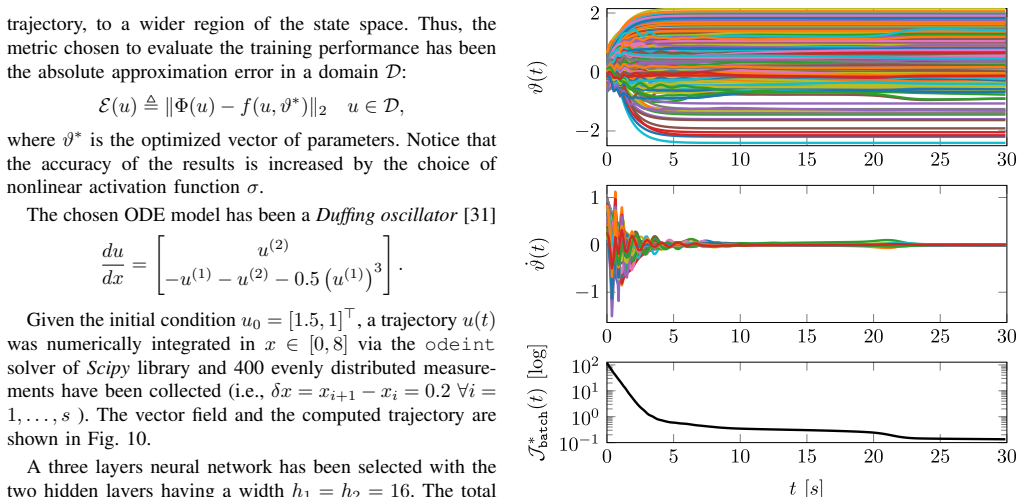
- [Section V-B] The numerical experiment in Section V-B reports that 'the state pas[s]es through a saddle point' of the batch loss. This observation directly undercuts the claim in Section VI that the framework 'circumvents the problem of getting stuck at saddle points.' While passing through a saddle is not the same as getting stuck at one, the paper provides no proof that a saddle cannot be an omega-limit point; indeed, the theoretical gap identified above allows exactly that possibility. The experimental passage through a saddle is therefore consistent with the weaker conclusion (convergence to critical points) and does not support the stronger convergence-to-minimum claim.
- [Example 4.2 and Section IV-B] There is an inconsistency between the general definition of the augmented loss and the special case in Example 4.2. In Section IV-B, J*(û, ŷ, ξ) is defined as J(û, ŷ, ϑ) + ω^T M^{-1}(ϑ)ω, with no factor of 1/2 on either term. In Example 4.2, with M = I and ω = ϑ̇, the definition becomes J* = 1/2[α||ŷ - f||² + βϑ^Tϑ + ϑ̇^Tϑ̇], i.e., both the potential and kinetic terms are halved. Consequently, Example 4.2 is not a special case of the stated general Hamiltonian, and the gradient and equations of motion derived from it do not correspond to the PH system (9) with H as defined in the general formula. This makes the example internally inconsistent with the framework it is meant to illustrate.
- [Assumption 4.1 and convergence conditions] Assumption 4.1 only requires the Hamiltonian to be lower-bounded and the solutions to be forward-complete. These conditions are not sufficient for the claimed convergence to a minimum. Non-increase of H along trajectories does not by itself guarantee that trajectories are bounded or that their omega-limit sets are nonempty and compact; additional coercivity or compactness of sublevel sets is needed. Even if the omega-limit set is compact, LaSalle's principle only locates it inside the critical set, not at minima. The paper therefore omits a necessary part of the convergence analysis, regardless of how the saddle-point issue is resolved.
- [Remark 4.7] Remark 4.7 concedes that sequential training converges to a minimum of the single-sample loss J*(û_ζ, ŷ_ζ, ξ) at the moment the procedure is stopped, which may not coincide with a minimum of the batch objective J*_batch. This is a serious limitation for the experimental validation: the classification experiment in Section V-A uses the sequential method, so its behavior is not governed by the convergence guarantee claimed for the batch objective. The paper would need to either provide a guarantee for the sequential/hybrid dynamics or clearly separate the theoretical claim (batch) from the experimental demonstration (sequential).
minor comments (4)
- [Section III-A] The sentence 'The set R (R+) is the the set of real (non negative real) numbers' contains a duplicated article 'the'.
- [Section V-A] The caption of Figure 7 labels the loss axis as 'J*(t) [log]'; the plot in the text appears to show J* on a logarithmic scale, but the axis label should specify the base or the transformation to avoid ambiguity.
- [Section VI] The conclusion states that the framework 'increases the probability of finding the global minimum of the objective function,' but no probability statement or mechanism is analyzed in the paper; this claim should be either supported or removed.
- [References] Reference [29] is listed as 'Submitted to 11th IFAC Symposium on Nonlinear Control Systems (NOLCOS 2019)'; if it has since appeared, the published version should be cited, and if it remains unpublished, the dependence of Remark 4.4 on it should be clarified.
Circularity Check
No circularity: the PH training claim is an application of external passivity theory, not a prediction that reduces to the definition of the loss; the main gap is a mathematical correctness issue, not a circular one.
full rationale
I find no circular step in the paper's derivation chain. The central construction is Eq. (9), where the Hamiltonian is set equal to the loss J*; passivity then gives H-dot <= 0, so monotone decrease of the loss is indeed a definitional consequence of choosing H = J*. However, the paper's advertised claim is stronger: asymptotic convergence to a minimum of J* and avoidance of saddle points (Section VI). That claim is not contained in the identity H = J*; it would require a LaSalle-type argument showing the omega-limit set contains only minima, which the paper does not supply. This is a missing or incorrect mathematical argument, not circularity: the conclusion is not equivalent to the input by construction, and no fitted parameter is renamed as a prediction. The only self-citation is [29] in Remark 4.4, a pointer to future work ('This open problem is left for future work'), so it is not load-bearing. The paper also honestly notes in Remark 4.7 that sequential training converges to minima of per-sample losses rather than the batch objective, and Section V-B reports an apparent saddle passage, both of which are limitations of the claimed guarantee but not circular reductions.
Assumptions & free parameters
free parameters (5)
- Damping matrix B =
I6, 100I6, or 0.5Ip depending on experiment
- Inertia matrix M =
Ip in all experiments
- Loss coefficients alpha and beta =
alpha=1, beta=0 or 0.001 depending on experiment
- Integration horizons tf and t* =
tf=5s single sample, t*=0.1s per epoch, tf=100s batch
- Softplus inverse temperature gamma =
gamma=10
assumptions (4)
- domain assumption Assumption 4.1: F, g, H smooth enough for forward-complete solutions and H lower bounded
- standard math Passivity-based convergence theorem from PH literature: strict minima are Lyapunov stable and damping injection asymptotically stabilizes equilibria
- domain assumption Smoothness of the loss and network, enforced by softplus activation
- domain assumption Existence of a target function Psi mapping inputs to labels
Cite this review
Pith. "Pith review of Port-Hamiltonian Approach to Neural Network Training." pith.science (2026). https://pith.science/paper/BQIL6YGH
@misc{pith2026190902702,
  author       = {Pith},
  title        = {Pith review of: Port-Hamiltonian Approach to Neural Network Training},
  year         = {2026},
  howpublished = {\url{https://pith.science/paper/BQIL6YGH}},
  note         = {Machine review of arXiv:1909.02702}
}
read the original abstract
Neural networks are discrete entities: subdivided into discrete layers and parametrized by weights which are iteratively optimized via difference equations. Recent work proposes networks with layer outputs which are no longer quantized but are solutions of an ordinary differential equation (ODE); however, these networks are still optimized via discrete methods (e.g. gradient descent). In this paper, we explore a different direction: namely, we propose a novel framework for learning in which the parameters themselves are solutions of ODEs. By viewing the optimization process as the evolution of a port-Hamiltonian system, we can ensure convergence to a minimum of the objective function. Numerical experiments have been performed to show the validity and effectiveness of the proposed methods.
Figures


Figures from the paper (6 more)




Reference graph
Works this paper leans on
-
[22]
Gradient and hamiltonian dynamics applied to learning in neural networks
James W Howse, Chaouki T Abdallah, and Gregory L Heileman. Gradient and hamiltonian dynamics applied to learning in neural networks. In Advances in Neural Information Processing Systems , pages 274–280, 1996
work page 1996
-
[23]
Learning and system modeling via hamiltonian neural networks
Wieslaw Sienko, Wieslaw Citko, and Dariusz Jak ´obczak. Learning and system modeling via hamiltonian neural networks. In International Conference on Artificial Intelligence and Soft Computing , pages 266–
-
[1]
Multilayer feedforward networks are universal approximators
Kurt Hornik, Maxwell Stinchcombe, and Halbert White. Multilayer feedforward networks are universal approximators. Neural networks, 2(5):359–366, 1989
1989
-
[2]
Learning internal representations by error propagation
David E Rumelhart, Geoffrey E Hinton, and Ronald J Williams. Learning internal representations by error propagation. Technical report, California Univ San Diego La Jolla Inst for Cognitive Science, 1985
1985
-
[3]
Mask r-cnn
Kaiming He, Georgia Gkioxari, Piotr Doll ´ar, and Ross Girshick. Mask r-cnn. In Proceedings of the IEEE international conference on computer vision , pages 2961–2969, 2017
2017
-
[4]
Large scale gan training for high fidelity natural image synthesis
Andrew Brock, Jeff Donahue, and Karen Simonyan. Large scale gan training for high fidelity natural image synthesis. arXiv preprint arXiv:1809.11096, 2018
arXiv 2018
-
[5]
Deep residual learning for image recognition
Kaiming He, Xiangyu Zhang, Shaoqing Ren, and Jian Sun. Deep residual learning for image recognition. In Proceedings of the IEEE conference on computer vision and pattern recognition , pages 770– 778, 2016
2016
-
[6]
Bert: Pre-training of deep bidirectional transformers for language understanding
Jacob Devlin, Ming-Wei Chang, Kenton Lee, and Kristina Toutanova. Bert: Pre-training of deep bidirectional transformers for language understanding. arXiv preprint arXiv:1810.04805 , 2018
arXiv 2018
Show all 33 references
-
[7]
Kingma and Jimmy Ba
Diederik P. Kingma and Jimmy Ba. Adam: A method for stochastic optimization. In 3rd International Conference on Learning Represen- tations, ICLR 2015 , 2015
2015
-
[8]
Lecture 6.5-rmsprop: Divide the gradient by a running average of its recent magnitude
Tijmen Tieleman and Geoffrey Hinton. Lecture 6.5-rmsprop: Divide the gradient by a running average of its recent magnitude. COURS- ERA: Neural networks for machine learning , 4(2):26–31, 2012
2012
-
[9]
On the variance of the adaptive learning rate and beyond
Liyuan Liu, Haoming Jiang, Pengcheng He, Weizhu Chen, Xiaodong Liu, Jianfeng Gao, and Jiawei Han. On the variance of the adaptive learning rate and beyond. arXiv preprint arXiv:1908.03265 , 2019
1908 arXiv
-
[10]
Visualizing the loss landscape of neural nets
Hao Li, Zheng Xu, Gavin Taylor, Christoph Studer, and Tom Gold- stein. Visualizing the loss landscape of neural nets. In Advances in Neural Information Processing Systems , pages 6391–6401, 2018
2018
-
[11]
Training a 3-node neural network is np-complete
Avrim Blum and Ronald L Rivest. Training a 3-node neural network is np-complete. In Advances in neural information processing systems, pages 494–501, 1989
1989
-
[12]
Port-controlled hamiltonian systems: modelling origins and systemtheoretic properties
Bernhard M Maschke and Arjan J van der Schaft. Port-controlled hamiltonian systems: modelling origins and systemtheoretic properties. IFAC Proceedings Volumes, 25(13):359–365, 1992
1992
-
[13]
Modeling and control of complex physical systems: the port-Hamiltonian approach
Vincent Duindam, Alessandro Macchelli, Stefano Stramigioli, and Herman Bruyninckx. Modeling and control of complex physical systems: the port-Hamiltonian approach. Springer Science & Business Media, 2009
2009
-
[14]
Port-hamiltonian systems theory: An introductory overview
Arjan van der Schaft, Dimitri Jeltsema, et al. Port-hamiltonian systems theory: An introductory overview. Foundations and Trends® in Systems and Control , 1(2-3):173–378, 2014
2014
-
[15]
Putting energy back in control
Romeo Ortega, Arjan J Van Der Schaft, Iven Mareels, and Bernhard Maschke. Putting energy back in control. IEEE Control Systems Magazine, 21(2):18–33, 2001
2001
-
[16]
Interconnection and damping assignment passivity- based control of port-controlled hamiltonian systems
Romeo Ortega, Arjan Van Der Schaft, Bernhard Maschke, and Ger- ardo Escobar. Interconnection and damping assignment passivity- based control of port-controlled hamiltonian systems. Automatica, 38(4):585–596, 2002
2002
-
[17]
Control by interconnection and standard passivity- based control of port-hamiltonian systems
Romeo Ortega, Arjan Van Der Schaft, Fernando Castanos, and Alessandro Astolfi. Control by interconnection and standard passivity- based control of port-hamiltonian systems. IEEE Transactions on Automatic control, 53(11):2527–2542, 2008
2008
-
[18]
Neural ordinary differential equations
Tian Qi Chen, Yulia Rubanova, Jesse Bettencourt, and David K Duvenaud. Neural ordinary differential equations. In Advances in Neural Information Processing Systems , pages 6572–6583, 2018
2018
-
[19]
Deep neural networks motivated by partial differential equations
Lars Ruthotto and Eldad Haber. Deep neural networks motivated by partial differential equations. arXiv preprint arXiv:1804.04272 , 2018
2018 arXiv
-
[20]
Hamiltonian neural networks
Sam Greydanus, Misko Dzamba, and Jason Yosinski. Hamiltonian neural networks. arXiv preprint arXiv:1906.01563 , 2019
1906 arXiv
-
[21]
Deep relaxation: partial differential equations for optimizing deep neural networks
Pratik Chaudhari, Adam Oberman, Stanley Osher, Stefano Soatto, and Guillaume Carlier. Deep relaxation: partial differential equations for optimizing deep neural networks. Research in the Mathematical Sciences, 5(3):30, 2018
2018
-
[24]
A learning algorithm for boltzmann machines
David H Ackley, Geoffrey E Hinton, and Terrence J Sejnowski. A learning algorithm for boltzmann machines. Cognitive science , 9(1):147–169, 1985
1985
-
[25]
Neural networks and physical systems with emer- gent collective computational abilities
John J Hopfield. Neural networks and physical systems with emer- gent collective computational abilities. Proceedings of the national academy of sciences , 79(8):2554–2558, 1982
1982
-
[26]
Theory of holors: A generalization of tensors
Parry Hiram Moon and Domina Eberle Spencer. Theory of holors: A generalization of tensors . Cambridge University Press, 2005
2005
-
[27]
Tikhonov regularization and total least squares
Gene H Golub, Per Christian Hansen, and Dianne P O’Leary. Tikhonov regularization and total least squares. SIAM Journal on Matrix Analysis and Applications , 21(1):185–194, 1999
1999
-
[28]
A simple weight decay can improve generalization
Anders Krogh and John A Hertz. A simple weight decay can improve generalization. In Advances in neural information processing systems , pages 950–957, 1992
1992
-
[29]
Multistable energy shaping of linear time–invariant systems with hybrid mode selector
Stefano Massaroli, Federico Califano, Angela Faragasso, Atsushi Yamashita, and Hajime Asama. Multistable energy shaping of linear time–invariant systems with hybrid mode selector. In Submitted to 11th IFAC Symposium on Nonlinear Control Systems (NOLCOS 2019), 2019
2019
-
[30]
An introduction to hybrid dynamical systems , volume 251
Arjan J Van Der Schaft and Johannes Maria Schumacher. An introduction to hybrid dynamical systems , volume 251. Springer London, 2000
2000
-
[31]
The Duffing equation: nonlin- ear oscillators and their behaviour
Ivana Kovacic and Michael J Brennan. The Duffing equation: nonlin- ear oscillators and their behaviour . John Wiley & Sons, 2011
2011
-
[32]
The expressive power of neural networks: A view from the width
Zhou Lu, Hongming Pu, Feicheng Wang, Zhiqiang Hu, and Liwei Wang. The expressive power of neural networks: A view from the width. In Advances in Neural Information Processing Systems , pages 6231–6239, 2017
2017
-
[33]
The power of depth for feedforward neural networks
Ronen Eldan and Ohad Shamir. The power of depth for feedforward neural networks. In Conference on learning theory , pages 907–940, 2016
2016
Reviewed August 14, 2026 · model on record in the stance chip above.
Discussion (0). Continue with ORCID to comment.