TOMOYO Linux: A Mandatory Access Control Method Based on Application Execution State
Pith reviewed 2026-06-27 19:07 UTC · model grok-4.3
The pith
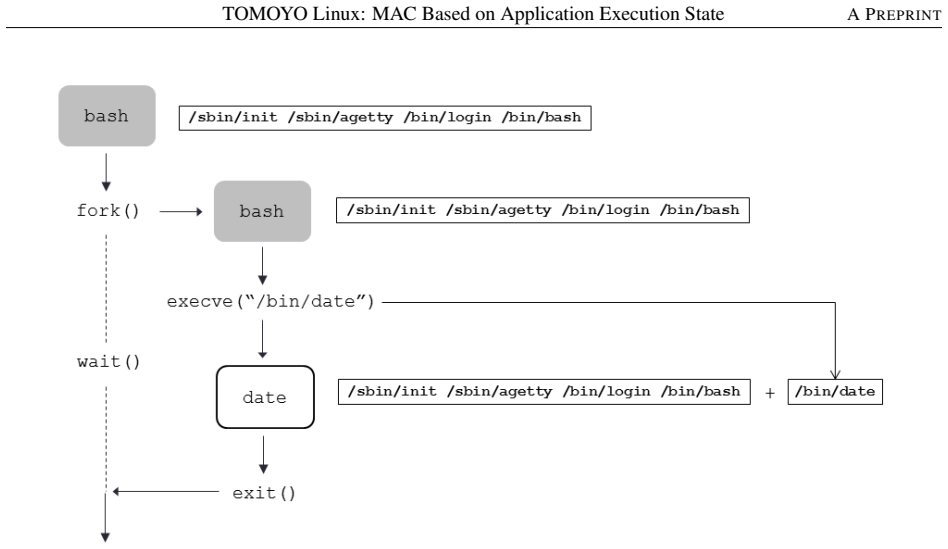
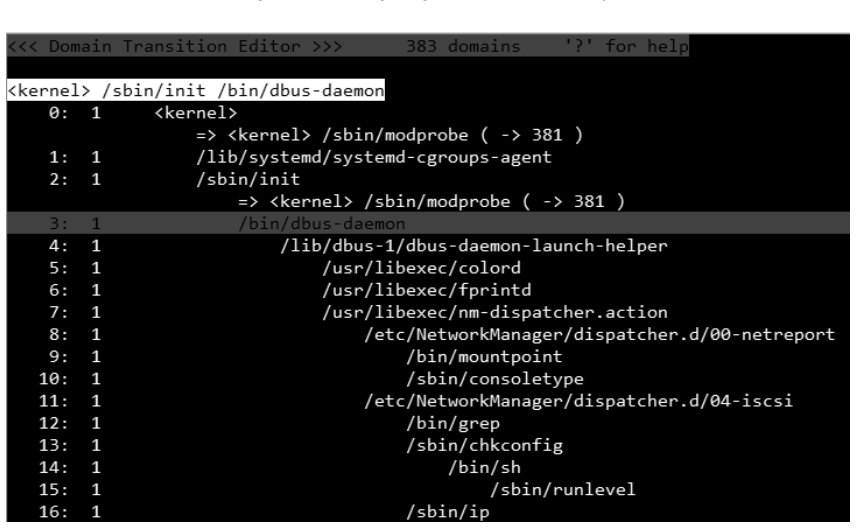
TOMOYO Linux implements mandatory access control by tracking application execution history and state to account for intents.
A machine-rendered reading of the paper's core claim, the machinery that carries it, and where it could break.
Core claim
The paper claims that basing access control decisions on application execution history and state, rather than solely on subject-object combinations, makes it possible to consider the intent of the requesting application and thereby lets system administrators reduce the risks caused by malicious access attempts and wrong operations. The concept and implementation design of TOMOYO Linux are presented as a concrete realization of this method.
What carries the argument
Application execution history and state used as the basis for deciding whether an access request matches the application's intended behavior.
If this is right
- Administrators can define policies that reflect the sequence of steps an application normally takes.
- Access requests outside expected execution paths can be denied to limit damage from compromised programs.
- The method supplies a mandatory control layer that is aware of how an application arrived at its current state.
Where Pith is reading between the lines
- The same state-tracking idea could be applied to other operating systems or combined with existing mandatory controls.
- Execution-state monitoring might also serve as a basis for runtime anomaly detection beyond static policy enforcement.
Load-bearing premise
Application execution history and state provide sufficient information to reliably distinguish intended from unintended or malicious access requests.
What would settle it
A concrete counter-example in which an application reaches a malicious access while its recorded execution history and state remain indistinguishable from a legitimate path would show the method cannot reliably separate intents.
Figures
read the original abstract
Existing access control methods grant access requests based on the combinations of applications as subject and files as objects. Therefore intents of applications and the possible effects caused by granting the access requests have not been taken into consideration. In this paper, we propose a new access control method based on application history and intents. With our access control method, system administrators can reduce the risks caused by malicious access attempts and wrong operations. In this paper, the concept and implementation design will be explained as well as the brief evaluation report of TOMOYO Linux, our implementation of the new access control method to Linux.
Editorial analysis
A structured set of objections, weighed in public.
Referee Report
Summary. The paper proposes TOMOYO Linux, a mandatory access control method for Linux that grants access based on application execution history and state (to capture intents) rather than solely on subject-object combinations. It claims this reduces risks from malicious access attempts and wrong operations, and describes the concept, implementation design, and a brief evaluation report.
Significance. If the execution-state approach can be shown to reliably distinguish intended from unintended accesses in practice, it would offer a practical advance in MAC design by incorporating behavioral context, which could complement existing Linux security mechanisms. The Linux implementation and any reproducible evaluation would be of interest to the OS security community.
major comments (2)
- [Abstract] Abstract, paragraph 2: the central claim that execution history and state suffice to identify malicious or erroneous requests is load-bearing, yet the manuscript supplies no formal model of distinguishable intent, no policy examples, and no data or error analysis from the evaluation report.
- [Design description] Design description (concept section): the claim that history-based decisions reduce risks is undermined by the absence of any analysis of mimicry attacks, in which an attacker substitutes code that follows an identical domain-transition path up to a disallowed access point.
minor comments (1)
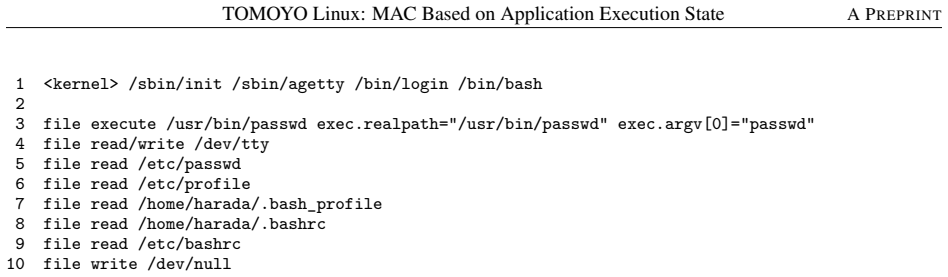
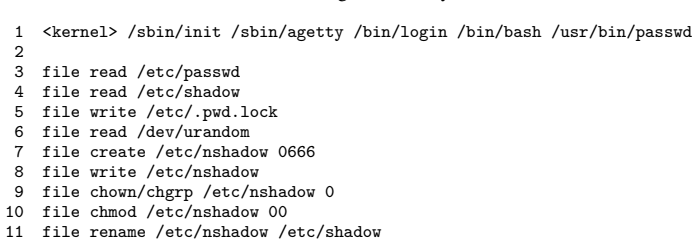
- [Evaluation] The evaluation report is described as 'brief' but lacks any tables, figures, or quantitative metrics; adding at least one concrete policy example with before/after behavior would improve clarity.
Simulated Author's Rebuttal
We thank the referee for the constructive comments. The manuscript presents TOMOYO Linux as a conceptual and implementation-focused introduction to history-based MAC rather than a comprehensive formal or empirical study. We address each major comment below and will make revisions to strengthen the presentation.
read point-by-point responses
-
Referee: [Abstract] Abstract, paragraph 2: the central claim that execution history and state suffice to identify malicious or erroneous requests is load-bearing, yet the manuscript supplies no formal model of distinguishable intent, no policy examples, and no data or error analysis from the evaluation report.
Authors: The abstract summarizes the motivation that history and state can help reduce risks from malicious attempts and wrong operations, without asserting that they formally suffice to identify all such requests. The manuscript is structured as a description of the concept and Linux implementation with only a brief evaluation report. We agree that the absence of a formal model, policy examples, and expanded evaluation data leaves the claims under-supported. We will revise the abstract for precision and add policy examples plus evaluation details in the updated manuscript. revision: yes
-
Referee: [Design description] Design description (concept section): the claim that history-based decisions reduce risks is undermined by the absence of any analysis of mimicry attacks, in which an attacker substitutes code that follows an identical domain-transition path up to a disallowed access point.
Authors: The design relies on execution history to capture behavioral context for access decisions. The manuscript does not analyze mimicry attacks or other adversarial scenarios. We acknowledge this as a substantive gap that weakens the risk-reduction claim. We will incorporate a discussion of mimicry attacks and related limitations in the revised concept section. revision: yes
Circularity Check
Design proposal with no circular derivation chain
full rationale
The paper presents a conceptual design for TOMOYO Linux as a new mandatory access control method based on application execution history and state. No equations, fitted parameters, predictions, or first-principles derivations appear in the provided text. The central claim is a design proposal rather than a quantity derived from inputs, with no self-citation chains, uniqueness theorems, or ansatzes that reduce the result to its own definitions. The method is described at a high level without any load-bearing steps that equate outputs to inputs by construction.
Axiom & Free-Parameter Ledger
axioms (1)
- domain assumption Access control decisions can be improved by incorporating application execution history and inferred intents rather than relying solely on subject-object identity pairs.
Reference graph
Works this paper leans on
-
[1]
Peterson, Matt Bishop, and Raju Pandey
David S. Peterson, Matt Bishop, and Raju Pandey. A flexible containment mechanism for executing untrusted code. In Proceedings of the 11th USENIX Security Symposium , pages 207–225, 2002
2002
-
[2]
Sandbox technologies for native code
Y oshihiro Oyama. Sandbox technologies for native code. Computer Software (JSSST) , 20(4):55–72, 2003. in Japanese
2003
-
[3]
Ian Goldberg, David Wagner, Randi Thomas, and Eric A. Brewer. A secure environment for untrusted helper applications: Confining the wily hacker. In Proceedings of the 6th USENIX Security Symposium , 1996
1996
-
[4]
The security architecture of the Chromium browser
Adam Barth, Collin Jackson, Charles Reis, and The Google Chrome Team. The security architecture of the Chromium browser. Technical report, Stanford University, 2008
2008
-
[5]
Loscocco, Stephen D
Peter A. Loscocco, Stephen D. Smalley, Patrick A. Muckelbauer, Ruth C. Taylor, S. Jeff Turner, and John F. Farrell. The inevitability of failure: The flawed assumption of security in modern computing environments. In Proceedings of the 21st National Information Systems Security Conference , pages 303–314, 1998
1998
-
[6]
Computer Security: Art and Science
Matt Bishop. Computer Security: Art and Science . Addison-Wesley, 2003
2003
-
[7]
Department of Defense
U.S. Department of Defense. Trusted computer system evaluation criteria (TCSEC). Technical Report CSC- STD-001-83, U.S. Department of Defense, Computer Security Center, 1983
1983
-
[8]
Integrating flexible support for security policies into the Linux operating system
Peter Loscocco and Stephen Smalley. Integrating flexible support for security policies into the Linux operating system. In Proceedings of the FREENIX Track: 2001 USENIX Annual Technical Conference, pages 29–42, 2001
2001
-
[9]
Loscocco and Stephen D
Peter A. Loscocco and Stephen D. Smalley. Meeting critical security objectives with security-enhanced Linux. In Proceedings of the Ottawa Linux Symposium , 2001
2001
-
[10]
Configuring the SELinux policy
Stephen Smalley. Configuring the SELinux policy. Technical Report Report #02-007, NAI Labs, 2005
2005
-
[11]
Smack in embedded computing
Casey Schaufler. Smack in embedded computing. In Proceedings of the Linux Symposium, pages 179–186, 2008
2008
-
[12]
SubDomain: Parsimonious server security
Crispin Cowan, Steve Beattie, Greg Kroah-Hartman, Calton Pu, Perry Wagle, and Virgil Gligor. SubDomain: Parsimonious server security. In Proceedings of the 14th USENIX Conference on System Administration (LISA) , pages 355–368, 2000
2000
-
[13]
Trusted computing building blocks for embedded Linux-based ARM TrustZone platforms
Johannes Winter. Trusted computing building blocks for embedded Linux-based ARM TrustZone platforms. In Proceedings of the 3rd ACM Workshop on Scalable Trusted Computing (STC) , pages 21–30, 2008
2008
-
[14]
Robert N. M. Watson, Jonathan Anderson, Ben Laurie, and Kris Kennaway. Capsicum: Practical capabilities for UNIX. In Proceedings of the 19th USENIX Security Symposium , pages 29–45, 2010. 19 TOMOYO Linux: MAC Based on Application Execution State A P REPRINT
2010
-
[15]
Buffer overflow attacks and their countermeasures
Ken Wakita. Buffer overflow attacks and their countermeasures. Computer Software (JSSST), 19(1):49–63, 2002. in Japanese
2002
-
[16]
Design and implementation of TOMOYO Linux
Toshiharu Harada, Tetsuo Handa, and Y ukio Itakura. Design and implementation of TOMOYO Linux. In Proceedings of the 21st Computer System Symposium (ComSys 2009) , 2009. in Japanese
2009
-
[17]
Security features of Linux (4): The limits of label-based security and its complement — the design philosophy and attempt of TOMOYO Linux
Toshiharu Harada and Tetsuo Handa. Security features of Linux (4): The limits of label-based security and its complement — the design philosophy and attempt of TOMOYO Linux. IPSJ Magazine, 51(10):1276–1283,
-
[18]
Sandhu and Pierangela Samarati
Ravi S. Sandhu and Pierangela Samarati. Access control: Principle and practice. IEEE Communications Maga- zine, 32(9):40–48, 1994
1994
-
[19]
Design and implementation of SysGuard: A wrapper/reference monitor for system calls
Kotaro Eiraku, Y asushi Shinjo, and Kozo Itano. Design and implementation of SysGuard: A wrapper/reference monitor for system calls. IPSJ Journal, 43(6):1690–1701, 2002. in Japanese
2002
-
[20]
Linux security mod- ules: General security support for the Linux kernel
Chris Wright, Crispin Cowan, Stephen Smalley, James Morris, and Greg Kroah-Hartman. Linux security mod- ules: General security support for the Linux kernel. In Proceedings of the 11th USENIX Security Symposium , pages 17–31, 2002
2002
-
[21]
Sandhu, Edward J
Ravi S. Sandhu, Edward J. Coyne, Hal L. Feinstein, and Charles E. Y ouman. Role-based access control models. IEEE Computer, 29(2):38–47, 1996
1996
-
[22]
A method to enhance login authentication using a security-enhanced os
Toshiharu Harada and Takaaki Matsumoto. A method to enhance login authentication using a security-enhanced os. Journal of Informatics, Shizuoka University , 11:93–102, 2005. in Japanese
2005
-
[23]
Guideline: Configuration and operation of secure internet servers
Information-technology Promotion Agency (IPA), Security Center. Guideline: Configuration and operation of secure internet servers. Technical report, Information-technology Promotion Agency, Japan, 2003. URL http://www.ipa.go.jp/security/fy14/contents/trusted-os/guide.html. in Japanese
2003
-
[24]
lmbench: Portable tools for performance analysis
Larry McV oy and Carl Staelin. lmbench: Portable tools for performance analysis. In Proceedings of the USENIX 1996 Annual Technical Conference, pages 279–294, 1996
1996
-
[25]
Implementation and evaluation of a perfor- mance measurement facility for secure operating systems using LSM
Naoto Matsuda, Kazuya Sato, Toshihiro Tabata, and Seiji Munetoh. Implementation and evaluation of a perfor- mance measurement facility for secure operating systems using LSM. IEICE Transactions on Information and Systems (Japanese Edition), Part D, J92-D(7):963–974, 2009. in Japanese
2009
-
[26]
A survey on context-aware systems
Matthias Baldauf, Schahram Dustdar, and Florian Rosenberg. A survey on context-aware systems. International Journal of Ad Hoc and Ubiquitous Computing , 2(4):263–277, 2007
2007
-
[27]
A survey on context-aware web service systems
Hong Linh Truong and Schahram Dustdar. A survey on context-aware web service systems. International Journal of Web Information Systems, 5(1):5–31, 2009
2009
-
[28]
Adaptive data protection based on context at data-access time in the privacy-aware os Salvia
Kazuhisa Suzuki, Y oshimi Ichiyanagi, Koichi Mouri, and Eiji Okubo. Adaptive data protection based on context at data-access time in the privacy-aware os Salvia. IPSJ Transactions on Advanced Computing Systems (ACS) , 47(SIG 3 (ACS 13)):1–15, 2006. in Japanese
2006
-
[29]
Techniques for preventing unauthorized access by operating systems
Takahiro Shinagawa. Techniques for preventing unauthorized access by operating systems. Computer Software (JSSST), 21(6):482–493, 2004. in Japanese. Author Biographies Toshiharu Harada Graduated from the Department of Applied Physics, Faculty of Engineering, Hokkaido University in 1985. Joined Nippon Telegraph and Telephone Corporation (NTT) in the same y...
2004
discussion (0)
Sign in with ORCID, Apple, or X to comment. Anyone can read and Pith papers without signing in.