REVIEW 1 major objections 34 references
Exact and Evolutionary Algorithms for Sequential Multi-Objective Transmission Topology Planning
T0 review · 1 major / 0 minor · reviewed 2026-06-30 · grok-4.3
Pith's one-line read A block algorithm computes the complete Pareto front of sequential transmission topology plans under N-1 constraints.
desk verdict The block algorithm gives a fast exact Pareto front on real Dutch grid data and beats the tested NSGA-III on low-switch plans, but the mapping from sequences to blocks and the aggregated N-1 check need explicit verification. read the letter →
The pith
A machine-rendered reading of the paper's core claim, the machinery that carries it, and where it could break.
The reading
What carries the argument
The block algorithm for aggregating consecutive identical topologies to enumerate the Pareto front for the four-objective problem.
What would settle it
Finding a day or grid instance where a valid low-switching topology plan satisfies all per-hour N-1 constraints but is not included in the enumerated front due to an incomplete admissible set or incorrect block aggregation.
Extended reading notes
Core claim
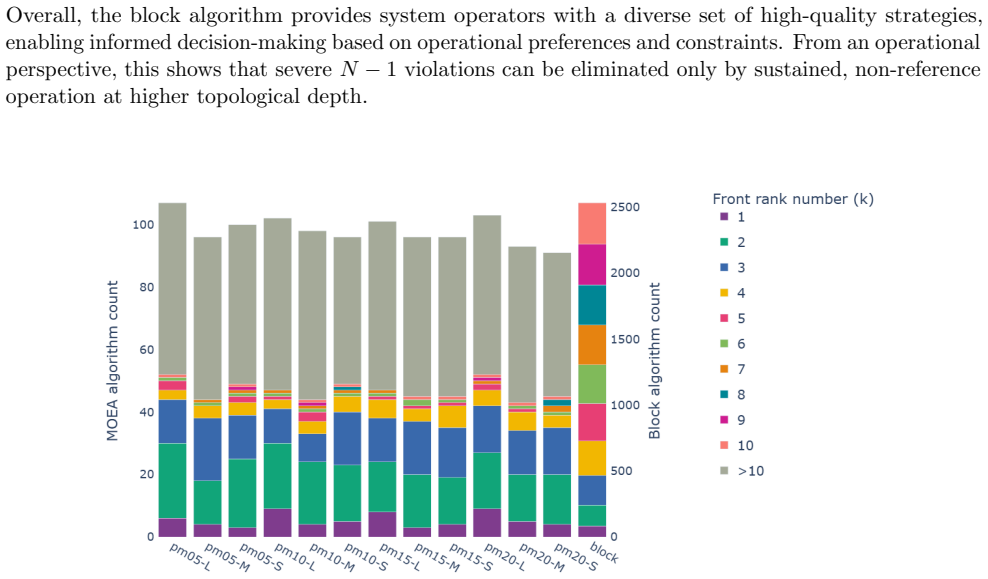
The block algorithm exploits the temporal structure of topology plans by representing consecutive hours with the same topology as blocks, enabling enumeration of the complete Pareto front over the admissible set of topologies under fixed operational bounds on depth and switching.
Load-bearing premise
The set of admissible topologies under the fixed bounds on depth and switching can be fully enumerated without any omissions, and the N-1 check on aggregated blocks preserves the per-hour security constraints.
Editorial extensions
If this is right
- The method provides a practical day-ahead decision-support tool for transmission operators.
- It serves as a benchmark for heuristic and learning-based topology-control methods.
- It reveals low-switching plans with no DC N-1 thermal overloads.
- The tested evolutionary search fails to find some of these optimal plans.
Reading between the lines
- Similar blocking techniques could reduce computation in other time-sequential optimization problems in power systems.
- Transmission operators could use the exact front to better calibrate limits on switching effort.
- The approach might scale to multi-day horizons if block enumeration is combined with decomposition.
- Exact fronts from this method can validate whether machine learning approaches to topology control achieve near-optimal performance.
Editorial analysis
A structured set of objections, weighed in public.
Referee Report
Summary. The manuscript formulates day-ahead transmission topology control as a sequential four-objective optimization problem (worst-case N-1 line loading, topological depth, number of changes, time outside reference topology) under N-1 security. It introduces an exact block algorithm that aggregates consecutive hours with identical topologies to enumerate the complete Pareto front over admissible sequences (bounded depth and switching) and compares the resulting front to plans obtained by a tailored NSGA-III evolutionary heuristic. On real TenneT Dutch HV grid data for a congested day, the block method is reported to produce the exact front in under three minutes after preprocessing and to identify low-switching N-1-secure plans missed by the evolutionary search.
Significance. If the block construction is shown to be bijective and to preserve the original per-hour N-1 constraints, the work supplies both a practical day-ahead decision-support tool for TSOs and a verifiable benchmark for heuristic and learning-based topology-control methods. The use of real operational data and the explicit comparison against an evolutionary baseline are strengths.
major comments (1)
- [Abstract / block-algorithm description] Abstract (paragraph on the block algorithm) and the corresponding algorithmic section: the central claim that the block construction enables 'enumeration of the complete Pareto front' rests on the unproven assertions that (i) every admissible sequence of topologies is represented exactly once and (ii) the N-1 security check performed on aggregated blocks is equivalent to checking the original per-hour thermal limits. No explicit bijection argument, small-instance verification, or error analysis is supplied; if either property fails, the reported 'exact front' is neither complete nor guaranteed to satisfy the original problem, undermining the evolutionary comparison.
Simulated Author's Rebuttal
We thank the referee for the careful and constructive review. The major comment identifies a genuine gap in the presentation of the block algorithm. We address it point by point below and will revise the manuscript to supply the requested formal arguments.
read point-by-point responses
-
Referee: [Abstract / block-algorithm description] Abstract (paragraph on the block algorithm) and the corresponding algorithmic section: the central claim that the block construction enables 'enumeration of the complete Pareto front' rests on the unproven assertions that (i) every admissible sequence of topologies is represented exactly once and (ii) the N-1 security check performed on aggregated blocks is equivalent to checking the original per-hour thermal limits. No explicit bijection argument, small-instance verification, or error analysis is supplied; if either property fails, the reported 'exact front' is neither complete nor guaranteed to satisfy the original problem, undermining the evolutionary comparison.
Authors: We agree that the manuscript does not contain an explicit bijection proof or a formal equivalence argument for the N-1 checks. The block construction groups consecutive hours that share an identical topology; the enumeration is performed over admissible block sequences whose total switching count and depth respect the stated bounds. The per-hour N-1 verification is intended to be preserved by evaluating the worst-case loading for each individual hour inside a block, yet this equivalence was stated rather than derived. In the revision we will insert a new subsection that (a) proves the mapping between original sequences and block sequences is bijective under the fixed depth and switching limits, (b) shows that the block-level N-1 test is equivalent because it applies the per-hour thermal limits to every hour within the block, and (c) supplies a small synthetic instance together with exhaustive enumeration to verify that no admissible sequence is omitted or incorrectly accepted. These additions will be placed immediately after the current algorithmic description. revision: yes
Circularity Check
No circularity; direct algorithmic construction against external grid data
full rationale
The paper describes a block-based enumeration algorithm for the Pareto front of topology sequences under explicit depth/switching bounds, followed by an NSGA-III heuristic benchmarked on the same real TenneT load-flow data. No derivation reduces a result to its own fitted inputs, no self-citation chain supports a uniqueness claim, and the central completeness assumption is stated as an operational bound rather than derived from prior self-work. The method is therefore self-contained as an explicit enumeration procedure.
Assumptions & free parameters
Cite this review
Pith. "Pith review of Exact and Evolutionary Algorithms for Sequential Multi-Objective Transmission Topology Planning." pith.science (2026). https://pith.science/paper/CCFZUGWT
@misc{pith2026260503753,
  author       = {Pith},
  title        = {Pith review of: Exact and Evolutionary Algorithms for Sequential Multi-Objective Transmission Topology Planning},
  year         = {2026},
  howpublished = {\url{https://pith.science/paper/CCFZUGWT}},
  note         = {Machine review of arXiv:2605.03753}
}
abstract
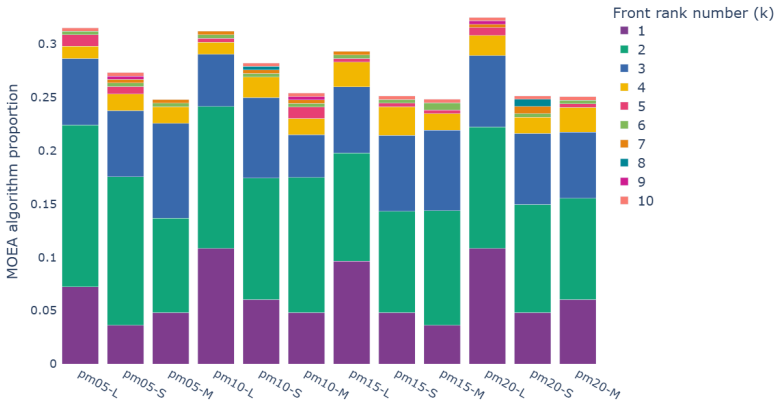
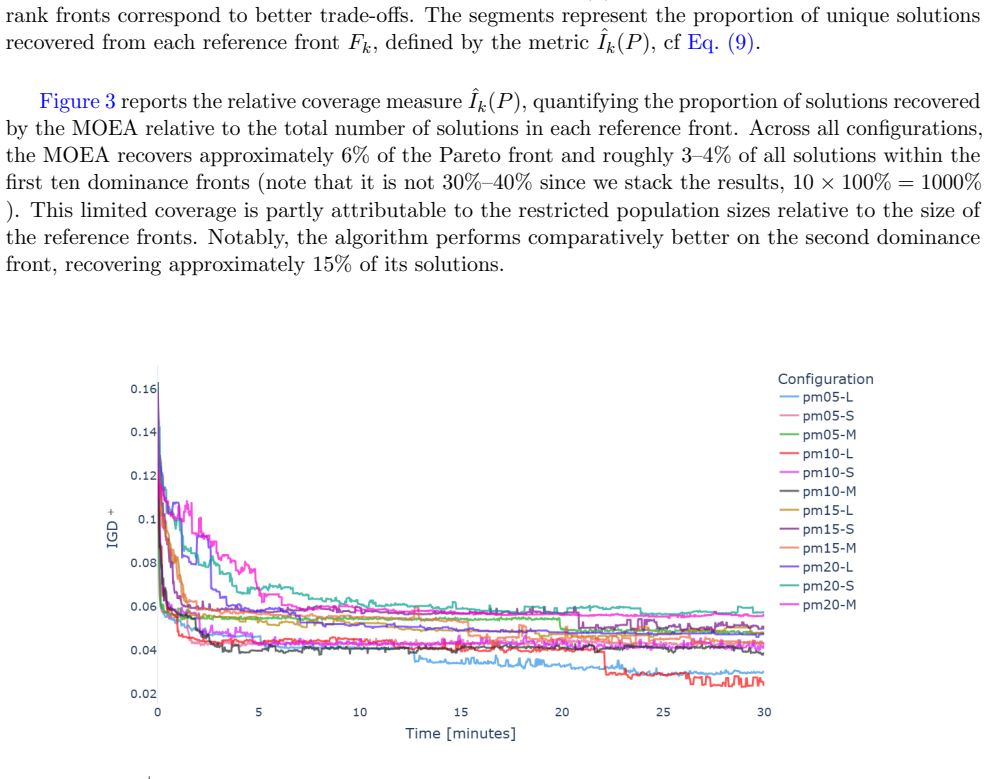
We study day-ahead transmission topology control for high-voltage grid operation under $N-1$ security constraints. The operational task is to select, over a 24-hour horizon, a sequence of substation topologies obtained via busbar-coupler switching to relieve line overloads while limiting switching effort and topological complexity. We formulate this task as a sequential multi-objective optimization problem with four objectives used in TSO decision making: worst-case $N-1$ line loading, maximum topological depth, number of topology changes, and time spent outside the reference topology. We propose an exact block algorithm that exploits the temporal structure of topology plans: consecutive hours with the same topology are represented as blocks, enabling enumeration of the complete Pareto front over the admissible set of topologies under fixed operational bounds on depth and switching. We also develop a tailored NSGA-III-based evolutionary heuristic and evaluate it against the exact front. Using real operational data from the Dutch high-voltage transmission grid operated by TenneT, the block algorithm computes the exact front for a highly congested day in under three minutes after topology-level load-flow preprocessing. The exact front reveals low-switching plans with no DC $N-1$ thermal overloads that the tested evolutionary search fails to find. The proposed method, therefore, provides both a practical day-ahead decision-support tool for transmission operators and a benchmark for heuristic and learning-based topology-control methods.
Figures


Figures from the paper (9 more)




Reference graph
Works this paper leans on
-
[1]
H. Behnia and M. Akhbari. Integrated generation and transmission maintenance scheduling by considering transmission switching.International Transactions on Electrical Energy Systems, 29(4):e2792, 2019
work page 2019
-
[2]
L. Beke, M. Weiszer, and J. Chen. A comparison of genetic representations and initialisation methods for the multi-objective shortest path problem on multigraphs.SN Computer Science, 2(3), Mar. 2021
work page 2021
-
[3]
J. Chen, Q. Zhang, and G. Li.MOEA/D for Multiple Multi-objective Optimization, page 152–163. Springer International Publishing, 2021
work page 2021
-
[4]
C. Coello Coello and M. Lechuga. Mopso: a proposal for multiple objective particle swarm optimization. InProceedings of the 2002 Congress on Evolutionary Computation. CEC’02 (Cat. No.02TH8600), page 1051–1056 vol.2. IEEE, 2002
work page 2002
-
[5]
C. Coello Coello, G. T. Pulido, and M. S. Lechuga. Handling multiple objectives with particle swarm optimization.IEEE Transactions on Evolutionary Computation, 8(3):256–279, 2004
work page 2004
-
[6]
M. de Jong, J. Viebahn, and Y. Shapovalova. Graph neural networks for transmission grid topology control: Busbar information asymmetry and heterogeneous representations.arXiv preprint arXiv:2501.07186v3, 2026
-
[7]
M. de Jong, J. Viebahn, and Y. Shapovalova.Imitation Learning for Intra-day Power Grid Operation Through Topology Actions, page 258–274. Springer Nature Switzerland, 2026
work page 2026
- [8]
Show all 34 references
-
[9]
Dorfer, A
M. Dorfer, A. R. Fuxj¨ ager, K. Kozak, P. M. Blies, and M. Wasserer. Power grid congestion management via topology optimization with AlphaZero.arXiv preprint arXiv:2211.05612, 2022
2022
-
[10]
A. E. Eiben and J. E. Smith.Introduction to Evolutionary Computing. Natural Computing Series. Springer, Cham, Switzerland, 2 edition, 2015
2015
-
[11]
E. B. Fisher, R. P. O’Neill, and M. C. Ferris. Optimal transmission switching.IEEE Transactions on Power Systems, 23(3):1346–1355, 2008
2008
-
[12]
Granelli, M
G. Granelli, M. Montagna, F. Zanellini, P. Bresesti, R. Vailati, and M. Innorta. Optimal network reconfiguration for congestion management by deterministic and genetic algorithms. Electric Power Systems Research, 76(6-7):549–556, April 2006. 17
2006
-
[13]
Hardin and E
D. Hardin and E. Saff. Minimal riesz energy point configurations for rectifiable d-dimensional manifolds.Advances in Mathematics, 193(1):174–204, 2005
2005
-
[14]
K. W. Hedman, M. C. Ferris, R. P. O’Neill, E. B. Fisher, and S. S. Oren. Co-optimization of generation unit commitment and transmission switching with N− 1 reliability.IEEE Transactions on Power Systems, 25(2):1052–1063, 2010
2010
-
[15]
K. W. Hedman, R. P. O’Neill, E. B. Fisher, and S. S. Oren. Optimal transmission switching with contingency analysis.IEEE Transactions on Power Systems, 24(3):1577–1586, 2009
2009
-
[16]
K. W. Hedman, S. S. Oren, and R. P. O’Neill. Optimal transmission switching: Economic efficiency and market implications.Journal of Regulatory Economics, 40:111–140, 2011
2011
-
[17]
K. W. Hedman, S. S. Oren, and R. P. O’Neill. A review of transmission switching and network topology optimization. InProc. IEEE Power and Energy Society General Meeting, pages 1–7, 2011
2011
-
[18]
Heidarifar and H
M. Heidarifar and H. Ghasemi. A network topology optimization model based on substation and node-breaker modeling.IEEE Transactions on Power Systems, 31(1):247–255, 2016
2016
-
[19]
Ishibuchi, R
H. Ishibuchi, R. Imada, N. Masuyama, and Y. Nojima. Comparison of hypervolume, igd and igd+ from the viewpoint of optimal distributions of solutions. InLecture Notes in Computer Science (including subseries Lecture Notes in Artificial Intelligence and Lecture Notes in Bioinfor...
2019
-
[20]
O. Kramer. Evolutionary self-adaptation: A survey of operators and strategy parameters. Evolutionary Intelligence, 3:51–65, 08 2010
2010
-
[21]
H. W. Li, C. S. Wan, N. Ding, and W. J. Mao. Two successive approximate models and linear formulations for power flow analysis of dc grid.Journal of Electrical Engineering and Technology, 2024
2024
-
[22]
P. Li, X. Huang, J. Qi, H. Wei, and X. Bai. A connectivity constrained milp model for optimal transmission switching.IEEE Transactions on Power Systems, 36(5):4820–4823, September 2021
2021
-
[23]
H. Ma, Y. Zhang, S. Sun, T. Liu, and Y. Shan. A comprehensive survey on nsga-ii for multi- objective optimization and applications.Artificial Intelligence Review, 56(12):15217–15270, December 2023
2023
-
[24]
Marot, B
A. Marot, B. Donnot, C. Romero, B. Donon, M. Lerousseau, L. Veyrin-Forrer, and I. Guyon. Learning to run a power network challenge for training topology controllers.Electric Power Systems Research, 189, 2020
2020
-
[25]
Numan, M
M. Numan, M. F. Abbas, M. Yousif, S. S. M. Ghoneim, A. Mohammad, and A. Noorwali. The role of optimal transmission switching in enhancing grid flexibility: A review.IEEE Access, 11:32437–32463, 2023
2023
-
[26]
Numan, D
M. Numan, D. Feng, F. Abbas, S. Habib, and A. Rasool. Mobilizing grid flexibility through optimal transmission switching for power systems with large-scale renewable integration. International Transactions on Electrical Energy Systems, 30(3):1–15, March 2020
2020
-
[27]
R. P. O’Neill, K. W. Hedman, E. A. Krall, A. Papavasiliou, and S. S. Oren. Economic analysis of the N− 1 reliable unit commitment and transmission switching problem using duality concepts.Energy Systems, 1(2):165–195, January 2010. 18
2010
-
[28]
Pranji´ c and P
F. Pranji´ c and P. Virtiˇ c. Analysis of the operational reliability of different types of switching substations using the monte carlo method.Energies, 17, 7 2024
2024
-
[29]
van der Sar, A
E. van der Sar, A. Zocca, and S. Bhulai. Optimizing power grid topologies with reinforcement learning: A survey of methods and challenges.Foundations and Trends in Electric Energy Systems, 9(1):1–119, July 2025
2025
-
[30]
van Dijk, J
J. van Dijk, J. Viebahn, B. Cijsouw, and J. van Casteren. Bus split distribution factors. IEEE Transactions on Power Systems, 39(3):5115–5125, 2024
2024
-
[31]
Viebahn, S
J. Viebahn, S. Kop, J. Van Dijk, H. Budaya, M. Streefland, D. Barbieri, P. Champion, M. Jothy, V. Renault, and S. Tindemans. Gridoptions tool: Real-world day-ahead congestion management using topological remedial actions.CIGRE Science & Engineering, 35:1–15, 2024
2024
-
[32]
Zhang and J
C. Zhang and J. Wang. Optimal transmission switching considering probabilistic reliability. IEEE Transactions on Power Systems, 29(2):974–975, March 2014
2014
-
[33]
Y. Zhou, A. S. Zamzam, A. Bernstein, and H. Zhu. Substation-level grid topology optimiza- tion using bus splitting. In2021 American Control Conference (ACC), page 1–7. IEEE, May 2021
2021
-
[34]
Zitzler and S
E. Zitzler and S. K¨ unzli.Indicator-Based Selection in Multiobjective Search, page 832–842. Springer Berlin Heidelberg, 2004. A Computational complexity of the block algorithm The tractability of the block algorithm rests on two observations: the number of distinct ways in wh...
2004
Reviewed June 30, 2026 · model on record in the stance chip above.
Discussion (0). Continue with ORCID to comment.